© 2014, IJCSMC All Rights Reserved 504 Available Online atwww.ijcsmc.com
International Journal of Computer Science and Mobile Computing
A Monthly Journal of Computer Science and Information Technology
ISSN 2320–088X
IJCSMC, Vol. 3, Issue. 11, November 2014, pg.504 – 513
RESEARCH ARTICLE
WSN Based Performance Evaluation of
Coordinator Fails in Different PAN
Network using OPNET
Devender
1, Chirag
2, Kuldeep Vats
3,
Deepika Madaan
41
M.Tech, Department of ECE, South point institute of engineering and technology, Sonepat, Haryana, India
Assistant professor, Department of ECE, South point institute of engineering and technology, Sonepat, Haryana, India
B.E. Honors, M.Tech, Department of computer science engineering, Sonepat, Haryana, India
M.Tech, Department of ECE, South point institute of engineering and technology, Sonepat, Haryana, India
_____________________________________________________________________________________
Abstract: Zigbee technology is based on Wireless sensor network, IEEE 802.15.4 standard is a worldwide open standard for wireless radio networks which provides network, security, and application support services. In this paper, an accurate simulation model, the behavior of Zigbee coordinates and nodes of multiple PANs is examined using OPNET simulator. We analyzed the performance of WSN based Zigbee network using different QoS: End to End Delay, Traffic Received, No of Hops, PAN Affiliation, Packet Dropped are measured. In this research work the performance of Star, Peer to Peer and Cluster tree topology are analyzed with the mobility of both ZigBee End Devices and ZigBee coordinator for different trajectories.
Keywords: IEEE-802.15.4, ZigBee WSN, Topology, MAC Layer, Network Layer, Application Layer, OPNET Modeler, End to End delay, Affiliation, Packet Dropped
© 2014, IJCSMC All Rights Reserved 505 INTRODUCTION
“The origin of ZigBee came from the peculiar behavior of bees, first noted in the 1960s by Nobel Prize-winner Karl von Frisch. Bees, after zigging and zagging around in the fields, return to the hive, and perform what some call the Waggle Dance to communicate the distance, direction and type of food to others in the hive. After receiving a WAGGLE-DANCE.indication, bees fly off directly to the source of food.” [1]
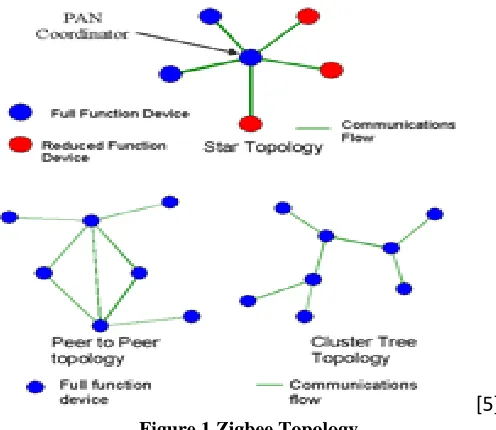
ZigBee is a wireless communication standard based on a standard network architecture using an OSI model through an IEEE 802.15.4-2006 IP layer[2]. ZigBee signals operate like network signals and most closely resemble Bluetooth and WiFI. ZigBee has adopted 2.4 GHz for its worldwide standard frequency. Because of potential bandwidth interference, ZigBee uses 915 MHz in the United States and 866 MHz in Europe. It is a PAN technology based on the IEEE 802.15.4 standard.[3] Unlike Bluetooth or wireless USB devices, ZigBee devices have the ability to form a mesh network between nodes. Meshing is a type of daisy chaining from one device to another. This technique allows the short range of an individual node to be expanded and multiplied, covering a much larger area. One ZigBee network can contain more than 65,000 nodes (active devices). The network they form in cooperation with each other may take the shape of a star, a branching tree or a net (mesh). What's more, each device can operate for years off of a AA cell. That means that each node uses little power.[4]
[5]
Figure 1 Zigbee Topology
ZigBee devices are of three types, Coordinators, Routers, and End Devices. Coordinators control the network formation and security. Routers pass on the signal and extend the network range. End Devices perform specific tasks such as turning on a light or taking a reading. In the wireless environment, the signal strength which is sent by coordinators can be weakened as distance from it increases, causing communication with target nodes to become difficult and abuse of the wireless resources. [6]
© 2014, IJCSMC All Rights Reserved 506
cooperatively network that can sense and control the environment enabling interaction between persons or embedded computers and the surrounding environment .[6] The problem of reliability is central to Wireless Sensor Networks (WSNs) . Nodes are battery-powered and communications are radio-based. However, nodes in WSNs are prone to failure due to the energy depletion, hardware failure, communication link errors, malicious attacks, etc. which means nodes can fail and temporary/permanent disconnections may occur. The dysfunctioning of few nodes can cause significant topological changes and might require packets rerouting and network re-organization.[7]
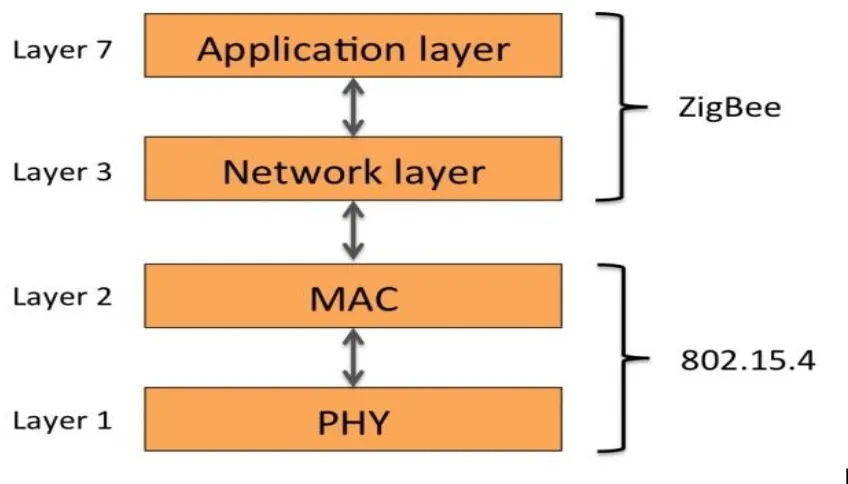
[8]
Figure 2 Zigbee Layers
Related Work
Use of Wireless Personal Area Networks (WPAN) has steadily grown in recent years. Its popularity comes from the convenience of using wireless signals in open areas such as office space or home rather than having to lay out wires. Removing the constraints of length and troublesome physical installation of wires, wireless solutions provide much more diversity and potentially reduced cost.
In 2013 Mumtaz M.Ali AL-Mukhtar et al represented ZigBee WSN devices failures on the overall efficiency of the network. Modeling the fundamental performance limits of Wireless Sensor Networks (WSNs) is of paramount importance to understand their behavior under the worst-case conditions and to make the appropriate design choices so that the requested QoS of the sensor network application is satisfied.[9]
In 2007 Baronti et al. presented a comprehensive review of ZigBee/IEEE 802.15.4 dealing with different aspects and deployments of this protocol in wireless sensor networks [10].
© 2014, IJCSMC All Rights Reserved 507 Table 1 : -
Parameters
MAC LayerNetwork Layer
Applicati on Layer Maximum Backoff
3 3 3
exponent Maximum number
4 4 4
Backoff exponent
Packet power Threshold -90 -90 -90
Transmit
0.5 0.5 0.5
power(coordinator)
Packet inter arrival time Constant Constant Constant
(0.5) (0.5) (0.5)
Memory used(MB) 32 32 32
Data Rate Automatic Automatic Automa
tic
Node Model :-
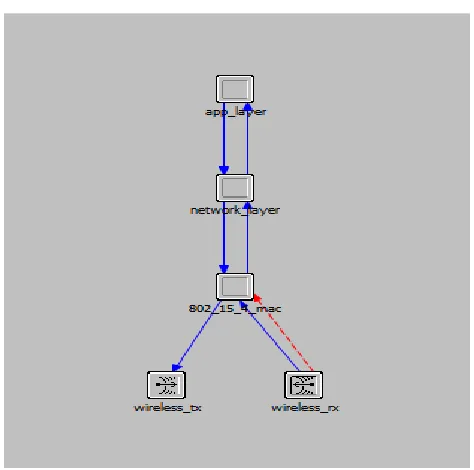
The node model specifies the internal structure of a network node. Typical nodes include workstations, packet switches, satellite terminals, remote sensors.Nodes can be fixed, mobile, or satellite type.
© 2014, IJCSMC All Rights Reserved 508 Process Model:-
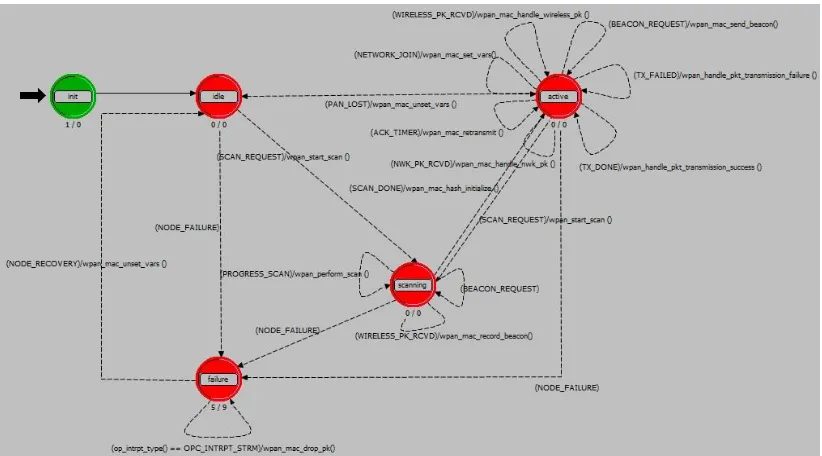
Process models are created using the Process Model Editor. The Process Editor lets you create process models which control the underlying functionality of the node models created in the Node Editor. Process models are represented by finite state machines (FSMs), and are created with icons that represent states and lines that represent transitions between states. Operations performed in a state or on a transition are described in embedded C or C++ code blocks. Each state contains two code blocks: the Enter Executive block that is executed as the state is entered and the Exit Executive block which is executed when the state is left. States can either be forced or unforced. A forced state will execute its enter executives and exit executives, then pass control to another state via a transition. An unforced state will execute its enter executives and pause, allowing the simulation to turn its attention to other entities and events in the model. A process enters an unforced state to await further interrupts, such as arriving packets or timer expiration.
Figure 4 Opnet Process Model
SIMULATION RESULTS
End to End Delay
© 2014, IJCSMC All Rights Reserved 509 Figure 5 End to End Delay (seconds)
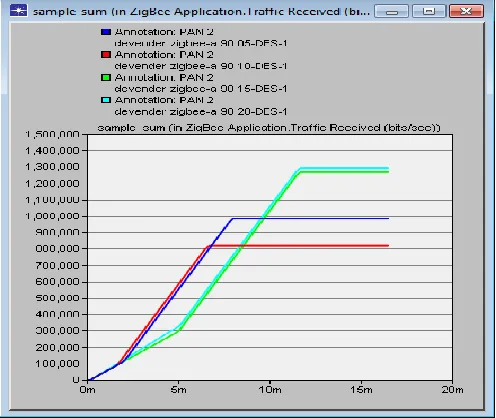
Traffic Received (bits/sec):
This metric concerns with evaluating the total average of data packets that received by each receiver overall receiver entities per one second. After simulation of 1020 sec PAN2 (Personal Area Network) using IEEE 802.15.4 standard show the result of traffic sent bits/sec.
Figure 6 Traffic Received (bits/sec)
Network Layer No of Hops PAN 1 :-
© 2014, IJCSMC All Rights Reserved 510 Figure 7 No of Hops per route in PAN1
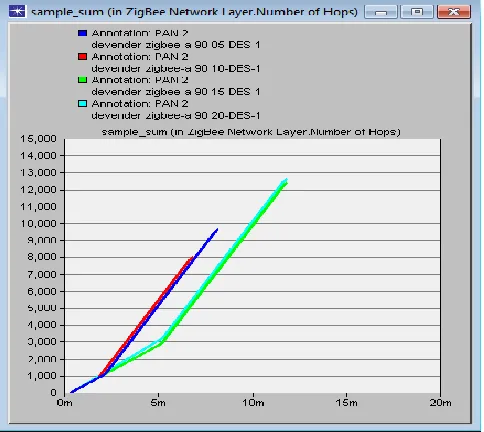
Network Layer No of Hops PAN 2 :-
No of Hops may be defined as average number of hops traveled by application traffic in the PAN. After the simulation of 1020 sec the no of hops per route in PAN 2 (Personal Area Network) using IEEE 802.15.4 standard show in the figure.
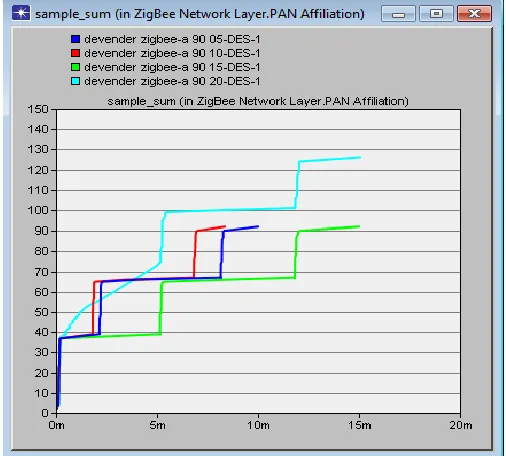
© 2014, IJCSMC All Rights Reserved 511 Network Layer Pan Affiliation:-
After the simulation of 1020 sec the personal area network Affiliation in PAN1 (Personal Area Network) using IEEE 802.15.4 standard show in the figure. It can be seen that the affiliation is higher as the transmit power and channel sensing duration time is increases.
Figure 9 PAN Affiliation
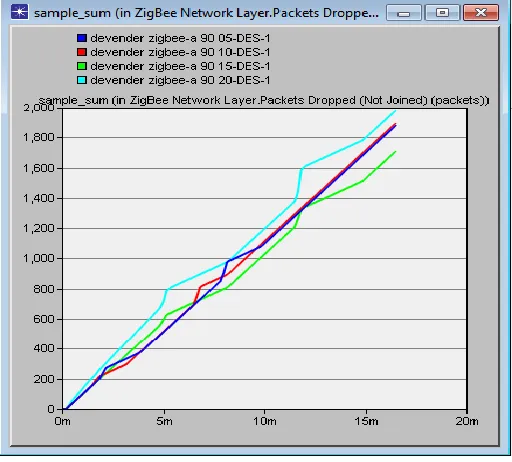
Network Layer Packet Dropped:
© 2014, IJCSMC All Rights Reserved 512 Figure 10 Network Layer Packet Dropped
Conclusion
The performance of Zigbee network is analyzed with the failure and recovery of coordinates and nodes in different personal area network. The performance is compared in terms of End to End Delay, Traffic received and sent, No of Hops, PAN affiliation, Packet Dropped. In this paper the coordinates are failed and recovered at different interval of times and transmit power. The results shows that at low transmit power End to End Delay, No of Hops, are high and as we increase transmit power and CSD (Channel sensing duration) the Traffic received, PAN affiliation and Packet dropped are increased. The result also shows that the performance of higher values of transmits power and CSD is better than low values.
References
[1] http://books.google.co.in/books
[2] http://compnetworking.about.com/od/zigbee/a/zigbee-wireless-network-standard.htm
[3] G. Ferrari, P. Medagliani, S. Di Piazza, and M. Martalo,` “Wireless sensor networks: Performance analysis in indoor scenarios,” EURASIP J. Wire-less Commun. and Networking, Special Issue on “MobileMAN (Mobile Multi-hop Ad Hoc Networks): From Theory to Reality”, 2007, 14 pages. doi:10.1155/2007/81864.
[4] http://www.microchip.com
© 2014, IJCSMC All Rights Reserved 513 [6] http://www.pacontrol.com/wireless-standards.html
[7] http://www.ensemble-tech.com/tech-knowledge/zigbee-for-projects
[8] http://electronicdesign.com/what-s-difference-between/what-s-difference-between-ieee- 802154-and-zigbee-wireless
[9] Mumtaz M.Ali AL-Mukhtar et al. “Diagnosis of Failures in Zigbee Based Wireless Sensor Networks” IJCSET |March 2013 | Vol 3, Issue 3, 104-108
[10]Baronti Paolo, Pillai Prashant, Chook Vince W.C., Chessa Stefano, Gotta Alberto, and Hu Y. Fun, "Wireless Sensor Networks: A Survey on The State of the Art and the 802.15.4 and Zigbee Standards", Computer Communications, Volume 30, Issue 7, pp. 1655-169526, 2007.