City, University of London Institutional Repository
Citation: Khudair, A.A. (2005). Health Sciences Libraries: Information Services and ICTs. (Unpublished Doctoral thesis, City University London)
This is the accepted version of the paper.
This version of the publication may differ from the final published version.
Permanent repository link: http://openaccess.city.ac.uk/11881/
Link to published version:
Copyright and reuse: City Research Online aims to make research outputs of City, University of London available to a wider audience. Copyright and Moral Rights remain with the author(s) and/or copyright holders. URLs from City Research Online may be freely distributed and linked to.
,
.
---..
)/;,>~ ~"J
;?-
tJ.-1-
cY
~
J-L
~r.
D
G..:-p
.:u \
. " .f '
U
)
~
~
L
~\
<:Z.---N
v--c
I
~ .0.-J~
UJ
\...1
c!Y~\ ~
&-P
~
\
~/
..
~\
~,",-1.
~'<Z0
.
\)
~ ~~---.
.
.
.
.
.
?
\~C./y(~
\, c· -
/'1
I
-z.. .
Health Sciences Libraries:
Information Services and leTs
By
Ahmad A. Khudair
Submitted in partial fulfilment of the Requirements for the award
of Doctor of Philosophy of City University
2005
Abstract
In Saudi Arabia the need is recognised significantly to move towards the concept of an Information Society, particularly for the benefit of the healthcare community. There have been some individual efforts, in this direction but they do not address the problem and related root issues. The problem is that the body and soul are not joined as one to formulate a single entity. The health professional is the body and the soul is the health information professional (health librarians). Health professionals spend a great deal of time in information searching, while the health information professional's role is underestimated.
This research is conducted to explore the state of health sciences libraries, and to investigate the strengths and weaknesses of the Information Services and Information, Communication Technology (ICT) in health sciences libraries in the capital city of Saudi Arabia, Riyadh. To accomplish this, a mixed method is used (qualitative and quantitative approaches) to collect related data. A framework is designed particularly for this research and a visionary organisational model is designed initially and developed throughout the research. This proposed model is to introduce a potentially possible successful paradigm for changing the health sciences libraries environment to encounter future challenges. In addition, for this research will contribute to the better understanding of how to provide fast, efficient and easy-to-use service to increase user satisfaction.
Changing the paradigm of health sciences libraries in Riyadh will facilitate better access, sharing and use of information resources from distant geographical locations,
and increase participation opportunities. In addition, the proposed model considers the human and social needs of communication, and the exchange of feelings and reactions. Importantly, successful change will help healthcare environments to move towards the establishment of a flourishing health information society by popularising the use of electronic resources and demonstrating the benefits and advantages of
continuous learning and development programmes. It is clear that access to fast. accurate and reliable health information and resources, may be, the difference
between life and death.
Keywords: Health Sciences Libraries. Information Services. Information and Communication
Table of Content
Abstract ... i
Table of Content ... ii
List of Tables ... xi
List of Figures ... xiii
Appendices ... xvi
Acknowledgment ... xvii
D d· e lca Ion ... XVlll t' ... Special Word ... xix
Glossary ... xx
Chapter One: Introduction ... 1
1.1 Aim of the Study ... 5
1.2 Study Objectives ... 6
1.3 Context of Study ... 7
1.3.1 Health Sciences Libraries ... 7
1.3.2 Health Information Professionals ... 7
1.3.3 Health Professionals ... 7
1.4 Value and Implications of Study ... 8
1.5 Scope and Limits of Study ... 8
1.6 Motives of this Study ... 10
1.7 Thesis structure ... 10
Chapter Two: Background ... 14
2.1 Introduction ... 14
2.2 Profile of Saudi Arabia ... 14
2.3 Healthcare in Saudi Arabia ... 16
2.3.1 Healthcare in Riyadh ... 20
2.3.2 Hospitals in Riyadh ... 21
2.3.2.1 2.3.2.2 2.3.2.3 2.3.2.4 King Faisal Specialist Hospital and Research Centre ... 21
King AbdulAziz City of Medicine ... 22
Riyadh Armed Forces Hospital.. ... 22
Security Forces Hospital ... 22
2.3.2.5
2.3.2.6
2.3.2.7
2.3.2.8
2.3.2.9
2.3.2.10
2.3.2.11
King Khalid University Hospital ... 23
King AbdulAziz University Hospital and College of Dentistry .. 23
Iman General Hospital ... 23
Yamamah Hospital ... 24
Saudi Centre for Organ Transplantation ... 24
Sulaimaniyah Children's Hospital ... 24
King Khalid Eye Specialist Hospital ... 24
2.4 Health Sciences Libraries in Saudi Arabia ... 25
2.4.1 Health Sciences Libraries in Riyadh ... 26
2.5 Summary ... 27
Chapter Three: Research Design ... 29
3.1 Introduction ... 29
3.2 Previous Research Strategies ... 30
3.3 Research Questions ... 31
3.4 Study Type and Method ... 31
3.5 Achieving study objectives ... 35
3.5.1 Health Sciences Libraries ... 35
3.5.2 Health Professionals ... 35
3.5.3 Health Librarians ... 36
3.5.4 Proposed Development ... 36
3.6 Study Framework ... 37
3.6.1 Explore Issues and Themes ofConcem ... 38
3.6.2 Identify Current Situation ... 38
3.6.3 Identify Relevant Themes ... 38
3.6.4 Develop Current Situation ... 39
3.6.4.1 Proposed Prototype ... 39
3.6.4.2 Organisational Change and Development. ... .40
3.6.4.2.1 Brown University Library Model ... .41
3.6.4.2.2 Organisational Visionary ModeL ... 44
3.7 Study Design ... 45
3.7.1 Literature Review ... 45
3.7.2 Questionnaire ... 47
3.7.3 Library Staff Fact Sheet ... 51
3.7.4 Interview ... 51
3.7.5 Observation ... 55
3.7.6 Document Analysis ... 57
3.7.7 Library Profile Form (Directory) ... 58
3.8 Population and Sampling ... 58
3.8.1 Sampling Methods ... 61
3.9 Ethical Considerations ... 64
3.10 Screening and cleaning of data ... 65
3.11 Data analysis methods ... 65
3.11.1 Quantitative ... 65
3.11.2 Qualitative ... 66
3.12 Research Process Roadmap ... 67
3.13 Summary ... 71
Chapter Four: The Literature Review ... 73
4.1 Introduction ... 73
4.2 Health Sciences Libraries ... 73
4.2.1 Importance and Impact. ... 75
4.2.2 Information Access and Use ... 77
4.2.3 4.2.3.1 4.2.3.2 4.2.3.3 4.2.4 Information Services ... 80
Reference services ... 83
CAS and SDI ... 84
ILL and DD ... 84
Health Information Professionals (Librarians) ... 85
4.2.5 Library and Information Science Educational Programmes ... 89
4.3 Health Librarianship in GCC countries ... 93
4.3.1 Health Libraries ... 93
4.3.2 LIS Educational Programmes ... 97
4.4 Information and Communication Technology (lCT) ... 99
4.4.1 Importance and Impact.. ... 101
4.4.2 ICT Impact on Health Sciences Libraries ... 104
4.4.3 ICT in Health Sciences Libraries ... 106
4.4.3.1 OPAC ... 110
4.4.3.2 CD-ROM ... 111
4.4.3.3 Networks ... 112
4.4.3.4 Internet ... 114
4.4.3.5 Personal Digital Assistant ... 119
4.4.4 Virtual Health Sciences Library ... 120
4.5 Related Studies ... 123
4.5.1 AbuOuf (1995) ... 123
4.5.2 Aseel (1996) ... 124
4.5.3 AI-Ogla (1998) ... 125
4.5.4 Arif et al. (1998) ... 126
4.5.5 AIShaya (2002) ... 127
4.6 Summary ... 128
4.6.1 Health Sciences Libraries ... 128
4.6.2 Education and Training ... 128
4.6.3 Information Services ... 129
4.6.4 Information and Communication Technology ... 129
4.6.5 Information Provision ... 129
4.6.6 Conclusion ... 130
Chapter Five: Users and Staff: Personal Characteristics ... 132
5.1 Introduction ... 132
5.2 Users ... 133
5.2.1 Gender ... 133
5.2.2 Age ... 134
5.2.3 Job Description ... 135
5.2.4 Academic Qualification ... 135
5.3 Staff in Health Sciences Libraries ... 136
5.3.1 Gender ... 137
5.3.2 Nationality ... 137
5.3.3 Academic Qualification ... 139
5.3.4 Job Description ... 141
5.3.5 Professionalism ... 142
5.3.6 Experience ... 143
5.4 Summary ... 146
Chapter Six: Health Sciences Libraries in Riyadh ... 148
6.1 Health Sciences Libraries Profile ... 149
6.1.1 Library Profile ... 149
6.1.2 Health Sciences Libraries Environment.. ... 153
6.1.2.1 Work Advantages ... 155
6.1.2.2 Work Disadvantages ... 156
6.2 Health Professionals' Use of Health Sciences Libraries ... 158
6.2.1 Seeking Information ... 158
6.2.2 Purpose of visit ... 160
6.2.3 Communication with Library ... 161
6.2.4 Library Visit Frequency ... 162
6.2.5 Difficulty in Visiting Library ... 165
6.3 Summary ... 167
Chapter Seven: Education and Training ... 170
7.1 Health library staff ... 171
7.2 Health Professionals ... 177
7.2.1 Learning to Use Electronic Sources ... 177
7.2.2 Computer Training ... 180
7.2.3 Seeking Advice ... 184
7.3 Summary ... 185
Chapter Eight: Information Services ... 188
8.1 Information Needs ... 189
8.2 Information Sources ... 192
8.3 Information Services ... 197
8.3.1 Books ... 199
8.3.2 Electronic Books ... ··· 199
8.3.3 Current Journals ... 200
8.3.4 Old Journals (old issues) ... 200
8.3.5 Electronic Journals ... ··· ... 201
8.3.6 CD-ROM Collections ... 201
8.3.7 Inter-Library-Loan (ILL) ... 202
8.3.9 Training ... 203
8.3.10 Staff Helpfulness ... 203
8.4 Further discussion: ... 206
8.5 Summary ... 214
Chapter Nine: Information and Communication Technology ... 217
9.1 Personal Computers (PCs) ... 218
9.2 Hospital Networks ... 220
9.3 Present System of Computing ... 223
9.4 CD-ROM Workstations ... 226
9.5 OPAC ... 228
9.6 Internet ... 229
9.7 Electronic Databases ... 232
9.8 Electronic Services ... 235
9.9 Information Tools ... 237
9.10 Summary ... 239
Chapter Ten: Information Provision ... 242
10.1 Health Professionals' Provision ... 243
10.1.1 Information Network ... 243
10.1.2 Information Sharing ... 246
10.1.3 Electronic Information Services ... 248
10.1.4 Introducing ICT ... 251
10.1.5 NHL - VHSL -AHIP ... 254
10.2 Library Staff Provision ... 257
10.2.1 Official Co-operation ... 257
10.2.2 Formulated Policy ... 259
10.2.3 Electronic Sources ... 261
10.2.4 Information Services Development ... 261
10.2.5 Information Services Plan ... 263
10.2.6 Information Network ... 264
10.2.7 NHL-VHSL -AHIP ... 265
10.2.7.1 10.2.7.2 NHL ... 266
VHSL ... 266
..
10.2.7.3 AHIP ... 267
10.3 Summary ... 268
Chapter Eleven: Organisational Change and Development ... 271
11.1 Brief literature review ... 272
11.2 Method ... 278
11.3 Proposed Visionary Model. ... 280
11.3.1 Administration ... , ... 282
11.3.2 Change Management ... '" ... 284
11.3.3 Human Resources Management. ... 287
11.3.4 Information Resources Management ... 289
11.3.5 Library and Information Service Management. ... 290
11.3.6 ICT Infrastructure Management. ... 292
11.3.7 Strategic Planning ... 294
11.4 Summary ... 296
11.5 Conclusion ... 297
Chapter Twelve: Saudi Health Information Network: A Proposed Prototype ... 300
12.1 Introduction ... 300
12.2 Rationale ... 301
12.2.1 Trends of Change ... 303
12.2.2 Saudi Health Information Network ... 305
12.2.3 Advantages of SHIN ... 306
12.3 Prototype Design ... 306
12.3.1 Prototype Vision and Objectives ... 307
12.3.1.1 Vision ... 307
12.3.2 Intended Audience ... 308
12.3.3 Information Gathering ... 308
12.3.4 Structuring Design ... 309
12.3.5 Prototyping ... 309
12.3.5.1 Mock-up prototype ... · 31 0 12.3.5.2 Interface building ... 310
12.4 Prototy"pe Outlines ... 311
12.4.1 Health Services ... 312
12.4.2 Health Professionals ... 313
12.4.3 Health Sciences Library ... 316
12.4.4 Health Librarians ... 320
12.4.5 Health Links ... 323
12.4.6 GeoMap ... 324
12.4.7 Contact Us ... 325
12.5 Additional Features ... 326
12.5.1 Online Appointment.. ... 326
12.5.2 Directories ... 327
12.5.3 Discussion Forum ... 330
12.5.4 Professional Experience ... 330
12.5.5 New to Site (What's new?) ... 331
12.5.6 Media Room ... 332
12.5.7 Helps and Tips ... 333
12.6 Expectation and Future ... 334
12.6.1 Expected Outcomes ... 334
12.6.2 Future ... 334
12.7 Prototype Quality ... 334
12.7.1 Visibility of Services ... 334
12.7.2 Logic and Reality ... 335
12.7.3 Consistency and Relevance ... 335
12.7.4 Friendly Interface ... 335
12.7.5 Management Control ... 335
12.7.6 Market Needs ... 336
12.7.7 Content Management System ... 336
12.7.8 Semantic Web ... 336
12.8 Summary ... 336
Chapter Thirteen: Conclusions and Recommendations ... 339
13.1 Health Sciences Libraries ... 342
13.1.1 Recommendations Related to HSL ... 344
13.2 Health Professionals ... 345
13.2.1 Recommendations Related to Health Professionals ... 348
13.3 Health librarians ... 348
13.3.1 Recommendations Related to Health Librarians ... 350
13.4 Further Research ... 351
13.5 Conclusion ... 352
Bibliography ... , .. 355
Appendices ... , ... 396
List of Tables
Number Title Page
2-1 HSLs founded in 1970s 26
31 Previous research strategies 30
3-2 Criteria employed for choosing mix method strategy 33
3-3 Interview advantages and disadvantages 53
3-4 Informal conversational interview 54
3-5 Observation advantages and disadvantages 56
3-6 Questionnaire distribution and response 61
3-7 Interviewee distribution 62
3-8 Distribution of respondent to library staff fact sheet 62
5-1 Gender (users) 130
5-2 Age group 132
5-3 Job description 132
5-4 Academic qualification 133
5-5 Gender (library staff) 134
5-6 Nationality of library staff 135
5-7 Staff qualification 136
5-8 Job description 138
5-9 Professionalism 139
6-1 HSL profiles 147
6-2 Seeking information 155
6-3 Seeking information for SCOT and KFSHIRC 156
6-4 Purpose of visit 157
6-5 Communication with library 158
6-7 Facing difficulties 162
6-8 Type of difficulties 163
7-1 Learning to use e-sources 174
7-2 Computer training 177
7-3 Training period 178
7-4 Training satisfaction 179
7-5
Seeking advice182
8-2
Type of sources190
9-1
Number of PCs216
9-2
Hospital network access218
9-3
Satisfaction with present system of computing220
9-4
satisfaction with computing system of hospitalsI
")'")1
9-5
CD-ROM workstation223
9-6
Internet use226
9-7
Where to access Internet227
9-8
Internet information rating229
9-9
Database access229
9-10
e-servlces access232
9-11
e-service evaluation233
9-12
Use of information tools235
10-1
Information network among HSLs241
10-2
e-servlce expansIon.
.
246
10-3
Establishment ofNHL-VHSL-AHIP251
10-4
Official co-operation254
10-5
Formulated policy257
10-6
e-source needs258
10-7
Information services development259
10-8
Information service plans260
10-9
Information network261
10-10
NHL-AHIP-VHSL262
List of Figures
Number Title Page
Chapter 1 Position in the Thesis 1
1.1 Thesis structure 11
Chapter 2 Position in the Thesis 13
2.1 Map of Saudi Arabia 15
Chapter 3 Position in the Thesis 28
3.1 Steps for conducting the mixed methods approach 34
3.2 Brown University library model "Organizational Framework" 43
3.4 Preliminary organisational visionary model 44
3.5 Scope of literature search 46
3.6 Questionnaire design process 49
3.7 Observation focus 57
3.8 Research process roadmap 66
3.9 General development process 67
Chapter 4 Position in the Thesis 69
Chapter 5 Position in the Thesis 128
5.1 Respondent groups by gender 131
5.2 Nationality of library staff in Riyadh hospitals 135
5.3 Staffwork experience in HSL 140
Chapter 6 Position in the Thesis 144
6.1 Library visits breakdown according to hospitals 160
Chapter 7 Position in the Thesis 166
7.1 Learning use of e-sources by age group 176
7.2 Learning use of e-sources by gender 176
7.3 Training satisfaction by gender 180
7.4 Training satisfaction by job description 180
Chapter 8 Position in the Thesis 184
8.1 Information needs by job description 187
8.2 Types of resources by job description 191
8.3 Quality of book collections 196
8.4 Quality of e-book collections 196
8.5 Quality of current journal collections 197
8.6 Quality of old journal collections 197
8.7 Quality of e-journals 198
8.8 Quality of CD-ROM collections 198
8.9 Quality of ILL services 199
8.10 Quality of photocopying service 199
8.11 Quality of training in HSL 200
8.12 Quality of HSL staff helpfulness 200
8.14 ILL by job description 201
8.15 Photocopying by job description 202
8.16 Training services by qualification 203
Chapter 9 Position in the Thesis 213
9.1 Access to hospital networks by job description 219
9.2 Network access by satisfaction with computer system 221
9.3 Internet use on regular basis by gender 227
9.5 Problem in accessing e-databases by gender 230
9.6 Rating of e-services by job description 234
Chapter 10 Position in the Thesis 238
10.1 HSL network by ways of accessing e-services 242
10.2 Preference for information sharing 244
10.3 Types of e-services 247
10.4 ICT problems and obstacles 249
Chapter 11 Position in the Thesis 267
11.1 Steps for change and development 275
11.2 Organisational Visionary Model for HSL 278
Chapter 12 Position in the Thesis 296
12.1 Pillars of health information society 299
12.2 Index page 309
12.3 Health services page 310
12.4 Health professionals directory 311
12.5 Health professional profile 312
12.6 HSL 314
~
12.7 Library search 315
i
12.8 Library profile 316
12.9 Health librarians ; 318
12.10 Health information professionals 319
12.11 Health links 321
12.12 Geomap 322
12.13 Contact Us form 323
12.14 Online appointment application 324
12.15 Hospitals directory 326
12.16 Hospital profile 326
12.17 Professional experience feature 328
12.18 Media room 329
12.19 Photo gallery - media room 330
Chapter 13 Position in the Thesis 335
Bibliography Position in the Thesis 349
Appendix Appendix Appendix Appendix Appendix Appendix Appendix
Appendices
(A) Health Sciences Libraries Profile ... 396
(B) Questionnaire ... , ,-W9 (C) Library Staff Fact Sheet ... 415 (D) Correspondence ... 4 1 7 (E) Conference Attendance ... 426 (F) Reproduction Permission ... 430 (G) Sample of Medical CD-ROM List ... 432
Acknowledgements
All praises are due to my Lord. the creator of the heavens and earth.
I would like to express my thanks to my supervisor. Dr David Bawden. for his embryonic thoughts, help and encouragement. I would like also h~ offer my appreciation to Professor David Nicholas for his co-supervision at the beginning of this research, and to Dr Tamara E. for her co-supervision. valuable comments and feedback. Also, no less appreciation is due Dr Andrew f\1ackFalen for his general support, care and constantly smiling.
I also wish to acknowledge the help afforded to me by many colleagues and friends. but I would particularly like to mention the following individuals:
S. Khudair - my older brother (consultant and management course advisor)
H. Khudair - my brother (Management and Financial Dept. Saudi Embassy. Cairo) Dr S. AI-Zahrani - my friend (Head of Information Science Dept. Imam University) Dr Muhammad Sibai - my teacher (Former head of LIS Dept. King Saud Univcrsity) Madi AI-Madi (my neighbour in Riyadh, roommate in Seattle, always caring friend) M Oshan (my real brother but not a blood brother)
Majeed Qa'osi (my beloved teacher).
I would like to thank many individuals and organisations who have made possible the development of some components of this thesis.
Last but not least, lowe my deepest gratitude and debt to my father. Abdullah Khudair. for his support and partial sponsoring of this work. my mother for her supplications and prayers. and Mary Oshan who gave me the kne, encouragement. and support throughout the journey of knowledge seeking. Special thanks to my dear brothcrs and sisters. friends and relatin~s for their blessings. endurance and paticl1(c during the time period I \vas a way from my homeland.
Dedication
My Father
I present to you one of your hopes, and I am on my way to achie\'ing your other hopes. I am your son who is still learning and always will learn from you, a high
quality of knowledge, attitudes and manners.
My Mother
Your supplications and prayers have been accepted; this completed thesis between your hands.
I can see your kindness and love will bring me back to you and I will tell you stories about my long journey, as you always tell me stories.
Mother, I am still your son, and I am always seeking your pleasure and satisfaction.
Mary Oshan
There are no words sufficient to praise your effort and patience with me during our journey of seeking knowledge.
For sure, purity, honesty, and passion are part of your qualit~ and character that always surround me.
Special Word
Smiles always make me happy.
With each smile there is love and a contribution
to peace and heavenly life
A. Khudair
Quincy, 1995
Glossary
ADC Access and Delivery Collaborative
AH Islamic calendar
AHIP Association of Health Information Professionals
BLDS British Library Document System
BT British Telecom
BU Brown University
BUL Brown University Library
CAS current awareness services
CD-ROM Compact Disc - Read Only Memory
CEHANET Centre for Environmental Health Activities (EMRO)
CILIP Chartered Institute of Library and Information Professionals (UK)
CISTI Canada Institute for Scientific and Technical Information
CO-OP AC Cooperative Online Public Access Catalogue
CPD DD EBM EMR EMRO ENHSL GCC GeoMap GOSI GPYW GULFNET HE HR
HRM
HSL ICT ICTS IFLAContinuing Professional Developments
Document Delivery
Evidence Based Medicine
Eastern Mediterranean Region
Easter Mediterranean Regional Office, (WHO)
Electronic National Health Sciences Library
Gulf Co-operation Council
Geographical Map
General Organization for Social Insurance
General Presidency of Youth Welfare
Gulf Network
Higher Education
Human Resource
Human Resource Management
Health Sciences Library
Information and Communication Technology
Information, Communication Technology and Services
International Federation for Library Associations
IGH ILL IP IPAC IRM ISP IT JAHVH KACM KACST KAUHlCD KFSHIRC KFUPM KKESH KKUH KSA KSU KSU LCRC LIS LISM MCH MLA MMA MODA MOH MOl MOP MVHL NeLH NHL NHS NIS NLC
Iman General Hospital
Inter-Library-Loan
Internet Protocol
Internet Public Access Catalogue
Infonnation Resources Management
Internet Service Provider
Infonnation Technology
James A. Haley Veterans' Hospital
King AbdulAziz City of Medicine
King AbdulAziz City for Science and Technology
King AbdulAziz University Hospital and College of Dentistry
King Faisal Specialist Hospital and Research Center
King Fahd University for Petroleum and Mineral
King Khalid Eye Specialist Hospital
King Khalid University Hospital
Kingdom of Saudi Arabia
King Saud University
King Saud University
Learning and Curricular Resources Collaborative
Library and Infonnation Science
Library and Infonnation Services Management
Material and Child Health
Medical Library Association (USA)
Mixed Methods Approach
Ministry of Defence & Aviation
Ministry of Health
Ministry of Interior
Ministry of Planning
Michigan Virtual Health Library
National electronic Library for Health (UK)
National Health Library
National Health Service
National Information Society
National Library of Canada
'L\1 OCD 00 00\1 OPAC OSC OVM PDA RAFH RAH SCH SCOT SOl SOP SFH SHIN SNG SRC T.V THML UAL UIDLP VIISL WHO WW\\' Yamamah
National Library of Yfedicine (USA) Organisational Change and Deyelopment Organisational De\-elopment
Organisational Development Model Online Public Access Catalogue '-' Organizational Support Collaboratiye Organisational Visionary Model Personal Digital Assistant
Riyadh Armed Force Hospital
The Royal Adelaide Hospital (Australia) Sulaimaniyah Children's Hospital
Saudi Center for Organ Transplantation Selective Dissemination of Information Seventh Development Plan
Security Forces Hospital
Saudi Health Information Network Saudi National Guard
Scholarly Resources Collaborative Television
Tawam Hospital Medical Library (UAE) United Arab Emirates
University of Iowa Digital Library Project Virtual Health Sciences Library
World Health Organisation World Wide \\'eb
Yamamah Hospital for Women and Child Birth
Chapter One
Introduction
Chapter One
Introduction
Infonnation technology has evolved rapidly during the last few decades. New
technologies have become progressively more prevalent in all areas of society in the
developed world and increasingly in the developing world. The movement has headed
towards the concept in communication of infonnation technology. In addition. the
emphasis has changed from the technical concept of infonnation technology (IT)
towards Infonnation and Communication Technology (lCT).
This changing paradigm facilitates more access, sharing and use of infonnation
resources. reducing cost. and increasing of participation opportunities. Additionally. it
considers the human and social needs of communication. and the exchange of feelings
Chapter 1: Introduction
exchange of medical and health information resources from distant geographical
locations. It is clear that this information has vital impacts which enhance the quality
of clinical and medical decisions, and improve patient care. Rapid access to fast~
accurate and reliable health information and resources, also may make the difference
between life and death.
In the USA and the UK, as well as in other developed countries, it has been proposed
that a national information infrastructure be used to convey medical and health
information. Practical examples can be found in studies in Wisconsin, USA (pemble,
1997) and Essex, UK (Health Report, 1999). In brief, many hospitals are planning and
developing their infrastructure to link various health information users by using ICT.
British Telecom (BT) started rolling out its largest NHS community project in 1999.
This five-year project would link 300 sites and over 10,000 users within 10 NHS
organisations across Essex (Health Report, 1999). Increasingly, health information
and medical knowledge are becoming available digitally.
In view of the importance of access to health information, the health library has an
important role to playas a part of the entire healthcare environment. Reid and Foster
(2000) stated that the contribution this special library makes to the operational
mission of the organisation, particularly hospitals and health organisations, must be
made evident. The demands of health organisations and the sector as a whole certainly
call for a combination of services and skills that is, in many ways, quite different from
that required in public and academic settings. The library must be proven and seen to
be as dynamic and vital as all other functions. More precisely, the special library is
designed to serve specific professional needs. The users of the special library require
information services mainly from it to support tasks and functions which are part of
their work.
In very clear outlines, for most readers who have an interest in the field of health
librarianship, Matthews and Picken (1979) explain that there has been a marked
growth in the provision of health libraries in hospitals, especially since the early
1960s. This had two main causes: the establishment of postgraduate medical centres,
and the extension of public library services to hospitals in their localities. Health
Chapter 1: Introduction
sciences libraries can be divided into numerous types with varying functions, and they
differ considerably within each category.
Thornton (1963) pointed out that there are a great variety of health libraries but that
they differ widely in size, scope and administration within the various broad groups.
Matthews and Picken (1979) distinguished that the largest are not necessarily the best,
and that smaller collections specialising in the more specific branches of medicine are
sometimes the best administered. They define several types of health sciences
libraries as follows: 1) Hospitals and postgraduate centres, 2) Universities and
medical schools, 3) Private societies, 4) Government sponsored, 5) Pharmaceutical
companies, 6) Research institutes, and 7) Other educational establishments. Carmel
(1995), states that the fundamental aim of informatics and library services is to ensure
that providers of health care have access to reliable, relevant and up to date
information, enabling them to enhance the quality of care.
Interest in this field is also increasing in developing countries, particularly in the
Kingdom of Saudi Arabia (KSA). Bukhari (1994) studied the impact of ICT on the
Saudi academic environment, including the health science environment, and indicated
that a number of complex issues arise due to the implementation of campus-wide
network systems. These include training, and lack of professionals. Bukhari suggested
that a new ICT strategy is essential to support and develop effective networks.
AI-Zahrani (2001) investigated the ICT healthcare issues in Saudi University Hospitals.
He suggested that the adoption and use of ICT in the country as a whole can be
anticipated in the near future. The current use of computers and the positive attitude
of health professionals toward computers in all Saudi hospitals are recognised, since
ICT is needed for rapid economic development.
Recently, health sCIences libraries in Saudi Arabia have been improved when
compared to past decades. Generally, with the impact of the computer and Internet,
libraries have been equipped with resources for information needs. Dosary and Ekrish
(1991) and AI-Ogla (1998) mentioned that the special libraries, including health
sciences libraries, play an essential role in automation projects. These libraries to
some extent. and when compared with other libraries, receive better funding, staff and
Chapter 1: Introduction
equipment. The health sciences libraries have been affected by the advances in IT
introduced into the country, especially that of the healthcare system.
In a relatively short period, of time IT has come to be used to a significant degree in
library and information services in Saudi Arabia. Technology may enable libraries to
offer access to vast online information resources and to the various library activities
yet to be automated. In recent years, there has been a very real concern about the
implication of adoption of various kinds of electronic information services into health
sciences libraries. Therefore, the infrastructure of these libraries is becoming a
collection of multiple technologies, including online databases, CD-ROMs, Internet,
etc.
A weakness of libraries, however, is that generally they have grown up without being
carefully planned to fit in with existing facilities and information and communication
technology infrastructure. Moreover, their development has been ad hoc, without
proper planning or co-operation with neighbouring libraries (Arif et aI., 1998).
Furthermore, improvement is made difficult by the fact that very little research has
been conducted to explore the health sciences libraries, their staff members, services,
and users in Riyadh, Saudi Arabia. There is some research concerned only with
physicians' information needs, ignoring those of other health professionals. Given the
enormous amount of medical literature published annually, there is a need for
constantly expanding efforts in conducting research related to health sciences libraries
and their role in serving the entire healthcare profession and all groups of
professionals within it.
1.1 Aim of the Study
The aim of this study is to explore the state of health sciences libraries, and to
investigate the strengths and weaknesses of the Information Services and ICT in
health sciences libraries in the capital city of Saudi Arabia, Riyadh. This research
aims to increase understanding of how to provide a fast. efficient and easy-to-use
service to increase user satisfaction.
Chapter 1: Introduction
1.2 Study Objectives
To accomplish the aim of this study, the following objectives were established:
1. To explore the current state of health sciences libraries in Riyadh.
2. To determine the adequacy or otherwise of the health SClences libraries'
resources, services, and co-operative activities in Riyadh.
3. To identify the health professionals' information needs which determine the
reasons for using the information sources provided by the health sciences
libraries.
4. To identify the types of information sources used by health professionals and
which of those sources meet their needs.
5. To investigate the type of difficulties facing health professionals in acquiring
information and in accessing library resources and electronic information
servIces.
6. To explore the perception of health professionals towards information
provision and the use of information and communication technologies in
health sciences libraries.
7. To explore the condition of the health library profession in Saudi Arabia and
find out more about health information professionals working in Riyadh
hospitals.
8. To encourage quality programmes for the training of health library staff to be
able to provide the library and information services and to recognise their
work as an important component of the healthcare system.
9. To develop an organisational model that will ensure good health sciences
library practice for the smooth flow of health information to health
professionals.
10. To take steps for mobilising and upgrading the existing library and
information systems and services and initiating new development relevant to
the national needs, taking advantage of information and communication
technology.
11. To make appropriate recommendations; this will enable the government and
its various agencies to support improvements in the existing health sciences
libraries and information provision.
Chapter 1: Introduction
1.3 Context of Study
Three main focal elements are to be the discussion topics of this study and \\ill shape its outcomes:
1.3.1 Health Sciences Libraries
Many demands are made upon the existing health sciences libraries in Saudi Arabia. However, these libraries, generally, have grown up without being carefully planned to fit in with existing facilities, and information and communication infrastructure. Moreover, their development has been on an individual basis without proper planning and co-operation with neighbouring libraries. Furthermore, very little research has been conducted about health sciences libraries.
1.3.2 Health Information Professionals
The enormous amount of medical literature published annually necessitates constantly expanding efforts to provide the healthcare environment with professionals who can deal effectively and efficiently with the information resources. Health information professionals (health librarians) are facing problematic issues such as lack of training and few promotion opportunities, and to some extent they feel they are ignored. In the matter of research, health information professionals are certainly ignored, as there is no research conducted concerning health information professionals in Riyadh or in the country as a whole.
In the present research, health information professionals (health librarians) in Riyadh are members of health sciences libraries located in hospitals and health research
centres in the city of Riyadh.
1.3.3 Health Professionals
Health professionals are widely scattered in Riyadh. The great developments in medicine make it difficult for individuals to keep themselves up to date. In some
cases, health professionals find their information needs in a place other than the health library. because the libraries do not satisfy their information needs. In addition. the little research available to date has been concerned only with physicians' information
needs and information seeking. and has not involved other health professionals as part
of the research investigation.
Chapter 1: Introduction
In the present research~ health professionals in Riyadh are members of hospitals and
health research centres in the city of Riyadh.
1.4 Value and Implications of Study
With the advent of Information and Communication Technologies and the increased
establishment of electronic databases and resources in the developed countries, it has
become important to discover their implementation and use in the developing
countries, particularly in the field of health sciences librarianship. As mentioned
earlier, there has been a relatively little research conducted relating to the health
sciences libraries in the Kingdom of Saudi Arabi~ in view of the fact that the information service is regarded as a vital facility offered by a library to users to
facilitate access to and use of a wide range of resources.
This research plans to investigate the current situation of health sciences libraries and
their information services and implemented ICTs within government hospitals in
Riyadh. To accomplish this, the study will look at the use of electronic information
services, and the levels of users' satisfaction towards those services and facilities. In
addition, this study will highlight the role of the health information profession and the
challenges encountered by professionals, which have never been discussed in
previous studies related to the health sciences libraries in Saudi Arabia. As a final
step, this research will provide a vision for development and recommend some
changes.
1.5 Scope and Limits of Study
The research interest is to undertake an investigation and exploration of the condition
of health sciences libraries in Riyadh. The investigation is based upon health
professionals' perceptions as the potential users of these health libraries. Additionally,
this investigation is dependent upon the judgement of health information professionals
working in these health sciences libraries.
This study will attempt to benefit the country of the researcher with effective research
providing a clear picture of the current condition of the research phenomenon,
supported by practical solutions as a blueprint for development. It is not intended that this study will be comprehensive in coverage and exhaustive in depth, otherwise it
Chapter 1: Introduction
would be time-consuming and too lengthy. The study is based on existing knowledge and located within the general framework of information studies. It is specifically focused on governmental hospitals in the city of Riyadh which have health libraries.
There are certain parameters and considerations to be remembered:
1. Riyadh, not other cities. The focus of this thesis is upon Riyadh as the capital
city of the Kingdom of Saudi Arabia, because the most significant
governmental hospitals are located in Riyadh. Although the most significant
governmental hospitals in other cities in the kingdom are either part of or
branches of parent hospitals in Riyadh, it is clearly difficult to cover other
cities comprehensively because of the size of the country. The Kingdom of
Saudi Arabia has an area of 2,250,000 square kilometres, which is
approximately equivalent to that of the UK, France, Germany, Italy and Spain
combined.
2. Government, not private. The research is concerned with governmental
hospitals only, and not private hospitals. As this research is funded by the
government, the outcome of this research is mainly aimed at government
hospitals, since they provide free healthcare to the people of Saudi Arabia.
3. Bureaucracy. Administrative bureaucracy affected the time taken for this
study. A lack of co-operation and the long administrative procedures needed to
approve the conducting of this study in hospital sites and library sites led to
the need for conducting various visits prior to the actual field trip, as well as
an extension of the time spent on field work.
4. Time factor. As well as the extended time required for this study, the research
is limited by a time plan imposed by the sponsor (King Saud University).
5. Budget. The allocated budget designated has limited the researcher from
further expansion, and in fact the researcher has occasionally had to pay from
his own funds in order to make this study successful.
Chapter 1: Introduction
1.6 Motives of this Study
Although there were some difficulties and limitations facing this study, there are some
factors which motivated and strengthened the desire for the researcher to conduct a
study of this type.
These factors are:
1. The researcher has a particular interest in the area of health librarianship.
2. The study background of the researcher is in the field of information science.
3. The growth of the concept of services in the market, in particular services in
libraries and health sciences libraries, is important and indeed vital in
influencing the work progress of the parent organisations.
4. There has been a lack of empirical studies in the field of health librarianship
specifically in relation to Saudi Arabia.
5. There have been few studies concerned with the entire range of health
professionals working in government hospitals in Riyadh.
6. As an information professional, the researcher regards it as important to
inform health information professionals of his research which includes their
views, something not yet observed in existing research in the country of Saudi
Arabia.
7. There is no base line for conducting research and findings into the
development progress of health sciences libraries.
8. It is the researcher's strong desire and will to produce a successful research document which will add to the knowledge of health librarianship in the
country of Saudi Arabia.
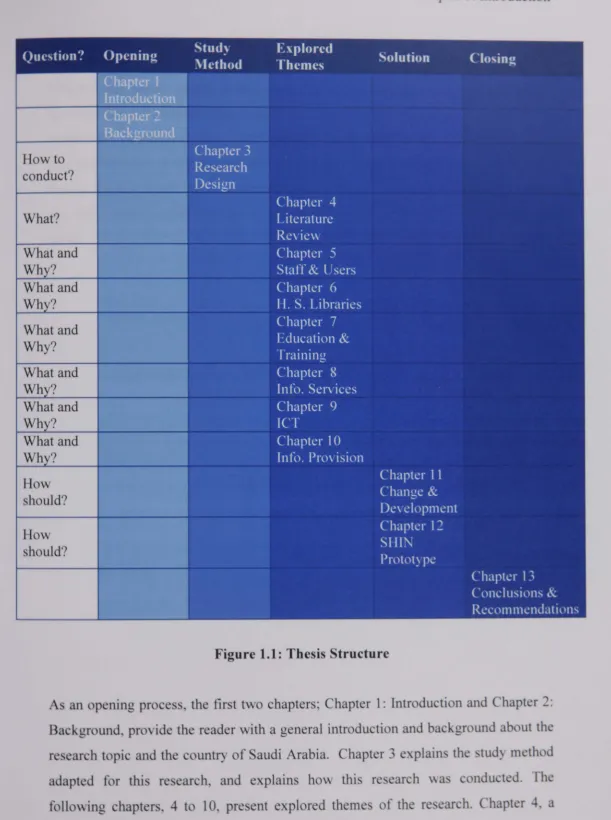
1.7 Thesis structure
The current thesis contains 13 chapters, opening with this introduction chapter and
closing with the conclusions and recommendations chapter. In addition, it is followed
by two important sections: bibliography and appendices. The thesis structure section
illustrates the thesis structure from beginning to end (Figure 1.1).
How to conduct?
What?
What and Why?
How should?
How should?
Figure 1.1: Thesis Structure
A an p ning proce s, the first two chapters' Chapter 1: Introducti n and hapter_:
Background, pr vide the reader with a general introduction and backgr und ab ut the
research topic and th country f audi rabia. Chapter 3 explain~ the tudy mdh<.
adapted tor thi re arch, and explain h w thi re ear h \\ a c ndu kd. 'I he following chapt r . 4 t 10. pre ent expl r d theme of th re earch. hapkr 4. a literature re\'i~w, pre cnt concept and theme generated b) prc\ i U' \\ fiter ' and re earcher . and it tell what ha been acceph::d and experienced Sl far. 'hapkrs: h)
[image:36.682.29.641.17.838.2]Chapter 1: Introduction
10 discuss explored themes in this research and basically explain what is the case and
why. The last two chapters, Chapter 11: Organisational change and development. and
Chapter 12: Saudi Health Information Network Prototype, present a practical
development and solution to the current situation, and suggest how the change process
should be conducted. The thesis closes with Chapter 13: Conclusion and
Recommendation. It summarises the whole work and presents recommendations for
further improvement. It is important to note that this chapter highlights some
important ideas for further exploration of issues that could not to be covered in this
thesis.
Chapter Two
Background
Chapter Two
Background
2.1 Introduction
This chapter will provide background information to the study in terms of a general
overview of Saudi Arabian health care and an introduction to health science libraries
in Riyadh.
2.2, Profile of Saudi Arabia
The Kingdom of Saudi Arabia is within the Arabian Peninsula. It was founded in the
latter period of the nineteenth century as a modem state. The Kingdom itself occupies
approximately 2.250,000 square kilometres (868,730 square miles) it is bordered on
the north by Jordan, Iraq and Kuwait: on the east by the GulL Bahrain. Qatar and the
Chapt r _: Ba k_ und
west by the Red Sea. The capital city Riyadh is located in the 'ajd r ::)on. th
central area of the kingdom (Figure 2.1: map of Saudi Arabia).
-Red
Sea
f
Je
'
ddah
I
Saudi Arabia
·H~il AI
Ju
b~)l1 .D.-mman-.
Dh h~n J
AI Khoba
@Riyad
---N
r-~--~~~----~---~----~,-20· N
o·
t...;; EI(hami s Mu sh)lt , ..
~ .. N~jran " 200
Miles Ioo--...-.._~
o
0 Kilome,ers,
,~"
tlO'E
~
rabian
Sea
[image:40.635.28.607.20.676.2]..
Figure 2.1: Map of Saudi Arabia
According to the 1974 (1393/94 AH) census, the Kingdom's population was just 0 er
7 million. Since then, by all accounts, the population has grown dramatically.
Preliminary results of the 1992 (1412/13 AH) census gave a figure for the t tal
population of 16.9 million, of which 12.3 million were Saudi nationals. Ofth audi
national population, 50.4% are male and 49.6% female. Currently, it i stimat d that
more than half of the Saudi population is under the age of 20 (audi rabia
Infonnation Re ource,2004a).
rabic i the official language f the country. Alth ugh m t pe pic \\h li\l.~ in
audi rabia p ak Arabic. n t all f them ar f Arab rigin. Thi i. bccaust: Mu lim hay immigrated to the land ( audi Arabia). p rti ularly t tht: \\l:.·tl:m
Chapter 2: Background
since the prophet Muhammad (peace be upon him and upon all prophets) was born
here and delivered his message mainly inside the Arabian Peninsula. Islam is
therefore the way of life for the majority of people who live in Saudi Arabi~ and they do not admit a significant separation between life-spiritual and life-mundane.
Economically, Saudi Arabia has the largest oil reserves in the world, having 250/0 of
the world's total. The policy of the Kingdom is to develop a viable economy based on
refined petroleum products (Abdrabboh, 1984). Oil reserves in Saudi Arabia are set to
rise within the next two decades after the government has announced that a new well
had been discovered in the Rub 'al-Khali desert, and production began there in the
first quarter of 1996. The source contains 14 billion barrels of crude oil and more
than 25 trillion cubic feet of gas (Middle East Newspaper, 1998). Moreover, Saudi
Arabia has started a massive development programme with long-term objectives to
diversify the economy and build a strong private sector (Ministry of Planning, 2000).
2.3 Healthcare in Saudi Arabia
The health infrastructure of Saudi Arabia and its curative and prevention services
have made important and increasing progress during the past decade. The delivery of
a health service was developed to be integrated into regional and district health care
systems to ensure that a health service is provided to all citizens and residents. This
development achieved a better co-ordination and utilisation of available resources.
The Saudi health system has also experienced a series of changes over the years as it
has sought to respond to the demands and needs of its citizens (Ministry of Health,
1999; 2005).
Organised preventive health services in Saudi Arabia began in the early 1950s when
the Ministry of Health (MOH), the Saudi Aramco oil company, and the World Health
Organisation (WHO) launched the first campaign against malaria in Qatif and
AI-Hassa Oasis in the Eastern Province, the success of which led to the expansion of the
malaria control programme to other provinces in the country (AI-Yousuf et al.. 2002).
From 1970 to 1980, health services were predominantly curative, as most health
professionals had received their training in patient-oriented, hospital-based medical
institutions. Furthermore, there was a general population expectation of curative care
Chapter 2: Background
(Sebai, 1985). This care was delivered through a number of hospitals and dispensaries, while preventive care was delivered by health offices and, to some extent, through maternal and child health care centres. Disease control activities were handled by vertical programmes. Episodic outbreak control activities were managed through the health offices (AI-Mazrou, 1990; AI-Mazrou et aL 1995; Ministry of Health, 1999).
In the early 1980s, the concept of primary health care (PHC) became popular. with the WHO slogan 'Health for All' gaining recognition. The MOH led to the establishment of the health centres, administratively integrating the existing dispensaries, health offices and maternal and child health (MCH) centres into one unit (AI-Yousuf et aI., 2002).
Some of the best hospitals in Saudi Arabia are owned and operated by the government. Healthcare in Saudi Arabia, traditionally provided by the Ministry of Health (MOH), is increasingly being shared with other public and private agencies. According to the latest available figures, by the end of 1999, the total number of hospitals in the Saudi health sector stood at 314 (45,729 beds). The MOH had 186 hospitals, the private sector 89, and other government agencies accounted for 39. The main provider of health care services to the general public is the MOH. Other government agencies, such as the Ministry of Defence & Aviation (MODA), the Saudi National Guard (SNG), and Ministry of Interior (MOl) operate separate hospitals for their employees (Ministry of Planning, 2000).
The security and military agencies provide high levels of health care directly for their staff and segments of the general public. The school health units provide immediate primary health care for students. The General Organisation for Social Insurance (GOSI) and the General Presidency of Youth Welfare (GPYW) provide health services to a large number of affiliated populations. The Kingdom' s universities provide, through their medical colleges and hospitals, specialist curative services and
medical education and training programmes, while they also conduct health research in collaboration with other research centres (Ministry of Health. 1999: Ministry of
Planning, 2000).
Chapter 2: Background
The Saudi Red Crescent Society undertakes an important and effective role in
providing emergency services at the pre-hospital stage, either at the scene of accidents
or during the transportation of patients to hospitals. The Red Crescent also undertakes
a unique task by providing such services for pilgrims (Saudi Red Crescent Society.
2005). In addition, the private sector provides health services through its health
facilities including, hospitals, dispensaries, laboratories, pharmacies and
physiotherapy centres throughout the Kingdom (Ministry of Health, 2005).
Health care is not limited to preventive and curative aspects only; it also extends to
the domain of medical research. For illustration, the King Faisal Specialist Hospital
and Research Centre (KFSHlRC) uses highly advanced technologies and acts as a
reference hospital for cases that require advanced and special treatment, while it also
conducts research on health issues in general, and those related to the Kingdom in
particular. The KFSHIRC works hard to implement and apply these technologies in
the field of medicine. The hospital has developed a satellite link with advanced hospitals and research centres in North America for conferencing,
Tele-pathology, and Tele-radiology (KFSH&RC, 2005).
Saudi Arabia is the largest market for medical equipment and health care products in
the Gulf, and the Ministry of Health is the largest buyer, representing around 600/0 of
the market. In its 2003 budget, the Saudi government allocated $6.2 billion for health
and social care (Ministry of Health, 2005). However, Saudi health care is facing new
challenges as the government continues to finance health services for a population of
22.7 million, which is rapidly growing at 30/0 per annum. Financial constraints in the
face of a growing population are now forcing the Saudi Government to re-evaluate
this policy in order to ensure the continuous upgrading of health services for its
people (Saudi Arabia Information Resources, 2004b). Accordingly, the MOH has
privati sed a few government hospitals, while encouraging and creating more
opportunities for private sector participation in the health sector to lessen the burden
on its budget. This is evident with the growing number of private hospitals as well as
educational academies (Ministry of Health, 2005).
The Kingdom's health services are heavily dependent on expatriates, who provide
around 80% of physicians and nurses (Saudi Arabia), This is because local medical
Chapter 2: Background
training programmes have not kept up with the growing demand for physicians and
other para-medical staff. Therefore, the need for continuous improvement in, and
development of, health sector products and services is increasing.
In the matter of planning and implementation, the recently implemented plan in Saudi
Arabia called the Seventh Development Plan stresses the importance of establishing a
national council for the coordination of health services. This council will be entrusted
with ensuring there is optimal utilisation of health facilities and available resources in
the Kingdom, conducting studies and research in the domain of health services at a
national level, and coordinating educational and training institutions to meet the needs
of Saudi workers in the health field. Another target of the Seventh Development Plan
(SDP) is to ensure steady private sector growth in health care services, through greater
participation in financing the establishment of health facilities, and increased
investment in the manufacturing of medicines, pharmaceuticals and medical
equipment (Ministry of Planning, 2000).
AI-Ofi, in Al-Watan newspaper (2002), reported that a planning committee in Saudi
Arabia, involving professionals and experts, reviewed health information, and
information communication and technology (ICT) in the Kingdom. This committee
reached some vital conclusions and reported some urgent solutions to the problems
which were highlighted in their report. The report highlighted nine important issues:
1) the need to establish a National Information Society (NIS) in 2004-2005, 2) a
unique number (Personal Identification) to be used and applied to patient records, 3)
each of the computer administrations to be connected to the high authority in the
hospital or parent organisation, 4) creation of statistical databases for diseases and
infections to be made available on the Internet for researchers, 5) the need to unite and
define clinical computing and health information systems, 6) the importance of
developing information infrastructure and a health information network among the
Saudi Hospitals and research centres, 7) the desirability of considering the
information services broadly as part of the information health process, 8) the need for
automation in the health sector and its administrations. and 9) special concern
regarding the payment system and the introduction of health insurance.
Chapter 2: Background
AI-Oft, in his report, gave a brief description of the current situation, based on field
visits and investigations. He found that the Saudi hospitals and health centres are the
least fortunate sector in utilising the ICT and most of them have a poor information
infrastructure. Most of these hospitals have no connection to the Internet and have no
electronic mail service. There is no strategic plan for health information in the
country. Essentially, there is no match between the needs in practice and the outcomes
of educational programmes related to health science.
The report further revealed that most of the findings and recommendations of
previous health committees and conferences since 1996 are still appropriate. In
addition, AI-Oft argued that the health information service should play an essential
part of the national health system. The communication of health information has an
important role in the delivery of quality health care. Quality information with timely
delivery must be available to enhance quality performance. This supporting system of
'information delivery' is the focal task that the health sciences libraries should
perform.
AI-Zahrani (2002) confirmed that the majority of hospitals in Saudi Arabia still rely
on traditional working practices such as pen and paper, post, and some staff are
involved in booking appointments for outpatients manually. This, he argued, leads to
unnecessary delays, frustration for patients and staff alike, and the potential for errors.
In these hospitals, there is generally very little use of ICT in the health care system
functions. Additionally, health professionals do not have enough ICT knowledge,
experience and skills to manage and use computers efficiently in the medical
environment and, therefore, they cannot take full advantage of their computer
information systems. AI-Zahrani argued that the responsibility rests with the
department of human resources in the Ministry of Health for meeting the technology
and information needs of health professionals and staff.
2.3.1 Healthcare in Riyadh
Riyadh is the capital city of the Kingdom of Saudi Arabia within which are the
headquarters of government ministries. departments and organisations; several
regional, national. as well as international organisations are also based in the city. In
Chapter :2: Background
addition to these administrative areas, Riyadh is the central point of the Kingdom' s
commerce, health, education and transportation.
The population of Riyadh stands at more than 3.4 million. Saudis comprise almost
two-thirds (66%) of the population, the remainder being foreigners. The population of
the city is projected to increase to 6.4 million by the year 2007. In 1994 the city had
26 major hospitals, including government and private hospitals, and 276 primary
health care centres, with a total of 5,013 beds. That same year, Riyadh had
approximately 2,607 physicians, 6,659 nurses, and 3,224 assistant technicians
(Arriyadh Development Authority, 1999).
Furthermore, Riyadh is home to a number of internationally recognised hospitals, to
which cases of serious disease are referred from many other cities in the country and
many parts of the world, including the Arab world, Afghanistan, Africa, and Pakistan.
In brief, Riyadh is considered to be the primary centre for health care facilities and
medical research in Saudi Arabia. The health care industry is projected to be a
growing and significant sector in the city due to high population growth and the
proximity of a number of local manufacturers and medical products suppliers
(Arriyadh Development Authority, 1999).
2.3.2 Hospitals in Riyadh
In Riyadh there are a number of famous and important government hospitals affiliated
to various government bodies such as the Ministry of Health, universities, and others.
The following are brief backgrounds of the major hospitals in Riyadh whose health
sciences libraries have been investigated in this study.
2.3.2.1 King Faisal Specialist Hospital and Research Centre (KFSHIRC)
King Faisal Specialist Hospital and Research Centre (KFSHIRC) is an independent
government health and medical institution founded in 1970, which opened in 1975 at
the end of the First National Plan (Ministry of Health, 1999). This hospital. in the
northwest section of Riyadh, has gone through a series of developments and
expansions. The hospital seeks to establish the basis and rules for specialist medical
services in the Kingdom by provision of advanced specialist medical services setting
up and implementing higher studies programmes for training Saudi physicians and