City, University of London Institutional Repository
Citation
:
Chen, Y. (2009). Essays on the Role of Informed Trading in Stock Markets.(Unpublished Doctoral thesis, City University London)
This is the accepted version of the paper.
This version of the publication may differ from the final published
version.
Permanent repository link: http://openaccess.city.ac.uk/8712/
Link to published version
:
Copyright and reuse:
City Research Online aims to make research
outputs of City, University of London available to a wider audience.
Copyright and Moral Rights remain with the author(s) and/or copyright
holders. URLs from City Research Online may be freely distributed and
linked to.
City Research Online: http://openaccess.city.ac.uk/ [email protected]
Essays on the Role of Informed Trading in Stock Markets
Yifan Chen
A dissertation submitted to City University London
for the degree of Doctor of Philosophy
Faculty of Finance
Cass Business School
City University London
Table of Contents
List of Tables··· 5
Acknoledgments ··· 6
Declaration··· 8
Abstract··· 9
CHAPTER 1: Introduction··· 10
CHAPTER 2: Literature Review ··· 19
2.1. The Efficiency of Financial Markets ···19
2.1.1. The Challenges to the EMH ···20
2.1.2. The Defence of the EMH···27
2.1.3. Are Financial Markets Efficient?···29
2.2 Momentum Literature ···31
2.2.1. The Form of Momentum ···31
2.2.2. Overreaction and Underreaction···32
2.2.3. Empirical Evidence ···34
2.3. Short-Sale Constraints Literature ···35
2.3.1. The Source of Short-Sale Constraints···37
2.3.2. The Overvaluation Effect of Short-Sale Constraints···41
2.3.3. Short-Sale Constraints under Asymmetric Information ···57
2.4. Asymmetric Information Literature···62
2.4.1. The Importance of Information ···63
2.4.2. No-Trade Theorem and Partially Revealing Equilibrium ···64
2.4.3. Asset Pricing under Asymmetric Information···66
2.5. Information Uncertainty Literature···74
2.5.1. The Concept of Information Uncertainty···74
2.5.2. Asset Pricing under Information Uncertainty ···75
2.5.3. Information Uncertainty and Information Disclosure ···78
CHAPTER 3: Informed Trading, Short-Sale Constraints, and Trading
Volume ··· 79
3.1. Introduction···79
3.2. Related Literature···84
3.3. Data and Sample ···90
3.3.2. Short-Sale Constraints Proxy···92
3.3.3. Information Uncertainty Proxy···95
3.3.4. Sample Selection Criteria ···97
3.3.5. Risk-adjusted Returns···98
3.3.6. Summary Statistics ···101
3.4. Empirical Results ···103
3.4.1. Portfolio Returns Sorted by One Variable···104
3.4.2. Portfolio Returns Sorted by Information Uncertainty Proxy and PIN··105
3.4.3. Portfolio Returns Sorted by Short-Sale Constraints Proxy and PIN ····107
3.4.4. Portfolio Returns under Three-Way Sorting ···109
3.4.5. Subperiod Analysis··· 113
3.4.6. Comments on Robustness··· 114
3.5. Conclusion ··· 115
Appendix 3.1. Summary Statistics of PIN Estimates in Easley, Hvidkjaer, and O’Hara (2005)··· 118
CHAPTER 4: Informed Trading, Short-Sale Constraints, and Trading
Volume ··· 131
4.1. Introduction···131
4.2. Related Literature···137
4.3. Data and Sample ···144
4.4. Empirical Results ···148
4.4.1. Portfolio Returns Sorted by One Variable···148
4.4.2. The Interaction between Trading Volume and Short Sale Constraints ·150 4.4.3. The Interaction between Trading Volume and PIN ···152
4.4.4. The Interaction between Short-Sale Constraints and PIN ···153
4.4.5. Portfolio Returns under Three-Way Sorting ···155
4.4.6. Subperiod Analysis···159
4.4.7. Comments on Robustness···160
4.5. Conclusion ···162
CHAPTER 5: Informed Trading, Information Uncertainty, and
Momentum··· 179
5.1. Introduction···179
5.2. Related Literature···186
5.3. Data and Sample ···192
5.4. Empirical Results ···196
5.4.1. Portfolio Returns Sorted by One Variable···197
5.4.2. Portfolio Returns Sorted by Momentum and Information Uncertainty 198 5.4.3. Portfolio Returns Sorted by Information Uncertainty and PIN ···199
5.4.5. Portfolio Returns under Three-Way Sorting ···202
5.4.6. Subperiod Analysis···207
5.4.7. Comments on Robustness···208
5.5. Conclusion ···210
CHAPTER 6: General Conclusion··· 239
List of Tables
Table 3.1 Summary Statistics ··· 119
Table 3.2 Portfolio Returns Sorted by One Variable ··· 121
Table 3.3 Portfolio Returns Sorted by Information Uncertainty and PIN··· 122
Table 3.4 Portfolio Returns Sorted by Short-Sale Constraints and PIN··· 124
Table 3.5 Portfolio Returns Sorted by Uncertainty, Short-Sale Constraints, and PIN··· 125
Table 3.6 Subperiod Analysis ··· 128
Table 4.1 Summary Statistics ··· 165
Table 4.2 Portfolio Returns Sorted by One Variable ··· 167
Table 4.3 Portfolio Returns Sorted by Trading Volume and Short-Sale Constraints··· 168
Table 4.4 Portfolio Returns Sorted by Trading Volume and PIN··· 170
Table 4.5 Portfolio Returns Sorted by Short-Sale Constraints and PIN··· 171
Table 4.6 Portfolio Returns under Three-Way Sorting ··· 172
Table 4.7 Subperiod Analysis ··· 176
Table 5.1 Summary Statistics ··· 212
Table 5.2 Portfolio Returns Sorted by One Variable ··· 214
Table 5.3 Portfolio Returns Sorted by Momentum and Information Uncertainty ··· 215
Table 5.4 Portfolio Returns Sorted by Information Uncertainty and PIN··· 217
Table 5.5 Portfolio Returns Sorted by PIN and Momentum··· 219
Table 5.6 Portfolio Returns Sorted by Information Uncertainty, PIN and Momentum ··· 220
Table 5.7 Portfolio Returns Sorted by PIN, Information Uncertainty and Momentum··· 223
Table 5.8 Portfolio Returns Sorted by Momentum, PIN and Information Uncertainty··· 226
Acknowledgements
I would like to express my gratitude to my supervisor, Dr. Huainan Zhao, for his kindness, support, and exceptional guidance during the past five years. Dr. Zhao encouraged me to pursue doctoral research and brought me to the research area of asset pricing under asymmetric information. He provided insightful discussions and advices about my research. He was and remains my best role model. I also would like to thank Dr. Sotiris K. Staikouras for his kindness and support as my co-supervisor. In particular, he gave me helpful suggestions and encouraged me to be confident when I was preparing for my transfer and viva presentations.
My sincere thanks must go to my thesis committee members. Prof. Ales Cerny, the chair of committee, had been very supportive and understanding. He also gave me insightful suggestions about my research during my transfer presentation. Prof. Abhay Abhyankar, the external examiner, asked many good questions to help me think how to improve my work. I have learnt a lot from his insightful comments on my thesis. Prof. Mario Levis, the internal examiner, also gave me constructive feedbacks and comments. In particular, he was very patient and helpful during my thesis revision stage.
Harrisburg, for his encouragement and constant guidance. Dr. Bu has been a friend and mentor. His knowledge and academic experience have been significant useful throughout the years of my study.
Declaration
Essays on the Role of Informed Trading in Stock Markets
Abstract
The first essay, Chapter 3, shows that uninformed investors require a price discount to hold the stock because they perceive a new information uncertainty risk when short-sale constraints are binding and informed trading is absent. Stock prices become less informative when short-sale constraints keep informed investors out of the market. The less informative prices create a new information uncertainty risk for uninformed investors because uninformed investors are unable to figure out the true value of the stock without knowing the private information of informed investors. The new information uncertainty risk effect becomes greater if stocks have greater information uncertainty, which reflects the convenience of learning fundamental news.
The second essay, Chapter 4, examines two special new information uncertainty risk effects by controlling for trading volume. When volume is large, uninformed investors observe high buying pressure but cannot distinguish noise demand from information-based buying. They confront this new information uncertainty risk and demand premium to buy stock. Thus, overvaluation caused by short-sale constraints is reduced. When volume is small, uninformed investors convince that informed investors have negative information but do not know how bad the information is. They will not hold the stock under this new information uncertainty risk and therefore future return will becomes worse.
The third essay, Chapter 5, studies the impact of informed trading to the momentum effect. It proposes that if momentum is a result of underreaction and if informed trading identifies stocks with underreaction, the presence of informed trading predicts future momentum effect. Consistently, the empirical results show that momentum effect arises when informed trading is present. Greater informed trading leads to greater momentum effect. Although information uncertainty is related to both informed trading and momentum, the identified relationship between informed trading and momentum is robust after controlling for uncertainty.
Chapter 1
Introduction
This thesis contains three essays on the role of informed trading in stock markets. Informed trading is the trading behaviour of informed investors who trade on their superior information. Informed investors have superior information because they either have private information or have excellent skills to analyse public information. Informed trading is important because informed traders move prices towards the full informational efficiency, which, however, is not continuously attainable because at least information itself changes over time. Therefore, the influence of informed trading in financial market should not be neglected.
stock without knowing the private information of informed investors.
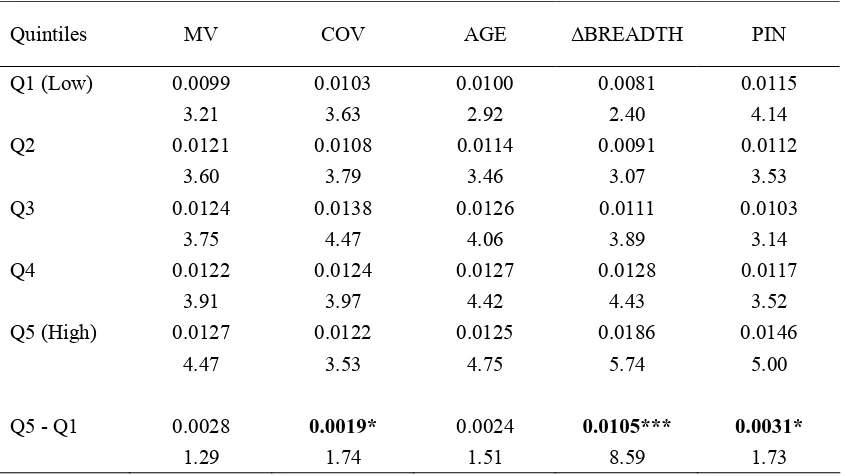
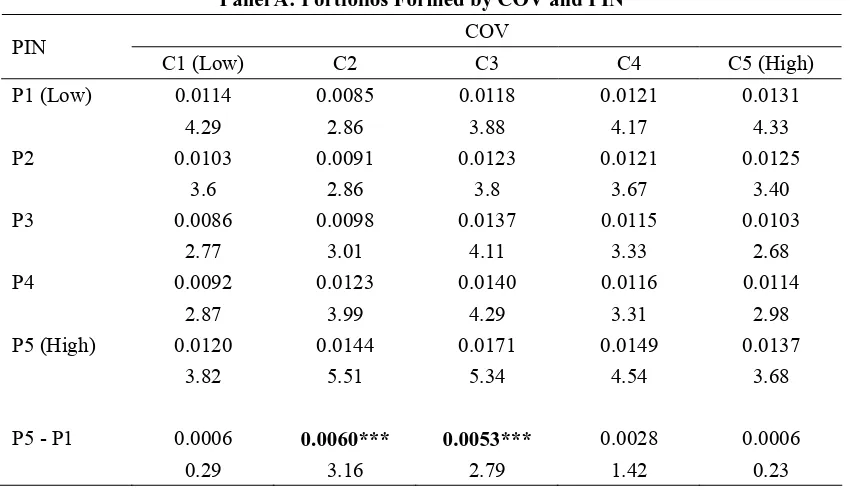
Specifically, Chapter 3 examines the general impact of the new information uncertainty risk on stock returns. That is, the new information uncertainty risk causes stock prices to decline when uninformed investors perceive the new information uncertainty risk because they are reluctant to hold the stock unless there is a price discount. Moreover, Chapter 3 further suggests the new information uncertainty risk effect can be affected by stock’s information uncertainty condition, which reflects the convenience of learning the fundamental value of stock. Accordingly, the level of stock’s information uncertainty is negatively related to the level of price’s informative condition. Therefore, chapter 3 proposes three testable hypotheses. First, stocks will have lower future returns if the level of informed trading is lower and when short-sale constraints are binding. Second, when information uncertainty is high, the new information uncertainty risk effect presented in the first hypothesis is strong. When information uncertainty is low, this effect rarely arises. Third, when information uncertainty is low and short-sale constraints are not binding, this new information uncertainty risk effect will not emerge. All these hypotheses are confirmed by the empirical results.
kinds of new information uncertainty risk effect. In particular, short-sale constraints are likely to bind when prices are high in Yuan (2006), which captures the overvaluation situation. In this case, new uncertainty dampens the upward price movement because uninformed investors are reluctant to hold asset because they cannot distinguish high noise demand from information-based buying. Hence, the first kind of new information uncertainty risk reduces the level of overvaluation. By contrast, Marin and Olivier (2008) and Bai, Chang, and Wang (2006) argue that short-sale constraints are likely to bind when asset prices are low. Without a high noise demand in the market, uninformed investors can only infer that informed investors are in possession of bad news since otherwise informed buying activities can be observed. Uninformed investors become aware of a new information uncertainty risk as they could not find out how negative the information really is. Thus, the second kind of new information uncertainty risk exacerbates downward price movement as uninformed investors demand an information-disadvantage premium to hold the stock.
(2) short-sale constraints are binding. Secondly, the scenario suggested by Bai, Chang, and Wang (2006) and Marin and Olivier (2008) can be captured by the low level of trading activities. The low levels of trading activities and informed trading would convince uninformed investors that majority of investors hold downward beliefs and informed investors hold negative private information. This is because not only informed investors but also most of investors in the market stop buying stock. The empirical evidence also reports that stock will have lower future returns if the level of informed trading is lower and when (1) the level of trading activities is low; and (2) short-sale constraints are binding.
The third essay, Chapter 5, concentrates on the impact of informed trading to the momentum effect. It proposes that if momentum is a result of underreaction and if informed trading identifies stocks with underreaction, the presence of informed trading predicts future momentum effect. Consistently, the empirical results show that momentum effect arises when informed trading is present. Greater informed trading leads to greater momentum effect. Although information uncertainty is related to both informed trading and momentum, the identified relationship between informed trading and momentum is robust after controlling for uncertainty.
information uncertainty. Chapter 5 also sheds light on the information uncertainty effect on momentum. It reexamines Zhang (2006)’s findings by controlling for informed trading. The empirical findings, however, provide many contrary evidence to Zhang (2006)’s findings. High level of information uncertainty does not produce momentum unless the level of informed trading is relatively high. Furthermore, past winners with higher uncertainty could earn lower future returns when the level of informed trading is low. These findings suggest the reported relationship between information uncertainty and momentum requires careful interpretations.
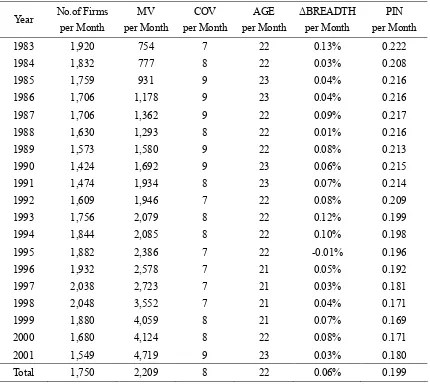
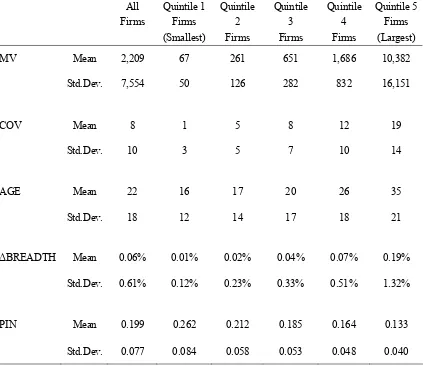
The three essays use the sample of NYSE and AMEX stocks during the period from January 1983 to December 2001. They also share one common proxy for informed trading: probability of information-based trade (PIN). The change in breadth of ownership (ΔBREADTH) is used to measure the short-sale constraints in Chapter 3 and Chapter 4. Chapter 3 and Chapter 5 adopt analyst coverage (COV), firm age (AGE), and firm size (MV) as the proxies for information uncertainty. Chapter 4 uses trading volume (VOL), the total number of shares traded at each month t, to measure the level of trading activities. The past 11-month stock returns RETt-11, t-1 are used to
examine price momentum strategies in Chapter 5
are used to calculate ΔBREADTH (CDA/Spectrum s12 in the Thomson Reuters). All the original frequencies of COV, AGE, MV, VOL, and stock returns are monthly. COV is calculated based on the raw detail forecast data unadjusted for stock splits in I/B/E/S, and it is the number of analysts providing annual FY1 earnings estimates lagged 12 months from the end of the month. AGE is measured as the number of years since the firm was first covered by CRSP. The CRSP monthly tape provides data on firm age, firm size, and monthly returns.
Since all the portfolios in the empirical tests are monthly rebalanced, the annual PIN data and quarterly ΔBREADTH data are adjusted into monthly frequency. The value of PIN at month t takes the value of PIN in that year. The value of ΔBREADTHt at
month t is equal to the value of ΔBREADTHT in quarter T if month t belongs to
Therefore, the possible frequency mismatches may not lead to accurate results for the monthly portfolio analysis.
to momentum. This is because during the period of one quarter or one year, prices may have adjusted to fundamental news with the help of informed trading and the following trading by uninformed investors.
This thesis also has other limitations. Although each essay has presented robustness checks like subperiod analysis, the empirical results can still be sample specific or because of the specific proxy variables used. Duarte and Young (2009) show that the PIN component related to illiquidity is priced. They suggest that liquidity effects unrelated to information asymmetry explain the relation between PIN and the cross-section of expected returns. Chen, Hong, and Stein (2002) also suggest that the changes in breadth might not really reflect binding short-sale constraints, but represent the superior stock-picking skill of mutual fund managers who are smarter than individuals. While this thesis yields several predications that expected returns should be increasing (or decreasing) with the level of informed trading under certain some conditions, Patton and Timmermann (2009) suggest that the full set of monotonicity in expected returns should be exploited. They propose new and simple ways to test for Monotonicity in financial variables and compare the proposed tests with extant alternatives such as t-tests, Bonferroni bounds and multivariate inequality tests through empirical applications and simulations.
Chapter 2
Literature Review
2.1. The Efficiency of Financial Markets
Economics is the science of how to satisfy unlimited requirements with limited resources. Since market facilitates the allocation of resources, economists introduced the concept of “efficiency” to assess the market performance.
In the case of financial economists, a market is efficient if it is “informationally efficient”. Asset prices are informational efficient if they fully and correctly reflect the relevant information. The Efficient Markets Hypothesis (EMH) is intended to provide a benchmark for assessing the performance of financial markets according to the concept of informational efficiency.
Obviously, the stock prices of efficient market would provide unbiased signals for optimal resource allocation. Thus, the market truly performs well if the EMH holds. In order to examine whether the EMH holds, enormous empirical and theoretical studies have been developed. At first, a vast array of findings supports the EMH in early decades. However, more and more empirical evidence shows that the EMH has been challenged since 1980.
Economists have developed theoretical idea to understand these financial phenomena. In particular, behavioural finance emerges. As a new approach to financial markets, behavioural finance assumes that some agents are not fully rational. Shleifer (2000) presents that behavioural finance theory rests on two foundations: “limits to arbitrage”, which show that arbitrage in real-world financial markets is far from perfect; “investor sentiment”, which focuses on how irrational investors actually form their beliefs, preferences and valuations, and more generally their demands for securities.
2.1.1. The Challenges to the EMH
Behavioural finance challenges the EMH with both empirical and theoretical evidence.
In general, the EMH provides two broad categories of empirical predictions. First, when the news about the fundamental value of an asset emerges in the markets, its price should react and incorporate this news both quickly and correctly. Second, since the asset price must be consistent to its fundamental value, price should not move without any news about the value of this asset.
The principal hypothesis following from quick and accurate reaction of prices to new information is that people cannot earn superior risk-adjusted profits from the stale information. Fama (1970) distinguishes between three types of stale information based on the three forms of the EMH. For the weak form, stale information is past prices and returns. The semi-strong form means that any publicly available information is stale. The strong form states that even the private information could be stale quickly. To be fair, most evaluations of the EMH have focused on weak and semi-strong form efficiency.
Firstly, the weak form EMH suffers from anomalies such as contrarian and momentum that imply investor can make excess profits using past price information. De Bondt and Thaler (1985) find that a long-term contrarian strategy, which consists in buying losers and selling winners based on a performance observed two to five years earlier, could generate positive returns in the following years. Momentum, first presented by Jegadeesh and Titman (1993), is much more significant. They show that movements in individual stock prices over the period of six to twelve months tend to predict future movements in the same direction. That is, while contrarian refers to the long-term trends, momentum reveals that the short-term trends persist. Subsequently, even Fama (1991) admits that stock returns are predictable from past returns.
1998, Davis, Fama and French 2000).
Finally, empirical results also show that stock prices could react to non-information. In fact, many sharp changes in stock prices do not appear to accompany significant news. Cutler, Poterba and Summers (1991) report that the 50 largest day stock price movements came on days of no major announcements. Roll (1984, 1988) point out that shocks other than news appear to move security prices, in contrast to the EMH. Wurgler and Zhuravskaya (2002) find that the inclusion in the S&P500 generates a substantial uninformed demand for the shares of the company.
The Theoretical Challenges
Following to the empirical challenges to the EMH, financial economists begin to criticize three theoretical foundations of the EMH.
Second, the EMH claims that even if some investors are not fully rational, markets could still be efficient as long as they trade randomly and hence their trades would cancel each other. This implies that the correlation in the strategies of the irrational investors is limited. In contrast, Kahneman and Tversky (1973) reveal that investor sentiment typically determines the common judgment errors made by a substantial number of investors. Shiller (1984) argues that the mistakes would become more severe when the noise traders behave socially and follow each others. Empirical studies also confirm that the aggregate trading of noise traders could be systematically correlated. Barber, Odean, and Zhu (2006a) demonstrate that the trading of individual investors is surprisingly systematic using trading records in U.S. stock markets. Barber, Odean, and Zhu (2006b) argue that noise traders indeed move the markets because they find that noise trader can affect stock prices using eighteen years of tick-by-tick transactional data for U.S. stocks. Finally, Shleifer (2000) presents that professional managers of pension and mutual funds are subject to the same biases as individual investors.
opportunity, thereby correcting the mispricing. Ross (2004) defines an arbitrage opportunity as an investment strategy that guarantees a positive payoff in some contingency with on possibility of a negative payoff and with no initial net investment. Thus, rational investors in the EMH are typically referred to as “arbitrageurs” because of the belief that a mispriced asset immediately creates an opportunity for riskless profits.
arbitrageur is trying to exploit worsens in the short run, generating negative returns, investors may withdraw their funds. Then the arbitrageur will be forced to liquidate position prematurely. Moreover, many arbitrageurs borrow money and securities from intermediaries to take advantage of mispricing. They have to pay interest and also face the risk of liquidation. After poor short-term returns, lenders will call their loans seeing the value of their collateral erode.
2.1.2. The Defence of the EMH
While the EMH encounters seriously attacks, its advocators strike back as well.
Anomalies and Market Efficiency
Some financial economics argue that anomalies do not necessarily mean the death of EMH. At first, since every appraisal of market efficiency depends upon an asset pricing model, the test must assume an equilibrium model that defines normal security returns. If efficiency is rejected, this could be the case that market is truly inefficient, or because an incorrect equilibrium model has been assumed. Hence, Campbell, Lo and Mackinlay (1997) suggest that this joint hypothesis problem implies that market efficiency as such can never be rejected.
Finally, some researchers have found that anomalies often seem to disappear, reverse, or attenuate. Schwert (2003) indicates that most anomalies are more apparent than real in his survey on anomalies and market efficiency. Even if the anomalies existed in the sample period in which they were first identified, the practitioners who would take advantage of anomalies and consequently cause them to disappear.
The Challenges to Behavioural Finance
Neoclassical and behavioural finance are two revolutions in financial economics that came at different periods and largely from different people. The efficient market theory and traditional asset pricing framework stem from neoclassical finance, in which agents are fully rational. In contrast, assuming agents are not fully rational, behavioural finance claims that it explains the evidence that appears anomalous from the EMH and generates new predications that have been supported in empirical results. However, proponents of neoclassical finance also argue that behavioural finance remains controversial.
mispricing induced by irrational traders.
It is true that most of the people usually indeed misbehave as the suggestion from behavioural finance. To cope with this, the neoclassical theories rely on the abilities and motivations of some smart and well-financed investors. Meanwhile, the well-developed normative neoclassical portfolio theories also assist individual investors when they are tempted to stray from rationality. Thus, the theoretical need for the average investor to be rational is a straw man. Given the effort neoclassical finance has made to distance itself from preference assumptions and rely on the stronger principle of no arbitrage, Ross (2004) argues that the behavioural critique is ironic.
Although neoclassical and behavioural finance are often seemed to be incompatible, Shiller (2006) suggests that the two approaches in fact have always been intertwined, and some of the most important applications of their insights will require the use of both approaches.
2.1.3. Are Financial Markets Efficient?
set and maintained by rational agents. The second statement is “no free lunch”, which implies that no investment strategy could earn excess risk-adjusted returns.
These two propositions are important because they guide financial economists to investigate the market efficiency. Since both of them are true in an efficient market, many researchers take it for granted that they are the same. However, Barberis and Taler (2003) argue that they are not equivalent. If prices are right, then there is indeed no free lunch. But the absence of free lunch does not necessarily mean that prices are right. The rationale is that even if mispricing exists, arbitrageurs could not eliminate it away definitely. In the view of behavioural finance, the arbitrage can be limited. Thus, no free lunch can also be true in an inefficient market. In other words, the evidence that no one could beat the markets does not necessarily mean that the market is efficient.
on whether prices are right than on whether there is any free lunch for taking.
Considering this distinction, Shiller (2003) concludes that researchers should not expect market efficiency to be so egregiously wrong that immediate profits should be continually available. But market efficiency can be egregiously wrong in other senses such as it could not interpret sock market bubbles. Indeed, mispricing always emerges and even persists in financial markets. Therefore, the innovations of asset pricing theory are required.
2.2 Momentum Literature
The studies on momentum are always popular because it is the strongest challenge to EMH and economists try to explain it in all kinds of approaches.
2.2.1. The Form of Momentum
(Rouwenhorst 1998, 1999). Other forms of momentum have been measured using different initial impulses. Post-earnings-announcement drift is momentum following a surprise earnings announcement (Ball and Brown 1968, Bernard and Thomas 1989, 1990), while earnings momentum is momentum following a revision in analysts’ earnings forecasts (Chan, Jegadeesh, and Lakonishok 1996).
2.2.2. Overreaction and Underreaction
Traditional asset pricing model requires high returns to compensate for some kind of risk, but stocks that have superior performance recently, or have had positive earnings surprises, typically seem to have lower risk, not higher risk. Therefore, momentum cannot be explained by measures of risk (Grundy and Martin 2001, Griffin, Ji, and Martin 2003). In contrast, momentum arises more naturally under behavioural asset pricing model.
families that have performed well recently, consistent with the herding hypothesis. However, there is less evidence that herding generates short-run momentum that eventually reverses. Brunnermeier and Nagel (2004) present one closely related result. They show that hedge funds rode the technology bubble through the late 1990’s even after technology stocks are regarded to be overpriced by any conventional measure. These funds appeared to believe that positive short-term momentum would overcome poor long-term value, and their strategy was quite successful.
2.2.3. Empirical Evidence
Empirical studies test implications of behavioural theories and provide many interesting findings. First, momentum should be stronger when fundamental news is less obvious and harder to analyse. Zhang (2006) confirms that momentum is stronger in stocks that are hard to value such as young stocks, small stocks, stocks that are covered by relatively few analysts, stocks with widely dispersed analyst earnings forecasts, and stocks with volatile returns and cash flows. Hong, Lim and Stein (2000) show that momentum is greater when fundamental news is bad and hence not publicized by firm management. Grinblatt and Moskowitz (2004) also present that momentum is stronger when news comes out slowly over several months than when there is a large disclosure that is obvious even to inattentive investors. Furthermore, momentum effects exist not only within stocks but across stocks, particularly from large-cap and high-volume stocks to small-cap low-volume stocks, and from stocks in one industry to their suppliers and customers (Chordia and Swaminathan 2000, Lo and MacKinlay 1990, Menzly and Ozbas 2006).
Third, momentum should be stronger when rational investors face high transactions costs in their arbitrage trading. Johnson and Schwartz (2000) find that during the 1990’s, earnings momentum and post-earnings-announcement drift weakened in liquid markets such as the US and the UK, but remained stronger in less liquid international markets.
Finally, arbitrageurs could exploit the underreaction phenomenon. Cohen, Gompers, and Vuolteenaho (2003) study the aggregate holdings of US institutional investors and confirm that institutions buy shares from individuals in response to good cash-flow news. However, institutions are not simply following price momentum strategies as they sell shares to individuals when price goes up in the absence of positive cash-flow news.
2.3. Short-Sale Constraints Literature
impact remain inconclusive. Note that although this thesis focuses on short-sale constraints in the stock market, their importance is recognized in other markets as well such as the fixed-income market (Krishnamurthy 2002).
in certain states.
2.3.1. The Source of Short-Sale Constraints
The Frictional Securities Lending Market
At first, there are short-sale constraints that stem from the mechanics of shorting. To be able to sell a stock short, one must borrow it first. In order to borrow shares, an investor needs to find an institution or individual willing to lend shares. Financial institutions, such as mutual funds, trusts, or asset managers, typically do much of this lending. These lenders receive a fee in the form of interest payments generated by the short-sale proceeds, minus any interest rebate that the lenders return to the borrowers.
demand in the stock lending market, much like the “repo” rate in the fixed income market. Obviously, if every investor were willing and able to lend shares in a competitive market, the lending fee would be close to zero. However, as Duffie (1996) and Krishnamurthy (2002) show, if some investors who are willing to hold overpriced assets do not lend, a strictly positive fee can arise.
Apparently, rebates create costs for establishing a short position in a security. In addition, short sellers incur searching costs since the fact that security owners and those wishing to short have to find each other. This is because the security lending market is not a centralized market with a market-clearing price, and hence rebates only partially equilibrate supply and demand. While individual retail investors are particularly likely to be unable to short, there is also extensive evidence of institutional investors unable to short no matter how much they are willing to pay for borrowing shares.
refuse to lend their stock because they fear that by helping short sellers, they will be helping drive stock prices down. Third, for individual investors, brokers typically only have the ability to lend out of margin accounts, not cash accounts. Fourth, some institutions do not have stock lending programs at all, perhaps because they feel their holdings are too small and the income generated by lending would not be enough to compensate for the fixed cost of setting up a lending program.
Generally, it is easy and cheap to borrow most large cap stocks, but it can be difficult to borrow stocks which are small, have low institutional ownership, or which are in high demand for borrowing. A somewhat paradoxical description of the stock lending market is that it usually works very well, except when you want to use it, in which case it works terribly. In particular, it can be difficult or expensive to short stocks that many people want to short.
Other Frictions for Short Selling
10a-1), a higher tax rate on profits on short sales (which are treated as short-term capital gain), the risk of short squeeze, and others. Many institutions set up to encourage individuals to buy stocks, but few institutions set up to encourage them to short. For some institutional investors, short selling is prohibited by their charters. Almazan, Brown, Carlson, and Chapman (2002) report that about 70% of mutual funds explicitly state (in Form N-SAR they file with the SEC) that they are not permitted to sell short.
discourage shorting and securities lending. A major lender of European stocks announced it was ceasing securities lending and urged others to do the same.
Thirdly, short sellers also face hostility from the firms they short. Managers of firms do not like people who short sell their stock, especially if the short sellers are accusing the firms of fraud and even more especially when the fraud accusations are true. Consequently, sometimes companies will fight with their short sellers.
Note that derivatives, such as options and futures, could provide alternative ways to take a short position in a security. However, derivatives trading has its own costs and restrictions (Ofek and Richardson 2003).
2.3.2. The Overvaluation Effect of Short-Sale Constraints
Extensive literature studies the overpricing impact of short-sale constraints. In particular, the combination of differences of opinion among market participants and short-sale constraints could deliver overvaluation to securities.
The Source of Heterogeneous Beliefs
seems that asymmetric information might cause differences of opinion. The presence of private information suggests that investors could use it to trade and make a profit. However, Tirole (1982) and Milgrom and Stokey (1982) use no-trade theorem to rule out this possibility. They show that rational investors who share the same prior beliefs cannot expect to profit from speculating against each other based on differences in information. In particular, Tirole (1982) demonstrates that the no-trade theorem holds in dynamic Rational Expectations Equilibrium (REE). In his model, the resale options suggested by Harrison and Kreps (1978) cannot arise in asset prices even if short-sale constraints are imposed.
from adopting certain beliefs. Nevertheless, Overconfidence is the most well documented behavioural bias that can generate heterogeneous beliefs.
Overconfidence is the tendency of people to overestimate the precision of their knowledge. Psychology studies, such as Alpert and Raiffa (1982), Brenner, Koehler, Liberman, and Tversky (1996), suggest that people are overconfident. Camerer (1995) argues that even experts can display overconfidence. Financial economists have developed theoretical models to analyse the implications of overconfidence on financial markets. Kyle and Wang (1997) adopt overconfidence as a commitment device over competitors to improve one’s welfare. Daniel, Hirshleifer, and Subrahmanyam (1998) use overconfidence to explain the predictable returns of financial assets. Odean (1998) demonstrates that overconfidence can cause excessive trading. Bernardo and Welch (2001) discuss the benefits of overconfidence to entrepreneurs through the reduced tendency to herd. In these studies, overconfidence is modelled as overestimation of the precision of one’s information. Scheinkman and Xiong (2003b) exploit the consequences of this overestimation in a dynamic model of pricing and trading. They regard overconfidence as a convenient way to generate a parameterized model of heterogeneous beliefs. Since overconfident investors believe more strongly in their own assessments of an asset’s value than in the assessment of others, heterogeneous beliefs arise.
In an earlier paper, Miller (1977) theorizes that in the presence of short-sale constraints, security prices tend to reflect a more optimistic valuation than the average opinion of potential investors and thus tend to be upward biased. This overvaluation argument is based on two conditions: (1) A security’s short sales are either prohibited or costly, and (2) investors have heterogeneous beliefs or information about the security’s value. The underlying intuition is quite straightforward. Pessimistic investors are forced to sit out of the market when short sales are not available, and thus some negative information is not reflected in prices, enabling enthusiastic buyers to bid prices above the level that average investors perceive as fair.
Chen, Hong, and Stein (2002) obtain a similar result in their model that allows for risk aversion—stocks with short-sale constraints reflect optimistic beliefs and thus realize lower future returns.
While the above static models analyse the overvaluation generated by optimistic beliefs, other studies adopt dynamic models to show that the price can be higher than the valuation of all investors because of the opportunity to speculate that arises when short selling is prohibited. In their dynamic model, Harrison and Kreps (1978) consider the trading dynamics of heterogeneous investors. They call that investors exhibit speculative behaviour if the right to resell an asset makes them willing to pay more for it than they would pay if obliged to hold it forever. They attribute this speculation to Keynes (1936), who finds that a trader speculate if his most interest is in cashing in capital gains rather than enjoying a future dividend stream. The speculation is particularly compelling when agents are risk-neutral since in this case no risk-sharing benefits arise from trading. Furthermore, short sales must be costly in order to make the resale option valuable in speculation. They show that speculative behaviour arises in the model under the assumptions that heterogeneous investors are risk-neutral and short sales are not possible. Thus, differences of opinions generate trading and speculation.
shows that even if traders’ posterior beliefs are converging to the true fundamental value, the speculative premium never disappears. As traders learn about the true distribution of some asset’s dividends, a speculative premium occurs as each trader anticipates the possibility of reselling the asset to another trader before complete learning has occurred. The speculative premium depends on differences in beliefs at all possible future contingencies.
Duffie, Garleanu, and Pedersen (2002) present a dynamic model to show that the prospect of lending fees may push the initial price of a stock above even the most optimistic buyer’s valuation. This happens because the optimistic investors not only expect returns from capital gains and from dividends, but also they expect to get extra fees from lending their stocks to short-sellers. This added benefit is of greatest significance when differences of opinion are particularly strong.
incentive to buy the asset. This statement is analogous to the zero-sum argument in the proof of the no-trade theorem. In other words, this condition implies that there have to be gains from trade or at least some investors have to think that there might be gains from trade. Second, each agent must be short-sale constrained at some period in the future with positive probability. If an investor assigns positive probability to being short-sale constrained at some future contingency, he might like to hold on to an asset, even if the price is strictly higher than his marginal valuation of the asset. These two conditions above are necessary for expected bubbles as well as for strong bubbles because any strong bubble is also an expected bubble. Allen, Morris, and Postlewaite derive an additional necessary condition for strong bubbles. If a strong bubble occurs, everybody knows that no possible dividend realization can justify the price. To make this happen in equilibrium, traders must believe that the other traders do not know this fact. Therefore, strong bubbles can only occur if each trader has private information. This condition implies that strong bubbles can never arise in a market setting where net trades of all agents are common knowledge.
“optimism effect” (see, e.g., Miller 1977, Chen, Hong, and Stein 2002). Second, speculations can arise in the dynamics of trading. Investors pay prices that exceed their own valuation of future dividends as they anticipate find a buyer willing to pay even more in the future. This is the “resale option effect” (see, e.g., Harrison and Kreps 1978, Scheinkman and Xiong (2003b).
which is exactly the resale option value, can be reasonably called a bubble. Fluctuations in the value of the bubble contribute an extra component to price volatility. Scheinkman and Xiong emphasize that the bubble is a consequence of the divergence of opinions generated by the overestimation of informativeness of the distinct signals. On average, agents in their model are neither optimists nor pessimists.
Apart from bubbles, market crashes could occur under short-sale constraints as well. Hong and Stein (2003) develop a theory of market crashes based on differences of opinion among investors. Because of short-sale constraints, bearish investors do not initially participate in the market and their information is not revealed in prices. However, if other previously bullish investors bail out of the market, the originally bearish group may become the marginal “support buyers”, and more will be learned about their signals. Therefore, accumulated hidden information comes out during market declines.
Empirical Studies
one can measure the extent of overpricing or the extent of private information left out of the market. The idea behind looking at shorting supply is that shorting a stock requires that one first borrow the shares, and thus a low supply of lendable shares may indicate that short-sale constraints are binding tightly.
The oldest empirical literature on short-selling focuses on short interest ratios (shares sold short divided by shares outstanding) as a proxy for shorting demand. Figlewski (1981) examines the relationship between the level of short interest and subsequent stock returns. His tests assume that short interest proxies for the level of shares that would be sold short if short-sale constraints were nonexistent, and therefore, the amount of adverse information that was excluded from the market price. He provides some evidence that more heavily shorted firms underperform less heavily shorted firms. Note that his findings is not strong because while the least shorted firms produced positive abnormal returns with high statistical significance, the most shorted deciles did not produce statistically significant negative abnormal returns.
However, other papers, including Woolridge and Dickson (1994), Brent, Morse and Stice (1990), and Figlewski and Webb (1993), find little or no relation between the level of short interest and subsequent returns. Desai, Ramesh, Thiagarajan, and Balachandran (2002) argue that this could be due to the problematic nature of short interest. For example, a low level of short interest may not indicate low shorting demand: Stocks that are impossible to short could have a huge shorting demand, yet the level of short interest is zero. The weak results could also be due to the typical focus on levels of short interest, rather than changes. Alternatively, they argue that the weak results could be due to the use of small and/or biased samples in these early studies.
A variety of studies offer alternative approaches to measure the short-sale constraints by exploiting the fact that an unwillingness or inability to short may limit the revelation of negative opinions. For example, institutional or cultural norms may limit shorting. Almazan, Brown, Carlson, and Chapman (2002) find that only about 30% of mutual funds are allowed by their charters to sell short and only 2% actually do sell short. Chen, Hong, and Stein (2002) use this fact to motivate their choice of breadth of mutual fund ownership as an indicator of the extent to which negative valuations are not expressed in prices. They find that reductions in breadth, which signal an increase in the amount of negative information withheld from the market, lead to negative subsequent abnormal returns on average during the sample period, 1979 to 1998.
Stein (2002), it is not clear which channel (shorting demand or shorting supply) drives the results. Mutual fund and institutional investment, aside from representing only a portion of the investing universe, are also driven by nonshorting considerations such as investment style.
Asquith, Pathak, and Ritter (2005), one of the few papers that explicitly recognizes the competing effects of shorting supply and shorting demand, argue that stocks with high shorting demand and low shorting supply are the most likely to face binding short-sale constraints. They show that stocks in the highest percentile of short interest (their proxy for shorting demand) and the lowest third of institutional ownership (their proxy for shorting supply) underperform by 215 basis points per month during the 1988 to 2002 period on an equal-weight basis. Note that they also face the same interpretation problems mentioned above since they proxy for shorting supply and demand using institutional ownership and short interest.
demand is an important predictor of future stock returns: an increase in shorting demand leads to negative abnormal returns of 2.98% in the following month. Furthermore, they show that the results are stronger in environments with less public information flow, suggesting that the shorting market is an important mechanism for private information revelation.
Another empirical approach tries to obtain data on the direct costs of shorting from the stock loan market, which provides a measure of the constraints on short selling. The most commonly used metric is the rebate rate, in particular, the spread between the rebate rate and the market interest rate. The existing evidence on rebate rates has generally been limited to proprietary databases over short time periods. Using a database from a single lender from April 2000 through September 2001, D’Avolio (2002) reports that only 9% of the stocks in his sample are “on special” (defined here as a loan fee greater than 1% per annum) on a typical day. The other 91% typically have loan fees around 20 basis points per annum. In other words, the rebate rate is typically about 20 basis points less than the Federal Funds rate. He does find that stocks on special have higher short interest.
document that stocks that violate put-call parity are more likely to underperform. Finally, using a small database of rebate rates hand-collected from the Wall Street Journal from 1926 to 1933, Jones and Lamont (2002) find that stocks with low rebate rates (high loan fees) experience low subsequent returns. However, the effect is modest. They only find large negative size-adjusted returns (−2.52% in the following month) among stocks that are both expensive to short and new to the loan crowd (another proxy for high shorting demand).
disproportionately bearish positions in newly listed options. This may serve to weaken the causal link between a relaxation of short-sale constraints and stock prices in the context of option introductions.
While the above empirical tests of the overpricing hypothesis examine the impact of short-sale constraints on stock prices, a different approach focuses on the degree of divergence in opinions. For example, Diether, Malloy, and Scherbina (2002) use the dispersion of analysts’ earnings forecasts to measure the dispersion of investor opinions and show that stocks with higher dispersion earn lower future returns than otherwise similar stocks. However, Boehme, Danielsen, and Sorescu (2006) argue that these pervious tests are imperfect because Miller (1977)’s hypothesis implies that both the dispersion of investors opinion and the short-sale constraints are necessary to stock price overvaluation. They examine the valuation effects of the interaction between these two conditions and show that high dispersion of investor opinions and short-sale constraints are both required to produce overvaluation. Mohanaraman (2003) also combine the two conditions to test the Miller (1977) story. He finds that high short interest stocks have lower returns the greater the dispersion in analysts’ forecasts.
paper that constructed by interacting short-sale constraint metrics with informed trade metrics produce more negative returns than portfolios constructed along only one dimension. Among highly shorted firms, portfolios with high levels of informed trading generally underperform but those with low levels of informed trading do not. The results suggest that the underperformance of high short interest stocks is driven by firms that have high levels of informed trading. However, this negative relationship between informed trading and returns is reversed for stocks with low to moderate short interest levels.
2.3.3. Short-Sale Constraints under Asymmetric Information
Miller (1977) and other optimism models, Diamond and Verrecchia’s (1987) work is more in the efficient markets tradition. However, they make a strong assumption by introducing a risk-neutral market maker who has perfect knowledge of the economic environment and can perform Bayesian updating in the short period between two consecutive trades.
More recently, three studies including Bai, Chang, and Wang (2006), Marin and Olivier (2008), and Yuan (2006) also focus on the asymmetric information setting and provide new insights on asset pricing under short-sale constraints. Firstly, Marin and Olivier (2006) provide an explanation to one puzzle that the price of individual stocks sometimes crashes without the arrival of fundamental news. They attribute this to one hypothesis that crashes may be caused by the absence of insider trading. Their theory indicates that rational uninformed investors may react more strongly to the absence of insider sales than to their presence (the “dog that did not bark” effect). Their empirical evidence supports this because they find that at the individual stock level insiders sales peak many months before a large drop in the stock price, while insiders purchases peak only the month before a large jump.
trades, and thus reduce the allocational and informational efficiency of the market. Limiting short sales driven by risk-sharing simply shifts the demand for the asset upwards and consequently its price. However, limiting short sales driven by private information increases the uncertainty about the asset as perceived by less informed investors, which reduces their demand for the asset. When this information effect dominates, short-sale constraints actually cause asset prices to decrease and price volatility to increase. Moreover, they show that short-sale constraints can give rise to discrete price drops accompanied by a sharp rise in volatility when prices fail to be informative and the uncertainty perceived by uninformed investors surges.
Thirdly, Yuan (2006) argue that short-sale constraints when combined with information asymmetry dampen the upward price movement and thus make bubbles difficult to form. Her theory considers the situation that when a high level of noise demand increases the price, informed investors may be constrained out of the market due to short-sale restrictions. In this scenario, informed investors' private information is not embedded in the market clearing price, resulting a noisy price. Uninformed investors are less willing to purchase the asset since they cannot distinguish noise demand from information-based buying. Their demand becomes more elastic as the price increases, inducing a dampening effect. Hence, large upward price movements become less likely.
(2008), and Bai, Chang, and Wang (2006). The differences are due to choice of model setup. In the model of Yuan (2006), there is a noisy demand or supply shock so that prices do not fully reveal private information, similar to the noisy rational expectations equilibrium (REE) model that used by Hellwig (1980). Instead of this independent noise trading, the latter two studies introduce noise trading through informed investor hedging need on their non-tradable asset. Following Bhattacharya and Spiegel (1991), Marin and Olivier (2008) extend the Grossman and Stiglitz (1980) model by substituting noise trading with rational trading driven by stochastic hedging needs. In addition, they introduce a simple constraint on asset holdings. Bai, Chang, and Wang (2006) also extend Grossman and Stiglitz’s (1980) framework with differently informed investors. They consider fully rational expectations equilibrium model, in which investors trade to share risk and to speculate on private information in the presence of short-sale constraints.
Hellwig’s model (1980) captures the information aggregation role of prices. If there is not only one piece of private information but there are many informed investors with different pieces of private information, the equilibrium price corresponds to some aggregate of all the pieces of private information. In this case, the aggregation of private information through price depends on investors’ preferences. Intuitively, the price impact of investor i’s private information should depend on the reaction of investor i to this information, which in turn should depend on investor i’s preference. Hellwig study the aggregation of information in a large market, in which individual investors have no influence on the price. In particular, the relative importance of the information available to investor i depends on his preferences. His information is relatively the more important, the less risk averse he is. Furthermore, the equilibrium price will reflect only those components of information that are common to a large number of informed investors. In other words, the market is a good aggregator of information, if there are many informed investors with many independent sources of private information. In this case, the “noise” in the information available to any individual investor is filtered out and does not affect the price.
likelihood of bubbles but will not cause crashes. By contrast, in Marin and Olivier (2008), and Bai, Chang, and Wang (2006), short-sale constraints are likely to bind when asset prices are low. This is because informed investors are endowed with excess non-traded risky assets. To hedge this non-traded risk, they have to short-sell the traded asset that is positively correlated with the non-traded asset. Consequently, the sharp drop of price informativeness due to short-sale constraints causes a crash in the price of the traded asset. Therefore, they capture a different set of market conditions.
Furthermore, the source of uncertainty in Yuan (2006) is also different from that identified in these two studies. In Marin and Olivier (2008), and Bai, Chang, and Wang (2006), at a given price, informed investors' demand can be inferred and so is their constraint status. By comparison, in Yuan (2006), informed investors' constraint status cannot be inferred with certainty since the high price could be caused either by a high realization of private signals or by a high level of noise trading. This introduces an additional source of perceived uncertainty to uninformed investors and causes equilibrium price more skewed and more volatile.
2.4. Asymmetric Information Literature
different investors hold different information in reality.
2.4.1. The Importance of Information
The fact that information matters in financial markets is because of the close relationship between information and price. First, information could have significant impact on prices. Since asset entails uncertain future payments, asset prices are driven by expectations about these future payoffs. In order to make trading decisions, traders evaluate their expectations based on their information. Thus, their information could affect their trading activity and, hence the asset prices. Second, investors can learn information from price system. Since the actions of informed traders are driven by their information set, uninformed traders can infer part of the private information held by informed traders from the current movement of an asset’s price. Thus, Brunnermeier (2001) presents that prices have a dual role: an index of scarcity or bargaining power and a conveyor of information.
value. Hence, traders with different background information might draw different conclusions from the same news.
Finally, the impossibility of perfect information efficiency enhances the impact of asymmetric information. Grossman and Stiglitz (1980) argue that market prices cannot fully reveal all relevant information since, if they did, no one would have an incentive to spend resources on gathering information in the first place. Traders who collect information must make extra profit from doing that. Consequently, the competitive equilibrium with costly, endogenous information acquisition does not exist if markets are perfect informationally efficient. This is known as the “Grossman-Stiglitz paradox”.
Therefore, financial markets cannot be well understood without considering asymmetric information. As a result, the study of asset pricing under asymmetric information arises.
2.4.2. No-Trade Theorem and Partially Revealing Equilibrium
information alone cannot explain the high trading volume in financial markets.
No-trade theorem shows that asymmetry in information will not lead to trade if it is common knowledge that all traders are rational and the current allocation is ex ante Pareto efficient (Milgrom and Stokey 1982, Tirole 1982). An event is common knowledge in a certain state if all agents know that the true sate lies in this event and all know that all know this and so on, ad infinitum. Note that the no-trade theorem goes further than market efficiency and argues that even if you do know something that others do not, you still cannot profit from that knowledge. Ross (2004) explains that the key to this result is that the method by which people acquire information is common knowledge, which roughly means that while someone else does not know what you know, they do know that you might know something useful and that you know that they know it, and so on. As a result, trader will have the idea that why should I trade with others since if they want to trade with me, they must think they can make money at my expense.
Currently, the preferred way to rule out the no-trade theorem is by positing a noisy rational expectations equilibrium model. Following Grossman and Stiglitz (1980), most models exogenously introduce noise in order to make the equilibrium price only partially revealing.
traders cannot determine whether the unexpected price changes are due to others’ information of common interest or information of their private interest. The literature refers to trade due to information of common interest as informational trading, whereas trade due to information of private interest is called uninformed trading or noise/liquidity trading.
Thus, investors receive different information in partially revealing equilibrium. Consequently, they will have different beliefs and hence, trade for holding different assets.
2.4.3. Asset Pricing under Asymmetric Information
Since the traditional asset pricing theory abstracts from the trading mechanics, O’Hara (2003) argues that it ignores the central fact that market microstructure literature focuses: Asset prices evolve in markets. Much of market microstructure analyses differences in information between investors, and how the flows of differential information generate trade, spreads and price changes (O’Hara 1995, Madhavan 2000, Harris 2003). Therefore, Easley and O’Hara (2003) suggest that a junction of traditional asset pricing and market microstructure paradigms would be beneficial for asset pricing under asymmetric information.
could affect prices. In the standard story, with an infinite number of assets and an infinite number of agents with the same information, diversification can remove any asset-specific risk. In particular, if risks are uncorrelated across assets, then diversifying makes the risk totally vanish, and hence investor could simply hold one share of every asset. If the risks are correlated, then only market risk remains, this is the CAPM story. Thus, in either case, the idiosyncratic risk attaching to individual assets is not important.
However, she suggests that, this is not the case if there is differential information. Information creates a risk for uninformed traders as the trading gains of the informed come from the trading losses of the uninformed. Unfortunately, the uninformed are unable to diversify the risk that the informed are making their profit. Thus, unless prices are fully revealing, or public information is perfect, this kind of non-diversifiable risk remains.
Theoretical Evidence
Akerlof (1970) suggests that the asymmetric information among traders creates an “adverse selection problem” (or “lemon’s problem”): uninformed traders cannot discern the extent to which the price change is due to informed or uninformed demand. This problem triggers the substantial research on how asymmetric information affects asset prices. In particular, the literature on partially revealing rational expectations shows how differential information affects asset prices.
Grossman and Stiglitz (1980) consider a noisy Rational Expectations Equilibrium (REE) in which investors are competitive price takers who learn from prices. In equilibrium, while some investors refrain from collecting information, others incur cost in gathering information and get compensated in the form of superior expected investment performance such that the two groups of investors have the same overall expected utility.
Grossman and Stiglitz’s model captures the partial information transmission role of prices, but does not illustrate the information aggregation role of prices. This is because information is not dispersed among the traders in their model. This additional aspect is analysed by Hellwig (1980) and Diamond and Verrecchia (1981).
competitive REE. On the one hand, each trader takes the equilibrium price as given when making his trading decision. On the other hand, he tries to infer information from the price, which means that he thinks that private information is reflected in the price. To deal with this problem, Admati (1985) extends Hellwig’s setting to a model with multiple risky assets and infinitely many traders. Thus in this “large market” model each informed trader becomes “small” in an appropriate sense. In this model, her analysis shows how investors face different risk-return tradeoffs when differential information is not fully revealed in equilibrium.
Wang (1993) presents a two-asset, dynamic REE model that asymmetric information has three effects on asset prices. First, uninformed investors require a risk premium to compensate them for the adverse selection problem. Second, informed trading also makes prices more informative, thereby reducing the risk for the uninformed and lowering the risk premium. Third, the increasing asymmetry in information among investors can cause price volatility to increase because the adverse selection problem becomes more severe. Moreover, the optimal investment strategy of the informed investors depends not only on the value of the underlying true state variables but also on the reaction of uninformed investors. At last, he suggests that it can be optimal for less informed traders to chase the trend.
domestic investors possess a cumulative information advantage over foreign investors about their domestic market, investors tend to purchase foreign assets in periods when the return on foreign assets is high and to sell when the return is low.
Jones and Slezak (1999) construct a multi-asset dynamic rational expectations model to investigate the implications of asymmetric information on both cross-sectional and dynamic properties of asset returns. They demonstrate that the model is capable of generating a variety of behaviour, some of which are roughly consistent with well-established empirical regularities, including (1) the size effect, (2) the asymmetric lead-lag between the returns on large and small firms over short horizons, (3) the weak relationship between beta (from CAPM) and expected return, and (4) the success of other variables (e.g., book-to-market) at explaining the cross section of expected returns.
Easley and O’Hara (2004) build a multi-asset partially revealing REE model to examine the role of information in affecting a firm's cost of capital. They show that if information about an asset is private, rather than public, then uninformed investors demand a higher rate of return on the asset to compensate for the risk of trading with better informed traders. In equilibrium, the quantity and quality of information affect asset prices.
Despite that information, particularly private information, is not directly observable, the microstructure literature provides ways for empirical research. Firstly, Kyle (1985) provides Kyle λ, which measures the responsiveness of prices to signed order flow. It can be estimated by regressing price changes on signed order flow. This measure is developed based on the idea that liquidity suppliers in securities markets are always aware that other traders may have better information. In particular, Kyle (1985) models the behaviour of a single market maker who sets a ‘‘break-even’’ price in response to the net combined order flow of informed and uninformed traders. The market maker’s price sensitivity to order flow, also called the ‘‘price impact’’, is set to balance the market maker’s losses from trades with the informed against gains from trades with the uninformed. Thus, the price impact is a function of the degree of asymmetric information in the market.