i
A STUDY OF THE EFFECT OF PRODUCT INFORMATION CUES ON CONSUMERS’ PURCHASE DECISION-MAKING OF UNKNOWN BRANDS
By Xuesong Bai, B.A. Advanced Translation (DUFL), M.I.B (UTAS)
Submitted in fulfilment of the requirements for the degree of
Doctor of Philosophy
University of Tasmania
ii
DECLARATION
I declare that this thesis contains no material which has been accepted for a degree or diploma by the University or any other institution, except by way of background information and duly acknowledged in the thesis, and to the best of my knowledge and belief no material previously published or written by another person except where due acknowledgement is made in the text of the thesis, nor does the thesis contain any material that infringes copyright.
Xuesong Bai
iii
AUTHORITY OF ACCESS
This thesis may be made available for loan. Copying and communication of any part of this thesis is prohibited for two years from the date this statement was signed; after that time limited copying and communication is permitted in accordance with the Copyright Act 1968.
Xuesong Bai
iv
STATEMENT OF ETHICAL CONDUCT
The research associated with this thesis abides by the international and Australian codes on human and animal experimentation, the guidelines by the Australian Government's Office of the Gene Technology Regulator and the rulings of the Safety, Ethics and Institutional Biosafety Committees of the University.
Xuesong Bai
v ABSTRACT
China is rapidly becoming an important market for consumer goods. Though branding across a number of product categories in the context of the Chinese market is well studied, relatively little is known about how consumers respond to products carrying brands that are neither known nor familiar with. In order to address this gap of research, the purpose of this study is to gain an insight into how Chinese consumers utilise product attribute cues to evaluate product quality and their intention to purchase, particularly towards unknown brands.
Through a review of relevant theories and literature, this study comprehensively identified and analysed all major external product cues which may directly influence consumers’ perception towards unknown brands. In particular, this study created a multi-cue situation to understand consumers’ decision-making process with all product cues presented to consumers simultaneously for consumers to evaluate. Field experiment was employed and the data was analysed using conjoint analysis and 2x2x2x2 factorial design. The results of the experiment indicated that price similarity and package similarity, among all other external factors, exhibited the highest level of influence in consumers purchase decision-making under the shopping context. Retailer image exhibited moderate level of influence in the decision-making process while third party organisation endorsement does not show significant influence. Significant interaction effect was also found between price similarity and package similarity indicating the congruence signal of external cues also affect consumers decision-making significantly.
vi
this research proposed two unique external product cues that were critical to consumers’ decision-making process but largely neglected by previous studies.
vii
ACKNOWLEDGMENTS
First and foremost, I owe special thanks to my supervisor, Dr. Fan Liang for his invaluable advice, support, encouragement, and caring that has motivated me to successfully complete my PhD program.
I would also like to extend my sincere gratitude to my dearest co-supervisor and my dearest friend, Dr. Rob Hecker. Rob has always been my inspiration and role model for striving for excellence in teaching, research, and everything else that I do and have done during the time at this university. I am so grateful for having him in my life.
My appreciation is also extended to Dr. Stuart Crispin, Dr. Mark Wickham, Dr. Tommy Wong, Dr. Megan Woods, Associate Professor Martin Grimmer and Associate Professor Angela Martin for their coaching and advice throughout my PhD program. I am also grateful to Dr. Phyra Sok, Ms. Sophie Clark, Mr. Thomas Lee and Ms Vicki Smith for their advice, support and encouragement during the course of my program, research publication and my job search.
viii
raising me to be who I am today. Thank you mom and dad for guiding me in the right direction!
Finally, I would like to extend my deepest gratefulness to YUM International, especially to the wonderful people in Market 2 operations and HR department, Justine Figot, David
Gorecki, Nick Bryden, Toby Camilleri and Leon Murden for supporting my study and my life. During my past six years of employment in Yum Brands, I have learnt vital life skills,
ix
LIST OF TABLES
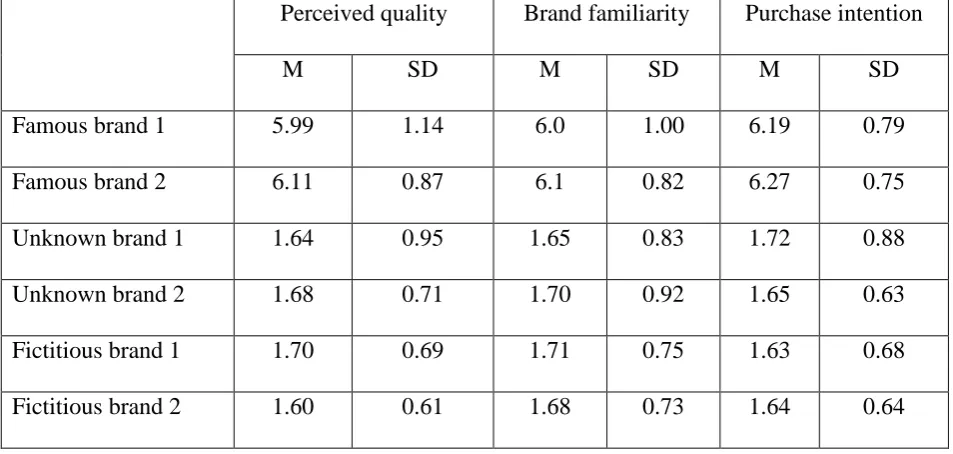
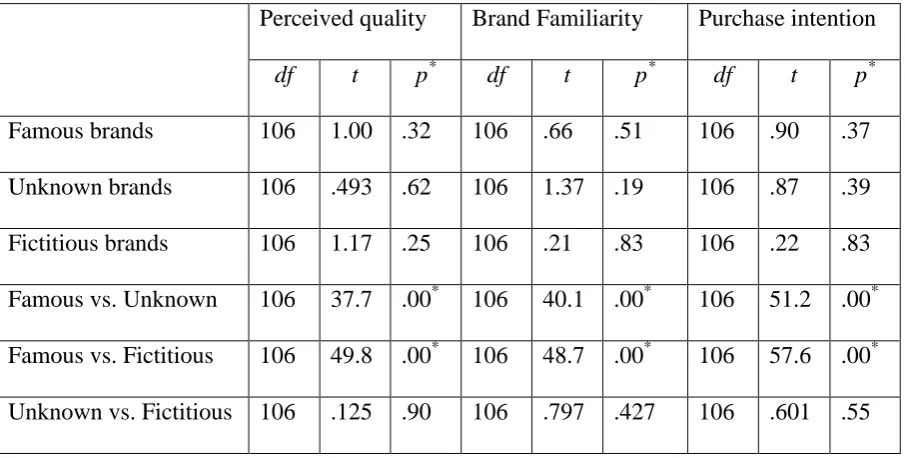
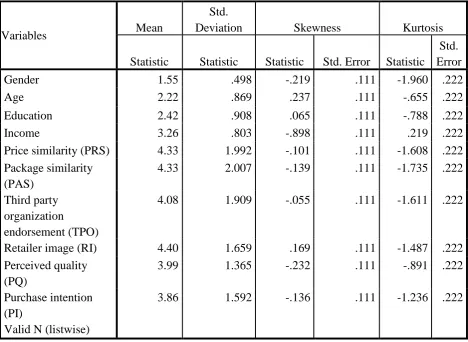
Table 2.1 Review of Empirical Signaling Research on Consumer Behaviour 31 Table 3.1 Descriptive Data for Pre-test One 112 Table 3.2 T Test Results for Pre-test One 113 Table 4.1 Demographic Profile of the Respondents 124 Table 4.2 Means, Standard Deviations, Skew and Kurtosis for Variables 127
Table 4.3 Descriptive Statistics 134
x
LIST OF FIGURES
Figure 2.1 The Research Model 89
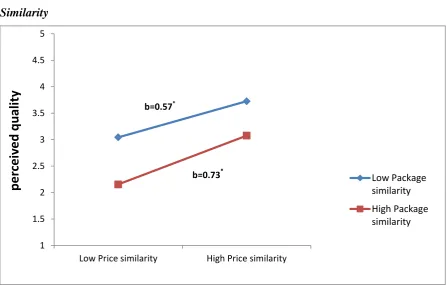
Figure 4.1 Effect of Price Similarity on Perceived Unknown Brands Quality: By
Package Similarity 151
xi
TABLE OF CONTENTS
DECLARATION... ii
AUTHORITY OF ACCESS... iii
STATEMENT OF ETHICAL CONDUCT ... iv
ABSTRACT ... v
ACKNOWLEDGMENTS ... vii
LIST OF TABLES ... ix
LIST OF FIGURES ... x
CHAPTER 1: INTRODUCTION 1 1.1 CHAPTER OVERVIEW ... 1
1.2 UNKNOWN BRANDS IN WORLDWIDE ... 1
1.3 THE ISSUES OF UNKNOWN BRANDS IN CHINA ... 6
1.4 CHINA’S ECONOMIC AND MARKET CONDITION ... 7
1.5 THE IMPORTANCE OF BRANDING FOR CHINA’S SMEs ... 9
1.6 THE CHALLENGES OF SMEs BRANDING IN CHINA ... 10
1.7 THE CURRENT SITUATIONS OF CHINA’S BRANDS ... 14
CHAPTER 2: LITERATURE REVIEW AND HYPOTHESIS DEVELOPMENT ... 20
2.1 CHAPTER OVERVIEW ... 20
2.2 THEORETICAL FOUNDATIONS FOR CONSUMERS BEHAVIORAL INTENTION OF UNKNOWN BRANDS PURCHASE ... 21
2.2.1 Introduction ... 21
2.2.2 Major Perspectives of Consumer Purchase Decision Making ... 21
2.2.3 Signaling Theory ... 26
xii
2.3 MAJOR ANTECEDENTS TO CONSUMERS PURCHASE DECISION MAKING OF
UNKNOWN BRANDS... 53
2.3.1 Price Similarity ... 53
2.3.2 Package Similarity ... 60
2.3.3 Third-Party Organisation Endorsement ... 70
2.3.4 Retailer Image ... 75
2.4 THE CONCEPTUAL FRAMEWORK OF CONSUMERS UNKNOWN BRANDS PURCHASE DECISION MAKING ... 79
2.4.1. Stimulus-Organism-Response theory ... 79
2.4.2 Stimulus: Product Attributes ... 81
2.4.3 Organism (cognitive states): Perceived Quality ... 82
2.4.4 Responses: Purchase Intentions ... 84
2.5 CHAPTER SUMMARY ... 90
CHAPTER 3: METHODOLOGY ... 92
3.1 CHAPTER OVERVIEW ... 92
3.2 RESEARCH METHODS ... 92
3.3 SAMPLE POPULATION ... 95
3.4 DATA COLLECTION ... 97
3.5 QUESTIONNAIRE DEVELOPMENT ... 101
3.6 MEASURES ... 103
3.7 INSTRUMENT VALIDITY AND RELIABILITY ... 106
3.8 COMMON METHOD BIAS ... 107
3.9 DATA ANALYSIS TECHNIQUES: CONJOINT ANALYSIS-FACTORIAL DESIGN ... 109
3.9.1 Pre-tests ... 110
3.9.2 Main Study ... 115
3.10 CHAPTER SUMMARY ... 119
xiii
4.1 INTRODUCTION ... 120
4.2 PRE-ANALYSIS DATA SCREENING AND CLEANING ... 121
4.3 SAMPLE DESCRIPTION ... 123
4.4 PRELIMINARY DATA ANALYSIS ... 124
4.4.1 Overview of Preliminary Data Analysis ... 124
4.4.2 Preliminary Analysis Step One: Exploratory Analysis ... 127
4.4.3 Results of Exploratory Analysis ... 130
4.4.4 Preliminary Analysis Step Two: Confirmatory Analysis ... 136
4.4.5 Results of Confirmatory Analysis ... 138
4.5 CONVERGENT VALIDITY ... 141
4.6 DISCRIMINANT VALIDITY ... 142
4.7 COMMON METHOD BIAS ... 144
4.8 HYPOTHESIS TESTING ... 145
4.9 TEST FOR MEDIATION ... 156
4.10 CHAPTER SUMMARY ... 159
CHAPTER 5: DISCUSSIONS AND FUTURE RESEARCH ... 160
5.1 CHAPTER OVERVIEW ... 160
5.2 PRICE SIMILARITY ... 161
5.3 PACKAGE SIMILARITY ... 165
5.4 RETAILER IMAGE ... 168
5.5 TPO ENDORSEMENT... 170
5.6 THE INTERACTION EFFECT ... 171
5.7 LIMITATIONS AND FUTURE RESEARCH ... 172
APPENDICES ... 219
APPENDIX A ... 219
APPENDIX B ... 226
xiv
1 CHAPTER 1: INTRODUCTION
1.1CHAPTER OVERVIEW
This chapter provides the definition of unknown brands, discusses the current problem of unknown brands in the context of China’s fast-developing market, and the significance of studying unknown brands. This chapter is structured into three main parts. Firstly, it is necessary to present the current situations of unknown brands in the global market, which leads to an overview of the practical context of the research. The second part will be devoted to unknown brands and the consumer behaviour characteristics in China which helps to understand the background of the study. Then the relevance and significance of studying unknown brands consumption in China will be discussed.
1.2UNKNOWN BRANDS IN WORLDWIDE
2 prices were possible by virtue of the reduced costs of packaging and promotion (Prendergast & Marr, 1997). Product quality of generic brands was considered inferior to that of manufacturers’ brands. In a sense, generic brands were a second private brand- an additional level of a private brand (Herstein & Sigal, 2007). The concept behind marketing generic brands was to compete against manufacturers’ brands in the belief that some consumers had become sceptical about the link between quality and manufacturers’ brands, and that these consumers would be willing to purchase generic brands at a lower price, especially during economically hard times.
Generic brands were first marketed in the USA in 1977 by the Jewel supermarket chain of Chicago. This chain began with 44 no-name brands. The demand for generic brands was so impressive that the chain increased the number of generic brands to 100 (Fitzell, 1998). By 1979, generic brand marketing had penetrated most Western countries and had reached Canada, Australia and Japan (McGoldrick, 1981). In practice, the actions of distributors in marketing generic brands induced many consumers to substitute their regular private brand by a generic one. Research conducted by SAMI (Selling Areas-Marketing, 1983) shows that in 1982 generic brands attained a significant portion of the market by encroaching on the market share of private brands, without diminishing the market share of national brands.
3 not compete with the established national brands. Nevertheless, during the mid-1990s generics reappeared in stores. According to de Chernatony and McDonald (1998), the reason for their re-introduction may have been a response to the aggressive marketing of discount stores.
4 been well-studied in the previous marketing and branding literature in the recent years (Robert et al., 2010, Dany et al., 2013, Wu et al., 2011, Beneke et al., 2012, Jin & Yong, 2005) while the other two types had received little attention. The latter refers to those products produced by SME or large corporation and sold with brand names consumers are not familiar with. Nevertheless, regardless of the origin of the brands, from the perspective of the consumers, there is one thing in common: the lack of consumers’ recognition of brand names. Therefore, in order to avoid the controversial definition of brands with such features, brands with such features are defined in a more accurate and precise way as “unknown brands”. For the purpose of this study, the boundary of “unknown brands” includes both non-staple products and labelled products with brand names consumers cannot recognise or are not familiar with.
5 (OCED, 2010, OECD, 2004, Oviatt & McDougall, 1994) and have contributed more than 35% of exports from Asia and more than 25% of exports from the rest of the world (Ausland & Johnson, 2004). In some countries such as China, India, South Korea and Italy, these companies account for over 60% of total national exports (Ausland & Johnson, 2004). Despite their importance to international business, very little research has focused on either unknown-brand-producing companies or SMEs in general. The non-brand issue restricts these companies to the bottom of the value chain to either produce low-end products and sell them at a cheap price or become a pure manufacturer for large corporations, which is particularly the case in China (Martin, 2006). From time to time, the low value margin limits the finance of these companies and defeats the faith of entrepreneurs on the growth of their business. Given these companies usually suffer from limited finance and cannot afford massive advertising campaign to build strong brand identity, the question lies on how these unknown-brands-producing companies can find another way to survive in the regional, national and world market and make their brands and products stand out among the peers.
6 are left in an uncomfortable position of not knowing what to do in order to manage their marketing mix as well as enhancing their market share. Due to this, a study on how consumers perceive and behave to products with unknown brands is needed and will have great significance within marketing theory and to those unknown-brand-producing companies for their future products marketing and long term brand development.
1.3THE ISSUES OF UNKNOWN BRANDS IN CHINA
7 1.4CHINA’S ECONOMIC AND MARKET CONDITION
For Chinese enterprises, development of the brand is a complicated matter because economic change took place very quickly, even though there were some positive factors that help Chinese companies to grow in recent years. China has one of the fastest growing economies in the world (IMF, 2013a). Added to this is the fast growing middle class of about 200 million customers who will increasingly be able to and willing to pay higher prices to own their favourite branded goods (Yuval et al., 2012). To make market conditions even more conducive for enterprises, the Chinese government has been allowing private companies in an increasing number of different industry sectors. The changing environment has provided many positive factors to Chinese companies, but there are a lot of inherent challenges that Chinese companies have to overcome before becoming noted brands. Indeed, Chinese companies need to quickly understand the essence of a brand before being left out of the competitive market.
8 Chinese of the total 1.2 billion are moving up the pyramid into middle class and have the resources to indulge in consumer products (Yuval et al., 2012). There is a huge divide between the haves and the have-nots. Cities such as Beijing and Shanghai have become the clusters for the new affluent class and many of the interior cities and towns are still predominantly rural (N.B.S.C., 2013). Given this huge disparity, it is only natural that companies are still grappling with their strategies for the Chinese market. The evolution and current situation of China’s economy show without doubt the unique characteristics of this emerging market. In this context, to attract Chinese consumers, Small-to- Medium sized companies in China must have a thorough understanding of their ways of thinking, their values and decision-making levers to make the smart and accurate marketing decisions.
9 consumers decision making, may significantly contribute to not only the extension of marketing theories but also the implications to business practitioners.
1.5THE IMPORTANCE OF BRANDING FOR CHINA’S SMEs
The statistics on China’s recent economic development provide substantial reason for such tremendous interest by the global media and companies in China (Gao et al., 2006). Even though these numbers paint a very vibrant, strong and thriving picture of the Chinese economy, one very crucial aspect of capitalistic economies is very conspicuous by its absence – Chinese brands. Much of the current Chinese success can be attributed to the low cost that Chinese companies have managed to achieve over the years. Further, the sheer size of the market also has allowed Chinese companies to grow substantially (Gao et al., 2003). But with the liberalization of the Chinese economy, the impending global competitors in China pose very grave challenges to such growth. Building strong brands that can offer companies real differentiation seems to be the only source of long term competitive advantage.
10 have limited branding to a day to day tactical capacity (Yuval et al., 2012) . Branding incorporates the strategic elements of the customer touch points to ensure that the brand promises are consistently delivered to all internal and external stakeholders. In this way, building a brand that has characteristics favoured by consumers can be considered a viable way of branding for SME’s who cannot afford massive spending on advertisement.
Furthermore, given the inflow of foreign competition into the Chinese market and the erosion of low cost as a comparative advantage for Chinese companies, companies are forced to innovate constantly to differentiate their offerings in the market place (Roll, 2008). Moreover, given the empowerment of customers, companies are on a constant lookout for strategies that could help them ensure customer loyalty. For these and many other strategic reasons, branding has become a necessity for Chinese companies. Some of the more important strategic reasons for branding are discussed below.
1.6THE CHALLENGES OF SMEs BRANDING IN CHINA
11 From the perspective of entrepreneurs, the trading mindset had been a key factor that limits the brand creation of the Chinese companies. China has long been under the dominant trading mindset, where business have been overly concerned with transaction, sales and turnovers (Kshetri, 2007). This meant that companies usually focused on building tangible assets like factories, assembly plants, R&D labs and so on. This also suggested that the focus of the company was more on immediate tangible gains rather than long term intangible gains. All these factors have combined in making marketing and branding not so important for Chinese businesses. This mindset has not allowed the companies to make any substantial investments in brand building, neither strategically or financially. With the low cost that Chinese companies were exploiting till very recently, it seemed that branding was not so important because branding is a long term organization wide exercise that may not yield tangible and immediate benefits (Roll, 2008). Further, top class brand management practices demand substantial allocation of managerial, financial and human resources over fairly long periods of time. This route directly contradicts the traditional mindset of Chinese businessmen (Kshetri, 2007, Wu & Wu, 2008, Yang & Li, 2008). But as the Chinese economy is evolving and as more and more global companies are making their marks in such diverse industries as consumer electronics, fashion, fast food, and even cosmetics. Chinese companies are gradually realizing the importance of having a strategic outlook and investing in building brands rather than factories. But this is just a beginning and this dominant mindset which has dictated business practices for centuries cannot be easily overlooked and it will indeed be an arduous task for Chinese companies to evolve with the times and adapt brand management practices.
12 empires based on constant innovation and creativity. Although innovation is difficult to measure, R&D spending as a ratio of gross domestic product (GDP) can be an indication. On a national level, Asian economies used to lag behind the rest of the world on R&D spending as a ratio of GDP from 1987 to 1997, with the exception of Japan and South Korea. However this trend has changed dramatically in the last decade. In 2011, the combination of East/Southeast and South Asia (including China, Taiwan, Japan, India, South Korea) accounted for 34% ($492 billion) of worldwide R&D. In the meantime, China continues to exhibit the world’s dramatic R&D growth pattern since 2007 and the pace of growth over the past 10 years in China’s overall R&D remains exceptionally high at 20.7% annually (U.N.E.S.C.O., 2013). For Chinese companies to reach the next level of building really resonating brands, one of the first steps is to develop a mindset of creating something novel rather than adopting ideas from the western world to local customers.
13 holistic level and for the individual companies that have to combat this problem on a daily level.
Till very recently, most of the Chinese companies were protected and financially supported by the government (Chunyun, 2003, Atherton & Smallbone, 2010). As not many sectors were open to foreign competition, Chinese companies did not face any sort of urgency to improve their productivity and enhance their competitive advantage. Most of the companies had favourable access to resources which offered them a greater advantage than the non-Chinese companies. But with the opening up of the Chinese economy, market conditions gradually changed. Even though the favourable treatment continues to a certain extent, most of the industry sectors have become highly competitive. Chinese companies were forced to improve their productivity and build sustainable competitive advantage that would allow them to survive and thrive in the competitive market (Williamson & Zeng, 2004). This sudden shift in the market structure and the business conditions pose a huge challenge to Chinese companies. To adjust to the changing competitive spectrum and also to update business practices and culture simultaneously would be a long drawn process.
14 long time, the changing times is forcing them to realise the critical importance of branding in allowing their companies to successfully compete in the global markets.
1.7THE CURRENT SITUATIONS OF CHINA’S BRANDS
15 In western markets, copycat brands normally face legal issues and public condemnations. However, in China, consumers may respond to certain copycat brands in a different way. A common understanding is that many Chinese consumers may feel a sense of pride when they see a cheap copy of a western brand (Lung-Kee, 2002). They believe it reflects well on the ingenuity and resourcefulness of the Chinese people. Purchasing some copycat brand that looks like the real brand but with more features and at half the price sounds like a good deal to consumers in China. Under this mindset, the “Shanzhai” are respected more than they are reviled. A number of Chinese SMEs are very clever at mimicking more successful brands, they know they do not need to actually copy an actual product in order to benefit at the expense of other famous brands. Most of the time, all they need to do is leveraging their brand equity by mimicking the famous brands. It is interesting because this is an issue that many Chinese companies (especially SMEs) seeking to build their unique brand equity are struggling to deal with (Luo et al., 2011). Without an initial familiarity with the brand and what it stands for most, consumers may look askance at the unfamiliar brands. Even when the products appear to provide them the features that they need, they will be concerned about the product quality and reliability. Although with the increasing product quality for Chinese products, this is now a much less of a concern, in the absence of brand name recognition, the products must find ways to communicate with customers and speak for themselves.
16 steps of the successful ones is something considered normal (Kennedy, 2002). In the mind of traditional Chinese, copying the best means they are as good as the best and if a company can produce bag as LV, they are just as good as LV. The culture influence on the behaviour of Chinese people is significant (Cai & Shannon, 2012, Elman, 1991, Shek, 2004, WangDoss et al., 2010). The best example would be calligraphy. Traditionally, the study of calligraphy was (and still is) based on copying master pieces from reputed calligraphers, thus learning them by copying strictly, continuously, until the move of the hand becomes instinctive, routinely, and the copy perfect. Any deviation or personal deformations from the model were seen as a failure of the student, and so, dismissed. The entrepreneurs were educated in such a teaching system which remains the same as it is now: creativity is not welcomed, and “copy and reproduce” is the proper way to pass all the tests, especially the National University Examination (also known as GaoKao). So when they finish all their studies, it is not unusual this mindset gets stuck and makes them lose their creativity and talent in doing business in the real world. There are also some economic reasons. For example, by copying actual brands, they skimp on R&D costs, and sell the product to a population which cannot really differentiate between a BlackBerry and a BlockBerry, as it looks the same, thus concerning a big part of the huge Chinese Market.
17 legendary US basketball star who has a massive fan base in the country- despite the fact that Qiaodan is also the name used in China by Nike for its range of “Air Jordan” shoes and apparel. In developed markets, using a logo similar to somebody else’s registered one is enough to get the brand into deep trouble, but clearly, this was not the case in mainland China. Another similar example relates to Chinese Lifestyle Food & Beverages, a company which sells snacks under the “Crayon Shin-Chan” brand, raising just under US $100m in an initial public offering in Hong Kong (Yvonne, 2011). Crayon Shin-Chan is a well-known Japanese cartoon character which became popular in China during the 1990s when it was dubbed and shown on television. Chinese Lifestyle F& B acknowledges that it has not received permission from the Japanese publishing house that owns the character to make money from it but stated confidently in its prospectus that it didn’t expect to get into trouble. Official “Crayon Shin-Chan” products endorsed by the Japanese publishing house display the Chinese characters “Labixiaoxin” horizontally, whereas the Chinese snack maker displayed the characters vertically (Yvonne, 2011). Although both Qiaodan and Chinese Lifestyle F & B are successful examples of China’s SME standing out in the ultra-competitive market, they raised two main issues. Firstly, the copyright in one of the world’s most important consumer market is still murky. Second, stealing, copying and mimicking are still the main strategy for China’s SME to survive and grow, even for successful ones.
18 of unknown brands versus known brands in China. How should China’s firm embrace marketing, especially the branding of unknown brands, have not yet been fully studied. This research contributes to the international marketing and brand development by demonstrating that consumers rely on unique product attributes when determining product quality of unknown brands and based on this, make purchase decisions.
19 intention associated with unknown brand purchasing need to be investigated from the consumer standpoint, to better understand consumers’ perception of unknown brands and further assist marketers effectively allocate their resources to achieve optimum marketing strategies. Furthermore, while the phenomenal rise of unknown brands in developing countries is well documented, the academic literature investigating consumer behaviour in these countries is relatively underdeveloped and dominated by western perspectives utilizing samples based on mature western markets, such as U.S. (Field et al., 2012) and Europe (Norberg et al., 2011), yielding findings that would otherwise not be generalizable in the context of emerging economies such as China, in which the business environment for unknown brands shopping may be constrained by different set of cultural factors (Hofstede, 1980). Since there is limited understanding on consumers unknown brands purchasing in China, more insightful investigation is imperative in explaining consumers perceptions towards unknown brands and how perceptions eventually drives the purchase behaviour. Therefore, the research question in this thesis is mainly around what are the factors that drive consumers positive perceptions towards unknown brands and subsequently influence consumers’ intention to purchase unknown brands.
20 CHAPTER 2: LITERATURE REVIEW AND HYPOTHESIS DEVELOPMENT
2.1 CHAPTER OVERVIEW
21 2.2 THEORETICAL FOUNDATIONS FOR CONSUMERS BEHAVIOURAL
INTENTION OF UNKNOWN BRANDS PURCHASE
2.2.1 Introduction
Although the topic of branding has been well-studied in the past 20 years, the attention on unknown brands remains frustratingly scant. Understanding how consumers respond to unknown brands and the flow of consumer decision making are critical for the branding of unknown brands. Within the literature, the process of consumers decision making is believed to be very complicated involving a number of different constructs which also vary in different shopping contexts. In order to understand consumers’ decision making of unknown brands, several perspectives within consumer behaviour literature are considered in this study.
2.2.2 Major Perspectives of Consumer Purchase Decision Making
23 not to evaluate the relations between attitudes, beliefs and the environment but to fulfil a desire and to obtain pleasure in life.
24 when consumers’ involvement is low. The theory can also be extended to explain the behaviour of high-involved consumers from the perspective of information processing framework.
From the information processing perspective, cues can be regarded as “pieces of information” while a product can be conceived as an array of cues. When consumers are highly involved in the decision making, they can be expected to engage in a more extensive internal and external information search for the purpose of reducing the risk of making a “wrong” choice. Thus, such a consumer will have a high degree of cognitive activity and will make strong efforts in conducting evaluations and comparisons of products before reaching a reasoned decision. The information processing framework also regards perceived quality as a less abstract concept than attitude (Grunert, 1996). Hence, perceived quality should be expected to precede attitude formation which in turn should be expected to precede buying intention in the consumer decision-making process (Hansen, 2005).
From an emotional perspective, although consumers do not make compensatory or non-compensatory types of cognitive evaluations when considering purchasing a product, cues still play significant roles in the appraisal process as antecedents of affective responses which could result in conation (intention) and subsequently lead to action (Bagozzi et al., 1999).
25 consumer may banish a product from his evoke set because he believes the “made in” label of the product reflects its inferior quality. Or a consumer simply may like a product because it elicits positive emotions when the consumer looks at it (emotional perspective). Such a positive emotion may affect the consumers’ purchase behavioural intention directly which could subsequently lead to purchase action (Kotler, 1974, Babin & Darden, 1996). Another consumer might assess trade-offs from a value perspective for a number of product alternatives and then use these trade-offs as input to a product comparison procedure (information processing perspective). Regardless of which perspective on consumer decision making is adopted, it is obvious that cue utilization plays a critical role across all the various decision making processes. The consumers rely on cue utilization to determine the perceived quality of product and reduce the uncertainty of valuation. The cues are interpreted as pieces of information in the information process perspective. The emotion is driven by cognitive evaluation which is also based on the evaluation of cues and environmental stimuli. Therefore, cue utilisation theory is considered as a very important theoretical foundation for the exploration of consumer decision making process of unknown brands.
26 decision making under the context of unknown brands shopping, but consumer research may benefit from an integration of multiple perspectives. Following such considerations, the thesis proposes a conceptual framework for understanding and integrating aspects of various perspectives on consumers’ decision making of unknown brand purchasing. Based on this purpose, this chapter will review relevant consumer decision making theories in regards to unknown brands, and then propose an integrated model explaining consumers purchase decision making of unknown brands driven by cognitions and affections.
2.2.3 Signaling Theory
Signaling theory pertains to a number of theoretical works investigating communications between individuals or organizations where information is conveyed by transmitting the visible, audible or other detectable signals or cues (Spence, 1973). The theory is particular useful in explaining behaviours when two individuals or organizations have access to different amounts of information. Typically, the party who sends out information must decide the issue of whether or how to communicate their side of information through a signal while the party who receives information must decide how to interpret this signal.
27 As a result, signaling theory also possesses a distinguishable position in a wide range of management literatures (Certo, 2003, Turban & Greening, 1997), including marketing, consumer behaviour, strategic management, organizational behaviour, human resource management and entrepreneurship (Boulding & Kirmani, 1993, Kirmani, 1997, Kirmani & Rao, 2000) as a framework for understanding how two parties (e.g., buyer and seller) address limited or hidden information in precontractual (prepurchase) contexts.
Although the implementation of signaling theory has gained significant attention recently, it has been applied mainly to resolve the concerns of organizations instead of being explored at the level of individual consumers. The review of signaling theory will provide a concise synthesis of the theory and its key concepts and findings, review its extensive use in the management literature and extend the theory into the context of unknown brands purchase.
The applications of signaling theory
28 workers’ productivity, signaling theory took an unique view by focusing on education as ways of communicating those desirable characteristics of the candidates that were hard to observe otherwise (Weiss, 1995). The signaling function was further illustrated by many subsequent studies. Kirmani and Rao (2000) explained the basic signaling model vividly by using a general example regarding high quality and low quality firms. In their example, both firms know very well about their true quality and performance but the investors and customers do not, therefore, an asymmetry of information exists between the insiders and outsiders. As such, both firms have the opportunity to signal or conceal their true quality to the investors and customers. If high quality firms receive payoff A when they signal and pay off B when they don’t, low quality firms receive payoff C when they signal and payoff D when they don’t, signaling represents higher payoffs and appears to be a viable strategies when A is great than B and D is greater than C. Under such circumstance, high quality firms are motivated to signal their true quality but low quality firms are not, which results in separate equilibrium. In such a situation, the investors and customers are able to distinguish the high and low quality firms easily and accurately. In contrast, when both firms benefit from signaling, then a pooling equilibrium presents and consumers will not be able to distinguish between the high and low quality firms (Cadsby et al., 1990).
29 1) information asymmetry presents at the pre-contractual stage and 2) the source of signal has high credibility. In other words, if the consumers do not trust the source where signals come from, it is unlikely that the signal will convey positive information to consumers and persuade them to have positive evaluations of the quality of the products. Compared to broader theories such as agency theory, signaling theory only address pre-contractual information problems (Bergen et al., 1992) and is more specific about qualifying conditions. Compared to the more narrow theories such as source credibility theory, signaling theory explains the nature of the signals and the information asymmetries.
30 when 1) extrinsic signals are more readily available to consumers compared to intrinsic signals; 2) extrinsic signals are more commonly accepted and are more easily understood (Dawar & Parker, 1994, Zeithaml, 1988); 3) consumers have limited time to make decision to purchase (Zeithaml, 1988); and 4) consumers have a lower need for cognition and are less apt to engage in elaborative thinking (Chatterjee et al., 2002).
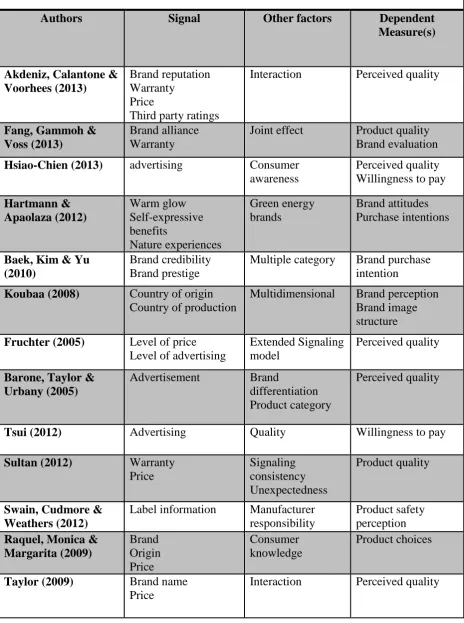
31 review of product attributes used as signals to study consumer behaviour is listed in Table 2.1.
Table 2.1. Review of Empirical Signaling Research on Consumer Behaviour
Authors Signal Other factors Dependent
Measure(s)
Akdeniz, Calantone & Voorhees (2013)
Brand reputation Warranty
Price
Third party ratings
Interaction Perceived quality
Fang, Gammoh & Voss (2013)
Brand alliance Warranty
Joint effect Product quality Brand evaluation Hsiao-Chien (2013) advertising Consumer
awareness
Perceived quality Willingness to pay Hartmann & Apaolaza (2012) Warm glow Self-expressive benefits Nature experiences Green energy brands Brand attitudes Purchase intentions
Baek, Kim & Yu (2010)
Brand credibility Brand prestige
Multiple category Brand purchase intention Koubaa (2008) Country of origin
Country of production
Multidimensional Brand perception Brand image structure Fruchter (2005) Level of price
Level of advertising
Extended Signaling model
Perceived quality
Barone, Taylor & Urbany (2005)
Advertisement Brand
differentiation Product category
Perceived quality
Tsui (2012) Advertising Quality Willingness to pay
Sultan (2012) Warranty Price
Signaling consistency Unexpectedness
Product quality
Swain, Cudmore & Weathers (2012)
Label information Manufacturer responsibility
Product safety perception Raquel, Monica &
Margarita (2009) Brand Origin Price Consumer knowledge Product choices
Taylor (2009) Brand name Price
32 Asymmetries of Information
Signaling theory focuses on resolving the issue of information asymmetry. The decision making processes of individuals, private and public organizations are affected by various available information. The information that individuals rely on for making decisions could be public information which is freely available to the public, or private information which is only available to specific small group of the public. The asymmetries of information will occur when different parties possess different information or put simply, different people know different things (Stiglitz, 2002). Because some information is private, those who possess that information can choose to withhold the information from other parties and therefore they could potentially make better decisions than those who don’t have access to the information. For more than a hundred years, classical economic theories were developed solely on the assumption that information was perfect between parties while such asymmetries of information were largely ignored (Stiglitz, 2002). In order to address this major drawback in the classical economic theories, much research has been devoted to understanding how people’s and organization’s decision making processes are affected by the imperfect information in the market place (Hadar & Fox, 2009).
33 (Elitzur & Gavious, 2003).
34 package, etc. Based on signaling theory, a higher price signal may convey quality information such as “higher durability, higher reliability” while low price signal may send the opposite information to consumers.
35 process in the post-purchase stage, consumers are able to determine whether or not they have purchased a high-quality product. Credence goods refer to a good or services whose utility impact is difficult for consumer to ascertain either at the prepurchase stage or the post-purchase stage, due to consumers’ lack of specialised knowledge (Darby & Karni, 1973). Consumers experience high levels of pre-purchase information scarcity and are unable to conduct information clarity at the post purchase stage; therefore credence goods represent the highest level of information asymmetry in the market place.
The level of prepurchase information scarcity and post-purchase information clarity determines the qualifying conditions for the implementation of signaling theory. While intrinsic product attributes are unavailable to consumers, the need for extrinsic signals is desired to determine the quality of the product. The ability to evaluate product attributes after purchase enables consumers to determine whether or not the signals conveyed accurate product quality. Therefore, the signaling theory is highly applicable to experience goods which are often characterised by the combination of high prepurchase scarcity and high post-purchase information clarity rather than on search or credence goods which do not have such features.
Signaling credibility
36 situation, buyers also cannot trust the reports provided by the owners who have the motivation to lie in order to sell their “lemons” at a higher price. Therefore, the imperfect information between sellers and buyers has caused negative consequence in the market. The buyers have concerns about the quality of the cars and therefore offer a price for quality cars that is lower than the sellers’ expectation. After seeing this price, the seller of the “lemons” finds great incentives in concealing the flaws of their cars to sell their cars at more than their worth and at the same time, the owners of the real quality used cars are reluctant to sell their cars in such a market causing the average quality of cars in the market to fall. Overtime, the market is gradually occupied by “lemons” while the real quality cars are driven out (Akerlof, 1970). For the owners of real quality cars who try to make a sale, one viable way to address this issue, as suggested by (Spence, 1973), is that the seller looks for a reliable signal to convey his private information on the quality of the car to those who seek high quality cars in the market and have the intention to pay premium price for them.
Such signals could come in various forms, for instance, warranties. If the owner knows that their car is in good condition, they could offer a solid warranty to cover any potential cost of repair if the car mechanically failed in a certain period of time. In such cases, the owners of the inferior quality cars will find it too costly to imitate such a strategy and offer a similar warranty to their potential buyers therefore they may simply withdraw from the market and leave the opportunities to the owners of high quality cars. As a result, a warranty will become a credible signal to bring a premium price for the sellers in the market.
37 Ippolito, 1990). Just as previously discussed, warranty is a typical example of a credible signal. In the event that a seller sells low-quality product with a warranty, the seller will be liable for the cost of repair or replacement when the warranty claims are made by the buyers. On the other hand, a seller selling high-quality product does not need to worry about such cost because the number of warranty claims will be low. Signaling credibility is a key theoretical condition for a signal to be an effective mechanism for conveying high product quality. Signaling credibility is often described as bond credibility where bond refers to either the tangible and intangible asset that will be forfeited in the event that a false signal is sent by the sellers or it can be described as the form of insurance to the buyer that the seller will sell high quality products. High signal or bond credibility occurs where the seller is believed to have made significant investment by sending a high quality signal and that the investment will be at risk in the event that a false signal is sent. Accordingly, a false signal becomes very expensive for the “lemon” sellers to send. From the perspective of information economy (Boulding & Kirmani, 1993), such a distinction will create a separating equilibrium where only sellers of high quality products are able to afford to send credible signals conveying high quality, enabling buyers to distinguish between buyers who sell high quality or low quality products. Conversely, if the gains of sending a false signal outweigh the cost of doing so, then a pooling equilibrium will occur (Bergen et al., 1992).
38 subject to loss of reputation, customer retention and word of mouth if the meal is not of great taste and high quality. Consumers may believe that a restaurant in a busy, downtown area, or a small community area may be penalised for selling poor quality meal because the business relies on repeat customers and word of mouth, but consumers are unlikely to believe that a roadside restaurant on a highway is too concerned with reputation and repeat customers and therefore their investment will be less vulnerable if a false signal is sent. For the latter case, a roadside restaurant near a highway may have low signal credibility and therefore customers will not assume the signal as an indication of high quality (Boulding & Kirmani, 1993). As such it is appropriate to use signaling theory to explain the situation in which the consumer feels that the vendor has invested substantially to send a high quality signal and that the risk of the investment increases if the signal is wrong
Signaling Outcomes
Signaling theory has been applied extensively across multiple disciplines to understand how a transaction or exchange can be completed by providing the necessary trade information through the transformation of the quality signals from the more knowledgeable party to the less-informed party.
39 Within the literature of consumer behaviour, the majority of the studies focus on perceived quality of product or services as a key outcome with some research also dedicated to addressing the reduction of uncertainty (Moraga-González, 2000), the quality of brand or organization (Tsui, 2012) and the intention to purchase (Wells et al., 2011).
In spite of the fact that the perceived quality dimension is incorporated in most of the signaling models as the distinguishing characteristic, the understanding of quality can be interpreted in various ways. In some research, quality refers to the unobservable ability of individual, for example being signalled by completion of the educational requirements necessary for acquiring a degree (Spence, 1973). Some others believe quality as the unobservable ability of organizations to make profit and provide high investment return for shareholders in the future. In this study, quality refers to the underlying, unobservable characteristics of the products to fulfil the needs or demands of a potential buyer observing the signal. Table 2.1 has listed the qualifying conditions and attributes of the key constructs in signaling theory along with examples. In the following section, the signaling process will be reviewed in the form of a time line to reveal how information asymmetry is resolved through such a process.
Signaller, signal, receiver and feedback
40 highlighted the relationship between information asymmetry and signaling theory. In this section, a review of primary components of signaling theory is presented following the time line approach adopted by Connelly et al. (2011). The signaling timeline includes three primary actors: the signaller, receiver as well as the signal itself and each of these elements will be discussed under the context of management and consumer behaviour.
The literature regarding signaling theory refers to the signallers as the insiders who obtain private information about individuals, organizations or products that is not available to the outsiders (Spence, 1973, Kirmani & Rao, 2000, Connelly et al., 2011). Generally speaking, the insiders hold some information that could be positive or negative that the outsiders may find important and useful in making a decision. Such information could include various things such as the specific details or functional features of certain products or services, the early stage of R&D test results of an unlaunched product or preliminary sales results regarding product sales performance reported by the test market. In short, private information enables the insiders to gain a privileged perspective regarding the underlying quality of some aspects of the individual, products or organizations.
41 Applying the definition of signaller in the context of consumer goods shopping, the signaller may mostly refer to producers, retailers or manufacturers, those who hold insider information on certain aspects of the product. The information could be both positive and negative in regards to the assessment of their product quality. The possession of this insider information makes producers have a clearer understanding of the underlying quality and value of the products they produce and supply. In other words, the signallers may understand clearly how much their products are worth but the consumers do not. This information also assists producers in having an advantageous position in the market and dishonest signallers may use this information to hide negative product information and charge buyers at a price more than their product actually worth.
42 In order to create efficacious signals, the observability of the signal is necessary but not sufficient. In the theory of costly signalling, BliegeBird et al. (2005) has suggested that signaling cost is a central dimension within the signaling framework. In reality, some signallers are in a better position to absorb the associated signaling cost than others. The costs associated with obtaining authority endorsed quality guarantees (such as ISO9000) are high because the certification process is complex and time consuming which makes cheating and dishonest signaling very difficult. However, the certification process is less costly for the high-quality manufacturers than the low-quality manufacturers because the former only need to make very limited adjustment to their products to meet the certification standards. If the signaller does not have the underlying quality associated with the signal but believes the benefits of signaling exceed the cost of producing a signal, they may be motivated to produce false signal. In such a case, the misleading signals will be flooding into the market until the receivers learn to ignore them.
Drawing from the literature, signals as either “strong” or “weak” based on some aspects of the signal (Gulati & Higgins, 2003). The strong signals are more readily detected by the receivers than the weak signals are. Such classification more or less overlaps with the studies of signal observability. Therefore, Ramaswami et al. (2010) draw a theoretical distinction between the “strength” and the “visibility” of the signals. According to the conceptualization of these two important signal dimensions, “strength” refers to the importance and the salience of the signal for the signaller that is different from “visibility” which related to the defect of the signal to the receivers.
43 the discrepancy between signal and signaller will create ineffective signalling which is described as “lack of signal fit” (Busenitz et al., 2005, Zhang & Wiersema, 2009). The level of the signal fit is determined by the extent to which the signal is correlated with the unobservable quality. Secondly, the signalling effectiveness can be enhanced by increasing the number of signals within a period of time which is described as signal frequency (Janney & Folta, 2003). Davila et al. (2003) suggest that signals are just essentially snapshots of the unobservable quality in a particular place at a particular time. While the business environment is dynamic and information obtained by the signallers and the receivers are constantly changing, the signallers need to signal repetitively in order to keep reducing the asymmetry of information and keep themselves differentiated in the competitive market (Janney & Folta, 2006, Park & Mezias, 2005). Increasing the frequency of signals can increase the signal effectiveness especially when different types of signals are used to communicate the same message (Balboa & Martí, 2007). Signallers dedicated to increasing signaling frequency should also be aware of the issue of signaling consistency. If the signaling purpose is to send the same message repetitively to consumers, the multiple signals from one source must be consistent otherwise conflicting signals will confuse the customers and reduce the effectiveness of the communication (Chung & Kalnins, 2001, Fischer & Reuber, 2007).
44 this study, the receivers are considered as consumers. Management research has highlighted the importance of receivers for signaling effectiveness. The signaling process will not be effective if the targeted receivers are not looking for the related signal or do not know what they should be looking for. For example, research has found that the young firms’ successfulness of their effort of initial IPO largely depends on whether the investors are attending the IPO market (Gulati & Higgins, 2003). Furthermore, signals with weaker visibility, are different to find by receivers unless they are looking for them (Ilmola & Kuusi, 2006). Once the receivers have identified a signal and successfully make a decision based on the signal, they are more likely to search for similar signals to help with decision making in the future (Cohen & Dean, 2005).
45 Feedback refers to the information sent back from the receivers to the signallers regarding the effectiveness of the signaling process (Gupta et al., 1999). To improve the effectiveness of the signaling process, receivers can send feedback to the signallers in the form of countersignals. The asymmetry of information works in two different directions: receivers desire information from signallers to reduce the information asymmetry so as to make a better decision and the signallers also desire information from the receivers to find out how exactly the signals are interpreted by the receivers and determine which signals are most useful to attract receivers’ attention. The latter direction not only reduces information asymmetry but also can serve as a guideline for signallers to improve their signaling effectiveness in the future (Gulati & Higgins, 2003). As a result, in the similar way that receiver attention can improve signaling process, the signallers’ attention to countersignals can also result in more efficacious signaling. It is suggested that such case is particular evident in the context of iterative or sequential bargaining (Srivastava, 2001).
46 of other receivers) is very important and influential (Branzei et al., 2004). One other factor that could potentially distort the signaling environment refers to the bandwagon effect. Bandwagon effect could occur when the receivers are unsure of how to interpret certain signals based on their own judgments, therefore they may imitate others’ interpretation of the signals as a means of decision making, while such interpretation may not always be accurate (McNamara et al., 2008, Sliwka, 2007). Furthermore, the literature suggests that the behaviour of other signallers is also important because more honest signallers in the market increase the signaling credibility in general while deceptive signallers bring the opposite effect.
Management research has made significant contributions toward interpreting the complex signalling processes that occur between two parties in an environment of asymmetrical information. The implication of signalling theory from multiple disciplines (Smith & Harper, 1995, BliegeBird et al., 2005, Kirmani & Rao, 2000, Riley, 2001) now forms a more complete picture about signalling theory constructs, relationships and processes. However, signalling theory still needs to extend its boundaries to help to explain a broader range of social and organizational phenomena. In this research, the application of signaling theory is extended to the context of understanding how unknown brands can convey positive product quality information to potential customers and therefore improve their sales performance by driving customers’ intention to purchase.
48 2.2.4 Cue Utilisation Theory
50 (Rao & Monroe, 1989, Olson, 1972, Dawar & Parker, 1994, Kirchler et al., 2010), product warranty (Olson, 1977, Rao & Monroe, 1989, Boulding & Kirmani, 1993, Neranartkomol, 2000), product advertisement (Milgrom & Roberts, 1986, Gotlieb & Sarel, 1992, Dahlén et al., 2008), brand name (Olson, 1977, Dawar & Parker, 1994, Ramaseshan & Tsao, 2007, Taylor, 2009), product appearance (Nelson, 1970, Olson, 1977, Dawar & Parker, 1994), and retail reputation (Dawar & Parker, 1994, Cooper & Ross, 1985, Cudmore, 2000). As noted by Dawar and Parker (1994) the relative importance of these signals and cues generally follow their specificity. The more specific a product cue, the more likely it will provide information that is useful in assessing the quality of that product.
51 factor for consumers in judging beer quality was its taste and colour (Szybillo & Jacoby, 1974). Compared to intrinsic cues, extrinsic cues are more general and applicable to a wider range of products. For example, HP sells many computers with different features across different models. The brand name, HP, which is an extrinsic cue, is associated with all the computer models it sells, whereas some specific, intrinsic attributes such as memory size and processing speed are applied only to a particular model. Hence, it is believed that consumers are generally more familiar with extrinsic cues than intrinsic cues, and thus tend to rely more heavily on them when evaluating products. The significant effects of extrinsic cues on product evaluations found in many past studies substantiate such belief (Dodds et al., 1991, Han & Terpstra, 1988).
52 measure. It is easy to measure the price level of the product as high or low, but it is hard to measure the taste of the food or odour of the wine in view of the fact that the perception towards such features varies across different people. Therefore, the intrinsic cues need to be controlled when studying the effects of extrinsic cues.
53 2.3 MAJOR ANTECEDENTS TO CONSUMERS PURCHASE DECISION MAKING
OF UNKNOWN BRANDS
2.3.1 Price Similarity
Price is one of the most important and commonly used evaluative criterion for consumers’ product overall evaluation (Scitovszky, 1944). The studies on price and product evaluation can be traced back to early 1940s. Initially, price was generally recognised to have a significant positive relationship with perceived quality, thus affecting the overall evaluation of the products (Tull et al., 1964, Gabor & Granger, 1966, McConnell, 1968). There were two streams of research supporting this relationship and provided an explanation to this phenomenon. The first stream explained this relationship using signalling theory, claiming that price can release signal to consumers which make it an indicator of quality (Jacobson & Aaker, 1987). In this way, consumers will interpret price signal and come to a conclusion that high quality products will be sold at higher prices. Another stream approached this topic from an economic point of view, claiming that people could simply generate a belief in mind that the forces of supply and demand would lead to a “natural” ordering of products on a price scale (Scitovszky, 1944). Both theories suggest that higher price can induce a higher evaluation of the product.
54 differences among alternatives (Obermiller & Spangenberg, 1989), the consumer’s beliefs of quality differences (Veale & Quester, 2009, Veale, 2008) as well as how limited is the available objective quality information (Tellis & Gaeth, 1990), product price levels (McConnell, 1968, Kirchler et al., 2010), price range (Monroe & Krishnan, 1985, Zeithaml, 1988, Murray & Sarantis, 1999, Kirchler et al., 2010, Monroe, 1973) and the availability of multiple product cues (Stafford & Enis, 1969, Prabhaker & Sauer, 1994, Miyazaki et al., 2005). These influential factors of price-perceived quality relationship can be sorted into two categorization namely characteristics of the product and characteristics of the distribution surroundings.
56 products in product evaluation studies to proximate reality, the influence of brand image had been investigated by merely manipulating labels on identical products simultaneously. Jacoby et al. (1971) argued that this type of brand image manipulation was oversimplified compared to real marketplace conditions, and the wrong use of this manipulation had caused inaccurate experiment results for the effect of brand image on perceived quality. An improvement to this method would be to use existing brands as independent variables.
57 competitiveness is gone (Kahn & McAlister, 1997). Therefore, the price of products in comparison to its rivals’ in the market stays within a certain range. The implication of this finding is significant, especially for this study of products with brands that consumers did not know. Given the fact that the prices of most unknown brands are set far below the well-known national brands, it seems reasonable to expect that increasing the price of unwell-known brands within a certain range closer to national brands can increase both consumers’ perception of the unknown brand and the profit margin of the producer.
59 this context, it is reasonable to assume that if the price of unknown brands can be referenced with that of famous brands, then the price of unknown brands can be increased up to a point, given the consumers limited pricing knowledge, without growing a negative consumer reaction. It is possible that some price aware customers may be lost; however, consumers of well-known brands may also be attracted to the implied unknown brands’ quality and switch their interest towards those unknown brands.
Consistency theory and assimilation-contrast theory have provided more support to the development of the hypothesis for the study. Consistency theory (Osgood & Tannenbaum, 1955) is about the relationship between people’s thought and ideas, which identifies that people prefer harmony, or consistency in their thoughts. On the basis of consistency theory, Mandler (1982) predicts that consumers are more likely to respond to moderate price change than to extreme price changes. Therefore, the optimal price of unknown brands shouldn’t reside at a level that is extreme (international brands), but should be at a level that is more moderate, which is lower than the price of international brands. In this way, not only the perceived quality of unknown brands is increased because of the price increase, the price may be utilised as a similarity cue to quality categorization with international brands as well. According to assimilation-contrast theory, the reduction of the price gap between national brands and unknown brands can be considered as movement from unknown brands towards the direction of an anchor and will therefore signify an assimilation effect. The assimilation effect then may be very likely to trigger consumers’ comparison behaviour.
60 characteristics of product and characteristics of distribution surroundings. For the latter, the significance of price differences among alternatives seems to have a more notable moderating effect for price-perceived quality relationship. Therefore, related topics should be addressed in further in-depth studies. Further, the characteristics of unknown brands and their distribution surroundings suggested that consumers may rely on a special price cue to judge the overall quality of unknown brands. Extant literature shows that price similarity cues, that is, price similarity information between unknown brands and its anchor (national brands), is expected to trigger consumers’ comparison behaviour. In other words, for unknown brands, consumers are very likely to use price similarity as a cue for quality judgment.
Based on the above review and analysis, the following hypothesis is proposed:
H1a: For products with brands unknown to consumers, the higher price similarity they have to famous brands, the higher consumers’ perceived quality.
2.3.2 Package Similarity
61 Since the importance of packaging design and the role of packaging as a vehicle for consumer communication and branding are necessarily growing, in order to achieve the communication goals effectively and to optimise the potential of packaging, retail manufacturers must understand consumer response to their packages, and integrate the perceptual processes of the consumer into the design (Nancarrow et al., 1998, Silayoi & Speece, 2007, Silayoi & Speece, 2004) Thus also implies that knowledge about consumer psychology is important so that manufacturers understand consumer response to their packaging.