Understanding Quantifiers in Language
Jakub Szymanik ([email protected])
Institute for Lofic, Language and Computation, Plantage Muidegracht 24 1018 TV Amsterdam, The Netherlands
Marcin Zajenkowski ([email protected])
Department of Psychology, Stawki 5/700-183 Warszawa, Poland
Abstract
We investigate the comprehension of simple quantifiers in nat-ural language as described in a computational model posited by many linguists and logicians. In particular, we compare time needed for understanding different types of quantifiers. We show that the computational distinction between quanti-fiers recognized by finite-automata and push-down automata is psychologically relevant. Our research improves upon hypoth-esis and explanatory power of recent neuroimaging studies as well as provides evidence for the claim that human linguistic abilities are constrained by computational complexity.
Keywords:language comprehension; generalized quantifiers; finite- and push-down automata; computational semantics.
Introduction
We investigate the comprehension of simple quantifiers in natural language as described in a computational model posited by many linguists and logicians (see e.g. van Ben-them (1986)). We refer to a recent neuropsychological in-vestigation of the same problem by McMillan, Clark, Moore, Devita, and Grossman (2005) and account for some troubles with the interpretation of its results (see Szymanik (2007)). Moreover, we give some direct empirical evidence linking the computational complexity predictions with cognitive reality. Therefore, we provide an argument in the recent debate on the role of computational complexity in the cognitive science (see e.g. van Rooij (2008)). In particular, we compare time needed for understanding different types of quantifiers. We show that the computational distinction between quantifiers recognized by finite-automata (simple devices without internal memory) and push-down automata (finite-automata with data storage) is psychologically relevant. For more extensive discussion and additional experiments see the manuscript (Szymanik & Zajenkowski, 2008).
Computability and Cognition
One of the primary objectives of cognitive psychology is to explain human cognitive performance. Taking a very abstract perspective we can say that a cognitive task is a computa-tional task. Namely, the aim of a cognitive task is to trans-form the initial given state of the world into some desired final state. Therefore, cognitive tasks can be identified with functions from possible initial states of the world into possi-ble final states of the world. Notice, that this understanding of cognitive tasks is very closely related to psychological prac-tice. For instance, experimental psychology is naturally task
oriented, because subjects are typically studied in the context of specific experimental tasks (see e.g.van Rooij (2008)).
David Marr (1983) proposed a commonly accepted general framework for analyzing levels of explanation in cognitive sciences. In order to focus on the understanding of specific problems, he identified three levels (ordered according to de-creasing abstraction):
1. computational level (problems that cognitive ability has to overcome);
2. algorithmic level (the algorithms that may be used to achieve a solution);
3. implementation level (how it is actually done in neural ac-tivity).
Computability and Comprehension
In the paper we are concerned with a very basic linguis-tic ability of understanding quantifier sentences. In parlinguis-tic- partic-ular, we deal with the capacity of recognizing the truth-value of sentences with simple quantifiers (like “some”, “an even number of”, “more than 7”, “less than half”) in finite situa-tions illustrated by pictures. We show that a simple compu-tational model describing the processing of such sentences is psychologically plausible with respect to reaction time pre-dictions.
Our interest in computational models of language compre-hension is natural from a theoretical point of view. There is a tradition in the philosophy of language, going back to Gottlob Frege (1892), of thinking about the meaning of a sentence as
the mode of presentingits truth-value. In modern terms we
can try to explicate this idea by saying that the meaning of a sentence is an algorithm for finding its truth-value. This ap-proach has been adopted by many theoreticians, to different degrees of explicitness, very often with a psychological mo-tivations (see e.g. Suppes (1982) and Lambalgen and Hamm (2005)).
Previous Investigations in the Area
Quantifiers have been widely treated from the perspective of cognitive psychology (see e.g. Sanford, Moxey, and Pater-son (1994)). But only recently cognitive science research de-voted to computational model of quantifier comprehension has been published for the first time. Research presented by McMillan et al. (2005) was the first attempt to inves-tigate the neural basis of natural language quantifiers (see also (McMillan, Clark, Moore, & Grossman, 2006) for evi-dence on quantifier comprehension in patients with focal neu-rodegenerative disease, (Troiani, Peelle, Clark, & Grossman, 2009) for comparison between logical (Aristotelian) and nu-merical (cardinal) quantifiers, and (Clark & Grossman, 2007) for more general discussion). It was devoted to study brain activity during comprehension of sentences with quantifiers. Using neuroimaging methods (BOLD fMRI) the authors ex-amined the pattern of neuroanatomical recruitment while sub-jects were judging the truth-value of statements containing natural language quantifiers. According to the authors their results verify a particular computational model of natural lan-guage quantifier comprehension posited by several linguists and logicians. One of the authors of the present paper has challenged this statement by invoking the computational dif-ference between elementary quantifiers and parity quantifiers (Szymanik, 2007). The starting point of this research is this very criticism. Let us have a closer look at it.
McMillan et al. (2005) were considering the following two standard types of quantifiers: first-order and higher-order quantifiers. First-order quantifiers are those expressible in first-order predicate calculus, which is the logic containing only quantifiers ∃ and ∀ binding individual variables. In the research, the following first-order quantifiers were used: “all”, “some”, and “at least 3”. Higher-order quantifiers are
those not expressible in first-order logic, for example “most”, “every other”. The subjects taking part in the experiment were presented with the following higher-order quantifiers: “less than half of”, “an even number of”, “an odd number of”.
To recognize first-order quantifiers we only need com-putability models which do not use any form of internal mem-ory (data storage). Intuitively, to check whether sentence (1) is true we do not have to involve short-term memory (working memory capacity) (for a psychological model see e.g. (Bad-deley, 2007)).
1. Every sentence in this paper is correct.
It suffices to read the sentences from this article one by one. If we find an incorrect one, then we know that the statement is false. Otherwise, if we read the entire paper without find-ing any incorrect sentence, then statement (1) is true. We can proceed in a similar way for other first-order quantifiers. For-mally, it was proven by Johan van Benthem (1986) that first-order quantifiers can be computed by such simple devices as finite automata without cycles (loops of length>1).
Theorem 1 A quantifierQis first-order definable if and only if it can be recognized by an finite automaton without cycles.
For example, have a look at the automata in Figures 1, 2.
q0 q1
correct
incorrect
[image:2.612.337.545.560.609.2]correct, incorrect
Figure 1: This finite automaton checks whether every sen-tence in the text is correct. It inspects the text sensen-tence by sentence starting in the accepting state (double circled),qo. As long as it does not find incorrect sentence it stays in the accepting state. If it finds such sentence, then it already “knows” that the sentence is false and move to the rejecting state,q1, where it stays no matter what sentence is next.
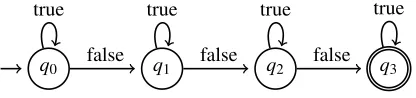
q0 q1 q2 q3
true true true true
false false false
Figure 2: This finite automaton recognizes whether at least 3 sentences in the text are false. This automata needs 4 states. It starts in the rejecting state,q0, and eventually, if the condi-tion is satisfied, moves to the accepting state,q3. Furtermore, notice that to recognize “at least 8” we would need 9 states and so on.
sentence (2) is true we must identify the number of correct sentences and hold it in working memory to compare with the number of incorrect sentences.
2. Most of the sentences in this paper are correct.
Mathematically speaking, such an algorithm can be realized by a push-down automaton, PDA, (see e.g. Hopcroft, Mot-wani, and Ullman (2000)).
From the perspective of those computational differences, McMillan et al. (2005) have hypothesized that all quantifiers recruit the right inferior parietal cortex, which is associated with numerosity. Taking the distinction between the com-plexity of first-order and higher-order quantifiers for granted, they also predicted that only higher-order quantifiers recruit the prefrontal cortex, which is associated with executive re-sources, like working memory. In other words, they believe that the logical differences between first-order and higher-order quantifiers are also reflected in brain activity during processing quantifier sentences. This prediction was con-firmed.
In our view the authors’ interpretation of their results is not convincing. Their experimental design may not provide the best means of differentiating between the neural bases of the various kinds of quantifiers. The main point of criticism is that the distinction between first-order and higher-order quan-tifiers does not coincide with the computational resources re-quired to compute the meaning of quantifiers. There is a proper subclass of higher-order quantifiers, namely divisibil-ity (pardivisibil-ity) quantifiers, which corresponds — with respect to memory resources — to the same computational model as first-order quantifiers. In fact, most of the quantifiers iden-tified in the research as higher-order quantifiers can be rec-ognized by finite automata. Both “an even number” and “an odd number” are quantifiers recognized by two-state finite au-tomata with a transition from the first state to the second and
vice versa. In general, exactly the quantifiers definable in
di-visibility logic,FO(Dn)(i.e. first-order logic enriched by all
quantifiers “divisible byn”, forn≥2), are recognized by fi-nite automata (FA) (Mostowski, 1998).
Theorem 2 A monadic quantifierQis definable in the divis-ibility logic iff it can be recognized by a finite automaton.
Let us consider a relevant example. In the case of the au-tomaton corresponding to “even” the initial state is also the accepting state. In the automaton for “odd” the other state is the accepting one. Intuitively, to check whether sentence (3) is true you do not need to count the number of incorrect sentences and then compare it with that of the set of even in-tegers.
3. An even number of the sentences in this paper is incorrect.
You need only remember parity. For example when you find an incorrect sentence you write “1” at the blackboard, if you find another one you erase “1” and put “0” again, then if you see another incorrect sentence you put “1” in place of “0”,
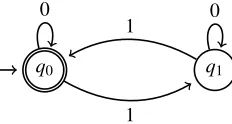
and so on. At every moment you have only one digit at the blackboard no matter how long is the paper. Compare with the automaton from Figure 3.
q0 q1
0
1
[image:3.612.382.498.123.185.2]1 0
Figure 3: Finite automaton checking whether the number of “1”s is even.
To sum up, first-order and higher-order quantifiers do not always differ with respect to the memory requirements. For example, “an even number of” is a higher-order quantifier that can still be recognized by a finite automaton. Therefore, differences in processing cannot be explained based solely on logical properties, as those are not enough fine grained. A more careful computational perspective — taking into ac-count all mentioned results summed up in Table 1 — have to be applied to investigate quantifier comprehension. In what follows we present research exploring the subject empirically with respect to the computational model outlined in this sec-tion.
expressibility examples recognized by
FO “all cars”, “at least 3 balls” acyclic FA parity “an even number of balls” FA
proportional “most lawyers” PDA
Table 1: Quantifiers, logics, and complexity of automata.
The Experiment
The study compares reaction times needed for the compre-hension of different types of quantifiers. In particular, it im-proves upon the hypothesis of McMillan et al. (2005) by taking directly into account predictions of the computational model of quantifier comprehension and not only expressibil-ity differences among quantifiers. Additionally, we compare two classes of quantifiers inside the first-order group: Aris-totelian and cardinal quantifiers, relating to the very recent research of Troiani et al. (2009).
Procedure
General Idea First, we compared reaction time with re-spect to the following classes of quantifiers: those recognized by acyclic FA (first-order), those recognized by FA (parity), and those recognized by PDA (proportional). McMillan et al. (2005) did not report any data on differences between first-order and parity quantifiers.
parity quantifiers (even, odd) will take more time than first order-quantifiers (all, some) but not as long as proportional quantifiers (less than half, more than half).
Moreover, we have additionally compared Aristotelian quantifiers with cardinal quantifiers of higher rank, for in-stance “less than 8”. In the study of McMillan et al. (2005) only one cardinal quantifier of relatively small rank was taken into consideration, namely “at least 3”. We predict that complexity of the mental processing of cardinal quantifiers depends on the number of states in the relevant automata. Therefore, cardinal quantifiers of high rank should be more difficult than Aristotelian quantifiers (see Figure 2 for more explanation). Additionally, presumably the number of states in automata (size of memory needed) influences comprehen-sion more directly than the use of loops. Hence, we hypothe-size that the reaction time for the comprehension of cardinal quantifiers of higher rank is between that for parity and pro-portional quantifiers.
Participants Forty native Polish-speaking adults took part in this study. They were volunteers from the University of Warsaw undergraduate population. 19 of them were male and 21 were female. The mean age was 21.42 years (SD = 3.22) with a range of 18–30 years. Each participant was tested in-dividually and was given a small financial reward for partici-pation in the study.
Materials and Procedure The task consisted of eighty grammatically simple propositions in Polish containing a quantifier that probed a color feature of car on display. For example:
4. Some cars are red.
5. Less than half of the cars are blue.
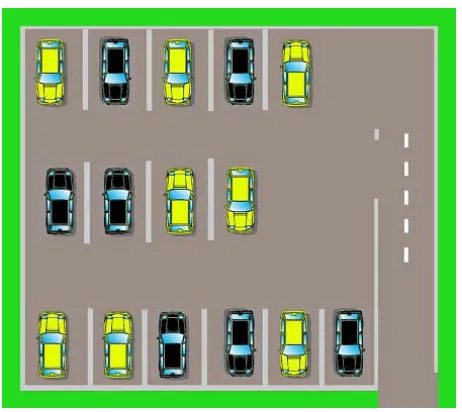
Eighty color pictures presenting a car park with cars were constructed to accompany the propositions. The colors of the cars were red, blue, green, yellow, purple and black. Each picture contained fifteen objects in two colors (see Figure 4).
[image:4.612.322.553.68.274.2]Eight different quantifiers divided into four groups were used in the study. The first group of quantifiers was first-order Aristotelian quantifiers (all, some); the second was par-ity quantifiers (odd, even); the third was first-order cardinal quantifiers of relatively high rank (less than 8, more than 7); and the fourth was proportional quantifiers (less than half, more than half) (see Table 2). Each quantifier was presented in 10 trials. Hence, there were in total 80 tasks in the study. The sentence matched the picture in half of the trials. Propo-sitions with ”less than 8”, ”more than 7”, ”less than half”, ”more than half” were accompanied with a quantity of tar-get items near the criterion for validating or falsifying the proposition. Therefore, these tasks required a precise judg-ment (e.g. seven targets in ”less than half”). Debriefing fol-lowing the experiment revealed that none of the participants had been aware that each picture consisted of exactly fifteen objects.
Figure 4: An example of a stimulus used in the first study.
The experiment was divided into two parts: a short prac-tice session followed immediately by the experimental ses-sion. Each quantifier problem was given one 15.5 s event. In the event the proposition and a stimulus array containing 15 randomly distributed cars were presented for 15000 ms fol-lowed by a blank screen for 500 ms. Subjects were asked to decide if the proposition was true at the presented picture. They responded by pressing the button with letter “P” if true and the button with letter “F” if false. The letters refer to first letters of Polish words for ”true” and ”false”.
The experiment was performed on a PC computer running E-Prime version 1.1.
Results
Analysis of Accuracy As we expected, the tasks were quite simple for our subjects and they made only a few mistakes. The percentage of correct answers for each group of quanti-fiers is presented in Table 2.
Quantifier group Examples Percent
Aristotelian FO all, some 99
Parity odd, even 91
Cardinal FO less than 8, more than 7 92 Proportional less than half, more than half 85
Table 2: The percentage of correct answers for each group of quantifiers.
ap-plied. Moreover, polynomial contrast analysis was performed for the within-subject factor. SPSS 14 was used for the anal-ysis.
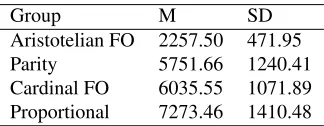
Table 3 presents mean (M) and standard deviation (SD) of the reaction time in milliseconds for each type of quantifier.
Group M SD
Aristotelian FO 2257.50 471.95
Parity 5751.66 1240.41
Cardinal FO 6035.55 1071.89 Proportional 7273.46 1410.48
Table 3: Mean (M) and standard deviation (SD) of the reac-tion time in milliseconds for each type of quantifier.
[image:5.612.67.286.412.559.2]We observed that the increase in reaction time was deter-mined by the quantifier type (F(2.4, 94.3) = 341.24, p< 0.001,η2=0.90). Pairwise comparisons among means indi-cated that all four types of quantifiers differed significantly from one another (p<0.05). Polynomial contrast analysis showed the best fit for a linear trend (F(1, 39) = 580.77, p<0.001). The mean reaction time increased as follows: Aristotelian quantifiers, parity quantifiers, cardinal quanti-fiers, proportional quantifiers (see Figure 5).
Figure 5: Average reaction times in each type of quantifiers in the first study.
Discussion
Conclusions
We have been studying comprehension of natural language quantifiers from the perspective of simple, automata-theoretic computational models. Our investigation is a continuation of previous studies. In particular, it enriches and explains some data obtained by McMillan et al. (2005) and Troiani et al. (2009) with respect to reaction times. Our results support the following conclusions:
Plausibility of the Model The automata-theoretic model correctly predicts that quantifiers computable by finite-automata are easier to understand than quantifiers recognized by push-down automata. It improves results of McMillan et al. (2005), which compared only first-order quantifiers with higher-order quantifiers, putting in one group quantifiers rec-ognized by finite-automata and those recrec-ognized by push-down automata.
Aristotelian, Cardinal, and Parity Quantifiers We have observed a significant difference in reaction time between Aristotelian and parity quantifiers, even though they are both recognized by finite automata. This difference may be ac-counted for by observing that the class of Aristotelian quanti-fiers is recognized by acyclic finite automata, whereas in the case of parity quantifiers we need loops. Therefore, loops are another example of computational resources having influ-ence on the complexity of cognitive tasks. Moreover, we have shown that processing first-order cardinal quantifiers of high rank takes more time than comprehension of parity quanti-fiers. This suggests that the number of states in the relevant automaton plays an important role when judging the difficulty of a natural language construction. Arguably, the number of states required influences hardness more than the necessity of using cycles in the computation. These observations shed some light on the differences between numerical and logical quantifiers assessed in (Troiani et al., 2009).
Cognition and Complexity Last but not least, our research provides direct evidence for the claim that human linguistic abilities are constrained by computational resources (internal memory, number of states, loops).
Perspectives
There are many questions we leave for further research. Be-low we list a few of them.
Comprehension and Brain Even though we believe that computational properties are directly responsible for quanti-fier difficulty in natural language we are aware that our exper-iment does not support automata-theoretic account uniquely. However, our experimental setting can be used for neuropsy-chological study extending the one by McMillan et al. (2005). On the basis of our research and findings of McMillan et al. (2005) we predict that comprehension of parity quantifiers — but not first-order quantifiers — depends on executive re-sources that are mediated by dorsolateral prefrontal cortex. This would correspond to the difference between acyclic fi-nite automata and fifi-nite automata. Further studies would con-tribute to extending our understanding of simple quantifier comprehension on Marr’s implementation level.
comprehen-sion. In principle it is possible to try to extract real algorithms by letting subjects manipulate the elements, tracking their be-havior and then drawing some conclusions about their strate-gies. This is one of the possible future directions to enrich our experiments.
Comprehension and Working Memory Before starting any neuropsychological experiments it would be useful to measure memory involvement for different types of quanti-fiers using some classical methods known from cognitive psy-chology, like a dual-task paradigm combining a memory span measure with a concurrent processing task.
Comprehension Beyond Quantifiers Finally, the automata-theoretic model can be extended for other no-tions than simple quantifiers. For example, as it was already suggested by van Benthem (1987), by considering richer data structures it can account for conditionals, comparatives, compound expressions in natural language, non-elementary combinations of quantifiers, link to learnability theory (Gierasimczuk, 2007) and others. Possibly such extensions could be valuable not only from linguistic but also a cognitive point of view.
Acknowledgments
The first author was supported by a Marie Curie Early Stage Research fellowship in the project GLoRiClass (MEST-CT-2005-020841). We would like to thank Johan van Benthem, Victor Ferreira, Nina Gierasimczuk, Theo Janssen, Marcin Mostowski, Jonathan Shaheen, and Iris van Rooij for com-ments on the previous version of the paper.
References
Baddeley, A. (2007). Working memory, thought, and action (1st ed.). Oxford University Press, USA.
van Benthem, J. (1986).Essays in logical semantics. Reidel. van Benthem, J. (1987). Towards a computational semantics. In P. G¨ardenfors (Ed.),Generalized quantifiers(pp. 31–71). Reidel Publishing Company.
Cherniak, C. (1981). Minimal rationality. Mind,90(358), 161–183.
Church, A. (1936). An unsolvable problem of elementary number theory. American Journal of Mathematics,58(2), 345–363.
Clark, R., & Grossman, M. (2007, March). Number sense and quantifier interpretation.Topoi,26(1), 51–62.
Frege, G. (1892). ¨Uber Sinn und Bedeutung. Zeitschrift f¨ur
Philosophie und philosophische Kritik,100, 25–50.
Frixione, M. (2001). Tractable competence. Minds and
Ma-chines,11(3), 379–397.
Gierasimczuk, N. (2007). The problem of learning the se-mantics of quantifiers. In B. Ten Cate & H. Zeevat (Eds.),
Lecture notes in computer science (Vol. 4363, pp. 117–
126). Springer.
Hofstadter, D. (2007). G¨odel, Escher, Bach(3rd ed.). Tus-quets.
Hopcroft, J. E., Motwani, R., & Ullman, J. D. (2000). Intro-duction to automata theory, languages, and computation (2nd ed.). Addison Wesley.
Lambalgen, M. V., & Hamm, F. (2005).The proper treatment
of events. Wiley-Blackwell.
Levesque, H. J. (1988, November). Logic and the complexity of reasoning. Journal of Philosophical Logic,17(4), 355– 389.
Marr, D. (1983). Vision: A computational investigation into the human representation and processing visual informa-tion. San Francisco: W.H. Freeman.
McMillan, C., Clark, R., Moore, P., Devita, C., & Grossman, M. (2005). Neural basis for generalized quantifiers com-prehension. Neuropsychologia,43, 1729–1737.
McMillan, C., Clark, R., Moore, P., & Grossman, M. (2006). Quantifiers comprehension in corticobasal degeneration.
Brain and Cognition,65, 250–260.
Mostowski, M. (1998). Computational semantics for monadic quantifiers. Journal of Applied Non-Classical
Logics,8, 107–121.
Mostowski, M., & Wojtyniak, D. (2004). Computational complexity of the semantics of some natural language con-structions. Annals of Pure and Applied Logic,127(1-3), 219–227.
van Rooij, I. (2008). The tractable cognition thesis.Cognitive
Science: A Multidisciplinary Journal,32(6), 939–984.
Sanford, A. J., Moxey, L. M., & Paterson, K. (1994, March). Psychological studies of quantifiers.Journal of Semantics, 11(3), 153–170.
Suppes, P. (1982). Variable-free semantics with remark on procedural extensions. In Simon & Scholes (Eds.),
Lan-guage, mind and brain(pp. 21–34). Erlbaum: Hillsdale.
Szymanik, J. (2007). A comment on a neuroimaging study of natural language quantifier comprehension.
Neuropsy-chologia,45(9), 2158–2160.
Szymanik, J., & Zajenkowski, M. (2008).
Com-prehension of simple quantifiers. Empirical
eval-uation of a computational model (Prepublications
Series PP-2008-49). Institute for Logic, Lan-guage and Information. (Manuscript available at http://www.illc.uva.nl/Publications/ResearchReports/PP-2008-49.text.pdf)
Troiani, V., Peelle, J., Clark, R., & Grossman, M. (2009, January). Is it logical to count on quantifiers? Dissociable neural networks underlying numerical and logical quanti-fiers. Neuropsychologia,47(1), 104–111.
Tsotsos, J. (1990). Analyzing vision at the complexity level.
Behavioral and Brain Sciences,13(3), 423–469.
Turing, A. (1936). On computable numbers, with an appli-cation to the Entscheidungsproblem. Proceedings of the