Preface
Primary users of this manual are NBC staff officers, staff weather officers, fire support coordination personnel, artillery officers, and others involved in planning NBC operations. These soldiers must understand what effect weather and terrain have on nuclear, biological, and chemical (NBC) operations and smoke. This manual contains general information and the basic principles on how to get the best results. Commanders and staffs involved in planning for use of incendiaries or smoke operations will also benefit from the use of this manual along with other references such as FM 3-50, FM 3-100, FM 3-3, FM 3-4, and FM 3-5.
On the battlefield, the influences of weather and terrain on NBC operations provide opportunities to both sides. To retain the initiative, friendly forces leaders and staff officers must understand how weather and terrain can be used to their advantage.
FM 3-6 implements International Standardization Agreement (STANAG) 2103, Reporting Nuclear Detonations, Radioactive Fallout, and Biological and Chemical Attacks and Predicting Associated Hazards.
This manual explains how weather and terrain influence nuclear, biological, and chemical operations and discusses the following topics for use when planning operations:
Basic principles of meteorology as they pertain to NBC operations. Influence of weather on the use and behavior of NBC agents.
Local weather predictions and their use.
Influence of terrain on the behavior of NBC agents.
US Air Force Air Weather Service (AWS) forecasts and their use in planning for operations in an NBC environment. (The Navy gets meteorological forecasts from components of the Naval Oceanography Command. Meteorological report information is in the NAVOCEANCOMINST 3140.1 publications series. It also contains information on the behavior of smoke clouds and incendiaries. In addition, it discusses the influences of weather and terrain on the thermal, blast, and radiation effects of a nuclear detonation.)
of weather on chemical agent use. The remaining chapters address the impact of weather on smoke, incendiaries, biological agents, and nuclear detonations.
The field dependent on temperature, precipitation.
CHAPTER 1
Chemical Agents
behavior of chemical agents is understand the impact of chemical agents on the weather variables such as wind, battlefield, the soldier must also understand how air stability, humidity, and these agents are affected by weather and terrain. The influence of each variable The following paragraphs give an overview of the depends upon the synoptic situation and is locally basic characteristics of chemical agents and how influenced by topography, vegetation, and soil. weather and terrain influence and have specific
Chemical agents may appear in the field in effects on them. different forms: vapors, aerosols, or liquids. To
Basic Characteristics
Vapors and small particles are carried by the winds, while any large particles and liquid drops fall out in a ballistic-like trajectory and are quickly deposited on the ground. Many agents give off vapors that form vapor clouds. The speed at which an agent gives off vapors is called volatility. Agents may be removed naturally from the air by falling out (large particles fall out much more quickly), by sticking to the ground or vegetation, or by being removed by precipitation. Once deposited upon vegetation or other ground cover, volatile agents may be re-released to the atmosphere for further cycles of travel and present a hazard until sufficiently diluted or decontaminated.
During approximately the first 30 seconds, the size and travel of an agent are determined primarily by the functioning characteristic of the munition or delivery system. Thereafter, the travel and diffusion of the agent cloud are determined primarily by weather and terrain. For example, in high temperatures, volatile agents produce maximum agent vapor in 15 seconds. Light winds and low turbulence allow high local concentrations of agents. High winds and strong turbulence reduce the concentration and increase the area coverage by more quickly carrying away and diffusing the agent cloud.
Vapors
When a chemical agent is disseminated as a vapor from a bursting munition, initially the cloud
expands, grows cooler and heavier, and tends to retain its form. The height to which the cloud rises, due to its buoyancy, is called the height of the thermally stabilized cloud. If the vapor density of the released agent is less than the vapor density of air, the cloud rises quite rapidly, mixes with the surrounding air, and dilutes rapidly. If the agent forms a dense gas (the vapor density of the released agent is greater than the vapor density of air), the cloud flattens, sinks, and flows over the earth’s surface. Generally, cloud growth during the first 30 seconds is more dependent upon the munition or delivery system than upon surrounding meteorological conditions.
Nevertheless, the height to which the cloud eventually rises depends upon air temperature and turbulence. These determine how much cooler, ambient air is pulled into the hot cloud (and, hence, determines its rate of cooling). The agent concentration buildup is influenced by both the amount and speed of agent release and by existing meteorological conditions.
increases, the agent cloud dilutes or dissipates faster.
Aerosols
Aerosols are finely divided liquid and/or solid substances suspended in the atmosphere. Sometimes dissolved gases are also present in the liquids in the aerosols. Chemical agent aerosol clouds can be generated by thermal munitions and aerosol spray devices or as by-products of liquid spray devices and bursting munitions.
Airborne aerosols behave in much the same manner as vaporized agents. Initially, aerosol clouds formed from thermal generators have a higher temperature than clouds formed from other types of munitions. This may cause some initial rise of the cloud at the release point. Aerosol-generated clouds are heavier than vapor clouds, and they tend to retain their forms and settle back to earth. Being heavier than vapor clouds, they are influenced less by turbulence. However, as the clouds travel downwind, gravity settles out the larger, heavier particles. Many particles stick to leaves and other vegetative surfaces they contact.
Liquids
When a chemical agent is used for its liquid effect, evaporation causes the agent to form into vapor. Depending upon volatility, vapor clouds are usually of low concentration, have about the same temperature as the surrounding air, and tend to stay near the surface because of high vapor density. Additionally, vapor density governs the extent that the vapor will mix with the air. Liquid agents with high vapor density impact at ground level with very little evaporation of the agent. These agents are termed persistent agents. While drops are airborne, and after impacting, the liquid continues to evaporate. Agent vapor pressure will govern the rate at which the liquid will evaporate at a given temperature and pressure. Initial concentrations are lower, since the vapor source is not instantaneous as a vapor agent is but evolves over a long period (until the liquid source is gone). Liquid agents may be absorbed (soaked into a surface) and adsorbed (adhered to a surface), and they may also evaporate. Once the liquid is no longer present on the surface, desorption (going back into the air) begins. The vapor concentration over areas contaminated with a liquid agent tends
to be less than with newly formed vapor clouds, and downwind agent concentrations are not nearly as great as with other types of agents.
Atmospheric Stability
One of the key factors in using chemical weapons is the determination of the atmospheric stability condition that will exist at the time of attack. This determination can be made from a meteorological report or by observing field conditions.
When a meteorological report is available, it should contain a description of the current or projected atmospheric stability condition. If the data given are based on an atmospheric description, Figure 1-1 may be used to convert the data into traditional atmospheric stability categories/conditions. When meteorological reports are not readily available, the stability condition can be derived by using the stability decision tree shown in Figure 1-2. Figure 1-2 is entered at the top with the current observed weather conditions (or estimated weather conditions). Follow the decision tree to determine the stability condition. The stability condition plus the wind speed indicates the dispersion category of an agent vapor cloud.
Unstable conditions will cause lower concentrations and/or poorer target coverage. Stable conditions will cause greater agent stability and higher concentrations. Use Figure 1-2 as guidance for employing an agent by starting in upper left corner at the word START. Follow arrowed line to the first question. Answer question “Is it nighttime?” by selecting,
accordance with the facts, the yes or no arrow indicating your decision. At each branch in the arrows, follow the arrow most nearly correct for the conditions under which the stability category is required. As questions are encountered along your path, answer each and proceed along the most nearly correct path until a dispersion category is identified. The result from Figure 1-2 is the stability category. An example of the use of Figure 1-2 is if you are inland one hour before sunset and the winds are calm, the stability category is neutral (N) (category 4).
The dispersion category, the wind speed in knots, and the wind direction are the most important meteorological data for deciding the influence of weather on vapor cloud dispersion. For any given dispersion category, a lower wind speed will produce higher dosages, smaller area coverage, and, consequently, higher toxic effects. This is because when the wind speed is lower, the cloud moves more slowly past the individual in the target area; and the individual is in the cloud longer, yielding a higher dose of the agent. See Table 1-1 for the dispersion categories and wind speeds during which atmospheric conditions are either generally favorable, marginal, or unfavorable for employment of chemical agents. Factors such as agent toxicity, target vulnerability, and the amount of the agent released will determine the actual doses, casualties, and other effects. Elevated agent releases will alter the table results somewhat, but the same trends occur. The main effect to be considered for elevated release effectiveness over a specific target is that the agent must be released further upwind to compensate for the drift as the agent comes down.
Table 1-1 is a general reference tool to provide an estimate, based on dispersion category and wind speed, when it would generally be most effective to employ a chemical agent vapor. Table 1-2 indicates the typical cloud widths at given downwind distances from a point source release for a chemical agent vapor cloud. Note that the cloud width depends upon dispersion category and not directly upon wind speed. The cloud width distances represented in Table 1-2 are the dosage contours for 0.01 milligram-minutes per cubic meter (mg-min\M³). If the agent is released from a line source (spray system), the line length should be added to the cloud width (Table 1-2) to determine
total cloud width for travel distances up to 1 kilometer. For longer travel distances, the length of the line source loses its importance (due to dissipation), and the total cloud width is represented by the values in Table 1-2. The chemical cloud widths listed in Table 1-2 are estimates. The widths will vary depending on the weather and terrain of a specific area.
The following examples are cited to explain further the use of Table 1-2. Based on a chemical agent vapor being released from a point source in dispersion category 4, the chemical cloud width at 7 kilometers downwind would be approximately 2.3 kilometers. Based on a chemical agent vapor being released from a line source that is 0.1 kilometer in length (dispersion category 2), the chemical cloud width at a 0.5 kilometer downwind distance would be .850 kilometer (0.75+0.1).
Table 1-3 presents the relative center line dosages (mg-min/M³) at different distances downwind for different dispersion categories and wind speeds. Remember, low wind speeds at the same dispersion category give higher dosages. The dosages listed in Table 1-3 are estimates and will vary depending on the estimated category and wind speed in the target area. The dosage values in Table 1-3 are based on 100 kilograms of the nonpersistent nerve agent (GB) being released at ground level from a point source.
The information reflected in Table 1-3 is the dosage that would be incurred if the target were stationary. The dosage would decrease if the target were moving through the downwind cloud hazard area. Additionally, in general, if the source strength (100 kg) were doubled, the dosage would also double, and if the source strength were halved, the dosage would also decrease approximately one-half.
To aid in using Table 1-3, the following example is provided. With dispersion category 4, wind speed 8 knots, and a downwind distance of 2 kilometers, the center line dosage would be 18.91 mg-min/M³. With dispersion category 2, wind speed 3 knots, and at a downwind distance of 4 kilometers, the center line dosage would be 1.030 mg-min\M³.
Vapor Concentration and Diffusion
continually expand, agent concentration levels decrease over time. Wind speed determines the downwind growth of the cloud. Vertical and horizontal turbulence determines the height and width of the cloud. The rate at which the downwind, vertical, and horizontal components expand governs the cloud volume and the agent concentration.
To be effective the agent cloud, at a specific concentration level, must remain in the target area for a definite period. Wind in the target area mixes the agent and distributes it over the target after release. For ground targets, high concentrations and good coverage can best be achieved with low turbulence and calm winds when the agent is
delivered directly on target. A steady, predictable wind drift over the target is best when the agent is delivered on the upwind side of the target. Conditions other than these tend to produce lower concentrations and/or poorer target coverage. However, unless weather conditions are known within the target area, the effects of the agent on target will be approximations.
The concentration and diffusion of a chemical agent cloud are also influenced by the factors of hydrolysis, absorption, adsorption, lateral spread, drag effect, and vertical rise.
of hydrolysis is too slow. However, hydrolysis can be important for smoke screens. See the discussion of the effect of humidity on increasing smoke screen effectiveness in Chapter 2.
Absorption is the process of the agent being taken into the vegetation, skin, soil, or material. Adsorption is the adding of a thin layer of agent to vegetation or other surfaces. This is important in dense vegetation. Both absorption and adsorption of chemical agents may kill vegetation, thus defoliating the area of employment.
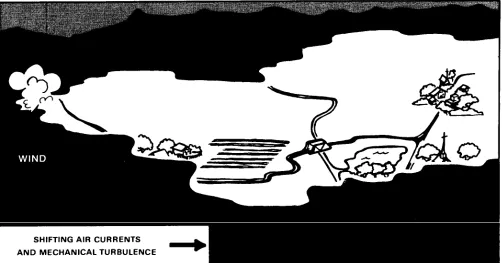
When a chemical cloud is released into the air, shifting air currents and horizontal turbulence blow it from side to side. The side-to-side motion of the air is called meandering. While the agent cloud meanders, it also spreads laterally. Lateral spreading is called lateral diffusion. Figure 1-3 shows a cloud with lateral spread and meandering. Table 1-2 indicates the amount of lateral spread that occurs under different dispersion categories and distances downwind. In more unstable conditions, the lateral spread tends to be greater than in stable conditions.
Wind currents carry chemical clouds along the ground with a rolling motion. This is caused by the
[image:11.615.58.560.400.663.2]differences in wind velocity. Wind speeds increase rapidly from near zero at the ground to higher speeds at higher elevations above the ground. The drag effect by the ground, together with the interference of vegetation and other ground objects, causes the base of an agent cloud to be retarded as the cloud stretches out in length. When clouds are released on the ground, the drag amounts to about 10 percent of the vertical growth over distance traveled over grass, plowed land, or water. It amounts to about 20 percent over gently rolling terrain covered with bushes, growing crops, or small patches of scattered timber. In heavy woods, the drag effect is greatly increased. The vertical spread of the cloud is illustrated in Figure 1-4.
ground on the forward edge of the cloud may be uncontaminated, while the air a few feet up may be heavily contaminated. This layering effect becomes more pronounced and increases proportionately with the distance of the forward edge of the cloud from the source. Figure 1-5 illustrates this. A small puff of agent cloud released from its source some time earlier has tilted forward, while the bottom has been retarded due to slower winds caused by drag.
The vertical rise of a chemical cloud depends upon weather variables, such as temperature gradient, wind speed, and turbulence, and the
Vapors and
Wind, temperature, humidity, precipitation, terrain contours, and surface cover influence the field behavior of vapors and aerosols. For example, in a chemical attack on US forces (lst Division) 26 February 1918 in the Ansauville section, extremely stable conditions, calm winds,
difference between the densities of the clouds and the surrounding air. As mentioned earlier, the temperature of both the cloud and the air influences their relative densities. Hotter gases are less dense and, therefore, lighter than cooler gases and air. Therefore, they rise until they are mixed and somewhat diluted and attain the same temperature and approximately the same density as surrounding air.
The vapor cloud formed by an agent normally employed for persistent effect rises in a similar manner, but vapor concentrations build up more gradually.
Aerosols
and terrain conditions for tactical employment of a chemical aerosol or vapor cloud are summarized in Table 1-4.
If a chemical cloud is to be placed directly on an occupied area, the best possible weather conditions are calm winds with a strong, stable temperature gradient. Under these conditions, the cloud diffuses over the target with minimum dilution and does not move away. Such conditions are most apt to occur on a calm, clear night. If a small amount of air movement is required to spread the cloud evenly over the target area, a low wind speed and stable or neutral conditions are most favorable. These conditions most often occur on a clear night, a cloudy night, or a cloudy day. When the desired effect is for the chemical cloud to travel, the most favorable conditions are stable or neutral conditions with a low to medium wind speed of 3 to 7 knots. These conditions may be present on a clear night, a cloudy night, or a cloudy day. The presence of low to medium wind speeds keeps the cloud traveling over the area without too much diffusion, and the stable or neutral conditions keep the agent concentration high and the cloud close to the ground.
Favorable terrain conditions for a chemical cloud are smooth or gently rolling contours or wooded areas. Unfavorable conditions for chemical clouds (usually found on clear days) are extreme or marked turbulence, wind speeds above 10 knots, an unstable dispersion category, rain, and rough terrain.
Wind
High wind speeds cause rapid dispersion of vapors or aerosols, thereby decreasing effective coverage of the target area and time of exposure to the agent. In high winds, larger quantities of munitions are required to ensure effective concentrations. Agent clouds are most effective when wind speeds are less than 4 knots and steady in direction. The clouds move with the prevailing wind as altered by terrain and vegetation. Steady, low wind speeds of 3 to 7 knots enhance area coverage unless an unstable condition exists. With high winds, chemical agents cannot be economically employed to achieve casualties. The chart at Figure 1-2 indicates the effect of wind on stability categories. Tables 1-1, 1-2, and 1-3
indicate the effects of wind and dispersion categories upon dosage and area coverage.
Unstable conditions, as indicated in Figure 1-2 and Tables 1-1, 1-2, and 1-3, are the least favorable conditions. Unstable conditions (such as many rising and falling air currents and great turbulence) quickly disperse chemical agents. Unstable is the least favorable condition for chemical agent use because it results in a lower concentration, thereby reducing the area affected by the agent. Many more munitions are required to attain the commander’s objectives under unstable conditions than under stable or neutral conditions. Stable conditions (such as low wind speeds and slight turbulence) produce the highest concentrations. Chemical agents remain near the ground and may travel for long distances before being dissipated. Stable conditions encourage the agent cloud to remain intact, thus allowing it to cover extremely large areas without diffusion. However, the direction and extent of cloud travel under stable conditions are not predictable if there are no dependable local wind data. A very stable condition is the most favorable condition for achieving a high concentration from a chemical cloud being dispersed.
Neutral conditions are moderately favorable. With low wind speed and smooth terrain, large areas may be effectively covered. The neutral condition occurs at dawn and sunset and generally is the most predictable. For this reason, a neutral dispersion category is often best from a military standpoint.
Temperature
There will be increased vaporization with higher temperatures. Also, the rate of evaporation of any remaining liquid agent from an exploding munition can vary with temperature. Generally, the rate of evaporation increases as the temperature increases. See FM 3-9/AFR 355-7 for specific information on chemical agents, such as their boiling and freezing points and vapor density.
Humidity
Humidity is the measure of the water vapor content of the air. Hydrolysis is a process in which compounds react
hydrolysis rates are less effective under conditions of high humidity.
Humidity has little effect on most chemical agent clouds. Some agents (phosgene and lewisite) hydrolyze quite readily. Hydrolysis causes these chemical agents to break down and change their chemical characteristics. If the relative humidity exceeds 70 percent, phosgene and lewisite can not be employed effectively except for a surprise time-on-target (TOT) attack because of rapid hydrolysis. Lewisite hydrolysis by-products are not dangerous to the skin; however, they are toxic if taken internally because of the arsenic content. Riot control agent CS (see glossary) also hydrolyzes, although slowly, in high humidities. High humidity combined with high temperatures may increase the effectiveness of some agents because of body perspiration that will absorb the agents and allow for better transfer.
Precipitation
The overall effect of precipitation is unfavorable because it is extremely effective in washing chemical vapors and aerosols from the air, vegetation, and material. Weather forecasts or observations indicating the presence of or potential for precipitation present an unfavorable environment for employment of chemical agents.
Terrain Contours
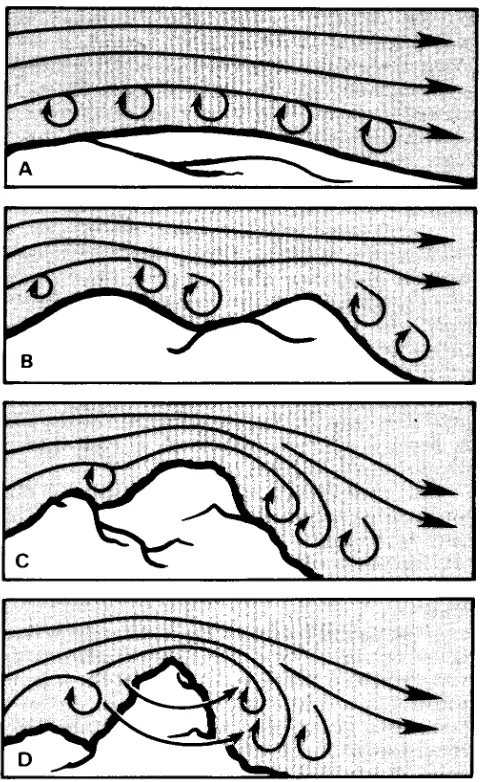
Terrain contours influence the flow of chemical clouds the same as they influence airflow. Chemical clouds tend to flow over low rolling terrain and down valleys and settle in hollows and depressions and on low ground. Local winds coming down valleys at night or up valleys during the day may deflect the cloud or reverse its flow. On the other hand, they may produce conditions favorable for chemical cloud travel when general area forecasts predict a calm.
A chemical cloud released in a narrow valley subjected to a mountain breeze retains a high concentration of agent as it flows down the valley. This is because of minimal lateral spread. Hence, high dosages are obtained in narrow valleys or depressions. High dosages are difficult to obtain on crests or the sides of ridges or hills. After a heavy rain, the formation of local mountain or valley winds is sharply reduced. In areas of adjacent land and water, daytime breezes from the
water and nighttime breezes from the land control chemical cloud travel.
Surface Cover
Ground covered with tall grass or brush retards flow. Obstacles, such as buildings or trees, set up eddies that tend to break up the cloud and cause it to dissipate more rapidly. However, street canyons or spaces between buildings may have pockets of high concentrations. Flat country (during a neutral or inversion condition) or open water promotes an even, steady cloud flow. Figure 1-5 illustrates the horizontal and vertical spread of a cloud over flat country.
The amount and type of vegetation in the area of the chemical operation also influence the travel of a chemical cloud. Vegetation, as it relates to meteorology or diffusion, is called vegetative canopy or just canopy. The effects of canopies are considered below.
Woods are considered to be trees in full leaf (coniferous or deciduous forests). The term “heavily wooded canopy” denotes jungles or forests with canopies of sufficient density to shade more than 90 percent of the ground surface beneath. For chemical operations, areas containing scattered trees or clumps of bushes are considered to be open terrain although drag is somewhat increased. In wooded areas where trees are not in full leaf or where foliage has been destroyed by previous attack so that sunlight strikes the ground, the diffusion (stability) category will be similar to those in the open.
When bombs are dropped into a wooded area, some may be expected to burst in the treetops. Although the released aerosol and vapor settle toward the ground, some of the agent is lost, depending upon the thickness and height of the foliage. The initial burst and pancake areas of chemical clouds released within woods or jungles are smaller than those released in the open. However, concentrations within the initial clouds are higher in wooded areas, sometimes three times that of bursts in the open. The magnitude of concentration from ground bursts depends upon the density of undergrowth and trees.
wind speeds under the canopies spread agent clouds slowly in a downwind and downslope direction. Areas of dense vegetation also increase the potential surface area for the deposition of chemical agents. If there are gullies and stream beds within the woods, clouds tend to follow these features. This flow may be halted or diverted by upslope winds.
Vegetation absorbs some agents. However, for an attack against troops poorly trained in NBC
defense (where lethal dosages may be obtained in 30 seconds or less), the amount of agent absorbed by foliage will have little or no effect on the success of the attack. High concentrations of chemical agents may destroy vegetation, since the leaves absorb some of the agent. In some instances, the absorbed agent may be released or desorbed when the vegetation is disturbed or crushed, creating a secondary toxic hazard.
Liquids
Weather, terrain contours, vegetation, soil, and some other surfaces affect the rate of evaporation. That, in turn, influences the persistence of a chemical agent liquid and the concentration of the vapor. Most weather conditions do not affect the quantity of munitions needed for an effective initial liquid contamination. Table 1-5 summarizes favorable and unfavorable weather and terrain conditions for the employment of a liquid chemical agent.
When a liquid agent is used to cause casualties through contact with the liquid in crossing or occupying the area, its duration of effectiveness is greatest when the soil temperature is just above the agent’s freezing point. This limits the rate of evaporation of the liquid. Other favorable conditions are low wind speed, wooded areas, and no rain.
Conversely, unfavorable conditions are high soil temperature, high wind speed, bare terrain, and heavy rain.
Favorable and unfavorable conditions for liquid agents for vapor concentration effects are much the same as those for chemical clouds. In woods, however, a high temperature with only a very light wind gives the highest vapor concentrations.
Weather
Duration of the effectiveness of initial liquid contamination may be affected by wind speed; stability, mixing height, and temperature; and precipitation.
Wind Speed
Wind direction
the upwind side of a target for release purposes butis important in determining
has little impact on the duration of effectiveness, regardless of the method of release The vapor created by evaporation of the liquid agent, however, moves with the wind. Therefore, the vapor concentration is greatest on the downwind side of the contaminated area. Vapors are moved by the wind as discussed earlier in this chapter.
Evaporation due to wind speed depends on the amount of the liquid exposed to the wind (the surface of the liquid) and the rate at which air passes over the agent. Therefore, the duration of effectiveness is longer at the places of greater liquid agent contamination and in places where the liquid agent is sheltered from the wind.
The rate of evaporation of agents employed for persistent effect in a liquid state is proportional to the wind speed. If the speed increases, evaporation increases, thus shortening the duration of effectiveness of the contamination. Increased evaporation, in turn, creates a larger vapor cloud. The vapor cloud, in turn, is dispersed by higher winds. The creation and dispersion of vapor are a continuous process, increasing or decreasing in proportion to wind speed.
Releasing agents for persistent effect by point dispersal via bombs, shells, rockets, or land mines results in an unevenly distributed contaminant. Heavier concentrations of the liquid are found around the point of burst. Lighter concentrations result farther from the bursting position. There probably will be small areas between the points of burst that are not contaminated, depending upon the number of munitions used and the uniformity of dispersal.
than when the liquid agent is unevenly dispersed downwind from the sprayed area.
some of these agents are extremely toxic, so even a very slight surface concentration represents a massive overkill dosage. When agents of this category are released from spray munitions under low wind speeds, they cover only a narrow zone. When released under higher wind speeds, they cover wider areas more effectively. Thus, when downwind safety is not a limiting consideration, high wind speeds may be more desirable than low wind speeds for these very persistent agents.
With agents that vaporize readily, high wind speeds may cause complete vaporization before the agent reaches the ground, creating only a vapor hazard. The resulting vapor cloud is nonpersistent and dissipates quite rapidly due to the high degree of mechanical turbulence associated with high wind speeds.
Turbulence has the same effect on agents employed for persistent effect, whether released from bombs, rockets, artillery shells, or land mines. Turbulence tends to reduce the duration of effectiveness in the liquid state by helping to increase the rate of evaporation. Temperature, rather than turbulence, has the greater effect on the duration of effectiveness of liquid agents. However, a contaminated area that has been subjected to pronounced turbulence does not remain contaminated as long as one that has been subjected to only slight turbulence with low wind speeds.
Turbulence also influences the spraying of agents employed for persistent effect. High winds and air movements divert the drops from the target or spread them over a larger area. Steep mountain regions sometimes produce large-scale eddies that prevent effective coverage of the target. Any vapor concentrations built up from sprayed areas are slight when the degree of turbulence is high.
Stability, Mixing Height, and Temperature
Unstable conditions are characterized by warmer surfaces. The solar heating then causes evaporation to be more rapid.
Temperature, velocity, and turbulence also affect the dispersion of spray. When stable (inversion) conditions prevail, there usually is little or no thermal turbulence, wind speeds are
low, and the degree of mechanical turbulence is also low. Often stable conditions exist continually only near the ground. Above the top of the stable surface layer, wind speed and turbulence are increased. Wind direction here also may be substantially different from the surface wind direction. A chemical spray released below the top of the inversion falls fairly quickly. The height of the top of an inversion varies throughout the period of the surface inversion existence, and it may vary rapidly over large hills and mountains. The mixing height is the capping inversion at the top of the mixing layer and serves as a lid. It prevents further upward vertical growth of a chemical vapor. A mixing height can also exist above unstable or neutral surface stability conditions. In radiation inversions, which commonly form at night, the top of the surface-based (mixing) stable layer is very close to the earth’s surface shortly after the neutral condition changes to a stable condition (soon after sunset). As the surface stable layer intensifies, its top rises, reaching its maximum elevation between 0200 and 0400 hours local time. Maximum elevation may be 400 meters in a very intense stable layer. In the morning, solar radiation heats the surface and causes a good mixing condition close to the ground. The mixing height and turbulence condition increase until they destroy the stable layer. The mixing height can extend from the earth’s surface up to 2 kilometers in elevation on a hot summer day. On a calm, clear night, the mixing height may extend only 50 to 100 meters above the earth’s surface.
If a chemical agent is released above the surface stable layer, most of the agent remains aloft in the turbulence layer, and most of it will dissipate before settling low enough to be effective. For this reason, most spray missions are flown at either sunrise or sunset to take advantage of a neutral temperature gradient. With this gradient, there is some vertical exchange of air, and the chemical spray, being relatively heavy, has a natural tendency to settle to the ground. The Air Weather Service or an assigned meteorologist can provide information on the mixing height and the height of the top of the surface stable layer.
and much of it may dissipate before reaching the target area.
Temperature is one of the most important factors affecting the duration of effectiveness and vapor concentration of liquid agents. Agents employed for persistent effect acquire the temperature of the ground and the air they contact. Their evaporation rates are proportional to the vapor pressure at any given temperature. The temperature of the ground surface in winter in temperate zones closely follows the air temperature with a range of only 10 to 20 degrees between day and night. In the summer in temperate zones, the surface temperature may be much higher than that of the air in the daytime and much cooler at night. Turbulence usually accompanies a high ground temperature. The result is that although the vapor concentration in the immediate area may be very high, it falls off rapidly a short distance away. Temperature of vehicles, buildings, and other surfaces may be warmer. This is because of internal heat sources and/or higher solar heating.
From a defensive viewpoint, a dangerous situation is likely to occur on a summer evening when the ground temperature is still high and a stable condition has started to set in. Under these conditions, a heavy vapor cloud produced by evaporation could be dangerous downwind to a distance of 2,000 meters or more. With ordinary concentrations, however, danger from vapor is somewhat less.
Another important temperature factor to consider is that people perspire freely and wear lightweight clothing in a warm climate. Thus, they are more susceptible to the action of chemical agents.
For effective tactical employment of bombs, shells, rockets, and land mines in releasing liquid chemical agents, the actual temperature of the agent itself is vitally important. Generally, liquid agents are not effective when used at temperatures below their freezing points. However, liquid agents can produce casualties when the frozen particles thaw.
Humidity has little effect on how long liquid agents are effective. However, high relative humidity, accompanied by high temperatures, induces body perspiration and, therefore, increases the effectiveness of these agents. Also, permeable protective clothing is less resistant
when sweat-soaked than when dry. Since sweaty skin is more susceptible to the action of vapor, lower vapor dosages produce casualties when the humidity is high.
Precipitation
Light rains distribute persistent agents more evenly over a large surface. Since more liquid is then exposed to the air, the rate of evaporation may increase and cause higher vapor concentrations. Precipitation also accelerates the hydrolysis effect. Rains that are heavy or of long duration tend to wash away liquid chemical agents. These agents may then collect in areas previously uncontaminated (such as stream beds and depressions) and present an unplanned contamination hazard.
The evaporation rate of a liquid agent reduces when the agent is covered with water but returns to normal when the water is gone. Precipitation may force back to the surface some persistent agents that have lost their contact effectiveness by soaking into the soil or other porous surfaces. These agents may again become contact hazards. Snow acts as a blanket, covering the liquid contaminant. It lowers the surface temperature and slows evaporation so that only very low vapor concentrations form. When the snow melts, the danger of contamination reappears.
Terrain Contours
Terrain relief has little direct effect on a liquid agent. However, a slope affects temperatures and winds, and these influence the evaporation rates of liquid agents. However, the slope or contour may affect the delivery means capable of most efficiently delivering the agent on an area (for example, reverse slopes are normally not good for artillery employment, and mountainous terrain may restrict use of spray tanks).
Vegetation
brushing against the foliage. Within shaded woods, however, despite the greater surface covered by the liquid chemical agent (because of the vegetation), the reduction in surface temperature and wind speed increases the duration of effectiveness.
When bombs or shells burst in woods, usually most of the liquid falls near enough to the ground to be effective. An exception is bursts in virgin forests with dense canopies that may extend to 50 meters high.
A thick jungle or forest canopy usually prevents liquid agent spray from airplanes from reaching the ground in quantities sufficient to produce significant casualties. When stable conditions exist above the forest canopy, however, enough vapor penetrates the canopy to cause casualties.
Soil
The soil on which liquid agents are placed influences the evaporation rate and the duration of effectiveness. Bare, hard ground favors short-term effectiveness and high-vapor concentration. If the surface is porous, such as sand, the liquid agent quickly soaks in; and the area no longer appears to be contaminated.
The rate at which liquid agents evaporate from a sandy or porous surface is about 1/3 less
than the evaporation rate from nonabsorbent surfaces. Extended contact with a contaminated porous material is dangerous if unprotected. However, if there is no free liquid on the surface, the danger from brief contact is relatively small if protected. If a porous surface on which liquid contamination falls has been wet by rain, the contaminant does not soak in as readily, and the surface is initially more dangerous to touch than it would be if the liquid agent had soaked in. When a mustard agent (HD) falls onto a wet surface, it stays in globules; and a thin, oily film spreads over the surface, making contamination easier to detect.
Other Surfaces
Persistence of liquids on painted surfaces of vehicles is much shorter than on most terrain. This is due to a number of factors, including increased surface temperature, turbulence of airflow over the vehicles or other equipment, and greater spread of drops to give more surface area for evaporation.
Smoke
CHAPTER 2
and Incendiaries
Smoke and incendiaries are combat long been employed as a means of concealing multipliers. Their effective use on a target can battlefield targets. Additionally, incendiary fire provide tactical advantages for offensive and damage causes casualties and materiel damage defensive operations. For example, smoke has and can also impact psychologically.
Smoke
Chemical smokes and
obscurants can degrade theother aerosoleffectiveness of sophisticated antitank guided missiles (ATGMs). The precision guidance systems of ATGMs are typically electro-optical devices and generally operate in the near-, mid-, or far-infrared portions of the electromagnetic spectrum, rather than in the visible light band of the spectrum. The use of smoke in the target area can be a convincing combat multiplier offensively and a dynamic countermeasure defensively. Smoke should be of primary interest to all commanders and staff planners because the proper use of smoke can provide many operational advantages.
Smoke has four general uses on the battlefield—obscuring, screening, deceiving, and identify ing/signalling. Obscuring smoke is placed on an enemy to reduce vision both at, and out from, the position. Screening smoke is used in friendly operational areas or between friendly units and the enemy. Deceiving smoke is used to mislead the enemy. Identifying/signalling smoke is a form of communication that has multiple uses. Overall, the objective of smoke employment is to increase the effectiveness of Army operations while reducing the vulnerability of US forces. Specifically, smoke can be used to accomplish the following:
Deny the enemy information.
Reduce effectiveness of enemy target acquisition.
Disrupt enemy movement, operations, command, and control.
Create conditions to surprise the enemy. Deceive the enemy.
During offensive operations, smoke can screen the attacker while an attack is carried out.
Some offensive applications include concealing movement of military forces and equipment; screening locations of passages through barriers; and helping to secure water crossings, beachheads, or other amphibious operations.
For defensive operations, smoke can be effectively used to blind enemy observation points to deprive the enemy of the opportunity to adjust fire, to isolate enemy elements to permit concentration of fire and counterattack, and to degrade the performance of threat ATGMs.
There are generally two categories of smoke operations on a battlefield-hasty and deliberate smoke. Hasty smoke operations are conducted with minimum prior planning, normally to counter some enemy action or anticipated action of immediate concern to a commander. Hasty smoke is usually used on small areas, is of short duration, and is most often used by battalion or smaller units. Deliberate smoke is planned in much greater detail. It is often employed over a large area for a relatively long period by brigades, divisions, or corps. For further information on hasty and deliberate smoke operations, refer to FM 3-50.
The following paragraphs on smoke operation contain information on smoke characteristics, diffusion of smoke, weather effects, hasty and deliberate smoke operations, and tactical considerations.
Characteristics
material between the observer and the object to be screened exceeds a certain minimum threshold value, the object cannot be seen.
The effectiveness of smoke used to obscure or conceal depends primarily on characteristics such as the number, size, and color of the smoke particles. Dark or black smoke absorbs a large proportion of the light rays striking individual smoke particles. In bright sunlight, a large quantity of black smoke is required for effective obscuration because of the nonscattering properties of the particles. At night or under low visibility conditions, considerably less smoke is needed.
Grayish or white smoke obscures by reflecting or scattering light rays, producing a glare. During bright daylight conditions, less white smoke than black smoke is required to obscure a target. Years of experience with smoke screen technology have shown that white smoke is superior to black smoke for most applications. Available white smoke includes white phosphorus (WP) and red phosphorus (RP) compounds, hexachloroethane (HC), and fog oil (SGF2). WP, RP, and HC are hydroscopic—they absorb water vapor from the atmosphere. This increases their diameters and makes them more efficient reflectors and scatterers of light rays. Fog oils are nonhygroscopic and depend upon vaporization
[image:22.612.39.533.449.669.2]techniques to produce extremely small diameter droplets to scatter light rays. The reflecting and absorbing qualities of smoke are illustrated in Figure 2-1.
Smoke, when placed between a target and a viewer, degrades the effectiveness of target-acquisition and aiming systems. The amount of smoke necessary to defeat aiming and acquisition systems is highly dependent upon the prevailing meteorological conditions, terrain relief, available natural light, visibility, and the attenuation effects of natural particles in the atmosphere. Other factors that must be considered include smoke from battlefield fires and dust raised by maneuvering vehicles and artillery fire.
The ability to detect and identify a target concealed by such a smoke screen is, in turn, a function of target-to-background contrast. Additionally, the amount of available natural light, the position of the sun with respect to the target, the reflectance of the smoke screen and the target, and the portion of the electromagnetic spectrum to be attenuated below the threshold contrast for detection will impact on detecting and identifying a target.
Diffusion
atmosphere generally obeys physical laws. Diffusion is governed by wind speed, turbulence, stability of the atmosphere, and terrain. The diffusion of smoke, as used on the battlefield, originates from four basic source configurations. These may be defined as continuous point sources, instantaneous point sources, continuous line sources, and area sources. A continuous point source may bethought of as a smoke release from a single smoke generator or smoke pot. The bursting of a projectile containing WP is considered to be an instantaneous source. A series of generators, set up crosswind, represent a line source. Munitions which scatter smoke-generating submunitions in an area are considered an area source.
Weather Effects
Meteorological conditions that have the most effect on smoke screening and munitions expenditures (including the deployment of smoke generators) include wind direction, relative humidity, visibility, and atmospheric stability. To be effective, an obscuring screen must be placed in an advantageous position with respect to the prevailing wind direction. The target area to be
screened must be defined in terms of whether the prevailing wind direction is considered to be a head or tail wind, a quartering wind, or a flank wind. Figure 2-2 illustrates these conditions. It must be remembered that flanking winds can be from either the right or left side of the screening area and that there are four quartering-wind directions. Wind direction is critical for determining the adjustment or aim point for screens deployed by artillery or mortars and also for the placement of generators if used to produce either hasty or deliberate smoke.
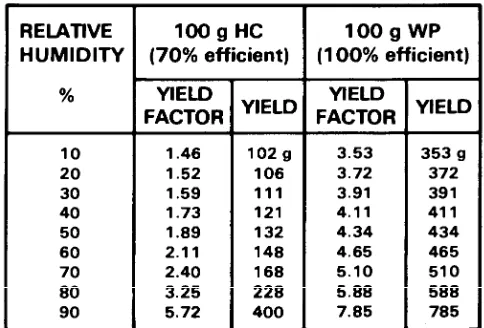
The relative humidity of the atmosphere is important to the use of smoke on a battlefield. As previously stated, WP, RP, and HC smoke compounds are hydroscopic—they absorb moisture from the atmosphere. As relative humidity increases, the amount of screening material available for target obscuration increases. For example, the HC compound is considered to be only about 70-percent efficient; that is, for every 100 grams of HC in a munition, only 70 grams are available for screening. If the relative humidity yield factor is then added in, the screening power of HC increases. This is shown in Table 2-1. Applicable technical references indicate the amount of HC or WP contained in various munitions. For example, the 105-millimeter WP (M416) round contains 6 pounds of WP; the 155-millimeter HC (Ml16A1) round contains 5.45 pounds of HC; and the 76-millimeter WP (M361A1) round contains 1.38 pounds of WP (453.6 grams equals 1 pound).
Phosphorous compounds are considered to be better screening agents than HC. This is because WP and RP have large yield factors for various relative humidities. Yields for WP are also shown in Table 2-1. Upon ignition, WP burns at a temperature of about 800ºC to 850°C. As a consequence, the smoke from a WP munition pillars, creating an excellent vertical screen, especially with high relative humidities. However, only about 10 percent of the smoke generated from WP munitions is available for screening near the
ground. This should be considered when planning smoke missions.
Battlefield visibility can be practically defined as the distance at which a potential target can be seen and identified against any background. Reduction of visibility on a battlefield by any cause reduces the amount of smoke needed to obscure a target.
Turbulence, atmospheric instability, and wind speed can have an adverse effect upon smoke expenditures. Unstable conditions are usually considered to be unfavorable for the use of smoke. Under calm or nearly calm conditions, the use of smoke is also sometimes unsatisfactory. In general, if the wind speed is less than 3 knots or greater than 20 knots, smoke can be an unsatisfactory countermeasure on the battlefield.
Operations
Smoke operations are of two types: hasty and deliberate.
Hasty Smoke
Hasty smoke generally is placed in the area to be screened by artillery, smoke pots, or mortar projectiles. Obscuring smoke usually is employed on enemy forces to degrade their vision both within and beyond their location. Screening smoke is used in areas between friendly and enemy forces to degrade enemy ground and aerial observation and to defeat or degrade enemy electro-optical systems. Screening smoke also may be employed to conceal friendly ground maneuver. Deception or decoy smoke is used in conjunction with other measures to deceive the enemy regarding friendly intentions. Decoy smoke can be used on several approaches to an objective to deceive the enemy as to the actual avenue of the main attack.
generators. Hasty obscuring smoke also may be ideal for this type of hasty smoke.
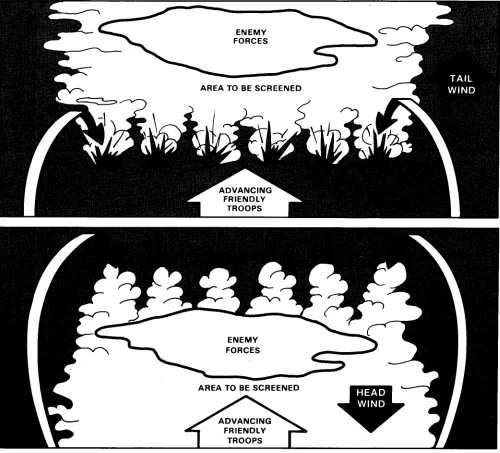
placed on enemy strongpoints. Figure 2-3 shows the positioning of an On defense, hasty smoke may be used to obscuring hasty smoke cloud on enemy forces for impede and disrupt enemy formations. It also may tail wind and head wind conditions. Figure 2-4 be used beyond the forward line of own troops illustrates screening smoke for flank and (FLOT) to silhouette Threat targets as they emerge quartering winds ahead of an advancing force. through the smoke and are engaged. Smoke Figure 2-5 is an example of mechanized units screens also may be used to conceal defensive generating a smoke screen for a counterattacking positions and cover disengaging and moving force.
[image:25.612.69.569.217.670.2]Deliberate Smoke
Large area smoke screens generally fall within the realm of deliberate smoke in that they are usually planned well in advance of the operation. Large area screening or the establishment of a smoke blanket or haze is generally carried out by the use of smoke generators. Generators usually are positioned in a line source configuration at a right angle to the prevailing wind direction. Usually, if the terrain allows it, the generators are evenly spaced along the smoke line. Generators are ideal for screening river crossings if the prevailing wind direction is upstream, downstream, or a tail wind.
The employment of large smoke is probably most effective if the screen is generated before sunrise when stable conditions and light-to-moderate winds are most likely. Screens generated in these conditions will remain close to the ground with only moderate vertical diffusion. Screens also reduce incoming solar radiation reaching the ground so that convective turbulence is suppressed, similar to overcast weather
conditions. Thus, smoke hazes and blankets can be maintained and remain useful for longer time periods.
The use of large area smoke screens in any area depends upon the prevailing wind direction. Operators must be prepared to shift their generators to preselected locations if the wind direction changes.
Tactical Considerations
In addition to the importance of wind direction, relative humidity, visibility, stability, and turbulence to the successful completion of a smoke mission, the effects of terrain and soil conditions should be considered. Terrain effects discussed in Appendix C apply to smoke as well as NBC agents. A diffusing smoke plume also tends to follow the terrain-influenced surface winds. Also, in forests and jungles smoke has a tendency to be more evenly dispersed and to persist longer than over more open terrain.
mortar-delivered smoke but has very little direct effect upon screening or obscuring smoke. An impacting smoke munition bursting in soft soil loses effectiveness since part of the filling compound is driven into the dirt. In some cases, totally ineffective screens result if smoke munitions are delivered to a boggy or swampy target area.
A last point to consider involves wind direction effects upon smoke screens. Munitions
expenditures for a screen deployed in quartering wind conditions must be increased by a factor of about 1.5 over a flank wind direction condition. For head and tail winds, expenditures are three to four times those for flank winds. Thus, reduction in expenditures owing to visibility and relative humidity effects may be negated by wind directions.
Incendiaries
Weather conditions have little influence on incendiary munitions themselves. Wind and precipitation, however, may greatly influence the combustibility of the target and its susceptibility to fire spread. The purposes of incendiaries are to cause maximum fire damage on flammable materials and objects and to illuminate. Initial action of the incendiary munition may destroy these materials, or the spreading and continuing of fires started by the incendiary may destroy them. Incendiary materials used include gasoline gels, burning metals, incendiary mixes, and white phosphorus.
To be effective, incendiary munitions should be used against targets susceptible to fire or heat damage. A considerable part of the target must be flammable, so the fire can spread. Fire walls and cleared lanes offer some resistance to the spread of fires.
Winds assist in the effectiveness of incendiaries, increase the rate of combustion, and can spread fires downwind more rapidly. Actually, each large fire can create a wind system of its own. This wind system results from the tremendous heat generated and the resulting vertical wind currents. Incoming winds can feed more air to the fire. This increases the rate of combustion, which, in turn, can increase the wind. In extreme cases, this wind is called a fire storm and sometimes exceeds 60 knots.
Smoke, sparks, and flames fly in the direction of the wind. Incendiary strikes (at successive targets) should be planned to begin with the farthest downwind target and proceed upwind. This will prevent aiming points from becoming obscured by smoke traveling downwind of initial fires. Additionally, the position of friendly forces or facilities that must not be damaged must be
considered (in relation to the wind direction) when planning incendiary strikes.
Temperature, temperature gradient, and clouds have little if any effect on incendiaries. Humidity also has little effect upon incendiary munitions but may affect combustible material. Wood, vegetation, and similar material absorb some moisture from the air over a period. If relative humidities have been high for some time, as in the tropics, it may be more difficult to achieve combustion from incendiary action.
Rain or snowfall, even when light, can render grass and brush quite incombustible and make a continuing fire unlikely. Heavy timbers are not affected unless they have been exposed to long periods of precipitation. Combustible materials exposed to rain may be susceptible to fire damage, such as in mass incendiary attacks. In these attacks, the heat of combustion may be sufficient to dry combustible materials in the target area.
In regions of high humidities, such as the tropics, mass incendiary attacks generate tremendous amounts of heat, causing vertical wind currents. This rising air can cause thunderstorms, counteracting the effects of the incendiaries.
It is difficult to extinguish burning metals with water; a spray actually speeds the burning. Water surrounding the area of burning metals prevents fire spread. Water extinguishes burning phosphorus, but unconsumed particles will burn again when dry.
CHAPTER 3
Biological Agents and Nuclear Detonations
In a general war, US forces may be faced by an enemy capable of employing nuclear or biological weapons. The effects of weather and terrain on
Biological
In a general war, US forces may be faced by an enemy capable of producing and employing biological agents. These include disease-causing microorganisms (pathogens) and toxins. Toxins are biologically derived chemical substances that have desirable characteristics for use as biological warfare agents. Toxins may be natural or synthetic.
Biological agents will most likely be disseminated as an aerosol. Therefore, a basic knowledge of their field behavior is essential for estimating friendly vulnerability. These agents differ from chemical agents in some aspects of field behavior. Pathogens decay as a result of factors such as weathering. They also require time to invade a body and multiply enough to overcome the body’s defenses. This is known as the incubation period. This period may vary from hours to months, depending on the type of pathogen.
The following paragraphs discuss biological agent dissemination, weather effects, and terrain influences, and they briefly summarize the influence of these on biological agent field behavior.
Dissemination
Pathogens are most likely to be disseminated as aerosols. Toxins, on the other hand, may be disseminated as either aerosols or large liquid drops. An aerosol is composed of particles containing pathogens or toxins. The force of the wind moves it along. At the same time, the aerosol spreads by turbulent diffusion.
Biological agents that die rapidly are said to have a high decay rate. High wind speeds (10 to 20 knots) carry these agents over more extensive
biological agent aerosols and on nuclear weapons follow.
Agents
areas during the agent survival period. Multiple wind shifts occur at low wind speeds. These shifts may cause more lateral spread and downwind diffusion than higher speeds. Optimum effect depends on the nature of the agent and atmospheric conditions. Highly virulent (malignant) agents with low decay rates can spread over large areas (by low or high wind speeds) and still present a casualty threat. Virulent agents with higher decay rates employed under the same atmospheric conditions are much less effective.
Weather Effects
Air stability, temperature, relative humidity, pollutants, cloud coverage, and precipitation have an effect on biological agents.
Air Stability
Atmospheric stability influences a biological cloud in much the same way it affects a chemical cloud. However, biological agents may be more effective in lower concentrations than chemical agents. This is because of their high potency. A stable atmosphere results in the greatest cloud concentration and area coverage of biological agents. Under unstable and neutral stability conditions, more atmospheric mixing occurs. This leads to a cloud of lower concentration, but the concentration is sufficient to inflict significant casualties. The coverage area under unstable stability conditions is also reduced.
Temperature
received. Normal atmospheric temperatures have little direct effect on the microorganisms of a biological aerosol. Indirectly, however, an increase in the evaporation rate of the aerosol droplets normally follows a temperature increase. There is evidence that survival of most pathogens decreases most sharply in the range of -20°C to -40°C and above 49°C. High temperatures kill most bacteria and most viral and rickettsial agents. However, these temperatures will seldom if ever be encountered under natural conditions. Subfreezing temperatures tend to quick-freeze the aerosol after its release, thus decreasing the rate of decay. Exposure to ultraviolet light—one form of the sun’s radiation—increases the decay rate of microorganisms. Ultraviolet light, therefore, has a destructive effect upon the biological aerosol. Most toxins are more stable than pathogens and are less susceptible to the influence of temperature.
Relative Humidity
The relative humidity level favoring employment of a biological agent aerosol depends upon whether the aerosol is distributed wet or dry. For a wet aerosol, a high relative humidity retards evaporation of the tiny droplets containing the microorganisms. This decreases the decay rate of wet agents, as drying results in the death of these microorganisms. On the other hand, a low relative humidity is favorable for the employment of dry agents. When the humidity is high, the additional moisture in the air may increase the decay rate of the microorganisms of the dry aerosol. This is because moisture speeds up the life cycle of the microorganisms. Most toxins are more stable than pathogens and are less susceptible to the influence of relative humidity.
Pollutants
Atmospheric pollutant gases can also affect the survival of pathogens. Pollutant gases have been found to decrease the survival of many pathogens. These gases include nitrogen dioxide, sulfur dioxide, ozone, and carbon monoxide. This could be a significant factor in the battlefield over which the air is often polluted.
Cloud Coverage
Cloud coverage in an area influences the amount of solar radiation received by the aerosol. Thus, clouds decrease the amount of destructive ultraviolet light the microorganisms receive. Cloud coverage also influences factors such as ground temperature and relative humidity, as discussed in Chapter 1.
Precipitation
Precipitation may wash suspended particles from the air. This washout may be significant in a heavy rainstorm but minimal at other times. High relative humidities associated with mists, drizzles, and very light rains are also an important factor, These may be either favorable or unfavorable, depending upon the type of agent. The low temperatures associated with ice, snow, and other winter precipitation prolong the life of most biological agents.
Terrain Influences
Soil, vegetation, and rough terrain influence a biological agent aerosol.
Soil and Vegetation
Soil influences a biological agent aerosol as related to temperature and atmospheric stability. Appendix C discusses the interrelationship between soil and these weather elements.
Vegetation reduces the number of aerosol particles. Impact of the suspended particles upon trees and grass causes some particles to settle, and this settling reduces agent concentration. However, vegetative cover reduces exposure to ultraviolet light, increases relative humidities, and may reduce temperatures (while fostering a neutral temperature gradient). All these factors favor the survival of wet aerosols.
Rough Terrain
Rough terrain creates wind turbulence, and turbulence influences the vertical diffusion of aerosol. This turbulence reduces agent effectiveness and area coverage. Terrain affects the path of the aerosol
Nuclear Detonations
When a nuclear explosion occurs, blast radiation and heat or thermal effects will occur. The influence of weather and terrain on these effects will be discussed in this section. When a nuclear weapon detonates at low altitudes, a fireball results from the sudden release of immense quantities of energy. The initial temperature of the fireball ranges into millions of degrees, and the initial pressure ranges to millions of atmospheres. Most of the energy from a nuclear weapon detonation appears in the target area in the form of three distinct effects. These are nuclear radiation, blast, and thermal radiation.
Nuclear Radiation. Neutron and gamma
radiation from the weapon detonation produces casualties and, in many cases, material damage as well. Ionized regions, which may interfere ‘with the propagation of electromagnetic waves associated with communication systems and radars, result when the atmosphere absorbs nuclear radiation.
Blast. A blast wave with accompanying drag
effects travels outward from the burst.
Thermal Radiation. Intense thermal
radiation emits from the fireball, causing heating and combustion of objects in the surrounding area. In the detonation of a typical fission-type nuclear weapon, the percentage of the total energy appearing as nuclear radiation, blast, or thermal radiation depends on the altitude at which the burst takes place (subsurface, surface, or air) and on the physical design of the weapon. For bursts within a few kilometers above the earth’s surface, slightly more than 50 percent of the energy may appear as blast, approximately 35 percent as thermal energy, and approximately 15 percent as nuclear radiation.
Certain weather conditions will influence the effects of nuclear weapons. Likewise, different types of terrain will also influence the effects of nuclear weapons. In addition to these considerations, the type of operation can have a direct bearing on weather and terrain effects on nuclear weapons use.
Nuclear Radiation
When a nuclear explosion occurs, one usual result is the well-known mushroom-shaped cloud. This cloud may extend tens of thousands of meters, and in the case of a surface burst or
shallow subsurface burst, it is a tremendous vertically developed aerosol cloud bearing radioactive material. The effect of wind speed and direction at various altitudes is of particular interest. These factors are of great importance in predicting the location(s) of the fallout that may result from a nuclear explosion.
The effects of weather and terrain apply to both the initial and residual effects of nuclear explosions, although this section will primarily address the residual aspects. For more information on the effects of weather on both initial and residual effects, refer to FM 3-3.
Precipitation
Precipitation scavenging can cause the removal of radioactive particles from the atmosphere. This is known as rainout. Because of the uncertainties associated with weather predictions, the locations that could receive rainout cannot be accurately predicted. Rainout may occur in the vicinity of ground zero or the contamination could be carried aloft for tens of kilometers before deposition. The threat of rainout especially exists from a surface or subsurface burst. Vast quantities of radioactive debris will be carried aloft and be deposited downwind. However, rainout may cause the fallout area to increase or decrease and also cause hot spots within the fallout area.
For airbursts, rainout can increase the residual contamination hazard. Normally, the only residual hazard from an airburst is a small neutron induced contamination area around GZ. However, rainout will cause additional contaminated areas in unexpected locations.
Yields of 10 kilotons or less present the greatest potential for rainout, and yields of 60 kilotons or more offer the least. Additionally, yields between 10 kilotons and 60 kilotons may produce rainout if the nuclear clouds remain at or below rain cloud height.
Wind Speed and Direction
Wind speed and direction at various altitudes are two factors that determine the shape, size, location, and intensities of the fallout pattern on the ground because contaminated dirt and debris deposit downwind. The principles and techniques of fallout prediction from winds-aloft data are in FM 3-3. Surface winds also play an important role in the final location of fallout particles. Just as snow falls on pavements or frozen surfaces and surface winds pile it in drifts, so, too, can local winds cause localization of fallout material in crevices and ditches and against curbs and ledges. This effect is not locally predictable, but personnel must be aware of the probability of these highly intense accumulations of radioactive material occurring and their natural locations.
Clouds and Air Density
Clouds and air density have no significant effects on fallout patterns.
Terrain Contours
Ditches, gullies, small hills, and ridges offer some protection against the gamma radiation emanating from the contaminated area. Terrain contours also cause local wind systems to develop. These wind systems will affect the final disposition of fallout on the ground, creating both hot spots and areas of
pattern.
Heavy Foliage
Heavy foliage can
low-intensity within the
stop some of the fallout from reaching the ground. This may reduce the intensity on the ground.
Soil
Soil surface materials (soil) at the burst site determine particle size (large or small). The particle size helps determine when and where most of the fallout will reach the ground, the larger particles settling first. Composition of the soil near ground zero will materially affect the size and decay rate of the pattern of residual radiation induced by neutrons from the weapon.
Type of Operation
Temperature and terrain can also influence the effects of nuclear radiation on tactical operations. The effects of cold weather, desert, jungle, mountain, and urban operations on nuclear defense planning follow.
Cold Weather Operations
Weather conditions limit the number of passable roadways. Radiological contamination on roadways may further restrict resupply and troop movement. Seasonal high winds in the arctic may present a problem in radiological contamination predictions. These winds may reduce dose rates at ground zero. At the same time, they extend the area coverage and create a problem for survey/monitoring teams. Hot spots or areas of concentrated accumulation of radiological contamination may also occur in areas of heavy snow and snow drifts.
Desert Operations
Desert operations present many varying problems. Desert daytime temperatures can vary between 90°F to 125°F (32°C to 52°C). These temperatures create an unstable temperature gradient. However, with nightfall, the desert cools rapidly and a stable temperature gradient results. A possibility of night attacks must be considered in all planning.
Nuclear defense planning in a desert is generally much the same as in other areas, with a few exceptions. Lack of vegetation and permanent fixtures, such as forests and buildings, makes it necessary to plan for and construct fortifications. Construction may be difficult because of inconsistencies of the sand. However, sand, in combination with sandbags, gives additional protection from radiation exposure. Blowing winds and sand make widespread radiological survey patterns likely. The varying terrain may make radiological survey monitoring very difficult.
Jungle Operations