A Demand of Reason:
Dependence in Logic and Probability
MSc Thesis(Afstudeerscriptie) written by
Nathaniel Forde
(born April 6th, 1987 in Dublin)
under the supervision of Dr. Sonja Smetsand Prof.dr Martin Stokhof, and submitted to the Board of Examiners in partial fulfillment of the requirements for the degree of
MSc in Logic
at the Universiteit van Amsterdam.
Date of the public defense: Members of the Thesis Committee:
September 2nd, 2013 Dr Maria Aloni
Dr. Ing. Robert van Rooij Dr Sonja Smets
Abstract
Acknowledgements
“I get by with a little help from my friends”. In particular, this thesis would never have begun were it not for Paal - who taught by example. In 2011 I resolved to “try with a little help from my friends” this thing called logic. Looking back “when I was younger, so much younger than today” I can’t say that “I never needed anybody’s help in any way.” The first semester in Amsterdam was tough. Learning logic often seemed like trying to “speak double dutch to a real double duchess.” To my friends, I have to say “I do appreciate you being round” you helped me “get my feet on the ground.” This can’t be overstated, for the “greatest thing you can ever do/ Is trade a smile with someone who’s blue.” Even now, after we’ve “come together” I feel oddly grateful for the “hours that the clock cannot define” spent in the seemingly shared agony of the MoL. But beyond the MoL, the support of my family and friends back home made this adventure possible - “I’d be lost if not for you/ And you know it’s true.” In particular I owe my brother Jamie; his ambition is always an inspiration. There is not enough room to thank my parents in full. Their tolerance is appre-ciated, especially given that “[on] this obstacle course/... it [often] seems I’m getting nowhere” trying to “ride the concept of the horse” while ignoring practical alternatives. Finally, and most directly, this thesis would not have been finished without Sonja and Martin, who kindly agreed to jointly supervise my fumbling efforts. That we managed to distil anything at all from my initial enthusiastic ramblings is a testament to their patience and prodding. Their insightful questions more often than not broke the“paralysis of analysis” which prevents pen from contacting paper. I hope you both find the final product somewhat satisfying and not entirely false - its completion almost made me “insane in da brain.”
Contents
Preface 3
1 Arguably True: Underdetermination Problems 7
1.1 Introduction: Goodman’s Riddle . . . 7
1.2 Truth Approximation . . . 9
1.2.1 Theory Choice and IBE . . . 9
1.2.2 Simplicity: Reconsidered . . . 11
1.2.3 Simple Logic: Toward Formalising Simplicity . . . 13
1.3 Choice Criteria and Reliability . . . 15
1.3.1 Generalising the Picture . . . 16
1.4 Conclusion . . . 18
2 Probably True: Gradations of Possibility 19 2.1 Introduction: A Quantitative Model of Belief . . . 19
2.1.1 Bayesian Probability Theory . . . 19
2.2 Bayesian Confirmation Theory . . . 25
2.3 Problems and Prospects . . . 30
2.3.1 Dostoyevsky’s Challenge . . . 30
2.3.2 Ignoring Ignorance . . . 31
2.3.3 The Problem of Mother Mary . . . 32
2.4 Conclusion . . . 34
3 Plausibly True: Qualitative Rankings 35 3.1 Introduction: A Qualitative Model of Belief . . . 35
3.2 Epistemic Logic . . . 35
3.2.1 The Syntax . . . 36
3.2.2 The Interpretation and the Semantics . . . 36
3.2.3 The Problem of Logical Omniscience . . . 38
3.2.4 Epistemic Doxastic Logic . . . 41
3.2.5 Conditional Belief . . . 43
3.3 Justification Logic . . . 46
3.3.1 The Syntax and Axioms . . . 47
3.3.2 The Model and the Semantics . . . 49
3.3.3 Logical Omniscience: A Solution . . . 51
3.3.4 Belief via Justification . . . 51
3.4 Conclusion . . . 53
4 True: Structural Commitments 54 4.1 Introduction: Species of Evidence . . . 54
4.2 Abduction . . . 54
4.2.1 The Gettier Problem . . . 55
4.2.3 The Rule Following Objection . . . 59
4.3 Epistemology and Structural Information . . . 61
4.3.1 Epistemology of Mathematics: A Hard Case . . . 62
4.3.2 The Logic of Full Ground . . . 65
4.3.3 Relevantly Verified? . . . 67
4.3.4 Our Hard Case Reconsidered . . . 68
4.4 Grounding and Explanation: A Model to Mimic . . . 69
4.4.1 Explanations and Expectation . . . 70
4.4.2 Our Hard Case Again . . . 72
4.5 Generalising the Picture . . . 73
5 Because: Identified Dependency 76 5.1 Introduction: Patterns of pattern seeking . . . 76
5.1.1 Mathematical Preliminaries . . . 77
5.2 Bayesian Networks . . . 79
5.2.1 Quantitative Bayesian Networks . . . 81
5.2.2 The d-separation Criterion . . . 82
5.3 Causality and Model Testing . . . 84
5.3.1 The Suppression Test . . . 84
5.3.2 Simpson’s Paradox . . . 85
5.3.3 Identification of Causal Effects by Model Preference Algorithms . . . 86
5.4 Causal Reasoning . . . 88
5.4.1 The Logic of Causal Dependence . . . 89
5.4.2 Causation or Causal Dependence . . . 90
5.4.3 Explanation and Causation . . . 93
5.5 Conclusions . . . 95
6 Arguably, arguably true: Objections and Replies 97 6.1 Introduction . . . 97
6.2 The Two Axes: Systematic concerns . . . 97
6.2.1 Explanatory relevance and Justificatory update . . . 98
6.2.2 Dynamic Update and Explanation as Public Announcement . . . 99
6.2.3 Explanations: Specifying the Preconditions and Postconditions . . . 100
6.2.4 Common Knowledge: Controversial Explanations . . . 102
6.2.5 Belief Revision for Identifying Explanations . . . 103
6.2.6 Gettier Again: Knowledge as Convergence under Conflict Resolution . . . . 104
6.3 Structural Realism . . . 105
6.4 Constructive Empiricism . . . 106
6.5 Pragmatics of Explanation . . . 109
6.5.1 Explanation as Answer . . . 109
6.5.2 Evaluating Answers . . . 111
6.5.3 Counterfactual dependence and Relevance . . . 111
6.5.4 The Quantum Counterexample . . . 112
6.6 Structural Realism: An Offensive Defence . . . 112
6.6.1 Evolutionary Epistemology and The Ultimate Argument are consistent . . 113
6.6.2 Microphysics does not entail Constructive Empiricism . . . 113
6.6.3 Constructive Empiricism requires Abstracta . . . 114
6.6.4 Constructive Empiricism is inconsistent or perverse. . . 115
6.7 Conclusion . . . 117
Conclusions 118
Preface
Reason makes this demand in accordance with the principle that if the conditioned is given, the entire sum of the conditions, and consequently the absolutely unconditioned... is also given. - Kant inThe Critique1
Introduction
This thesis is best viewed as a polemic. The target of the polemic is certain kind of specialisation in philosophy; namely, formal epistemology. We seek to argue that current models in formal epistemology are plagued with problems. On a more positive note we suggest that the solution to these problems becomes clear if we simply stop treating the epistemic and doxastic notions as unanalysed primitives. We seek to unpack the notions of belief and knowledge in such a way so as to reveal the evidence which underlies our beliefs and knowledge. To do so we explicitly link formal epistemology with formal ontology. The broad moral of this thesis is simple:
No formal epistemology without formal ontology.
Less enigmatically, we seek to elaborate the conditions under which reasonable belief arises. To do so we find that we have to draft principles of inference which respect the natural dependency structures between the occurrence of the events about which we reason. Ultimately we wish to show that the idealisations which underlie traditional models of knowledge and belief are inappro-priate to cash out any notion of rational belief or knowledge. But by including these dependency structures we can suitably amend our models of belief to capture various species of rational in-ference. In particular this approach allows for the development of a theory of explanation in a dynamic epistemic setting. To develop this conclusion we argue in the following pattern.
Abstract Thesis Structure
Structurally the thesis is split into two sections. The first three chapters are spent initially on elaborating a problem for epistemology generally; namely underdetermination of rational belief, and secondly we develop two paradigmatic models of formal epistemology. The hope is that by establishing these models we can address the underdetermination problem. The idea here is that (a) one necessary condition for any model of formal epistemology is that the model be able to articulate the traditional problems of epistemology and that (b) a condition of adequacy for any model of formal epistemology is that it be able to address the traditional problems of epistemology. In other words, we ought be able to formally model the resolution of those problems. We first show that the traditional models of formal epistemology do not satisfy either constraint, hence we rec-ommend an alteration of such models. On a positive note we draw an instructive moral from the failings of our epistemic doxastic models. With this moral in hand we turn to the second section (i.e the last three chapters) of our thesis.
In this part of the thesis we aim to augment our epistemic doxastic models by the inclusion of structural dependency information. For instance, we shall focus in chapter five on how our knowl-edge of a certain kind of explanatory relation subsists on the observations of causal dependence. With this augmented model we show how we may resolve or dissolve the earlier underdetermi-nation problems. Of the last three chapters, our fourth chapter is spent presenting an argument for why the inclusion of structural dependency information can play a positive role in our models of knowledge and belief. Our fifth chapter compounds this argument by giving an example of an epistemic doxastic model which is positively improved by the inclusion of structural dependency information. In our sixth and final chapter we set ourselves two tasks: on the one hand we aim to suggest the shape of future work in which we can develop a model of explanation as an update operation of suitably detailed information states. These suggestions are just that. On the other hand, we defend our postulation of real (extant) dependency structures against van Fraassen style objections to our brand of structural realism. We take our defence to be more than adequate. On this we conclude.
Detailed Thesis Structure
Chapter 1: Arguably True In this chapter we present Goodman’s grue paradox as an underdetermination problem for the notion of rational belief. That is to say we use Goodman’s argument to suggest that belief is always question begging and knowledge unattainable. The majority of this chapter is spent informally developing the notion of theory preference and choice, in such a way that there is reason to reject the grue-hypothesis. We draw on the work of Kevin Kelly and Peter Lipton in our discussion of theory preference and argue that underdetermination results pose a problem in so far as they motivate a search for non-obvious choice criteria. We conclude this chapter with a general discussion of underdetermination problems and the structure of their solution, drawing on the work of Clark Glymour. These observations play a motivating role in all which follows since the underdetermination problem provides a test of adequacy for our models of formal epistemology.
Chapter 2: Probably True In this chapter we seek to elaborate the grue problem in the standard Bayesian model of belief. The hope is that such an elaboration will be able to accommo-date the kind of solution we glossed in the informal discussion of undetermination problems in the previous chapter. This fails. We then develop some criticisms of the Bayesian model, not least of which is the failure to cope adequately with underdetermination problems. We also consider the role of Bayesian theory as against some famous results in the psychology of reasoning drawing here on the work of L.A. Paul and Kahneman and Tversky. We conclude the chapter with a recogni-tion of the limits of the Bayesian model, in particular the failure to capture the norecogni-tion of when a statistical correlation encodes evidentiary relevance. The main point of this chapter is that the notion of belief is not well understood on a Bayesian setting. We follow van Fraassen’s voluntarist position in this conclusion.
Chapter 4: True In this chapter we seek to show (a) how underdetermination problems underlie many of the issues which afflict both Bayesian and Hintikka style models of knowledge and belief, and (b) how the incorporation of structural dependencies information can be used to avoid such underdetermination problems, and (c) how such structural information can be used to define multiple notions of evidentiary relevance. We conclude this chapter by showing how to link Kit Fine’s logic of grounding relations with a species of justification logic. In this way we hope to circumscribe a species of justification based on a particular kind of dependency relation. We deploy these considerations in the evaluation of Benacceraf’s famous dilemma.
Chapter 5: Because In this chapter we elaborate a model of causal dependence discussed by Judea Pearl, and formalise the logic causal dependence defined by Pearl and Halpern. The idea is to show that the abstract discussion about the role of dependency relations in last chapter, can be made concrete. We apply this to the consideration of the grue-paradox, and show that the latter is resolved. We further argue with Pearl that the failure to incorporate such dependency relations in our models effectively cripples our ability to provide reasonable models of the world, and hence cripples our ability to draw reasonable inferences. This is not quite a reductio of the alternatives, but it does demonstrate the kind of impoverishment afflicting the standard models of formal epistemology.
Chapter 6: Arguably, arguably true In this chapter we sketch some ideas for the fur-ther development of a model of explanation as a species of information update, based upon the foregoing discussion of evidentiary relevance and justification logics. Perhaps more significantly we defend the species of structural realism we have hitherto elaborated. The nature of the defence is largely offensive. We attack van Fraassen’s theory of constructive empiricism as an adequate of model scientific reasoning, thereby (we hope) motivating our modest postulation of effectively unobservable dependency structures.
Conclusion We conclude by situating our discussion amongst some existing models of expla-nation. Ultimately we recommend that our approach is both complementary of most such models, and an improvement on all. We credit this result to the explicit inclusion structural dependen-cies within our epistemic considerations. So we recommend further research in the intersection of formal epistemology and formal ontology.
How to (Quickly) Read this Thesis
If this all sounds eminently reasonable, non-trivial and beyond refutation feel free to stop reading now, otherwise please continue.
How to Read this Thesis
Chapter 1
Arguably True: Underdetermination
Problems
I choose my friends for their good looks, my acquaintances for their good characters, and my enemies for their intellects. A man cannot be too careful in the choice of his enemies. - Oscar Wilde
1.1
Introduction: Goodman’s Riddle
We shall argue that a particular kind of underdetermination problem admits a solution. Crucially, we shall treat underdetermination as a problem for rational choice, rather than a mere fact of theory construction. In this chapter we present the issue and in later chapters we treat it as a paradigmatic instance of a general form of problem we wish to solve.
The Problem
Assume that a law of the form ∀x(Ex → Gx) whether scientific or otherwise, is confirmed by its instances. So naturally, any well established record of a universal claim which accords with the facts, might be taken to confirm our hypothesis to a high degree. In particular, we might think that if every emerald hitherto observed has been seen to be green, the claim that all things, if they are emeralds are green, is true. If this law holds, then it supports counterfactual reasoning about emeralds. For then we know that for some particular jewel, if it were an emerald, it would be green. We might even be tempted to say that this law is an explanation for both our current information and our expectations. So clearly many issues depend on our ability to endorse such a law. However, there is a problem. Nelson Goodman argues1 that we cannot exclusively endorse
one law on the basis of our evidence. There are many mutually exclusive laws which are compatible with our evidence, and so the appeal to explanatory laws is fundamentally underdetermined. Why this law, and not another?
Illustration
By way of example observe that we may define a law to accord with our evidence but that differs from the intuitively agreeable hypothesis. Suppose that you encounter an advocate for the grue-hypothesis; that is the claim that ∀x(x is an Emerald, → x is Grue), where Grue is a colour that changes upon time-indexed instances of observation. In particular, our antagonist claims that all emeralds are grue just when all emeralds observed before the year 2015 are seen to be green, and all emeralds observed after the year 2015 are seen to be blue. As such our current information equally confirms the hypothesis that all emeralds are green, as much as it confirms our antagonist’s claims. Fundamentally this becomes a problem of determining which theory provides the more plausible
explanation. If you accept that plausibility rankings are arbitrary, then we have no non-arbitrary reason to prefer one hypothesis over the other. This comes to the view that all explanatory laws are equally viable. If you claim our ranking is non-arbitrary and provide a criteria by which to rank explanatory laws, then the sceptic can easily generate alternative criteria which results in the inverse ranking of explanatory hypotheses. So it appears that we have no motivation to accept any explanation or a theory of explanation. This is an intolerable sceptical thesis which seems to motivate the view that all explanatory laws are equally plausible so long as they are consistent with what we know.
Connected Problem
This problem repeats in a more obviously pernicious fashion if we consider counterfactual reasoning. Any counterfactual claim which states that ψ would be true, if it were the case that φ can only be judged true when we are in a position to know, putting it bluntly, that φ was relevant to the evaluation ofψ.2 If we can’t determine relevance, then we can’t evaluate counterfactuals. Following Hume, this is also a clear statement of a problem which plagues any account of inductive reasoning. For if it’s not clear over which counterfactual situations in which φ is relevant to ψ, it’s not clear in which future states φ is relevant to the truth of ψ. In effect Goodman’s argument prompts the conclusion that we impose our arbitrary individual standards of relevance on inductive and counterfactual reasoning. We do so because we wish to endorse the emerald-hypothesis and reject the grue-claim.
Discussion
It might be natural to suggest that there is always some law available to introspection which assures the connection between the antecedent φand the consequent ψ. However, the formulation of this law requires that we specify (a) the compatibility or cotenability of our antecedent with our conse-quent, and (b) the necessary or plausible connection between the truth of the antecedent, in some specific situation, and the truth of the consequent. Given that the specification of (b) is arguably difficult to defend a posteriori for Humean reasons, we might hope it admits an a priori justifi-cation... unfortunately such a presumption is unwarranted in general. Worse, we are faced with the problem of circularity since the specification of (a) involves the elaboration of a counterfactual which ensures the contenability of the antecedent and consequent in all counterfactual situations. In other words, we need to say that if it were the case that φ, then ψ is never an unreasonable hypothesis. Usually we would spell out why ψ is a reasonable hypothesis with reference to some law or other which is assumed to hold over said counterfactual situation. Loops beckon.
For example the claim “If it were the case that your jewels were emeralds, then your jewels would be green” relies on the implicit premise that “if anything is an emerald, it would always be a green jewel”. As such, no counterfactual can be understood without the understanding of counterfactuals; specifically the laws involved in our projections across counterfactual situations. This is either a circle or a regress which proves problematic if we seek to justify the laws we use. But do we even have a good grasp of the laws governing our projections? In other words, can we give an a priori specification of when a particular inductive generalisation is warranted? Can we inductively learn when our best information about emeralds is suitably secure so that it motivates a unrestricted projection of our candidate law across all possible situations? Goodman’s riddle is an argument to the effect that we do not have a clear grasp of the validity of our projective estimates because we cannot say when a particular law is relevant to the assessment of a given hypothesis. This does not entail that we cannot argue for our preferences.
2We’re not assuming any particular notion of relevance, but this could be fleshed out either in terms of
Preliminary Conclusion
Two schematic solutions suggest themselves. Either adopt a primitive ranking of explanations and concede that our ranking of such explanations is not epistemologically transparent i.e. that we are ignorant of why the grue-hypothesis is implausible, or we can accept some such explanations as self-explanatory. The latter move is problematic because it leads to the mentioned regress, if the self-explanatory law is contestable. We can have explanatory chains which admit a benign regress, and take our preference ranking on explanations to be a non-transparent primitive. So for instance, we might explain a counterfactual claim in terms of the laws which underlie it, and the validity of laws in terms of the intuitively correct counterfactuals they support, while at the same time confessing ignorance about what makes a counterfactual intuitively correct. The process from which we reason on our ranking of explanatory laws is called the inference to the best explanation, in which we accept some explanatory laws just when we have determined it to be best of the avail-able options. The open question is whether our best option is a true option? The assumption that we get it right, is often called the process of over-fitting, in so far as it risks a presumption that the world might not fit the laws we choose to project. Nevertheless, we reason by counterfactual considerations, and they seem to require projective laws. Furthermore over-fitting clearly works evidenced by the survival (to date) of our species; the riddle of induction is that we can’t clearly say why it works.
You might think that over-fitting works because the laws which we choose are simply true. Not a radical idea admittedly, but at least now we have a tractable question. What reason do we have to believe that our law-like projections, and the theories in which they fit, are true? The hope is that if we can answer such a question we might be able to provide a motivation for the plausibility ranking of our possible explanations.
1.2
Truth Approximation
One reason to think our procedures of inference get it right is that the more effective our theory is, the more likely that it approximates the truth. Theory improvement occurs, so theory im-provement makes it reasonable to think that our theories increasingly approximate truth.3 Our theories improve because we incessantly make minor choices and adaptations to our theories in the aim of making them more explanatory or predictively accurate. We choose, for instance, to admit green emeralds and deny the grue-hypothesis. But in what sense is the grue-hypothesis worse than the alternatives? In this chapter we will argue that there are good reasons to reject the grue-hypothesis, because our theories increasingly approximate the truth and simplicity in theory choice can be used to rule out the grue-hypothesis.
1.2.1 Theory Choice and IBE
The process of inference to the best explanation is not a species of deduction. So by Goodman’s reasoning any hitherto reliable appeal to a particular explanation will fall victim to one or other underdetermination scenario. This by now is familiar. Reliance on one or other explanation rests on an implicit premise regarding the uniformity of nature, but this uniformity cannot be projected into the future without begging the relevant question. Nevertheless, such projective estimates are regularly employed. This is in line with Goodman’s observation that the problem of induction does not indicate defective reasoning so much as it highlights the mystery of what makes inductive reasoning valid. Why are some explanations projectable, and others not? Consider the following process. Upon observing a particular event [ψ] for which they seek an explanation each agent
runs a comparative ranking of a short-list of theories determined to be viable by their background theory or beliefs. Now allow that this comparative ranking is effective or highly reliable.
Objection
Since the short-list of viable theories necessitates an exclusion of other theories we have no reason to think that the true theory will be in our short list. Taking this together, we might think that inference to the best explanation provides no assurance of truth whatsoever, because whatever short-list an agent generates cannot be thought of as privileged.
Response
Lipton4 rejects this thought, on the basis that for any comparative ranking we need only insist that the short-list contain contrary explanatory theories. Since our process of comparative ranking is effective we now know that one of the contraries is more likely true. Hence, for any short-list we zero-in on the truth in a piece meal manner.
Objection
The short-list ranking is always apt to generate the simplest explanation, and the simplest expla-nation is always the easiest, so not necessarily the truth. Hence new theories are unlikely to be any more accurate than our background theory.
Response
This is clearly false. We are not trapped by the acceptance of one false belief to a steady increase in the falsity of our beliefs just because we seek conformity with our initial false belief. We don’t merely seek conformity. So apart from being descriptively false, there is another problem with the view that comparative choice always favours the simplest explanations.5
Reflection
If you wished to maintain that scientists naively seek only simplicity or conformity, then you should reject the view that they can reliably rank any generated short-list of theories. Reliability is surely a guide to the truth, and simplicity alone is not. The reliability of the ranking mechanism entails the reliability of theory choice. Whereas the insistence on unnuanced simplicity ( or some other ideological preference) contradicts the notion that our theory choice is truth-apt because it allows for the acceptance of a theory which is arbitrarily far from the truth.
Evidently we arrive at our background theory on the basis of a prior ranking, but if (as we’ve supposed) our method of comparative ranking is reliable then the background theory is supported as the result of a reliable mechanism. So we should expect to zero-in on the truth, because each stage of comparative analysis ensures increased accuracy by the iterative winnowing of poor choices. This motivates the following claim:
If a scientist knows her method of ranking is reliable, then she is also in a position to know that her background is probably true, which entails she is capable of absolute evaluation....So the initially plausible idea that scientists might be completely reliable rankers yet arbitrarily far from the truth is an illusion.6
4 [64] 5
Even accepting that there is a phenomenon of confirmation bias, this by no means entails that we seek to confirm our beliefs by the simplest methods. Consider the exponential growth of complexity accompanying questionable conspiracy theories.
6
Returning to the grue problem, we can see that this argument suggests that projectable ex-planations are required to be in conformity with some details of our background theory. This is just question begging if we mean that the projectable explanatory laws are simply those which are a generalisation of our hitherto observed evidence. In the grue-case, such a move is clearly too simple. However, we can seek to exclude the grue-case, not on the basis of it’s unintuitive nature, but rather as a result of a broader categorical restriction. So you might suggest that our theory construction procedures have winnowed the notion of time indexed colour change from plausibil-ity. This does not require that conformity with our accepted beliefs is the only or over-riding factor in theory choice. But where experience attests to the static nature of colour-properties, the burden of proof surely rests with the grue-advocate, especially if grue is the unique time-indexed colour. So at least we have no reason to accept the grue-hypothesis. This constitutes some progress.
1.2.2 Simplicity: Reconsidered
If we consider more general objections to the view that our theories approximate truth, they seem to require that we reject the assumption that we are any good at comparative ranking of theories, but this collapses into radical scepticism which is at least false if not also incoherent. A particular objection to this view questions the effect of simplicity as a criterion for theory choice. Above we saw a claim that the over-riding concern for simplicity will lead us astray, in such a way that we cannot expect to converge on the truth. But is this true?
There is undoubtedly a role for simplicity to play in the adjudication of preference, for as Kevin Kelly observes
Ockham’s razor is not a bloodless, formal rule that must be learned - it has a native visceral grasp on credence...Empirical simplicity is more than mere notational brevity - it implies such red blooded considerations as explanatory power, unity, independent confirmable principles and severe testability.7
That said, Kelly argues convincingly that simplicity as the sole criteria for preference involves a viscous circularity of reasoning. Ockham’s razor cuts cleanly, but thankfully it is not the only instrument available to us. This is just as well, for as Kelly argues we cannot suppose that simplicity is a short term guide to truth without presupposing the inherent simplicity of nature. The claim that privileging simplicity in all choices will ensure that we shall eventually converge on the truth after incessantly running through all options repeatedly until our theory comes to fit the data, is a very weak claim. Any choice function based on nearly any criterion will eventually converge to truth in the ideal limit of inquiry. But in each of these cases we would not think that the preference-rankings prompted by these singular choice criteria are reliable. For effective choice we need to augment our decision criteria.
Effective Test on Theory choice
We might hope that a choice function converges on the truth just so long as there is an accurate test procedure for after choices are made, such that failure of the test prompts renewed choice and explicit rejection of the failed theory. In effect Kelly argues8 for exactly this, when he states that the use of Ockham’s razor in empirical circumstances leads efficiently to the truth because the range of any empirical inquiry is finite due to our restricted focus over the class of possible theories. The idea is that our choices must eventually accord with the truth fully because a scientist needs to ensure that any new information is consistent with our old (presumed true) information.9 At each stage of inquiry there is check for the simplest theory compatible with the accrued experience
7
Section 1 of “Simplicity, Truth and Probability” in [11] forthcoming.
8
Sections 6 and 7 of the aforementioned essay in [11] forthcoming
of an agent. Accrued experience brings with it new observations which are taken to be true, and since consistency is an effective method of test, we can see that if the world is logically consistent, and our prior information was correct then Ockham’s razor in empirical situations converges to the truth.
Of course, if our prior information was achieved by an application of Ockham’s razor, we are back to square one. But since our methods of decision are based on more than considerations of brute simplicity, we need not worry overly much. Reasoning from true premises with a concern for simplicity is a reliable strategy so long as the truth of our premises wasn’t established by appeal to Ockham’s razor.10 Hence Lipton’s argument is correct, concern for simplicity alone allows that we can develop a theory which is arbitrarily far from the truth. However, for any effective method of decision, we can expect to converge on the truth after successive stages of inquiry.
The Grolour Argument
Now suppose that before the grue advocate there was a Grolour advocate. The Grolour hypoth-esis is the statement that all colours are time indexed. That is, every conceivable shade has a time parameter - after which the shade shifts by an observable degree anywhere the colour was instantiated. More precisely, allow that the infinite number shades were arrayed so that from the beginning of time objects have been shifting their shades every hour. Now the Grolour hypothesis could be refuted if we were to array objects of every shade and note the total failure to change colour. No one has had the time to bother or the relevant paints. Nevertheless no one is a Grolour advocate any longer. Why?
Take the needless complexity of the theory to be an indicator of it’s falsity, and cite Ockham’s razor as our criterion of choice, then we have a reason to reject the Grolour hypothesis. In particu-lar, note that the Grolour hypothesis makes all our intuitive colour terms derivative constructs from the primitive vocabulary of time-indexed colours. If this is not reason enough, observe that if the grue-hypothesis is reasonable, the Grolour hypothesis would prompt innumerable specific grue-like hypotheses. In these situations you can imagine some enterprising young individual who predicts a specific colour change for the hour in question. The likelihood of predictive success is infinitesimal (even if the Groulor hypothesis were true!), and so any attempt to support the Grolour hypothesis by grue-like claims will (I’ll bet) fail. However, the reverse is true if we argue against the Grolour hypothesis. Each prediction of a static colour instantiation has been borne out by the testimony of experience.11 Now note that the grue-advocate is arguably committed to the Grolour hypothesis. By what standard could they deny it? If they can offer a reason for restricting change-parameters to blue/green, we can surely cite the same reason for denying even that! If they accept the Grolour hypothesis they have a poorly confirmed theory, even if the specific grue-hypothesis is equally well confirmed as the alternative green-hypothesis. As such we should reject the grue theory because either it entails a falsity or is itself arbitrary and question begging.
10In Kelly’s setting, this reasoning is depicted as an inquiry problem (K, Q) which asks us to use the information
we know K about observable effects in the world to choose an answer to a particular question Q which is a partition of optional theories and the empty set depicted as “?”. Ockham’s razor is a method M which says always choose the simplest theory in Q. But if we set the observablestream of experience to be empty, or deny that the true set of effects is in the observed set of effects K, then there is little reason to think Ockham’s method converges on the truth. Either M would be a function M:K 7→ ?, modelling a state of constant indecision or M:K7→ Ti for some
arbitrary incorrect but simple theory.
11Realistically in both cases we have a finite resource bound on testing the claims, this resource can be construed
1.2.3 Simple Logic: Toward Formalising Simplicity
We have elaborated some intuitive reasons to reject the grue-hypothesis but the problem admits treatment in a more formal setting if Ockham’s razor applies. For instance if we could conclude with Kelly that:
There is a structural sense in which constantly coloured worlds are simpler than worlds of changing colour...[I]n constantly coloured worlds, Nature eternally “reserves the right” to present an “anomaly” later by exhibiting a colour change, but in chang-ing colour worlds she eventually exercises her right to change the colour and never gets an opportunity to make the world appear constantly coloured thereafter.12
However, to make this sense of structural simplicity explicit we need to delve further into a slightly more formal setting. In this section we examine a discussion of simplicity related in an widely circulated but unpublished manuscript [52] as the discussion is explicitly linked to the grue-paradox. 13
The Setting: An empirical problem can be thought of as a question Q and a set of pre-suppositions K. The question can be conceived of as a partition of mutually incompatible theories
{T1, ....Tn} i.e. potential answers. Our presuppositions are assumed to be consistent, and each
theory determines a uniquecorrect answer to every question. Given the empirical nature of the problem we can assume access to an constant stream of experience. This experience should be thought of as a series of discrete stages of informational update; construed either as the passing of time or successive stages of inquiry. A method is a function which maps each finite stream of experience compatible with the problem’s presuppositions to a potential answer. In this setting a potential answer is either one amongst the partition of available theories or the state of ignorance “?”. A methodsolvesour problem just when it ensures that answer eventually stabilises or con-verges to the correct answer.
Everymethod has a resource bound (which can be finite or infinite), we say that a problem is solved efficiently or has an efficient solutionjust when the problem (and any sub-problems) are solved with the least achievable resource expenditure. The resource expenditure is here considered in terms of poor choices, and required retractions over the length of inquiry. So if for a method we need to move throughn choices based on an increasingly large set of presuppositions to reach the convergence point (i.e the true theory), with k retractions (denoted kr) than our method is n-kr
retraction efficient. So our problem is efficiently solvable if our resource bound is greater than or equal to n-kr. Of course the resource bound is the number of further steps available to us at
any stage of inquiry.
The Task: Now recall that we wish to use Ockham’s razor as our choice criterion to dis-tinguish between theories. Let Ockham’s razor be defined in terms of a problem relative to an ordinal ranking of simplicity. Which is to say, that the simplicity of a theory is to be defined (in terms of potentially anomalous parameters or free variables) against the background presupposi-tions involved in the statement of our empirical problem. Hence Ockham’s razor is a choice method used to ensure that we choose the simplest theory given our information. We state the main result of Kelly’s paper and then expand on some of these notions.
12 [52]pg3 13
Proposition: (Ockham) If a method solves a problem retraction efficiently then the method complies with Ockham’s razor in the problem.14
With the notion of simplicity so defined you might wonder how we could apply it?
An Application
Recall our grue-hypothesis. If the goal is to maintain simplicity and avoid retraction errors, then we are justified in maintaining that the world is constantly coloured. For if we are wrong, and Nature admits an “anomaly” we need only retract our error once. However, if we concede to the grue-advocate and the hypothesis fails we risk having committed two retraction errors. Of course we need our situation to be empirical to observe errors which would prompt retraction, but as the grue-case exemplifies we can advocate against theories which do violate the possibility of observational confirmation on the basis that they ignore Ockham’s razor. For suppose that the grue-hypothesis is amended to predict a colour shift after the heat death of our sun, presuming we have exited the stage some time before, we could not by observation confirm or deny this grue-hypothesis. However, we can argue against its plausibility simply because it exposes us to a greater error potential than if we rest content and think of the world as constantly coloured.
Since every method is construed as a question answering mechanism we say that Ockham’s Answer is determined by a function s: Q 7→ On, which assigns to each member of Q an ordinal ranking, so that the simplest answer is the theory which has the least degree of complexity i.e. has lesser potential anomalies than any other theory and is otherwise compatible with our presup-positions. Of course since an anomaly is defined as a deviation from any uniformity recorded in our stream of experience, this means that theories with fewer anomalies respective to our presup-positions are deemed simpler and therefore preferable. The number of anomalies which need to be confirmed or denied determine the length of our inquiry and the resources available determine the maximal length of our inquiry. In other words, Ockham’s answer is the theory Ti such that
the resource cost of checking Ti is less than the resources available. The process of checking can
be thought of as the expenditure of time waiting for the potentially anomalous parameters of our theory to resolve themselves. In other words the simplicity ranking of our theory, given our presup-position is less than that of all competing theories, because it contains less potentially anomalous parameters. Ockham’s Razor is the method that takes Ockham’s answer to always be the best choice under the resource bound.
Note that on this measure of complexity we treat theories as being possessed of objectively measurable degrees of potentially anomalous parameters. The assumption is plausible only if Q partitions the state space in such a way that each theory is closed under logical entailment so that all potentially anomalous parameters are the only variable elements of each theory. This seems tolerably reasonable. However it is much less clear how, once those variable parameters have been allocated, we evaluate the probability of whether these parameters will be uniform with our acquired evidence and stream of experience or not. Unfortunately, this is exactly the grue problem, we are not a priori in a position to judge the grue-hypothesis less probable than the natural alternative. Seen this way Kelly’s argument boils down to making a methodological choice for preferring theories with lesser retraction potential. However such a claim would not deter the sceptic, because the sceptic claims that your ability to detect error doesn’t work either. Any further information you receive and cite in defence of your conclusions will be perpetually undermined by the Sceptic. Should this worry anyone?
We’ve already argued that where a method of comparative evaluation is effective, then we can expect to converge on the truth, but this argument relied on the fact that assessment of a particular
14
claim (i.e. the grue hypothesis) took place at a relatively high level of abstraction with reference to a broad theoretical setting which admitted empirical test and corroboration. What if our theories are not amenable to such testing procedures? Are there methodological criteria for motivating choice over metaphysical hypothesis?
1.3
Choice Criteria and Reliability
To sum up briefly. We have considered a number of arguments for why we should expect our theory improvement methods to result in a true theory. So scepticism about knowledge in general seems ill advised. But what of the traditionally problematic cases: metaphysics, morality or the number of stars? Surely some scepticism is here warranted. Can we, for instance, undermine the argument that we are likely to converge on the truth, if our choice mechanism is effective? Consider a case where there is no reliability of IBE?
The crucial premise relates to the effectiveness of comparative reasoning. If such reasoning fails, we should not expect any kind of successive increase toward truth. But in Kelly’s argument the effectiveness of comparative reasoning was determined by reliability of inference. The reliability of inferences based on metaphysical conjecture or moral intuition cannot be gauged in the same way as we assess the reliability of empirical theories i.e. by means of predicting the actions of observables. Assuming that no a priori justification for the use of IBE is forthcoming we have to resort to ana posteriori defence of our choice moral or metaphysical intuitions. It is, to my mind, far from obvious that we have no means of assessing the effectiveness of comparative reasoning with respect to metaphysical conjectures or moral precepts. Nevertheless, here’s a reason to think comparative reasoning fails in the case of metaphysics.
The moral derived about IBE and non-deductive arguments generally applies here as well. So long as we are trapped in the domain of inference alone, we have no way whatsoever of determining when the arguments we use are reliable. We have no idea whether we have exceeded their domains of applicability.15
Here’s a reason to doubt that reason. Assume, as above, that no degree of effectiveness will ever accrue to any metaphysical reasoning, then no consideration of the sub-benefits of any metaphys-ical theory could motivate us to adopt said theory wholesale. We could not definitively determine whether, for instance, Lewis’ account of counterfactuals was better than any other, or vice versa. Mood might take us one way on a given day and another the next. But since, it’s uncontested that modal reasoning of the kind Lewis’ theory vindicates is indispensable, we have put ourselves in a position where we are forced to admit an inability we can ill afford. Worse still, we could not ever mount a reasoned rejection of Lewis’ theory in favour of an alternative, but this is precisely what our assumption sought to motivate. So the assumption undermines its motivation.
What could you say (on metaphysical grounds) to the grue-advocate? On face value the hy-pothesis is consistent and not immediately false so do we have to tolerate it until it’s empirically confirmed or denied? Can we not reason about it on metaphysical grounds? Have we not already been doing so? Metaphysicians or moralists (of any stripe) need not rely on predictive reliability as a criterion for developing theory preference, but they need to be able cite some some criteria. The task before us seems to involve figuring out what kind of criteria are apt for use in any particular domain. Surely Ockham’s razor applies here too?
Regardless, the convergence results discussed by Lipton and Kelly relied explicitly on the fact that our choice procedures were aided by empirical corroboration. But as we’ve seen above not all our theories are amenable to such kinds of corroboration, so what kind of reasoning takes place
in those domains? One natural suggestion, is to think that where empirical reasoning can rely on objective probability measures, metaphysical or moral reasoning will have to make use of subjective probability measures or perhaps we might cite methodological conventions of metaphysics. Both of these options will be explored in some detail later in this thesis. For the moment we take a more neutral stance and argue simply that the all our above argumentation implicitly relies on a method of theory confirmation called minimalistic confirmational holism; a method in which we seek to exclude the grue-hypothesis on the basis that it cannot fit into our most defensible theories, and since we should adopt our most defensible theories, we will never adopt the grue hypothesis. In particular we shall try to demonstrate that any restriction of the state-space which would rule out grue-like hypotheses can be well motivated by appeal to the in-built restraints which underlie our processes of theory formation and maintainment.
1.3.1 Generalising the Picture
We have been arguing that we can effectively sort between genuine and grue-like theories on the basis that grue-like hypotheses cannot fit well into the overall intellectual mileau which is our theory of the world. In other words, we have stated that underdetermination problems undermine what counts as rational belief. Taken as a explanation of our observations the grue hypothesis is an arguably rational suggestion. But if we hope to maintain any kind of notion of rational belief we need to privilege either the green or grue hypothesis as an explanation for our observation. On this model the primary purpose of an explanation is to induce either belief or knowledge. We cite laws about the properties of emeralds to induce particular kinds of expectations. These laws are, in their turn, motivated by the broader theory in which they are formulated.
We distinguish between justification and explanations as follows: where a justification is used to induce belief in a particular propositionφbecause certain a set of facts Π have occurred, an expla-nation is used to induce a belief in the (possibly hypothetical) occurrence of the facts Π because the claimφis believed (or known). Both justifications and explanations are answers to why-questions; although arguably an explanation tracks the inverse of a justification relation. An explanation is factive if it tracks a factive justification relation i.e. if the fact that our future emerald turn out to be green, is sufficiently explained by the fact that all past emeralds were green. Or at least, if we can say truthfully, that the grue-hypothesis was made improbable by the weight of experience, then the future shade of our jewel is explained in some weaker sense by the high probability of the result. This structural similarity between justification and explanation ensures that our pro-cedures of explanation are plagued by many of the same problems as our propro-cedures of justification.
In particular we are subject to problems of underdetermination. We state the problem as follows:
UD For any claimφand any candidate explanatory theory Ψ, there is at least one rival explanatory theory Π such that Π is a contrary of Ψ and both are equally explanatory.
This accounts for why it is typically problematic to specify the relevance of some theory to the available evidence. A corollary of this is the observation that since the explanatory relation is underdetermined generally, it is underdetermined in specific instances too. As such, for any partπ
orψof Π and Ψ respectively, we can claim that said part explainsφ, or fails to do so just when we are prepared to entwineπ orψ in a further explanatory network. This amendment to our theory allows us to include our theoretical considerations amongst further theoretical considerations. Let
π ⊂Π, then for some amendment to our theory, we find a theory ∆, such thatπ⊂Π⊂∆ and (π
manner we can find all the explanations we care to. So we have a kind of Quinean observation.16
QUD Any theory Π can be reconciled with any recalcitrant evidenceφby making suitable amend-ments to our other assumptions about the explanatory links in our theory.
This is not a trivial problem but it does admit a solution. We need to block the move in which a theorist can simply appeal to a more inclusive explanatory theory. Our explanatory resources are finite, and incessant theory change is no more viable than the flight of pigs. It is an a priori fact that we may only consider a finite number of explanatory claims, and the acceptance of some excludes the viability of others, so long as consistency is a concern. Another way of construing this strategy is to see our restriction as a way of blocking ascent to meta-level considerations. This move is then motivated by the observation that most situations call for reasoning from your beliefs, and not from beliefs about your beliefs. As such, patterns of plausible explanations are likely to proceed from establishing that explanatory links such as “π explains φ” already exist within our theory Π. Intuitively, we can think of this as a constraint on relevance since we have no way of ensuring that arbitrary extensions of Π will be relevant to the considerations of φ.17 Not only is this kind of constraint importantly motivated as a response to underdetermination arguments, but it is also descriptive of scientific practice.
Typically, the theory will contain a great many hypotheses, and a given experiment or collection of experiments may fail to measure values of more than one quantity in the theory. To determine the value of one the latter quantities the use of several hypotheses in the theory may be required, and the determination may proceed through the computation of intermediate quantities or combinations of such.18
This is the notion of bootstrap confirmation19, where we use parts of the theory to confirm other parts, thereby confirming the whole. The result is that something very like our initial theory is confirmed. This we have been arguing is somewhat inevitable, as we would wish the support structures for our beliefs to rest within the confines of our active theory; this “new procedure, in effect, has us deduceinstances of laws from singular statements and other laws” within our exist-ing theory.20 Given our restriction on theory expansion, there will be a finite number of internal expanatory connections we can observe in a theory. The discovery of these connections allows us to simplify the theory. For instance, in book III of the Principia Newton uses his first two laws to deduce Kepler’s laws which ensure that the centripedal force enacted on a planetary body in our solar system is in inverse proportion to their distance from the sun. Despite the fact that this conclusion is somewhat inexact, because it doesn’t factor for the mass of other planetary bodies in the solar system, we do not need to reject this kind of corroboration. We can accept this claim be-cause Newton can argue from independent observational evidence within astronomical theory that the mass of the planets in our solar system is not sufficient to make our calculations woefully wrong.
This strategy of explanation has a claim to be descriptive of scientific practice, and in a cer-tain sense, logically inevitable. Failure to subscribe to such a method of confirmation will lead to undetermination. We argue that while claims are to be corroborated against the background of a theory, no claim is tested against an infinitely expanding background. Furthermore some theories are more plausible relative to first premises than others. This plausibility ranking is not arbitrary as we can cite positive criteria for our particular choices. Hence, underdetermination is empirically false, and the bootstrap theory of confirmation explains it’s falsity. We should also note
16
For details surrounding the history of this argument see [66]pg385-390. But it is also worth consulting Quine directly in [74]
17
But this restriction can also be motivated independently as an application of thestalwartnessprinciple discussed in Kevin Kelly’s contribution to [11].
18 [39]pg409. 19
Introduced by Glymour in [39]
that the structure of the solution accords well with the solution to Goodman’s underdetermination problem. Instead of choosing a primitive ranking criterion by which to restrict theory choice, we constrain our theory choice by a voluntary focus on the explanatory power of the facts already available to us. In particular, the information which indicates the patterns of the laws which un-derlie our projective estimates. The rationale of both the bootstrapping method and our rejection of the grue-hypothesis is similar in structure, and both stand or fall together. Whether we appeal to the implausible consequences of accepting grue-like claims, or the methodological restraints of Ockham’s razor. In both cases the connection between theory and evidence is determined by the theorems of our meta-theory i.e our procedural standards both of which are well motivated from within the theory. This can be construed as an inclination towards bootstrapping explanations or particular types of projective estimate. This is as it should be, the logic of the meta-theory is not easily changed, or undermined. Nor should it, as we expect it to be true if anything is. Failure to do so, paves the slippery slope on which the sceptic invites us to slide.
More generally underdetermination problems are to be resolved by observing that the breadth of logical space is not the only domain of rational thought. We can adopt heuristic rules of reasoning motivated by stricter principles than mere deductive possibility. These motivations are what we seek to uncover when faced with an undetermination problem. They are the constraints on rational belief.
1.4
Conclusion
In this chapter we have offered a presentation of a particular riddle about inductive inference. We have sought to demonstrate that for reasons of explanatory implausibility, we are justified in our rejection of the grue-hypothesis, and in particular the false generalisation which underlies it. In effect this chapter has been a case study of explanatory plausibility. We have assessed the plausi-bility rankings of rival theories and seem some suggestions as to how this ranking may be achieved. The open question is whether we can take the morals learned in this discussion and develop a systematic approach to deriving solutions for abductive problems generally.
Chapter 2
Probably True: Gradations of
Possibility
“Don’t let us forget that the causes of human actions are usually immeasurably more complex and varied than our subsequent explanations of them.” - Dostoyevsky in The Idiot
2.1
Introduction: A Quantitative Model of Belief
What kind of ranking should we expect to hold of our beliefs? If, as seems fair, we admit that belief comes in more degrees than two, we might wish to represent beliefs numerically. There is a reasonable motivation for this move; consider a piece of evidence and a theory where the fact of the evidence renders the theory more probable. We can represent this increase numerically only when we can assess our belief in the theory as being less than true and more than false. Similarly, when choosing between two theories and we might wish to accept the latter over the fomer on grounds of its greater probability, not merely because we know it to be true. In short we need to be able to represent uncertainty.
In this chapter we will elaborate the standard Bayesian approach to belief representation, and point to some problems arising. In particular we will note a categorical failing of the Bayesian system, i.e. the inability to represent heuristic principles and non-probabilistic reasoning, and the role of such principles in explanatory reasoning. We conclude this chapter by using these deficits to motivate another approach towards the representation of belief, which can be used to better capture explanatory reasoning.
We shall present a bare bones axiomatisation of Bayesian theory indebted to Halpern’s discus-sion in Reasoning about Uncertainty.1 We shall first present the theory largely without comment and then turn to consider the standard Dutch book arguments which are used to motivate the adoption of these axioms.
2.1.1 Bayesian Probability Theory
As in standard probability theory we have a structure (Ω,℘(Ω),σ), where we let Ω be our sample space, andσ be our probability assignment on the powerset of our statespace Ω. That is,σ is map from ℘Ω into the set of real numbers between 0 and 1.
Probability function σ:℘(Ω)7→[0,1]
1
Subsets of Ω are typically called events, or analogously propositions describing those events. However, given that we wish to use this probability metric to represent an agent’s subjective es-timates of probability, we should treat the subsets of ℘(Ω) as a set of propositions which σ maps to probability values representative of an agent’s credences. If the idea is that an agent would represent beliefs to themselves probabilistically we should be able to associate certain propositions with a particular numerical value determined by the probability functionσ. In this case the prob-ability determines an agent’s degrees of belief. For the moment we ignore whether these beliefs are motivated by an objective or subjective probability measure. Some questions arise. For instance, if an agenti believes the proposition p to some degreen, what kind of threshold probability should distinguish belief from unbelief? Ifσ: p7→ .7, do we observe a sufficient strength of belief to indi-cate i’s acceptance of p? Is there a non-arbitrary point? This prompts a more general question; what kind of constraints should we impose on σ.
Note that Ω is a sample space closed under the operations of union and complementation, which is just to say that if E, H and T are in Ω, then E ∪ T, H ∪ E.... and E, T and H are in Ω. This makes sense on the assumption that you might wish to assign probabilities to conjunctive propositions, and negative claims. Now consider the following constraints.
(P1) σ(Ω) = 1
(P2) σ(E∪ T) =σ(E) + σ(T), if E and T are disjoint sets subsets of Ω.
It’s straightforward to see that the above constraints entail that σ(∅) = 0, and more impor-tantly the probability measure satisfies the property of finite additivity, which is just to say that the generalised version of (P2) holds.2 But why would we want to insist that the probability of
the union of a set is equivalent to the sum of it’s parts?
Before answering this question, we must first observe that we can calculate the conditional probability of an proposition T given E whereσ(E)> 0.
CondP:
σ(T |E) := σ(T∩E)
σ(E)
Although strictly speaking we might better think of conditional probability space as an exten-sion of standard probability space in which we have:
Definition (Conditional Probability Space) CPS = (Ω, ℘(Ω), Ω’, σ) where Ω is as before butσ is a function σ : ℘(Ω)×Ω’ 7→ [0, 1] and Ω’ is non-empty subset of Ω closed under boolean operations.
The idea is that we take conditional probability as our primitive so that every probabilistic statement comes in the form σ(T | E), and we derive particular values from our conditional in-formation. But to do this we need, for every statement in our language, to conditionalise of some subset of the statespace. That is to say if every statement is of a conditional format, then every claim involves the assumption that some element of the statespace is given. We use Ω’ to indicate the region of the statespace we take as given. On this understanding the natural analogues of (P1) and (P2) come out as follows:
(CP1) σ(E|E) = 1 if E ∈Ω’
(CP2) σ(T1∪T2|E) =σ(T1 |E) + σ(T2|E) if T1∩T2 =∅ and T1, T2 ∈℘(Ω) and E∈Ω’.
2
(CP3) σ(T∩ E|H) = σ(T|E ∩H)×σ(E|H) if E ∩H ∈ Ω’ and T∈ ℘(Ω).
Halpern analyses the third axiom, and shows it to cover some natural properties of the con-ditional probabilistic estimates; such as the constraint that when conditioning on E, everything should be relativised to E.3.
The general idea is that we can define the notion of a conditional bet σ(T| E) as being tan-tamount to the claim that if E happens then T is credible to the degree determined by σ. The axioms are justified because if they are not assumed irrational behaviour is assured. We proceed as follows: we assume, for instance, that the probability calculus does not satisfy the additivity condition and the Bayesian agent remains rational. We elaborate a Dutch book argument to prove that the Bayesian cannot be rational under such conditions. This is an argument to a contradiction where rationality is defined in terms of pursuing non-negative betting outcomes. It seeks to show that the probability axioms are required for a rational account of probabilistic reasoning.
Defence of the (Basic) Axioms
Allow that our degrees of belief are expressed by the degree of fiscal commitment we are prepared to make while betting on the corresponding proposition. So we distinguish between the degrees of belief determined by σ which determine our willingness to bet and the stakes α which determine how much we will pay for a particular bet. There is a transitive preference order over bets such that we prefer the bets that give more money for lesser stakes. The preference order is sure to comparatively rank a bet and its complement. Let (P, α) is the bet such that if P occurs then you win α and the bet costsσ(P)α, and if it doesn’t occur then you lose whereα is thought of as your stake in the bet. A bet is deemed acceptable if an agent takes the probability of σ(P) to be sufficiently high to outweigh the risk induced by the stake required to bet on (P) i.e. an agent buys a fair bet (P) for cost of at most σ(P)α. So imagine that σ(P) = 1/2 and you stand to gain £1, then you will be willing to pay at most£.50. So your winnings will be£1.00 - £0.50 as expected. The synchronous Dutch book argument states that if the axioms of probability theory do not hold, then there is a series of bets that an agent will find simultaneously acceptable, but which ensure a net loss.
Proof: To show (P1) assume σ(Ω) 6= 1. There are two cases, we show one. Let σ(Ω) > 1. Hence 1-σ(Ω)<0. Then take a bet such that the stakeα >0, so given that (Ω) is always true we calculate our winnings as the stake minus the cost the cost determined by our belief i.e α- σ(Ω)α
= (1 - σ(Ω))α <0. So any single bet (Ω, α, σ(Ω)) with α > 0 will ensure a loss, since the pay out will always be α-σ(Ω)α regardless of the values, because Ω is always true. This is a negative quantity given our assumption.
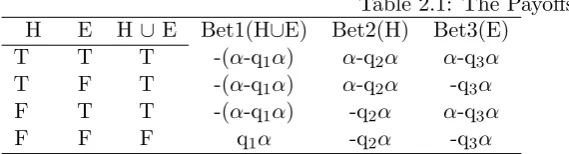
To show (P2) assumeσ(H∪E)6=σ(H) +σ(E) where H and E are mutually exclusive. Notation: let σ(H∪E) = q1 andσ(H) = q2 and σ(E) = q3. Again we show one direction. Let q1 <q2+q3.
We fix the stake on each bet as follows Bet 1 = St(H∪E) = -α, and Bet2 = St(H) = Bet 3 =St(E) =α. So we have the following payoff table.
3cf. [45]pg75 for details. The broad idea is that it should be possible to calculate the proportion of educated
Table 2.1: The Payoffs H E H∪ E Bet1(H∪E) Bet2(H) Bet3(E) T T T -(α-q1α) α-q2α α-q3α
T F T -(α-q1α) α-q2α -q3α
F T T -(α-q1α) -q2α α-q3α
F F F q1α -q2α -q3α
By assumption (H) and (E) are mutually exclusive, so we can effectively ignore the top line of our table. If all events fail to occur then you straightforwardly lose you money to bookie ensuring a loss. Assume Bet2 is true and Bet3 is false, then the payoffs for the set of bets is (α-q2α-q3α
-(α-q1α)) =α(q1-(q2+q3))<0. Hence, so long as α >0, we are ensured a net loss. a
More intuitively this is a Dutchbook-able payoff distribution since the bookie can offer to sell the individual bets with potential winnings ofα, but himself buys the disjunctive bet from you for the same potential winnings at fair prices. This ensures you a net loss on any of the payoff distributions since the amount of money you place on each bet plus the payout you need to make will exceed any winnings you might accrue.4 So it can’t be rational to think the degrees of belief don’t obey the probability calculus. In addition, Van Fraassen offers a diachronic argument (discussed below) which shows us the importance for conditionalisation and its role in planned betting. The idea is that if we violate the axioms of conditional probability a Dutch book can be formed, and the probability of achieving any gain in such a circumstance is 0, we should be able to avoid entering into such gambles. That is to say that belief change should occur only under conditions which factor for the consequences of those changes i.e. when we conditionalise. This latter claim assumes an idealised kind of a reasoner, who can (and does) constantly calculate the odds of gain that emerge from future actions.5
Bayesian Conditionalisation and Update
Recall our definition of CondP, you might want to ask why this procedure should hold. Curd and Cover offer the following rationale:
E T
Ω
Suppose that you are told that a dart has been thrown, randomly, at the figure and has landed somewhere inside the T-circle. Given that the dart is inside the T-circle, what isσ(E|T), the probability that the dart is also in the E-circle. The answer is simple: it is the area common to both circles divided by the area of the T-circle. In other words given that probabilities are proportional to areas,σ(E|T) is equal toσ(E∩T) divided by σ(T).6
4A very similar proof is used to show that violations of countable additivity also result in a Dutch book situation. 5
These arguments are originally owed to Ramsey and de Finetti. A discussion appears in ”Why Conditionalise” in [62]pg403, and other (more formal) justifications for using probability to represent reasoning under uncertainty can be found in [45]pg77 -78 and [27]. The intuitive idea behind all Dutch book arguments is the same in each setting.
From this observation, it becomes quite clear that the conditionalisation operation is as it should be, but can we use this to assess issues of theory choice? Surely we should be able to assess the probability of a theory given some evidence. First we simplify things slightly. By CondPwe derive the following rule since σ(E) cancels out.
σ(E∩T) =σ(T |E)∗σ(E).
This latter rule is called the general multiplication rule. It allows us to assess the probability
σ(E∩T) in two stages, arguably this is easier than computing the probability directly. From this simplification we draw (finally) a statement of Bayes’ theorem by noting the equivalence of σ(T
∩ E) = σ(E ∩ T), and substituting the former into the multiplication rule, and the latter into CondP. We get:
σ(T |E) = σ(E|T)∗σ(T)
σ(E)
This result is uncontroversial (even elementary) in probability theory, but given our intended application we should specify what Bayes’ theorem means. First we distinguish the parts: σ(T) is theprior probability of the theory T, whileσ(E) is the prior probability we ascribe to the evidence E, this can be thought of as the expectedness of E. Furthermore the probability σ(E ∩ T) is the expectedness that our theory and evidence coincide. Bayes’ theorem states that the probability of a theory T given evidence E, is equal to the chance that the truth of our evidence and theory coincide, divided by the chance our evidence is true. Now consider how we develop a Dutch book style argument for conditional probabilities.
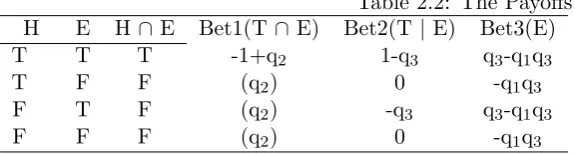
Proof Assume thatσ(E) = q1 >0. Ifσ(T |E) = q3 6=σ(T∩E)÷σ(E) = q2/q1 i.e. contrary
to the definition of CondP, then we can show that there is a Dutch book. Again the proof is in two parts, we show one direction i.e. that q3 >q2/q1 is contrary to reason. Let’s set the stakes as
[image:26.595.65.353.464.541.2]follows: Bet1 = St(T∩ E) = -1 and Bet2 = St(T|E) = 1 and Bet3 = St(E) = q3.
Table 2.2: The Payoffs H E H∩ E Bet1(T∩E) Bet2(T|E) Bet3(E) T T T -1+q2 1-q3 q3-q1q3
T F F (q2) 0 -q1q3
F T F (q2) -q3 q3-q1q3
F F F (q2) 0 -q1q3
On this table we have input the relevant values for α.The payoffs for the conditional bets are determined in such a way the bet fails just when E is false. The values allow us to determine the payoffs for this set of bets. As such we can see that for any values of H and E, the value of the set of bets will be q2 - q1q3, so by our assumption we know that q2 <q1q3 and this quantity will be
negative for any truth-values. a
The Diachronic Dutchbook
Perhaps more interestingly we can think of the creation of a diachronic Dutch book where the bets are time indexed as follows: (1) the bookie offers to sell the unconditional wager whether (E) at cost σ(E) = σ(T) = 1/5, where the bet pays £.10, and buy the conditional wager (T |E) at cost