MSc Thesis
(Afstudeerscriptie)
written by
Thom van Gessel
(born October 10th, 1987 in Apeldoorn, The Netherlands)
under the supervision of Dr. Floris RoelofsenandDr. Ivano Ciardelli, and submitted to the Board of Examiners in partial fulfillment of the requirements for the degree of
MSc in Logic
at theUniversiteit van Amsterdam.
Date of the public defense: Members of the Thesis Committee: August 25, 2016 Dr. Ivano Ciardelli
Prof. dr. Benedikt L¨owe (chair) Dr. Floris Roelofsen
are uncertain about information being exchanged. These models show how publicly or pri-vately announced statements can bring about change in knowledge. In real communication, questions also play a big part. Asking a question can raise an issue, which typically triggers the recipient to resolve it. Therefore, adding questions and issues to action models makes them more suitable as models of communication.
and Ivano Ciardelli. I thank them for their comments on my drafts, which helped me get things much more precise. I especially enjoyed the discussions we had about the thesis, which were always very helpful, and I appreciate the great amount of time they dedicated to this project.
I am also thankful for the questions and suggestions put forward by the other members of the thesis committee: Benedikt L¨owe, Katrin Schulz, Sonja Smets and Frank Veltman.
I thank my friends Tom Schoonen and Nina Dongen. We worked together a lot during the past two years, which I enjoyed very much. Also, they read a complete draft of this thesis and gave many helpful comments.
1 Introduction 1
1.1 Motivation . . . 1
1.2 Epistemic logic, dynamics and inquisitiveness . . . 1
2 Background 3 2.1 Introduction . . . 3
2.2 Questions in logic . . . 3
2.2.1 Partition semantics . . . 3
2.2.2 Inquisitive semantics . . . 4
2.2.3 Dynamic epistemic logics . . . 5
2.3 Inquisitive Epistemic Logic . . . 6
2.3.1 Inquisitive Epistemic Models . . . 6
2.3.2 Syntax and semantics . . . 7
2.3.3 Modalities and questions . . . 9
2.3.4 Properties of IEL . . . 10
2.3.5 Dynamics . . . 13
2.4 Action Models . . . 14
2.5 GeneralizingAMLandIDEL . . . 16
3 Action Model Logic with Questions 19 3.1 Introduction . . . 19
3.2 Definitions . . . 19
3.2.1 Action model . . . 19
3.2.2 Update procedure . . . 21
3.2.3 Syntax and semantics . . . 24
3.2.4 Epistemic maps and state maps in updated models . . . 25
3.3 Examples . . . 27
3.4 Properties ofAMLQ . . . 32
3.4.1 Persistence and empty state . . . 32
3.4.2 Declaratives . . . 32
3.4.3 Resolutions and normal form . . . 33
3.4.4 Declarative variant . . . 34
3.5 Dynamic modalities in action content . . . 35
3.6 Set modalities and non-deterministic actions . . . 36
3.7 Composition of action models . . . 38
3.8 Reduction . . . 41
3.8.1 Atom and⊥ . . . 41
3.8.2 Conjunction and inquisitive disjunction . . . 42
3.8.3 Implication . . . 42
3.8.4 Knowledge modality . . . 44
3.8.5 Entertain modality . . . 45
3.8.6 Reduction procedure . . . 46
3.9 AxiomatizingAMLQ . . . 48
3.9.1 Completeness via replacement of equivalents . . . 48
3.9.2 Completeness via monotonicity . . . 50
3.10 Comparison . . . 53
3.10.1 Inquisitive Dynamic Epistemic Logic . . . 53
3.10.2 Action Model Logic . . . 55
3.11 Conclusion . . . 56
4 Inquisitive Action Model Logic 59 4.1 Introduction . . . 59
4.2 Definitions . . . 59
4.2.1 Action model . . . 59
4.2.2 Update procedure . . . 61
4.2.3 Syntax and semantics . . . 63
4.2.4 Epistemic maps and state maps in updated models . . . 63
4.3 Examples . . . 64
4.4 Properties ofIAML . . . 66
4.4.1 Persistence and empty state . . . 67
4.4.2 Declaratives . . . 67
4.4.3 Resolutions and normal form . . . 67
4.4.4 Declarative variant . . . 68
4.5 Dynamic modalities in action content . . . 68
4.6 Composition of inquisitive action models . . . 69
4.7 Reduction . . . 71
4.8 AxiomatizingIAML . . . 72
4.8.1 Completeness via replacement of equivalents . . . 72
4.8.2 Completeness via monotonicity . . . 73
4.9 Comparison toAMLQ,IDELandAML . . . 74
4.9.1 AMLQ . . . 74
4.9.2 IDEL, AML . . . 78
4.10 Comparison toELQm . . . 79
4.10.1 Introduction . . . 79
4.10.2 Refinement . . . 79
4.10.3 Dynamics . . . 80
4.10.4 Translation . . . 82
4.10.5 Global issues in updated models . . . 84
4.10.6 Conclusion . . . 85
4.11 Conclusion . . . 85
5 Inquisitive Action Model Logic with Questions 87 5.1 Introduction . . . 87
5.2 Definitions . . . 88
5.2.1 Action model . . . 88
5.2.2 Update procedure . . . 88
5.2.3 Syntax and semantics . . . 92
5.2.4 Epistemic maps and state maps in updated models . . . 92
5.3 Examples . . . 93
5.4 Properties ofIAMLQ . . . 95
5.4.1 Persistence and empty state . . . 95
5.4.2 Declaratives . . . 96
5.4.3 Resolutions and normal form . . . 96
5.4.4 Declarative variant . . . 96
5.6 Composition of action models . . . 97
5.7 Reduction . . . 97
5.8 AxiomatizingIAMLQ . . . 99
5.8.1 Completeness via replacement of equivalents . . . 99
5.8.2 Completeness via monotonicity . . . 100
5.9 Comparison . . . 100
5.10 Conclusion . . . 101
6 Conclusions and further work 103 6.1 Conclusions . . . 103
6.2 Further work . . . 104
6.2.1 Axiomatization strategies . . . 104
6.2.2 Common knowledge and common issues . . . 104
6.2.3 Cheating and deceiving . . . 105
6.2.4 Pragmatics . . . 105
Bibliography 107 Appendices 109 A Computing updates in IAMLQ 109 A.1 Introduction . . . 109
A.2 Inquisitive epistemic model . . . 109
A.3 Formulas . . . 111
A.4 Inquisitive action model . . . 112
Introduction
1.1
Motivation
Let us start by announcing a joyful occasion: Anna and Bob are getting married. The couple has invited all their friends and family to the ceremony. However, not everyone has responded to their invitation yet. Today, Anna receives a phone call from Peter, who tells her that either he will attend (p) or that he will not (¬p). Meanwhile, Bob is watching television from the couch. Although he knows that Anna is on the phone with Peter, he cannot hear the conversation. When Peter announces to Anna that he is attending, Anna’s knowledge about this fact changes, while Bob’s knowledge about this fact does not: the only thing that Bob knows is that Anna now knows whether Peter is attending.
Situations like these can be represented in Dynamic Epistemic Logic (DEL). We encode the knowledge agents have in a model by specifying which possible worlds they can distinguish. An epistemic event takes place that transforms this epistemic model: namely, Anna learns thatp. While Anna knows exactly which epistemic event takes place, Bob only knows what the possibilities are. As a consequence, Anna now considers onlyp-worlds to be possible. In contrast, Bill still considers bothp- and¬p-worlds.
Later, Anna gets another phone call. This time it is Quinn, who may also announce whether he is attending (q or¬q). However, Anna and Bob know that he may also call for another reason: namely, to ask whether his ex-wife Rita will be attending (?r), so he can base his decision on this. In fact, this is what he asks Anna. She replies that she does not know this yet, but she promises him that she will find out.
This second situation is one that cannot be modelled in standardDEL, since the epistemic event that occurs involves a question rather than a statement. This question has an effect on Anna: namely, it becomes her goal to find out whether Rita is attending, so she can communicate this to Quinn. This question was not asked publicly, since Bob, who is still on the couch, has not heard. It seems that we cannot capture such a situation in a dynamic epistemic model in the familiar way: we need to rethink the notion of epistemic models and the ways in which they are updated.
1.2
Epistemic logic, dynamics and inquisitiveness
Traditionally, epistemic models are used to capture the knowledge of agents. These are standard Kripke models, which include an S5 accessibility relation for each agent,
fying which possible worlds are indistinguishable to them. We express the knowledge of agents using the modalityK: Kaϕ is true in a worldw just in caseϕ is true in all worlds
indistinguishable to agentafromw.
The idea behind dynamic epistemic logic is to add actions that have the ability to transform this epistemic model. In the most basic variant, Public Announcement Logic (PAL) (Plaza, 1989;Gerbrandy & Groeneveld, 1997), actions are public announcements of some formula
ϕ, that have the effect that all worlds where ϕis false are removed from the model. The language extends standard epistemic logic with new logical operators calleddynamic modal-ities. The idea is that a formula with a dynamic modality, such as [ϕ]ψ, meaning ‘afterϕ,
ψ is the case’, gets its truth value in worldw of epistemic model M by evaluating ψ in w
of the updated model Mϕ, which is the model that results from announcingϕpublicly in
M.
But announcements do not necessarily have to be public: in more advanced frameworks such as Action Model Logic (AML) (Baltag et al.,1998), updates are performed using action models. These are Kripke models that encode possible epistemic events and accessibility relations for all agents, thereby encoding the knowledge agents have about which epistemic event is occurring. In this way, we can encode epistemic events that are not public, but only (fully) perceived by a subset of the agents.
The asking of a question is also an epistemic event, but a different one: intuitively, the primary effect of asking a question is not on the knowledge of agents, but on theirissues. This idea is the basis of Inquisitive Dynamic Epistemic Logic (IDEL) (Ciardelli & Roelofsen, 2015). The models of this logic are not standard epistemic models butinquisitive epistemic models: they encode not only knowledge, but also issues of agents. The dynamic actions thatIDELmodels are public utterances: a generalization of public announcements that also includes the public asking of questions.
BecauseIDELcan encode onlypublicutterances, all agents are always aware of the content of the utterance, just like in PAL. As a result, they will all learn that the announced information was true or, often, entertain the new question that was asked.1 In our scenario, the utterance of Quinn is not a public one, since he utters it to Anna and not to Bob. That means the utterance will definitely have a different effect on Anna than on Bob. To model such scenarios,IDELis not a suitable framework.
BothAML andIDEL can be seen as extensions ofPAL: on the one hand, IDELmakes PAL more general by encoding the issues of agents, thereby making it possible to encode the effect of questions. On the other hand,AMLmakesPALmore general by allowing not only public announcements, but also more private announcements. However, to model situations like our example we need a mix of both: a model that can encode issues, questions and (semi-)private epistemic actions. The goal of this thesis is to provide a system that can encode the epistemic actions familiar fromAML, but in which actions can change an epistemic scenario not only by providing new information, but also by raising new issues.
We start by discussing some background literature in the next chapter. At the end of that chapter, we will outline the structure of the rest of this thesis.
1Strictly speaking, it is notalways the case that the question asked is entertained by all agents, because
Background
2.1
Introduction
In this chapter we lay the foundation for this thesis, by discussing the literature on which we will build. We start the chapter with a brief introduction to questions in logic. The goal of this introduction is to illustrate the scientific context of this thesis. Additionally, it provides a motivation for the use of inquisitive epistemic logic, rather than some other logic, as a basis for a dynamic logic of questions.
After this overview, we describe inquisitive epistemic logic formally and we introduce some definitions and facts about this logic that we will use and build on in the coming chapters. Then, inSection 2.4, we briefly introduce standard action models and show how they are used to extend standard epistemic logic with dynamic modalities.
We end this chapter with a first step towards the original material presented in this thesis: we determine the strategy that we will follow and we explain how the rest of the thesis is set up.
2.2
Questions in logic
2.2.1
Partition semantics
The meaning of sentences is often associated with their truth conditions. While this is a suitable notion of meaning for statements, it is not for questions: we do not think of questions as being true or false. In most theories about the meaning of questions, predominantly originating in the philosophy of language and formal semantics, the meaning of a question is therefore not a basic proposition, but rather built up out of several propositions. Namely, the propositions denoted by the possible answers to the question in a certain world (Hamblin, 1973; Karttunen, 1977). Logic has traditionally been used to reason about the relations between propositions, which meant that questions did not play a role there (Ciardelli,2016, chapter 1).
The idea that the meaning of a question is determined by its answers has been formalized by Groenendijk & Stokhof(1984). In their system, the meaning of a question is a function from worlds to propositions. Namely, questions denote in each world their true exhaustive answer. Because of this exhaustivity, different answers are always mutually exclusive. Moreover, in every world, one of the answers is true. Therefore, this conception of questions is known as
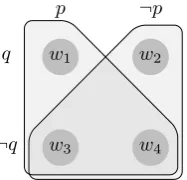
partition semantics: we can think of the meaning of a question as dividing the logical space in cells, which form a partition (seeFigure 2.1).
p ¬p
q
¬q
w1 w2
w3 w4
(a) The question whetherpis the case
p ¬p
q
¬q
w1 w2
w3 w4
[image:14.595.254.348.443.533.2](b) The question whether p∨q is the case
Figure 2.1: Examples of question representations in partition semantics
This way of thinking about questions has been very influential, and has been used in various frameworks of formal semantics (seeAloni et al.(2007) for an overview). The idea behind these frameworks is that questions give rise to issues, which can be modelled by an indif-ference relation between possible worlds, reflecting the partition that the question gives rise to.
However, the partition conception of questions turned out to have some limitations: for instance, it cannot account for conditional questions such as ‘If your knee hurts, will you play in the finals?’. Such a question, arguably, gives rise to two exhaustive answers that overlap (namely, ‘if my knee hurts, I will play in the finals’ and ‘if my knee hurts, I will not play in the finals’, seeFigure 2.2). (Groenendijk & Roelofsen,2009).
p ¬p
q
¬q
w1 w2
w3 w4
Figure 2.2: If your knee hurts (q), will you play in the finals (p)?
Although at first the formal properties of the indifference relation were adapted in order to solve these problems (Groenendijk,2007; Mascarenhas, 2009), this eventually led to the development of a more general semantics of questions, in which the idea of an indifference relation was abandoned altogether (Ciardelli & Roelofsen,2011).
2.2.2
Inquisitive semantics
This is the basic idea behindinquisitive semantics(Groenendijk & Roelofsen,2009;Ciardelli & Roelofsen,2011). The notion of question meaning in inquisitive semantics is inspired by partition semantics, but it is strictly more general than that.
In inquisitive semantics, the set of information states that represents the meaning of a ques-tion is called an inquisitive proposition. It is crucial to understand that unlike standard propositions, this is not a set of worlds, but a set of information states. Inquisitive proposi-tions are alwaysdownward closed: they contain all subsets of all the sets they contain. This captures the fact that if being in some information state resolves a question, then so does being in a more specific information state.
To simplify notation of downward closed sets, we use the notationS↓ to indicate the down-ward closure of S. In this way, we can often write only the maximal elements of the set, instead of all subsets. For instance, the downward closure {{w1, w3}}↓ of {{w1, w3}} is {{w1, w3},{w1},{w3},∅}.
Apart from the fact that inquisitive propositions are more general than partitions, there is also another advantage: statements can be modelled in the very same way. They also denote downward closed sets of information states, but a special case. Namely, the ones that have only one maximal element, and therefore do not give rise to multiple alternatives. This means that in inquisitive semantics, both statements and questions express inquisitive propositions and are thus both basic.
Although inquisitive semantics was primarily developed to model questions in natural lan-guage, it also provides a new perspective on questions in logic: since questions as well as statements can now denote (inquisitive) propositions, it becomes possible to investigate their role in logic as well. For instance, we now have a notion of entailment in which both state-ments and questions can participate (Ciardelli, 2016, chapter 1). It is worth noting that inquisitive semantics brought a new perspective on pragmatics as well, since it it allows for formalizations of pragmatic maxims that prescribe how to rationally exchange information (Groenendijk & Roelofsen, 2009; Westera, 2013). Although pragmatics are not within the scope of this thesis, we will return to this briefly inSection 6.2.4.
2.2.3
Dynamic epistemic logics
In this thesis we are interested in dynamic epistemic logic: in particular, we want to de-scribe the exchange of information and questions and compute the results of this exchange. Although questions cannot be modelled in standard dynamic epistemic logic, some vari-ants have been developed in which this is possible. Most importantly, Baltag(2001) and Van Benthem & Minic˘a (2012) have both developed a dynamic logic in which they model the act of asking a question and the effect this has on the issues of agents. The common element in their approaches is to make questions special types of actions that, unlike regular actions, do not affect the epistemic relation, but a different relation: namely, the indiffer-ence relation which encodes the issue partition of each agent. However, in Baltag(2001), questions may also have an effect on the epistemic relation: namely, when some agent asks a question, under certain assumptions the other agents may come to know that this agent does not know the answer.
Although these logics are developed with similar intentions as the logics we develop in this thesis, they are based on the partition notion of questions and issues, which means the questions and issues that can be encoded in these systems is limited. We will come back to this inSection 4.10, when we compare one of the logics developed in this thesis to the logic ofVan Benthem & Minic˘a (2012).
This logic can be used to express public utterances of statements and questions, and en-code their effect on the knowledge and issues of agents. Since this system does not enen-code (semi-)private utterances, it is not yet enough to model the situation discussed in the in-troduction, but we will see that it is an important first step towards the systems that we develop in this thesis.
2.3
Inquisitive Epistemic Logic
2.3.1
Inquisitive Epistemic Models
Before we take a look atIDEL, we will first introduce its static fragment Inquisitive Epistemic Logic (IEL). Since this will be the static basis for the logics we develop in this thesis as well, we will discuss this in a more formal way. All definitions and facts given in this section are needed in later chapters.
We have already seen that in inquisitive logic, propositions are identified with downward closed sets of information states rather than with sets of worlds. As a result, inquisitive logics can express not just statements, but also questions. While a proper introduction would start with the most basic variant of inquisitive logic (InqB) (Ciardelli,2016, chapter 2), in this context it makes more sense to look at its epistemic variant. This is the logicIEL, which extendsInqBwith epistemic modalities.
Models of inquisitive epistemic logic encode not only the knowledge agents have, but also their issues or epistemic goals: the things they want to find out. In IEL we can express propositions about the knowledge of agents, but also about the issues they entertain.
Definition2.3.1. Inquisitive Epistemic Model(Ciardelli & Roelofsen,2015, p. 1650)
An inquisitive epistemic model is a tripleM =hW,{Σa |a∈ A}, Viwhere:
• W is the domain of worlds;
• Ais the domain of agents;
• Σa is a state map for agenta. For each worldw, Σa(w) is the inquisitive proposition
that encodes a’s knowledge state and issues at w. Σa(w) is a non-empty downward
closed set of information states. The knowledge state of a isσa(w) =SΣa(w): the
set of worlds she considers possible atw. Her goal is to get her knowledge state to be one of the information states in Σa(w);
• V : P → ℘(W) is a valuation function that specifies for each atomic proposition in which worlds it is true.
In this thesis, we restrict ourselves to truly epistemic cases. That is, we think about knowl-edge as factive: agents always consider the actual world as one of the possible worlds. Additionally, we assume that the agents have knowledge about their knowledge and issues. Formally, this amounts to requiring that the state maps satisfy the following two condi-tions:
• Factivity: for allw∈W,w∈σa(w)
• Introspection: for allw, v∈W, ifv∈σa(w) then Σa(v) = Σa(w)
Example2.3.1. Inquisitive Epistemic Model
As an example, take the following modelM withW ={w1, w2, w3, w4}, V(p) = {w1, w3},
but does not care about it. b does not know whether por whether q, but wants to know whetherq. The model will look like this:
Σa(w1) = Σa(w3) ={{w1, w3}}↓
Σa(w2) = Σa(w4) ={{w2, w4}}↓
Σb(w1) = Σb(w2) = Σb(w3) = Σb(w4) ={{w1, w2},{w3, w4}}↓
Throughout this thesis, we will represent inquisitive epistemic models by diagrams. We follow the conventions of Ciardelli (2016): for each world w, the worlds within the same dashed line are the worlds held possible by the agent inw. The solid lines represent the issues within each epistemic state: these states and their subsets are the ones that the agent strives to be in. Because of downward closure, we only need to draw the maximal states of the state map. The example modelM is represented inFigure 2.3.
p ¬p
q
¬q
w1 w2
w3 w4
(a) State map fora
p ¬p
q
¬q
w1 w2
w3 w4
[image:17.595.192.409.280.396.2](b) State map forb
Figure 2.3: Example of state maps in an inquisitive epistemic model
2.3.2
Syntax and semantics
As we will use the languageLIELto describe our models and action content, we now briefly introduce its syntax and semantics here.
Definition2.3.2. Syntax of LIEL (Ciardelli,2016, p. 254)
ϕ::=p| ⊥ |ϕ∧ϕ|ϕ→ϕ|ϕ> ϕ|Kaϕ| Eaϕ
We use the following abbreviations:
Negation: ¬ϕ:=ϕ→ ⊥ Classical disjunction: ϕ∨ψ:=¬(¬ϕ∧ ¬ψ) Wonder modality: Waϕ:=¬Kaϕ∧Eaϕ
Question operator: ?ϕ:=ϕ> ¬ϕ
Tautology: >:=⊥ → ⊥
In order to be able to interpret both statements and questions, formulas inIELare evaluated relative to information states rather than single worlds. Therefore, we cannot formulate the semantics of inquisitive epistemic logic in terms of truth conditions. Instead, we specify the conditions for a formula to be supported by an information state.
M, s|=p iff s⊆V(p)
M, s|=⊥ iff s=∅
M, s|=ϕ∧ψ iff s|=ϕands|=ψ
M, s|=ϕ→ψ iff for allt⊆s,t|=ϕimpliest|=ψ M, s|=ϕ> ψ iff s|=ϕors|=ψ
M, s|=Kaϕ iff for allw∈s: M, σa(w)|=ϕ
M, s|=Eaϕ iff for allw∈s, for allt∈Σa(w) : M, t|=ϕ
Let us also define the notion of support set, which is simply the set of all information states in a model that supportϕ.
Definition2.3.4. Support set(Ciardelli,2016, p. 12)
Letϕbe a formula andM an inquisitive epistemic model. Then the support set [ϕ]M is the
set of all information states inM whereϕis supported:
[ϕ]M ={s⊆WM |s|=ϕ}
While not a primary notion but a derived one, the notion of truth still plays an important role in inquisitive logic. Truth in a world is defined as support in the corresponding singleton information state.
Definition2.3.5. Truth (Ciardelli,2016, p. 48)
LetM be an inquisitive epistemic model andwa world.
M, w|=ϕ ⇐⇒ M,{w} |=ϕ
This lets us obtain the following truth conditions for our connectives:
Fact 2.3.1. Truth conditions inIEL(Ciardelli,2016, p. 49, 50, 255) Letwbe a world in inquisitive epistemic modelM.
M, w|=p iff w∈V(p)
M, w6|=⊥
M, w|=ϕ∧ψ iff w|=ϕandw|=ψ M, w|=ϕ→ψ iff w6|=ϕorw|=ψ M, w|=ϕ > ψ iff w|=ϕorw|=ψ M, w|=Kaϕ iff M, σa(w)|=ϕ
M, w|=Eaϕ iff for allt∈Σa(w) : M, t|=ϕ
Apart from a support set, we also define a truth set on any formula. This is the set of worlds in a model in which the formula is true.
Definition2.3.6. Truth set (Ciardelli,2016, p. 12)
Letϕbe a formula and M an inquisitive epistemic model. Then the truth set|ϕ|M is the
set of all worlds inM in which ϕis true:
|ϕ|M ={w∈WM |w|=ϕ}
Definition2.3.7. Truth-conditionality (Ciardelli,2016, p. 26)
A formulaϕistruth-conditional iff for all modelsM and statess:
s|=ϕ ⇐⇒ w|=ϕfor allw∈s
Following Ciardelli (2016), we will regard truth-conditional formulas as corresponding to statements and non truth-conditional formulas to questions. As a convention, statements are often denoted byαor β and questions byµorν.
The difference between questions and statements can be illustrated by looking at the dif-ference between a classical disjunction (p∨q) and an inquisitive disjunction (p > q): both formulas express the information thatporqis true, but the inquisitive disjunction also raises the issue whether it ispor q, which is resolved by finding out thatpor finding out thatq. In this way, the inquisitive disjunction expresses a question, while the classical disjunction expresses a statement.
It is important to note that if we look just at the fragment of formulas of IEL that do not contain any inquisitive disjunction or entertain modality, we have exactly the syntax of standard epistemic logic.
2.3.3
Modalities and questions
The modality Ka is familiar from standard epistemic logic and it has the same meaning
whenever it is applied to a statement: namely,Kaα is true in a worldw just in case αis
true in any world indistinguishable from w to agent a. Thus, whenever αis a statement, it expresses that a knows this statement to be true. However, we can now also express knowledge about questions. For instance,Ka?pis true just in case aknows whetherp(she
either knows thatpor that¬p).
p ¬p
w1 w2
(a)Ka?p
p ¬p
w1 w2
(b)Eb?p
p ¬p
w1 w2
[image:19.595.145.452.466.537.2](c)¬Kc?p,¬Ec?p
Figure 2.4: Examples of modalities ranging over questions
While we use the modality Ka to express the knowledge of agents, we use the entertain
modalityEa to express their issues. For instance, Ea?pmeansa entertains ?p: she either
knows or wants to know the answer to the question ?p. It is easy to see that wheneverαis a statement,KaαandEaαexpress the same thing, but whenever they range over a question,
their meanings come apart.
The wonder modalityWais an abbreviation of not knowing and entertaining. That is,Waµ
is true just in case a does not know the answer to the question µ and wants to know it. The wonder modality can only be meaningfully used to range over questions, sinceWaαis
a contradiction wheneverαis a statement.
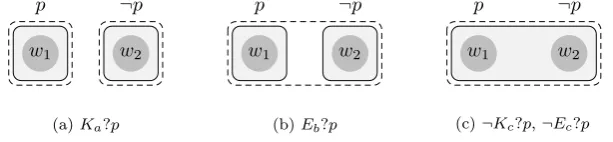
To understand better how these modalities work when they range over questions, let us have a look atFigure 2.4. In subfigure (a), we see from the dashed line that a can distinguish
w1fromw2. This means that her information state is such that it resolves the question ?p.
In subfigure (b), the dashed line indicates that w1 and w2 are not distinguishable to b. Therefore, her information state does not resolve the question ?p. However, the solid lines indicate the information states she wants to be in: she wants to be either in{w1}or {w2}. Both of these information states resolve the question ?p. Therefore, we say thatbentertains ?p: Eb?p.
Subfigure (c) depicts the state map of agentc. Just like agentb, her information state does not resolve the question ?p. The solid line, however, indicates that she is fine with being in this state: she does not strive to be in a more informative information state. Since this means that there is at least one information state in her state map that does not resolve ?p
(namely{w1, w2}), she does not entertain ?p: ¬Ec?p.
Agents do not just have knowledge and issues about general facts, but also about each others knowledge and issues. Consider the following examples of formulas, taken from Ciardelli (2016, p. 269):
• Ka?Kb?pexpresses thataknows whether bknows whetherp(Figure 2.5);
• KaWb?pexpresses thataknows thatbwonders whether p(idem);
• Wa?Kbpexpresses thatawonders whetherbknows that p(Figure 2.6);
• Wa?Wb?pexpresses thatawonders whetherb wonders whetherp(Figure 2.7).
p ¬p
w1 w2
(a) State map fora
p ¬p
w1 w2
[image:20.595.203.395.362.432.2](b) State map forb
Figure 2.5: aknows whetherb knows whetherp, aknows that bwonders whetherp
p ¬p
w1 w2
w3 w4
(a) State map fora
p ¬p
w1 w2
w3 w4
(b) State map forb
Figure 2.6: awonders whetherbknows that p
2.3.4
Properties of
IEL
We will now introduce a few interesting notions that are used inIEL. They will be useful to us when we extend this logic in the coming chapters.1
1InCiardelli(2016), some of these definitions are presented in the context of inquisitive modal logicInqBM.
[image:20.595.202.394.488.605.2]p ¬p
w1 w2
w3 w4
(a) State map fora
p ¬p
w1 w2
w3 w4
[image:21.595.205.393.109.229.2](b) State map forb
Figure 2.7: awonders whetherbwonders whether p
First, we take a closer look at the support relation ofIEL. It is a principle of inquisitive logics that whenever some information supports a formula, every enhancement of this information still supports it. Furthermore, the empty set, which is the inconsistent information state, should support all formulas. It is easy to show from the support conditions that these principles indeed hold inIEL.
Fact 2.3.2. Properties of the support relation(Ciardelli,2016, p. 50, 255)
For all modelsM and formulasϕ∈ LIEL, we have the following properties:
• Persistence property: ifs|=ϕandt⊆s, then t|=ϕ. • Empty state property: ∅ |=ϕ
As we will develop new inquisitive logics in this thesis, it is important to note that it is a desideratum of the support relation of these new logics to have these properties too.
We have seen in the previous section that truth-conditionality separates questions from statements on the semantic level. We now introduce the syntactic notion of declarativity. The set of declaratives ofLIELrepresents all truth-conditional meanings that can be expressed inIEL.
Definition2.3.8. Declarative fragment of LIEL (Ciardelli,2016, p. 260)
The set of declarative formulasLIEL
! is defined inductively as follows, whereϕ∈ LIEL:
α::=p| ⊥ |α∧α|α→α|Kaϕ|Eaϕ
Fact 2.3.3. All declarative formulas ofLIEL are truth-conditional (Ciardelli,2016, p. 260)
This is a consequence of the fact that the only source of non truth-conditionality is the inquisitive disjunction. Furthermore, the support conditions of the modalities are such that any Kaϕand Eaϕare truth-conditional. Truth-conditionality is preserved by conjunction
and implication.
With each ϕ ∈ LIEL we can associate a corresponding declarative, called the declarative variant ofϕ, which is defined as follows.
Definition2.3.9. Declarative variant in LIEL (Ciardelli,2016, p. 260)
The declarative variantϕ! of a formulaϕ∈ LIEL is defined inductively as follows:
• α!=αifαis an atom,⊥or a modal formulaK
aϕorEaϕ
• (ϕ→ψ)!=ϕ!→ψ! • (ϕ> ψ)!=ϕ!∨ψ!
By induction it can be checked that althoughϕandϕ! are not necessarily supported in the same information states, they are true in exactly the same worlds. We have the following fact:
Fact2.3.4. Declarative variants inLIEL have equal truth conditions(Ciardelli,2016,
p. 261)
For allϕ∈ LIEL, for every inquisitive epistemic model M and worldw:
M, w|=ϕ ⇐⇒ M, w|=ϕ!
We have already seen thatLEL is a fragment ofLIEL. We can now also see that by the defi-nition of declaratives, all formulas of LEL are declaratives, and therefore truth-conditional. Since the truth conditions ofLEL-formulas are standard inIEL,IELis a conservative extension ofEL.
Note that while declaratives and declarative variants are truth-conditional, they are not nec-essarily formulas of standard epistemic logic, because they might still contain the entertain modality or an inquisitive disjunction (the latter only within the scope of a modality). The notion of declarative variants will be used to define the preconditions of epistemic actions that may be questions.
Notice that ifϕis itself a truth-conditional formula, thenϕ≡ϕ!. This means that declara-tives are representative of truth-conditional formulas. We thus have the following fact.
Fact2.3.5. Any truth-conditional formula is equivalent to a declarative(Ciardelli,
2016, p. 261)
For allϕ∈ LIEL, ifϕis truth-conditional, then there is someα∈ LIEL
! such thatϕ≡α.
We now move on to the notion of resolutions. The set of resolutions of a formula in IELis a set of declaratives that we associate with it.
Definition2.3.10. Resolutions inLIEL (Ciardelli,2016, p. 261)
For any formulaϕ∈ LIEL, its set of resolutionsR(ϕ) is defined inductively as follows: • R(α) ={α} ifαis an atom,⊥or a modal formulaKaϕorEaϕ
• R(ϕ∧ψ) ={α∧β |α∈ R(ϕ) andβ∈ R(ψ)}
• R(ϕ→ψ) ={V
α∈R(ϕ)(α→f(α))|f is a function from R(ϕ) toR(ψ)} • R(ϕ> ψ) =R(ϕ)∪ R(ψ)
These resolutions are relevant, because it can be shown by induction that for a state to support a formula ϕ is to support at least one of its resolutions. As these resolutions are declaratives, this fact allows us to connect support for declaratives with support for inquisitive formulas. This is often used in proofs, for instance in completeness proofs for inquisitive logics.
Fact 2.3.6. A formula is supported iff some resolution of it is(Ciardelli, 2016, p. 261)
For allϕ∈ LIEL, for every inquisitive epistemic model M and states:
From this fact and the support condition of inquisitive disjunction it follows that any formula
ϕ ∈ LIEL is equivalent to the inquisitive disjunction of its resolutions, which is called the normal form of the formula.
Fact 2.3.7. Normal form
For allϕ∈ LIEL,ϕ≡
>
R(ϕ).The above notions all play an important part in IEL and inquisitive logics in general, and we will refer to them often in the coming chapters.
2.3.5
Dynamics
We end this section onIELwith a brief introduction to the dynamic variantIDEL(Ciardelli & Roelofsen,2015;Ciardelli,2016). This is especially relevant because the logics we develop in this thesis can be seen as generalizations of this logic.
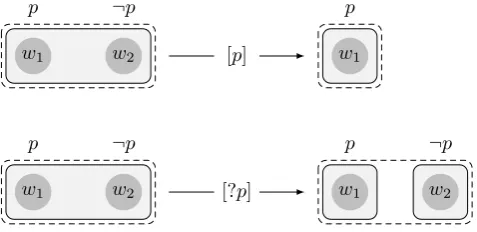
A public utterance is the inquisitive counterpart of a public announcement: it is an epistemic action that transforms the model when it is executed. When a statement is announced, all worlds in which the statement is false are dropped, like in Public Announcement Logic (PAL). However, inIDELa public utterance can also be a question. In that case, agents will typically come to entertain the question in the updated model: they will make it their goal to resolve it.
The following definition contains the procedure by which we can update a model with a public utterance, which makes use of the notions of truth set and support set.
Definition2.3.11. Updated model(Ciardelli,2016, p. 311)
LetM =hW,{Σa |a∈ A}, Vibe an inquisitive epistemic model and ϕ∈ LIDEL. Then the
model updated withϕisMϕ=hWϕ,{Σϕ
a |a∈ A}, Vϕi, defined as follows.2
• Wϕ=W∩ |ϕ|M
• Vϕ=V
|ϕ|M
• Σϕ
a(w) = Σa(w)∩[ϕ]M
This definition says that updating an inquisitive epistemic model with a formulaϕhas two effects. First, the worlds in whichϕis false are dropped from the model. Second, for each agent a and world w, the information states that count as resolving the issues of a in w
become restricted to the ones that supportϕ. SeeFigure 2.8for an illustration of the effect of a public utterance of a statement and a question.
The languageLIDEL extendsLIELby adding a public utterance operator [ϕ] to the inductive definition of the syntax. Then the following support condition is added:
Definition 2.3.12. Support condition for dynamic modalities (Ciardelli, 2016, p.
313)
M, s|= [ϕ]ψ ⇐⇒ Mϕ, s∩ |ϕ|M |=ψ
This means that [ϕ]ψ is supported in information state s of model M just in case ψ is supported in the information state s, restricted to the worlds in which ϕ is true, in the
2The definition given here differs slightly from the original definition: we use formulas as the content of
p ¬p
w1 w2 [p]
p
w1
p ¬p
w1 w2 [?p]
p ¬p
[image:24.595.179.418.99.215.2]w1 w2
Figure 2.8: Public utterance inIDEL
updated modelMϕ. In other words, our information statesis such that it would support
ψif it would be enhanced with a public utterance ofϕ.
As we mentioned before, utterances inIDELare always public. In the next section, we will look at a way to encode epistemic events that are not public.
2.4
Action Models
In this section we will provide a more formal introduction to standard action models and their logic. Consider again the first scenario from the introduction: Peter tells Anna on the phone that he will be attending the wedding. While Bob is aware of the conversation, he also considers it possible that Peter calls to say he will not attend.
In dynamic epistemic logic, epistemic actions which are more complex than public announce-ments can be modelled using action models (Baltag et al.,1998). These models encode the knowledge that agents have about the action taking place, which can differ from agent to agent. The action model is a Kripke model containing all possible actions (in the example, the announcement that Peter either is or is not attending), an accessibility relation for each agent (which encodes their knowledge about the action taking place) and for each action a precondition: a formula that encodes what must be true for the action to be possible. Formally, action models are defined as follows.3
Definition2.4.1. Action Model(Van Ditmarsch et al.,2007, p. 149) An action model is a tripleM=hS,{∼a |a∈ A},preiwhere:
• Sis a finite domain of action points;
• For each a∈ A,∼a is an equivalence relation onS;
• pre:S→ Lis a function that assigns a formulapre(x)∈ Lto each action pointx∈S.4
The original epistemic model and the action model are combined to create a new epistemic model: the product update of the two. This new model encodes the knowledge of the agents after the action has taken place.
3Although the definitions have also been given elsewhere, we followVan Ditmarsch et al.(2007, chapter
6).
4It is not very important at this point which languageLwe use. Throughout this thesis, we will assume
Definition2.4.2. Updated model(Van Ditmarsch et al.,2007, p. 151)
LetM be an epistemic model andMan action model. ThenM0= (M⊗M) is the product update ofM andM, defined as follows.
M0=hW0,{∼0
a |a∈ A}, V0i, where:
• W0 ={hw,xi |w∈W,x∈Sand M, w|=pre(x)} • hw,xi ∼0
a hw0,x0iiffw∼aw0 andx∼a x0
• hw,xi ∈V0(p) iffw∈V(p)
This update procedure says that the domain of the updated model is the Cartesian product of the domain of the original model and the domain of the updated model, restricted to the pairs that are compatible with each other. For instance, a world in which p is false is not compatible with an action that has precondition p. Hence, we associate with each world in the updated model a world from the original model and an action. Two worlds are indistinguishable in the updated model just in case the corresponding two worlds in the original model and the corresponding two actions are indistinguishable.
To illustrate this update procedure, we will look at two examples. The first one is the first scenario from the introduction.
Example2.4.1. Peter is attending
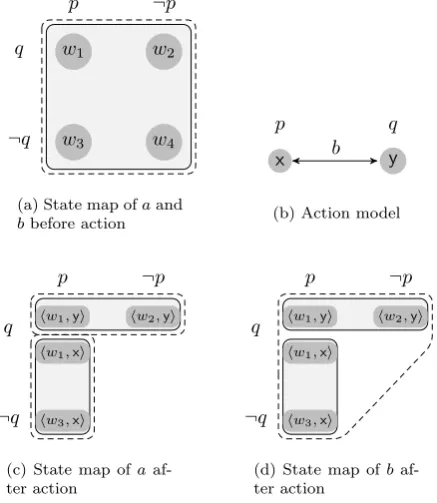
Initially, neither Anna nor Bob knows whether Peter is attending. Then, actionx occurs: Peter tells Anna that he will attend (p). Bob also considers it possible that Peter tells Anna that he will not attend (¬p). Let us call this possible action y. To Bob, actions x and y are not distinguishable, but they are to Anna: by the update procedure, this goes for the corresponding worlds in the updated model as well. SeeFigure 2.9for a visual representation of this (we omit all reflexive arrows).
p ¬p
w1 w2
a, b
(a) Original model
p ¬p
x b y
(b) Action model
p ¬p
hw1,xi hw2,yi b
[image:25.595.143.464.457.524.2](c) Updated model
Figure 2.9: Example 2.4.1
Example2.4.2. Patrick or Qasim is attending
This time, Anna and Bob get an RSVP message in the mail. They know that the sender is attending, but they are not sure yet about the identity of the sender: this may either be Patrick (p) or Qasim (q). Anna (a) opens the envelope, while Bob (b) watches from a distance and is not immediately aware of the contents.
Let the initial model and the action model be defined as inFigure 2.10(this time, we omit both reflexive and transitive arrows). Let pre(x) = p and pre(y) = q. Then the updated model is shown in subfigure (c).
A difference between this example and the previous one is that this time, both agents learn something: namely, since either p or q is true, w4 is no longer a candidate for the actual world. However,alearns either thatpor thatq, while bonly learns thatp∨q.
p ¬p q
¬q
w1 w2
w3 w4
a, b
a, b
a, b
a, b
(a) Original model
p q
x b y
(b) Action model
p ¬p
q
¬q
hw1,yi
hw1,xi
hw2,yi
hw3,xi b
a, b
a, b
(c) Updated model
Figure 2.10: Example 2.4.2
Definition2.4.3. Syntax of LAML(Van Ditmarsch et al.,2007, p. 149)
The language of Action Model Logic is defined as follows, where x is an action in action modelM:5
ϕ::=p| ¬ϕ|ϕ∧ϕ|Kaϕ|[λ]ϕ
λ::=M,x|λ∪λ
Definition2.4.4. Truth conditions in AML(Van Ditmarsch et al.,2007, p. 151) Letwbe a world in epistemic modelM.
M, w|=p iff w∈V(p)
M, w|=¬ϕ iff M, w6|=ϕ
M, w|=ϕ∧ψ iff w|=ϕandw|=ψ
M, w|=Kaϕ iff w∼aw0 impliesM, w0|=ϕ
M, w|= [λ]ϕ iff for allM0, w0 : (M, w)JλK(M0, w0) impliesM0, w0 |=ϕ
(M, w)JM,xK(M0, w0) iff M, w|=pre(x) andM0, w0= (M⊗M),hw,xi
Jλ∪λ 0
K = JλK∪Jλ
0 K
AML extends standard epistemic logic with dynamic modalities. These modalities can be used to express what would be true if some action were to take place: a formula of the form [M,x]ϕis true just in case ϕis true after action x. For instance, [M,x]Kapexpresses that
afterx,aknows thatp. It is also possible to formulate non-deterministic actions: a formula of the form [M,x∪M,y]ϕis true just in caseϕis true after one ofxandytakes place. This is a feature that will be of interest to us later.
2.5
Generalizing
AML
and
IDEL
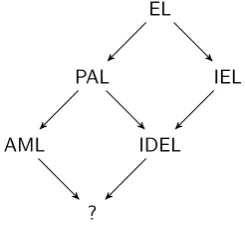
In the previous sections, we have discussed some extensions of basic epistemic logic (EL) in detail, in particularIEL and AML. Let us now zoom out a bit, to see how these systems relate to each other. The relation between them, and some other logics we have mentioned, is shown in Figure 2.11. We take the arrows down to represent generalization. Arrows to the left stand for an extension of the dynamic possibilities in the system: adding public utterances (EL →PAL, IEL →IDEL) or private utterances (PAL →AML). Arrows to the
5Modalities for common knowledge or other group knowledge are not included in this thesis. We will
right stand for making the logic inquisitive. Replacing the question mark in this diagram with an adequate new system is exactly the goal of this thesis. Notice that this logic can be seen as a generalization ofAML (it is the inquisitive variant of it) and as a generalization of IDEL (it adds actions besides public announcements). Because of this, the rest of this thesis is intended to be read as a “possible next chapter” in Van Ditmarsch et al. (2007) (to fit after the introduction ofEL, PALand AML) as well as inCiardelli(2016) (after the introduction ofInqB,IELandIDEL).
EL
PAL IEL
AML IDEL
[image:27.595.236.359.196.311.2]?
Figure 2.11: Relation between dynamic and inquisitive epistemic logics
Instead of developing one system to fill the gap in the diagram, we will look at more than one candidate. The reason for this is that there are two strategies we can take to make the logic of action models inquisitive. Obviously, we will replace the static language ofAMLwith IEL. However, from this point on, there are still two directions possible. The first option is to make it possible for questions to be the content of an action in the action model. In this way, actions can raise issues as well as convey information. The second option is to change the structure of our action models: the issues that the actions raise can be encoded in the model itself, as issues agents have about which action is the actual one.
We will work out both options in detail. The resulting logic of the first option will be called Action Model Logic with Questions (AMLQ) and the second logic will be Inquisitive Action Model Logic (IAML). We will even take a step further and follow both strategies at once. The result will be a merge of the two previous systems, which we will call Inquisitive Action Model Logic with Questions (IAMLQ). The relation between these three logics and AML andIDELis shown inFigure 2.12.
IAMLQ
AMLQ IAML
AML IDEL
Figure 2.12: Relation between the three logics developed in this thesis and the two logics they are based on.
[image:27.595.241.353.526.626.2]Action Model Logic with
Questions
3.1
Introduction
In this chapter we will follow the first strategy mentioned in the previous section: we will define an Action Model Logic with Questions (AMLQ). In this system we use IEL as the language of our static models, rather than standard epistemic logic, and refine the definition of the content of actions. This means that our actions can be utterances of a statement as well as a question.
We will start by giving a new definition of action models. Then we define an update pro-cedure that can deal with both statements and questions. In Section 3.3 we show some examples of situations our models can describe. In Section 3.4, we will show that some important properties ofIELare inherited byAMLQ.
We will then extend our language and action models in a recursive way, to allow for formulas ofLAMLQinAMLQaction models. After this, we will say a few words about how we interpret dynamic modalities of sets inSection 3.6. We define the notion of action model composition inSection 3.7. Then,Sections 3.8and3.9are dedicated to developing a proof system for the logicAMLQand showing that it is complete. InSection 3.10, we will show that our system is a conservative extension of both systems it is based on, after which we end the chapter with a short conclusion in which we summarize our findings.
3.2
Definitions
3.2.1
Action model
Making action models compatible with questions requires us to change the way we think about the content of actions. In AML, actions can only convey information. As a result, we only have to check in which worlds they can be executed, which is expressed by their precondition. In other words, the content of the action is equal to its precondition.
However, in the inquisitive setting there is more to actions than just information: the content of an action can also raise issues. For instance, a question like ?phas an effect on the agent that hears it: namely, if she does not know the answer, she will come to wonder about the question. This means that in the inquisitive setting, assigning a precondition to each
action is not enough, as this assigns only informative content and not inquisitive content. We therefore replaceprewithcont(for content) everywhere in the definition.
For now, the range ofcont is restricted to formulas ofIEL. The reason for this is that the language ofAMLQ is not yet defined at this stage, and in fact depends on the definition of action models. To prevent our definitions from being circular, we give the full definition of AMLQaction models and their language at a later stage. What we define now areAMLQ0 action models: AMLQmodels of the lowest level. We will often omit the subscript to make our notation more concise.
Definition3.2.1. Action Model with Questions
AnAMLQ0 action model is a tripleM=hS,{∼a |a∈ A},conti, where:
• Sis a finite domain of action points;
• For each a∈ A,∼a is an equivalence relation onS;
• cont:S→ LIELis a function that assigns a contentcont(x)∈ LIELto each action point x∈S.
As the content of an action is a formula ofIEL, it can be either a statement or a question. What remains unchanged is that we can still think of the precondition of an action as its informative content. In case the content is a statement, the precondition is the statement itself. In contrast, in case the content is a question, the precondition is a statement which we regard as capturing the question’s presupposition that one of the proposed alternatives is true.
Instead of explicitly defining a precondition for each action, we can retrieve the precondition of an action from its content. If the content of an action is ϕ, the precondition for this action is its declarative variantϕ!, which is a statement with the same truth conditions as
ϕ.
Definition3.2.2. Precondition of an action
Given an actionx, its preconditionpre(x) is defined as: pre(x) :=cont(x)!
To illustrate this, consider the following examples: the precondition of an action with content
pisp, because it can only truthfully be executed in worlds wherepis true. In contrast, an action with content ?pcan be truthfully executed in any world, as it contains no information. Therefore its precondition isp∨ ¬p≡ >.
As we identify the precondition of an action with the declarative variant of its content, we have the following proposition, which will play an important part in the rest of our proofs.
Proposition 3.2.1. Action content and precondition have equal truth conditions For all actionsx, for every inquisitive epistemic modelM and worldw:
M, w|=cont(x) ⇐⇒ M, w|=pre(x) Proof: Immediate fromDefinition 3.2.2 andFact 2.3.4.
effect. In all other cases (e.g. when restricting a set of worlds to the ones compatible with an action) we usepre.
3.2.2
Update procedure
Now that we have generalized the notion of action models to make it compatible with questions, we also need to generalize the update procedure fromDefinition 2.4.2to make it compatible with our new definition.
Like the update procedure for standard action models, our procedure should take care of preserving the knowledge from the original model and incorporating the knowledge obtained from the action. However, it should now also preserve the issues from the original model and incorporate the issues that arise from new action content.
To formulate our definition, we make use of two projection operators, defined as follows.
Definition3.2.3. Projection operators Ifs⊆W×S, then:
π1(s) :={w| hw,xi ∈sfor somex}
π2(s) :={x| hw,xi ∈sfor some w}
These projection operators are useful because they allow us to associate to each states in the updated model a stateπ1(s) in the original model and a stateπ2(s) in the action model. For example: π1({hw1,xi,hw1,yi,hw2,xi}) ={w1, w2}, whileπ2({hw1,xi,hw1,yi,hw2,xi}) = {x,y}.
With these projection operators in place, we are now ready to define the update procedure. We will first give the formal definition and then provide a motivation.
Definition3.2.4. Updated IEL model
Let M be an inquisitive epistemic model and M an AMLQ0 action model. Then M0 = (M⊗M) is the product update ofM andM, defined as follows.
M0=hW0,{Σ0
a | a∈ A}, V0i, where:
• W0 ={hw,xi |w∈W,x∈Sand M, w|=pre(x)} • s∈Σ0a(hw,xi) iff
(i) π1(s)∈Σa(w)
(ii) ∀y∈π2(s) :x∼a y
(iii) There is at most oney∈π2(s) (iv) ∀y∈π2(s) :M, π1(s)|=cont(y) • hw,xi ∈V0(p) iffw∈V(p)
Like in standard action models, the domain of the updated model consists of pairs containing a world from the original model and an action from the action model. We allow only those pairshw,xiof which the precondition of the actionxis true in the worldw. This restriction is necessary because only in worlds where the content of x is true, x can be truthfully uttered.
difference with respect to standard action models. Therefore, we can leave the definition of the domain in the updated model unchanged.
What also remains unchanged is the principle that epistemic actions do not change non-epistemic facts of the world: they only have an effect on the knowledge and issues of agents about the world and about each others knowledge and issues. This means that worlds in the new domain make the same atomic propositions true as the corresponding worlds in the old domain. Therefore, our definition of the valuation function can also be just like in standard action models.
This means that the crucial part of this definition is the definition of Σ0a. The update pro-cedure for standard action models formulates two conditions for two worlds to be indistin-guishable in the updated model. Similarly, we formulate four conditions for an information statesto be in Σ0a(hw,xi). These conditions match the following four desiderata:
(i) Preservation of knowledge and issues from the original model
Epistemic actions can only enhance the knowledge of the agents, not decrease it. Formally, this means that if an agent can distinguish two worlds in the original model, she can also distinguish the corresponding worlds in the updated model. This is why in standard action models, one of the requirements for two worlds to be indistinguishable in the updated model (hw,xi ∼0
a hw0,x0i) is that their corresponding worlds were
indistinguishable in the original model (w∼a w0). In our current setting, this means
that a requirement for hw0,x0ito be in σa0(hw,xi) is thatw0 ∈σa(w). Consequently,
for an information statesto be in Σ0a(hw,xi), we require thatπ1(s)⊆σa(w).
However, we should not just preserve knowledge in our updated model: we should also preserve issues. In the original model, the issues that the agent has in world w
are encoded by the state map Σa(w): this state map contains only information states
that resolve her issues. As she does not lose interest in these issues after the update, we want all states in the updated state map to resolve these issues as well. We can achieve this by requiring thatπ1(s)∈Σa(w).
Because the requirement that π1(s)∈Σa(w) is stronger thanπ1(s)⊆σa(w), we need
to require only the former.
(ii) Preservation of knowledge from the action model
In the same way that the original model encodes knowledge of the agents, so does the action model. As in standard action models, if two actionsxandyare distinguishable for agent a (x 6∼a y), then so are any corresponding worlds in the updated model
(hw,xi 6∼0
ahv,yi). This means that a requirement for any worldhv,yito be inσa0(hw,xi)
is thatx∼ay. Hence, for a statesto be in Σ0a(hw,xi), we require that for allhv,yi ∈s
: x∼ay, which we can also write as∀y∈π2(s) :x∼a y.
(iii) Raising of issues about what the actual action is
Standard action models encode only the knowledge agents have about which action is the actual one and not whether they consider this an issue. Action models with questions are no different in this respect. As our updated model is an inquisitive epistemic model, we have to decide in our update procedure how we interpret our action models: that is, whenever an agent does not know what the actual action is, does this become an issue or not? In other words, do we assume that agents are curious? This is a rather arbitrary decision, because we could interpret the action models either way.
does not have. We will deal with these inChapter 5, when we develop action models that actually encode to what extent each agent is curious.
Hence, what we want is that agents who do not know whetherx ory was the actual action, want to know this in the updated model. This means that a state only counts as resolving the agent’s issues if it determines exactly what the actual action was. That is why we require for every states∈Σ0a(hw,xi) that π2(s) contains at most one element.
(iv) Raising of issues by action content
The novelty of action models with questions is that actions can have the effect of raising an issue. We can reflect this in the updated model by requiring information states in the state maps of the agents to support the action content. In that way, if the content is a question, the state maps of the agents indicate that they want to be in an information state that resolves the question.
However, there might be uncertainty about which action is the actual one. Suppose there are two actions x and y, with content ?p and ?q respectively. Intuitively, an agent who knows which of the two actions is the actual one (and had no issues in the original model) should entertain only the corresponding question after the update. In contrast, an agent who cannot distinguish betweenxandyhas no reason to entertain ?pnor ?q.
We can obtain this effect by raising issues locally in the state maps of our updated model. Recall that by condition (iii), all information states in the state maps of agents that are not empty, belong to exactly one action. This means that there are no mixed information states that contain bothx-worlds andy-worlds. We require, for each action x, the states consisting ofx-worlds to support the content of x. Formally, for a states
to be in Σ0a(hw,xi), we require that∀y∈π2(s) :M, π1(s)|=cont(y).
Now that we have formulated the update procedure, it is important to check that any updated model is indeed an inquisitive epistemic model. Most importantly, we need to check that the state map for every world and every agent is still an inquisitive proposition.
Proposition 3.2.2. Updates result in inquisitive epistemic models
For any inquisitive epistemic modelM and for anyAMLQaction modelM,M0= (M⊗M) is an inquisitive epistemic model.
Proof: We need to check that for every worldhw,xi, Σ0
a(hw,xi) is non-empty and downward
closed. Furthermore, Σ0a should satisfy factivity (for all w ∈ W, w ∈ σa(w)) and
introspection (for allw, v∈W, ifv∈σa(w) then Σa(v) = Σa(w)).
Take an arbitrary worldhw,xi ∈W0.
We will first show that Σ0a(hw,xi) is downward closed. Take any states∈Σ0a(hw,xi) and anyt⊆s.
(i) π1(t)∈Σa(w) sinceπ1(t)⊆π1(s) and Σa(w) is downward closed.
(ii) ∀y∈π2(t) :x∼a ysinceπ2(t)⊆π2(s) and∀y∈π2(s) :x∼ay.
(iii) Asπ2(t)⊆π2(s), it too contains at most one element.
(iv) As ∀y∈π2(s) :M, π1(s)|=cont(y), we have∀y∈π2(t) :M, π1(t)|=cont(y) by persistence of support.
(i) {w} ∈Σa(w) by factivity and downward closure of Σa(w).
(ii) x∼a xby reflexivity of∼a.
(iii) π2({hw,xi}) ={x}, which contains exactly one element.
(iv) By definition of W0 we haveM,{w} |=pre(x). Therefore, byProposition 3.2.1,
M,{w} |=cont(x).
We have{hw,xi} ∈Σ0a(hw,xi). It follows that hw,xi ∈σ0a(w).
That leaves introspection. Take any two worlds hw,xi and hw0,x0i from W0 such thathw0,x0i ∈σ0a(hw,xi). By downward closure of Σ0
a(hw,xi) we obtain{hw0,x0i} ∈
Σ0a(hw,xi). From condition (i) we learn that it must be the case thatw0∈σa(w). By
introspection of Σa we obtain Σa(w) = Σa(w0). From condition (ii) we havex∼a x0,
so for all actionsy, y∼a xiffy∼a x0. Then it is easy to check that for all statest,t
satisfies conditions (i-iv) for Σ0a(hw,xi) iff it satisfies them for Σ0a(hw0,x0i). Therefore
Σ0a(hw,xi) and Σ0a(hw0,x0i) are equal.
3.2.3
Syntax and semantics
We have seen how IDEL extends IEL with a dynamic public utterance modality, and how AMLextends epistemic logic with dynamic modalities containing actions in action models. In this section, we will show how these extensions can be generalized to an Action Model Logic with Questions (AMLQ), which is an extension of IEL with dynamic modalities for actions.
In what follows, we will use s and t to denote information states, which is common in inquisitive logic, andsandtfor sets of action pointsxin an action model.
Like in AML, we add dynamic modalities for actions, to express that an action has been executed. However, we will see later that we need something more general. We need modalities for actionsx, but also for sets of actions s. We interpret these set modalities as expressing information about which action is executed: it is one actionx∈s, but it is not determined which one. We then recover the execution of a single action as a special case, namely the case wheresis a singleton.
Definition3.2.5. Syntax of LAMLQ0
Level 0 of the language of Action Model Logic with Questions is defined as follows, wheres is a set of action points within theAMLQ0action model M:
ϕ::=p| ⊥ |ϕ∧ϕ|ϕ→ϕ|ϕ> ϕ|Kaϕ|Eaϕ|[M,s]ϕ
For now, we restrict the definition of our language to the fragment that has dynamic modal-ities of AMLQ0 action models. The definition of the full language can only be given when action models of higher levels are defined, which we will do inSection 3.5. We denote this fragment byLAMLQ0. As this is the only part of the language defined so far, we will omit the subscript until we get to the full definition.
We take over the abbreviations from IEL. For actions we introduce two new notational conventions. Firstly, we allow ourselves to omit the action modelMwhenever no confusion can arise about the model that the action belongs to. Secondly, for single actionsxwe allow [x] as an abbreviation for [{x}].1
1In order to makeLAMLQ a superset ofLAML, one might also allow the PDL-style notation of complex actions and let [x1∪. . .∪xn]ϕ:= [{x1, . . . ,xn}]ϕ, although this notation is less natural in our setting. We
The semantics of AMLQ consists of the support conditions of IEL, extended with a new support condition for the dynamic modalities. Before we can define this support condition, we need a way to connect states in the original model to the corresponding states in the updated model. LetM be an inquisitive epistemic model andsan information state in that model. LetMbe anAMLQaction model andsa set of actions in that model. Furthermore, letM0=M⊗M.
Definition3.2.6. Updated state
s[M,s] is the information state inM0 such that:
s[M,s] ={hw,xi ∈W0 |w∈sandx∈s}
We allow omission of the action modelMin the notation of updated states. Notice that by the above definition, the sets[s] consists of all the pairshw,xi ∈s×ssuch thatM, w|=pre(x). Using the notion of updated states, we can now give the support condition for dynamic modalities.
Definition3.2.7. Support condition for dynamic modalities
The support condition for dynamic modalities is the following:
M, s|= [M,s]ϕ ⇐⇒ M0, s[M,s]|=ϕ
Like inIEL, truth in a world is defined as support in the corresponding singleton state. We therefore have the following truth condition for dynamic modalities.
Fact 3.2.1. Truth condition for dynamic modalities
Letw[M,s] ={hw,xi ∈W0 |x∈s}. Then the truth condition for dynamic modalities is the following:
M, w|= [M,s]ϕ ⇐⇒ M0, w[M,s]|=ϕ
Becausesmay contain multiple actions, s0 may be an information state consisting of more than one world. This means that, for [s]ϕto betrue in w, ϕmust besupported inw[s]. If we want to give a characterization of truth of dynamic formulas only in terms of truth, we can only do this for dynamic modalities of single actions:
M, w|= [M,x]ϕ ⇐⇒ w|=pre(x) impliesM0,hw,xi |=ϕ
This formulation makes it clear that [x]ϕis true inwjust in case either the actionxis incom-patible withw(which makes the formula vacuously true) orϕis true in the corresponding worldhw,xiin the product update. More importantly, this formulation corresponds exactly to the truth condition of dynamic modalities inAML.
The intuitive reading of a formula with a dynamic modality, like [x]ϕ, should be: ‘ϕ is supported after action xis executed’. A formula with a dynamic modality that contains a setsof actions, like [s]ϕ, can be read as: ‘after getting the information thatsome action of sis executed,ϕis supported’. This means we think of sets of actionssin the same way as we think of information statess. Namely, as encoding the information that the actual world (action) is one of the worlds (actions) in the set.
3.2.4
Epistemic maps and state maps in updated models
an alternative characterization of the update procedure, and will be useful when proving reduction equivalences inSection 3.8.
To simplify notation in what follows, we defineδa(x) :={y |y∼a x}. In this way, we can
useδa(x) to refer to the set of actions indistinguishable fromxtoa. We can then prove the
following lemma, which tells us that the information state ofain worldhw,xiof the updated model is simply the information state ofa in world w of the original model updated with the set of actionsδa(x).
Lemma3.2.1. Epistemic maps in updated models
Letwbe a world in an inquisitive epistemic modelM,xan action in action model Mand
M0=M ⊗M. Lethw,xibe a world in M0. Then we have the following:
σ0a(hw,xi) =σa(w)[δa(x)]
Proof: (⊆) Take any hv,yi ∈ σa0(hw,xi). This world is in this set because it belongs to a state that satisfies conditions (i)-(iv) of the update procedure inDefinition 3.2.4. From condition (i) we obtainv ∈σa(w). From condition (ii) we obtainy∼a x.
But these are, byDefinition 3.2.6, exactly the conditions to be inσa(w)[δa(x)].
Sohv,yi ∈σa(w)[δa(x)].
(⊇) Take an arbitrary worldhv,yi ∈σa(w)[δa(x)]. Then byDefinition 3.2.6, we know
thatv∈σa(w) andy∼a x. It follows that the state{hv,yi}satisfies condition
(i) and (ii) of Definition 3.2.4 to be in Σ0a(hw,xi). It also satisfies condition (iii) by being a singleton. As hv,yi is in the domain of M0, it must be the case thatM, v |=pre(y). ByProposition 3.2.1 it follows that M, v |=cont(y). Therefore the state {hv,yi} satisfies condition (iv) as well. This means that {hv,yi} ∈Σ0a(hw,xi) and hence thathv,yi ∈σa0(hw,xi).
The above lemma shows us that epistemic maps in the updated model are obtained as in standard action model logic. The next lemma shows how information states in original and updated models are related.
Lemma3.2.2. State maps in updated models
Letwbe a world in an inquisitive epistemic modelM,xan action in action model Mand
M0=M ⊗M. Supposehw,xi ∈W0. Then we have the following:
Σ0a(hw,xi) ={s[y]|s∈Σa(w),y∼a xandM, s|=cont(y)}
Proof: (⊆) Assumes0∈Σ0a(hw,xi).
Letsbeπ1(s0). Ifs0 is non-empty, by condition (iii) ofDefinition 3.2.4there is exactly one yin π2(s0). Then s0 =s[y]. For take any world hv,yi ∈s0. It can only be in the domain of the updated model ifv|=pre(y). Then by definition of s[y], hv,yi ∈ s[y]. Now suppose hv0,yi ∈/ s0. Then v0 will not be in s, so
hv0,yi∈/ s[y].
In cases0 is empty, then so iss. In that case lety=x.
From conditions (i), (ii) and (iv) of Definition 3.2.4 it is immediate that s ∈ Σa(w),y∼axandM, s|=cont(y).
(⊇) Assumes∈Σa(w),y∼a xand M, s|=cont(y).
We can show that s[y] ∈ Σ0a(hw,xi) by checking conditions (i)-(iv) of Defini-tion 3.2.4for a state to be in Σ0a(hw,xi).
(i) As M, s|=cont(y), all worlds in ssatisfy the precondition ofy. Therefore