O R i g i n a l R e s e a R c h
open access to scientific and medical research
Open access Full Text article
specifying active components of educational
interventions to promote adherence to treatment
in glaucoma patients: application of a taxonomy
of behavior change techniques
Kathryn M Berzins1
Trish a gray1
heather Waterman1
Jill J Francis2
1school of nursing, Midwifery and
social Work, University of Manchester, Manchester, UK; 2school of health
sciences, city University london, london, UK
correspondence: heather Waterman school of nursing, Midwifery and social Work, University of Manchester, Room 6.314a, Jean McFarlane Building, Oxford Road, Manchester M13 9Pl, UK Tel +44 61 306 7864
Fax +44 161 306 7894
email [email protected]
Purpose: In response to recent calls for clearer specification of behavior change interventions, the purpose of this study was to apply a system of taxonomy for behavior change techniques (BCTs) to two educational interventions to improve adherence to glaucoma eye drops. Clarification of constituent BCTs will promote easy and reliable application of the interventions in clinical settings and research.
Methods: A published taxonomy of BCTs was used to code two interventions (group and individual) to increase adherence to eye drops. Intervention materials were coded by assigning a BCT label to each text unit. We noted the frequency with which each BCT occurred, compared the interventions in terms of the BCTs that were delivered, and identified whether the taxonomy was sufficient to describe the intervention components.
Results: The individual intervention consisted of 94 text units. Fifty-seven were identified as targeting behavior change and coded using 18 BCTs, many coded more than once. In the group intervention, 165 units of text were identified, and 125 were coded using 22 BCTs. The most frequently coded BCT was “provide information about behavior–health link” in the group intervention and “prompt barrier identification” in the individual intervention. The interventions included similar BCTs. All text units targeting behavior change were codable into BCTs. Conclusion: The similarity of the two interventions may have implications for the cost-effectiveness of the interventions. The taxonomy was found sufficient to describe both interventions. This level of specification can be used to ensure that precisely the same intervention that has been pilot tested is reproducible in the clinical setting and in any further research. Keywords: behavior change techniques, glaucoma, adherence
Introduction
Recent calls for clearer reporting of behavior change interventions propose that the “active ingredients” of interventions should be specified to facilitate reproducibility of the intervention and clarity about the mechanisms by which behavior is proposed to change.1 The extension of the Consolidated Standards of Reporting Trials (CONSORT)
statement for Trials of Nonpharmacologic Treatment calls for precise details of the experimental treatment.2 It is difficult to provide such precise details of the active
ingredients of complex interventions without a well-defined language to describe the components. Taxonomies of behavior change techniques (BCTs) have been developed in an attempt to provide a way of specifying intervention components that are transparent and facilitate both reporting and replication.3 A BCT has been defined
Number of times this article has been viewed
This article was published in the following Dove Press journal: Psychology Research and Behavior Management
as “any explicit description of an intervention content that can alter a participant’s behavior”.3 Further defining
charac-teristics of a BCT are that it is observable, irreducible, and a postulated active component of the intervention.3 BCTs
precisely describe the content of an intervention that seeks to change behavior. Other variables will also be important in how interventions are delivered, eg, whether an intervention has been delivered in groups or to an individual, the demo-graphics of the individuals,4 who the intervention is delivered
by, and in what setting,3 the timing, and the frequency of
delivery of BCTs.3,5,6 All these variables would need to be
specified to allow them to be replicated in practice and in future clinical trials. This paper describes the application of a reliable, preexisting, 26-item taxonomy of BCTs1 to
two educational interventions to fully specify the proposed “active ingredients” and to facilitate replication by clinicians and researchers. Both the interventions aimed to improve treatment adherence behavior of people with glaucoma, a condition that can lead to irreversible loss of vision.
The numbers of people globally who suffer from glau-coma are expected to rise between 2010 and 2020, from 60.5 million to 79.6 million, and the number of those who are bilaterally blind as a result is expected to increase from 8.4 million to 11.2 million.7 Medication in the form of eye
drops to lower intraocular pressure is the most common initial treatment for glaucoma and ocular hypertension.8 However,
as with other asymptomatic long-term conditions, adherence to and persistence with ocular hypotensive therapy is less than optimal.9,10
A recent systematic review of 16 studies demonstrates that to improve adherence, patients need support to change their behavior.11 Seven studies employed some form of
edu-cational intervention, including providing information about glaucoma, an assessment of patients’ individual barriers to adherence, and teaching drop instillation techniques. Three of these studies reviewed reported significant improvements in adherence;12–14 all these interventions were complex and
varied in what they appeared to deliver to patients. This apparently differing array of educational interventions can be confusing to those who wish to educate patients with glau-coma and to researchers because it remains unclear as to what type of intervention should be provided. To date, the specific components or “active ingredients” of these interventions have not been investigated. If the components were known, the educational interventions could be specified and applied much more easily, as well as compared and contrasted for their efficacy. Furthermore, once the educational interven-tions have been broken down into their constituent parts, it
may be possible to rebuild them to find out in what combina-tions the various components of these complex intervencombina-tions are most “potent” and to observe whether some components have no or little impact on actual behavior.
Two pilot evaluations of glaucoma adherence interven-tions have shown promising results.12,15 One intervention
was delivered to individual patients at home or in clinic and included regular follow-up over 1 year and another was delivered over two group sessions, 1 week apart. Details of these interventions have been previously published.12,15–17 The
intervention materials were the focus of this investigation. As far as we know, specification of interventions in terms of BCTs has not previously been carried out within the sphere of ophthalmic research. The aims of the study were as follows:
1. To identify the active ingredients of the interventions used to increase patients’ adherence to drop instillation, to assign a BCT label to each component and to note the frequency with which each BCT was coded.
2. To compare the two interventions in terms of the BCTs that were delivered.
3. To determine whether the taxonomy was sufficient to describe the BCTs used in the interventions.
Methods
The first step in specifying BCTs as active ingredients of behavior change interventions is to specify the target behavior,1 which in this case was the timely and accurate
instillation of eye drops. Ethical review was not needed for this study because it involved analysis of documentary data.
The materials to be coded were the written documents that guided the delivery of the two interventions. The first, an intervention delivered to individual patients (by an oph-thalmic nurse), was described in a paper,12 thesis, and
sup-porting patient information written by the researcher. The second, an intervention delivered to groups of patients (by an ophthalmic nurse), was described in a Powerpoint presenta-tion used to guide the groups, a schedule of activities, and a self-assessment document. The intervention materials are described in the papers reporting their findings6,18 and are
available from the authors on request. Both interventions dem-onstrated positive findings. The group intervention showed significant improvement in illness perception, patient enable-ment, knowledge of glaucoma, and beliefs about medicine. Adherence remained level before and after the interven-tion, which is a positive finding as it would be expected to decline.4 The individual intervention showed improvement
Self-report adherence was improved and glaucoma knowledge increased. Patients reported stronger beliefs in the necessity of eye drops and perceived that they had more control over managing their condition. A limitation of both studies was that they were unable to report which components of the interventions were most effective.
The intervention materials were split into text units, typi-cally a short example sentence (from the thesis) or a heading (on a Powerpoint slide). Illustrations and photographs were coded by their headings. Care was taken to ensure that each text unit referred to only one topic, eg, drop instillation. Auxiliary information was obtained through discussion of the interventions with the developer of the group (HW) and indi-vidual (TG) interventions. Notes were taken recording this information and were used to inform the coding process.
coding
The text units of the glaucoma treatment adherence interven-tions were coded using a taxonomy of 26 BCTs1 as an a priori
coding frame. The 26 BCTs are detailed in Table 2. Using this coding frame, the interventions were independently coded by two reviewers (one from a health services research background [KB] and one from a clinical nursing background [Rachel Crayton]), supported by a project management group (Eilidh Duncan, JJF, HW). The intervention documents were read independently by the two reviewers and BCTs were assigned to individual units of text. The coding was compared, and similarities and differences were highlighted. The differ-ences were brought back to the project management group for discussion. The individual intervention was coded first, followed by the group intervention.
The completed coding was tabulated to allow compari-sons between the two interventions with regard to presence and absence of BCTs and the frequency of their occurrence. The sufficiency of the taxonomy was assessed by whether there were techniques described in the interventions that could not be coded.
We paid particular attention to the frequency with which each BCT was coded. The frequency and duration of deliver-ing specific active deliver-ingredients of a complex intervention are the equivalent of “dosage” in a pharmacological intervention. In the complex interventions literature, this is referred to as “intensity.”18 It is likely that the effects of complex
interven-tions depend on adequate intensity, in the same way as the effects of pharmacological interventions depend on appropri-ate dosage. Hence, we propose that specification of intensity is an important aspect of describing the interventions that we investigated.
Results
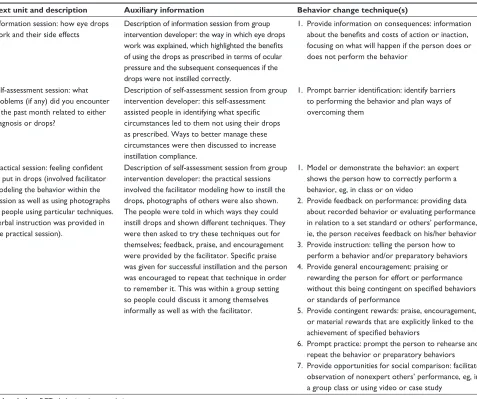
The individual intervention was broken down into 94 text units. Of these, 57 were coded using 18 of the BCTs, with many being coded with more than one BCT. The 57 text units were coded 118 times, with a range between one and six per unit. In the group intervention, 165 units of text were identified. Of these, 125 were identified as targeting behavior change and coded using 22 of the BCTs 157 times (range of 1–9 BCTs per text unit). Those that were not coded related to subjects covered in the intervention that did not directly relate to drop instillation, eg, requirements to inform the Driver Vehicle Licensing Authority or DVLA (text unit: Driving and Glaucoma – When to inform the DVLA). Examples of text units and their associated coding can be seen in Table 1. These have been selected to show how text units were coded with more than one BCT.
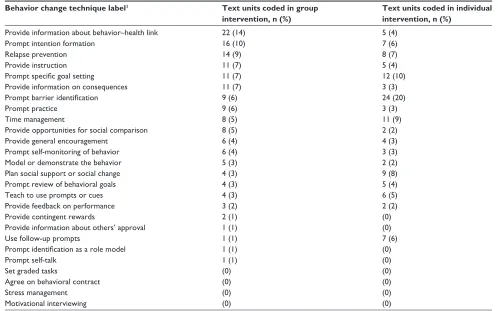
There was a high level of agreement between the two cod-ers, with only 13 (of 157) units in the group intervention and 17 (of 118) in the individual intervention coded differently. High interrater agreement was found, 87% in the individual intervention and 92% in the group intervention. Because many of the text units had been coded multiple times, it was not possible to calculate an intercoder reliability statistic. The coding process allowed the BCTs of each intervention to be counted each time they occurred (Table 2).
The interventions were very similar in content. First, they provided information about glaucoma and the eye drops used to treat it. Second, they helped patients to identify bar-riers to instilling drops as prescribed. Third, they provided techniques to overcome these barriers using both physical demonstrations and advice on incorporating the drops into everyday life, through integration into existing routines or the use of drop diaries. There was a core of BCTs related to these behaviors coded at similar frequencies in both interventions. These provided general encouragement, taught prompts, modeled the behavior, prompted self-monitoring, and reviewed behavioral goals. However, the coding only showed how often these BCTs were identified rather than their duration. For example, one mention in the text of a behavior may have involved 15 minutes of discussion, whereas another may have been much briefer.
(n=14) to relapse prevention. The greatest differences were in the use of prompting barrier identification, which accounted for 20% (n=24) of the coding in the individual intervention, in contrast to only 6% (n=9) of the group intervention. The provision of information about behavioral health links was 10% greater in the group intervention (group 14%, n=4; individual 4%, n=5).
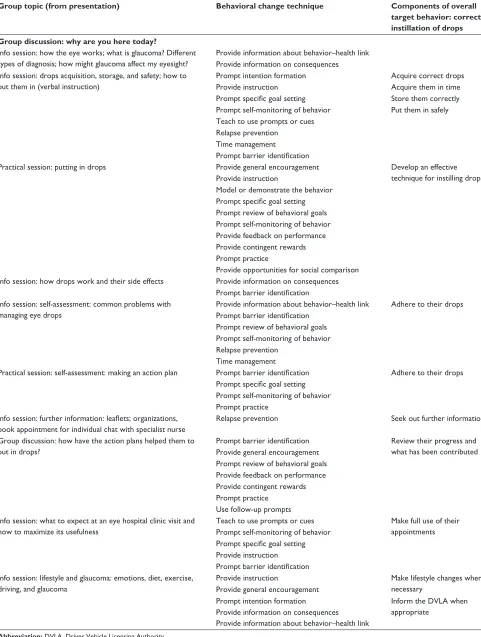
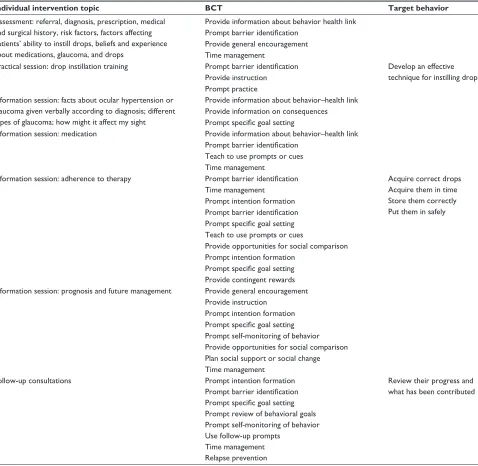
A further aim of this research was to identify whether any of the elements of the intervention targeted at changing behavior could not be coded within the 26-item taxonomy; this was not found to be the case because all behavior-related text units of the interventions were assigned to at least one BCT (Tables 3 and 4).
Discussion
This study aimed to identify and compare the active ingredi-ents of two educational interventions to promote adherence
to glaucoma eye drops and to consider whether the taxonomy thus applied was adequate in covering all aspects of the interventions.
[image:4.612.61.538.63.462.2]Using a prespecified, reliable taxonomy of BCTs resulted in the identification of 18 BCTs in the individual intervention and 22 BCTs in the group intervention. This showed the com-plexity of the interventions with a range of techniques being used. Although one intervention was designed for delivery to individuals and the other to groups, in terms of their active ingredients, the interventions had similar content, but a dif-ferent focus, which may partially be explained by the method of delivery. Author HW was involved in the development of both interventions, which might also have led to greater similarities than if two completely independent interventions had been analyzed, although the limited number of reported interventions of this nature demonstrates that there is often common ground.
Table 1 examples of intervention text units, auxiliary information, and associated coding using BcTs
Text unit and description Auxiliary information Behavior change technique(s)
information session: how eye drops work and their side effects
Description of information session from group intervention developer: the way in which eye drops work was explained, which highlighted the benefits of using the drops as prescribed in terms of ocular pressure and the subsequent consequences if the drops were not instilled correctly.
1. Provide information on consequences: information about the benefits and costs of action or inaction, focusing on what will happen if the person does or does not perform the behavior
self-assessment session: what problems (if any) did you encounter in the past month related to either diagnosis or drops?
Description of self-assessment session from group intervention developer: this self-assessment assisted people in identifying what specific circumstances led to them not using their drops as prescribed. Ways to better manage these circumstances were then discussed to increase instillation compliance.
1. Prompt barrier identification: identify barriers to performing the behavior and plan ways of overcoming them
Practical session: feeling confident to put in drops (involved facilitator modeling the behavior within the session as well as using photographs of people using particular techniques. Verbal instruction was provided in the practical session).
Description of self-assessment session from group intervention developer: the practical sessions involved the facilitator modeling how to instill the drops, photographs of others were also shown. The people were told in which ways they could instill drops and shown different techniques. They were then asked to try these techniques out for themselves; feedback, praise, and encouragement were provided by the facilitator. Specific praise was given for successful instillation and the person was encouraged to repeat that technique in order to remember it. This was within a group setting so people could discuss it among themselves informally as well as with the facilitator.
1. Model or demonstrate the behavior: an expert shows the person how to correctly perform a behavior, eg, in class or on video
2. Provide feedback on performance: providing data about recorded behavior or evaluating performance in relation to a set standard or others’ performance, ie, the person receives feedback on his/her behavior 3. Provide instruction: telling the person how to
perform a behavior and/or preparatory behaviors 4. Provide general encouragement: praising or
rewarding the person for effort or performance without this being contingent on specified behaviors or standards of performance
5. Provide contingent rewards: praise, encouragement, or material rewards that are explicitly linked to the achievement of specified behaviors
6. Prompt practice: prompt the person to rehearse and repeat the behavior or preparatory behaviors 7. Provide opportunities for social comparison: facilitate
observation of nonexpert others’ performance, eg, in a group class or using video or case study
Use of the Abraham and Michie1 taxonomy resulted
in reliable coding with high interrater reliability. All components of the interventions directed at accurate and timely drop instillation were able to be coded using these 26 BCTs.
Breaking down an intervention into its constituent BCTs allows the potential active ingredients of interventions to be identified. It thus may raise awareness among intervention facilitators about exactly what it is they are trying to achieve when trying to promote adherence, eg, be it imparting information on health risk behavior or identifying personal barriers to adherence. Consequently, it means that facilita-tors can be trained appropriately in all aspects of an inter-vention knowing precisely what is to be expected in terms of patient behavior. This may also increase the fidelity to the intervention, leading to a greater chance of getting the desired patient outcome.
This exercise also reveals the differences and simi-larities of BCTs for promoting health behaviors in different situations. For example, in trying to stop smoking, there are no BCTs geared toward modeling or demonstrating the
desired behavior, whereas it featured strongly in both our interventions for patients with glaucoma.3,19 This not only
leads to a better understanding about what is effective but may also lead to a critical review of the presence, intensity, and frequency of BCTs in an intervention in efforts to improve its effectiveness.
[image:5.612.66.564.65.376.2]Describing an intervention in this manner allows a large number of potentially effective components to be identi-fied and, in principle, these components could be separately evaluated. Hence, this kind of specification could ultimately lead to the discarding of ineffective components (or “inactive ingredients”) and more efficient (cost-effective) and targeted interventions. There are three ways to identify the effective-ness of individual components of complex interventions. The first method is to conduct randomized comparisons of each component. Although this approach has been proposed by some researchers (eg, using adaptive designs), such studies are extremely complicated and expensive to conduct. The second method involves a systematic review, in which every inter-vention in the review is coded for BCTs and then the studies are compared to identify whether inclusion of a specific BCT Table 2 Frequency of BcTs coded for the two interventions
Behavior change technique label1 Text units coded in group intervention, n (%)
Text units coded in individual intervention, n (%)
Provide information about behavior–health link 22 (14) 5 (4)
Prompt intention formation 16 (10) 7 (6)
Relapse prevention 14 (9) 8 (7)
Provide instruction 11 (7) 5 (4)
Prompt specific goal setting 11 (7) 12 (10)
Provide information on consequences 11 (7) 3 (3)
Prompt barrier identification 9 (6) 24 (20)
Prompt practice 9 (6) 3 (3)
Time management 8 (5) 11 (9)
Provide opportunities for social comparison 8 (5) 2 (2)
Provide general encouragement 6 (4) 4 (3)
Prompt self-monitoring of behavior 6 (4) 3 (3)
Model or demonstrate the behavior 5 (3) 2 (2)
Plan social support or social change 4 (3) 9 (8)
Prompt review of behavioral goals 4 (3) 5 (4)
Teach to use prompts or cues 4 (3) 6 (5)
Provide feedback on performance 3 (2) 2 (2)
Provide contingent rewards 2 (1) (0)
Provide information about others’ approval 1 (1) (0)
Use follow-up prompts 1 (1) 7 (6)
Prompt identification as a role model 1 (1) (0)
Prompt self-talk 1 (1) (0)
set graded tasks (0) (0)
agree on behavioral contract (0) (0)
stress management (0) (0)
Motivational interviewing (0) (0)
Notes: abraham c, Michie s. a taxonomy of behavior change techniques used in interventions. Health Psychology. 27(3):379–387, 2008. aPa as publisher, adapted with permission.1
Table 3 group intervention
Group topic (from presentation) Behavioral change technique Components of overall target behavior: correct instillation of drops Group discussion: why are you here today?
info session: how the eye works; what is glaucoma? Different types of diagnosis; how might glaucoma affect my eyesight?
Provide information about behavior–health link Provide information on consequences info session: drops acquisition, storage, and safety; how to
put them in (verbal instruction)
Prompt intention formation acquire correct drops
Provide instruction acquire them in time
Prompt specific goal setting store them correctly Prompt self-monitoring of behavior Put them in safely Teach to use prompts or cues
Relapse prevention Time management Prompt barrier identification
Practical session: putting in drops Provide general encouragement Develop an effective
technique for instilling drops Provide instruction
Model or demonstrate the behavior Prompt specific goal setting Prompt review of behavioral goals Prompt self-monitoring of behavior Provide feedback on performance Provide contingent rewards Prompt practice
Provide opportunities for social comparison info session: how drops work and their side effects Provide information on consequences
Prompt barrier identification info session: self-assessment: common problems with
managing eye drops
Provide information about behavior–health link adhere to their drops Prompt barrier identification
Prompt review of behavioral goals Prompt self-monitoring of behavior Relapse prevention
Time management
Practical session: self-assessment: making an action plan Prompt barrier identification adhere to their drops Prompt specific goal setting
Prompt self-monitoring of behavior Prompt practice
Info session: further information: leaflets; organizations, book appointment for individual chat with specialist nurse
Relapse prevention seek out further information
group discussion: how have the action plans helped them to put in drops?
Prompt barrier identification Review their progress and what has been contributed Provide general encouragement
Prompt review of behavioral goals Provide feedback on performance Provide contingent rewards Prompt practice
Use follow-up prompts info session: what to expect at an eye hospital clinic visit and
how to maximize its usefulness
Teach to use prompts or cues Make full use of their appointments Prompt self-monitoring of behavior
Prompt specific goal setting Provide instruction Prompt barrier identification info session: lifestyle and glaucoma: emotions, diet, exercise,
driving, and glaucoma
Provide instruction Make lifestyle changes where
necessary Provide general encouragement
Prompt intention formation inform the DVla when
appropriate Provide information on consequences
Table 4 individual intervention
Individual intervention topic BCT Target behavior
assessment: referral, diagnosis, prescription, medical and surgical history, risk factors, factors affecting patients’ ability to instill drops, beliefs and experience about medications, glaucoma, and drops
Provide information about behavior health link Prompt barrier identification
Provide general encouragement Time management
Practical session: drop instillation training Prompt barrier identification Develop an effective technique for instilling drops Provide instruction
Prompt practice information session: facts about ocular hypertension or
glaucoma given verbally according to diagnosis; different types of glaucoma; how might it affect my sight
Provide information about behavior–health link Provide information on consequences Prompt specific goal setting
information session: medication Provide information about behavior–health link Prompt barrier identification
Teach to use prompts or cues Time management
information session: adherence to therapy Prompt barrier identification acquire correct drops acquire them in time store them correctly Put them in safely Time management
Prompt intention formation Prompt barrier identification Prompt specific goal setting Teach to use prompts or cues
Provide opportunities for social comparison Prompt intention formation
Prompt specific goal setting Provide contingent rewards information session: prognosis and future management Provide general encouragement
Provide instruction Prompt intention formation Prompt specific goal setting Prompt self-monitoring of behavior Provide opportunities for social comparison Plan social support or social change Time management
Follow-up consultations Prompt intention formation Review their progress and
what has been contributed Prompt barrier identification
Prompt specific goal setting Prompt review of behavioral goals Prompt self-monitoring of behavior Use follow-up prompts
Time management Relapse prevention Abbreviation: BcT, behavior change technique.
is associated with greater effectiveness. However, these are not randomized comparisons and therefore do not provide a high level of evidence. The third method has been proposed within the complex interventions literature. This consists of 1) theorizing each intervention component in terms of the process variables that each should change and 2) conducting a theory-based process evaluation alongside a randomized study to identify whether the targeted process variables do indeed change and whether they are mediators of behavior change. We hypothesize that, if there is evidence that the intervention has its effect through the proposed mediating pathways, then the
identified components are effective. This is what we propose to do in future studies, but the first step, which we have achieved in this paper, is to specify the components in a robust way so that these other important questions can be addressed.
It has been suggested that some BCTs may be interde-pendent and operate in clusters3; the cluster may be more
powerful than the individual BCT and this may be the case in glaucoma interventions. Future research could investigate whether this is indeed the case. As well as operating in clus-ters, Longabaugh and Magill6 also identify that some BCTs
This analysis was carried out using Powerpoint slides, text descriptions, and interview information with the devel-oper of the interventions rather than verbatim records of the actual intervention being delivered (eg, audio transcript or video). It might be that additional BCTs were delivered but not described in the materials or that those featuring in the written materials were not in fact delivered.6 These limitations
could be reduced and the intervention tested for fidelity by coding a video recording of the actual delivery of the interventions.20
Although the text units used for coding were coherent sections of the documents (eg, full sentences or Powerpoint prompts), they did vary in length and so both they and their associated BCTs may not have been of equal duration throughout.
A further related limitation concerns that of intensity (or dosage). It is likely that intensity is related to the effectiveness of interventions. It has been suggested that intensity may be specified in terms of the amount of time spent delivering the intervention.5 However, as not every
minute of a face-to-face intervention is spent delivering active ingredients, we propose that a more precise speci-fication of intensity would involve noting the duration of delivery of each active ingredient (BCT) of the intervention and the frequency with which each BCT is delivered. This could be done by coding of audio or video recordings of the interventions.
The research reported here used a reliable taxonomy of behavior change techniques to specify the active ingredients of two interventions that have been designed to improve adherence to eye drop treatment for glaucoma. Although one intervention was designed for individual delivery and the other for group delivery, the two interventions included similar active ingredients. This level of specification can be used to ensure that precisely the same intervention that has been pilot tested is reproducible in routine clinical practice and in a proposed definitive trial.
Acknowledgments
We are very grateful for the assistance of Rachel Crayton in the data analysis and the contribution of Eilidh Duncan in the management group. There were no external sources of funding for this study. Parts of this work have previously been presented at the meeting of the UK and Eire Glaucoma Society, Nottingham, UK, 5–6 December 2013, and at the annual conference of the British Psycho-logical Society Division of Health Psychology, Brighton, 11–13 September 2013.
Disclosure
The authors report no conflicts of interest in this work.
References
1. Abraham C, Michie S. A taxonomy of behavior change techniques used in interventions. Health Psychol. 2008;27(3):379–387.
2. Boutron I, Moher D, Altman DG, Schulz KF, Ravaud P, CONSORT Group. Extending the CONSORT statement to randomized trials of nonpharmacologic treatment: explanation and elaboration. Ann Intern
Med. 2008;148(4):295–309.
3. Michie S, Hyder N, Walia A, West R. Development of a taxonomy of behaviour change techniques used in individual behavioural support for smoking cessation. Addict Behav. 2011;36(4):315–319.
4. Albarracín D, Gillette JC, Earl AN, Glasman LR, Durantini MR, Ho MH. A test of major assumptions about behavior change: a comprehensive look at the effects of passive and active HIV-prevention interventions since the beginning of the epidemic. Psychol Bull. 2005;131(6):856–897. 5. Davidson KW, Goldstein M, Kaplan RM, et al. Evidence-based
behav-ioural medicine: what is it and how do we achieve it? Ann Behav Med. 2003;26(3):161–171.
6. Longabaugh R, Magill M. Commentary on Michie et al. (2012): the lid is off the black box. Addiction. 2012;107(8):1441–1442.
7. Quigley HA, Broman AT. The number of people with glaucoma worldwide in 2010 and 2020. Br J Ophthalmol. 2006;90(3):262–267. 8. Vass C, Hirn C, Sycha T, et al. Medical interventions for primary open
angle glaucoma and ocular hypertension. Cochrane Database Syst Rev. 2007;(4):CD003167.
9. Reardon G, Kotak S, Schwartz GF. Objective assessment of compliance and persistence among patients treated for glaucoma and ocular hyper-tension: a systematic review. Patient Prefer Adherence. 2011;5:441. 10. Lu VH, Goldberg I, Lu CY. Use of glaucoma medications: state of the
science and directions for observational research. Am J Ophthalmol. 2010;150(4):569–574.
11. Waterman H, Evans JR, Gray TA, Henson D, Harper R. Interventions for improving adherence to ocular hypotensive therapy. Cochrane
Database Syst Rev. 2013;(2):CD006132.
12. Gray TA, Fenerty C, Harper R, et al. Individualised patient care as an adjunct to standard care for promoting adherence to ocular hypoten-sive therapy: an exploratory randomised controlled trial. Eye (Lond). 2012;26(3):407–417.
13. Okeke CO, Quigley HA, Jampel HD, et al. Adherence with topical glaucoma medication monitored electronically. The Travatan dosing aid study. Ophthalmology. 2009;116(2):191–199.
14. Norell SE. Improving medication compliance: a randomised clinical trial. Br Med J. 1979;2(6197):1031–1033.
15. Richardson C, Brunton L, Fenerty C, et al. A study to assess the feasibility to undertake an RCT on adherence to eye drops in glaucoma patients. Patient Prefer Adherence. 2013;7:1025–1039.
16. Waterman H, Brunton L, Fenerty C, Mottershead J, Richardson C, Spencer F. Adherence to ocular hypotensive therapy: patient health edu-cation needs and views on group eduedu-cation. Patient Prefer Adherence. 2013;7:55–63.
17. Waterman H, Annis G. IGA open summer patient meeting. IGA News. 2011; Winter, 15–25. Available from: http://www.glaucoma-association. com/uploads/Newsletters/IGA_Winter_News_11.pdf. Accessed February 9, 2015.
18. Craig P, Dieppe P, Macintyre S, Michie S, Nazareth U, Petticrew M. Developing and evaluating complex interventions: the new Medical Research Council guidance. Br Med J. 2008;337:a1655–a1655. 19. West R, Walia A, Hyder N, Shahab L, Michie S. Behavior change
tech-niques used by the English Stop Smoking Services and their associations with short-term quit outcomes. Nicotine Tob Res. 2010;12(7):742–747. 20. Bellg AJ, Borrelli B, Resnick B, et al. Enhancing treatment fidelity
Psychology Research and Behavior Management
Publish your work in this journal
Submit your manuscript here: http://www.dovepress.com/psychology-research-and-behavior-management-journal
Psychology Research and Behavior Management is an international, peer-reviewed, open access journal focusing on the science of psychology and its application in behavior management to develop improved outcomes in the clinical, educational, sports and business arenas. Specific topics covered include: Neuroscience, memory & decision making; Behavior
modification & management; Clinical applications; Business & sports performance management; Social and developmental studies; Animal studies. The manuscript management system is completely online and includes a quick and fair peer-review system. Visit http://www.dovepress. com/testimonials.php to read real quotes from published authors.