White Rose Research Online URL for this paper: http://eprints.whiterose.ac.uk/85752/
Version: Accepted Version
Article:
Brown, Helen and Gaskell, M. Gareth orcid.org/0000-0001-8325-1427 (2014) The time-course of talker-specificity and lexical competition effects during word learning. Language Cognition and Neuroscience. pp. 1163-1179. ISSN 2327-3801
https://doi.org/10.1080/23273798.2014.916409
[email protected] https://eprints.whiterose.ac.uk/
Reuse
Items deposited in White Rose Research Online are protected by copyright, with all rights reserved unless indicated otherwise. They may be downloaded and/or printed for private study, or other acts as permitted by national copyright laws. The publisher or other rights holders may allow further reproduction and re-use of the full text version. This is indicated by the licence information on the White Rose Research Online record for the item.
Takedown
If you consider content in White Rose Research Online to be in breach of UK law, please notify us by
The time-course of talker-specificity and lexical competition effects during
word learning
Helen Brown* & M. Gareth Gaskell
Department of Psychology, University of York, YO10 5DD, UK
* Please address correspondence to:
Helen Brown
Department of Psychology
University of Warwick
Coventry
CV4 7AL
Email: [email protected]
Tel: 02476 573 946
Short title: Talker-specificity during word learning
Abstract
Three experiments examined the time-course of talker-specificity and lexical competition
effects during spoken word learning. Talker-specificity effects depend on access to highly
detailed lexical representations, whilst lexical competition may exploit more abstract
representations. By tracking the time-courses of these effects concurrently we examined
whether there was a common mechanism underlying their storage and retention.
Talker-specificity effects on recognition of novel words were robust immediately after study and
were generally stable over the course of a week. In contrast, lexical competition effects
emerged only at delayed test points. This time-course dissociation supports a dual-system
model of lexical processing in which episodic representations of new words are generated
rapidly, but robust representations underlying lexical competition emerge only after a period
of offline consolidation.
Keywords: word learning, lexical representation, memory consolidation, indexical
Talker-specificity effects (TSEs) occur when spoken words are processed faster and more
accurately if heard in the same voice at study and test as opposed to different voices. They
suggest that voice-specific details are encoded and stored in memory when a word is heard.
Lexical competition, on the other hand, is often characterized as relying on a more abstract
phonological code; words that are phonologically similar take part in a competition process
during spoken word recognition (Marslen-Wilson & Zwitserlood, 1989). Nonetheless, some
models of word recognition encapsulate this competition process using the same kind of
episodic or detailed representation that could underlie TSEs (e.g., Goldinger, 1998). In this
paper we look at the extent to which the processes that support TSEs and lexical competition
have similar properties. In particular, we look at the time-course of the TSEs and lexical
competition effects when new words are encountered as a means of determining whether they
rely on the same processes for encoding and retention.
With regards to TSEs, many studies have already shown that recently studied existing
words are processed faster and more accurately when the surface details of the speech form
(Bradlow, Nygaard, & Pisoni, 1999; Craik & Kirsner, 1974; Goh, 2005; Goldinger, 1996;
Goldinger, Kleider, & Shelley, 1999; McLennan & Luce, 2005; Schacter & Church, 1992;
Sheffert, 1998), or the written form (see Tenpenny, 1995, for a review), remain consistent
between study and test. Similar specificity effects have also been observed immediately after
study for newly-learned words (Creel, Aslin, & Tanenhaus, 2008; Creel & Tumlin, 2009,
2011).
Additionally, studies of lexically-driven perceptual learning (e.g., Norris, McQueen,
& Cutler, 2003), in which exposure to an ambiguous phoneme /?/ midway between (for
example) /f/ and /s/ in the context of /f/-final words results in a bias to interpret /?/ as /f/ at
test (and vice-versa given exposure to /?/ in /s/-final words), also provide further evidence
found robust perceptual learning only when the same talker was heard during exposure and
test. However, Kraljic and Samuel (2005) reported more mixed findings. Perceptual learning
was not observed when items were trained in a male voice and tested in a female voice,
suggesting that perceptual learning effects were talker specific. Conversely, when items were
trained in a female voice and tested in a male voice perceptual learning was observed despite
the change in talker, suggesting that perceptual learning was not talker specific (see also
Kraljic & Samuel, 2006). Thus, lexically-driven perceptual learning effects appear in some
cases to be talker-specific and in others talker-general even when participants are tested
immediately after study.
Whereas it is clear from previous research that TSEs can be observed soon after
learning there is less evidence relating to whether talker-specific details are retained in
long-term memory. The retention intervals used in the experiments cited above were all relatively
short (typically less than an hour). Only a handful of studies have examined longer-term
retention of episodic details in lexical memory, and these have provided mixed findings. On
one hand, Goldinger (1996) found significant TSEs for existing words in an
identification-in-noise task one week post-study. Ernestus (2009) also showed that information about
unreduced vowels affected recognition of newly-encountered past participles one week
post-study. On the other hand, using the same stimuli as in the identification-in-noise task,
Goldinger failed to demonstrate sustained TSEs one week post-study in an old/new
recognition task, suggesting that episodic details may be lost over time. Thus, whilst there is
substantial evidence indicating that talker-specific details are likely to be encoded and affect
processing for a short period of time immediately after a word has been encountered, the
retention of this information in long-term memory is less clear.
In comparison to the immediacy of TSEs, lexical competition effects for new words
& Gaskell, 2007; Henderson, Weighall, Brown, & Gaskell, 2012). One way to examine
whether new and existing lexical representations have been integrated is to determine
whether new words (e.g., biscal) impact upon processing of phonologically-similar existing
words (e.g., biscuit). Slower processing of existing ‘base-words’ with new competitors
(compared to control ‘base-words’ without new competitors) indicates that the new nonwords
have been integrated with existing knowledge and are engaging in lexical competition with
similar-sounding words during spoken word recognition (cf. Marslen-Wilson & Zwitserlood,
1989). Previous studies largely demonstrate slowed processing of test base-words only at
delayed test points following periods of sleep-associated offline consolidation (Dumay &
Gaskell, 2007; Henderson et al., 2012; although see Lindsay & Gaskell, 2013).
To summarise, existing evidence suggests that lexical competition effects for new
words are typically absent immediately after learning, and emerge following a consolidation
period. On the other hand TSEs are robust immediately after learning, but it is less clear
whether they remain in the longer term. The different time-courses observed for TSEs and
lexical competition effects might suggest that these two effects depend upon different
processing mechanisms. In the context of word learning, a dissociation between immediate
establishment of highly-detailed lexical representations and their integration with existing
knowledge may be interpreted within dual-system models of learning and memory (e.g.,
Davis & Gaskell, 2009; McClelland, McNaughton, & O'Reilly, 1995). Such dual-system
models assume that new information is initially retained in an episodic temporary store, but
over time becomes integrated (via consolidation processes) into a long-term memory store.
Assuming that a dual-systems account is viable, there remain uncertainties regarding the
precise roles of the two subsystems in the representation and processing of words.
It is possible that the two different subsystems are responsible for two different types
Norman, 2002). In other words, consolidation may be responsible for generating abstract,
context-free representations. Such a finding would be consistent with hybrid models of
lexical memory, in which representations are initially episodic, with multiple episodes
combining into more abstract units over time, given multiple exposures to a word (Feustel,
Shiffrin, & Salasoo, 1983; Goldinger, 2007; Grossberg, 1986; McLennan, Luce, &
Charles-Luce, 2005). Importantly, episodic representations are not lost once more abstract
representations are formed in hybrid models. Rather, both representations may co-exist in
memory. Distributed memory models (e.g., McClelland & Rumelhart, 1985) offer a similar
explanation; traces of individual experiences are represented as unique patterns of activation
across a number of nodes in a connectionist network, with abstraction emerging from the
superposition of similar memory traces.
Alternatively the consolidation processes responsible for integrating new and existing
lexical information might strengthen and enhance memory for all encoded information.
Evidence that this is the case would support pure episodic/exemplar models of lexical
memory which assume that the lexicon consists of episodic traces containing perceptual and
contextual details specific to each individual occurrence of a word (Goldinger, 1998;
Hintzman, 1986, 1988; Jacoby, 1983a, 1983b).
Although previous research suggests that TSEs and lexical competition effects follow
different time-courses, there are a number of factors limiting this conclusion. First,
experiments using existing words to examine the retention of talker-specific information are
limited by the fact that these words will have been encountered many times, in many different
voices, prior to the experimental sessions. TSEs may be masked by this past experience.
Second, methodological differences between studies examining TSEs and lexical competition
effects make a direct comparison of their courses difficult. Studies examining the
only one time point (e.g., Goldinger, 1996) whilst studies examining the time-course of
lexical competition effects typically use a within-participants design (e.g., Dumay & Gaskell,
2007). Perhaps crucially, the number of words encountered during study, and the level of
exposure to each word tend to be very different. For instance, participants in Goldinger’s
study encountered 150 existing words just once each before completing a test of TSEs whilst
Dumay and Gaskell (2007) exposed participants to 24 new words 36 times each before
testing for lexical competition effects. This level of exposure may be crucial in engaging
consolidation processes to enhance later memory.
The experiments reported here used an artificial lexicon enabling us to eliminate
potential confounds associated with participants having heard existing words in many
different voices prior to the experiment. Moreover, by teaching participants new words we
were able to carefully control the number of voices that each word was encountered in during
study, as well as the number of exposures to each word prior to test. All participants received
the same amount of exposure to the same number of words, and completed tests of both TSEs
and lexical competition effects at the same time points. This enabled us, for the first time, to
test the time-course of TSEs and lexical competition effects in comparable circumstances.
A subsidiary question was whether talker information affected lexical processing once
new and existing information had been integrated in long-term memory. Few previous studies
have addressed this question. In one experiment Creel et al. (2008) taught participants novel
words-novel object associations. During study each novel word was heard in only one voice.
Critically, the target and competitor items (a novel cohort or rhyme competitor) were spoken
either consistently by the same talker, or by different talkers. At test more fixations to the
target item and fewer fixations to the competitor item were observed when the target and
competitor had been spoken by different talkers during study. These findings suggest that
words engaged in lexical competition (see Creel & Tumlin, 2009, 2011, for similar findings).
Nonetheless, Creel et al.’s experiment demonstrates only that talker information affects
lexical competition within a small set of novel words; they did not investigate whether talker
information affects the amount of lexical competition that is observed between existing and
novel words. The design of the three experiments reported here allowed us to address this
question.
Returning to the key question, a dual-systems account would predict marked
differences in the time-courses of the tasks: episodic TSEs should emerge immediately after
study and remain or weaken over time, whereas lexical competition effects should be absent
immediately and emerge only after a consolidation period. Alternatively, an
episodic/exemplar account would predict that TSEs and lexical competition effects should
follow the same time-course, given that they are both underpinned by the same learning
process and representation.
Experiment 1
In Experiment 1 participants studied 24 fictitious nonwords (e.g., biscal), with half of
the items consistently spoken by a male talker and half consistently by a female talker. Talker
gender was selected as the episodic detail to be manipulated since it has been widely used in
previous studies with existing words. Participants completed two test tasks immediately after
study, as well as one day later, and one week later; (i) a lexical decision task, designed to
measure lexical competition between new and existing words, and (ii) an old/new
categorisation task, used to measure the extent to which talker information affected
recognition of the new words themselves. Critically, half of the studied items were heard in
different voices at study and test whilst the other half remained in the same voice, enabling us
to examine TSEs as well as the extent to which talker identity affected lexical competition
Method
Participants
Thirty-one students (age range 18–23yrs, 9 male) from the University of York
completed the experiment, receiving either payment or partial course-credit. Participants in
this and subsequent experiments were native British English speakers and reported no known
hearing, speech or language impairments. Informed consent was obtained prior to the first
session.
Stimuli
Forty-eight stimulus triplets, each containing one existing ‘base-word’ (e.g. biscuit)
and two nonwords (e.g. biscal, biscan), were selected from stimuli used by Tamminen and
Gaskell (2008; see Appendix A). Base-words were monomorphemic with uniqueness points
located at or before the final vowel. Nonwords differed from their base-word at the final
vowel, and from each other at the final consonant/consonant cluster. The nonwords
encountered during study will be referred to as ‘novel nonwords’ and the untrained nonwords
used as distracters in the old/new categorisation task as ‘foil nonwords’. Lexical competition
between phonologically similar words occurs up to the point where only one word in the
lexicon matches the speech input (the uniqueness point of the word; Cohort Model –
Marslen-Wilson & Zwitserlood, 1989). By teaching participants novel nonwords that differ
from their base-words only after the uniqueness point of that word, the uniqueness point can
be artificially shifted towards the offset of the word. Thus, slowed processing of
base-words with novel nonword competitors (compared to control base-base-words without novel
competitors) in a lexical decision task would indicate that newly-learned nonwords were
engaging in lexical competition.
The stimulus triplets were split into two lists of 24, with base-words matched on
as possible on number of phonemes (M=7.96, Range=6-11) and frequency (M=3.63,
Range=2-14; CELEX database, Baayen, Piepenbrock, & van Rijn, 1993). T-tests indicated
that whilst the two lists did not differ significantly in the mean number of phonemes per
word, t(46)=-.423, p=.67, the difference between the mean frequency of each list approached
significance, t(46)=-1.799, p=.08. In order to ensure that this marginal difference did not
affect results the two lists were counterbalanced across participants; each list was the ‘test’
list for half of the participants, and the ‘control’ list for the other half.
Forty-eight monomorphemic English nouns (24 monosyllabic, 12 bisyllabic and 12
trisyllabic), 96 nonwords (each generated by changing one or two phonemes of existing
words), and 30 practice items (15 words; 15 nonwords) were also selected from Tamminen
and Gaskell (2008) as filler items for the lexical decision task.
One male and one female British English speaker recorded the stimuli in a sound
attenuated booth. On average, the acoustic duration of words recorded by the male talker
(M=691ms, SD=96ms) was shorter than those recorded by the female talker (M=805ms,
SD=89ms), t(143)=-13.75, p<.001. Although this difference in acoustic duration between
talkers was unplanned, and will have added to the acoustic differences between talkers this is
not of critical importance since the experiments reported in this paper primarily address the
time-course of TSEs for novel nonwords rather than the specific variables driving the TSEs
themselves. The stimuli were digitized at a 44.1Hz sampling rate with 16-bit
analogue-to-digital conversion. Peak amplitude was normalised using Adobe Audition.
Design
Participants were tested individually in sound-attenuated booths. Tasks were run
using DMDX experimental software (Forster & Forster, 2003). Stimuli were presented
Participant completed three sessions on Days 1, 2 (~24 hours later), and 8 (one week
later). In Session 1 participants were exposed to the novel nonwords in a phoneme
monitoring task. Participants subsequently completed the lexical decision and old/new
categorisation tasks. On Days 2 and 8 participants completed only the lexical decision and the
old/new categorisation tasks. The order of these two tasks was fixed across sessions, with the
lexical decision task always occurring first.
Procedure
Each participant studied one list of 24 novel nonwords, counterbalanced across
participants, in a phoneme monitoring task. Twelve nonwords were spoken consistently by
the male talker and 12 by the female talker. Participants listened for and indicated the
presence/absence of specified phonemes in the novel nonwords. Following five existing-word
practice trials, participants completed six experimental blocks, each specifying a different
target phoneme (/p/, /t/, /b/, /m/, /s/, /d/). The novel nonwords occurred three times per block,
with the order of the novel nonwords randomised in groups of 24 (i.e., one full repetition of
the list).
Unless otherwise stated, in this and all subsequent tasks, (i) instructions emphasised
both speed and accuracy; (ii) feedback stating the average RT and the number of errors made
was provided at the end of each block to encourage quick and accurate responding; (iii) RTs
were measured from word onset, with a maximum RT of 5s, after which the program
automatically moved on to the next item with an inter-trial interval of 500ms.
At test the study lists were further subdivided so that 6 of the 12 nonwords studied in
the male voice were tested in the female voice, whilst the other 6 remained in the male voice,
and likewise for nonwords studied in the female voice. Overall, 12 nonwords were heard in
the same voice as study, and 12 in a different voice. The test voice was the same for all items
then the foil nonword ‘biscan’ was also heard in the male voice in the old/new categorization
task, and the base-word ‘biscuit’ was spoken in the male voice in the lexical decision task.
Test-talker remained constant across test-sessions such that items classed as different-talker
items in Session 1 remained in the opposite voice to study at all test-points (and likewise for
all same-talker items). Participants were not informed about the manipulation of voices
between study and test in order to avoid drawing attention to this variable.
In the lexical decision task participants heard all 48 base-words, 48 word fillers, and
96 nonword fillers presented in a randomised order in two experimental blocks of 96 items.
Blocks were matched in the number of test base-words, control base-words, word fillers, and
nonword fillers, with the order of the blocks counterbalanced across participants. Half of the
test base-words, control base-words, word fillers, and non-words were heard in the male
voice, and half in the female voice, counterbalanced across participants so that half heard
each item in the male voice and half in the female voice. Thirty practice items were included
at the start of the task. Participants were instructed to decide whether each item was an
existing word or a made-up word, indicating their response by pressing the right or left
response key respectively.
In the old/new categorisation task participants heard the 24 studied novel nonwords
and 24 corresponding foil nonwords presented one at a time in a randomised order.
Participants decided whether each nonword was old (heard during the phoneme monitoring
task) or new (had never been heard before), indicating their response by pressing the left or
right response key respectively. Feedback was not provided in this task.
Results
RTs were analysed for the lexical competition task, whilst accuracy data were
analysed for the old-new categorisation task. For all analyses in this and subsequent
estimate of random variation (Pollatsek & Well, 1995). Significant main effects and
interactions involving this variable are reported only for the study task.
Study phase
Fifteen participants learned List 1 and 16 learned List 2. The mean error rate in the
phoneme monitoring task was 5.6% (SD=2.5%).1 A 2 (study talker: male, female) x 2 (list: 1,
2) repeated-measures ANOVA revealed a non-significant main effect of list, Fs<1, but a
marginally significant effect of study talker, F1(1,28)=3.51, p=.071, p2=.11, F2(1,46)=1.83,
p=.18; p2=.04, indicating that participants made fewer errors in the phoneme monitoring task
when items were heard in the male (M=5.0%) rather than the female (M=6.0%) voice.
Nonetheless, there was no significant interaction between study talker and list, Fs<1.
Lexical competition effects
Across all items in the lexical decision task the mean accuracy score was 92.3%
(SD=4.0%), indicating that participants were paying close attention to the task. Only data
from the 48 base-words were included in the analysis, allowing comparison between words
with (test) and without (control) novel nonword competitors. All incorrect responses were
removed prior to analysis (6.5% of the data), as were correct data points with RTs <200ms or
>2.5SD from the mean RT for each participant in each session (2.3% of the data). One
participant had an error score more than 2.5SD above the mean and was removed from the
dataset. With this participant removed the mean RT was 930ms (SD=214ms) and the mean
accuracy was 91.7%. Mean RTs for test and control base-words in each session are reported
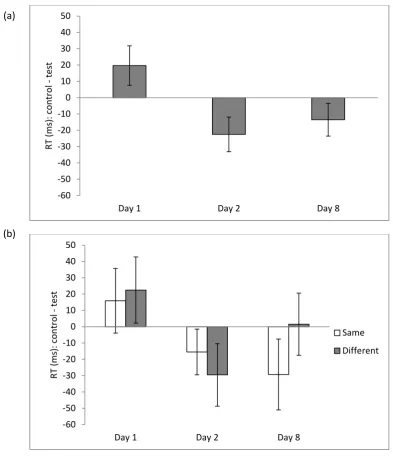
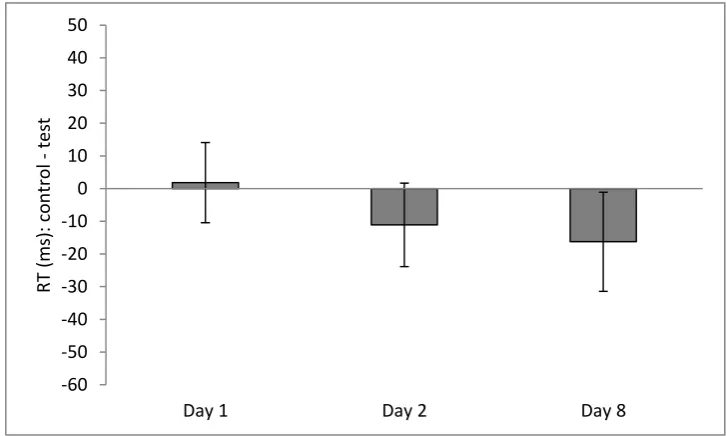
in Table 1. Difference scores are plotted in Figure 1a.
A 2 (base-word type: test, control) x 3 (day: 1, 2, 8) repeated-measures ANOVA
revealed a significant main effect of day, F1(2,56)=13.47, p<.001, p2=.33, F2(2,94)=45.82,
p<.001, p2=.49. RTs were significantly slower on Day 1 (M=968ms) compared to both Day
8 (M=927ms), F1(1,28)=7.00, p=.013, p2=.20, F2(1,47)=32.52, p<.001, p2=.41, likely due
either to practice effects and task repetition resulting in faster RTs on Days 2 and 8, or to
fatigue on Day 1 where participants had just completed the 20-25 min phoneme monitoring
task. RTs were also significantly faster on Day 2 compared to Day 8, F1(1,28)=4.95, p=.035,
p2
=.15, F2(1,47)=10.64, p=.002, p2=.19.
The main effect of word-type was not significant, F1(1,28)=1.08, p=.31, p2=.04,
F2(1,47)=1.30, p=.26, p2=.03, but crucially the interaction between day and word-type was
highly significant, F1(2,56)=10.64, p<.001, p2=.28, F2(2,94)=5.46, p=.006, p2=.10. RTs
were quicker to test compared with control base-words on Day 1, F1(1,28)=6.49, p=.017.
p2
=.19, although this effect was only marginally significant by-items, F2(1,47)=3.16,
p=.082, p2=.06. In comparison, test word RTs were significantly slower than control word
RTs on Day 2, F1(1,28)=8.28, p=.008, p2=.23, F2(1,47)=7.47, p=.009, p2=.14, with this
effect remaining marginally significant by-participants on Day 8, F1(1,28)=3.31, p=.079,
p2=.11, although the effect was no longer significant by-items, F2(1,47)=2.04, p=.16,
p2
=.04, suggesting that lexical competition between phonologically similar nonwords and
base-words emerged after a period of sleep-associated offline consolidation and remained (to
some degree) one week later. The facilitatory effects observed for test base-words on Day 1
(see also Gaskell & Dumay, 2003) may be due to participants having become aware of the
phonological similarity between the studied novel nonwords and their base-words. Even if
participants were not consciously aware of this similarity, hearing the novel nonwords 18
times during study may have primed their phonologically similar base-words such that they
were activated more rapidly than control base-words on Day 1.
Whilst the analyses above show that, as predicted, lexical competition effects
emerged only after a consolidation period, they do not distinguish between base-words heard
information about the talker then stronger lexical competition effects should be evident in
cases where base-words and new competitors were matched both in terms of the initial
phoneme sequence and the identity of the talker. To address this possibility, control-test
difference scores were calculated separately for same- and different-talker base-words (see
Table 2). These difference scores were analysed using a 2 (base-word talker: same, different)
x 3 (day: 1,2,8) repeated-measures ANOVA.. As in the main analysis there was a significant
main effect of day, F1(2,56)=9.97, p<.001, p2=.26, F2(2,94)=4.52, p=.013, p2=.09. The
main effect of base-word talker was not significant, F1<1, F2(1,47)=1.30, p=.26, p2=.03.
There was however a significant interaction between day and base-word talker in the
by-participants analysis, F1(2,56)=3.27, p=.045, p2=.10, although this was not significant by
items, F2(2,94)=1.83, p=.17, p2=.04. Further analysis revealed that the difference between
same and different talker items approached significance only on Day 8, F1(1,28)=3.07, p=.09,
p2
=.10, F2(1,47)=5.85, p=.020, p2=.11 (see Figure 1b).
Talker-specificity effects
In the old/new categorisation task, participants responded correctly to 83.7%
(SD=7.0%) of the items. The data were analysed using signal detection theory (SDT; Green &
Swets, 1966): d-prime (d) provides an estimate of sensitivity (the ability to distinguish signal
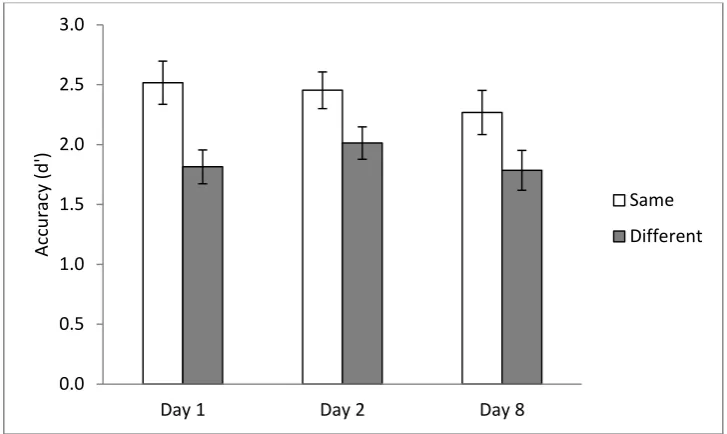
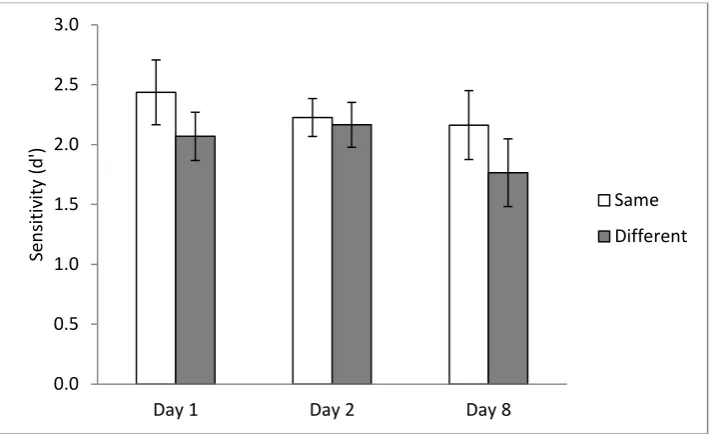
from noise) that is unaffected by individual response biases (Figure 2). Hit rates and false
alarm rates are reported in Table 3.
A 2 (test-talker: same, different) x 3 (day: 1, 2, 8) repeated-measures ANOVA
revealed a significant main effect of test-phase talker, F(1,29)=36.46, p<.001, p2=.56, with
higher accuracy scores for same- compared to different-talker items. There was also a
marginal main effect of day, F(2,58)=3.05, p=.055, p2=.10. Posthoc comparisons revealed a
significant difference only between Days 2 and 8, F(1,29)=4.50, p=.043, p2=.13. All other
between test-phase talker and day, F(2,58)=1.60, p=.21, p2=.05, suggesting that the
same-talker advantage did not change significantly over time.
Discussion
Experiment 1’s key finding was that TSEs and lexical competition effects for novel
words have different time-courses. Talker identity influenced recognition of the new words
immediately after study, and remained equally influential at delayed test-points up to one
week later. Conversely, lexical competition effects were absent immediately after learning,
but emerged after a period of offline consolidation and remained (to some degree) one week
later. This dissociation may be explained by these two effects being subserved by different
processes/memory mechanisms. Talker identity can be encoded immediately into new
episodic lexical representations, whereas lexical competition effects may be reliant on lexical
representations that arise as a result of the consolidation processes responsible for integrating
new and existing information.
The effect of time on the emergence of lexical competition is consistent with previous
research showing that a period of sleep-associated offline consolidation is sufficient for
phonologically-similar new and existing words to become integrated and begin competing
during spoken word recognition (Davis, Di Betta, Macdonald, & Gaskell, 2009; Dumay &
Gaskell, 2007; Dumay, Gaskell, & Feng, 2004; Gaskell & Dumay, 2003; Henderson et al.,
2012; Tamminen & Gaskell, 2008). Experiment 1 also provided an opportunity to address
whether lexical competition effects for novel words were talker-specific. There was limited
evidence that this was the case. The magnitude of lexical competition effects did not differ
significantly for same- and different-talker items on Day 2, and even on Day 8 this difference
only approached significance by-participants despite being fully significant by-items,
suggesting that competition between similar-sounding novel and existing words during
finding is inconsistent with results from Creel et al.’s (2008) study in which talker-specific
lexical competition effects were observed between pairs of phonologically similar novel
words. However, in this study participants were required only to consider a small set of
newly learned words associated with visually presented novel objects. In such an
environment talker information may become more salient or even strategically encoded and
used to aid performance at test. Our experiment, which examined lexical competition
between existing and novel words, required participants to consider the whole lexicon,
making strategic use of talker information less likely.
In terms of TSEs in recognition memory, Experiment 1 showed that accurate
form-based representations of new words were rapidly generated, with both phonological and
talker information being encoded and stored. The immediacy of TSEs is consistent with
previous studies demonstrating TSEs for existing words immediately after study (e.g.,
Goldinger, 1996). However, the finding that TSEs remained strong in the d data one week
later is more novel, contrasting with Goldinger’s (1996) old/new categorisation task in which
TSEs for existing words declined over the course of a week. The retention of TSEs over a
week in Experiment 1 is particularly surprising given that test-talker remained constant across
test sessions. Hearing a novel nonword in a different voice at test on Day 1 should have
resulted in that nonword being represented by two unique memory traces, each containing
different talker information. As a result, recognition of these different-talker items should
have subsequently improved on Days 2 and 8, thus decreasing the size of the TSEs. The
absence of an interaction between test-talker and day suggests that TSEs did not change in
size over a week.
One explanation for the different time-courses of TSEs for existing and novel words
may be that repeated presentation of a single token of each nonword during study highlighted
An additional experiment conducted in our lab using a similar methodology provides initial
evidence against this suggestion. This experiment used a surprise old/new categorisation task,
reducing the likelihood that participants deliberately encoded talker information during study
as a cue to aid later recognition memory. Moreover, participants completed test sessions only
on Days 1 and 8, minimizing re-testing effects and potential confounds associated with using
a within-participants design. Nevertheless, d data from the old/new categorization task still
revealed significant TSEs in the Day 8 re-test. These results suggest that talker information is
automatically encoded and stored alongside phonological information when new words are
encountered.
An alternative explanation highlights the use of nonwords in our study. Only one
token of each nonword was heard during study in Experiment 1 and participants had no prior
experience of these items. In contrast, participants would have encountered different tokens
of each existing word many times prior to Goldinger’s study. As more tokens of the same
word are encountered, the invariant properties of the word may become abstracted and
episodic details lost; that is, variability in the input may be essential (in addition to periods of
sleep-associated offline consolidation) in order for robust abstract lexical representations to
be established in long-term memory. Experiments 2 and 3 explore this possibility in more
detail.
There is already evidence from other research areas within psycholinguistics that
variability is vital in order for robust abstract representations that are capable of
generalisation to be formed. For instance, variable input during training appears to be vital in
order for adults to form robust, abstract perceptual categories (e.g., Bradlow,
Akahane-Yamada, Pisoni, & Tohkura, 1999), and developmental studies suggest that variability in the
input may be important in the early stages of word learning (Singh, Morgan & White, 2004;
tokens may alter the time-course with which abstract representations become dominant in our
word learning experiment. That is, introducing greater talker-variability during study may
alter both the time-course of TSEs and the lexical competition effects. However, different
types of variability during study may have different effects on these two measures.
If talker information remains constant across different training instances of a novel
word while speech rate and intonation differ (within-talker variability; Experiment 2) then
TSEs may still be observed when participants are later required to recognise the studied novel
nonwords. Within an exemplar model of lexical memory this should arise due to all episodic
traces of each novel nonword containing the same talker information. Within a hybrid model
this pattern of TSEs may result from the variable aspects of the input (speech rate and
intonation) being treated as irrelevant, but the invariant aspects of the input (in this case talker
identity, in addition to the phonological form of the novel word) being retained in memory.
This results in a further (but rather extreme) prediction that TSEs in recognition memory may
become stronger over time as a result of using within-talker variability during study if
learners consolidate and strengthen information about all invariant properties of the input, in
this case both the phonological information and the talker information. If this latter prediction
is correct then talker-specific lexical competition effects may also be observed in Experiment
2.
In comparison, introducing multiple talkers during study (between-talker variability;
Experiment 3) should result in smaller TSEs than Experiment 1. Within an exemplar memory
model this would result from different episodic traces of a novel word containing different
talker information. An exemplar model would predict that the size of TSEs following
between-talker variability should be equivalent in size at all time points since recognition
memory and lexical competition should be based on activation of the same set of traces at all
identity varies across training tokens alongside variation in speech rate and intonation then
only the phonological form of an item will be invariant across the different study tokens of a
novel word, promoting the establishment of abstract phonological representations and
resulting in a decrease in TSEs over time. If abstract representations require a period of
offline consolidation in order to become established, then the size of TSEs may change
between the immediate test, and delayed test sessions in Experiment 3.
Experiment 2: Within-talker variability Method
Participants
Thirty-two undergraduate students (age range 18-21yrs, 18 male) from the University
of York completed the experiment.
Stimuli
The stimuli were the same as Experiment 1. Eighteen tokens of each novel nonword
(varying in intonation and articulation rate) were recorded by each talker for the phoneme
monitoring task. An additional token of each novel nonword was recorded for the old/new
categorisation task using an ‘average’ speech rate and ‘normal’ intonation. Foil nonwords,
base-words, and filler items for the lexical decision task were also re-recorded to minimise
differences in recording or voice quality. As in Experiment 1 the acoustic duration of items
recorded by the male talker (M=694ms, SD=158ms) was, on average, shorter than those
recorded by the female talker (M=830ms, SD=151ms), t(1151)=-5.76, p<.001. However, the
standard deviations reported here indicate that there was a similar amount of variability in the
duration of tokens produced by both talkers. Audio stimuli were recorded and edited in the
same manner as in Experiment 1. The counterbalancing of stimuli and talker was identical to
Experiment 1 except for the lexical decision task (changes to this task are described below).
The phoneme monitoring task was identical to Experiment 1, with half of the words
consistently spoken by the male talker and half consistently by the female talker. The key
difference was that 18 different tokens of each novel nonword (all produced by the same
talker) were heard rather than a single token being repeated 18 times. Training tokens were
ordered by acoustic duration, and split into three groups of six tokens (slow, medium, and
fast). Within each of the six phoneme monitoring blocks one slow, one medium, and one fast
token of each nonword was heard. The order of these three tokens was randomised within
each block.
As in Experiment 1, participants completed the lexical decision and old/new
categorisation tasks on Days 1, 2, and 8. The lexical decision task was identical to
Experiment 1 except that half of the participants heard only the female talker and half heard
only the male talker. For all participants this manipulation still resulted in half of the
base-words being heard in the same voice as the corresponding studied novel nonword, and half
being heard in a different voice, enabling talker-specific lexical competition effects to be
examined. The old/new categorisation task was identical to Experiment 1.
Results
Study Phase
Sixteen participants learned each list. Two items were removed from the data set due
to a programming error that resulted in these items having greater than/less than 18 exposures
during the study task. With these items removed the mean error rate was 5.1% (SD=2.3%). A
2 (study talker: male, female) x 2 (list: 1, 2) repeated-measures ANOVA showed that the
main effect of list was marginally significant, F1(1,30)=3.78, p=.061, p2=.11, F2(1,44)=3.51,
p=.068, p2=.07, with slightly more errors for List 2 items (M=5.9%, SD=2.7%) compared to
List 1 items (M=4.2%, SD=1.5%). However, there was no main effect of study talker, Fs<1,
p=.21, p2=.04. As such, whilst participants made more errors to List 2 items, study talker did
not influence this. List is therefore unlikely to have influenced TSEs in the test tasks.
Lexical competition effects
Overall accuracy in the lexical decision task was 92.6% (SD=5.8%), indicating that
participants were paying close attention to the task. As in Experiment 1, only RT data from
the 48 base-words were analysed. Data points were removed if they corresponded to incorrect
responses (6.7% of the dataset), if they contained data points with RTs <200ms or >2.5SD
from the mean of each participant in each session (2.5% of the data). One participant had an
error score more than 2.5SD above the grand mean and was removed from the dataset. With
this participant removed the mean RT was 987ms (SD=195ms) and accuracy was 91.5%.
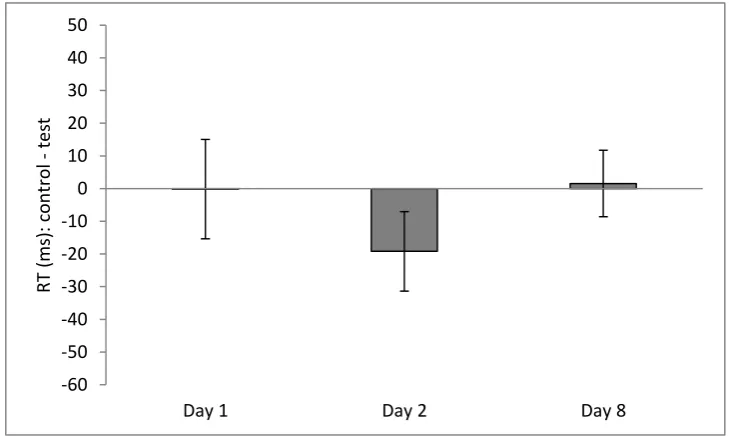
A 2 (base-word type: test, control) x 3 (day: 1, 2, 8) repeated-measures ANOVA for
the RT data (Table 1 and Figure 3) revealed a significant main effect of day, F1(2,58)=6.94,
p=.002, p2=.19, F2(2,90)=35.88, p<.001, p2=.44, with RTs being significantly slower on
Day 1 (M=1019ms) compared to Days 2 (M=976ms) and 8 (M=979ms), as in Experiment 1.
The main effect of base-word type was not significant, F1(1,29)=1.24, p=.28, p2=.04, F2<1,
nor was the interaction between base-word type and day, F1(2,58)=2.21, p=.12, p2=.07,
F2(2,90)=1.52, p=.23, p2=.03. Follow up comparisons confirmed that there were no
significant differences between test and control base-words on Days 1 and 8, Fs<1. However,
there was a significant main effect of base-word type on Day 2, F1(1,29)=5.61, p=.025,
p2
=.16, F2(1,45)=4.11 p=.049, p2=.08, with slower RTs to test than control base-words at
this time point as expected. However, since the lexical competition effects were not fully
significant in the overall analysis the data were not further subdivided to look at the
talker-specificity of lexical competition.
In the old/new categorisation task the mean accuracy score was 84.8% (SD=7.2%).
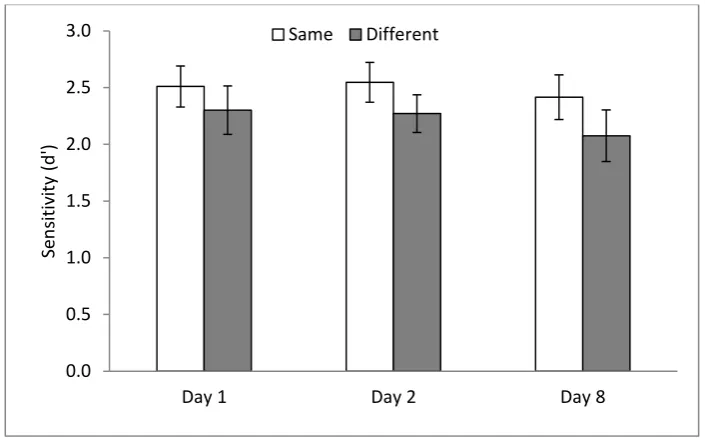
Analysis of d data (Figure 4, Table 3) using a 2 (test-phase talker: same, different) x 3 (day:
1, 2, 8) repeated-measures ANOVA revealed a significant main effect of test-phase,
F(1,30)=12.66, p=.001, p2=.30, but a non-significant main effect of day, F(2,60)=1.41,
p=.25, p2=.05, and no interaction between test-phase talker and day, F<1, indicating that the
size of TSEs in recognition memory did not change over time.
Discussion
Experiment 2, like Experiment 1, demonstrated that detailed representations of novel
nonwords were rapidly generated and could support significant TSEs in recognition memory
up to one week post-exposure. Thus, introducing within-talker variability did not change the
time-course of TSEs for new words.
In terms of lexical competition, robust effects were present on Day 2 consistent with
previous research showing that new words engage in competition within similar sounding
words only after a period of offline consolidation (e.g., Dumay & Gaskell, 2007; Henderson
et al., 2012). However, lexical competition effects were absent on Day 8, and the interaction
between day and base-word type was not statistically significant in the main ANOVA,
contrary to expectations. This finding is interesting given that all previous studies examining
the engagement of newly learned words in lexical competition with similar-sounding existing
words have used a single repeated token during the study phase of the experiment. It is
possible that variability in the training tokens weakens the extent to which new words engage
in lexical competition over the longer term. This possibility will be discussed further below.
Experiment 3: Between-talker variability Method
Thirty-two undergraduate students (age range 18-23yrs, 10 male) from the University
of York completed the experiment.
Stimuli
The stimuli consisted of the 48 word triplets from Experiment 1. For the phoneme
monitoring task nine tokens of each novel nonword were selected from the tokens recorded
by the two talkers (M1, F2) from earlier experiments. Two additional speakers (1 male (M2),
1 female (F1)), also recorded nine tokens of each novel nonword, varying in intonation and
articulation rate. Stimuli were recorded and edited as described above. The mean acoustic
duration of novel nonword tokens produced by each talker are as follows: Male 1 –
M=705ms, SD=173ms; Male 2 – M=629ms, SD=144ms; Female 1 – M=825ms, SD=175ms;
Female 2 – M=832ms, SD=162ms. The test-phase stimuli were identical to those used in
Experiment 2.
Design and procedure
In the phoneme monitoring task each novel nonword was heard in two voices (1 male,
1 female). In order that the test materials from Experiment 2 could be used, the male speaker
from Experiments 1/2 (M1) was paired with the new female speaker (F1), and the female
speaker from Experiments 1/2 (F2) was paired with the new male speaker (M2). Thus, in the
phoneme monitoring task half of the novel nonwords were spoken consistently by M1/F1,
and half consistently by M2/F2. Items were encountered 18 times during study, with 9 tokens
spoken by each talker. As in Experiment 2, tokens from each talker were ordered by acoustic
duration, and were split into three groups (slow, medium, and fast). In each block of phoneme
monitoring one slow, one medium, and one fast token of each novel nonword was heard,
presented in a random order. All four speakers were included in each block such that within
each pair of voices, two tokens occurred in one of the voices, and one in the other (e.g., 2
blocks (e.g., if the first block contained 2 female tokens and 1 male token, the second block
contained 2 male tokens and 1 female token etc.). Counterbalancing of talkers and stimuli
was the same as in Experiments 1 and 2 except that on occasions when participants had
previously only heard M1 during study they now heard tokens from both M1 and F1.
Likewise, on occasions when participants had previously heard only F2 during study they
now heard tokens from both F2 and M2. The counterbalancing of test stimuli was identical to
Experiment 2, involving only talkers M1 and F2.
The test phase of the experiment was identical to Experiment 2. As before, half of the
items were heard in the same voice as study (e.g., items studied in M1/F1 were heard in voice
M1 at test) and half were heard in a different voice (e.g., items studied in voices M1/F1 were
heard in voice F2 at test).
Results
Study Phase
Sixteen participants learned each list. The mean phoneme monitoring error rate was
5.4% (SD=2.1%). A 2 (study talker: M1/F1, M2/F2) x 2 (list: 1, 2) repeated-measures
ANOVA revealed non-significant main effects of study-phase talker, Fs<1, and list,
F1(1,30)=1.69, p=.20, p2=.05, F2(1,46)=1.37, p=.25, p2=.03, as well as a non-significant
interaction between study-phase talker and list, F1(1,30)=2.88, p=.10, p2=.09, F2(1,46)=1.20,
p=.28, p2=.03.
Lexical competition effects
Overall participants responded correctly to 91.3% (SD=4.7%) of items in the lexical
decision task. Data from the 48 base-words were filtered as in Experiment 1; incorrect
responses (8.2%) and data points with RTs <200ms or >2.5SD above the mean RT for each
participant in each session (2.3%) were removed prior to analysis. One participant with an
participant removed the mean RT was 1005ms (SD=247ms) and the accuracy was 90.0%.
Mean RTs for test and control base-words in each session are reported in Table 1 and
difference scores are plotted in Figure 5.
A 2 (base-word type: test, control) x 3 (day: 1, 2, 8) repeated-measures ANOVA
revealed a significant main effect of day, F1(2,58)=3.69, p=.031, p2=.11, F2(2,94)=13.62,
p<.001, p2=.23. RTs were significantly slower on Day 1 (M=1024ms) compared to Day 2
(M=983ms), F1(1,29)=7.93, p=.009, p2=.22, F2(1,47)=28.41, p<.001, p2=.38. All other
comparisons were non-significant. The main effect of base-word type was not significant by
participants F1(1,29)=1.47, p=.24, p2=.05, although it did approach significance by items,
F2(1,47)=3.63, p=.063, p2=.07. The interaction between base-word type and day was not
significant, F1(2,58)=1.18, p=.32, p2=.04, F2<1. Separate analyses of the data from each test
session confirmed these findings, revealing non-significant main effects of base-word type at
all time points. Thus, although numerically there were some hints of competition effects on
Days 2 (11ms) and 8 (16ms), neither of these reached significance level. As in Experiment 2,
since evidence of lexical competition was not reliable in the overall analyses, the data were
not further subdivided in order to examine talker-specificity in the lexical competition
measures.
Talker-specificity effects
In the old/new categorisation task participants responded correctly to 83.8%
(SD=7.4%) of the items. For two participants old/new categorisation data from one of the
three test sessions were lost due to a technical error. Data from the remaining two test
sessions for these participants were included in the analyses. A 2 (test-phase talker: same,
different) x 3 (day: 1, 2, 8) repeated-measures ANOVA revealed a significant main effect of
test-talker for d values (Figure 6, Table 3), F(1,28)=7.55, p=.01, p2=.21. The main effect of
higher on Day 1 compared to Day 8, F(1,28)=5.14, p=.031, p2=.16 and on Day 2 compared
to Day 8, F(1,28)=4.46, p=.044, p2=.14. There was no difference between d scores on Days
1 and 2, F<1. There was also no interaction between test-phase talker and day, F(2,56)=1.23,
p=.30, p2=.04, suggesting that the size of TSEs in recognition memory did not change
significantly over time.
Discussion
Experiment 3 demonstrates that even when novel nonwords are heard in more than
one voice during study, robust representations containing both phonological and talker
information are still formed and are able to support significant TSEs in recognition memory
up to one week post-exposure. Nonetheless, overall old/new categorisation performance did
decrease significantly over time, unlike Experiment 2 (within-talker variability) and
Experiment 1 (no variability; marginally significant decrease, p=.055). This finding suggests
that the representations supporting old/new categorisation decisions may decay at a faster rate
after novel words have been heard in more than one voice compared to when they are studied
in a single voice.
The presence of significant TSEs in Experiment 3 in the absence of a significant
interaction between test-talker and day is important for two reasons. Firstly, it argues against
Geiselman & Crawley’s (1983) voice connotation hypothesis, which states that TSEs should
only be observed when two talkers of different genders are used (see Palmeri, Goldinger, &
Pisoni, 1993, for further evidence that TSEs can be observed even when participants
encounter multiple male and multiple female voices). In Experiment 3, TSEs must depend
upon retention of talker-specific details, not simply the presence of different gender tags
associated with each novel nonword. Secondly, only nine tokens of each novel nonword were
Experiment 3 had revealed non-significant TSEs it could have been argued that these arose
due to less robust representation of talker information in memory. This was not the case.
Lexical competition data in Experiment 3 revealed numerical trends towards lexical
competition on Days 2 and 8, but these effects did not reach statistical significance. There are
now many published studies reporting significant delayed lexical competition effects,
although as would be expected from the “dance of the p-values” there are also a smaller
number of studies that have not reached the somewhat arbitrary p< .05 cut-off for the delayed
competition effect (Cumming, 2014). It is possible that the relatively weak evidence for
lexical competition in Experiments 2 and 3, as compared with Experiment 1 is just another
example of equivalent underlying effects happening to land either side of the significance
cut-off. Nonetheless it is also possible that the weakness of lexical competition effects across
Experiments 2 and 3 may in this case stem from the increased variability between training
tokens; when multiple talkers are heard the variability in voice information may attract
attention that would otherwise be used for other cognitive processes (Martin, Mullennix,
Pisoni, & Summers, 1989). In the case of learning new words, talker variability during study
may make the task of generating robust phonological representations of the new words more
difficult. This explanation could also account for the decreased accuracy in the old/new
categorisation task over the course of a week post-study in Experiment 3.
Given the lack of statistically reliable lexical competition effects within Experiments
2 and 3 it was not possible to explore whether talker information affected the magnitude of
lexical competition effects. Nonetheless in both experiments there were non-significant
numerical trends in the data that were consistent with weak lexical competition effects on
Days 2 and 8. Below we present a combined analysis of lexical decision data from
lexical competition effects as well as determining whether these effects are affected by talker
identity.
Cross-Experiment Analysis: Lexical Competition
RT data for the 48 base-words in Experiments 1, 2, and 3 were combined, and were
analysed in a 2 (base-word type: test, control) x 3 (day: 1, 2, 8) x 3 (variability: none,
within-talker, between-talker) repeated-measures ANOVA to determine the robustness of overall
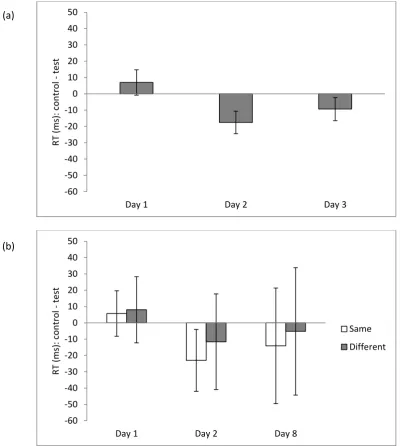
lexical competition effects (Table 1 and Figure 7a). There were significant main effects of
day, F1(2,172)=20.34, p<.001, p2=.19, F2(2,90)=69.41, p<.001, p2=.61 (with all pairwise
comparisons revealing significant differences – Day 1=1002ms; Day 2=953ms; Day
8=970ms), and variability, F1(2,86)=3.23, p=.044, p2=.07, F2(2,90)=83.80, p<.001, p2=.65,
(reflecting differences in the overall mean RTs for each experiment – Experiment 1 = 930ms;
Experiment 2 = 987ms; Experiment 3 = 1001ms). The main effect of base-word type was
also marginally significant, F1(1,86)=3.71, p=.057, p2=.04, F2(1,45)=3.24, p=.079, p2=.07.
Most importantly, the critical interaction between day and base-word type was
significant, F1(2,172)=7.92, p=.001, p2=.08, F2(2,90)=4.53, p=.013, p2=.09. Further
analysis revealed that there was no significant difference between RTs to test and control
base-words on Day 1, F1(1,86)=1.34, p=.25, p2=.02, F2<1, but that this difference was
significant on Day 2, F1(1,86)=12.37, p=.001, p2=.13, F2(1,45)=11.72, p=.001, p2=.21, and
marginally significant (by participants only) on Day 8, F1(1,86)=3.65, p=.06, p2=.04,
F2(1,45)=2.13, p=.15, p2=.05, suggesting that lexical competition was absent immediately
after study, emerged on Day 2, and was retained (to some degree) over the course of a week,
consistent with previous studies examining word learning in adults (Davis et al., 2009;
Dumay & Gaskell, 2007; Dumay et al., 2004; Gaskell & Dumay, 2003; Tamminen &
Following on from these findings a second set of analyses examined whether there
was any evidence of talker-specific lexical competition effects (Table 2 and Figure 7b). As in
Experiment 1, test-control difference scores were calculated separately for same- and
different-talker base-words. These difference scores were then analysed in a 2 (base-word
talker: same, different) x 3 (day: 1, 2, 8) x 3 (variability: none, within-talker, between-talker)
repeated-measures ANOVA. There was once again a main effect of day, F1(2,172)=7.57,
p=.001, p2=.08, F2(2,90)=4.20, p=.018, p2=.09. However, the main effects of variability,
Fs<1, and base-word talker F1(1,86)=1.03, p=.31, p2=.01, F2<1 were both non-significant.
None of the interactions reached or approached significance in both participants and
by-items analyses, although some reached significance in one or the other. Together these
findings do not provide good evidence for talker information being preserved in the
representations underlying lexical competition. Nonetheless, there are some numerical trends
in the data (see Table 2) that are suggestive of an influence of talker-specific information
affecting lexical competition effects. Further investigation is required in order to fully rule
out the possibility that talker information affects lexical competition between newly-learned
words and phonologically similar existing words.
General Discussion
The key finding in these experiments is that TSEs and lexical competition effects for newly
learned words follow different time-courses and as such may rely on different processing
and/or memory mechanisms. TSEs for novel words were present immediately after exposure
and remained stable during the week post-study. There was no evidence of any consolidation
benefit (i.e., strengthening of TSEs at later test points). In contrast, evidence that
newly-learned words engaged in lexical competition with phonologically similar existing words was
absent immediately after the new words had been learned, but emerged following a period of
base-word type in Experiment 1 and the combined analysis. The independent time-courses of
TSEs and lexical competition effects provide compelling evidence that they are underpinned
by separate mechanisms. This result is inconsistent with a purely episodic model of the
mental lexicon (e.g., Goldinger, 1998). Instead, the results are compatible with hybrid models
of lexical memory which assume that two different representational systems (episodic and
abstract) co-exist in memory.
A complementary learning systems framework (McClelland et al., 1995) offers one
account of a hybrid model, in which isolated and integrated representations depend upon two
different subsystems. Evidence that TSEs affect recognition of newly learned words
immediately after study suggests that isolated representations of new words in the first
subsystem can be generated rapidly and are detailed in nature, maintaining talker information
in addition to phonological information. In contrast, the lexical competition data (from
Experiment 1 and the cross-experiment analysis) suggest that more extended periods of
offline consolidation are required in order for new representations to become robustly
integrated with existing knowledge in the second subsystem. The absence of strong evidence
supporting talker-specific effects on lexical competition measures, although a null effect,
provides some evidence that the subsystem underlying lexical competition effects may rely
on more abstract representations than those involved in the simple recognition of new words.
This stands in contrast with research by Creel et al. (2008), which demonstrated
significant talker-specific lexical competition between pairs of newly learned
phonologically-similar nonwords, as well as between pairs of recently encountered phonologically-phonologically-similar
existing words. A critical difference between Creel et al.’s study and the experiments
reported here is that we exposed participants only to the novel nonwords, not their
phonologically-similar base-words, during study. It may be that stronger talker-specific
base-words were encountered in the same voice during the study phase of the experiment. If this
were the case it would suggest that talker specific lexical competition effects are dependent
upon the presence of both detailed isolated episodic representations (that are available only if
words have been recently encountered) in addition to robust abstract representations in
long-term lexical memory.
Notably TSEs during recognition of the new words did not appear to either strengthen
or weaken over the course of a week, indicating that the detailed, isolated representations are
maintained for at least one week after a new word has been encountered, even once new
lexical knowledge has been integrated into long term lexical memory. This finding is
consistent with hybrid memory models in which episodic and abstract representations are
able to co-exist, but inconsistent with previous research suggesting that TSEs for existing
words decrease over time in a similar old/new categorisation task (e.g., Goldinger, 1996).
One explanation for this difference may be that repeating the nonwords 18 times in the same
voice/pair of voices during study in the current experiments may have strengthened memory
for talker information in comparison to Goldinger’s study in which participants encountered
each existing word only once before test. Notably a study by Ernestus (2009), in which
participants were exposed to 12 tokens of each items during familiarisation, also
demonstrated retention of detailed lexical representations one week post study. Alternatively
the difference between Goldinger’s study and the experiments reported here may be that
existing words will have been encountered many times, in many different voices prior to an
experiment, and that this experience may subsequently mask or weaken TSEs for these items.
To summarise, the current data show a clear dissociation in the time-course of the
emergence of two key aspects of lexical knowledge. New words appear to be initially
encoded in a form that retains detailed episodic information such as talker identity.
words are initially learned, but do not show any consolidation advantage when tested at later
time points. In contrast, engagement in lexical competition is absent immediately after
learning, but emerges following a consolidation period of 24 hours. This profile of learning
suggests that lexical competition is dependent on the consolidation of rapidly formed
(episodic) representations into a more integrated network that links similar sounding new and
existing words. Notably, the consolidation of new lexical representations into the integrated
network did not appear to trigger the decay of episodic representations underlying recognition
memory. Rather, the two types of representation appear to be able to co-exist, supporting the
independent time-course of TSEs and lexical competition effects during word learning and
Acknowledgements
We would like to thank Alex Reid and Lisa Henderson for their help in producing the audio
recordings for Experiment 3. The research was supported by an Economic and Social
Research Council (ESRC) studentship awarded to HB, and an ESRC Grant awarded to MGG
(ES/E015263/1). Old/new categorisation data from these experiments were presented in the
following conference proceedings paper: Brown, H. & Gaskell, M.G. (2011). The
time-course of talker-specificity effects for newly-learned pseudowords: Evidence for a hybrid