Abstract:--- The communication between two devices without the use of any physical channel or connection between the two devices is called ‘Wireless Communication’. One of the most commonly used wireless communication is by using of radio waves, this type of communication can be used for data transfer upto a few meters, a few kilometers or also in deep-space communication. Electromagnetic technologies such as light, magnetic, electric and magnetic fields are also a part of wireless communication. This paper discusses the evolution of mobile networks over the years and their development compared to their previous generation counterparts. In the past 40 years’ wireless mobile technologies have evolved namely from 1G to 5G. At present the world is looking towards 4G and 5G wireless communication technology.
Index Term: 1G, 2G, 3G, 4G, 5G, Cellular, network, Mobile, Communication.
I. INTRODUCTION
Any communication without the physical connection between the two connected devices is called „Wireless Communication‟. Wireless communication is a cost-effective process as it eliminates the use of costly and tiresome physical connection between various equipment such as connecting cables in buildings, offices and industries.
Advantages of wireless communication over wired communication:
1. The mobility of users is limited in wired communication.
2. Users connected within a same wireless network can share files without the use of any external ports.
3. Wireless communication can sometimes handle large amount of users as they are not limited by a specific number of ports.
4. Wireless communication is considered time saving and economical as there is no need of laying any new wires and establishing connections.
Wireless Communication is one of the most active area of research and development in present day. The wireless communication in mobile technology is driven by the constant need of humans to communicate over long distances via voice, messages and images. The simplest and earliest form of wireless communication were smoke
Revised Manuscript Received on April 15, 2019.
Saradeep Manam, Amrita School of Engineering, Bangalore Amrita Vishwa Vidyapeetham, Coimbatore Bangalore,
India.([email protected])
Yashwanth P.V, Amrita School of Engineering, Bangalore Amrita Vishwa Vidyapeetham, Coimbatore Bangalore, India.
Pavan Telluri, Amrita School of Engineering, Bangalore Amrita Vishwa Vidyapeetham, Coimbatore Bangalore, India.
signals and carrier pigeon‟s. The next huge leap in the wireless communication was the invention of mobile panels which coded letters of alphabet by Robert Hooke in 1684. This was further enhanced when optical telegraph was invented by Claude Chappe a French scientist which transmitted coded words over long distances. This invention by Claude led to the emergence of large scale signaling towers in France and neighboring cities and these towers are considered as precursors to radio communication. Maxwell and Hertz had pioneered the use of electromagnetic waves in radio transmitted coded information and in early 1800‟s patented the telegraph and demonstrated the use of mobile communication. The next major advancements were during the World War 2 driven around radar and remote sensing and the subsequent application was the advent of TV broadcasting and the mobile communication began when AT&T and Bell labs devised cellular systems and continued to standardize the technology and also lowered the prices which led to commercial acceptance. Along with advancements in wireless communication wired communication also grew by leaps and bounds contemporarily. But still after almost 30 years‟ technical problems remain to be solved in wired communication, the demand for optical fiber, switches and routers keep ever growing with increase in demand these needs are largely fulfilled with the increase in the industrial capabilities, but the more cost-effective solution is wireless technology and the world is rapidly using it. There have been numerous research advancements in the wireless technology with deployment of intelligent techniques aimed at better signal transmission techniques and also advances signal processing that allow the increase in transmission capacity without the increase in the bandwidth or power requirements. But along with these advancements there also has been a significant increase in the user‟s base which is the reason for low connectivity speed and low bandwidth. But without the use of wireless networks our day-to-day usage of mobile communication will be almost impossible, this technology also finds its use in inter-continental communication and in radio technology for space communication. This provides a cost-effective alternative to installing physical network mediums such as coaxial and optical fiber cables, wireless communication helps in reducing the cost and as an escape from the physical installation procedures and mobility can be created in wireless networks. This paper introduces the concepts the
Comparative Analysis of Digital Wireless
Mobile Technology: A Survey
mobile generations from 1st generation to 5th generation and compares the different technologies and their advancements over the predecessors.
First generation (1G):
The 1G of wireless mobile technology was started in 1980‟s and was completed in early 1990. This technology used analog signals for communication of voice calls within a country with a speed of up to 2.4kbps. 1G used AMPS (Advanced mobile phone system) to replace or phase out 0G which used radio technology. Although the successors of 1G used digital communication, 1G used analog communication in which a voice call modulated to 150Mhz is transmitted between radio towers, FDMA (Frequency Division Multiplexing) is used in modulation. 1G suffered from low capacity, poor handoff, and low security as the voice calls played between radio towers can be eavesdropped. Nippon Telephone and Telegraph company (NTT) has first introduced 1G in Japan which was followed by implementation of 2 successful systems in Europe the Nordic Mobile Telephones (NMT) and Total Access Communication System (TACS). The European systems lacked the ability provide the users with the ability to inter-operate between the two networks, so the companies did not provide users with roaming and hand-over facilities although these facilities were present within the system. USA received its 1G network system in 1983 known as Advanced Mobile Phone System (AMPS).40Mhz bandwidth has been allocated by Federal Communication Commission (FCC) for the 1G technology, this allocated frequency consisted of 666 duplex channels in 800MHZ range with individual uplink and downlink channels of each 30Khz. Later an additional 10Mhz has been allocated which increased the number of duplex channels to 832.
General Features of 1G Systems:
1. 1G technology used only Analog systems
2. All 1G systems are based on Frequency Modulation (FM) scheme
3. 1G systems used FDMA multiplexing, which led to low capacity
4. 1G offered only voice calls
5. It was introduced in 1980 and continued to be used till the end of 80‟s
Advantages of 1G Systems:
1. This technology was a first of its kind which led to standardizing the network.
2. It allowed people to be mobile even when communicating
3. It allocated frequency to each caller
4. It costed much less compared to its successors Disadvantages of 1G Systems:
1. The voice quality was poor
2. Security was scarce as the calls can be easily eavesdropped by a third party
3. There was only a voice service but no data service 4. The handoff reliability was also quite poor
5. The capacity of 1G systems was highly limited as each user needs to be allocated a particular frequency
6. The mobiles that were to be used so as to support 1G technology were bulky in size which kept away many people from using them
Second generation (2G): -
Second generation wireless telephone technology preferably entitled as 2G, were commercially launched based on GSM standard in Finland by Radiolinja in 1991. 2G network uses digital signals and its data speed reaches up to 64kbps. Some of its significant features included text messages (SMS) (which was first possible on only GSM and later on all digital networks), picture messages, MMS (multimedia message) and also it provided better quality and capacity as compared to the previous generation. The difference between the 2G phone systems and the previous generation phone systems was that it used digital transmission instead of analog transmission and advanced fast phone-to-network signaling was introduced.
2.5G: -
This intermediate standard was introduced as people wanted both voice and data. In the 2G services only circuit switched networks were used which was unsuitable for internet. Then GPRS (General Packet Radio Service) was introduced in this intermediate stage which had the feature of packet switching which was more suitable for internet. Data transmission rate had a minimum speed of 50 kbps
2.75G: -
To enhance the data rates further GSM has been updated to which was known as EDGE (enhanced data rates for GSM evolution) technology. The feature with this new technology is that it allows clear and fast transmission of data and information up to 384kbits/sec speed.
Advantages of 2G: -
Due to low power emissions the major issue of health concerns has been addressed.
Digital data services such as SMS and email had been introduced.
Disadvantages of 2G: -
In less populated areas, the weaker signal failed to reach a cell tower.
Third Generation(3G):
Generations definiti on
Through speed
techno logy
Time period
features 1G Analog 14.4
Kbps (peak)
AMPS , NMT, TACS
1970-1980
During 1G wireless phones are
used for voice only. 2G Digita
lNarro w band circuit
data.
9.6/14.4 Kbps
TDM A ,CD MA
1990-2000
2G capabilitie
s are achieved
by allowing multiple users on a
single channel
via multiplexi
ng. 2G use data also along
with voice. 2.5G Packet
Data
171.2 Kbps(pe
ak) 20.40 Kbps.
GPR S
2001-2004
In 2.5G the internet becomes
popular and data becomes more relevant
2.5G multimedia
services and streaming
starts to show growth. Phones start supporting
web browsing
through limited and
very few phones have that. Fig I: - Classification of 1G, 2G, 2.5G
Telecommunications (IMT-2000). It is used to provide voice services wirelessly and internet services to individuals, company or an enterprise. 3G wireless communication provides of minimum data speed of 0.2Mbps (Megabytes per second).
History:
Based on the research carried upon in early 1980‟s and because of research of 15 years by ITU (International
Telecommunication Union), 3G has been introduced and made public by the name IMT-2000 (International Mobile Communication) and the communication spectrum between 400Mhz and 3Ghz has been allocated to the 3G spectrum.
Commercially the first test network was launched by NTT DoCoMo in Japan in 2001 branded as FOMA and it was commercially launched in a small-scale basis in 2001 of W-CDMA technology and was later released on large scale basis which was kept on hold due to reliability issues.
In 1998 a society named 3GPP (3rd Generation Partnership Project) was formed to help in deployment of 3G network that has descended from GSM (Global System for Mobile). The evolvement of GSM technology is as follows:
1. Speeds of up to 144Kbps (Kilobytes per second) are offered by GPRS (General Packet Radio Service)
2. A speed of up to 384Kbps has been reached by EDGE (Enhanced Data Rates for Global Evolution) 3. Downlink speed of up to 1.92Mbps has been
offered on UMTS Wideband CDMA (WCDMA). 4. A downlink speed of up to 14Mbps has been
achieved using High Speed Datalink Packet Access (HSDPA)
5. A speed of up to 100Mbps is being aimed by Evolved UMTS Terrestrial Radio Access (E-UTRA)
Benefits of 3G:
1. The data speed is significantly higher compared to the previous generation 2G,2,5G and 2.75G 2. 3G supports videoconferencing which was absent
inprevious generation and provided better in-call audio and video services
3. Thethirdgenerationofwirelessmobile
communication supported TV through internet (IPTV)
Applications of 3G Systems:
1. The advantage of 3G over its previous generation counterparts is its ability to be able to provide the users with location-based services such as Global Positioning System (GPS)
2. 3G provides its users with video-on-demand and provides teleconferencing services which was previously absent
3. The use of third generation also took multimedia and gaming services to a higher level
Advantages of 3G Systems:
1. The increase in bandwidth has resulted in relieving the overcrowded existing networks
3. The major drawback of 1G and 2G „interoperability‟ has finally been allowed in 3G networks
4. The multimedia services grew manifold over the existing services which were based upon the previous generations
5. 3G used the new IP (Internet Protocol) connectivity for data services which is packet based
Disadvantages of 3G Systems:
1. Due to increase in the protocols as well as the bandwidth the base stations as well as the cellular devices need to be upgraded to use 3G networks which is a costly affair
2. Due to more complex modulation/demodulation and also with the wide use of data the power consumption significantly increases
3. The ability for data and voice to work together was not yet implemented as well as the problems concerning roaming are still significantly present 4. The third generation requires base stations closer to
the users for improved services which is costly. Fourth Generation (4G):
4G represents the fourth generation of broadband cellular network standard. LTE stands for Long Term Evolution and is to provide high speed internet access through cellar communication. 4G is the acronym for fourth-generation wireless telephone communication that is an upgrade to 3G Mobile Carriers false claim the orthogonal frequency-division multiplexed (OFDM) carriers are 4G, even when their data speeds are not fast enough comparable to the speeds specified by the International Telecommunication Union (ITU) which is 100 Mbit/sec which can‟t be compared with slow data transfer speeds of around 3.84Mbit/s offered by 3G networks.
History:
4G system was based on the end-to-end Internet protocol (IP) architecture i.e., any mobile device in the 4G network, will serve not only as receiver but also as a router unlike the traditional spoke and hub architecture of 2G and 3G cellular communication. This technology was envisioned by DARPA i.e., Defense Advanced Research Projects Agency. The key difference not just being OFDM, in 4G, the circuit switched architecture is depreciated and only packet switched network is present unlike the 2.5G GPRS and 3G architecture which houses both Circuit and Packet switching mechanisms for calls and data services respectively
Features of Fourth Generation Technology:
1. High Performance: 4G offers ultra-fast downlink and uplink speeds without compromising on the reliability. The speed offered is almost 50 times that of the 3G and is around 100Mbps
2. Interoperability and Easy Roaming: Roaming in a 3G network is complex and difficult and the same is the case with Interoperability across various networks, whereas, roaming in 4G networks is proven significantly easy because of the global
standard which ensures global mobility. The difference in terms of coverage area, latency, Data transfer rate, and loss rate is evidently seen in various heterogeneous wireless access networks 3. Low Cost: 4G communication is cheaper since
[image:4.595.324.539.96.316.2]there is no necessity to completely retool the network architecture. It can be built on existing networks and will work on the same existing spectra which is an advantage to the mobile operators as they are not required to license new spectrum, which is a costly affair.
Fig II:- 4G LTE network architectural model
Fig III: - Comparison between 3G and 4G
Advantages of 4G:
1. Ultra-fast downlink and uplink speeds 2. Voice quality is improved dramatically 3. Ease of access and less latency
4. Higher bandwidth when compared to 3G Disadvantages of 4G:
1. New Hardware components on Cell towers since the usage of frequency
2. The data service cost would be high for the users 3. Consumers are forced to buy new 4G compatible
mobile devices
[image:4.595.316.566.358.523.2]Fifth Generation (5G):
Introduction:
1. The fifth generation provides the users with the latest technology providing users with higher data rates, reliable and a more secure way of communicating than its predecessor fourth generation
2. Combining the existing networks with the extensive research being carried out the fifth generation is expected to provide data speeds of upto 1Gbps (Gigabytes per second)
3. The world is fast moving across automation and Internet of Things (IoT) which are the next big things in the world these applications require a huge amount of data transfer at high speeds which will be catered by 5G
4. The fifth generation is currently under development and once it reaches the initial operation stages it is expected to work alongside the existing third and fourth generation networks to provide internet connectivity irrespective of the users‟ location by 2020
Working of 5G Systems:
1. Data is sent using radio waves by sectors which make up a cell site, the base structure of 5G is the 4G LTE but unlike the fourth generation which transmits data using cell towers that utilize high power the 5G systems uses cells sites which are smaller when compared to the cell towers and utilize less power.
2. The fifth generation has been assigned the spectrum 30Ghz to 300Ghz in this frequency range, this allows only for communication over short distances as it is more prone to interference which calls for the use of multiple small cells or cell sites
3. The largely prevalent challenges relating to the distance a wave can be transmitted and also interference the telecom industry is looking towards the use of lower frequency spectrum in 5G and this also helps as a cost effective way as the telecom operators own the low frequency spectrum used for older generations and this can be reused to develop new networks
Advantages of 5G Systems:
1. 5G network is less likely to be affected by overcrowding compared to previous networks as it aims at providing data with speeds in Gbps (Giga Bytes per Second)
2. 5G network can easily be incorporated with previous generation 3G and 4G networks to ensure availability to voice and data anywhere in the world by 2020
3. The new emerging technologies such as IoT and Cloud Computing require huge amounts of data
5G network aims at bringing all networks under a single platform
Disadvantages of 5G Systems:
1. It‟s an emerging technology and a lot of research still needs to take place for the technology to be functional
2. The speed that is being said to be achieved by using 5G looks impractical as the technological support to implement it is absent in most parts of the world 3. The implementation is a costly process as new
infrastructure needs to be developed and implemented
4. Also the old devices are obsolete and cannot access 5g technology the users need to get new devices which is a costly process
[image:5.595.317.555.247.464.2]The main concern for any technology the security problem is still present at large and needs to be resolved
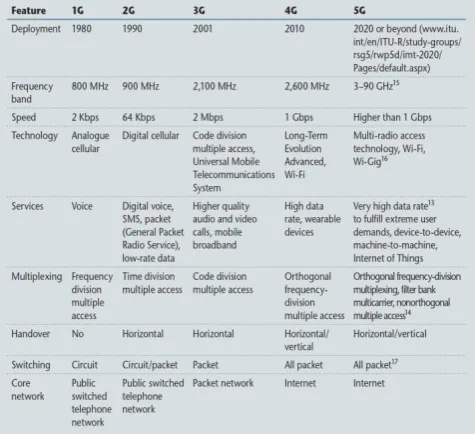
Fig IV: - Classification of features from 1G to 5G
II. CONCLUSION:
REFERENCE:
1. Aleksandar Tudzarov,Toni Janevski “Functional Architecture
for 5G Mobile Networks”, International Journal of Advanced Science and Technology Vol. 32, 2011.
2. Aman Aryaputra, Bhuvaneshwari.N, “5G- The Future of Mobile
Network”, in the proceedings of the World Congress on Engineering and Computer Science 2011, Vol II,WCECS 2011, October 19-21, 2011.
3. Nascimento, Andrea, et al. "A characterization of mobility
management in user-centric networks", Smart Spaces and Next Generation Wired/Wireless Networking. Springer Berlin Heidelberg, pg.314-325, 2013.
4. Akhilesh Kumar Pachauri, Ompal Singh , “5G Technology–
Redefining wireless Communication in upcoming years”, International Journal of Computer Science and Management Research Vol 1 Issue 1 Aug 2012.
5. Jay R Churi, Sudhish T Surendran, Shreyas Ajay Tigdi and
Sanket Yewale. “Evolution of Networks (2G-5G)”, in the IJCA Proceedings on International Conference on Advances in
Communication and Computing Technologies 2012
ICACACT(3):pp8-13,2012.
6. David Ott,Shilpa Talwar ,Intel Labs,University Research Office,
“Exploring Next Generation Wireless (5G): Transforming the user Experience”, 2013.
7. EricSavitz,Forbes,http://www.forbes.com/sites/ericsavitz/
2012/10/22/gartner-10-critical-tech-trends-for-the-next-
five-years/, 2012.
8. Federico Boccardi, Robert W. Heath Jr., Angel Lozano,Thomas
L. Marzetta, Petar Popovski “Five Disruptive Technology Directions for 5G”, IEEE Communications Magazine, 2014.
9. “5G:ATechnologVision”,www.huawei.com/ilink/en/downlo
ad/HW_314849
10. World Telecommunication/ICT Indicators Database.[online].
Available : www.itu.int/en/ITU-D/Statistics/Pages/stat
11. Jahangir Khan, Zoran S. Bojkovic,Muhammad Imran Khan
Marwat, “Emerging of Mobile Ad-Hoc Networks and New Generation Technology for Best QOS and 5G Technology”, CCIS 265,.© Springer-Verlag Berlin Heidelberg , pp. 198–208, 2011.
12. Sun, Junzhao, Douglas P. Howie, and Jaakko J. Sauvola,
13. “Mobility management techniques for the next-generation
wireless networks”, Asia-Pacific Optical and Wireless Communications Conference and Exhibit. International Society for Optics and Photonics, 2001. [13] Mohd. Maroof Siddiqui “Vision of 5G Communication”, A. Mantri et al. (Eds.): HPAGC 2011, CCIS 169,© Springer-Verlag Berlin Heidelberg ,pp. 252– 256, 2011.
14. Project “Mobile and wireless communications Enablers for the
Twenty-twenty Information Society (METIS)”, Document Number: ICT-317669-METIS/D1.1.
15. Mudit Ratana Bhalla,Anand Vardhan Bhalla, “Generations of
Mobile Wireless Technology:A Survey”, International Journal of Computer Applications (0975 – 8887),Volume 5– No.4, pp26,2010.
16. Ms. Reshma S. Sapakal & Ms. Sonali S. Kadam, “ 5G Mobile
Technology”, International Journal of Advanced Research in Computer Engineering & Technology (IJARCET) Volume 2, Issue 2, February 2013.
17. Navrati Saxena, Shamik Sengupta, Kai-Kit Wong, Abhishek
Roy, Special issue on “Advances in 4G wireless and beyond”,
EURASIP Journal on Wireless Communications and
Networking,pg.157, 2013.
18. Pankaj Sharm “Evolution of Mobile Wireless Communication
Networks-1G to 5G as well as Future Prospective of Next Generation Communication Network”, International Journal of Computer Science and Mobile Computing, Vol.2, Issue. , pg.47 – 53,2013.
19. Reshma S. Sapakal,Sonali S.Kadam, “5G Mobile Technology”,
1323 International Journal of Advanced Research in Computer Engineering & Technology (IJARCET) Volume 2, Issue 2, pg.568,2013.
20. Santhi, K. R., et al., “Goals of true broad band's wireless next