RIT Scholar Works
Theses
Thesis/Dissertation Collections
1987
Integrated voice/data through a digital PBX
Ian Schofield
Follow this and additional works at:
http://scholarworks.rit.edu/theses
This Thesis is brought to you for free and open access by the Thesis/Dissertation Collections at RIT Scholar Works. It has been accepted for inclusion
in Theses by an authorized administrator of RIT Scholar Works. For more information, please contact
.
Recommended Citation
Approvals:
A Diaital PBX
by
Ian James Schofield
A Thesis
Submitted to the Faculty of the
Graduate School of Computer Science
at
Rochester Institute of TechnoloaY
In partial fulfillment of the
Requirements for the
Degree of
Masters of Science in Computer Science
Dec
7, 1987
Jeffery Lasky
-Zr/.
6.
lf
Laltfy, Thesis
Advi.-(C1i~irm~-;)--Rayno Niemi
-=----I
wouldlike to dedicate
this thesis to
my
Mom & Dad
ABSTRACT
..i
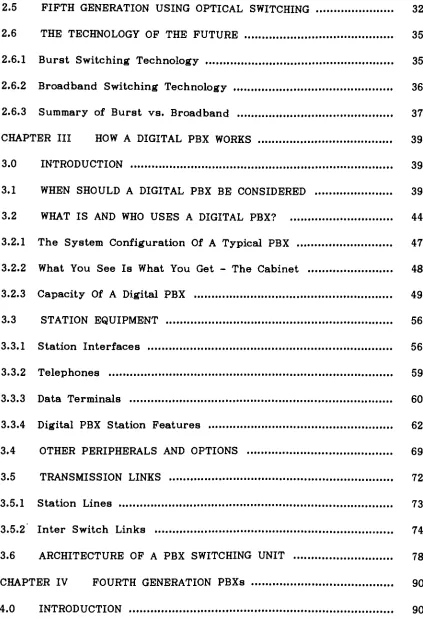
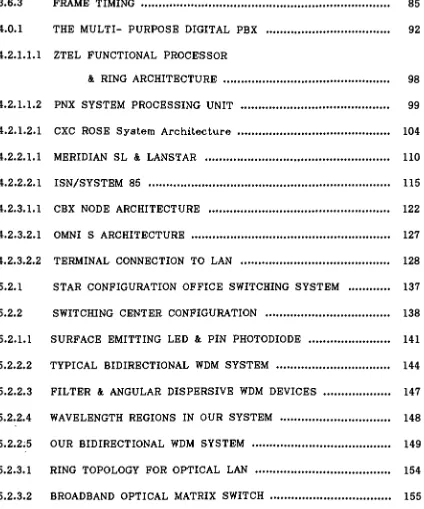
FIGURES AND DIAGRAMS
ii
CHAPTER I
1
1.0
INTRODUCTION
1
CHAPTER II
HISTORY
4
2.0
EVOLUTION OF PBX SWITCHING
TECHNLOOGY
4
2.1
First
Generation
PBXs
5
2.1.1
Manual
Switching
5
2.1.2
Step-By-Step Switching
6
2.1.3
Common Control
8
2.1.4
Stored
Program Control
10
2.1.5
First
Generation
Summary
11
2.2
SECOND GENERATION PBXs
12
2.2.1
Background
12
2.2.2
Analog,
The Old
King
13
2.2.3
Digital,
The Start
ofSomething Big
14
2.2.4
Digital Advantages
17
2.2.5
Second
Generation
Equipment
18
2.2.6
Second
Generation
Unresolved
Issues
20
2.3
THIRD GENERATION PBXs
23
2.3.1
Almost
There
At Last
23
2.3.2
Third
Generation
At Last
25
2.4
FOURTH
GENERATION PBXs
27
2.5
FIFTH GENERATION
USING
OPTICAL SWITCHING
32
2.6
THE
TECHNOLOGY
OF THE
FUTURE
35
2.6.1
Burst
Switching Technology
35
2.6.2
Broadband
Switching
Technology
36
2.6.3
Summary
ofBurst
vs.Broadband
37
CHAPTER III
HOW A DIGITAL PBX WORKS
39
3.0
INTRODUCTION
39
3.1
WHEN
SHOULD
A
DIGITAL
PBX BE CONSIDERED
39
3.2
WHAT IS AND WHO USES A DIGITAL PBX?
44
3.2.1
The System Configuration Of A Typical PBX
47
3.2.2
What You See Is What You Get
-The Cabinet
48
3.2.3
Capacity
Of A Digital PBX
49
3.3
STATION EQUIPMENT
56
3.3.1
Station Interfaces
56
3.3.2
Telephones
59
3.3.3
Data Terminals
60
3.3.4
Digital PBX Station Features
62
3.4
OTHER PERIPHERALS AND OPTIONS
69
3.5
TRANSMISSION LINKS
72
3.5.1
Station Lines
73
3.5.2
Inter Switch Links
74
3.6
ARCHITECTURE OF A PBX
SWITCHING
UNIT
78
CHAPTER IV
FOURTH
GENERATION PBXs
90
[image:5.541.60.483.67.686.2]4.1
THE FOURTH GENERATION APPROACH TO
INTEGRATION
94
4.2
FOURTH
GENERATION
IMPLEMENTATION
97
4.2.1
Original Designs For Dual Bus Architectures
97
4.2.1.1 Ztel's PNX
100
4.2.1.2 CXC Rose
105
4.2.2
Add On Packet Enhancements To
Existing
PBXs
109
4.2.2.1 Northern Telecom's Meridian Series
Ill
4.2.2.2 The AT&T System 85/ISN Marriage
116
4.2.3
The Best Of The Rest
120
4.2.3.1 Rolm CBX II
121
4.2.3.2
OMNI
S
Series Of Switches
129
CHAPTER V
THE FUTURE OF
SWITCHING TECHNOLOGY
133
5.0
INTRODUCTION
133
5.1
ACTIVE/PASSIVE OPTICAL
TECHNOLOGY
136
5.2
DESCRIPTION OF OUR OPTICAL
COMMUNICATION SYSTEM
139
5.2.1
Light Sources And Detectors
142
5.2.2
Wavelength Division
Multiplexing
145
5.2.3
The
Switching
Center
153
5.1.4
Advantages Of An
Active/Passive
Optical
Switching
System
156
The
digital
voice/dataPBX
is
finally
reaching
it's
anticipatedpotential and
becoming
a majorfactor
whenconsidering
the
total
communications picture
for
many
businesses
today.
The
digital
PBX
has
always
been
the
choicefor
voice communicationsbut
has lagged
behind
the
LAN
industry
whenit
comesto
data
transfers.
The
pendulumhas
begun
to
swing
withthe
enhanceddata
capabilities ofthird
andfourth
generation
PBXs.
The
battle
for
the
total
communication marketis
quitefierce between the LAN
andPBX
vendors now.This
researchthesis
looks
atthe
history,
evolution, and architecture
of voice/dataPBXs.
It
traces
development
ofPBXs
through
the
present
fourth
generation architectures.From the first
manual switchesintroduced
in
the
late
1800's
through the
Strowger
switch,
step-by-step
switching,
stored programcontrol,
commoncontrol,
digital
switches,
dual
bus
architectures,
andfinally
whatis
anticipatedin
the
future.
A
detailed
description
of ofthe
newfourth
generationdual
bus
architectures
is
presented.Lastly,
speculations onthe
future
direction
PBX
architectures will
take
is
explored.A
description
ofthe
mechanics of apossible
Wave
Division PBX is
presentedbased
on afiber
optictransport
FIGURE
1.
SELECTING A PBX
40
3.6.1
COMPONENTS OF A
DIGITAL
PBX
77
3.6.2
TDM BUS & CONTROLLER
82
3.6.3
FRAME TIMING
85
4.0.1
THE
MULTI-PURPOSE
DIGITAL
PBX
92
4.2.1.1.1
ZTEL FUNCTIONAL
PROCESSOR
& RING ARCHITECTURE
98
4.2.1.1.2
PNX SYSTEM
PROCESSING
UNIT
99
4.2.1.2.1
CXC
ROSE System Architecture
104
4.2.2.1.1
MERIDIAN SL & LANSTAR
110
4.2.2.2.1
ISN/SYSTEM 85
115
4.2.3.1.1
CBX NODE ARCHITECTURE
122
4.2.3.2.1
OMNI S ARCHITECTURE
127
4.2.3.2.2
TERMINAL CONNECTION TO LAN
128
5.2.1
STAR CONFIGURATION OFFICE SWITCHING SYSTEM
137
5.2.2
SWITCHING
CENTER CONFIGURATION
138
5.2.1.1
SURFACE EMITTING LED & PIN PHOTODIODE
141
5.2.2.2
TYPICAL BIDIRECTIONAL WDM SYSTEM
144
5.2.2.3
FILTER & ANGULAR
DISPERSIVE
WDM DEVICES
147
5.2.2.4
WAVELENGTH REGIONS IN OUR SYSTEM
148
5.2.2.5
OUR BIDIRECTIONAL
WDM SYSTEM
149
5.2.3.1
RING TOPOLOGY FOR OPTICAL LAN
154
[image:8.541.60.484.144.653.2]1.0.
INTRODUCTION
The
local
area network(LAN)
based
on packetswitching
technology
has
received allthe
publicity
in
the
battle for
the
data
communicationsmarket since
the
beginning
ofthe
information
generationin
the
midseventies.
This
is
quickly
changing
withthe
introduction
of sophisticated,
digital
switching
systemsusing
telephone
based
technologies.
The
Private
Automated
Branch
Exchange
(referred
to
hereafter
asjust
PBX)
had
receivedcomparatively
little
attentionto
this
point,
but is
nowbeing
viewedby
many
office communication managers asthe
probableanswer
to their data
communications problems.Once
some current problems
areovercome,
digital PBXs
may
become the
ultimate solutionto
data
sharing
in
both
the
local
and wide area networks.This
is
becoming
areality
withthe
recentintroduction
of new system architecturesbased
on
dual
busses
andintegrated
cabling
systems.The
digital
PBX
is
the
most workable and economical solution
to
the
current problem ofvoice/data communications on a common network.
PBX's
andLAN's
have
developed
two
very
different
genealogies.While
computer networkstied
aCPU
to
agroup
of peripheraldevices,
pc's
to
pc's,
orany
combinations of suchdevices,
the
telephone
networks were
implementing dialing
facilities
between
telephones.
Users
for
years
have dreamed
ofhaving
a singleswitching
systemthat
couldhan
dle
transmission
ofboth
voice anddata
over a commonintegrated
sysconsidered
the
ideal
candidatefor
the
integrated
voice/data system.First
is
the
existence of analready
in
place configurationfor
a starbased
LAN.
Every
officein
the
digital PBX
systemis
already
wiredto
the
switch over atwo
orfour
wire schemefor
voice communications.It
would
only
seemlogical
to
usethis
samewiring
schemefor
data
transmissions.
Integration
of voice anddata
across a common mediawould save
the
userthe
cost ofhaving
to
install
separate sets of wiresfor
eachindependent
voice ordata
network.A
major costin
the
instal
lation
of a packet switchedLAN
is
the
running
ofthe
coaxial cable.Secondly,
the
digital
PBX's
withtheir
new architecturesdesigned
to
incorporate the
best
features
of circuit and packetswitching
aregetting
very
closeto the
total
solution of voice/datahandling.
The
problem ofdata
transmission
speedsis
finally
being
addressed withthe
dynamic
allocation of
bandwidth
which was alimiting
factor
in
earlierPBX
systems.
The Rolm CBX II
has
adynamically
configured74 M
bps
bus.
This
can
handle
asynchronous and synchronousdata
at speedsup
to
19.6
K
bps
and64
K
bps
respectively.This
bus
willbe
increased
to
294
M
bps in
the
nearfuture,
withcorresponding
increases
in
data
transmis
sion speeds
[DATA85],
Northern Telecom
andGTE
are alsooffering
similar
features
onthe
Meridian
andOmni
S
line
ofdigital
PBXs.
Thirdly,
the
digital
PBX
had
already
establisheditself
ashaving
excellent administrative
capabilitiesfor
the
managementfunction.
Also their
is
an endless
list
of add onfeatures
for the
userto
selectfrom
that
are of proPBX
has
a -solidfoot in
the
door
asthe
solutionto
voice/dataintegra
tion.
There
is
no reasonthat
circuit and packetswitching
can notcoexist
in
a singlenetwork,
eachperforming
the
job
best
suitedto
it.
The PBX
designers
have
atleast
tried
to
addressthe
complex problemsassociated with
the
unique characteristics of voice anddata
transmis
sions.
The
newhybrid
circuit/packetswitching
PBX
is
their
solution.The
remaining
problems are ones oftechnology.
The
fulfillment
ofthe
potential of
the
PBX
for
voice/data communicationsis
looming
onthe
near
horizon.
As
the
remaining
problems aresolved,
the
capability
ofthe
PBX
will come onestep
closerto
the
reality
oftrue
voice/dataintegration.
To
further
understandthis
we willtrace
the
evolution ofHISTORY
2.0.
EVOLUTION OF PBX SWITCHING
TECHNOLOGY
If
welook
atthe
development
ofswitching
systems,
LANs
andPBXs,
it
is
quite obviousthat
the
PBX
has
along
andillustrious
his
tory.
The telephone is
a simplisticdevice
when comparedto
acomputer,
but
before
the
turn
ofthe
milliontelephones
in
a network.To
providequality
servicethe
telephone
andPBX
industries
have
alsodeveloped
error
tolerances
in
the
range of1 in 100,000
calls.The
computerindustry
has
only
been
aroundfor
aboutthirty-five
years,
andin
computerindustry
has
only
been
aroundfor
aboutthirty-five
years,
andfull
networking
afew
devices,
the
telephone
industry
wascompleting
international
direct
dialing
to
expandtheir
network.
The
PBX
designers
have
alwaysbeen
imaginative
andfuturistic
with microprocessor
controlling
switching
technology,
softwarefor
ahost
of user
options,
andthe
recording
of activities withdatabase
tech
niques.
Is
it
not possiblethat
the
PBX
mighthold
the
key
to
full
integration
of voice/data communications.In the
following
we will exploreThe
first
onehundred
yearslaid
the framework for the
entiretele
phone and
switching
industry.
Innovations,
such asstep-by-step
andcommon control
switching,
modulation and multiplexingtechniques,
andstored program
control,
became
the
basis
ofthe
safe, reliableindustry
we
have
today.
Transmission
andnetworking
of voice systems wereimplemented
to
the
satisfaction of all classes of usersduring
this time.
2.1.1.
Manual
Switching
In
the
beginning:
When the telephone
wasinvented
in
1876,
noone,
had
any
idea
ofthe
enormousinfluence
it
wasgoing
to
exert onsociety
in
the
coming
century.
Telephones
wereoriginally
leased in
sets oftwo,
with a singlededicated
line
connecting
the
two
specific endpoints.The
subscriber wasresponsible
for
providing
his
owndedicated
wirebetween
these
two
points.
The
costto
rent wascheap,
$40/year
for
abusiness
telephone,
and
$20/year
for
individual
use[JOEL84].
Other
then
afew
large
businesses,
atelephone
wastypically
aluxury
only
the
very
rich couldafford.
In
many
circlesit
was considered atoy
ofthe
very
affluent.It
quickly
became
apparent asthe
number of subscribersincreased
that
it
wouldbe
niceto
be
ableto
communicate with morethan
onelocation
at atime.
In
early
1878,
the
first
telephone
exchange wascreated
in
Hartford,
Connecticut
[CHOR84].
By
the
end ofthat
yearthere
were about a
dozen
exchangesin
major citiesalong
the
eastern seawere owned
by
anindividual
orgroup
ofbusinesses
for
their
privateuse.
They
wereusually
setup
for
communication within abuilding,
orpossibly
to
connectto
a remotebranch
office.In
either casethey
did
not cover
any
area morethan
afew
city
blocks
in
size.These
werethe
first
commercial uses ofPBXs.
A
public exchangefor
residential use wasnot
to
appear until1898
[JOEL84].
Each
ofthese
early
exchanges wasnothing
morethan
a manualswitching
center.A
single wire connected eachtelephone
location
through
the
central switch.In
1892 the
introduction
of a central powersupply
arrived onthe
scene[BHUS85].
At the
sametime
two-wire
cableappeared
in
an effortto
reducethe
noiseinduced
by
competing
electricpower and streetcar
lines,
whichbegan
to
appear onthe
same polesthat
were once
dedicated
to
telephone
lines.
Because
the
majority
oftele
phone systems at
that
time
were usedby
businesses,
these
early
PBXs,
although manual
in
nature,
werethe
forefathers
ofthe
massivetele
phone
switching
systems usedtoday
to
routethousands
of calls[JOEL84].
Some
manual switchboards are stillin
usetoday.
2.1.2.
Step-By-Step
Switching
Manual
switching
systems were made obsoletein
1891
when aKan
sas mortician,
Almon
B.
Strowger,
patentedthe
Strowger
switch.This
switching
system eliminatedthe
needfor
manual,
operatorIt
seemsthat
Mr.
Strowger
was afraidthe
local
town
switchboard
operator wasbeing
paid
to
route potentialbusiness
to
his
competitors.Removing
the
manual operatorfrom
this
function
seemed alogical
way
to
resolvePublicized
asthe
girl-lessswitching
system,
the
Strowger
switchused a
technique
calledstep-by-step,
direct,
or progressive switching.The
Strowger
switch,
electro-mechanicalin
naturebecame
the
workhorseof
the
budding
telephone industry.
In
a step-by-stepswitching
system,
the
call progresses onestep
at atime
asthe
telephone
userdials
eachsuccessive
digit
ofthe
number.This
systemis
also calleddirect
controlbecause
eachswitching
function
is
directly
responsiveto
eachdigit
dialed
in
the
phone number.Each
digit
dialed
initiates
a vertical moveto
acorresponding
layer
of newStrowger
switches andthen
a rotationto
find
the
first free
one.This is
done
for
all sevendigits
one at atime
with
the
last
set of switches eithermaking
the
connection, orif
the
line
is
busy
it
relays abusy
signalback
to the
calling
party
[MART76].
The
Strowger
switch wasthe
basis
ofthe
"701"PBX,
introduced
in
1928
by
the
newdivision
ofthe
Bell
Telephone
System,
Bell
Labs
[BELL79].
There
are stillhundreds
ofPBXs
from
the
700
seriesin
usetoday
onthe North
American
continent.Although,
the
step-by-step
switch wassimple,
economical,
and completely
modularin
nature,
it
had
some majordisadvantages.
It
wouldnot
be
stretching
the
truth
to
say
that
comparedto
todays
switchesit
was quite
bulky,
similarto
the
now extinctdinosaur.
Because
ofits
size
it
wasvery
labor
intensive
and required ahigh
degree
of maintenance.
There
was also ahigh
degree
ofswitching
delay
involved,
noeconomies of
scale,
andit
wasentirely
unsuitablefor
text
anddata
transfer
because
ofthe
its
instability
and noise problems.This
impulse
given amount of
time.
Also,
there
was noway
to
backtrack
andlook
for
alternative paths when all
the
available switches at a givenlevel
werenot
free.
A
busy
signal couldbe
sentback
to
the
callerif
the
switching
path was
interrupted
by
reaching
adead-end
atany
pointin
the
switching
sequence.This
couldvery
wellhappen
evenif the
destination
of
the
call was notin
use.Another
major problem wasthe
whole switching
system equipment wastied
up
until a call was completebecause
ofthe
nature ofthe
switches at eachlevel
in
the
step-by-step
method.Because
ofits
step-by-step
configuration,
the
system was alsolimited
by
the
number oftelephone
numbersthat
couldbe
assignedto
a particular central office.
Lastly,
any
logic
necessary
for
analyzing
a phonenumber prior
to
sending
it
to
the
switching
system was eithertotally
missing
orlacking
for
all practical purposes[JOEL84],
[MART76].
2.1.3.
Common
Control
The
nextimportant
step
forward
in
the
development
ofswitching
technology
occurredin
Sweden
withthe
introduction
ofthe
crossbarswitch
by
the
Ericsson
Corp.
in
1932
[BELL79].
This
corporationis
aEuropean
giantin
the
telecommunications
industry
similarto
our ownAT&T.
The
crossbar switch was much smallerthen
the
Strowger
switch.Because
ofits
electromechanical natureit
was alsofaster
andless
proneto
impulse
noise.Although,
the
first
crossbar switchesdid
usethe
step-by-step
technique,
it
soonbecame
apparentthat
this
new switchwas
to
be
a milestonein
the
establishment of a newtype
ofswitching
ure
hunt
withthe
first
digit
ofthe
telephone
numberrepresenting
the
first
cluein
the
search.If
that
clueis
correctly
deciphered,
it
is
des
troyed
and anotherclue,
the
seconddigit,
is
received.This
continuesuntil
the
whole series of cluesleads
usto
the
treasure,
or we arestopped at some phase and can not continue either
forward
orback
ward
because
a cluehas
notbeen
solved.On
the
otherhand
commoncontrol gives us
the
whole set of clues andlets
us use ourintuitive
senses
to
reach ourdestination.
We
are allowedto
handle
the
cluesin
any
logical
manner wedeem
appropriatein
orderto find
the treasure.
In
1933
Kempster
B.
Miller
published a series ofbooks,
Telephone
Theory
andPractice
[MILL33].
The
majority
ofthe three-volume
set wasdevoted
to
common controlswitching
technology,
both
automatic andmanual.
The
automatic systems were some ofthe
most sophisticated oftheir
time
including
newcircuitry
known
as"lockout
circuits"
similar
to
contention
logic
today.
Automatic
switches werebeginning
to
getaway
from
the
oldstep-by-step
method of switching.The
newkid
onthe
block,
common controlswitching,
began
to
take
its
place asthe
nextleading
innovation
[MIL33],
[JOEL84].
Common
control useslogic
circuitry
to
complete a phone call.Address
digits
generatedby
the
callerfirst
passthrough
a part ofthe
switch called a marker which recognizes
it
as a user requestfor
serviceand
forwards
the
numberdialed
to
anoriginating
registerfor
processing.
This
information
is
then
sentto
atranslator.
The
translator
converts
the
dialed
numberinto
switching
instructions,
someinstructions
instructions
are usedby
the
senderto
routedigits
to
outsidetrunks
if
necessary,
for
central office processing.Common
control allowsthe
system
to
flexibly
adaptitself
to
either aninternal
call orto
establish aconnection
to
the
outside world.This
is
accomplishedby
storing
the
entire number
being
calledbefore
the
connectionprocessing
begins
[MART79].
Common
control equipment madeit
possibleto
adaptflexible
numbering
schemesto
meet user requirements.Also
the
addition of newfeatures
couldbe
easily
incorporated
because
it
neededonly
to
be
applied
to
the
circuitry.Common
control equipment was also much easierto
maintain and requiredless
space.The
755A
PBX,
introduced
in
1938,
by
AT&T
wasthe
first PBX to
utilize a crossbar switch, andit
also useda
limited
form
of common control[JOEL82],
[BELL79].
As
circuitry
design
techniques
progressed,
the
add onfeatures
ofPBXs
increased.
2.1.4.
Stored Program
Control
The
explosionin
computing
technology
wasto
pavethe
way
for
oneof
the
most significant contributionsto
future
PBX
development.
As
aresult of
the
ESSEX
PROJECT
by
Bell
Labs
in
1958-1959,
a new conceptin
switching
control wasto
emerge[CHOR84].
Stored
Program
Control
(SPC)
enabledthe
switching
matrixto
be
controlledby
a codedprogram,
resident on a computer.
This
allowedfor
very
flexible
design,
even moreso
than
common control.Changes
andmodification,
newfeatures,
andnumber allocations could
be
easily
changedin
software withoutany
major
hardware
revisions.The
first
commercial application ofSPC
hap
famous
ESS
switching
series.The
101
ESS
switching
system was releasedin
1963
by
.BellLabs,
and wasthe
first
switchdesigned
to
use storedprogram control
[BELL79].
2.1.5.
First Generation
Summary
The
years afterWorld
War
II
wereto
become
the
golden erafor
switching
development.
Many
ofthe
electronic experts whohad
been
focusing
their
attention onthe
war effort were nowlooking
to
peddletheir
skillsin
the
commercial market.They
became
obsessed withthe
idea
ofincreasing
both
the
speed andpower,
while atthe
sametime
decreasing
the
size ofthe
switching
systems offered.The
problem wasthat
the
majority
ofthe
new workbeing
done
wasfor
the
publicexchange
system,
andvery
little
ofthe
newinnovations
werecarrying
over
into
the
development
ofPBX
systems atthis
time.
Both
manufactures
and users ofPBX
systems seemed contentto
sitback, happy
withthe
tried
andtested
systemsalready
developed
andin
use.They
seemed
to
be
waiting
for
some major newinnovation
in
switching
tech
nology
Even
though
some remarkable accomplishmentshad
been
achievedin
PBX
design,
everything
from
the
first
mechanicalPBX
in
1928
untilthe
early
1970s
was classified asfirst
generation.These
were all characterized
by
hard
wired or electromechanicalswitches,
space-division multiplexing,
step-by-step
or commoncontrol,
andanalog
loops.
In
1973,
the
beginning
ofthe
generationleaps
wasto
begin in PBX design [MOOR85].
It
took
nearly
acentury
for
the
first
erain
switching
to
cometo
an2.2.
SECOND GENERATION
PBXs
(1973
-still
in
use)Second
generationPBX's
are characterizedby
a number of newfeatures.
They
are computercontrolled,
programmableswitches,
using
SPC.
They
have
avariety
of newfeatures,
but
are stilllimited
because
of
their
blocking
architectures.Although
they
have
adigital
switching
matrix,
they
stillhave
analog
loops. The analog is
only changedto
digi
tal
onceit
getsto
the
switch.It
is
then
convertedback
to
analog
when
it
leaves
the
switchfor its
destination.
2.2.1.
Background
The
PBX
market wasready
to
take
off.The
personal computerrevolution
that
wasbeginning
to
getunderway
wasthe
nudgethat
wasneeded.
As
a result ofthe
increase
in
computing
poweralong
with a proportionaldecrease
in
cost,
the
PBX
wastaking
on a newlook.
Con
versely,
the
physical size ofthe
unit was alsodecreasing
drastically.
With
the
introduction
ofintegrated
circuitseconomy
of sizefinally
became
a reality.It
was now possibleto
place a16-bit
microprocessoron a
desk
top
muchlike
atypewriter.
A
PBX
withSPC
features
that
could
handle
athousand
lines
couldbe
setin
a corner similarto
anoffice
filing
cabinet[MART76].
The PBX designers
also saw a new nichefor
their
product.Data
in
digital
form
wasbecoming
animportant
factor in
the everyday
function
ing
of abusiness.
Also
the
volume of voicetransmissions
wasreaching
astronomical
levels in
the
office.Would it
be
possibleto
incorporate both
the
oldanalog switching
technology?
There
aretwo
distinct
methodsthat
canbe
usedfor
the
transmis
sion of
information
over commontelephone
wire,
analog anddigital.
To
understand what was
to
evolvein
the
nextten
years we willtake
aquick
look
athow
communications arehandled
by
both
these
transmis
sion methods.
2.2.2.
Analog,
the Old Established
King
Sound,
as we should allbe
aware,
travels
in
a waveformat.
Dis
tinct
variationsin
the
sound wehear
(loudness,
pitch,
etc,)
is
createdby
changesin
the
frequency
and amplitude ofthe
wave pattern.Another
characteristic of sound wavesis
their
continuous nature.This
was applied
to
PBXs
by
setting
up
adistinct
physical pathfor
eachconversation
going
through
the
PBX.
This
wastraditionally
atwo-wire
or
four-wire
connection.Because
each conversation was sentthrough
adedicated
set ofwire,
the
early
first
generationPBXs
all used spacedivision
switching,
(a
dedicated
wirefor
each conversation).This
waslater
replacedby
frequency-division
multiplexing,
whichbecame
the
standard
for
analog
transmissions.
Alexander
G.
Bell's
greatest achievement
to
telephony
wasthe
device
that
modulated soundwaves,
the
transducer
[ANGU84].
This
device
wasto
become
the
backbone
ofthe
telephone
industry
because
it
convertedthe
amplitude andfrequency
ofthe
sound waveto
an analogous electrical signal.Thus,
the
term
analog
was associated with
this
particulartechnique,
because
electric currentvibrations are a
direct
analog
ofthe
air pressurevariations,
increasing
A
view ofthe
electrical signal on an oscilloscope would reveal acontinuous wave which would mimic
the
pressures ofthe
original speechvibrations.
The young
human
ear can recognize soundsin
the
range of30
Hz
(cycles
persecond)
to
approximately
20,000
Hz.
The
telephone
company
only
transmits
in
the
frequency
range of30
to
3400
Hz
perchannel,
in
the
name of economy.The
standard voice channel adoptedby
the
majority
oftelephone
equipment manufacturers uses abandwidth
of
4
K
Hz.
This
rangeis
morethen
enoughfor
the
voice on atelephone
to
be
recognizable[RODE82].
Amplification
is
another aspect ofanalog
transmission
that
is
alsovery
important.
Amplification
is
continually
necessary
to
reconstructthe
wave
in
analog
transmissions
for
the
signalkeep
it's
integrity.
Amplifi
cation
is
the
process ofregenerating
the
shape ofthe
original waveonce
it
getsdistorted
and weak.A
amplifieris
usedto
amplify
and/orreshape
the
analog
signal.Unfortunately,
the
amplifier also amplifiesthe
noise onthe
line
because
the
amplifieris
not ableto
differentiate
between
noise andthe
wanted signal.At
some pointthis
line
noise ultimately
submergesthe
signalin
static and makesthe
true
signalunrecognizable.
This
is
one ofthe
problemsthat
mustbe
resolvedin
any analog
transmission
system[GOEL83].
2.2.3.
Digital,
the Start
ofSomething
Big
If
the
telecommunications
industry
wereto
startup
today,
digital
transmitting
withtime
division
multiplexing,
notanalog
transmitting
withfrequency
or spacedivision
multiplexing,
wouldbe
the
preferred choice.for
the
first
century
oftelephony,
willbe
with usinto
the
nextdecade.
Because
of .thismix,
there
willbe
many
problemsthat
will needto
be
addressed
for
a smoothtransition
asthe
old analog systems arebeing
replaced with newer
digital
systems.The
basis for digital
transmission
wasborn
in
the
1930's
whenthe
mathematician,
Harry
Nyquist,
provedthat
it
was notnecessary
to
transmit
acomplete,
continuous wavein
orderto
transmit
the
total
information
containedin
it
[KARP80].
If
the
waveis
sampled at afast
enough rate
(at
least
twice
the
maximumfrequency
ofthe
originating
wavelength
then
the
samples will contain enoughinformation
for
areceiving
device
to
recreatethe
signal withoutany
significantloss
ofinformation.
This
is
key
to the
eventualdigitalization
of soundthrough
the
PBX.
Nyquist's
sampling
technique
as appliedto
analog
transmissions
was referred
to
asPulse Amplitude Modulation
(PAM).
Once
sound waveshad
been
convertedinto PAM
pulsesby
sampling
its
waveform,
the
nextstep
wasdigital
communications.In
1937
A.
H.
Reeves
proposed a continuation
ofthe
process whichlead
to
the
measurement ofthe
pulseitself,
andthe
transmission
ofthe
measurementin
binary
[JOEL84].
Sound
wasthus
reducedto
a series ofdiscrete
l's
andO's.
This
further
refinement
to
binary
was calledlinear
Pulse
Code
Modulation
(PCM).
Other forms
ofPCM
have
been
developed.
These
include
log, differential,
and
delta.
All
are variations of waveform sampling
[RODE82].
There
arealso predictive methods which produce synthetic voice
using
vocoders.A
vocoder
is
adevice
that
operatesin
the
headset
ofthe
telephone.
The
characteristics rather
then
actual waveform encodingtechniques
[KARP80].
-When
we referto
PCM
we will assumethat
we meanlinear
unlessotherwise stated.
PCM
is
the
technique
mostcommonly
employed whenconverting
ananalog
signalto
adigital
one.The
analog
signalis
first
converted
by
a circuitsampling
processinto
PAM
pulses(discussed
earlier).
How
oftenis it
necessary
to
samplethe
signalin
orderfor
it
to
be
reconstructed?The
rule ofthumb
saysthat
for
anoriginating
sound
to
be
fully
reconstructedit
is
necessary
to
samplethe
sound attwice
the
highest
frequency
neededto
achievethat
sound.Standard
telephone
technology
samples at a standard of8000
PAM
pulses per second.
This
sampleis
then
encodedinto
8-bit
PCM.
This
means
that
the
digitized
voice signalis
transmitted
at a voicedata
rate(VDR)
of64
K
bps.
Seven
ofthese
bits
are usedto
recordthe
pulse andthe
eighthbit
is
usedfor
errordetection. Often
literature
refersto
the
data
rate asonly
56
k
bps
[MART76],
[RONA86].
Seven
data bits
allowsfor
the
possibility
of128
different
voice volumelevels.
Each
ofthe
data
bits
canbe
combined with other samplesusing
time-division
multiplexing
for
transmission.
The
higher
the
sampling
rate,
the
better
the
quality
of sound producedbecause
ofthe
greater number ofdifferent
voice volume
levels
possible.Hi-fidelity
music uses a10
bit
sampling
technique.
First
the
soundis
sampledusing
PAM
techniques.
The
PAM
pulses are
then
changedinto
a unique set of equal amplitude pulsesby
second process similar
to
PCM,
but
having
512
possible voice volumelevels.
This
resultsfrom
9
bits
for data
and1
bit
for
errordetection.
in
the
headset
ofthe
telephone,
anddoes
the
inverse
of what a modemdoes to
adigital
signal[MART76].
One
innovation leads
to
another.A
newtechnique
for
multiplexing
PCM
signals wasintroduced,
time
division
multiplexing(TDM)
[RODE82].
TDM
was realizedduring
WW
II
for
the
encryption of voicefor
military
applications
[JOE84].
TDM
techniques
adopted quitenicely
into the tele
phone system since
the
digital
signals generatedby
PCM
couldbe
easily
transmitted
using
TDM
principles.2.2.4.
Digital Advantages
There
aremany
advantages offered usersby
adigital
voice communication system
(DVC).
Some
ofthese
advantages willbe
realizedimmediately
while other willtake
time.
They
are:(1)
Compatibility
withdigital
networks:There
is
presently
along
range planby
the
common carriersto
phase
in
digital
transmission
lines.
Although,
along
range advantage
because
ofthe
high
cost ofswitching
from
analog
to
digital,
it
willbe beneficial in
the
future
[ROSS83].
(2)
Less
degradation:
Information
transmitted
digitally
suffersless
degradation
for
avariety
of reasons.First
digital
signals areeasily
regenerated via
the
use of repeaters.Secondly
error controlis
moresimply
appliedto
digital
signals.As
a resultanalog
transmis
sionimpairments
normally
associated withtelephone
networks such as crosstalk
and echo canbe
eliminated.Digital
transmissions
canthen
be
madedistant independent
[CHOR84],
(3)
Secure
communications:The
military
and certainbusinesses
musttransmit
voice conversationsin
a secure manner.The
most sophisti catedanalog
scramblerdoes
not affordthe
degree
of protectionthat digital
encryptiondoes
[KARP80],
transmission.
It
is
not uncommonfor
ten
or moredigitized
voice signals-tobe
carried on a singleanalog
channel of4 Hz [MOOR85].
(5)
Voice/data
integration:
Once
voicehas
been
digitized
it
canbe
freely
intermixed
withdigital
data
traffic.
This
flexibility
relievesthe
network planner of separatefacilities
and managementfor
two
separate networks
[ASE083].
(6)
Compatibility
with computers:Speech
in
digital
form
canbe
readily
processed,
transformed,
and storedby
computers.Since
allPBXs
atthis
time
are computerbased
it
would seemdesirable
to
do
this.
This
is
one ofthe
primary
reasonsfor
the
increase
in
voice relatedservices now.
being
offered such as voiceidentification
and voice[ASE083].
If
we wantto
take
full
advantages ofdigital
transmission
in
avoice/data
environment,
we must rethinkthe
presentway
PBXs
work.2.2.5.
Second Generation Equipment
The
second generationin
PBX
switching
technology
started whenNorthern
Telecom
introduced
the
first
fully
electronicPABX,
a systemthat
was referredto
asthe
PULSE
orSG-1.
This
system eliminatedthe
electro-mechanical
switching
matrixentirely,
processing
all callsthrough
solid state components.
Northern
Telecom's
SG-1
system gave practicalapplication
to
the
theoretical
works ofNyquist.
The
PULSE
usedPAM
principles;
therefore
it
was still considered ananalog
system.Because
of
the
booming
marketfor
data
transmission
in
the
local
plant,
the
first
digital
PBX
was notlong
in
appearing.In
1974
Digital
Telephone
Cor
poration, now a
division
ofHarris
Corporation,
introduced
the
D-1200
digital PBX.
In
that
same yearAmerican
Telephone
andEricsson
intro
duced
the
FOCUS
andPRODIGY
PBX
systems[DATA85].
All
ofthese
useddelta
modulation.Within
a shorttime
other vendorsquickly
came outseries,
Solid
State
Systems
withthe
STS-16,
andAT&T
withits
nowfamous
Dimension Series
[ANGU84].
These
second generationPBX
systems were all productsthat
usedcomputer
intelligence
to
routecalls,
previously
mentioned asSPC.
They
also restricted
features
by
setting
up
user groupsto
controlintentional
or
incidental
abuses.Because
ofthe
growing
use ofSPC
techniques,
avariety
of newPBX
features
wereintroduced.
These
included
Least
Cost
Routing
(LCR),
designed
to
selectthe
lowest
cost routefor
long
distance
toll
calling;
Voice
Store
andForward
(VSF)
for
message collection andelectronic
mail;
andCall
Detail
Review
(CDR),
which allowed managersto
review alllong
distant
calls made per extension.All
ofthese
add-onswere
helping
to
improve
the
reputation ofthe PBX
andthe
Telecommuni
cationsdepartment
withinthe
business
organization.Although
these
second generationPBXs
wereanalog
in
nature,
they
were marketed ashaving
limited
data
capabilities[GOEL83].
Two
ofthe
most popularPBXs
marketed appearedin
1975.
Northern
Telecom
introduced
the
SL-1,
andRolm
(now
asubsidiary
ofIBM),
presented
the
CBX.
Both
ofthese
usePCM
for
their
analog
to
digital
conversions and are
fully
digital
in
nature.Northern's
SL-1
used astandard
telephone
industry
encoding
schemebased
on eightbit
data
byte,
8000
samples persecond,
effectively
giving
64
K
bps
bandwidth.
Rolm
used a12
bit
data
byte
with12,000
samples per secondthat
2.2.6.
Second Generation
Unresolved
Issues
What
did
the
digital
PBX
really
meanin
the
questfor
true
voice/data systems?
Before
the
introduction
ofdigital
systems,
the
transmission
ofdata
through
aPBX
required modems.These
devices
converted
from
digital
to
analog
andback
againto digital
atthe
desti
nation.
There
were severaldisadvantages
to this.
At
the
top
ofthe
list
was
the
restrictions ontransmission
speeds resultingfrom
the
limited
bandwidth
available.Next their
wasthe
introduction
oftransmission
errorsresulting
from
constantdigital-to-analog,
analog-todigital
conversions.While
modemtechnology had
madetremendous
strides,
it
was also obviousthat
data
transmission
wouldclearly
be
better
offif
it
waskept
in
its
originaldigital
form
throughout
the
entirePBX
system.That
wasthe
promise,
but
it
wasfar
from
reality.The
actualdevelopment
wasfar
more complex.It
was quiteeasy
to
talk
aboutthe
integration
of voice anddata,
anotherthing
to
implement
it.
The
question
of cost effectiveness was evenfurther
offin
the
picture.The
second generation
digital
PBX
systems encouragedthe
fact
that
they
could
handle
data,
but
in
reality
they
were stillusing
an architecturedesigned
to
carry
voicetransmissions.
There
werethree
basic
design
issues
that
had
to
be
addressedbefore
any
ofthe PBX
system manufacturers
couldsay
atrue
voice/datadigital
PBX
systemhad
been
developed.
(1)
How
willdata
getfrom
the
device
connectedto
the
PBX
andback?
Although
the
second generationPBXs
introduced
in
1972-75
wereinformation
sentto
the
PBX
wasinitially
analog.Telephone
connections
still workedin
their
normalmanner,
anddata
wastransmitted
via a modem
in
analog
form
untilit
reachedthe
PBX.
After
the
signal reached
the
line
card atthe
PBX,
it
wasdigitized.
As
it
left
the
PBX it
was changedback
to analog for
transmissionback
to
the
sending
device
for
processing.If
the
digital
PBX
wasto
handle
data
and make a real contributionto
data
communications,it
ha to
be digital throughout
the
local
loop
as well asin
the
PBX
switching
matrix.
The
architecturehad
to
be
designed
for
digital
transmis
sions,
notjust
adapted as a retrofitto
an existinganalog
system architecture.(2)
How
willthe PBX handle
different data
speeds?Each
voice connection
requires afixed
amount ofbandwidth
rangingfrom
alow
of32,000
bps
to
800,000
bps.
Most
systems use64,000
bps
sothey
aretotally
compatible withthe
telephone
company
standardfor
voicetransmissions
asdiscussed
earlier.Data
communications onthe
otherhand
could requirefrom
alow
of300
bps
to
a millionbps depend
ing
onthe
kind
ofdata
being
transmitted.
A
digital
PBX
had
to
be
able
to
adaptto
avariety
of speeds.(3)
How
willthe PBX
handle data's
specialtraffic
characteristics?After
morethen
acentury
of experience with voicetelephony,
the
characteristics of voicetraffic
are wellknown
to
PBX
designers.
The
averagebusiness
telephone
callis
only
three
to
five
minutesin
duration
andthe
average number of callshandled
perhour
is
two
to
three
callsduring
peaktraffic
periods.That
is
why
the
PBX
worked so wellusing
dedicated
circuit switches.Since
it
is
extremely
unlikely
that
alltelephones
on a system willbe
in
use simultaneously,designers
could conserve onthe
most expensivecomponent of
the
switching
system,
the
switching
matrix.Mathemati
cal
techniques
madeit
possibleto
predictthe
percentage of callsthat
wouldbe
blocked,
denied
service atany
particulartime,
underany
givenload.
Reasonable
service was givenbased
onthese
fig
ures.Data
connections areinherently
different.
A
data
connection couldlast
from
a part of a secondto
hours
depending
onthe
amount ofdata
being
transferred.
The
sharing
ofthe
switching
matrix wasdesigned
aroundthe
dedicated
nature oftelephone
connections.
The
algorithms usedfor
this
couldusually
accommodatedata
transfer,
but
werereally
wasting
the
resources ofthe
switch.A
data device
connection couldtie
the
resources ofthe
PBX
up
in
afashion
not addressedby
the
traditional
PBX.
The
original second. generation
digital
PBXs;
therefore
were not ableto
handle
asmany
data device
connections asthey
were voice.Also
alarge
number ofdata
device
connections couldhave
a negativeimpact
onthe
way
the
PBX
handled
voice calls.We
must rememberthat
digital
PBXs
aresimply
digital
computers.they
process
arein
binary
like
those
processedby
a computer.The
introduction-of
digital
systems openedup
many
new opportunitiesfor
voice and
data
communications over a single system,using
an undifferentiated
binary
bit
stream.Hopefully,
data
communications couldbe
astransparent
as voicecommunications,
and multiplewiring
schemes could2.3.
THIRD
GENERATION
PBXs
Third
generation
PBXs
use anon-blocking
architecture and arecapable of
transmitting
adigital
signalfrom
sourceto
destination.
Third
generation offerings
integrate
voice/databy
design,
not as an add-on.They
also offer adistributed
architectureto
down
load
the
work.2.3.1.
Almost
There
The
three
problems statedin
section2.2.6
had
to
be
addressed.Each
manufacturer adopted adifferent
approach.The
first
efforts werenothing
morethan
adding
bandages
to
the
already
developed
secondgeneration
digital PBX
systems.Northern
telecom
wasthe
first
to
try
to
address some ofthe
second generation short-comings
by
trying
to
improve
their
existing
SL-1
seriesoriginally
introduced
in
1975.
In
1979,
they
introduced
the
Add-On
Data
Module
(ADM),
which pluggedinto the
side ofthe
switching
matrix with a companion
line
card.This
allowedany
digital
data
to
enterthe
switching
matrixdirectly
withoutany
conversionto
analog
atthe
sending
device.
The
digital
signalsfrom
data
devices
could notbe
sent overthe
same wire pair used
for
analog
voice signals.Therefore
a new method oftransferring
data to the PBX
was necessary.The
SL-1
normally
uses athree
wire pairfrom
the
sending
device
to
the
switch;
one set eachfor
voice,
power,
and signaling.Since
the
signaling
format
is
digital
to
start
with,
any
digital
data
transmissions
must also utilizethis
samekinds
of signalsgoing
into
the
central switch.An
analog
signalfor
voice,
which, was notdigitized
untilthe
analog
signal reachedthe
switching
matrix.The
othertwo
signals werefor
digital
data
andsig
naling
in digital format
originating
from
eachdata
device.
Things
seemedto
be
getting
morecomplicated,
not easier.Northern
Telecom
also assigned a separatetime
slotto
eachdata
connection
coming
in.
Each
time
slot supported voice at56 k
bps,
whichwas
the
maximumdata transfer
rate.By
assigning
onetime
slotto
eachdata
connection,
Northern
Telecom
simplified system administration.This
was
because
voice anddata
were stillhandled
identically,
thus
there
was no need
to
develop
special softwarefor data. This
was alsoeasy
to
do
on sitebecause
ofthe
modular expansion ofthe
SL-1
time
slots.By
assigning
onetime
slotto
eachdata
connection,
the
problem oftraffic
also
became
manageable.There
arelimits
to
the
number of simultaneousvoice and
data
connectionspossible,
but
this
wasonly
a problem withthe
size ofthe
switching
matrix.Over-kill
became
the
norm.Buy
a system
considerably
too
big
for
your needs andthere
wouldbe
no problems
withblocking.
This
wasthe
approachthat
Northern's
PBX
venderstook
withtheir
customers[ANGU84].
At the
sametime
Rolm
Corporation,
Northern's
biggest
competitorin
the. digital
PBX
market,
adopted anentirely
different
approachto
addons
to
existing
systems.Rolm
announcedits
Data
Terminal
Interface
andData
Line
Interface
in
1980
for it's
CBX
productline [KASS85],
The
Data
Terminal
Interface
was similarto
the
ADM,
exceptthat
it
requiredits
own
two
wire connectionto
the
PBX,
This
wasin
additionto
the
wireswire pairs
for
eachtelephone/terminal
combination.This
Data
Terminal
Interface
alloweddevices
to
senddata
signalsto the PBX.
The CBX's
architectureforced
Rolm
to
adopt adifferent
method ofallocating
bandwidth
withinthe
CBX
itself.
The
CBX
used a singlebus
with a
fixed
capacity
of74
megabits/second with a maximum of165
simultaneous connections.
If
onetime
slot were assignedto
eachdata
connection,
avery
small number ofthese
data
connections could overload
the
system.Rolm's
engineers got aroundthis
by
sub-multiplexing.Each
time
slot of192,000
bit
per second was subdivided,for
example,
into
five
19.2
kilobit
connections orforty
2.4
kilobit
connections.This
required additional software
because
voice anddata
arehandled
dif
ferently.
This
approach allowedthe
connection of quite alarge
numberof
devices
with a minimalimpact
ontraffic.
2.3.2.
True Third Generation At Last
No
soonerhad
Rolm
andNorthern Telecom
had
introduced
their
newsystems,
when anemerging
company
calledInterCom
ridiculedNorthern's
and
Rolm's
retrofit approachto
the
problems ofthe
second generation.To
be
true
third
generation,
the
architecture was supposedto
be
designed
for
both
voice anddata,
not an add-onto
anexisting
voicesystem.
InterCom
claimedthat their
system representedthe true
defini
tion
ofthird
generation.Intercom's
third
generation
products werebased
ontwo
newtechnological
innovations.
These
wereincorporated
The
first
was end-to-enddigital
communications.Instead
oftransmitting-
soundin
analog
form
from
the
setto
the
switch,
the
voicewas
digitized
atthe
headset.
IBX
was capable ofcarrying
data
at128,000
bits/sec;
64K
for
voice,
56K
for
data,
and8K
for
signaling
andoverhead
[ANGU84].
The
second was atotally
non-blocking
archite