Page i
Cisco
®Packetized Voice and Data Integration
Page ii
McGraw-Hill Technical Expert Series
Albritton Cisco IOS Essentials 0-07-134743-7 Burton Remote Access for Cisco® Networks 0-07-135200-7
Fischer Configuring Cisco Routers for ISDN 0-07-022073-5 Held and Hundley Cisco Security Architectures 0-07-134708-9
Lewis Cisco Switched Internetworks:VLANs, ATM, and Voice/Data Integration 0-07-134646-5
Lewis Cisco TCP/IP Routing Professional Reference, 2/e 0-07-041130-1 Long Cisco® Internetworking and Troubleshooting 0-07-135598-7
Nam-Kee Configuring Cisco® Routers for Bridging DLSW and Desktop Protocols
0-07-135457-3
Parkhurst Cisco Multicast Routing and Switching 0-07134647-3 Parkhurst Cisco Router OSPF 0-07-048626-3
Rossi Cisco and IP Addressing 0-07-134925-1 Rossi et al. Cisco Catalyst LAN Switching 0-07-134982-0
Sackett Cisco Router Handbook 0-07-058098-7
To order or receive additional information on these or any other McGraw-Hill titles, in the United States please call 1-800-722-4726, or visit us at www.computing.mcgraw-hill.com. In
other countries, contact your McGraw-Hill representative.
Page iii
Cisco
®Packetized Voice and Data Integration
Robert Caputo
CCIETM #13312
Page iv
Copyright © 2000 by The McGraw-Hill Companies, Inc. All rights reserved. Printed in the United States of America. Except as permitted under the United States Copyright Act of 1976, no part of this publication may be reproduced or distributed in any form or by any means, or stored in a data base or retrieval system, without the prior written permission of the publisher.
1 2 3 4 5 6 7 8 9 0 AGM/AGM 9 0 4 3 2 1 0 9 0-07-134777-1
The sponsoring editor for this book was Steven Elliot, the managing editor was Jennifer Perillo, the editing supervisor was Ruth W. Mannino, and the production supervisor was Claire Stanley. It was set in New Century Schoolbook by Victoria Khavkina of McGraw-Hill's desktop
composition unit in cooperation with Spring Point Publishing Services. Printed and bound by Quebecor/Martinsburg.
Systems, Inc. Cisco®, Cisco Systems®, CCDATM, CCNATM, CCDPTM, CCNPTM, CCIETM,
CCSITM, the Cisco Systems logo and the CCIE logo are trademarks or registered trademarks of
Cisco Systems, Inc. in the United States and certain other countries. All other trademarks are trademarks of their respective owners.
Throughout this book, trademarked names are used. Rather than put a trademark symbol after every occurrence of a trademarked name, we use names in an editorial fashion only, and to the benefit of the trademark owner, with no intention of infringement of the trademark. Where such designations appear in this book, they have been printed with initial caps.
Information contained in this work has been obtained by The
McGraw-Hill Companies, Inc. ("McGraw-Hill") from sources believed to be reliable. However, neither McGraw-Hill nor its authors guarantee the accuracy or completeness of any information published herein and neither McGraw-Hill nor its authors shall be responsible for any errors, omissions, or damages arising out of use of this information. This work is published with the understanding that McGraw-Hill and its authors are supplying information but are not attempting to render engineering or other professional services. If such servies are required, the assistance of an appropriate professional should be sought.
This book is printed on recycled, acid-free paper containing a minimum of 50% recycled de-inked fiber.
Page v
This book is dedicated to my loving wife, Karma.
Page vii
Contents at a Glance
Chapter 1
Introduction
Chapter 2
Packetized Voice Overview
7
Chapter 3
Voice Concepts for Data Engineers
31
Chapter 4
Quality of Service for IP Traffic
63
Chapter 5
Quality of Service for Frame Relay
111
Chapter 6
Understanding Voice Ports and Dial Peers
145
Chapter 7
Developing a Dial Plan
183
Chapter 8
Integrating It All
219
Chapter 9
Sample Configurations
261
Chapter 10
VoIP Case Study
305
Appendix
319
Index
327
Contents
Foreword
xix
Acknowledgments
xxi
Chapter 1
Introduction
1
Topics Covered
3
Telephony Basics
4
Quality of Service
4
Cisco Voice Concepts
5
Network Planning
5
Network Implementation
5
Products
5
Who Should Read This Book?
6
Level of Detail
6
Chapter 2
Packetized Voice Overview
7
Introduction
8
Basic Transport of Voice over an IP Network
9
Voice-to-Data Conversion
9
Raw Data to IP Conversion
10
Transport
11
IP-to-Data Conversion
11
Conversion from Data Back to Voice
11
Voice over IP Basics
11
Voice Compression
12
Phone Number Mapping
13
Call Leg Identification
13
Session Protocol
13
Enabling Technologies
14
Hardware Advances
14
Software
17
Protocols
22
Management Issues
25
Availability and Uptime
26
Configuration
26
Dial Plans
27
Call Detail Recording
27
Monitoring and Diagnostics
27
Performance Management
28
Cisco Voice-Enabled Routers
28
Cisco 2600
29
Cisco 3600
29
Cisco AS5300
29
Cisco 2600/3600 Voice/Fax Network Module
30
Cisco AS5300 Voice/Fax Carrier Card
30
Chapter 3
Voice Concepts for Data Engineers
31
Introduction
32
Analog Telephony
32
Basic Cabling and Connectors
32
Voice Signal
34
Signaling
34
Basic Call Processing Sequence
38
Other Analog Devices
41
Interface Types and Signaling Methods
42
Digital Voice
46
Transporting Voice
46
Digital Voice Signaling
50
Voice Compression
52
Compression Algorithms
53
Comparing the Voice Encoding Techniques
54
Factors That Affect Voice Quality
55
Compression
56
Voice Activity Detection
56
Echo
56
Jitter
60
Lost Packets
61
Tandem Switching
61
Page xi
Chapter 4
Quality of Service for IP Traffic
63
Overview
64
(Compressed) Real-Time Transfer Protocol
64
Configuring CRTP
66
Frame-Relay Considerations
67
Queuing
70
FIFO Queuing
70
Priority Queuing
70
Custom Queuing
72
Weighted Fair Queuing
74
PPP Enhancements
77
Traffic Shaping
80
Resource Reservation Protocol
84
Signaling
84
QoS Types and Queuing
85
Implementation Guidelines
85
IP Precedence
92
IP Precedence with Voice Traffic
93
Policy-Based Routing
94
Configuring Policy-Based Routing
94
Why Did I Set the Precedence Bit?
99
Weighted Random Early Detection
100
Operation of TCP
101
s
Congestion Collapse
102
Synchronization
102
RED
104
WRED Details
105
Chapter 5
Quality of Service for Frame Relay
111
Introduction
112
Frame-Relay Quality of Service
112
Class of Service
112
Congestion Management
114
Router-Based Frame Relay QoS Configuration
116
Discard Eligible Tagging
117
Generic Traffic Shaping
119
Frame-Relay Traffic Shaping
125
Page xii Generic Traffic Shaping versus Frame-Relay Traffic Shaping
136
Priority and Custom Queuing
138
Configuring Priority and Custom Queuing
139
Challenges for Frame Relay
139
Chapter 6
Understanding Voice Ports and Dial Peers
145
Introduction
146
Voice Ports
146
Physical Interfaces and Signaling
146
Analog Voice Ports
146
FXS
146
FXO
147
E&M
147
Configuring Analog Voice Ports
148
FXS and FXO Interfaces
148
E&M Interfaces
152
Additional Voice-Port Parameters
156
E&M Signaling-Specific Commands
159
Digital Interfaces
160
Cisco Digital Interface Support
160
Configuring PRI Interfaces
161
Dial Peers
164
Call Legs
165
Dial Peers
165
POTS Dial Peers
167
VoIP Dial Peers
169
Finishing the Dial-Peer Statements
170
Dial Peer Summary
171
Dial-Peer Details
172
Important Commands
172
Chapter 7
Developing a Dial Plan
183
Introduction
184
Issues Associated with Addressing
184
Dial-Plan Organization
184
Scaling Issues
185
Interior/Exterior Routing
188
Dial Plan Building Blocks
192
Voice Ports
192
Dial Peers
192
Creating the Basic Plan
196
Voice Network Diagram
196
Create a Configuration Table
198
Dial Plan Diagram Examples
198
Integrating with the External World
204
North American Numbering Plan
206
Reserved Addresses
206
Fitting In
207
Corporate Networks
211
Addressing Tools
212
Number Expansions
212
Hunt Groups
214
Wildcards
217
Chapter 8
Integrating It All
Introduction
220
Requirements Analysis
220
Information Gathering
221
Voice-Traffic Flow Analysis
223
QoS Determinations
227
Path for Voice Calls
228
Voice-Encoding Algorithm
228
Router Models
229
Processor Utilization
232
Packet-Switching Mode
233
Layer 2 WAN Transports
233
Additional Protocols
237
Existing QoS and Queuing Models
241
Router Software Versions
243
Dial Plan Creation
244
Generating the Configuration
244
Voice Connectivity
251
Network Integration
258
Security Filters
258
Rerouting
259
Network Address Translation
260
Page xiv
Chapter 9
Sample Configurations
261
Introduction
262
Simple Voice over IP Network
262
Network Summary
263
Basic Configurations
263
Configuration Review
263
Simple VoIP Network with Enhancements
269
Design Changes
269
Configuration Changes
270
PBX Trunking
279
Design Changes
279
Configuration Changes
280
Multipoint Frame-Relay Configuration
283
Network Summary
283
Router Configurations
285
Notes on the Multipoint Frame Configuration
297
Additional Phone Support and Management Servers
297
Design Changes
299
Configuration Changes
299
Chapter 10
VoIP Case Study
305
Overview
306
Connectivity Requirements
306
Network Design
306
Materials List
309
Network Configuration/Tuning Parameters/Performance
310
Index
327
Page xv
List of Figures
Figure 2-1
Simple voice over IP network.
10
Figure 2-2
Simplified voice over IP transport process.
12
Figure 3-1
Phone plug used in early switchboards.
33
Figure 3-2
(a) Standard RJ-11 phone plug and (b) jack used with modern
analog phones.
33
Figure 3-3
(a) On-hook (no current flow) and (b) off-hook circuit
(current flows) completed.
34
Figure 3-4
Simplified phone diagram: the ringer is placed before the
switch hook allowing it to receive the ac ring signal.
36
Figure 3-5
Pulse dialing—line voltage during the three successive
off-hook/on-hook intervals required to dial the number 3.
q
Figure 3-6
DTMF frequencies: identifies the frequencies associated with
each row and column of the keypad.
37
Figure 3-7
Initial idle state: both phones are on-hook, both circuits are
open.
38
Figure 3-8
The left-side user lifts the handset, closing the circuit.
39
Figure 3-9
Pulse digits are sent from the phone to the CO switch.
39
Figure 3-10
The phone switch performs number-to-port mapping to
determine output port.
39
Figure 3-11
The switch generates a ring signal for the receiving phone.
40
Figure 3-12
The receiving phone goes off hook, completing the circuit.
40
Figure 3-13
Waveform approximation, showing (a) extremely low sample
frequency and (b) twice the frequency of samples in a.
48
Figure 3-14
More granular waveform sampling.
49
Figure 3-15
Initial voice signal is transmitted from the switch.
g
Figure 3-16
Echo canceler stores an inverted sample of the original
signal.
57
Figure 3-17
Signal is reflected at the hybrid 4-wire/2-wire handoff.
58
Figure 3-18
Echo canceler combines echo with inverted sample in
memory.
58
Figure 3-19
Echo canceled signal is transmitted back toward the source.
58
Page xvi
Figure 3-20
Delay timeline.
60
Figure 4-1
PPP compressed RTP.
66
Figure 4-2
Frame-relay compressed RTP.
68
Figure 4-3
Priority-output queuing.
71
Figure 4-4
Custom queuing operation.
73
Figure 4-5
Weighted fair queuing.
Figure 4-6
LFI with WFQ.
79
Figure 4-7
Generic traffic shaping.
81
Figure 4-8
A complex RSVP example.
90
Figure 4-9
The C3600 sends an RSVP message.
90
Figure 4-10
A second reservation is made in the opposite direction.
91
Figure 4-11
Policy-based routing example.
96
Figure 4-12
Congestion collapse traffic pattern.
103
Figure 4-13
Graphical representation of synchronization—all three flows
are disrupted when the queue overflows, and so all begin
slow start together.
103
Figure 4-14
RED flow diagram.
104
Figure 4-15
WRED flow diagram.
106
Figure 4-16
WRED example.
Figure 5-1
The frame-relay (a) frame format and (b) header.
115
Figure 5-2
Discard eligible tagging.
118
Figure 5-3
Generic traffic shaping.
121
Figure 5-4
Standard hub-and-spoke configuration.
127
Figure 5-5
Basic unequal link-cost configuration.
127
Figure 5-6
A complex frame-relay traffic shaping example.
132
Figure 5-7
Generic traffic shaping using the token-bucket algorithm.
137
Figure 5-8
Frame-relay traffic shaping with the leaky-bucket algorithm.
138
Figure 6-1
Block diagram of Cisco 3640 router with an NM-2V and two
VIC-2FXS.
149
Figure 6-2
Voice port configuration excerpt.
149
Figure 6-3
The 3640 router connected to local phones, fax machines,
and PSTN.
Page xvii
Figure 6-4
FXO voice port configuration example—router
configuration.
153
Figure 6-5
PBX connected to a 3640 router with four E&M ports.
155
Figure 6-6
E&M voice port configuration example router configuration
excerpt.
156
Figure 6-7
ISDN port configuration.
162
Figure 6-8
Sample CAS interface.
164
Figure 6-9
Simple VoIP network.
164
Figure 6-10
Call legs for simple VoIP call.
166
Figure 6-11
Simple VoIP Network with phone extensions.
168
Figure 6-12
Sample network utilizing $d$ option.
175
Figure 6-13
Sample network utilizing $u$ option.
Figure 6-14
Voice-port loopback paths.
177
Figure 6-15
VoIP loopback path.
177
Figure 7-1
Simple phone network with poorly defined extensions.
186
Figure 7-2
Simple IP network with poorly defined addresses.
187
Figure 7-3
Organized telephony network.
189
Figure 7-4
Organized IP data network.
190
Figure 7-5
Cisco 3640 Router with four FXS voice ports.
193
Figure 7-6
POTS voice port configuration excerpt.
193
Figure 7-7
Dial-peer configuration excerpt.
194
Figure 7-8
LAN/WAN voice over IP network.
195
Figure 7-9
POTS dial-peer voice configuration excerpt.
195
Figure 7-10
VoIP dial-peer voice configuration excerpt.
Figure 7-11
VoIP dial-peer configuration with QoS request.
196
Figure 7-12
Basic VoIP network diagram.
199
Figure 7-13
Network details.
200
Figure 7-14
Network complete with phone numbers.
200
Figure 7-15
Frame-relay-based network example, Step 1.
203
Figure 7-16
Frame-relay-based network example, Step 2.
204
Figure 7-17
Frame-relay-based network example, Step 3.
205
Figure 7-18
Small office voice network diagram.
215
Figure 7-19
Hunt group configuration excerpt.
216
Page xviii
Figure 7-20
Longest match example.
Figure 8-1
Site administrative information
221
Figure 8-2
Telephony equipment summary.
222
Figure 8-3
Analog port information.
222
Figure 8-4
Digital port information.
222
Figure 8-5
Router summary.
223
Figure 8-6
Router WAN interface summary.
224
Figure 8-7
Base configuration example.
252
Figure 8-8
Simple PLAR example.
256
Figure 9-1
Simple VoIP network.
262
Figure 9-2
Site A—router configuration.
264
Figure 9-3
Site B—router configuration.
265
Figure 9-4
Section 1 of Site A's configuration.
Figure 9-5
Section 2 of Site A's configuration.
267
Figure 9-6
Section 3 of Site A's configuration.
267
Figure 9-7
Section 4 of Site A's configuration.
268
Figure 9-8
Section 5 of Site A's configuration.
268
Figure 9-9
Low-speed leased line with dial backup.
269
Figure 9-10
Router to router ISDN connectivity.
271
Figure 9-11
PBX trunking scenario.
279
Figure 9-12
Multipoint frame-relay network diagram.
284
Figure 9-13
Enhanced multipoint frame-relay configuration.
298
Figure 10-1
System layout.
307
Figure 10-2
High-level network design.
308
Figure 10-3
Voice/modem connectivity.
Page xix
Foreword
What's new about voice these days? Well, just about everything—from advanced applications integrating call centers with the World Wide Web, to the arrival of new products, carriers, and network service providers—all of which promise to change the way we live, work, learn, and play. At the core of these next-generation networks—where data, voice, and video converge—are the latest Cisco Systems routing and switching technologies—sending multimedia streams over IP, ATM, and Frame Relay.
The advent of voice over packet technology challenges the telecommunications industry in ways not seen since human voices first replaced electrical dots and dashes on the telegraph wires. The technical challenges are significant. Congestion, delay, packet loss, bandwidth scarcity, and echo are only a few of the obstructions users face in obtaining the quality and reliability they're
accustomed to in traditional telephone networks.
Planning is key to success, and this book discusses pertinent issues when planning a packetized voice network. Network-wide quality of service (QoS), telephony device integration, IP and dial numbering schemes, PSTN integration, capacity planning, scalability, and fault tolerance are all represented. Case studies bring concrete examples of these concepts. Knowledge gained from the author's years of design and troubleshooting of complex internetworks helps planners resolve difficulties in areas such as voice encoding and compression algorithms, voice activity detection, echo cancellation, latency, jitter, and packetization.
Cisco's networking innovations, extended to support voice/data integration—including physical layer telephony connections, telephony, and IP network signaling plus the mapping of multiple logical addressing schemes to physical endpoints—are reviewed. Specific Cisco products, and their capabilities, are identified. Samples of voice networking scenarios are presented and their implementation details provided and analyzed. Plus there are tips for integrating packetized voice into existing data network environments.
This book will bring success for network managers and engineers tasked with bringing the packetized voice network from plans to operation. Readers will realize the benefits of these new technologies without having to get their hands dirty or break a sweat—REALTECH has
—RAYMOND M. LA CHANCE PRESIDENT & CEO
REALTECH SYSTEMS CORPORATION
Page xxi
Acknowledgments
This book would not be possible without the tremendous support and assistance I received from McGraw-Hill's Editorial and Production staff: Steven Elliot, the executive editor first brought me this opportunity and is largely responsible for this book; Jennifer Perillo, the managing editor, took on the difficult job of making sure I turned in my final submissions; Franchesca Maddalena ably assisted Steve and me throughout the process; and Ruth Mannino, the editing supervisor, championed the copy editing, composition, and proofreading of the book.
Special thanks go to the entire staff of REALTECH Systems. These individuals continue to demonstrate the technical excellence and professionalism that has built this company and further set the stage for more explosive growth and leadership in the telecommunications industry. I would also like to thank several co-workers and friends for their contributions and support of this project: Ken Yanneck and Ray LaChance, the co-founders of REALTECH, whose sustained interest and support of my work enabled me to write this book; Stephen Conway, an intern who worked with me to edit and review the final text and diagrams; Cuong Vu, a CCIE who provided unfailing technical support; Steve Ziganto, a CCIE who shared his hands-on case study work; John Grady, an experienced technical writer who offered publishing and editing advice; Frank Sicilia, a client who facilitated field experience and testing; Kevin Foo Siam who assisted me; Damon Yuhasz, a CCIE who was always available for help; Mark Abolafia, who first brought the idea of this book to me and then supplied managerial support; Jacqueline Kim, whose technical expertise and generous help was invaluable; and Selcuk Benter, who provided me with logistical as well as technical assistance.
My thanks also go to Chuck Scheifele and Walter Jabs at Cisco Systems, who opened doors to a world of knowledge and experience at Cisco, while also giving me their own technical support.
—ROB CAPUTO
Page 1
Page 2 This chapter will cover the following:
• Topics covered
• Who should read this book? • Level of detail
The convergence of voice and data to a common transmission facility is at the forefront of development and marketing at all leading data networking and telecommunications equipment providers, as well as carriers and value-added service providers. Support for this trend is demonstrated by the recent wave of partnerships and mergers among leading data and telecommunications corporations, such as Cisco/Stratacom, Nortel/Bay Networks,
Lucent/Ascend, along with carrier announcements such as Sprint's ION, MCI WorldCom's OnNet, and AT&T's INC and new carriers such as Level 3 Communications and Quest. Cisco's early investments in this arena are beginning to pay off as its voice-enabled product line grows and matures. This book is intended to help network managers and engineers to understand and integrate this technology into their Cisco-based infrastructures.
The excitement over packet-based voice implementations is fueled by several factors, including new voice processing technology, the promise of computer telephony integration, reduced operating costs, increased network bandwidth, the ubiquity of the Internet and IP capable networks, and, of course, marketing hype.
Cisco was quick to forecast this trend and began acquiring technology and expertise early on with acquisitions such as Stratacom, Ardent, and many others. True to its tradition of technological agnosticism, Cisco made investments in voice technology for ATM, Frame Relay, and IP networks. Even today, Cisco continues to invest in each technology and is making tremendous strides toward enabling interoperability among the technologies and platforms that support them. Examples are the limited interoperability between the MC 3810 series products and the
2600/3600 series using the Frame Relay Forum's FRF.11 and FRF.12 standards, as well as planned integrated voice over X capabilities for the MGX 8850 and Cisco 7200 series routers. In particular, Cisco's 2600, 3600, and AS5300 series routers and access servers have enjoyed tremendous success within the voice over IP (VoIP) marketplace. These products give Cisco market leadership in both the number of ports shipped and in total revenue. The voice enabled router market segment is also the largest and most lucrative segment of the market to date. The modularity of the 2600 and 3600 series provides customers
The full-functioning router capability and wide variety of interfaces make the Cisco 2600 and 3600 routers ideal for remote and branch offices where they can serve as the office's LAN router, WAN access, and voice trunking device. By integrating voice capabilities with the existing voice-enabled Internetwork Operating System (IOS) services into a single chassis, these
effectively replicate the functionality once provided by T1 multiplexors at small sites. This is an initial step toward replacing TDM with packet-based technology.
The Cisco AS5300, when equipped with the voice/fax feature card, becomes a highly competent voice-packet gateway. It offers digital voice interfaces for PBX systems interconnections and integration with the PSTN using digital PRI or channelized T1 interfaces. Distributed processing of voice calls using specialized Digital Signal Processors (DSPs) enables a single AS5300 to support up to 96 concurrent calls in a T1 configuration. This makes the AS5300 ideal for enterprise environments supporting digital PBX interfaces and requiring integration with other Cisco voice-enabled products.
As always, the foundation of Cisco's offering lies in the intelligence embedded in the IOS. The efficiency of the IOS enables rapid packet processing and data transfer within the system, thus reducing latency and ensuring high voice quality. Quality of service (QoS) enhancements within Cisco's IOS prioritize voice traffic and ensure that it receives sufficient bandwidth and low network latency and jitter throughout the network. Cisco's extensive QoS features provide a level of end-to-end QoS, regardless of the underlying transport, that is unmatched in the industry today. Cisco's voice products leverage the IOS's flexibility, adaptability, installed base, and breadth of features to provide a solid platform for achieving superior voice connectivity and integration.
Topics Covered
The book begins by presenting the prevailing motivators behind voice over IP deployment within enterprise networks. The discussion highlights some of the key benefits to the technology and lists some of the applications being deployed.
This is followed by an overview of voice technology and then packet-based QoS techniques. The book then focuses on Cisco's voice networking
Page 4 concepts and configuration methods. Finally, these concepts and techniques are integrated to provide comprehensive voice networking configurations for common implementations. Case studies are included to reinforce the concepts presented.
Telephony Basics
how phones are connected, or networked, including topics such as call setup, signaling, pulse and tone dialing, and phone switching components.
After analog telephony, the case for digital telephony is made and the associated concepts are introduced. The digital telephony section begins with a discussion on how voice signals, which are inherently analog, can be digitally encoded. The next step is to discuss the transmission facilities for digital voice and its requisite signaling techniques.
Once these basics are introduced, the concepts associated with the transmission of voice over packet networks are discussed. The key topics in this area are voice encoding and compression algorithms, voice activity detection, echo cancellation, latency, jitter, and packetization. These topics lay the groundwork for understanding packetized voice networking implementations and challenges.
Quality of Service
One of the major issues in data networking today is quality of service. QoS is an especially important topic for packetized voice networking, which demands priority service from the network and is intolerant of the transient delays and variable throughput rates experienced on most packet networks. Given frame relay's popularity in enterprise networks, an entire chapter is dedicated to the discussion of frame-relay-specific QoS issues. Specific QoS topics include traffic classification, queuing, scheduling techniques, signaling techniques, traffic shaping, and rate enforcement. Included in the discussion of each topic are basic examples for implementation and notes on implementation details.
Page 5
Cisco Voice Concepts
Cisco's unique approach to networking is extended to support voice/data integration. As with other networking applications, Cisco logically isolates voice networking concepts and applies them to configuration constructs in an efficient, scalable manner. A review of these concepts is included so that they can be better understood and therefore more effectively applied in the real world. These sections cover physical layer telephony connections, telephony and IP network signaling, and the mapping of multiple logical-addressing schemes to physical endpoints.
Network Planning
Planning is essential to the success of any network implementation. The book introduces the topics and issues to consider when planning a packetized voice network. These issues include network-wide QoS, telephony device integration, IP- and dial-numbering schemes, PSTN integration, capacity planning, scalability, and fault tolerance.
Network Implementation
and their implementation details provided and analyzed. In addition to basic configuration and analysis, tips are provided for integrating packetized voice into existing data network
environments.
Products
The specific Cisco products addressed within the text are the Cisco 2600, Cisco 3600, and Cisco AS5300 routers and access server. Details on their architecture and configuration subtleties are provided to help plan a smooth implementation and integration within enterprise networks. These products have been chosen because they are ideally suited for most enterprise environments.
Page 6
Who Should Read This Book?
Network managers and network engineers who are looking to gain insight into Cisco's packetized voice networking products should find value in this book. Concepts are presented in a generic format that does not require extensive knowledge of Cisco's hardware and software.
Configuration sections assume a fundamental understanding of Cisco's IOS and its familiar command line interface. For example, QoS and voice configuration steps are presented in detail, but basic IP addressing and system configuration are not.
Level of Detail
Concepts and technology are presented in sufficient detail to gain an understanding of how they work and interact with other related processes. The level of detail is similar to that of a vendor white paper. The information provided is meant to stimulate an interest in the technology through understanding its basic operation, as well as its role within voice and data networks. Detailed algorithm analysis, state models, and engineering diagrams are beyond the scope of this text.
Summary
Cisco has made bold strides toward integrating voice technology into enterprise data networks. This book serves as a guide for understanding the concepts of voice networking and for
implementing integrated voice and data networks utilizing Cisco's voice-enabled router products.
Page 7
Chapter 2—
Packetized Voice Overview
This chapter will cover the following: • Business drivers
• Basic transport of voice over an IP network • Voice over IP basics
• Enabling technologies • Management issues
• Cisco voice-enabled routers
Introduction
The economics of voice and data integration coupled with advancements in voice/packet
technology have ushered in a new networking environment. This new environment promises cost savings, flexibility, and enhanced applications for improved productivity and efficiency. Recent enhancements and developments in hardware, software, and networking protocol design fuel this new converged infrastructure. These technologies have yielded a new breed of networking products and with them new management and operational challenges. This chapter discusses these issues and demonstrates their impact on the voice over IP networking environment.
Business Drivers
Voice over IP promises many benefits for enterprise, service provider, and carrier networks. The motivation to consolidate voice and data services to a single packet switched network is driven by the following advantages.
• Increased efficiency through statistical multiplexing
• Increased efficiency through enhanced features such as voice compression and voice activity detection (silence suppression)
• Long distance savings by diverting calls over the private data network • Lower administration costs by consolidating infrastructure components • Possibility of new applications leveraging computer telephony integration
Page 9 • Voice connectivity over data applications
• Efficient use of new broadband WAN technologies
investments. Offloading voice traffic to the data network then allows for a reduction in the number of costly dedicated circuits servicing voice applications.
Implementation of newer technologies such as Gigabit Ethernet, Dense Wave Division
Multiplexing (DWDM), and Packet over Synchronous Optical Network (SONET) within LAN, MAN, and WAN environments provides increased bandwidth for data networks at lower price points. Once again, these technologies offer significantly better price/performance when compared with standard TDM connectivity.
New applications and services such as ''click to talk" and desktop video conferencing improve productivity and offer new opportunities for service differentiation. Real-time fax over IP and Internet faxing applications also reduce long distance toll charges for geographically dispersed organizations.
Basic Transport of Voice over an IP Network
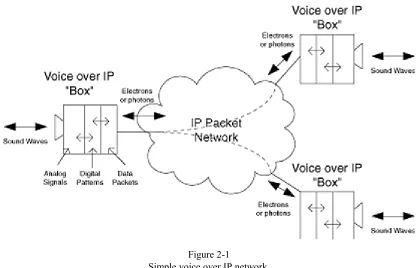
To transport voice signals over an IP network, several elements and functions are required. In its simplest form, the network would consist of two or more voice over IP capable devices linked by an IP network. Looking at the simple network in Figure 2-1, we can tell that somehow the VoIP devices convert voice signals into IP data streams and forward them to IP destinations which, in turn, convert them back to voice signals. The network in-between must support IP traffic and can be any combination of IP routers and network links.
Voice-to-Data Conversion
Voice signals are inherently analog waveforms. To transmit them over a digital data network, they must first be converted to some type of digital format. This is done using various
voice-encoding schemes. The source and destination voice encoders and decoders must implement the same
Figure 2-1
Simple voice over IP network.
scheme so that the destination device can successfully reproduce the analog signal that the source device encoded in a digital format.
Raw Data to IP Conversion
Once a voice signal is digitally encoded it becomes just another form of data for the network to transport. Voice networks simply setup physical connections between communicating end points (a circuit) and transmit the encoded signals between endpoints. IP networks don't form
connections in the same way that circuit switched networks do. IP networks require that data be placed in variable length datagrams or packets. Addressing and control information is then attached to each datagram and is sent through the network and forwarded, hop-by-hop toward its
Page 11 destination. To support the transport of digital voice data over this type of network, the voice over IP device must take the voice data, encapsulate them into IP datagrams (packets), attach addressing information, and forward them into the network.
Transport
Intermediate nodes within the network inspect the addressing information attached to each of the IP datagrams and use that information to forward the datagram to the next hop along the path to its destination. The network links can be any topology or access method that supports IP traffic.
The destination voice over IP device receives the IP datagram and processes it. In processing the datagram, the addressing and control information is removed so that the original raw data remain. The raw data are then presented to the voice decoding process.
Conversion from Data Back to Voice
The voice decoding process interprets the raw data generated by the source station and runs them through the decoding function. The output from the decoding function is an analog signal
resembling the original voice signal received by the source station line feed.
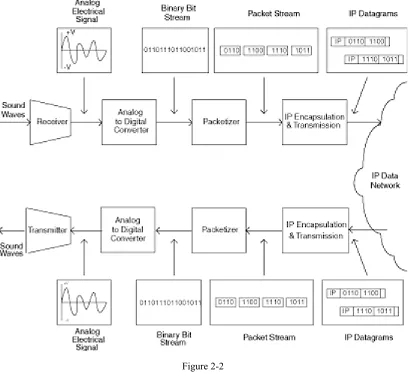
In summary, the transport of voice traffic over an IP network requires a conversion of the signal from analog to digital, packetization of the digital voice data, transport of the packetized
information through the network, de-packetization of the voice data, and conversion of the digital voice data back to an analog signal. This process is depicted in Figure 2-2.
Voice over IP Basics
The previous example only dealt with the base functionality required to transport a voice signal across a simple data network. It lacked several
Figure 2-2
Simplified voice over IP transport process.
functions that are required to build a simple voice over IP network. The most basic are voice compression, phone number mapping, call-leg identification (peer establishment), and a protocol for the transport of voice data.
Voice Compression
In order to offset the overhead introduced by converting an analog signal to digital and transporting it over a packet switched network,
Phone Number Mapping
The simple VoIP example above assumed that each voice over IP device would only transmit and receive calls from a single node. In more realistic environments, VoIP devices are required to dynamically form connections with multiple devices. In the voice world, destinations are selected using a dial string or phone number. In the IP world, destinations are selected using IP addresses. To allow a VoIP router to communicate with an array of other VoIP routers, a method of
mapping the phone numbers dialed by the telephone user to the IP addresses used by the routers is required. This mapping can be performed statically within each router, or dynamically using Domain Naming System (DNS). The planning of connections and their associated phone numbers is called a dial plan.
Call Leg Identification
In order to properly identify, process, and forward voice calls, the router divides calls into discrete segments, referred to as call legs. Once identified, the router can apply services specific to each call leg, including terminating sessions.
Session Protocol
The Real Time Protocol (RTP) is a standardized way to transport voice and video traffic over IP networks. RTP adapts connectionless IP traffic to support real-time traffic through providing timing, sequencing, and other control functions. RTP is defined by an Internet Engineering Task Force (IETF) standard to ensure interoperability in multivendor environments.
Page 14
Enabling Technologies
Widespread deployment of voice over IP is fast becoming a reality due to many innovations in hardware, software, protocols, and standards. Advancement in each of these areas contributes to the creation of a more efficient, capable, and interoperable voice over packet network. The primary innovations are briefly listed in Table 2-1.
Hardware Advances
Hardware advances in the areas mentioned in Table 2-1 are providing both the additional computational power and the additional bandwidth, thus helping to make VoIP a reality.
Digital Signal Processors
Digital Signal Processors
[image:40.612.68.445.188.422.2]Advanced digital signal processors, or DSPs, perform computationally intensive tasks required for voice and data integration. As their name professes, DSPs process digital signals and then perform complex functions which might otherwise have to be performed by a general purpose
TABLE 2-1
Key Advancements Enabling VoIP Deployment
Protocols and Standards
Software Hardware
H.323 Weighted fair queuing DSPs
MPLS, Tag switching Weighted random early detection
Advanced ASICs
RTP, RTCP Dual leaky bucket—generic cell rate algorithm
DWDM
RSVP Committed access rate SONET
Diffserv, CAR Cisco express forwarding CPU processing power G.729, G.729a:
CS-ACELP
Extended access lists ADSL, RADSL, SDSL
FRF.11 / FRF.12 Token-bucket algorithms Multilink PPP Frame-relay traffic shaping
SIP Precedence-based CoS
Packet over SONET IP and ATM QoS/CoS integration
Page 15 CPU. Their specialized processing capabilities combined with their low cost make DSPs well suited to carry out signal processing functions in VoIP systems. The computational overhead for G.729 voice compression on a single voice stream is tremendous, requiring up to 20 MIPS. This makes it unreasonable for a single processor system to effectively process multiple voice streams and still perform routing and system management functions. The use of multiple DSPs offloads this function from the central CPU and allows the system to process additional calls based upon DSP availability. DSPs are also well suited for functions such as voice-activity detection and echo cancellation because they process voice traffic in real time and have quick access to onboard memory.
Advanced Application-Specific Integrated Circuits
classification and inspection, and queuing functions (WFQ, WRR, FIFO, etc.). Their use in these devices results in higher performance and lower cost. They benefit the emerging VoIP market in that they provide increased bandwidth and better QoS support within networks. Examples of ASICs are the silicon queuing engine within the 12000 GSR or the switching elements within a Catalyst 5500 (SAINT, EARL2, etc.).
Dense Wave Division Multiplexing
Dense wave division multiplexing, or DWDM, is breathing new life into older fiber networks and providing astronomical bandwidth in the fiber backbones deployed by newer carriers. DWDM technology leverages the capabilities of fiber optics and advanced optical transmission
equipment. Wave division multiplexing derives its name from the fact that it transmits multiple wavelengths of light (LASERs) over a single strand of fiber. Current systems are capable of transmitting and discerning 16 different
Page 16 wavelengths, while future systems promise to support anywhere from 40 to 96 different
wavelengths. This is significant because for every wavelength added, another information stream is provided. The result is that an OC-48 (2.4-Gbps) network can be upgraded to support 16 times that without having to lay new fiber in the ground. Most newer fiber-optic networks are
provisioned to run at OC-192 speeds (9.6 Gbps), which, when combined with DWDM, results in a capacity of over 150 Gbps on a single pair of fiber-optic strands. The immense bandwidth provided by DWDM is providing ISPs and carriers higher powered backbones and making bandwidth cheaper and more accessible. This helps support the increased bandwidth demands of VoIP solutions and actually reduces QoS demands on the network since bandwidth is more plentiful. The increased transmission rates not only provide fatter pipes with less opportunity for congestion, but also introduce significantly less latency.
Synchronous Optical Network
Synchronous Optical Network (SONET) has been the backbone for carrier fiber optic networks for some time now. SONET continues to be deployed in both long distance and local markets due to its proven track record and excellent reliability with near lossless failover characteristics. Products from Cisco Systems and other vendors leverage SONET's flexibility and reliability through increased integration with SONET and internetworking equipment. Advances in SONET technology have yielded higher transmission rates and have lowered costs for bandwidth.
Widespread deployment within local markets is also helping to provide a cost-effective platform for VoIP networks to run over.
Digital Subscriber Line
The various flavors of digital subscriber line technology (xDSL) are helping to solve the local loop bandwidth problem which plagues Metropolitan and Wide Area Networks today. Symmetric DSL provides the ability to transmit and receive at up to T1 speeds over common POTS
asymmetric transmission rates where the user-side download speeds may be as great as 8 Mbps and the user-side upload speeds may be up to 1 Mbps. These and the other DSL variants are helping to provide the necessary bandwidth to business and residential users and to significantly reduce costs. With lower cost DSL local loops, companies now access the Internet and service provider–based VPNs at significantly increased speeds enabling higher call volumes for VoIP calls.
Page 17
Central Processing Unit Technology
Central processing units (CPUs) have continued to increase in functionality, power, and speed. This has enabled widespread deployment of multimedia PCs and improved the performance of system functions bound by CPU power. The PC's ability to process streaming audio and video has created an expectation within the user community that making voice calls over the data network is a logical next step. This computing power enables both advanced multimedia desktop applications and advanced functionality in the network elements supporting voice applications.
Software
Compressed Real-Time Protocol
Compressed Real-Time Protocol, or CRTP, is a mechanism that operates on the RTP headers used to encapsulate digitized voice segments. CRTP draws heavily from Van Jacobson's TCP header compression algorithm and manages to reduce the standard IP/UDP/RTP header from 40 bytes to a mere 2—5 bytes. This is significant, as it reduces both bandwidth consumption and the time required for a voice packet to traverse a low-speed network link. The efficiencies gained by CRTP help offset some of the overhead associated with packetized voice traffic. Tables 2-2 through 2-5 demonstrate both packetization overhead and the efficiency gains achieved using CRTP as well as some of the efficiency losses incurred by packetizing voice traffic. A 6-byte data-link header is assumed as this size
TABLE 2-2
Bandwidth Requirements for Packetized Voice
Voice Compression Algorithm Algorithm Bandwidth Requirements, kbps* Packetized Bandwidth Requirements before CRTP, kbps Packetized Bandwidth Requirements after CRTP, kbps
G.711 PCM 64 80 68
G.726 ADPCM 32 48 35
G.729 CS-ACELP 8 24 11
Page 18
TABLE 2-3
Packetization Overhead and Bandwidth Consumption without CRTP
Voice Compression Algorithm Payload Size, bytes* Packet Size w/o CRTP, bytes† Packetization Overhead, % Total Bandwidth Requirements, kbps
G.723.1 MP-MLQ 30 76 153 20.3
G.729 CS-ACELP 20 66 230 26.4
G.726 ADPCM 80 126 57.5 50.4
G.711 PCM 160 206 28.8 82.4
*Per packet.
†Including G-byte data-link header.
TABLE 2-4
Packetization Overhead and Bandwidth Consumption with CRTP
Voice Compression Algorithm Payload Size, bytes* Packet Size with CRTP, bytes† Packetization overhead, % Total Bandwidth Requirements, kbps
G.723.1 MP-MLQ 30 38 27 10.1
G.729 CS-ACELP 20 28 40 11.2
G.726 ADPCM 80 88 10 35.2
G.711 PCM 160 168 5 67.2
*Per packet.
†Excluding data-link header.
TABLE 2-5
CRTP Efficiency Gains
Voice Compression Algorithm
CRTP Efficiency Gain, %
G.723.1 MP-MLQ 101
G.729 CS-ACELP 135
G.726 ADPCM 43
Page 19 is consistent with frame relay, PPP, and HDLC header sizes. Low-bit-rate encoders, such as MP-MLQ and CS-ACELP, benefit the most from CRTP because of their smaller payload relative to the IP/UDP/RTP header size. Their gains are significant when considering the transmission of multiple voice calls over low-speed links. Without CRTP, only two MP-MLQ or CS-ACELP calls could be supported on a 56-kbps link; with CRTP, four calls could be supported over the same link. Further, lower end-to-end delays will be incurred for each call since the serialization delay for each packet will be 100 to 135 percent lower.
Weighted Fair Queuing
Weighted fair queuing, or WFQ, was first introduced in IOS v11.0 and has since become the default queuing mechanism for WAN interfaces running at less than 2 Mbps. WFQ classifies traffic streams, queues them individually, and ensures fair access to the exit interface by
intelligently scheduling queue transmissions using a weighted algorithm. Traffic is classified by network and transport-layer information as well as traffic rates and frame sizes. Low-bandwidth sessions are given higher priority to prevent them from being starved by the higher bandwidth sessions. This behavior results in more consistent and predictable transmission delays for both high-bandwidth sessions such as file transfers and low-bandwidth interactive sessions such as Telnet or chat. Weighted fair queuing's greatest virtues are that it operates automatically without requiring the user to configure complex queue structures and that it seamlessly supports all protocols. WFQ is important in voice environments because it automatically prioritizes voice traffic, especially when QoS parameters are set, and provides a consistent queuing delay through the network.
Weighted Random Early Detection
Weighted random early detection, or WRED, is a lightweight congestion avoidance technique that enables higher overall link utilization and goodput. Random early detection monitors link congestion and traffic flows and randomly drops packets from individual traffic flows, allowing their upper-layer protocols to adapt to the congestion condition. This technique optimizes the transmission rates of the individual flows and prevents both congestion collapse and
synchronization issues. Weighted Random Early Detection provides a means for supporting multiple priority levels, each with different discard thresholds. WRED helps voice over IP networks by providing preferential service to voice traffic while intelligently controlling nonvoice traffic and optimizing link efficiency.
Page 20
Generic Cell Rate Algorithm
As the newer name implies, GCRA provides a means for controlling the rate at which traffic flows into the network. The dual leaky-bucket algorithm uses common traffic control parameters such as minimum cell rate and burst size along with a complicated queuing and scheduling algorithm to police and shape traffic flows through the network. GCRA is directly applicable to ATM traffic, but variants of the leaky-bucket algorithm are applicable to variable-length packet networks as well. GCRA can be used in voice over IP networks to guarantee minimum
bandwidth levels to voice traffic and to shape nonvoice traffic and prevent it from introducing undue delay to voice traffic.
Committed Access Rate
Committed access rate, or CAR, is a value-added feature from Cisco that runs on the 7x00 class routers. CAR provides a means of controlling the bandwidth received or transmitted through an interface to a set of destinations. The set of destinations can be a discrete number of sites,
specific TCP or UDP ports, or simply all traffic through the interface. CAR measures traffic flow using a token-bucket algorithm and can tag, drop, or simply forward traffic based upon decision criteria for meeting or exceeding traffic rates. CAR is helpful in engineering networks to support differentiated service levels as multiple CAR policies can be applied to a single interface to control access to network bandwidth. It is useful in voice environments to help ensure that voice traffic receives the appropriate amount of bandwidth across the backbone.
Token Bucket—Generic Traffic Shaping
Cisco's generic traffic shaping uses a token bucket algorithm to monitor and shape traffic flow through a given interface. A token bucket algorithm differs from a leaky-bucket algorithm in two important ways. First, it transmits traffic at media rate instead of a specified rate, and, second, it provides greater adaptability for bursty traffic. Generic traffic shaping allows for excess traffic to be transmitted, but does so at a lower priority. The interface's queuing mechanism then filters out noncompliant traffic. Generic traffic shaping is of value in voice over IP networks because it provides a lower cost (processing-wise) way of controlling traffic flows and allows for both voice over IP traffic to be prioritized and nonvoice over IP traffic's effects to be limited.
Page 21
Frame-Relay Traffic Shaping
Cisco's implementation of frame-relay traffic shaping uses a single leaky- bucket algorithm to solve some of the QoS problems associated with frame-relay interaction. Frame-relay traffic shaping provides a means for limiting output rates on an individual PVC basis. The strict output rates enforced by the leaky-bucket algorithm prevent the router from transmitting traffic in excess of the individual committed rates for each PVC. This overcomes a common problem where ''hub" sites with high-speed access lines overwhelm "spoke" sites with lower-speed access lines. Traffic shaping minimizes packet loss and helps ensure that critical traffic gets through, which is of significant importance to voice traffic.
The IP precedence bits are special bits reserved within the headers of IP datagrams. The developers of the Internet Protocol envisioned that they would one day be used to prioritize traffic, but until recently, they have been ignored by most systems. Cisco uses the IP precedence bits to provide network-wide classes of service by integrating precedence bits into queuing and classification algorithms. CAR, WRED, and WFQ all utilize the IP precedence bits to help prioritize traffic. In voice environments, IP precedence bits are important as they are frequently used to ensure that voice traffic receives high priority when transiting the network.
IP to ATM Class of Service
Cisco has introduced a method for providing differentiated classes of service for IP traffic transiting an ATM network. Within the scheme, traffic is queued on a per-ATM virtual circuit basis and IP QoS mechanisms are performed on the individual queues. This feature relies on ATM's ability to guarantee cell delivery rates. IP to ATM class of service (CoS) is in its infancy, but will grow to support complex methods of forwarding IP traffic over ATM networks,
including flexible selection of output VCs based upon traffic priority. Thus, in the future, the router will be able to transmit delay sensitive voice traffic over a CBR or rt-VBR circuit, while transmitting normal data traffic over an ABR circuit. This feature is of significant value to voice over IP networks with ATM backbones in that it helps to marry the QoS mechanisms from both technologies to form a more cohesive network that can provide consistent voice quality.
Page 22
Protocols
Real-Time Protocol/Real-Time Control Protocol
The Real-Time Protocol (RTP) and Real-Time Control Protocol (RTCP) were created to transport real-time traffic, such as video and audio, over the Internet and/or Internet
Protocol–based networks. RTP is a session-layer protocol that usually runs on top of UDP/IP and is defined in RFCs 1889 and 1890. UDP is the favored transport-layer protocol because its connectionless nature enables its use in broadcast and multicast environments. RTP addresses some of the elements required for real-time traffic which are missing from UDP, including sequence numbering and time stamping. Sequence numbering enables the receiver to verify that datagrams have been received in order and that intermediate datagrams were not lost. Time stamping helps ensure proper playback rates regardless of datagram arrival times. Additionally, a payload-type field helps the receiving station identify which application or process to hand off the data to. Given this functionality Cisco and most of the VoIP community have chosen to use RTP for the transport of packetized voice in IP networks.
RTCP carries out the control functions for RTP streams. RTCP performs four discrete functions:
1. Communication of information and statistics about the RTP stream to the application
3. Limiting of control traffic
4. Secondary transport for small amounts of information
This protocol is important in voice environments for its ability to identify RTP sources and for the statistical information it provides applications.
Resource Reservation Protocol
Resource Reservation Protocol, or RSVP, is a protocol developed to allow applications to dynamically request specific levels of service from the network. RSVP's application-based approach enables it to be customized based on specific application requirements. RSVP-enabled applications communicate their bandwidth and network latency requirements to receiving applications. The receivers then issue RSVP requests to the network elements along the return path to the source station for these resources. Once a network element agrees to support a request, it is expected to honor that request for the duration of the reservation. In voice
Page 23 over IP environments, a voice-enabled router can issue RSVP reservations for each individual voice call and rely on the intermediate network elements to dynamically allocate the appropriate resources for the call.
In addition to standard RSVP requests over packet networks, Cisco offers a means to map RSVP reservations to ATM SVCs called RSVP-ATM QoS interworking. This feature is supported by the 7500 series and enables the router to dynamically set up an ATM SVC with the appropriate QoS parameters to support the RSVP request. In hybrid packet and cell environments,
RSVP-ATM QoS interworking provides enhanced QoS integration and leverages ATM's intrinsic QoS capabilities to support packet-based requests.
Diffserv/Committed Access Rate
Cisco's committed access rate (CAR) and the goals of the IETF's differentiated services (diffserv) working group are similar. The diffserv group is developing a standards-based approach to classifying IP traffic, setting bits within the IP header to identify a specific QoS, providing preferential service based on QoS levels, and supporting the QoS levels throughout the network. Cisco's committed access rate is an early implementation that provides rate control for IP traffic, interpretation and setting of IP precedence bits, and differentiated service throughout the network based upon IP precedence bits. This feature is significant in voice environments as it helps provide network-wide classes of service for IP traffic.
H.323
H.323 is an International Telecommunications Union (ITU) standard which was created in 1996 and updated in 1998. It provides a foundation for audio, video, and data communications across a packet-based network infrastructure. H.323 provides standards for voice-encoding, simple
and links to external networks. The voice over IP community has adopted H.323 standards in an effort to foster the interoperability of equipment from multiple vendors. H.323 provides a solid foundation for building multimedia networks and has become critical for developing large-scale VoIP networks.
G.729/G.729a
G.729 and G.729a are standard for voice-encoding algorithms. These algorithms analyze standard PCM voice segments and use a complex algorithm to encode them. Once encoded, a lookup pointer for the audio
Page 24 pattern's location in a shared code dictionary is forwarded to the receiving node. Since the actual audio signal is not sent over the network (just the code), this algorithm results in significant bandwidth savings. G.729 and G.729a are particularly significant in the voice over IP arena because their low-bandwidth requirements (8 kbps) help to offset the overhead introduced by encapsulating voice traffic in data packets.
Session Initial Protocol
The Session Initiation Protocol, or SIP, is the IETF initiative for providing audio and/or video transport over the Internet. It is an application-layer control (signaling) protocol for creating, modifying, and terminating sessions with one or more participants. These sessions include Internet multimedia conferences, Internet telephone calls, and multimedia distribution. Members in a session can communicate via multicast tree or a mesh of unicast relations. SIP is defined by RFC 2543 and is being considered by a number of vendors and service providers.
Packet over SONET
Packet over SONET provides higher speed, more efficient transmission of IP traffic across service provider backbones. Given that most of the high-speed links deployed are point-to-point links between routers, the signaling overhead and cell tax associated with ATM is an unnecessary inefficiency. Packet over SONET maps PPP or HDLC frames directly into SONET frames
avoiding the segmentation and reassembly processes associated with ATM. This improves efficiency significantly by increasing the effective throughput over an OC-3c link from approximately 135 Mbps to over 155 Mbps. Both the performance gains and ease of
implementation have made Packet over SONET a popular choice for large-scale IP networks. Packet over SONET is significant in voice environments in that it provides a more efficient way to transfer IP packets across network backbones.
FRF.11/FRF.12
The Frame-Relay Forum's FRF.11 specifies an implementation of voice over frame relay, while FRF.12 specifies a method for segmentation and reassembly of frame-relay frames at the