Ames Laboratory ISC Technical Reports
Ames Laboratory
6-1951
Methods of preparing spectrographically pure
praseodymium salts
F. H. Spedding
Iowa State CollegeT. A. Butler
Iowa State CollegeFollow this and additional works at:
http://lib.dr.iastate.edu/ameslab_iscreports
Part of the
Chemistry Commons
This Report is brought to you for free and open access by the Ames Laboratory at Iowa State University Digital Repository. It has been accepted for inclusion in Ames Laboratory ISC Technical Reports by an authorized administrator of Iowa State University Digital Repository. For more information, please [email protected].
Recommended Citation
Spedding, F. H. and Butler, T. A., "Methods of preparing spectrographically pure praseodymium salts" (1951).Ames Laboratory ISC Technical Reports. 23.
Methods of preparing spectrographically pure praseodymium salts
Abstract
An ion-exchange process was developed for the separation of spectrographically pure praseodymium salts in kilogram amounts from commercially available concentrates. The application of either 0.5% or 0.1% citrate solutions as eluting agents was show to result in excellent separations of praseodymium from samarium, neodymium, and lanthanum when the mixed rare earths were eluted from Amberlite IR-100 or Nalcite HCR cation-exchange resins.
Keywords Ames Laboratory
Disciplines Chemistry
,I •
)
Physical Sciences Reading Room
UNITED STATES ATOMIC ENERGY COMMISSION
ISC-148
METHODS OF PREPARING SPECTROGRAPHICALLY
PURE PRASEODYMIUM SALTS
By
F. H. Spedding
T. A. Butler
June 1951
Ames Laboratory
II
T e< h n i' a I Info' mali an S uv i <e, Oak Ridge, Ten nu u eCHEMISTRY
Reproduced direct from copy as submitted to this office.
Work performed under Contract No. W-7405-eng-82.
PRINTED IN USA PRICE 25 CENTS Available from the Office of Technical Services
Department of Commerce Washington 25, D.C.
.,
3
TABLE
OF
CONTENTS
Page
I. ABSTRACT
o • 0 0 0 0 0 0 0 0 0 0 0 0 05
II.
INTRODUCTION
o o o o o o • • 07
8
III. LITERATURE
REVIEW
0 0 0 0 0 0A.
Chemi
cal
and Physical Properties of
the
Rare
Earths o o o o o o o o o o o o o o o o o o o o oB. Methods for Separation
•
•
o • • o o • o • • • oC.
Basic Principles of
Ion~Exchange as Applied toRare-Earth Separations •
•
•
o • • • • •8
10rv.
EXPERIMENTAL
PROCEDURE
0 0 0 0 0 0 0 0 013
15
15
2021
23
A.
Apparatus
0.
0 0 0 0 0.
0 0 0 • •B.
Materials
. .
0 • •.
0•
0 • & 0 0 0 0 0c.
Typical Experiment
0 0 0 0 0 0 0 0 0D.
Methods of Analysis
0 0 0 0 0 0 0 0v.
RESEARCH
• • • •
•
•
o 0 0 0 0 e o o o 0 0 0 0 0 0 &25
A.
Investigations Using Five-Tenths
Per Cent Citrate
Solutions
•
o • • • • . • o • • o ., • o • • •2.5
1.
Preparation and loading of
resin
beds
26
2. Effect o.f pH on the elution of
pure
neodymium
at
two
flow rates •
o • oo •
26
3o Effect of resin particle size
on
the
elution at two flow rates • •
o
• •
28
4.
Effect of pH on
the
elution of
neodymium-praseodymium mixtures • • • •
o • o • o •30
5.
Pilot
-
plant operations
• • • •
• • •
34
B.
Investigations Using One-Tenth
Per Cent
Citrate
Solutions
o • • • • • •o
•
o • •
• o •
•
35
lo
Elution of equimolar mixtures of
neodymium
and praseodymium • • •
•
o • o35
2o
Effect
of particle
size of the resins
o38
3o
Lower
citrate concentrations •
o
o
oo •
40
4o
Effect
of column length
on the separation
of
mixtures
of
samarium~neodymium and
4
5o
Nalcite HCR resin •o • • • • • • • • •
6.
Increasing column length with a constantsample weight • • • • • o • o o o o
7.
Increased sample weight on a fixedcolumn length • o • • • • o • • o o • •
8.
Separation of praseodymium fromlanthanum • • • • o • • o • o o • •
9.
Nature of the column precipitate •• 10. Prevention of the column precipitate 11. Pilot~plant operation • o o • o o •VI.
SUHr1ARYAND
CONCLUSIONS •VII.
LITERATURE
CITEDVIII. ACKNOWLEDGMENTS •
ISC·-148
Page
44
45
45
47
49
49
50
53
56
.t?
METHODS OF PREPARING SPECTROGRAPHICALLY
PURE PRASEODYMIUM SALTS l
F. H. Spedding and T. A. Butl9r
From the Department of Chemistry Iowa State College
I. ABSTRACT
An ion-exchange process was d8-veloped for the separation of spec~· trographically pure praseodymium salts in kilogram amounts from commer-cially available concentrates. The application of either
0.5%
or 0.1%citrate solutions as elutj_ng agents was shown to result in excellent separations of praseodymium from samarium.? neodymium., and lanthanum
l-ihen the mixed rare earths Here eluted from Amberlite IR·~lOO or Nalcite
HCR ca~ion-exchange resins.
A number of variables were investigated whic.h were shown to be
important in the ion~exchange method for preparing pure praseodymium
salts. It is desirable t.0 approach equilibrium conditions as e:losely as possible during the elution process in order that the small differ~
ences between. the equilibrium constants of the individual elements may be fully utilized. Sufficient time must be allowed for the cations tc• diffuse into and out of the resin so that an equilibrium may be estab=
lished between the ra:r9 earths :in the resin phase and those complexed
by the citrate ions in the surrounding solution phase. Experimental
evidence is given to show tha.t a reducti.on in the flow-rat.e of the eluting solution and a decrease in resin particle sizes which decreases
the length of the diffusio:a path in the resin.r resulted in a closer approach to equilibrium conditions and inereased the separation of adjacent rare earthso
Small differenN'.s in the: pH of the cltrate so1utions9 used. to elut.e
the rareu>ear·th band from the res:I.:n bedq result~d in both a quaJ.i tati v-e
s.nd quantitat;ive change in 1/he shape of the elution curves. The varia··
tion in th.8 shape of the curve-1;3 wa~ i.nterpreted as bei.ng related -to a change in the relative import.anc6 of d.ifff)ren. rara·~earth citrate com·3
plexes in the e.luting solution. The exi .etence of at least five sueh
1This paper is based on a PbD
th~~
i
s
by Thomas Butler.i'~ubmitt.ed
in6
complexes 1'laV>3 been r~ported hy Spedd:ing and eo-workilrs (4)o In general, J.ower pH values of the ci"t;rata solutions, in the applicable pH range, :r:esult:.ed 2.n better sspa-.:·atlons. Howe·ver, in large~scale prod·u.cticP-, a compromise must. be~ made bet·ween
the
j_ncreased time necessary t.o complete the elution, with somewhatbetter
separation, at lower pH values, and labor cost.There is little choice between the use of Oo.5% or Ool% citrate solutions for separating sna11 am0unts of purf1 praseodymium. However, 0.1% eitrate is to be preferr·ed .for large-;-scale production since the cost of the operaticn is r<'lduced,
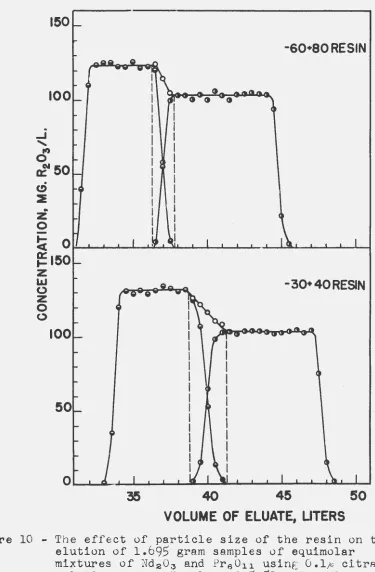
Nalcite HCR red!1 was .shown to be superior to Amberlite IR~lOO for large-scale praseodym:i.JJm separations. Nalcite HCR not only has a higher capacity but the spherical form of' the particles permits better packing in a c;:>lu.rnn, thus reducing the tendency of the rare-eart.h band to form streamers or to cham1el during the elution. Direct observation showed that irregularity of the band-fronts of the indivi.dual rare earths may account for a large percentage vf t.he overlapping of adjacent rare earths. In other words, the region of mixed rare earths in an elut.ion may be attributed in part
to
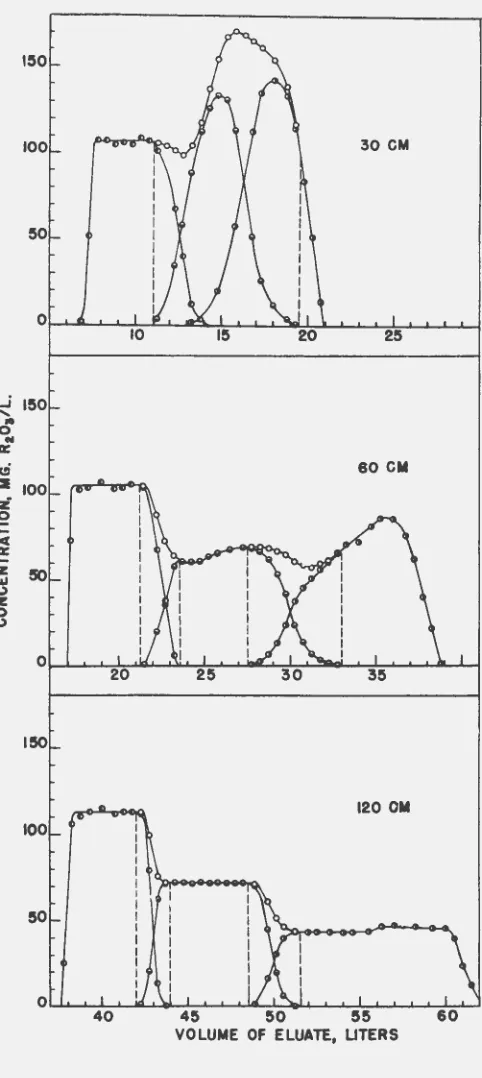
thA mer-hani.cal diffieulties of maint,aining a ho::.·izontal rare-eart~1 band-·front during tl:e elutionoPreliminary (;.xp::riments showed tha-t a greater percentage yield of the available praseodymium rc:su.lted. from increasing the sample weight of the praseodyroiU1Tl ccncent:."ate with .::. propc1rtionate increase in the
colUJ1111 lengt,h. This incJ:'easH in yield occurs because the region of over~ lapping rar•3-ea:::·th bands :r.emA-i.ns essentially constant if a minimum resh1 bed-le;ngth is pruvlded for allcwiJ:..g full development of tha eornponsr.:t
::'Cli"'8 e!lrt!1s into bands. l"urths:r.· increaBa in resin bed height above the
m:i.nimum length for a giv·en c':lh'.111Il load does n0t res.ul.t. in furt,her sep.?.r·a-tion between adja:.!ent !'!lre earth~.
A completr~ in-.restigation of the relation between column load and eol.umn length was prevented by the formation of a slightly soluble rare-earth dtrate compound which preeipitated in the resin bed as the sample weight was incraased. The rare-earth citrate precipitation in the re.sin bed was prevented by adding excess hydrc chloric acid or ammonium ch-loride to the mixed :rare-earth chlorides befor•3 the sam.ple was adsorbed on tho
:resin bed.
7
Durint; the course of thes>3 inves't;igar,ions.'! seven kilograms of spectrographically pure praseodymium oxide were prepared and made
available to a number of investigators conducting theoretieal researches on the properties of the rare earths.
II. INTRODUCTION
The series of elements with atomic numbers
58
through 71 are com~ monly. known as the rare earths; recently 01 following Goldschmidt'ssuggestion, they are also designated as the lanthanide series. These elements are so remarkably similar in their chemical and physical pro~
perties that they have be~;;n the object of extensive investigations to determine means of obtaining adequate amounts of their pure compounds for detailed studies of their properties. Although rare-earth compounds have been studied for a long time~ many of the reported physical~chemi,"!al data need revision because the result.s.l' in most instances11 were obtained
with relatively impure samples.
The synthetic production of plutonium by nuclear fission lent emphasis to the need for the general availability of pure ral·e=earth compounds. Isotopes of the rare earths are prominent among the fission products, and it became v:i.tally important to determine ,their nuclear cross~sections for capture of neutrons as well as their chemical pro~
perties.
The transuranie elements constitute a closely related group known as the actinide series or rare earths Type 5f in analogy to the lanthan-ide series or rare earths Type
4f.
It is evident that the lanthanide and actinide series of elements have analogous prope!'ties and~ sin;:;e the members of the actinid~ series are even less available for experi~mental work than are the members of the lanthanide series:> it follows that the latter find important use for stand=ins and carriers in research on the transuranic elements.
The research described· in this thesis was undertaken in order to dev-elop a more rapid and economical separation procedure .for the indi-vidual light rare earths9 the cerium groups with particular emphasis on
the preparation of praseodymium salts. Ion~exchange methods were chosen for study; it will be shown that this procedure has many advantages over those previously reported. The goal of this I'esearch was the development of a rapid, economical process for obtaining high yields of very pure praseodymium
m
il:h could be scaled up to a plant having a production capacity of several kilograms of pure salt per year.8
series of ~apr:-r-s by li'. H. Speddi.ng and eo~wo:rkers (l,2,3,4,.5,6.;?). This thesis p:>"·esents fur':.her applicat..: ons of this vechniqu.e as related to the purification of p:raseodymiumo
IIIo LITERATURE
REVIEW
Ao Chamical and Physical Properties
of the Rare Earths
The chemical properties of the elements in Group III~A of the periodj_c system are so si.milar that ordinary chemh:al methods of separa-tion are in most cases of :relatively little. valueo Lant,hanum and
yttrJ.mn ara always present with the rare earths in nature and follow thmn closely during separation schemes. The chemistry of the rar8 earths has been reviewed rather extensively in a number of publications
(8,9,10,11,12,13,1h). These references include a large body of quali~ tative chemical knowledge which has been obtained about rare--earth compounds, which prov-ed valuable in the development of better methods for the separatj_o:n and pur1fication Qf these elements.
The normal tripositive valency ::.d::.ara is common to all the ra.re earths. Other yalence states are known for some of the rare earths,; for example, tetrapo:3it.iv-8 cerium and bivalent ytterbitun, europh.tl'll. and samar:i.mn are well es·tablished. SomB controv.:::rsy exista regarding ot.her -.;ale:nce states of praseodymium and terbium. A search of the literature failed to reveal a serious cla.i.m for the exi.stence of any valence state other than the tripositive in aqueous solutions for the above two ele~
ments. However, higher valence st.a.tes have been shown to exist in the oxides of these elemfmts & The generally accepted oxides of praseodymium are Pr203, Pr60li and Pr02o Mars.'IJ. (1.5,16) has presented some evidence of a divalent praseodymium in the form of PrO. Prandtl (17) has claimed that praseodyrriu .. "'l. can exhibi.t. a higher valency of
5;
this claim has not been verified <md m'Jst. mrkers ~.ow agr8e that the positive four oxidation state is the ma ... >drmmloIt is accepted that the black oxide obtained as a result of heating F::.·?.03, or salts such as the oxalate, in air at 700~1000° has an atom:L~ c:'Jmposition represented by the formula Pr
0
0j_J.o Th.e exact form of the chemical binding in this oxide is questionableo Ma.rsh (1.5) prefers to represent Pr•6011 as P.c0lo8J3o On the basis of tensionmetrle measurements and X-ray diffraction patterns, he would represent Pr01o83'~ as being effect1valy Pr02 dei'ieient j_n oxygen, and not Pr0lo.5 with excess oxygen. McCullough (18) :~ on the other hand.9 presents evidence in support of the existence of Pr60ll as a separate a.."'ld distinct phaee in thepraseodyrrd.um-oxyg&n system. He prepared the higher oxide, P:-02, by heat:i..ng Pr60J.l
Many r;f t.he physic.ll :.:.;nd chemical properties of the rare earths
may be adequately explained on t..'be ba ·is of the electronic configura·· tions of the atgms ... Th~ ra!'e
eart?-
iC>,"\,'3 have t.~e ... elect~ni~ configu:ra~tion ls2 2.s2. 2.pb )st::
3pc
Jdl.Q 4s2. L~P'?4al0 4£Il
5s2.S'p6
1.
Sdl 6n2J;
the value of n increases from 0 to14
from =~a.nt.hanum through lutetium. The Sdl 6s2 electrons enclosed in brad<:eta are involved in ordinary chemi.calreac~ions in aqueous solut.:i.ons and account for the tripositi.ve valer..ce
of all these e lemE>nts e Ths addition of electrons at the hf level has 1i ttle effect on the c·hemical proper-tj es of the ion, s:l.:o.ce the normal valency is unaltered by their presence and they take no part in the formation of compounds. It. becomes apparent that. these elements should be similar chemically since they di.ffsr from each other only by the charge on the nucleus and the number of electrons in the
4f
shell.The absorption spectra of rare··earth ions in aqueous solution and
in crystals furnish the basis o.f a go.Jd physical IT17:thod for th8 analysis of several cf t.h~se element8. The absorption spectra have been shov.'11
to result from 11forbidden11 t::ransitions of the elec ·rons between states vd. thin the
hf
shell. These transi t.ions give rise t.0 sharp .. lineabso:rp-tior.s (19) which are of sufficient, int.ensi ty to al.low semi<~quant.itative
determinations to be made of several of the rare~earth ions. Good evl~
dence l.n support o.f the forbidden trarJsition hypothesis has been given
by Bethe and Spedding (20) ar:.d by Spedding (2l)o
The rare earths provide a uniqu,:; s~rjes of elements for the appli~
cation of modern ccncepts regarding thFJ pa:ramagnetism of i.ons. An
out-standing property of the rarE' earths is the strong paramagnetism di::>played
by the metals and their compounds. This property has been utiliz-ed a~
a method of analysis. The par-amagnet.ism arises from the
4.f
ele.etron5whi,~h are shielded to a large extent from the fields p·roduc.ed by the adjacent chemica1ly bonded groups. Thus the paramagnetism
character-istic of a particular ion is not greatly perturbed by the presence o.f surroundjng ions and may be used for semi-quanti.tatiYe analyses.
One of the most important .factors influencing the chemistry of the
rare earths ls the cont.raetion of the rare earth i.on as the atomic nv.m~
ber increases. r.he admission of successive electrons into the
4f
orbitals increases the nu:..:lear eharge whi:'!h pulls all of th.,_) -:3lectrons toward ths nucleus and result-s in a contraction of the atomic radius.
ThL3 effect i.ncreases the stl"engt.hs with wh1ch the eleet.rons are held to the atom and results in a decrease in ba::>iC'ity going f':t•om lanthanum
through lut.e+,ium. Yt-trium has properties of at.omic volumo and baeici ty
which places it roughly bet>·reen dyspr·osium and hoJ.mi,lm9 and it. is
usually found between these elemsn s .in ,c:; paration l'lchemeso A review of the basicity characteristics of scancli.um.!' yttrium and the rare earth elemen'l.;s, a.s related to separa+,ion methods, has been published hy Moeller
10
Bo Me t.hods for Separation
The rare eart.hG oc:cur so cl0sely associated in nature that it is extremely difficult, to separate them. They have been obtained, however, in varying degrees
cf
purity by el-s.bora-ce and laborious fractionationsof t.wo mixtures, 11ytt:d.a11 and 11 ceria11 o These mixtures were originally believe:d by their discoverers to be pure oxid.eso The perfJistent re·· searches of :t<Iosand.er, Delafontaine, Cleve.:> von Welsbach, Brauner:> James, Hopkins, .HcCoy, and many others :r.es11lt.ad in the separation of 11yttria11 into the oxides of Y, Tb.:> Dy, Ho, Er, Tm, Yb.., and Lu; and 11ceria11 into the oxides of
La,
C6!'Pr,
Nd, Sm,Gd,
and Eu.Mosander discovered that 11 ceria11 was not a pure material but w:as composed of at least three substances whicm he called ceria~ lanthana and did:rmia. This las·t oxide was afterwards split by von Welsbaeh into praseod;ylllia and neodymia. Biosba udran found samaria and gadolinia to be present in didyrr~a. Later, Demarcay made an elaborate series of frac-tionations of samarillm magnesium nitrate which resulted in the discovery-of a new rare earth oxide, europia.
In discus~1ing the rare earths it iB convenient to ret,ain their classification into two groups:
(1)
the cerium group or light rare ear-l:.hs and (2) the yttrium group or heavy rare earths. The division is by no means as sh-'3.rp as indicated abov-e, but in general these are the majorcon.st.ltuentso
The elements of the cerium group are compara~tively easily separat.ed frorr..those of the ytt.rium group by the doublf3 sulfate method (23, 24). By far the most abundant element of the first group is cerium. Sinc:e i t is also the most, easily purified due to its t.etra:.ralen'G stc.;.te~ most of the cerium~·group concentrates obtained from industrial sour~es arE: nearly frae from ce~.'iu..m.
The principal methods of ~eparating praseodymium may be classified as follows:
L Frartional recrystal.lizatioi! 2. Fractional precipitation
.3o
Chemieal separations4o
Ion-·e.x:cha.r..ge,
,
11
of praseod;rmium. The use of these salts and many others is adequately
reviewed :i.n a number o.f publications (<3,9~10Jlll·!J23.?26). A fractional
recrystallization step is desirable in th8 concentration of praseodymium
from the ore. No other process offers a comparable concentration in an
equal number of operations in a given time. This process is especially
useful for concentrat,ing praseodymium up to
50%
in a mixture but becomesless effieient after thi::- co;:centration is reached. On t.he other hand!'
ion-exchange methods be•.!ome more efficient as the element is enrir;hed in the crude m.:Lx:t1.;re. Thersf')Z>e9 a rap1.d_o inP.xpE:nsiYe 0oncentrat.ion method
is desirable and further investigations of the older methods of frac~~
tional recrysta.lJizat.ion are impor·tant o
Chemi.:;al separations ::>f prase·:>dymium have involved t.he use of the
tetravalent state of the element.~ particularly in the form •)f the ox::i.deo
The format.ion of P:c02 has been U3ed to separate praseodyrnium from
lantharnu'n by the ni trats fusion pro cess (27) o The presence of cerium
is desirable in this separation since thb Ce02 formed acts as a carrier
for Pr02 and cleaner separations are thus obtained from la..11.thanum.
Fractional precipitation is mainly useful in separating lant.ha.m.:.m
and praseodymium mix·tures~ sinee lanthanum i:s c:onsiderably roore basieo
The essential feature of t.his method is the controlled im .. rod.uct.ion of
a
reagent such as ammonia, or a sour·c:c; of carbonate ion 1-vhich prefe:':'en··tially pr:::;cipi tates the praseodymium. A repeti +,ion of this process on
the increasingly enriehed fract:i.ons results in a.n eventual pur'_,_ficati.on.
The air-borne ammonia technique dt=.ls!::irbed by Vickery ( 28) is rep.resent3.~
tive of this method. In this method_, t.he slow"' <...!ontrolled addit.:i.on 0f
l'llihOH to a ::s elution of mixed rare eart.hs is accompli.shed by bubbling
air through an arnmo;1ium hydroxide solution and leading th3 vapor to th6
solution of rare earths where the hydrox:J.des are fractionally predpi-t.ated.
A separation method wlnch may become increasingly important in "i:,he
future is t.hat o.f solvent ~xtrar.;tiono Only a few prelimi.na.ry resultR
have been reported to dat,e .• and auch wo:r·k will be necessary before the
met,hod Cc3.l"! be fully evaluated., Appleton and Selwood (29) haye rsported
the use of n··butyl alcohol as a solvent for the extraction of a.q;1sous
solutions of mixed rare--earth thiocy-a:n.a.te3., The distribution· o.f. nitrate.s
between water and n~hex,yl ale~1bol ahowed promise as reported by Templ8ton
and Peterson (30), and Templet. em (Jl)o The extract. ion ·of RoE ..
-5
.ll7
_.,
~dichloro-8~quinolinr..l c:helates with ohlorofo:rm is descirbed by Moeller
and Jackson (32) o These expE:rl.ments have been perfo:r•m8d in batd'l-wlse
fashion; result.s with .olumns v.flir..h c.·.an ut.iUze multiple stages have :1c·t,
been reported. No pUT'e :rare earths have been :r·epo:>:'ted by solvent. e:x-trac=
tion methods to date.
In summarizing ths separat.ion methods indi'.)ated ab ve, it must be
12
separate f-ract.:ionat:tonsJ s ;~tending over a period of perhaps eight to 12
r.tonths~ to ab'',ain 11·ery pr:.re praseodymium salts.
During the past 10 years, a tremendous adva.."l.ce in rare-earth sepa.re.-tion chern:i.stry has been developed. The ion-exchange technique has largely superseded all other methods for the final purification steps .for in~
d.ividual rare eart,hs.
The use of sili0eous ion-exchange material.\' Crystallite No. 20,
for the separation of the rare earths was reported by Russell and Pearce (33).
They emplcyed a ~olumn of the sodium·~form exchanger through which a solu-tion of !J'Ii.xed rare-earth nitrates was passed. The amount of exchangeable ions in the solution was greater than could be accommodated by the weight of exchanger used. Fractions from this adsorption operation indicated that lanthanum was adsorbed less strongly followed by the other rare earths in the order of increasing atomic number. It was demonstrated that the rare eatths could be eluted from the exchanger with 10% sodium chloride. The lanthanum ion was the most loosely-held and lvas enriched in the first effluent followed by the other rare~earth ions in the order of increasing atomic number. The use of a complexing solution, such as ammonium citrate~ for eluting the rare earths from cation-exchange resins
rr~sults in a :reversal in this order of elution and give;::; much better separations.
The development of suitable synthetic ion~exchange resins.'l just prior to and dur1.ng the late war years, enabled a. rapid advance to take place in the application of thib technique to r(ire-earth separation. As
me~tioned previously, the production of plutonium stimulated the further development of this method. The process as developed on the Manhattan Project ·was not released for publication until 1947. A,history of its development was published by JohnsonJ Quill and Daniels (34).
Spedding, et, aL, (2) have reported the separation of the adjacent rare earths; praseodymium and neodymium_, in gram amounts and of spectro~ graphic purity. This was accomplished by eluting the rare earths from a bed of Arnberlite IR··l cation-exchange resin with
5%
citrate solutions having pH values in the range of 2.50 to 2.80.Harris and Tompkins
(35)
used a similar technique for separating the rare earths of the cerium gr~up. They employed columns of Dowex-50 resin which also were elut.ed with5%
citrate solutions. It was claimed that excellent separations wer\3 obtained for the radioelements a..'1d for milligram quantities of the elements.13
More recently3 Spedding, et al.!'
(3,h.')5.'J6)
haye shown that theelution of mixed rare earths from ca~ion-excha~ge resins with citrate
solutions having concentrations of
0.5
and0.1%
citric acid and adjustGdto appropriate pH valuefl with ammmlium hydroxide, resulted in excellent
separations of the adjacent elements. These concentrations of citrate
are particularly advantageous for th~ preparation of large amounts of
the pure elements and result in lowering the over~all cost of the process.
C. Basic Principles of Ion-Exchange as Applied.
to Rare-E3.rth Separations
The cation-exchange resins may be depi~ted as high molecular WP-ight
polymers containing an acidic group~ such as the sulfonic group, as an
integral part of the resin and an equivalent number of cations to assure
electrical neutrality. The following practical aspects must be considered
in the synthesis of these resins.
L The resin must. be rendered negligibly soluble by sufficient
cross-linkage.
2.. The resin must be suffi0iently hydrophilic to permit diffusion
of ions throughout the particle at a useable rate.
3.
The resin must contain sufficient exchange groups to have apractical operating capacity.
4.
'I'he resin must be. chemically stable under the conditions ofapplication so as not to undergo degradation during use.
There are several excellent resins on the market which adequately
fulfill these requirements. These exchangers constitute a class of
electrolytes having properties that are in many ways similar to true
solutions of electrolytes. Cation exchangers are ionic solids in which
the anion is nondiffusi.ble but has free access to diffusible cations
which may compete for positions on the active groups.
In many respects the action of the resin follows the law of mass
action. Chemical equations for the adsorption reaction on the hydrogen-~
form cation exchanger may be written as follows.!' arbitrariJ..y assuming
the behavior of trivalent praseodymium to be typical for any trivalent
rare earths.
14
gro'lps. This equation rep.·esents the initial adso:rption step and is
generally refer:r.Gd to as "loading the column11 • In a deep··bed resin column the mixed. rare-earth c...~lori.d.(;; s.J1ut.:i..on is allowed to flow through
the bed, and the reacU_<. ... n is driven to completion since the r.tydrogen
ion is :removed. from the ;;j_ci:ni.ty of the exchange a:nd flows on dmm the
column as hydrochloric acid. The adsorption step results in a band of
:rare ea:rt.hs at the top of t.he column, and the acid produced i.n the ex ..
change is washed out of th9 bed with distilled water.
The column is now in ;:.~ondition t.o begin the elution. Since the
effe•..:lij:g-e c-on0ent~ration of a eai:.ion in solution may be reduced by
com,-plex farmation, an;)r cation can be replaced on the resin by a dilut.t?
solution of a second cation and an anion which will form a complex with
the bound cat.ion. The eomplexing agent most widely used for ra:re-earth
separations is a cit.rie acid s~lution adjusted to a given pH with ammoniUJn
h;y-d:L'oxide. When such e. citrate solution i.s passed t.[l.rough a ~olum:n of exchanger in t."le hydr~ge.n-fo:rm.., exchange occurs between the ammonium and hydrogen ions and the; f1.rst efflu~"'lt is citric acido The ammonium
ion remains on the ex.-.:harlger along with a small equilibrium concentration
of hyd:r-ogen ions which depends on the initial pH of the citrate 3olu.tiono
T"ne resin eventually bE-comes saturated with a.rrunor.du.'T! ions at the equili~ brium. concentration, a,D.d the efflue!lt reaches the composition o.f the original sol,.lti.on.
Ii' a m:i..xtur·e of rar;:.~earth ions had been previously adsorbed at the tc1p of the colunu1.!.' as mentioned abcve.s> the release of the hydrogen ions from the resi.n
:
.nt
o
the solut:bn would prevent the formation of a rareearch·-dtra.ce eomplex; the metal i·:ms would remain adsorbed on the e:x:-cn~ger until the pH had in~reased to the point where the complex is
stable. As a. re.sul t.3 no rare earth~(~omplex ions can precede th6 pH
region 'Whic:h will per:n.it tbei.r exts·tenee. This fact has been observed in all the researches described in this thesis. In the separation of the rare earths using
0.5
a.TJ.d 0.1% eitratP. solutions, the appearanc~ of the arrrnonium ion a:nd ra.r8··earth l.on at the bot tom of the column (generallycalled breakth ro1.1 gh) occurs essentially simultaneously. This sho-we that the rar8 aarth-citrate complex is destroyed and the rare-earth ions re~ deposited upon coming in conta::t with the hydrogen~:form exchanger.
During t.h8 elution, a eomplex series of equilibria occur within thz body of the resin whi(;h result in the separation of the ind.i vidual ra.re·· earth ions into bands ·which are subsequently reoovered in the effluent from the coJ.UJ.lll'l. The exact m<~chanism of this process -is not known.
As stated previcu.sly3 a single cb ernical operation gives only a small
15
thousands of times as tlx: :rare ear+,hs move dmm the column.9 and t.he
slight differences in the equilibrium values for the different rare earths are thus made effect:i.ve in separating the elements.
It is generally :recognized that the sharpness of separation depends upon several faetors9 such c;s
L Nature of the eluting agent
2. Concentration of the eluting agent in the solution
3.
The pH of th& eluting solution4.
Temperature of the elu:.ing solution5o
Size of l~esin parti cles6.
Size of column as relatedto
the column load7.
Rate of flow of the eluting solution8.
Type of ion-exchange resin9.
The cation to be separatedThe investigation of thest=; variables requires that one variable be selected for study while holding the remaining variables constant. I t is ev.i.d.ent that a large number of exper:i.ments would be necessary to complete a thorough study of the process. Fonunately, it has been possible to extrapolate some data to fit ot.he:r conditions without making a complete study of eaeh individual yar.iab&e. However.~ the extrapolation o.f data obtained from tracer scale (lo-o to 10"10 gm) experlment.s to multi~gram quanti ties has proved u_nreliable in several. instances. and should, be avoided if possible.
No attempt. has been made to review the extensive literature con ..
cerning the theories propnsed to explain the ion-,exchange process or
the many applications of t.he process. Several excellent reviews
(37,38,
39,L
.
0,41)
are available 'Which deal adequate;ly with this material.IV. EXPERIMENTAL PROCEDURE
A. Apparatus
The bulk of the data on the separation of praseodymium by ion~ exchange was obtained from the operation of small columns designed to handle up to the equivalent of 10 grams of rare earth oxide per elution.
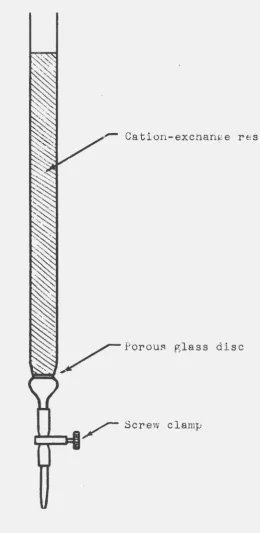
These columns~ shown in Figure 13 were 22
mm
inside diameterPyrex
glass tubes "Ti th a porous glass disc sealed into one end. The end c :on-taining the glass disc was drawn down to accommodate a one-quarter in~hinside diameter rubber or Tygon tube fitted with a glass nipple. A
1
6
I
SC
-1
4
.
8
Cation-exchan
g
e resin
[image:18.562.218.479.50.585.2]I c . • , ' u ... L~ .. .(.)
The ~"l u1nn was part:~ally f::i.l18d if.1i. th wc;.-ve.r a:Gd :-.he dry J.on~exchange
resin added slowly until a fm..r eentim.:: ":.er::; over the desired bed height
was obtained. The :res::i n bed was r;hen bar:k.>',J.shed with \.Yat.er i.,0 remove
any entrapped air bubble~.~. Ths detailed r.;perat.5.on of such a column :is
described in a later see;:.ion.
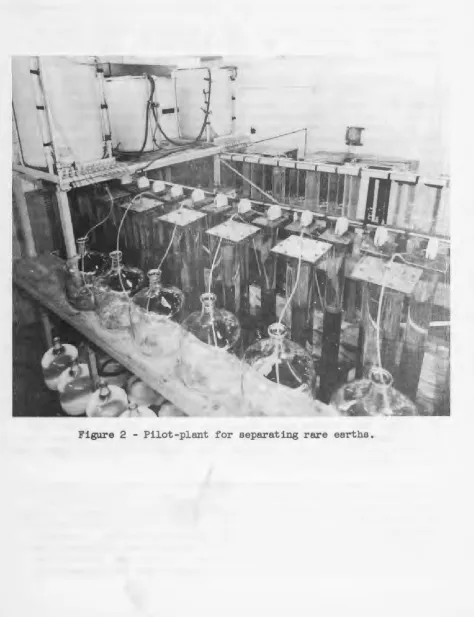
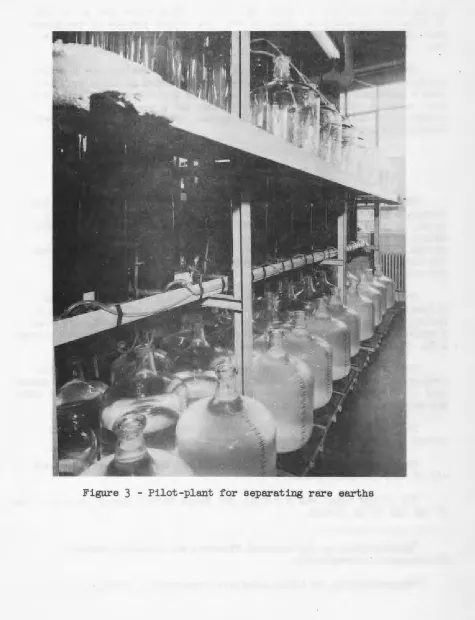
In addition to the .:;mall uclurr.ns mentioned above~ two pilot-plarrts
were set up during +lJ~ Gou r•.se of t.h1 ~ :Lnvest.igation. The operat.io::1al
design was essentially tht" sanJ~~ as th:;;:-1;. for the .:;mall-:.r r;:olumns; it.
i.n-Y•:>l ved a reservoir .fo:.." prepa:d!.lg the clu t~n.g sr: l·J.r.icn.. a me; an:.:: of supply~
ing the columns with t.he soJ.ut.ion and a means of collec,t.i.ng +he effluent. The first. pilot·~plant c:msisted of
2L
-.clumns ere.c:t.ed in .a verti(,al posi ..tion on ~.-inch by L~inch wood. supp·Jrts arr.·anged in a maP..rier conv&nj_ent
for the collect:i on of 45'·~11 ter volumes of effluent. The (:0lu.mns were
?yrex pipes 10 feGt. lcng ·with ~~in.::h insi.de d:Lamet:ars. Tht~ tcp;g of ti~e
columns were closed with standard f1anges and st.a:i n1 ess steel platef;
one-hal.f inch t.hick. N<':oprene gasket rn.at.erial vras -ased between the
glass and stainless steel plates tn .oJr'lke an air and wa t.er-T.igh.t. seaL The bottoms were clof:>ed ir: a sim:Ua.J, manner_. except, that- a 4•>,mesh
stainless steel screen was sealed between hro gaskets with rubber cem8nt and inserted betwEen the glass pipr:l aui bot.:.tnm plate to ret.a:i.n the :r-ssin.
The top and bottom plates WI'O:T''3 fitted wi t.h one.~ha.l.f inr~h stalnlEJ;ss steel pipes to serve as inle-t. and outlt- r" The e1 u t.i.ng Pol11t.ions wer6 allcwed to flow-9 by gravity, from e er:--n:stiant.~ho:Jad tarik Sl.!ppli.ed from a main storagE: tank by means of a Cf:nt.rifugE.Jl pu.mp. All tanks used tc contain the solution were of atahll?ss sr,r::el ir: O'!.'de:r i o r-educe l.~::>ntBmtnat,io:o.
of the solut,ion due; to corrusio:rl.
The second pi.lc-; .. -pla.nt wh:! ch was ()on:-:.t.rueted chf.fered OD~Y in detail,
but not in principle from tha~. pr·eviously d;:scri.bedo This unit consisted of 20 P..jTex pip~;; columns five feet l·.:mg 3.nd six :inches in di.arreter.
These columns were mounted ')11 a.r1 8,!"'g1e··i:ron framew·,)rk j_n banks c.f 10 columns. Ths ends WE:'I'c ~lc.sed with monel metal pla..t.es l!2 a simila.x· ma."l.··
ner to that de.sc:ri.bed for ths }-l,-inch diame·t.e.r r:olumn,s. Tl-:te ma.ks~up and storage tanks we:..1e of stainless stee:l as was ··.he constant head t.etnk.
The columns were mounted about t.hretC: fed . .f::t··Jm. the floor in order that
4.5~li ter carboys· could be pla(.ed or1 cart;, and rur1 under t.he columns :f.o::.'
collection of the effluent. O:JClutJ .. ons. T-"ra \"isws of this pilot--plant ara
shown in Figu.res 2 and
.3
.
Special not.e should 't:e ma.de of the r~fforu: to •Jbtalil a un.ifc.rn:. flow·
of t.he elut.ing sollltion. through the colu.:m.n~. Th8 rare--earth m.ixture
forms into bands of indivJdual rare earths o:1 the rc-:sin during t.he elu.~
tion process and i t is i.mporta..r'Jt to +he separ-a.ticn that these cancl.s be
18
ISC-148
[image:20.562.40.515.73.691.2]19
ISC-148
20
porous glass disc and th·:: }>Oint of o·,~ tJ.et. This volume was sufficient
to allow t.he pressure to eq:1alize over the entire surface of the glass
disc and resulted in fairly even flov1 through all parts of the resin
bed.
The bottom plate for each of the 6=inch diameter columns was fit~
ted with seven symmetrically=arranged outlets which withdrew solution from a reservoir one inch in depth below the resin bed. The seven out=
lets joined a common glass bulb which then had a single outlet for discharge of the solution. In this manner9 the flow was rendered more uniform throughout the resin bed.
B. M::tterials
Two types of resins were used in the experiments described in this
thesis; a low capacity resin~ Amberlite IR=l00*9 and a high capacity
resL'rl~ Nalci te HCR**. Amber lite IR=lOO is a phenol formaldehyde conden·~
sation product containing methylene sulfonic acid groups and phenol groups. Nalcite HCR is a copolymer prepared from a mixture of styrene and divinyl. benzene which j '3 sulfonated with sulfuric acid yielding
nuclear sulfonic acid group~.
The commercial·~grade resin was re rei ved i.n. a damp state and was
allo·wed to air~dry for several days before classification according to
particle size. U. S. Standard sieves were used to screen. the dry resin. A resin which. is designated =30.c.40 mesh size9 for exampleJ passed through a No. 30 sieve~ but was re~ained on a No. 40 sieve.
The citric acid was of ordinary commercial U.S.P. grade. A spec=
trographic analysis of Ghe ash after igniting some of the material showed only traces of impurities. Two forms o.f the solid citric acid were used9
the mono~hydrate and anhydrous.
The oxalic acid employed as a precipitating agent for the rare earths was Malli.nkrodt analytical reagent grade.
The hydrochloric acid~ sulfuric acid~ and ammonium hydroxide were
all of C. P. reagent grade.
The filter paper was S
&
S No.589
White Ribbon having below 0.07 mgof ash per 11 em circle.
-*Manufactured by the Resinous Products and Chemical Company.
Philadelphia9 Pennsylvania.
2l
The re.re"·earth cru.rL.;; clsed as etart.ing rn..aterials were obtained from
Lindsay Light and Chemical :;!ompany!l Woost Chicago, Illinois~ Lindsay code
Noo
630
11neodymiu.'11 caror.1nats11 is a rc.ad.J.ly available but poor source ofpraseodyrrd urn; a typical ;ma1 ysis of oxide obt,ained from this source
showed
76%
Nd20~, 11% S!T1'~03.11 ~% Pr60ll.? and.4%
other rare earth oxides.One of the best-commercial· sour0es 0f pra.BE:c·d.ymium is Lindsay 11praseo-· d:vmium ammonium nitra1.a11 , whic::h has a
30%
~0.3 content9 analyzing43
.5%
Pr6011, 10.2% Nd2
o
1,h6%
I.a2o
and traces of Sm2_01 and Ce02• In addi~ tion to these two soureE> ms.terials.:- s""veral exper1ments utilize:d pure or mixed rare eart.hn obtain~.::d as a result. of colurrn separations inthis laboratory.
C. Typical Expe iment
A detailed dE<s~ript.ion of an elutlon experiment ·will serve to illustrate the ger.1eral pro,,edu:re. Any essential changes in procedure will be noted in connectJ.on w'"it.h the particular experin.ent described.
The glass column was mounted in a ve:rti~al position and half-f:i.U.ed with water. The si6ve~g'~"aded resin waa pr:.u:r·ed into the colurrm until the
desired bed depth ,.•.:ts exr,eeded by five or SlX ccntime'terso T'ne resin
in the column wa.s then back,..-.a.shed for not. less than a half hour with water. The backwash period served to :remJve adhering air bubbleE and
fine resin dust from t.he bed. The bar;;kwash procedur"e also served to classify the resin in th8 cclumn ar:~cording to par-ticle size which led
to better flolf ~ha:ra~cteristic:s WJ.th a l'esultant, i.ncreaae in the separa -tion of the rare earths.
The resin was condition8d 'to rec::eive t.he rare earth charge by
re-moving all cations other than hydr·og':>n.. Tc· a-:ccmp1.J.sh thl.s, a
5.%
citrate solution w-as adjusted to pH t).,5 wi+,h concent.r"ated ammoniumhyd!•ox:i.de and then passed through the column. ar. a linear flow-rare of
0
.
5
em per minute. After the resin had beeJ!. convert.ed to theamrnonium-cycle,l) a
5%
hydrocllloric acid solution was passed through t.he bed t oconvert the resin to the hydrogen-cy.:;le. If, after the abol!e precedure,
the resin was st.i.ll \!ont.e.rninated wi t.h d:tffJ.cutly-remov-able cations,'j it was desirable t.o pass a
5%
sodium chloride solution through the columnwhich was followed with
5%
hyd:-:·ochJm·ic acid. The sulfonic acid groupswere thus c-,omrerted to the hyd't"ogen~ion (:ycle. The distilled water and
reagents used for these re.genera:ting s0lutions was free of undesirable
cationso This was ecpeciaJJ.y 'trlle of the hydrochloric acid solution used in the final st.ep. The~ c~Jumn was next flur::hed with distilled
water to remove the e:xcesa a.::id ard adjusr.ed t.o tha desired bed height,
after which i t was re.a.dy to re ce3. ve the rare--eart.r~ sampl "='.
22
The rare-earth samp.J..e was usually prepa:ed from the oxide~ and all sample weights in this thesis are giver in t.erms of the oxideo A given
weight of oxide was dissolved in a minimum of 6N hydrochloric acid and
diluted with distilled water so that a liter of solution contained from
0.005 to Oo05 moles of ra1:·e-earth oxideo The dilute rare-earth chloride
solution was passed through the column at a linear flow-rate of loO em per minute. The rare-earth ::Lons replace the hydrogen ions on the sul~
fonic acid groups to form a satu.rated rare earth-resin band at the top of the resin bedo After rinsing the column with distilled water to re-move the acid formed in the adsorption process, the column was considered
ready for elution and was attacr.1.ed by means of a siphon to a reservoir
of the eluting solution which is generall,y called the eluant.
The eluant used to effect the separation is designated as Oo5% or Olol% citrate sol:u.tiono It is to be understood that. the solution was made up with the proper weight of citric acid monohydrate per liter of
dis-tilled water and then adjusted to the desired pH with concen~r.ated
ammonium hydroxideo Beckinan pH meter .• La.boratory Model G., was used in adjusting the pH of the solutions; the values thus obtained were
probably accurate to
!
Oo02 of a pH unito In order to prevent the growth of mold, a gram of phenol was added for each liter of thesolu-tion (3).
The column was operated u.Tlder the condit:Lons prescribed for the particular experiment with regard to flow-rate, pH of the eluant and
any other special conditions. It was necessary to maintain all condi~
tions of elution fixed with the exception of the particular variable being investigatedo The elution was continued at the chosen flow~rate
until the leading edge of the rare earth band neared the bottom of the
resin bedo The solution was :~olle cted in volumetric flasks and the
breakthrough of the rare earth-citrate complexes was tested by t.he
addition of oxalic a'Jid~ When the breakthrough had occurred, the measured volumes of eluate were transferred to beakers. The precipi-tation of the rare-earth oxalates was accomplished by adding oxalic
acid crystals to the soluti.on and hea.t:ing to about 80° for one hour. The oxalate precipitate was allowed to set.t.le, and the solution allowed
to cool for not less than 12 hours. The filtered samples were then ignited at 700~800° for at least six hours to form the oxides and then weighed. The total elution curve was obtained by plotting the grarr.s per liter of oxide against the volume of eluant passed through the
column. The elution curve was further expanded by recording the analysis of the individual fractions on the curveo
When the elution had progressed long enough to furnish the infor~
2.3
The s+,r•i,_Jped :t•esitl Ha.s again conver-t:ed to the hydrogen~form by the method pre.lous:ly dera·:;ribed for regFmeration. The column was thus made ready for the next e:x:per:i.ment.o
In pr.·actice" sevaral columns were operated simultaneously to re~
duce the tim.8 required for investigation of the variables under
consideration. The operat.ion of 10 columns required about two months to complete the elution and analysis of the fractions.
D. Met.hods of Analysis
A rapid and accurate a.nalytical method is essential in evaluating any fractionation scheme employed for the separation of rare··earth mixtures into their :i.ndivldual elements. Because of the chemical simi~ larity o.f these element.s;l the usual methods of quantitative analysis are not appli:!able to the rar·e earths with the exception of cerium:
samariun~, europium and ytterbium which have ~ralence states other than triposi ti ve.
The average at.omir>·vmight method proposed by Gibbs in
1893
has been found very useful in f~::llowing fractionations where the atomic weight differences are large. HoweverJ the atomic weight of adjacentelements are close together, and the method has not been found sufficiently sensitive for following the fractionation to limits of high purity.
The magnetic susceptibility of the rare earths was used by Urbain (42) to analyze rare~·eart.b. mi:x:turec:>. This method is quite sensitive due t.o the paramagnetism exhibited by the individual members. Podashevskii and Kondoguri (43) reportE:'d an experimental error of 1.0 to leS% for the analysis of binary mixtures of neodymium oxide and praseodymium oxide. This method requires a highiy-de-veloped technique and does not lend itself to rapid determinat:l.ons. The a.ccuracy~ while good: is not adequate for following the final pur.i.fica.tion stepB.
other methods such as tht> X-ray emission spectra and fluorescent spectra!' while showing promi~A of high sensitivity;- are subject to rather large experimental errors and are difficult to adapt to routine pro·· cedures necessitated by t.he htmdreds of analyses required in the course of the investigation described in this thesis.
It soon became apparent that the analytical procedures best suited to this investigation were (l) the absorption spectra method and (2) the emission sper:.:tra method.
The absorption spectra method employed was similar to that described by Rodden (44). The sepctrophotometer was a Bsckman: Model DU,
ISu-148
A complete description o_. this instrument and its operation is given
elsewhere (45). The absorption cells used gave a light path of 1.000 ~ 0.003 centimeter. The elements associated with praseodymium which have
useable absorption bands are neodymium and samarium.
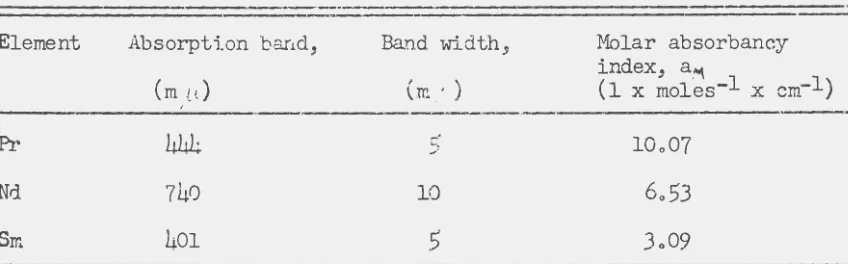
In order to put the spectrophotometric analyses on a quantitative basis. The molar extinction coefficients for chlorides of praseodymium, neodymium and samarium were determined for those absorption peaks whi~h
were free from interference by other ions. The complete spectrum from
340 m ) l to 1000 m,v< was investigated for each of these salts and
absorption bands chosen which were sufficiently intense to be detectable in low concentrations. The absorption bands meeting these requirements had peaks occurring at 444 m
Jl'-
for praseodymium, 740 mfl
for neodymium and 401 m?- for samarium.Table 1
Data for Spectrophotometric Analysis
Element Absorption band, Band width, Molar absorbancy index, aM
cm-1) (m tt) (m I{) (1 x moles-1 x
I /
Pr
444
. ; ~ 10.07Nd 740 10 6.53
Sm 401 5 3.09
The influence of excess hydrochloric acid in the solution was in-vestigated and found to be without effect on the molar absorbancy
indexes up to concentrations 2N with respect to the acid. Beer's law
was obeyed up to concentrations of 200 milligrams of oxide dissolved in hydrochloric acid and diluted to a volume of 10 milliliters. The
data used in the spectrophotometric analyses are summar1zed in Table 1. Using this method for analysis, it was found that samarium could be detected in amounts down to 0.5% and the lower limit for detecting neodymium and praseodyrnium was about 0.3%.
The steps involved in analyzing the samples of eluate consisted in
precipitating the rare earths from the citrate solution as oxalates by
[image:26.566.54.478.316.448.2]ISC-143
10 ml -vlith the same :.v:.!iJ. The log {I-/I) (absorbancy) value was deter
-rn:ined for the absorpt.ivn peak of each rare aarth present in the solution.
The amount of a particu.lar rare eart.h may be calculated from the rel a-tion
, Ic
..LOg·
-I
in which ~ is the mola·c absorbancy index3 ,_. is the concentration in
rr..oles perJ:"i te:.." and b :ts the l engtn. of the light path through the
solu-tion in ce
ntimeters.-In pract.ice it was found convenient. t..o modify the calculation some·~
what. Since the rare-earth solutions obey Beer's law3 and the light path
was essentially ~onstant a LOGO centimet,er.? the percentage of each
rare-·earth oxide in an oxide sample was calculated by determining the
ratio of t.he absorba.n:.::y value to the predetermined value for the pure rare earth measured unde:t" the sama conditions.
The absorptior"! spS:ctra method was found to be reliable for
deter-mining any individual raTe earths listed above within the limit~ of
0
.5
to 99.0%. None ofthe
frequently small and rare samples were lostduring the analyses 'Which was a Yery desirablE! .feature of this method.
For the detection of the srraller quantities of the elements, recourse
was made to quanti.tativ'3 spectrographic analyses.
The quantitative ·pectrographic analytical method for the rare
earths as developdd by Fassel and Wilhelm
(46,47)
was used to extendthe limits of detection for neodyrrri..um in praseodymium to less than 0.1%.
The presence of lanthanum and cerium" for "Which the spectrophotometric
method is not applicabie j were also measurable in amounts less than
0.1%. The speetr·ograph ·.tsed was the ... Taco-Wadsworth, 21-i'oot grating
instrument, manufactured by the Jarrell=Ash Company of Boston.~ Massa=
chusetts. The author wishes to thank Dr.
V.
A. Fassel and members ofhis group for performing the many spectrographic det.enninations so necessary to these resear:::hes.
V. RESEARCH
A. Imrestigations Using Five-Tenths Per
Cent Citrate Solutions
The application of 5%.~ o.S% and 0.1% c:i.trate solut.ions to the
separation of the rare-earth elements by means of ion-exchange has been
mentioned previously. The separations achieved with
0
.
5%
and 0.1%ISG-1h8
large-scale operations Sl.:1ce the cost of the operation was considerably
reduced. Therefore, it was decided to make a detailed study of the
variables affecting the purification of p:r·aseodymium using the
0.5%
and 0.1% cit~ate solutions for eluting the mixed rare-earth samples from ion-exchange resin beds.
1. Preparation and loading of resin beds
The cation-excha."l.ge resin selacted for use in the following
experi-ments.was Amberlite IR.-100 having a capacity of L 75 milliequivalents
per dry gram (40). 'rhe commercial ion-exchange resins are not prepared
for research purposes. It was therefore necessary to prepare a hom
o-geneous batch of the resin for use throughout the investigation in order
that the conclusions draw'Tl from the data obtained from the operation of several different column . .s vwuld be free of variables introduced by
non-homogenity of the excpanger. The homogeneous batch was prepared by drying and thoroughly :rr.ix:Lng the res:W."1. after which it was sieved to
obtain the desired mesh size::>.
Ana ther yar~_abl8 which may be introduced into the experiments
in-volves the preparation of the resin bed in the columns. Arnberlite
· IR-100 resin particles are irregularly shaped and may pack in the bed
in such a manner that channels would result.. Therefore, the same
proce-dure for preparing the resln beds was followed as nearly as possible in
each experiment. It. would be deeirable to have the same number of e x-change groups, or a proportional number, in each column in order to make
comparisons of the data. Since this was not practical to achieve~ i t vms
decided to prepare similar bed heights using the standardized packing
procedure.
Praseodymium concentrates were not available in the beginning of
the investigations using
Oo5%
citrate solutions. Therefore, several of the early experiments Here performed w:i th neodymium to determine thenature of the elution curves.
2o Effect of pH on the elution of pure neodymium at tw:> flow rates
Five columns having beds of ~30~40 mesh size Amberlite IE-100 resin,. 120 em long and 22 mm in dia~ter, tvere loa<_ied with 1. 683 grams
(Oo005 mole) of pure Nd203 per column. The samples were eluted at a linear flmv~rate of
0.5
em per minute (1.9 ml per minute) at pH values of 4.20, 4~10, 4.oo, 3.90 and J.Bo..i
'
~
soo
cG
2
-z
2
...
c(
a::
1-z w () z
0 ( )
100
0 I 111 10
l<'i gur e LJ-
-1.90 A
m
·
·~.~.
4.10 a
I
I I a' 1- "I !MA- I
...
1<(0 ! I "71. I I I I15 20 25 30 35 40 45
VOLUME OF ELUATE, LITERS
J.he effect of nd ,Jn the el ution of 1.083 gram sampl es of ~~d203 from 2 .2 x 120 em beds of -30+4.0 Arnoerlite IR-luU resin using 0
.
S
:'c
ei trate sol utions at two flow-rates: 0, G.5
em/min;I , 2.0 em/min. L-From SpecJdiw~, itulmer, Sutler and Powell
(5JJ
1\.,
~
~ 'I H
l/-CJ
I
f-' L
28
(eluant) iv indi.cated beside. the cut"': [,o whJ.eh 1 t:.;orrespo:n.dS$ 11A11
refers to the slower flow :rate and 111B10 t;o the faster flow :rate. It. is evident that a sufficient nl.lJTJbe:r o.f fra.~l~ions of ttJe effluent~ .from the c:olumns (eluat.e) were tak<?-n to trace ac:curately the c.ha'tacterlstic:'> of the elutionso
From this experimer1tp the natu:rP, of the elution c.ut'ves at different
pH values was determined and the effect of flow·=rats ascertained. 'l'he
significant effect of using the .faster flow~·.rate was to :reduce the :rare~
earth concentration in the eluate9 thus ~ausi.ng the volume of el'late
for t otal elution o.f the sample -r.o increase. It is also EVident: t,har
decreasing the pH of the eluant increased the 1rolurne requi!··ed for break"' through of the rare earths. At pH valueJ of 4.00 and above the effec"
is small9 but it becomes more pronoun0ed a 1'. lm·•er pH values.
Attention should be gi.ven to the elu+.ion curves for the pH 'Jalu€;,:::;
L.
.oo
)l
3o90 and 3.80. The curve for ,3.,90 .snows s nearly symrnetri.cal form.while those for 4.00 and
3
s
80
are roughly mirror irnage,::o From. the shapeof the curves» it is possible that as the pH of the eluant is changed
the relative importance of various citrate c0mplexes active in the elution
changes rapidly in t.hl.s pH rangeo Evidence has been given by Spe.dding.n
et al. .'1 ( 4) for the exister: -:;e of severaJ rare~earth d.tra t.e complexes.
E._;,..;;..;;...;;.,;;.,_,;..;;;.._~ffect of resi=.;;;,...n "O,;;..,..;.a:rtiele ;s..,__~~-size on ·~ the e1ut 'on .,...,~~ at t·w-o flow ra' ea ~~
Two colunms with beds of "'30.~Jo40 and ~6o.o-80 :mesh s:i.zes of Ambe
.rli.t.e-lR~lOO resin9 respectively, each 120 em long and 22 mm in diameter were
loaded with
1.68
3
grams of ,Pll.t''S Nd203o These t.wo ';olumns were elutedat a pH value of
3
o8
0
using a linear fl0w~rat.e of0
.5
r•m pe:r. minue
o
The experiment was repeated at a linear flm.r~rate of 2o0 em per minuteeThe data are shown in Figm'e
5
.
The mesh s:i.zd of the resin parli.~cles is in<li.cated beside the correspc..nding cu.rve. The letter 11Aill refers
to the linear flow-rate of
0.5
em per minute; 11B18 refers t,o the 2.0 emper minute flow=rateo
The elution curves show that the breakthrough volume was :reduL~ed
and the peak concentration ::Jf neodymium i.n ·he. eluate was increased when
the finer resin 1vas used. It. was also observed "that t.he max:J.mum concen=
tration of rar~ earth was reacined more r'api.dly in the case of the fi.ner resino This more vertical front of the e lut.ion curve for the finer resin was interpreted to mean that squili.bri.um condi ti.ons were more nearly
approachedo Again the faster flow~rate spread out the elu 1.on curve and
lowered the concentration maxima. A c•)mparJ.son of curves ·~..30;;.40 A ani
ISO ...J
I
~
\ /"')0+80 B
...
..,
0 .a. I<'
IN
a:
C) 2
- 100
z
0 ~ <(
r
I
I
+
l\
\,_
~
~
I
iX:
~
z
laJ
0 50
z
0
0
0
25 30 35 40 45
VOLUME OF ELUATE, LITERS
Fi~ure
5 -
rhe effect of particle size of resin on the elution of 1.683 grqm samples of pure Nd203 from 2.2 x 120 em jeds of Amberlite Ifi-lLO resin using L .S~ citrate solutions at a pd value of 3.80 andtwo floVJ-retes: 0,
u.S
cm/minj I, 2.U em/min.Li.
1rom .Sneddinr-·,Fulmer, Butler and Powell
{5)
J
~
--c
H
(l.i
0
'
1-'_
30
It may be concluded from t.he data presented above in Sections 2 and
3.
9 that the sP.paration of mixed rare earths would be improved by operat~ing at a flow~rate not greater than
0
.
5
em per minute. I t also appearsthat a ~60.,.80 mesh size resin would give a closer approach to equilibrium conditions which should result i.n better separationso
Although it was concluded that finer mesh sizes of resin would be
desira.blet such resins are diffi.cult to obtain in large quantities. One
of the pr,imary objects of these investiga~ions was to determine
condi-tions for separations which could be scaled up to pilot=plant size.
Therefore9 it was decided to use =30.,.40 mesh size resins~ for the most
part9 in the following st-,udies since. they are available in larger quan~
tities.
4.
Effect of pH on the elution o~Eeodymium-praseodymium mixturesSeve.n columns containing =.30<J.40 mesh size Amberlite IR~lOO beds,
120 em long and 22 mm in diameter~ were eaCh loaded with samples made
up from L
695
grams of a mix·ture containing equal weights of Nd203 andPr6D}.Iu The mixture closely approximates equimolar amounts of the two
rare earths and is equi valE 1.t to the number of moles used in the previous
experiments. The mixtures i~ere eluted with
oo.S%
citrate solutions havingpH values of
4.40
9 4e20~4.1
0
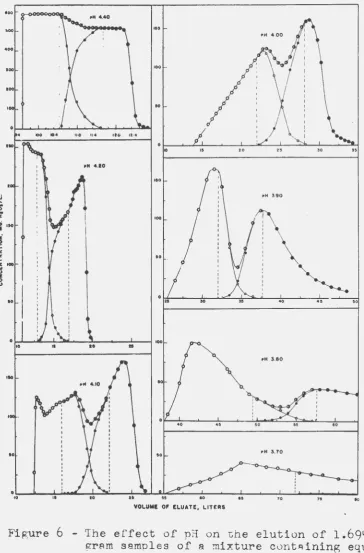
9 4.00.?3.90
9 3.80 and 3.70o The flow~ratewas 0.5 em per mi.nute. The data are given i.n Fi.gure
6.
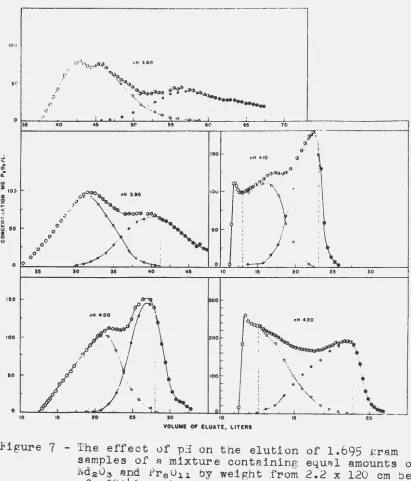
This experiment was rapeated at pH values of 4.209 4.109 4.00.v 3.90
and
3.80
.v
holding all other conditions the same except that the flow~·rat.@was increased to 2.0 em per minute. The data are shown in·Figure
7.
ThepH values used for the elution are recorded beside the corresponding curve
]n both figures.
All of the analyses were made using the spectrophotometric method
which easily detected amoun~s of one rare earth in the other down to
0.5%.
The data are summarized in Table 2 which shows the per cent ofthe .indjvidual rare earth~ originally available in the mixture~ which
was obtained greater than
99.5%
pure. The results of elution at pH.3
..
70 were not included since the elution rate was too slow for practicalpurposes and also showed a rather poor separation"
A number of conclusions may be drawn from this experiment. Referring
to Table 2.r; the separations using a 2.0 em per minute flow-rate were in
every case inferior to those obtained with a
0.5%
em per minute flow-rate.This was expected in view of the results obtained from the elution of
pure neodymium described in Sections 2 and
3
since the columns were31
L::iC-l/,_800
,.
20" 30
••
100
..) ,H 3.90
....
.
.,
.
..
100i
Ito5
>:
<
"'
1- 50
z 100
~
...
...
z 0
...
••
40••
[image:33.562.89.454.76.630.2]VOLUME Of ELUATE, LITERS
Figure
6 -
The effect of pH on the elution of1.695
~ram samples of a mixture cont~ining equal
amounts of Nd203 end Pr 601.1. by weight from
2.2
x 120
embeds
of-JC+hO
mesh size
Amberlite IR-100 resin using G