The Effect of Conceptual Change Model in the
Senior High School Student
s’ Understanding
and Character in Learning Physics
I Wayan Santyasa1,*, I Wayan Sukra Warpala2 , and I Made Tegeh1
1Physics Education Department of Universitas Pendidikan Ganesha, Bali, Indonesia 2Biology Education Department of Universitas Pendidikan Ganesha, Bali, Indonesia 3Educational Technology Department of Universitas Pendidikan Ganesha, Bali, Indonesia
Abstract. Learning physics for senior high school (SMA) students is often coloured by misconceptions that hinder students in achieving deep understanding. So a relevant learning model is needed. This study aims to examine the effect of conceptual change model (CCM) compared with direct instruction model (DIM) on the students’ conceptual understanding and character in the subject area of motion and force. This quasi-experimental research using a non-equivalence pre-test post-test control groups design. The population is 20 classes (738 students) of grade X consisted of 8 classes (272 students) of SMA 1 Amlapura, 8 classes (256 students) of SMA 2 Amlapura, and 6 classes (210 students) of SMA 1 Manggis in Karangasem regency in Bali. The random assignment technique is used to assign 6 classes (202 students, or 26.5% of the population). In each school there are set 2 classes each as a CCM group and DIM groups. The data of students’ conceptual understanding is collected by tests, while the characters by questionnaires. To analyse the data a one way MANCOVA statistics was used. The result of the analysis showed that there was a significant difference of effect between CCM group and DIM group on the students’ conceptual understanding and character. The effect of the CCM group is higher than the DIM group on the students’ conceptual understanding and character in learning subject area of motion and force.
Key words: conceptual change model, direct instruction, understanding, character
Introduction
High school students enter the classroom do not bring an empty head (blank mind), but they always bring some ideas. The student ideas commonly in the form of an existing knowledge. The knowledge is derived by previously experience, for example when in junior high school or elementary school, when interacting with the family or society and the media. Existing knowledge quality is often not scientific, but tend to be unscientific or misconception [1, 2, 3, 4, 5]. In the educational praxis, misconceptions caused by improper packaging rote learning that is more about learning [6]. Rote learning in physics is very authoritative to absorb students in building an in-depth understanding of the concepts and
principles of physics. On the other hand, rote learning closes opportunities for students to develop good character in learning physics [4].
Physics subject have differ properties if compared with other subjects. He feels the essence of physics as a product, as a process and as an attitude [4]. Physics as a process and attitude requires learning based on the analysis of the difficulties and misunderstandings of students before they learn new material. To build an effective model of learning in physics it should begin by identifying students’ difficulties and misconception [7]. Although some misconceptions are difficult to overcome, physics learning have to be aware about the existence of the misconception and keep addressing to overcome students’ misconceptions. Thus, physics learning becomes relevant and meaningful as well as providing opportunities for students to remediate their misconceptions and to build scientific concepts and character in learning. In fact, physics learning today still tolerates transmission models, which assume that students are merely the recipients of mechanistic knowledge. Physics learning is conducted by conventional instruction such as direct instruction model (DIM). Is conducted by conventional instruction such as direct instruction model (DIM). This assumption is a barrier to the change of misconception optimally, even though students have moved to higher level of education. Several studies have found that misconception still exist even when the students have attended more physics class, and the same misconception occurs and exists at primary and up to university level [7, 8]. These mean that the DIM which is unable to overcome misconception as a basis of learning have to be left and change to new model of learning which is based on constructivism.
Constructivism-based learning is very coherent with the human education in doing becoming process and growth in leaning. According to the constructivism, learning is the process of integrating new knowledge into the knowledge they have through a process of assimilation and accommodation [9, 10, 11, 12). To speed up the process of integrating the new knowledge to existing knowledge, students need to be assisted with a true model of learning based on the constructivism, as it has been developed before [6], namely conceptual change model (CCM). The learning model serve to accelerate the process of integrating new knowledge into existing knowledge through empower students’ prior ability independently. The CCM gives students the opportunity to learn critically, diligently, tenaciously, creatively, and collaboratively. These efforts potentially underlie the formation of a deep conceptual understanding and developing of good character for students in learning physics. This statement is in accordance with the results of previous research [9, 11, 1, 2, 3, 4, 13).
By comparing the description and prescription between the CCM and DIM above, there are shown that models have a different effect on the students’ outcome in learning physics theoretically. This research want to analyze the effect of the CCM compared with the DIM in achieving students’ conceptual understanding and character in learning physics. Our research question are 1) is there a significant different of student’ conceptual understanding and character between the CCM group and the DIM group after the treatment controlled by prior student’ understanding statistically? 2) which one of the learning physics models more advance one to another for students in achieving conceptual understanding and character?
Methods
principles of physics. On the other hand, rote learning closes opportunities for students to develop good character in learning physics [4].
Physics subject have differ properties if compared with other subjects. He feels the essence of physics as a product, as a process and as an attitude [4]. Physics as a process and attitude requires learning based on the analysis of the difficulties and misunderstandings of students before they learn new material. To build an effective model of learning in physics it should begin by identifying students’ difficulties and misconception [7]. Although some misconceptions are difficult to overcome, physics learning have to be aware about the existence of the misconception and keep addressing to overcome students’ misconceptions. Thus, physics learning becomes relevant and meaningful as well as providing opportunities for students to remediate their misconceptions and to build scientific concepts and character in learning. In fact, physics learning today still tolerates transmission models, which assume that students are merely the recipients of mechanistic knowledge. Physics learning is conducted by conventional instruction such as direct instruction model (DIM). Is conducted by conventional instruction such as direct instruction model (DIM). This assumption is a barrier to the change of misconception optimally, even though students have moved to higher level of education. Several studies have found that misconception still exist even when the students have attended more physics class, and the same misconception occurs and exists at primary and up to university level [7, 8]. These mean that the DIM which is unable to overcome misconception as a basis of learning have to be left and change to new model of learning which is based on constructivism.
Constructivism-based learning is very coherent with the human education in doing becoming process and growth in leaning. According to the constructivism, learning is the process of integrating new knowledge into the knowledge they have through a process of assimilation and accommodation [9, 10, 11, 12). To speed up the process of integrating the new knowledge to existing knowledge, students need to be assisted with a true model of learning based on the constructivism, as it has been developed before [6], namely conceptual change model (CCM). The learning model serve to accelerate the process of integrating new knowledge into existing knowledge through empower students’ prior ability independently. The CCM gives students the opportunity to learn critically, diligently, tenaciously, creatively, and collaboratively. These efforts potentially underlie the formation of a deep conceptual understanding and developing of good character for students in learning physics. This statement is in accordance with the results of previous research [9, 11, 1, 2, 3, 4, 13).
By comparing the description and prescription between the CCM and DIM above, there are shown that models have a different effect on the students’ outcome in learning physics theoretically. This research want to analyze the effect of the CCM compared with the DIM in achieving students’ conceptual understanding and character in learning physics. Our research question are 1) is there a significant different of student’ conceptual understanding and character between the CCM group and the DIM group after the treatment controlled by prior student’ understanding statistically? 2) which one of the learning physics models more advance one to another for students in achieving conceptual understanding and character?
Methods
This quasi-experimental research used the nonequivalence pretest-posttest control group design. The pretest scores represent covariate of pre-conceptual understanding that serves as a control statistically. The aim is to eliminate the influence of the nonequivalence
groups. The groups constitute an independent variable which are consisted of the CCM as an experiment group and the DIM as a control group. This research investigate two dependent variables (DVs), namely students’ conceptual understanding and character in learning physics.
Population and Sample
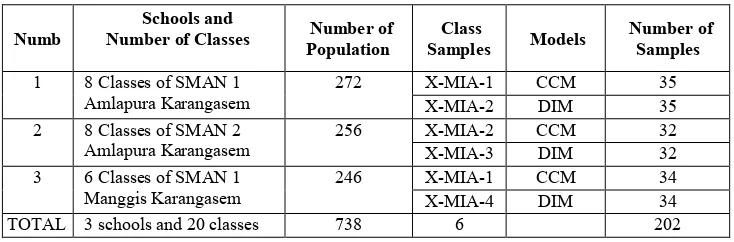
[image:3.482.58.425.268.389.2]The research population is 20 classes consisting of 738 students of grade X. The population consists of 8 classes (272 students) from SMA 1 Amlapura, 8 classes (256 students) from SMA 2 Amlapura, and 6 classes (210 students) from SMA 1 Manggis. All of them are located in Karangasem regency in Bali. To determine the sample, a random assignment technique was used to assign 6 classes (202 students, or 26.5% of the population) as a sample. In each school were selected 2 classes each as an experimental group which is learning with CCM and a control group which is learning with DIM. The number of students distribution at each school using CCM compared with DIM as presented in Table 1.
Table 1. Distribution of students’ number in each schools who use the conceptual change model (CCM) as compared to direct instruction model (DIM).
Numb Number of Classes Schools and Population Number of Samples Class Models Number of Samples
1 8 Classes of SMAN 1
Amlapura Karangasem 272 X-MIA-1 X-MIA-2 CCM DIM 35 35 2 8 Classes of SMAN 2
Amlapura Karangasem 256 X-MIA-2 X-MIA-3 CCM DIM 32 32 3 6 Classes of SMAN 1
Manggis Karangasem 246 X-MIA-1 X-MIA-4 CCM DIM 34 34
TOTAL 3 schools and 20 classes 738 6 202
Data Collection Tools
In this study, students' conceptual understanding in all groups before treatment was measured by test of physics conceptual understanding. The scores of the prior conceptual understanding are used as covariates. The students' conceptual understanding and character after the treatment both in the experimental group and in the control group were measured by test of physics conceptual understanding and questionnaire of students’ character respectively.
Physics Conceptual Understanding Instrument
The data of students’ conceptual understanding were collected by 35 items of physics conceptual understanding test in the form of five multiple choices with written justification with 0-4 scoring scale. The description of each 0-4 scoring scale is 0 means without choosing answer, 1 means choosing answer but wrong, 2 means choosing right answer but wrong reason, 3 means choosing correct answer true reason but less complete, 4 means choosing right answer and right as well as complete reason. Item-total correlation coefficient of conceptual understanding test are r = 0.33 moving up to r = 0.66. The reliability coefficient shown by Cronbach Alfa coefficient of α = 0.85.
Students’ Character Questionnaire
students’ character are collected by questionnaire, consists of 55 items list of statements, each equipped with four choices are degradation using 0-4 scale. Description of each scale of degradation 0-4 is 0 means strongly disagree, 1 means disagree, 3 means agree, 4 means strongly agree. The internal consistency of the items moving from r = 0.36 to r = 0.72. The index of Reliability questionnaire are determined by Cronbach Alfa coefficient of α = 0.80.
The Procedure of The Implementation
This quasi experiment was conducted for 4 weeks. Prior to treatment, students in all groups were given a pretest on the subject of physics conceptual understanding. In the experimental group with CCM and DIM control group, students studied for (45 minutes x 3) in each week. Every week students work on one type of lesson plan. The subject matter that becomes the object of research is the straight motion.
Implementation of the CCM follows 6 major steps, namely 1) finding and researching conceptual and contextual issues (students discover and examine conceptual and contextual conceptual issues prepared by teachers or other sources) related to material will be learned); 2) confrontation of misconceptions (students put forward ideas that are related to the initial problem that has been discovered and researched); 3) refute of the misconceptions (facing and examining the misconceptions in the form of physics refute text, physics lab activities, demonstration strategies, analogies, and confrontation by counter examples relating to the student's initial ideas or conceptions), 4) proof of concept and principle scientifically (students perform evidence based on scientific concepts and principles for strengthening the misconceptions that students face); 5) enrichment of material and contextual examples (students are invited to enrich material and contextual examples linked to proven concepts and principles); 6) knowledge testing (students conduct self-evaluation concerning their knowledge that has been constructed through problem solving)[4].
Implementation of the DIM follows 6 major Steps, namely 1) the teacher explains the learning objectives; 2) the teacher demonstrates the skills correctly, or presents the information step by step; 3) teachers plan and provide initial training guidance; 4) the teacher checks out the students who have been and who have not been able to perform the task well, and provide feedback; 5) teachers prepare for advanced training opportunities, with particular attention to application to more complex situations and everyday life [4].
After students in all groups get treatment as in accordance with the syntax of each learning model above, they answer a posttest on the subject of conceptual understanding about 90 minute, and then they answer questionnaire concerning their character in learning physics about 30 minute.
Results and Discussion
Results
Test of Normality of Data Distribution
The result of normality analyze of data of the pre conceptual understanding, conceptual understanding, and character of student show that Kolmogorov-Smirnov and Shapiro-Wilk statistic values in each data have significance number move from the sig = 0.220 > 0,05 to sig = 0.841> 0.05. The results of this analysis indicate that the data of pre conceptual understanding, conceptual understanding, and character of each group is normally distributed.
Test of Homogeneity of Variance
students’ character are collected by questionnaire, consists of 55 items list of statements, each equipped with four choices are degradation using 0-4 scale. Description of each scale of degradation 0-4 is 0 means strongly disagree, 1 means disagree, 3 means agree, 4 means strongly agree. The internal consistency of the items moving from r = 0.36 to r = 0.72. The index of Reliability questionnaire are determined by Cronbach Alfa coefficient of α = 0.80.
The Procedure of The Implementation
This quasi experiment was conducted for 4 weeks. Prior to treatment, students in all groups were given a pretest on the subject of physics conceptual understanding. In the experimental group with CCM and DIM control group, students studied for (45 minutes x 3) in each week. Every week students work on one type of lesson plan. The subject matter that becomes the object of research is the straight motion.
Implementation of the CCM follows 6 major steps, namely 1) finding and researching conceptual and contextual issues (students discover and examine conceptual and contextual conceptual issues prepared by teachers or other sources) related to material will be learned); 2) confrontation of misconceptions (students put forward ideas that are related to the initial problem that has been discovered and researched); 3) refute of the misconceptions (facing and examining the misconceptions in the form of physics refute text, physics lab activities, demonstration strategies, analogies, and confrontation by counter examples relating to the student's initial ideas or conceptions), 4) proof of concept and principle scientifically (students perform evidence based on scientific concepts and principles for strengthening the misconceptions that students face); 5) enrichment of material and contextual examples (students are invited to enrich material and contextual examples linked to proven concepts and principles); 6) knowledge testing (students conduct self-evaluation concerning their knowledge that has been constructed through problem solving)[4].
Implementation of the DIM follows 6 major Steps, namely 1) the teacher explains the learning objectives; 2) the teacher demonstrates the skills correctly, or presents the information step by step; 3) teachers plan and provide initial training guidance; 4) the teacher checks out the students who have been and who have not been able to perform the task well, and provide feedback; 5) teachers prepare for advanced training opportunities, with particular attention to application to more complex situations and everyday life [4].
After students in all groups get treatment as in accordance with the syntax of each learning model above, they answer a posttest on the subject of conceptual understanding about 90 minute, and then they answer questionnaire concerning their character in learning physics about 30 minute.
Results and Discussion
Results
Test of Normality of Data Distribution
The result of normality analyze of data of the pre conceptual understanding, conceptual understanding, and character of student show that Kolmogorov-Smirnov and Shapiro-Wilk statistic values in each data have significance number move from the sig = 0.220 > 0,05 to sig = 0.841> 0.05. The results of this analysis indicate that the data of pre conceptual understanding, conceptual understanding, and character of each group is normally distributed.
Test of Homogeneity of Variance
Variants tested their homogeneity are variant of the data about students’ pre understanding, understanding, and character between CCM group and DIM group. The results show that Levene statistics are either based on mean, based on median, based on median and with adjusted df, or based on trimmed mean having moving significance numbers of sig = 0.397
> 0,05 to sig = 0.975 > 0,05. This indicates that the variant of students’ pre understanding, understanding, and character between the two groups is homogeneous. Furthermore, Levene's Test of Equality of Error Variances is done. The results show that for DV of students 'understanding, F = 0.368 with sig = 0.545 > 0,05, and DV of students' character, F = 0.004 with sig = 0.950 > 0,05. This result shows that the error variance of the dependent variable is equal across groups.
Test of Linearity between Covariate and Dependent Variables (DV’s)
In this research we tested two linearity events. The first is between pre conceptual understanding and DV of students' conceptual understanding. The test results show that F (linearity) = 51.82 with sig = 0.001 < 0.05. The second is between pre conceptual understanding and the DV of students' character. The test results show that F (linearity) = 0.150 with sig = 0.699 > 0.05. This means that the pre conceptual understanding covariate is only linear with the DV of students' conceptual understanding, but not linear with the DV of students' character.
Test of Collinearity between DV’s
As mentioned above, there are two DVs studied, i. e students' conceptual understanding and students' character. The relationship between the two DVs is shown by Pearson Correlation coefficient (r). The results show that r = 0.049 < 0.80. These result indicate that there is no effect of collinearity between the two DVs .
Box's Test of Equality of Covariance Matrices
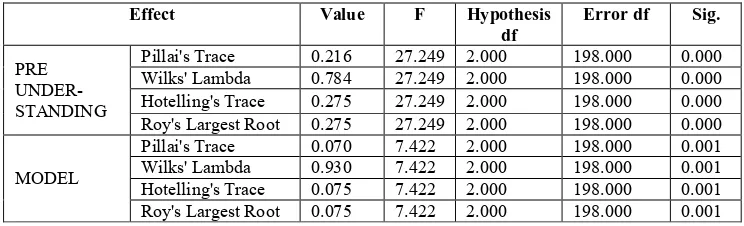
[image:5.482.55.427.372.485.2]The result of Box's test of equality of covariance matrices is F = 0.292 with sig = 0.831 > 0.05. These results indicate that the covariant matrices of DV are the same between groups. Table 2 Multivariate Tests
Effect Value F Hypothesis
df Error df Sig. PRE
UNDER-STANDING
Pillai's Trace 0.216 27.249 2.000 198.000 0.000 Wilks' Lambda 0.784 27.249 2.000 198.000 0.000 Hotelling's Trace 0.275 27.249 2.000 198.000 0.000 Roy's Largest Root 0.275 27.249 2.000 198.000 0.000
MODEL
Pillai's Trace 0.070 7.422 2.000 198.000 0.001 Wilks' Lambda 0.930 7.422 2.000 198.000 0.001 Hotelling's Trace 0.075 7.422 2.000 198.000 0.001 Roy's Largest Root 0.075 7.422 2.000 198.000 0.001
Table 2 shows two main points. First, that from source of influence of covariate pre conceptual understanding to DV of students' conceptual understanding and character shows statistical value F = 27.249 with significance number 0.001 < 0.05. The meaning that the covariates have a significant effect on students' understanding and character together. Second, that from source of influence of model to students' conceptual understanding and character shows statistical value F = 7.422 with significance number 0.001 < 0.05. Thus Ho who states there is no difference in students' conceptual understanding and character between those who learn with CCM and DIM, rejected. So students' conceptual understanding and character differ significantly between those who studied with CCM and DIM. Different test of each DV is presented in Table 3.
Source Dependent Variable Type III Sum of
Squares df Square Mean F Sig.
Pre-understanding Understanding 766.757 1 766.757 54.723 0.000
Character 6.120 1 6.120 0.117 0.733
Model Understanding Character 121.329 269.166 1 1 121.329 8.659 0.004 269.166 5.150 0.024
Error Understanding Character 10401.068 199 2788.313 199 14.012 52.267
R Squared = 0.239 (Adjusted R Squared = 0.231), R Squared = 0.026 (Adjusted R Squared = 0.016)
Based on the Table 03, the following research findings can be presented. First, from the source of the influence of students' pre understanding on the DV of students' understanding, it was found that the statistical value F = 54.723 with the significance number 0.001 <0.05, but against the DV of students' character found statistical value F = 0.117 with the significance number 0.733> 0 , 05. So students' pre understanding had a significant effect on the DV of students' understanding, but no significant effect on the DV of students' character. Second, from the source of the influence of the model on the DV of students 'understanding found the statistical value F = 8.659 with the significance number 0.004 <0.05, and against the DV of students' character found the statistical value F = 5.150 with the significance number 0.024 <0.05. These findings indicate two things, 1) that Ho stating that there is no difference in DV of students' understanding between those who study with CCM and DIM, is rejected; 2) that Ho stating that there is no difference in DV of students' character between those studied with CCM and DIM, is rejected. So individually both the DV of students 'understanding and the DV of students' character differed significantly between those who studied with CCM and DIM. Students' conceptual understanding who studied with CCM (M = 49.825, SD = 0.527) was significantly higher (Mean Difference = 1,550; sig = 0.004 < 0.05) than those who studied with DIM (M = 48.274; SD = 0.527) . Students' characters who studied with CCM (M = 187.620; SD = 1.018) were significantly higher (Mean Difference = 2,309; sig = 0.024 < 0.05) than those who studied with DIM (M = 185.311; SD = 1.018).
Discussion
Physics misconception phenomena for high school students occur because learning in schools tend to apply direct learning model (DIM). These misconceptions are a major obstacle for them in building a deep conceptual understanding and good character. Physics learning for understanding and developing good character requires a conceptual change model (CCM) to make the learning meaningful. This study aims to analyze the effect of the CCM compared with the DIM on the students’ conceptual understanding and character of high school students.
The results showed that the effect of the CCM is higher than the DIM on the students' conceptual understanding and character. Students who learn in the CCM can achieve a higher conceptual understanding and characters than those who learn in the DIM. The results of this study are in accordance with previous research findings [15, 10, 7, 8, 4, 12].
Source Dependent Variable Type III Sum of
Squares df Square Mean F Sig.
Pre-understanding Understanding 766.757 1 766.757 54.723 0.000
Character 6.120 1 6.120 0.117 0.733
Model Understanding Character 121.329 269.166 1 1 121.329 8.659 0.004 269.166 5.150 0.024
Error Understanding Character 10401.068 199 2788.313 199 14.012 52.267
R Squared = 0.239 (Adjusted R Squared = 0.231), R Squared = 0.026 (Adjusted R Squared = 0.016)
Based on the Table 03, the following research findings can be presented. First, from the source of the influence of students' pre understanding on the DV of students' understanding, it was found that the statistical value F = 54.723 with the significance number 0.001 <0.05, but against the DV of students' character found statistical value F = 0.117 with the significance number 0.733> 0 , 05. So students' pre understanding had a significant effect on the DV of students' understanding, but no significant effect on the DV of students' character. Second, from the source of the influence of the model on the DV of students 'understanding found the statistical value F = 8.659 with the significance number 0.004 <0.05, and against the DV of students' character found the statistical value F = 5.150 with the significance number 0.024 <0.05. These findings indicate two things, 1) that Ho stating that there is no difference in DV of students' understanding between those who study with CCM and DIM, is rejected; 2) that Ho stating that there is no difference in DV of students' character between those studied with CCM and DIM, is rejected. So individually both the DV of students 'understanding and the DV of students' character differed significantly between those who studied with CCM and DIM. Students' conceptual understanding who studied with CCM (M = 49.825, SD = 0.527) was significantly higher (Mean Difference = 1,550; sig = 0.004 < 0.05) than those who studied with DIM (M = 48.274; SD = 0.527) . Students' characters who studied with CCM (M = 187.620; SD = 1.018) were significantly higher (Mean Difference = 2,309; sig = 0.024 < 0.05) than those who studied with DIM (M = 185.311; SD = 1.018).
Discussion
Physics misconception phenomena for high school students occur because learning in schools tend to apply direct learning model (DIM). These misconceptions are a major obstacle for them in building a deep conceptual understanding and good character. Physics learning for understanding and developing good character requires a conceptual change model (CCM) to make the learning meaningful. This study aims to analyze the effect of the CCM compared with the DIM on the students’ conceptual understanding and character of high school students.
The results showed that the effect of the CCM is higher than the DIM on the students' conceptual understanding and character. Students who learn in the CCM can achieve a higher conceptual understanding and characters than those who learn in the DIM. The results of this study are in accordance with previous research findings [15, 10, 7, 8, 4, 12].
Six CCM steps as mentioned above characterize the model as a derived student centered learning approach. The approach appreciates students' autonomy to flourish on their own [4, 9]. Autonomous student awards provide openness and sharing between them and with teachers, thus motivating the growing awareness and responsibility of learning. Such motivation makes it easier for students to change their views when their misconceptions are denied. The strategy of denial accompanied by proof of scientific concepts and principles can foster students' confidence in choosing a scientific conception rather than defending their misconceptions [2]. The belief in the scientific conception leads
to the possibility of constructing a deep understanding. The two CCM steps that support this are the enrichment of materials and self-assessment that leads students to self-reflection based on critical and creative thinking as well as collaborative action on an ongoing basis. These CCM steps accommodate the nature of physics as a product, as a process, and as attitudes [4]. The CCM process that fits the bill of physics as the product provides students the opportunity to develop a deep conceptual understanding [2, 4, 11]. The CCM process that accommodates the nature of physics as a process and as an attitude provides opportunities for students to develop good character [4, 13, 16]. The learning processes provided by the CCM are a factor of excellence in achieving conceptual understanding and character for the students in learning physics.
The superiority of the CCM in physics learning as mentioned above is not provided by DIM. DIMs that are derived from behavioristic approaches tend to be teacher centered, thus accommodating only the nature of physics as a product and are less accommodative of the nature of physics as a process and as an attitude [2, 4]. The learning process provided by DIM appears less humanistic, less involving students in the learning process, less triggers the growth of critical and creative thinking, and does not allow students to engage in collaborative activities. This is a barrier to students not only in building a deep understanding, but also inhibiting them in developing good character in learning physics.
The implications can be drawn from the results and discussion of this study, that physics learning on the material of force and motion should reduce and even leave the DIM, but should prioritize the CCM in order students be able to achieve learning outcome optimally, especially in the level of high conceptual understanding and good character. The implementation of CCM in learning is preceded by the effort of exploration and identification of student misconception before they learn the new material. The results of the misconception identification are used to develop and refine the physics lesson and implementation in school.
Conclusions
Based on the results of research and discussion that has been described above, can be drawn conclusion research as follows. There is a significantly different students’ conceptual understanding and character between those learning with CCM and DIM. Students’ Conceptual understanding and character both collectively and individually for students learning with CCM is significantly higher than those studied by DIM. Thus, the effect of CCM higher than DIM in achieving students’ conceptual understanding and character in learning physics on the material of force and motion.
The result of this research is very important for physics teachers to apply CCM in physics learning. The goal is that students have the opportunity to build conceptual understanding and character optimally. The implementation of the model can be done by first exploring and identifying students’ misconception before they learn. It is important for the principal to always provide opportunities for physics teachers for training to explore and identify prior knowledge of students in order to plan and apply the lesson more meaningful and relevant for the students learning.
Acknowledgements
Thanks to the physics teachers and students at SMA 1 Amlapura, SMA 2 Amlapura, and SMA 1 Manggis Karangasem for their participation and collaboration in this research. We also thank to the reviewers of global conference on teaching, assessment, and learning in education for their corrections for the refinement of this article.
[1] I W. Santyasa, I K. Suardana, N. K. Tantris, N. N. Suarti, N. P. Paryawati, JIKA, 6, 2, (2008).
[2] I W. Santyasa, I N. P. Suwindra, JRED, 3, 1, (2009).
[3] I W. Santyasa, AAIN. Marhaeni, I W. Suastra, JRED, 5, 1, (2011). [4] I W. Santyasa, I W. S. Warpala, I M. Tegeh, IEJ, 5, 1, (2015).
[5] Y. YYILDIZ, L. TARHAN, JE, 42, (2012).
[6] H. Gardner, (Simon & Schuster Inc, New York, 1999). [7] A. Halim, T. Meerah, L. Halim, Sains Malaysiana, 38, (2009).
[8] H. Halim, T. K. Yong, T. S. M. Meerah, Creative Education, 5, (2014). [9] M. F. Ayaz, H. Şekerci, TOJET, 14, 4, (2015).
[10] G. Aydin, IJPES, 2, 2, (2015).
[11] G. Özdemir, D. B. Clark, EJMSTE, 3, 4, (2007). [12] G. ZHOU, McGill Journal of Education, 47, 1, (2012). [13] T. D. Singh, (Kolkata: The Bhaktivedanta Institute, 2011).
[14] Suyanto, (http://waskitamandirikbk.wordpress.com/ 2010/06/02/urgensi-pendidikan-karakter/, 2010).