Copyright © 2017, Scholarly Research Journal for Interdisciplinary Studies
INFLUENCE OF PRINCIPALS’ ADMINISTRATIVE EXPERIENCE ON
PRINCIPALS’ EFFECTIVENESS IN INSTRUCTIONAL SUPERVISION IN PUBLIC
SECONDARY SCHOOLS IN MUKAA SUB-COUNTY, MAKUENI COUNTY,
KENYA
Jacob Kyengo Muthoka1, David M. Mulwa2, Ph. D. & Francis B. Mutua3, Ph. D. 1
(M Ed Student), Machakos University 2
Senior Lecturer, Department of Educational Management and Curriculum Studies
Machakos University Email: [email protected]
3
Lecturer, Department of Educational Communication Technology, Machakos University
In Mukaa Sub-county, instructional supervision by principals is yet to be effectively realized. In many cases, teachers do not complete their syllabus and students also register low academic grades in both internal and national examinations. Thus, the purpose of the study was to assess the influence of principals’ administrative experience on effectiveness in instructional supervision in public secondary schools in Mukaa Sub-county, Makueni County, Kenya. The study was guided by the path-goal theory. The study adopted correlation research design. Questionnaires were used to collect data from the respondents. Validity was established through expert judgment. Data were descriptively analyzed using frequencies and percentages and inferentially using Pearson’s Product Moment Correlation Test Analysis with the help of Statistical Package for Social Science (SPSS 23) and presented using tables and charts. The study established that many secondary schools register low grades in national examinations (KCSE) and that principals’ administrative experience influence principals’ effectiveness in provision of instructional supervision. However, many secondary schools are headed by principals with relatively few years of administration. Thus, the study recommends that the Ministry of Education through Teachers’ Service Commission (TSC) should promote teachers to positions of school principals based on merit and above all the number of years one has served progressively in positions of headship such as Heads of Departments and Deputy Principals.
Keywords: Academic Performance, Administrative Experience, Instructional Supervision
Introduction
Administration is an integral part of an organization. It is crucial for maintaining and expanding the effectiveness and productivity of complex institutions like schools, colleges and other institutions. According to Musaazi (1994), the survival of organizations like schools is depended largely on the quality of administrative service available. According to Sergiovani (1991) the success of administrative actions depends on the interpretations that
Scholarly Research Journal's is licensed Based on a work at www.srjis.com
Copyright © 2017, Scholarly Research Journal for Interdisciplinary Studies
principals make as they translate theoretical understanding into practical decisions and behaviors. Administration therefore is indispensable component of all institutions and organizations. Leadership demonstrated by principals play a pivotal role in the success of secondary schools and given such an assertion, Armstrong (2001) indicates professional management training of secondary school principals help them acquire pre-requisite skills to improve their understanding of different aspects which are necessary for their leadership. Training of principals on preparedness for management of secondary schools has been a common practice worldwide. For example, Keegam (2003) indicated that training of principals in Greece was considered important for instructional supervision and had a lot of benefits for the secondary school principals. Such training equips principals with a better grasp of the management skills and as a result they can proactively manage school finances, human resources, physical facilities and risks within the school. In a study conducted in Malaysia, Karia and Ahmad (2000) revealed that training of secondary school principals on management skills increase efficiency and competency. In other words, training of secondary school principals on management can essentially be thought of as a measure of the extent to which the principals have acquired pre-requisite skills for running the daily school activities. Consistent with Karia’s and Ahmad’s (2000) findings, Stoll, Bolam and Collarbone (2011), in a study conducted in the Netherlands, reported that change requires strategic initiatives, and such initiatives don’t die from lack of buy in from the schools’ management, instead, from the lack and kind of high-level commitment and direction that are critical to the implementation of strategy and sustainable performance at school. In Kenya, the need for preparation and development of principals can be traced back to The Training Review Committee (Wamalwa Report, 1971) of 1971-72. The committee discovered that there was no formal programme to train administrators and therefore, saw the need to train them in administrative aspects of their work. This led to formation of Kenya Institute of Administration (KIA).
Copyright © 2017, Scholarly Research Journal for Interdisciplinary Studies
principals, deputy principals and heads of departments in school management (Asuga & Eacott, 2012). This has been done to enhance quality of management capacities amongst education managers and the delivery of educational services to learners in the most effective and efficient manner (KESSP, 2005-2010).
In Mukaa Sub-county, cases of leadership challenges are on the rise which has led to low performance amongst students, poor commitment of teachers and staff in their work and rise in cases of indiscipline amongst staff and students. Principals need therefore, to know techniques and preparedness for offering effective instructional supervision for their school’s progress. Most secondary schools have registered low performance amongst students and witnessed increase in cases of staff and students’ indiscipline despite the numerous professional advancement trainings principals have undergone in the past (Onderi & Croll, 2008). Despite these findings, few studies have interrogated the influence of administrative factors on principals’ effectiveness in instructional supervision; thus, the study.
Principals’ instructional supervision is key for realization of quality education offered in public secondary schools. According to MoEST (2015), the government of Kenya recognizes effective instructional supervision as the vital tool towards achieving quality basic Education that is in line with its development goals. However, in Mukaa sub-county, instructional supervision by principals is yet to be effectively realized. In many cases, teachers do not complete their syllabus and students also register low academic grades in both internal and national exanimations. For example, in 2012, low grades (E, D- and D) in KCSE stood at 51.9%, 2013 (47.2%) and 2017 stood at 61.4% (Mukaa Sub-county Education Report, 2018). Despite these statistics, much is yet to be done to assess the extent to which administrative experience influences principals’ effectiveness in instructional supervision in public secondary schools, hence the study.
Theoretical Framework
Copyright © 2017, Scholarly Research Journal for Interdisciplinary Studies
achieving desired rewards. This theory further stresses that effective leadership is a function of the interaction between the leaders and situational or contingency variables of the sub-ordinate characteristics and environmental factor.
The Path –Goal theory is relevant in this research because the Principal of a school is the leader who is charged with the responsibility to show the staff under him /her the way. In the context of this study, this theory fits in that it underscores the fact that the principal must guide the subordinates (teachers) on what is expected and clear the paths for them to achieve the expectations. The principal helps his subordinates to interpret the work environment in order to understand the challenges and how to overcome them. This can be done through effective instructional supervision which is influenced by principals’ administrative experience.
Research Methodology
Copyright © 2017, Scholarly Research Journal for Interdisciplinary Studies Results and Discussions
The mainobjective of the study was to assess the influence of principals’ administrative experience on effectiveness in instructional supervision in public secondary schools in Mukaa Sub-county, Makueni County, Kenya.
Respondents’ Background Information
In this study, 36 questionnaires were administered to principals and 191 to teachers. In return, 32 principals and 145 teachers filled and returned their questionnaires. This gave response rates shown in Table 1;
Table 1: Response Rates
Respondents Sampled
Respondents
Those Who
Participated
Achieved
Return Rate (%)
Principals 36 32 88.9
Teachers 191 145 75.9
Total 227 177 78.0
Table 1 shows that principals and teachers registered a response rate of 78.0% which lends credence to the assertions of Creswell (2009) that a response rate above 75.0% is adequate for generalization of the study outcomes to the target population.
Influence of Administrative Experience on Principals’ Effectiveness in Instructional
Supervision in Public Secondary Schools
The study sought to establish how administrative experience which secondary school principals have influence their effectiveness in providing instructional supervision. This was measured in terms of the number of years principals have served as secondary school heads. Descriptive data was collected from principals and teachers, organized and summarized and results are shown in Tables 2 and 3:
Table 2: Principals’ Administrative Experience
Experience in Year Number of Principals Percentage (%)
Less than a year 0 0.0
1-5 8 25.0
6-10 11 34.3
11-20 10 31.3
Over 20 years 3 9.4
Source: Field Data (2018)
Copyright © 2017, Scholarly Research Journal for Interdisciplinary Studies
five years of administrative experience. Similar views were also expressed by Kirui (2012) who also noted that principals work experience is a critical factor in supervision of instruction as it improves performance. This points to the fact that principals are expected to possess superior knowledge, skills and attitudes obtained through training and experiences to enable them discharge their instructional duties effectively. Hence, these findings indicate that majority of the principals had accumulated a wealth of headship experience which could enable them to provide plausible and reliable information as far as the influence of administrative factors on their effectiveness in providing instructional supervision in public secondary schools is concerned.
Table 3: Principals’ and Teachers’ Views on the Influence of Administrative Experience on Principals’ Effectiveness in Instructional Supervision
Test Items RESP. Ratings
SA A U D SD
% % % % %
Administrative experience influences principals’ effectiveness in instructional supervision
PR TR 75.0 87.5 11.5 7.5 4.5 1.1 7.5 3.1 1.5 0.8 A longer administrative experience enhances
principals’ effectiveness in instructional
supervision PR TR 65.0 75.0 10.5 17.1 3.0 1.2 11.5 3.2 10.0 3.5
Inadequate administrative experience is the cause of ineffectiveness in instructional supervision by principals PR TR 75.0 62.5 10.5 19.8 2.5 2.8 9.0 10.2 3.5 4.7
Administrative experience before appointment to the position of principal greatly influences effectiveness in instructional supervision
PR TR 88.5 62.5 2.5 9.9 1.5 3.7 4.5 13.7 3.0 10.2
Key: RESP-Respondents; PR-Principals; TR-Teachers
Table 3 reveals that majority 117(75.0%PR) and 168(87.5%TR) of the principals and teachers strongly agreed with the view that administrative experience influences principals’ effectiveness in instructional supervision in public secondary schools as did 18(11.5%PR) and 15(7.5%TR) who agreed. However, only a paltry 7(4.5%) of the principals as well as 2(1.1%) of teachers were undecided, 12(7.5%) of principals as did 6(3.1%) of the teachers disagreed whereas 3(1.5%) of principals and 2(0.8%) of the teachers strongly disagreed. These findings corroborate the assertions of Huang (2000) that experience which secondary school principals are very important in improving their ability to provide instructional supervision and leadership.
Copyright © 2017, Scholarly Research Journal for Interdisciplinary Studies
of a study conducted in Saudi Arabia in which Alzaidi (2008) established that the quest for improved instructional supervision witnessed through improved academic performance of students necessitated the ability of principals to demonstrate or use certain administrative experience and strategies to ensure a complete well-round education and production of quality students from the secondary school system. Alzaidi (2008) further notes that the government, parents and other stakeholders in education expect principals to work effectively for the enhancement of students’ academic performance. Alzaidi (2008) further asserts that principals, as schools’ chief executives, are charged with the daunting task of managing the school for effectiveness in instructional supervision. Thus, these findings affirm the fact that students’ academic performance largely depends on principals’ administrative experience and effective administration. In other words, for a secondary school to realize its educational objectives, experience which principals have matters a lot and only through such experience in the job within which decisions will be made and carried out and through which both organizational and environmental contexts will be confronted can the principal clarify what he or she believes.
The study also found out that majority of the respondents 101(65.0%PR) and 144(75.0%TR) strongly agreed with the view that a longer administrative experience enhances principals’ effectiveness in instructional supervision in secondary schools. At the same time, 16(10.5%) of the principals as did 33(17.1%) of the teachers agreed. However, 5(3.0%) of principals and 3(1.2%) of the teachers were undecided, 18(11.5%) of principals and 6(3.2%) of the teachers disagreed whereas 16(10.0%) of the principals as did 7(3.5%) of the teachers strongly disagreed. In the same token, these findings further lend credence to the findings of a study carried out in Nigeria in which Owoeye and Yara (2010) established that experience-derived practice understands administrative situations and problems as complex entities, interlinking facets of a composite not knowable except in its original manifestation. In other words, principal effectiveness drawing from administrative experience may interact importantly with leadership approach.
Copyright © 2017, Scholarly Research Journal for Interdisciplinary Studies
majority 117(75.0%PR) and 120(62.5%TR) of the respondents strongly agreed with the view that inadequate administrative experience is the cause of ineffectiveness in instructional supervision by principals.
On the same breath, 16(10.5%) of the principals as did 38(19.8%) of the teachers agreed. However, 4(2.5%) of principals and 5(2.8%) of the teachers were undecided, 14(9.0%) of principals and 20(10.2%) of the teachers disagreed whereas 5(3.5%) of the principals as did 9(4.7%) of the teachers strongly disagreed. Majority 138(88.5%PR) and 120(62.5%TR) of the respondents strongly agreed with the view that administrative experience before appointment to the position of principal greatly influences effectiveness in instructional supervision. A paltry 4(2.5%) of the principals and 19(9.9%) of the teachers agreed. At the same time, 2(1.5%) of the principals and 7(3.7%) of teachers were undecided, 7(4.5%) of principals and 26(13.7%) of the teachers disagreed whereas 3.0% of the principals as did 10.2% of the teachers strongly disagreed. These findings are consistent with the assertions of Mwiria (1995) that limited teaching and administrative experience contribute to management deficiencies in those with less than five years of administrative experience. Similarly, these findings concur with the assertions of Olembo, Wanga and Karugo (1992) that principals are expected to possess superior knowledge, skills and attitudes obtained through training and experiences to enable them discharge their instructional duties effectively.
This points to the fact that secondary school principals are promoted on the basis of seniority and experience. In other words, the principals’ administrative experience plays an important role in teachers’ perception towards the principals’ instructional supervision practices. This further implies that effectiveness in provision of instructional supervision is attained when principals are trained, experienced, organized and motivated. With experience, secondary school principals are able to employ and manifest characteristics which help them achieve their intended objectives. Thus, administrative experience which secondary school principals have, give rise to higher efficiency and beliefs that in turn predict future performance of their schools.
Copyright © 2017, Scholarly Research Journal for Interdisciplinary Studies
Table 4.: Results of the Number of Years Principals have Served as School Heads and
Meanscore in 2017 KCSE Performance
No. of Years as Principal Meanscore in 2017
KCSE
4 1.95
6 2.16
12 2.254
21 2.316
10 2.348
7 2.433
3 2.481
4 2.533
20 2.545
4 2.614
8 2.644
10 2.732
22 2.754
11 2.772
5 2.777
7 2.936
5 3.016
7 3.02
7 3.069
5 3.111
13 3.286
12 3.316
5 3.528
20 4.194
10 4.294
12 4.417
10 4.424
16 4.439
14 4.576
23 4.742
10 5.171
17 6.046
Source: Field Data (2018)
Copyright © 2017, Scholarly Research Journal for Interdisciplinary Studies
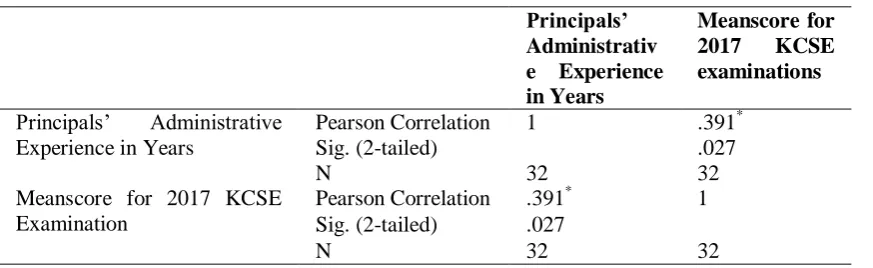
Table 5: Pearson’s Product Moment Correlation Test Analysis Showing Relationship between Principals’ Administrative Experience in Years and Meanscore of 2017 KCSE
Examinations
Principals’ Administrativ e Experience in Years
Meanscore for
2017 KCSE
examinations
Principals’ Administrative
Experience in Years
Pearson Correlation 1 .391*
Sig. (2-tailed) .027
N 32 32
Meanscore for 2017 KCSE Examination
Pearson Correlation .391* 1
Sig. (2-tailed) .027
N 32 32
*. Correlation is significant at the 0.05 level (2-tailed).
From Table 5, a Pearson Product-Moment Correlation was run to determine the relationship between principals’ administrative experience in years and mean score of 2017 KCSE examinations. The test generated a correlation coefficient of r = 0.391 with corresponding significant level (p-value) of 0.027 which was less than the predetermined level of significance, 0.05, that is, p-value = 0.027<0.05. These findings further affirm the fact that principals work experience is a critical factor in supervision of instruction as it improves performance. This is indicative of the fact that administrative experience plays an important in teachers’ perception towards the principals’ instructional supervision practices.
CONCLUSION
From the study findings, administrative experience which principals have plays a major role in enhancing their ability to provide effective instructional supervision in public secondary schools. Despite this, many principals have served for relatively shorter periods as school heads which has had major contributions to the management deficiencies in principals with less than five years of administrative experience. This has had a negative implication on principals’ ability to provide effective instructional supervision in secondary schools.
RECOMMENDATIONS
Copyright © 2017, Scholarly Research Journal for Interdisciplinary Studies REFERENCES
Alzaidi, A. (2008). A study of Job Satisfaction among Male Secondary School Head Teachers in Saudi
Arabia. PhD Thesis. Newcastle University.
Armstrong, H. (2001). Principles of Best Value. London, HMSO
Creswell, J. (2009). Research design: qualitative, quantitative and mixed methods approach. Thousand Oaks, California: Sage Publications.
Huang, T.C. (2000). Are the Human Resource Practices of Effective Firms Distinctly Different from Those of Poorly Performing Ones? The International Journal of Human Resource Management, 11(2): 436–51.
Karia, N. & Ahmad, Z. (2000). Quality practices that pay: Empowerment and teamwork. Malaysian Management Review, 35(2), p.66-76.
Keegam, L. (2003). Miscellaneous Leadership Issues. Education Next. Vol 3:2.
Kenya Education Sector Support Programme (2005-2010). Educational Planning Practices in Kenya. Nairobi: Government Printer.
Kirui, P. K. (2012) Institutional Factors Influencing Implementation of Curriculum Change in Public Primary School in Kipkelion District. Unpublished M.Ed. Thesis, UON.
Kothari, C. R. (2005). Research Methodology. New International Publishers, New Delhi.
Krejcie, R. V. & Morgan, D. W. (1990). Determining sample size for research activities. University of Minnesota, Duluth
Muigai Report (1978). Feasibility Report on Establishment of Secondary Schools. Nairobi: Longman Publishers
Musaazi, J.C.S. (1994). The Theory and Practice of Educational, Administration, McMillan PressLtd, London.
Mwiria, K. (1995). Constraints and Challenges to Effective Primary School Management in Eritrea. Unpublished study for UNICEF and Ministry of Education, Eritrea.
Nandwah, I. (2011). Preparation and Development of Public Secondary Schools Principals in Kenya. International Journal of Humanities and Social Science Vol. 1 No. 9
MoEST (2015): Report on The Status of Teachers in Kenya: A National Case Study Coordinate by Kenya Education Staff Institute. Nairobi Republic of Kenya.
Onderi, H. & Croll, P. (2008). In-service training needs in an African context: a study of headteacher and teacher perspectives in the Gucha district of Kenya”, Professional Development in Education, Vol. 34 No. 3, pp. 361-373.
Owoeye, P. & Yara, T. (2010). School Facilities and Academic Achievement of Secondary School
Agricultural Science in Ekiti State Nigeria. Asian Siciak Sciences.7(7)
Stoll, L., Bolam, R. and Collarbone, P. (2011). Leading for Change: Building Capacity for Learning. Kluwer Academic Publishers, Dordrecht, Netherlands