Evaluating the efficiency of functioning of integrated
structures in industry
Larisa Suvorova1,*, Tatyana Baibakova1, and Irina Pestova1
1
Economics Department, Vyatka State University, 610000 Kirov, Russia
Abstract. In the article the authors review approaches to evaluating the efficiency of the integrated structures in industry in order to improve the methodology of this evaluation. In contrast to existing indicators for evaluating the efficiency, which characterize the performance of some aspects of the integrated structures activities, the authors propose the methodology based on calculating and comparing general and individual efficiency indicators of current (operating), financial and investing activities on the integrated structure as a whole. These indicators are presented in the form of the coefficients. By means of mathematical analysis, the authors have found out the strong and direct correlation among the given indicators, which confirms the objectivity of choosing the indicators. The received results of evaluating the efficiency of functioning of the integrated structures are proposed for use in the developed algorithm of making managerial decisions. The validity of the developed methodology is shown on the example of the integrated structure of the joint-stock company “Kirov Dairy Plant”.
Keywords: integrated structures, methods of evaluation, industry, efficiency of functioning
1 Introduction
In the field of economics, the organizational manifestation of the integration is forming the integrated structures. It is made with the help of integrating resources and capital in order to build the integrity of the production and technological, financial and economic chains in the company activities [1, 2].
The integrated structure is viewed as the union of industrial enterprises and companies on the basis of the technological principle in order to improve the quality parameters of the finished product, to optimize its production and marketing costs, to develop mutually beneficial economic relations, to consolidate individual functional structures [3]. The purpose of merging enterprises and companies into the integrated structure is to strengthen its competitive potential, to increase output through applying innovative technologies and increasing the competitiveness of their products.
One of the most important tasks of researching the activities of the integrated structure is to evaluate the efficiency of its functioning.
Nowadays there are three groups of methods for evaluating the efficiency of company functioning.
The first group of methods is based on using the quantitative approach, which allows to evaluate the cost indicators of the company's performance and their dynamics [2, 4].
Using the methods of the second group gives the possibility to make the calculation of indicators of quality of production, the level of qualification of the personnel, the level of technology and of diversification of production [5].
The methods of the third group rely on using the integrated approach, which helps us to evaluate the efficiency indicators of companies functioning [6, 7, 8, 9].
In spite of the existing extensive system of indicators used to evaluate and analyze the effectiveness of the company’s activities, there is a need to develop the methodology for evaluating the efficiency of the integrated structure as the whole entity.
2 Defining the task of the research
result in obtaining the fair evaluation of the efficiency of the integrated structure as a whole.
The aim of this study is to develop the methodology, based on calculating and comparing general and individual indicators of current (operating), financial and investing activities of the integrated structure as an economic system.
3 Developing the approaches to
evaluating the efficiency of functioning
of integrated structures
[image:2.595.303.544.70.275.2]Modern scientists` approaches to evaluating the efficiency of functioning of the integrated structures are very diverse and they allow to determine the performance of their activities according to a number of positions. Let us consider some of the main approaches to evaluating the efficiency of functioning of the integrated structures (Table 1).
Table 1. Approaches to evaluating the efficiency of functioning of integrated structures [1].
The Name of the
Approach The Essence of the Approach
The principle of
“Triple Helix”
The performance of the integrated structures is evaluated according to the performance of its
three components: science, business, government
Contextual approach
The integrated structure has the contextual characteristic of useful results that can be obtained from the system, the evaluation of which shows the efficiency of its functioning Program and
target-oriented approach
The efficiency of functioning of the integrated structures is determined on the basis of evaluating the degree of target achievement. In this case, the evaluation is the ratio of the level of the target implementation with the costs for
its achievement Managerial
approach
The efficiency of functioning of the integrated structures is determined at different levels of
government: state, industries, region and enterprises
Synergetic approach
Evaluating the performance of the integrated structures is made on the basis of calculating
the net synergetic effect Structural
approach
Evaluating the performance of the integrated structures can be carried out on the basis of the
structural shift method, which relies on the assumption that the effectiveness is determined
by the combined efforts of three factors: the growth of the national economy, the growth of
an industry in the country, the growth of the regional economy
Economic approach
Applying different methods of functioning evaluation of the integrated structures, including income, market and costs methods
Aggregative approach
Making up the integral indicators of functioning evaluating of the integrated
structures on the basis of its main characteristics, parameters, features and
properties: competitiveness, exports, employment, innovation, manufacturing,
relationship of participants, science and education, investments, gross value added,
area, productivity Adapting
the idea of cross-efficiency
The approach allows to connect different levels of the integrated structures. A level is a standard, and the level of an individual item cannot be higher than the level of the cluster as
a system Adaptive
approach
Adapting the idea of a dynamic normal and the order of indicators to evaluating the efficiency
of functioning of the integrated structures
[image:2.595.60.485.327.778.2]For evaluating the efficiency of functioning of the integrated structures one can use different groups of indicators (Table 2).
Table 2. Groups of indicators for evaluating the efficiency of functioning of the integrated structures.
Group of Indicators
Indicators Authors
The main indicators of
functioning
The increase in volume of output.
The increase in profit growth. Improving parameters of
product quality. The increase in labour
productivity. The increase in productivity from the use
of labor and capital investments. The decrease in costs in the
production process.
Gordeev A. V. Donskova
S. V. [2]
Indicators summarizing the results of economic
activity
Indicative industry profits. Indicative profitability. Indicative expenditures for
a unit of output.
Kosholkina L., Borhunov
N., Rodionova
O. A. [4] Indicators of the
financial aspect of activities
The increase in the value of the enterprise. The decrease in transaction
costs.
Savings on tax payments. The decrease in overheads.
Shmidt U. D., Romanova
I. M., Mihina I. S.
[5] Indicators of the
production aspect of activities
Reduced costs of productive work. Improved product quality.
The expansion of product range.
The growth of returns from the use of means and
Indicators of the investment
aspect of activities
The increased investments in long-range assets. The increased investments in the development of new
technologies in the production of traditional
and new products. The increased investments
in production equipment. Indicators of
evaluating the integrated organization
potential
Evaluating the peculiarity of funds. Evaluating the market
concentration. Evaluating the growth potential of the market
power. Evaluating the effect of logistics decisions in the
field of supplies.
Sitnikova T. V. [6]
Indicators for selecting potential organizations in
order to build the integrated organization
and their evaluation
Evaluating the potential of strength and sustainability
of the cooperative. Evaluating the market
potential. Evaluating the effect of
logistics decisions. Evaluating the merger of other organizations into the
integrated structure. Indicators for
monitoring the integrated
company
Excluding the organizations, that have
exhausted resource efficiency, from the
structure. The formation of new integration connections
among the entered organizations or the
inclusion of new companies. Individual
indicators
As for federal and state organizations it is the proceeds from selling the products of the companies that are members of the
holding. As for regional and municipal organizations it
is the number of employees.
Shubin S. A. [7]
Indicators of the efficiency of
using raw materials
The level of food consumption by
population. The size of the gross
product. The yield of marketable
products. Gross income.
Net profit. Indicators
revealing the degree of
The availability of raw materials for the Production Capability.
integration The distance of transporting raw materials
A large number of existing indicators allow to make diverse evaluation of activities of companies that are members of the integrated structure [8-17], but there are no indicators to measure the efficiency of functioning of the integrated structure as a whole.
4
Developing the methodology of
evaluating the efficiency of functioning
of integrated structures in industry
Multidimensional nature of integrated structures activities requires using a certain number of characteristics in the form of appropriate efficiency indicators while evaluating the efficiency of the integrated structures. The appropriate efficiency indicators form the system, which gives them unity in their mutual relations.
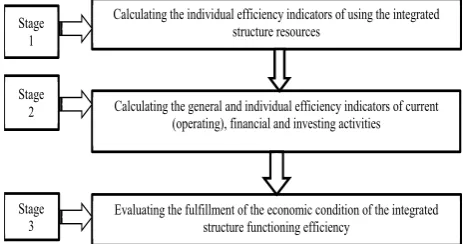
The authors propose the methodology for evaluating the efficiency of the integrated structures [18-22]. This methodology consists of three stages and it is based on calculating and comparing general and individual efficiency indicators of current (operating), financial and investing activities (Fig. 1).
Stage 1
Calculating the individual efficiency indicators of using the integrated structure resources
Stage
2 Calculating the general and individual efficiency indicators of current (operating), financial and investing activities
Stage 3
[image:3.595.307.539.394.516.2]Evaluating the fulfillment of the economic condition of the integrated structure functioning efficiency
Fig. 1. Stages of evaluating the efficiency of functioning of the integrated structure in industry.
General and individual indicators for evaluating the efficiency of functioning of the integrated structures are presented in the form of dimensionless coefficients (Table 3).
The correlation coefficients were calculated by means of the program Excel using the “Data Analysis” package. These coefficients let us make the conclusion that there is a strong direct correlation among figures presented in Table 3.
After calculating the general indicators (Eca, Efa and
Eia) we matched their values in order to make future
Table 3. General and individual indicators for evaluating the efficiency of functioning of the integrated structures in
industry.
A type of activity Individual indicators of the efficiency of using resources
General indicators of the efficiency of functioning
Calculation formulas Correlation coefficient Current (operating) activity
Rf – fixed assets turnover ratio; Rt – circulating assets turnover ratio, turnover
per year
Eca = Rf × Rt Eca – efficiency
ratio of current (operating)
activity
0.94
Financial activity
Rd – debt ratio; Pbc – profitability of
borrowed capital, coefficient
Efa= Rd× Pbc Efa – efficiency ratio of financial
activity
0.63
Investing activity
Cc – capital coefficient; Rc – circulating
assets capacity ratio; Ic – capital
intensity
Eia = Cc × Rc × Ic Eia – efficiency ratio of financial
activity
0.94
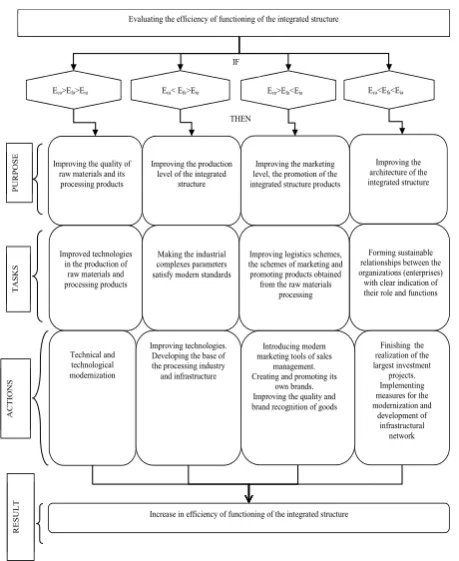
The developed algorithm of decision-making supposes the choice of actions according to the results of comparing the proposed efficiency indicators of the current (operating), financial and investing activities (Fig. 2).
Evaluating the efficiency of functioning of the integrated structure
Eca>Efa>Eia Eca< Efa>Eia Eca>Efa<Eia Eca<Efa<Eia
IF
THEN
Improving the quality of raw materials and its processing products
Improving the production level of the integrated
structure
Improving the marketing level, the promotion of the integrated structure products
Improving the architecture of the integrated structure
Improved technologies in the production of
raw materials and processing products
Improving logistics schemes, the schemes of marketing and promoting products obtained from the raw materials
processing
Forming sustainable relationships between the organizations (enterprises) with clear indication of their role and functions Making the industrial
complexes parameters satisfy modern standards
Technical and technological modernization
Improving technologies. Developing the base of the processing industry and infrastructure
Finishing the realization of the largest investment projects. Implementing measures for the modernization and development of
infrastructural network Introducing modern
marketing tools of sales management. Creating and promoting its
own brands. Improving the quality and brand recognition of goods
Increase in efficiency of functioning of the integrated structure
PUR P OSE TA SK S AC T IONS RES U LT
Fig. 2. The algorithm of making managerial decisions of the integrated structure in industry.
Under the condition when Eca>Efa>Eia, the integrated structure has the task to improve production technologies through its modernization.
Receiving the condition when Eca< Efa>Eia, the integrated structure needs to aim at developing the material-technical base and its infrastructure. It should be done in order to make economic security parameters of industrial complexes satisfy modern standards.
Under the condition when Eca>Efa<Eia, the integrated structure needs to improve its logistics schemes of promoting finished products, to create and promote its own brands, to raise its brand name recognition.
In the case of the condition when Eca<Efa<Eia, the integrated structure needs to focus on forming sustainable relationships between its constituent organizations with clear indication of their role and functions. This is solved through realizing major investment projects, implementing measures for modernization and development of the infrastructure network.
5
The practical importance of the
research
The proposed methodology was tested on the data about functioning of the integrated structure of the joint-stock company (JSC) “Kirov Dairy Plant”, which is the leader of raw milk processing in the Kirov region nowadays.
[image:4.595.59.289.467.748.2]According to the results of the evaluation it is found out that the condition of the functioning efficiency of the integrated structure of the JSC “Kirov Dairy Plant” has not been fulfilled (Table 4).
Table 4. Indicators of the efficiency of functioning of the JSC “Kirov Dairy Plant” before and after the integration.
A group f indicators
The name of an indicator Before integration After integration Individual indicators of the efficiency of using resources Fixed assets turnover ratio 1.28 1.87 Circulating assets turnover ratio, turnover per year 3.34 4.50
Debt ratio 0.27 0.51
Profitability of borrowed capital, coefficient 0.41 0.87 Capital coefficient 0.78 0.54 Circulating assets capacity ratio 0.30 0.22
Capital intensity 0.54 0.83 General
indicators
Current (operating)
[image:4.595.304.539.480.787.2]activity, coefficient
Financial activity, Coefficient
0.11 0.45
Investing activity, Coefficient
0.13 0.10
The actual fulfillment of the condition of the efficiency of
functioning
Eca > Efa < Eia.
Eca > Efa < Eia
The main reason for failing the condition is the inefficiency of the investing activity of the integrated structure of the JSC “Kirov Dairy Plant”, which results in income deficiency.
The positive aspect in the integrated structure functioning is that after the integration all parameters, except for the general indicator of the investing activity efficiency, have significantly increased.
Having analyzed the problem, we offer the following management decisions in order to increase the efficiency of functioning of the integrated structure of the JSC “Kirov Dairy Plant” on the basis of the developed algorithm:
of the product range of milk products as a result of modernizing production facilities,
nts of the integrated structure,
development of its own distribution system of produced dairy products on regional and interregional markets,
brand of manufactured dairy products.
The realization of the proposed managerial decisions will enable the integrated structure of the JSC “Kirov Dairy Plant” to increase the efficiency of its functioning.
6
Conclusions
1. Our review of existing approaches to evaluating the efficiency of functioning of the integrated structures has revealed the absence of systematization in the indicators for evaluating their activities according to different groups of parameters.
2. We have offered the methodical approach based on introducing the related general and individual indicators of efficiency of current (operating), financial and investing activities of the integrated structure in industry as one entity.
3. The algorithm for making managerial decisions of the integrated structure has been offered. The essence of this algorithm is choosing actions according to the results of comparing the proposed efficiency indicators of current (operating), financial and investing activities. 4. Due to the practical application of the proposed methodology we have found out the causes of ineffective functioning of the integrated structure of the
JSC “Kirov Dairy Plant”. So, a number of recommendations for realizing certain managerial decisions in the field of investing activities have been given.
References
1. U.N. Androsuk, Economics and Management.
Evaluating the performance of the cluster functioning and the sustainable development of the enterprise, 1, 65-70 (2015)
2. A.V. Gordeev, O.A. Maslennikova,
S.V. Donskova, N.K. Dolgushin, A.H. Zaveryuha,
E.V. Ulyanov, Economics of food industry
enterprises (Agrokonsult, Moscow, 2003)
3. T.V. Baibakova, The system for evaluating the
financial condition of the integrated unities of dairy of agro-industrial subcomplex in the Kirov
region. Monograph (Vyatka state university,
Kirov, 2015)
4. L. Kosholkina, N. Borhunov, O.A. Rodionova,
AIC: Economy, management. Methodology for determining the parity relations in the agricultural sector, 1, 43-48 (2009)
5. Yu.D. Schmidt, I.M. Romanova, I.S. Mihin, The
economic analysis: theory and practice. Complex technique of evaluating the efficiency of the integration processes in bakeries, 30, 13-19 (2009)
6. T.V. Sitnikova, Possibilities of forming the
vertically integrated industrial enterprise. http//uecs.ru/uecs54-542013/item/2204-2013-06-20-08-16-53
7. S.A. Shubin, Development of the mechanism of
forming and evaluating the performance of the
vertically-integrated structures (Russian state
library, Moscow, 2007)
8. Kin Lo, and Z. Thomas Lys, The Ohlson Model:
Contribution to Valuation Theory, Limitations, and Empirical Applications: Sauder School of Business
Working Paper (2000).
9. The model of Edwards-Bell-Olson (EBO).
http//www.valnet.ru
10. J. Spengler, Journal of political economy. Vertical
Integration and Antitrust Policy, 58, 347-352
(1950)
11. O. Willson, New developments in the analysis of
market structure. Cambridge (Mass). Vertical Integration and Related Variation on a
Transaction-Cost Economics Theme (1986).
12. A.E. Kozhin, Economic efficiency of the vertical
integration of timber enterprises (in the example of
the Arkhangelsk region) (Russian state library,
Moscow, 2003)
13. P.Yu. Poluhin, Evaluating the efficiency of
enterprise integration in the sphere of industrial
14. A.A. Popov, The integration of economic entities
in the market economy (Russian state library,
Moscow, 2005).
15. O.A. Rodionova, N.A. Borhunov,
O.A. Grebenkova, Large and small unities:
analysis, trends of development and mechanisms of
interaction (NIPKTS Voshod-A, Moscow, 2013)
16. M.F. Tazetdinov, Evaluating the economic
efficiency of enterprise integration (Russian state
library, Kazan, 2006)
17. Yu.V. Yakutin, Russian Economic Journal.
Conceptual approaches to evaluating the efficiency of corporate integration, 5, 71-81 (1998)
18. T.V. Baibakova, Economy, labor, management in
agriculture. The sectoral approach to evaluating the
efficiency of the integrated agrounities, 1, 61-63
(2016)
19. T.V. Baibakova, Economics and Management:
problems and solutions. Evaluating the efficiency of the integration processes in the agro-industrial complex, 2(56),8, 119-123 (2016)
20. L.A. Suvorova, I.V. Pestova, Economics and
Management: problems and solutions. The analysis of approaches to evaluating the synergetic effect of functioning of the biotechnology cluster, 2(56), 8, 59-64 (2016)
21. L.A. Suvorova, The synergetic effect of the
industry clustering: the analysis, evaluation,
forecast. Monograph (the Vyatka State University,
Kirov, 2015)
22. L.A. Suvorova, III International Scientific and
Practical Conference. Sustainable Development of Society and Economy. Integration, clustering and synergy as the constituent elements of sustainable
![Table 1. Approaches to evaluating the efficiency of functioning of integrated structures [1]](https://thumb-us.123doks.com/thumbv2/123dok_us/8233124.268848/2.595.303.544.70.275/table-approaches-evaluating-efficiency-functioning-integrated-structures.webp)