Abstract: The article is devoted to the urgent theme of the modernity – modeling the activities of Internet companies, whose main task is to run efficient business. The main purpose of this article is to define the basic regularities that determine the peculiarities of risk assessment in business as the main element that contributes to achieving the economic security of an organization, as well as to explain the choice of the optimal model for integrating a company into the information business. In the article the information business models have been analyzed, the areas of information commerce, factors for the efficient implementation of business models, and the attractiveness of the online market have been considered. The possibilities of using new online technologies in intracompany processes and communications in advertising and other commercial activities of the company have been assessed.
Keywords: enterprise integration model, information business, online business, innovations, business models.
I. INTRODUCTION
Every year in Russia and around the world information technologies are more and more widely introduced into all areas of activity. They have impact both on companies and on the economy, as a whole. New programs are developed, old ones are improved, and platforms for creating online businesses are opened.
The article is devoted to the urgent theme of the modernity – modeling the activities of online companies, whose main task is to run efficient business.
There is certain specificity in performing work online. It is necessary to use various approaches, models and knowledge for a business to become successful on a certain platform. It is necessary to choose the right content, advertising space and design of an Internet resource.
Every day the number of companies on the Internet continues growing. This type of activity has positive dynamics: new websites, instant messengers, groups, and channels are constantly developed and created. Since nowadays this type of activity is very efficient and attractive, it can be the main source of income, traffic, or an auxiliary source. A lot of online transactions are made, new chains of relationships are formed, and there is an increase in monetary
Revised Manuscript Received on September 07, 2019
Irina Anatolievna Kiseleva, Plekhanov Russian University of Economics, Moscow, Russian Federation.
Irina Sergeevna Lebedeva, Plekhanov Russian University of
terms. A new market and a new economic space called the “online market” are formed. This is a system of new economic relations. In Russia, online business is just emerging. Various opportunities for business in the Internet environment are created. In the article the information business models are analyzed, the areas of information commerce, factors for the efficient implementation of business models, and the attractiveness of the online market are considered. The possibilities of using new online technologies in intracompany processes and communications in advertising and other commercial activities of the company are assessed.
II. LITERATUREREVIEW
Online technologies are used in many areas of the economic activity. They integrate the supplier, the manufacturer, and the consumer. Good indicators of the online business performance will be achieved only in case of a competent approach [1 – 3].
The information business is a business model where many parts of business are automated by using information systems.
The Internet environment is the area of innovations. It has a number of advantages. They include:
No risks associated with the human factor,
Reduction of labor costs,
High speed of operations, and therefore, increasing the speed of business,
High business scaling speed,
Reduction or lack of tangible assets of the company,
Lack of distance between the seller and the buyer, and
Possibility of competition between small companies and behemoths, etc.
Consequently, the information business is the business activity associated with earning a profit. The activity should occur in the global networks. If no Internet resources are used, the business activity will be a traditional business [4 – 6].
III. METHODS A. General description
Let us consider the structure of the information business. Its components include:
Extranet – the external online interaction with partners, suppliers and customers,
Modeling the Activities of Internet Companies
by Using Innovative Processes
Business to business, B2B – from business to business – various ways of interaction between corporate users,
Business to consumer, B2C – from business to consumer – the communication based on the producer – final consumer strategy.
B. Block Diagram
The Internet environment is a set of global network space factors that have impact on the company introducing online technologies into its operations.
These factors include:
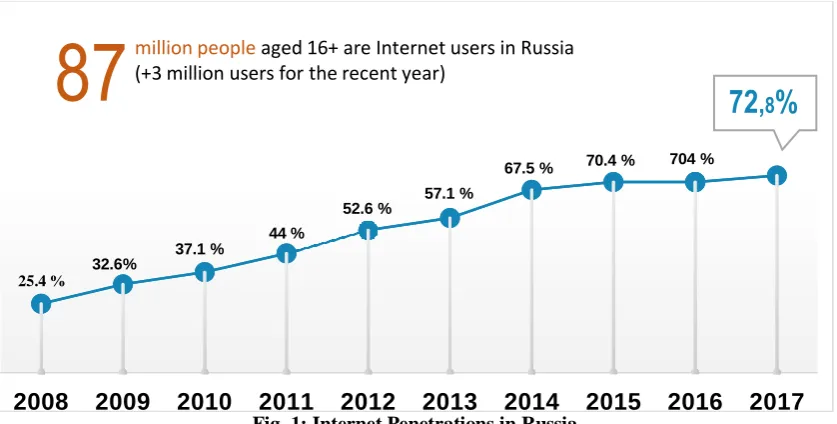
[image:2.595.90.509.168.380.2] Internet audience and its various characteristics. Figure 1 shows the percentage of the people aged 16+ who are active Internet users in Russia. In 2017, this number was 72.8%.
Fig. 1: Internet Penetrations in Russia Infrastructure (information resources, types of services,
technologies, structure of commercial participants),
Development of telecommunications infrastructure,
Feasibility of transactions, and
Development of the legal framework of online business.
C. Algorithm
Business models can be classified depending on the degree of introduction and interaction of IT in the company.
B0 Model – Intranet Model
The creation of this model, an internal information system, is the first stage in the consolidation of a company. An online company serves as a tool to improve the efficiency of company communications. Information resources are accessed on a limited basis. The access is provided only to company employees. It is limited from the outside world [7, 8].
The intranet model systems increase the speed, efficiency of data exchange among employees, improve feedback and interaction. They also enable the staff to work together regardless of their location.
Such systems reduce the transaction costs of the company, as well as improve management and planning.
B1 Model – Business Card Model
At this stage, the company’s internal information system is formed. This is considered to be the emergence of the extra-type information system.
This system can be used by employees and other individuals authorized by relevant rights from the outside world. The system contains data on the cost and range of goods, discounts or benefits, as well as the user database. The company can inform consumers about the activities and products and form a feedback with the consumer. This is done by using e-mail, subscription, multicasting, creating channels, websites, and various records to comment.
This system improves the communications performance not only in the internal space of the company, but also from the external environment. The time for searching for partners decreases. There is no bond to the local market or geographic area.
B2 Model – Electronic Order Model
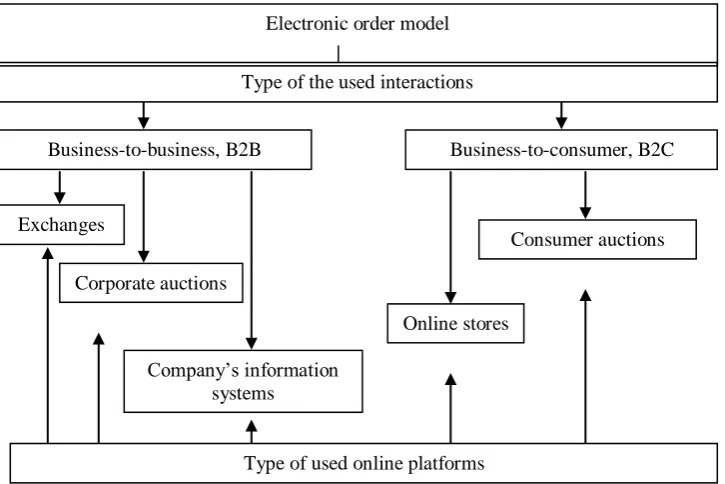
There is a reverse interaction with the consumer. It is carried out through the information order system. Users themselves begin to work in the information system. The contractor – the manufacturer and the manufacture – the consumer form communication chains. At this stage of integration, the user is a corporate client (business-to-business, B2B), as well as the final consumer (business to consumer, B2C) (Fig. 2).
25.4 %
32.6%
37.1 %
44 %
52.6 %
57.1 %
67.5 % 70.4 % 704 %
2008 2009 2010 2011 2012 2013 2014 2015 2016 2017
72
,
8%
87
million people aged 16+ are Internet users in RussiaFig. 2: Electronic Order Model
When a company performs its activities with corporate customers, it is supposed to create one of two types of trading platforms:
Information system on interacting with corporate customers, or
Independent trading information system.
In the first case, the consumer forms an order for production and almost on his own controls the supplier’s warehouse. The entire trading site is automated. It fulfills such functions as
Search for the target position in the price list,
Financial statements,
Archive,
Selection and optimization of delivery routes,
Analysis of supply and demand,
Payment and insurance, etc.
In the second case, the trading site is formed as an electronic procurement system. There is a possibility to arrange tenders, with a mechanism for comparing and searching for prices. Search for the right partner and compliance with the terms of the transaction are automated. The main income of the organizer is formed by the cost of financial and logistics services, advertising, additional information on suppliers, fees for entering the information system, as well as transaction fees. The consumer can quicker choose a product at the lowest price. The costs for purchase are reduced. It is possible to interact with more buyers.
The main factors of this business model (B2B) include:
A lot of participants and transactions,
Increase in the value and efficiency of the business model, as a result,
Standardization of goods and services,
Low prices for connecting to trading information systems,
Greater functionality of trading information systems, and
Information systems enable companies to have fewer inventories. They improve the efficiency of response to changes in demand and reduce the risk of overstocking. Another advantage of creating an online store according to this model is lower prices for goods on the Internet than in traditional stores. At the Internet environment, it is possible to place more goods, unlike at a traditional store [9 – 11].
These are success factors for implementing integration models (B2C) in Russia:
Offline and online strategy. It is efficient for traditional stores. Expenses for accessing the Internet are almost unnoticeable, unlike Internet projects that do not have an offline business,
The attention is focused on the needs of a solvent Internet audience,
The Internet is good for active marketing. Internet advertising is very efficient. The global network can reach a large audience, despite the location and place of the people’s residence,
High speed of websites and data sharing, and
Improved product delivery system, etc.
The main reasons for the decline in the efficiency of models that focus on the end consumer are the following:
Poor development of the telecommunications infrastructure,
Non-availability of credit cards for some people,
No express delivery throughout Russia, and
Low average income.
In the future, traditional stores cannot do without the Internet. Information systems enable traditional stores to communicate, organize supplies, and connect with online companies. In the future the Internet will be a necessary element of retail business.
B3 Model – Full Automation Model
The model includes:
Electronic order system, Electronic order model
Type of the used interactions
Business-to-business, B2B
Consumer auctions
Type of used online platforms
Business-to-consumer, B2C
Company’s information systems Exchanges
Corporate auctions
Such company works with corporate customers. They are provided with the access to databases that contain the information on inventories and the current status of contracts. Orders and purchases are automated, and retail sales are carried out in their electronic stores.
The above model uses a sophisticated interaction scheme (business-to-business-to-consumer, B2B2C). It enables all participants of such a chain to considerably reduce their disbursements and gain time.
The additional profit is formed by savings that arise in the following cases:
Automation of document flow and accounting,
Management optimization,
Optimization of commodity, raw materials, financial flows, and
Improving the quality of communications and marketing. Such company has to incur all costs on
Maintaining the infrastructure of the information space,
Organizing the intercompany sales,
Brand, and
Promoting goods through an online store.
Today it requires large investments. Therefore, large companies with a strong brand and customer base that have succeeded in the traditional business try to implement such model.
B4 Model – Outsourcing Model
When using this model, almost all business processes are automated, interaction schemes are simplified, opportunities are expanded, and the speed and quality of work coordination increase. The structure of the functions and the configuration of the company also change. In the outsourcing model, it is cheaper to transfer a part of the company’s functions to another one that has the same specialization. It is possible to introduce outsourcing through the Internet. A company can outsource a lot of functions: marketing, manufacturing, logistics, finances, while retaining more important ones: strategic management, product and technology creation and development, and sales and customer service. The B4 model decreases the size of the company and reduces its costs. As a result, the competitiveness and efficiency of the company increase.
D. Flow chart
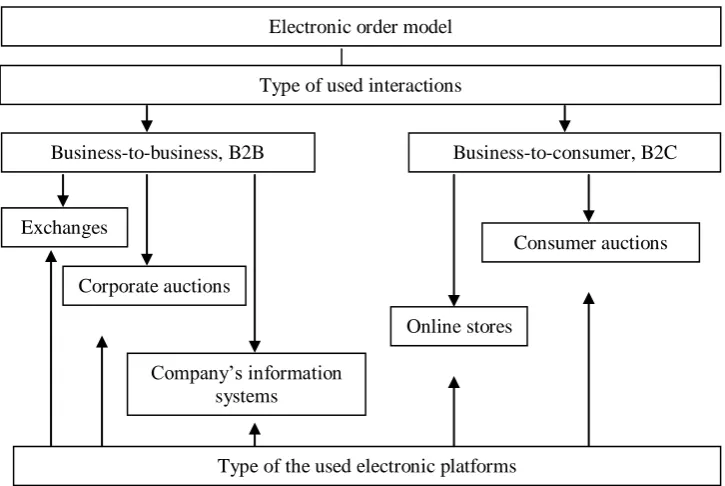
[image:4.595.117.480.321.564.2]Models are classified in the following diagram (Fig. 3):
Fig. 3: Classification of Business Models E. Features of Integration Models
The Internet creates new branding opportunities and other marketing approaches. Using new technologies, it is possible to make a full, instead of an approximate segmentation of the market. The advanced models collect detailed information about the demand, as well as market conditions and all customers. Besides, there is the possibility of personal communication with feedback. The customer actively
provides information about his needs, and thus acts as a supplier. The company makes a relevant focus and advertises for a certain group of persons. Services and products are personalized. The commercial risk and miscalculations go down almost to zero [12, 13].
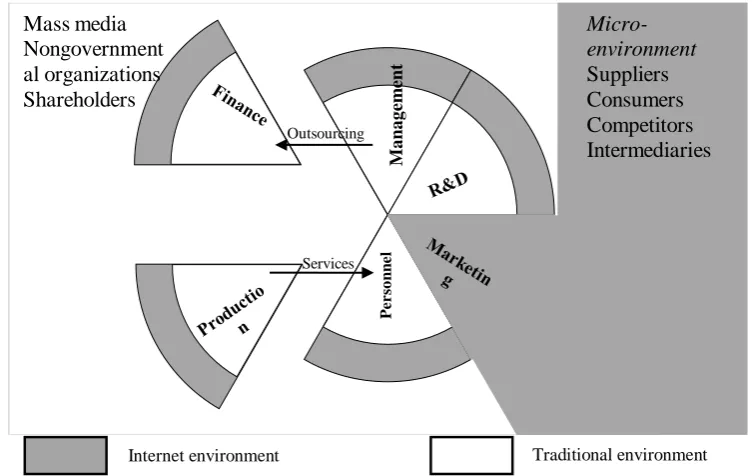
The Internet market covers a growing area of the company’s activity (Fig. 4).
Electronic order model
Type of used interactions
Business-to-business, B2B
Consumer auctions
Type of the used electronic platforms
Business-to-consumer, B2C
Company’s information systems Exchanges
Corporate auctions
Company
Intranet
P
er
so
n
n
el
M
an
age
m
en
t
Micro-environment
Banks Suppliers Consumers Competitors Intermediaries Mass media Shareholders Creditors
Nongovernmental organizations
Extranet Per
so
n
n
el
M
an
age
m
en
t
Micro-environment
Banks Suppliers Consumers Competitors Intermediaries Mass media Shareholders Creditors
Nongovernmental organizations
P
er
so
n
n
el
M
an
age
m
en
t
Mass media
Nongovernmental organizations Shareholders
Micro-environment
Fig. 4: Changing the Zone of Interaction between the Company and the Internet Environment in the Integration Models: 1) B0 Model, 2) B1 Model, 3) B2, B3 Models, and B4 4) Model.
In B2, B3, B4 models, the Internet environment merges with the micro-environment, because business is integrated into the Internet space. Consequently, it is necessary to simultaneously take into account the impact of forces and subjects of the traditional environment, as well as the factors of the Internet impact [5, 10, 14].
IV. RESULTS
A. Choosing the Optimal Model for the Company to Integrate into the Information Business
Many businessmen have faced the question whether to start a business in the Internet environment, to integrate their business into the Internet, or whether it is better to have a
traditional form for a considerable part of their business. A company is challenged to choose the optimal integration model. Sometimes a company needs only to implement a business card model or to create a call-center.
The main goal is to determine the efficiency of implementing Internet models and to assist the management in developing the best integration strategy [15 – 18].
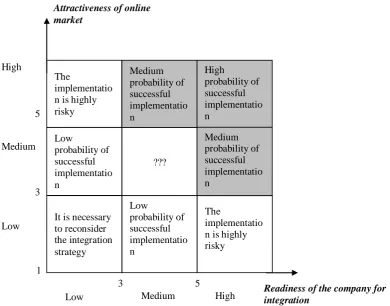
It is necessary to start the selection with positioning the selected integration model in the matrix on the probability of successful implementation of the project (Fig. 5).
The following factors are taken as assessment criteria: • Attractiveness of the online market for a company, • Readiness of the company for integration.
P
e
r
so
n
n
e
l
Man
agem
ent
Mass media Nongovernment al organizations Shareholders
Micro-environment
Suppliers Consumers Competitors Intermediaries
Outsourcing
Services
Fig. 5: Matrix of Probability of Successful Project Implementation
In the matrix any square indicates the probability of successful implementation of the integration model. Question marks indicate that it is difficult to formulate recommendations for a general case rather than for a certain
one.
The selection comes with ranking, analysis of business integration models in terms of the probability of successful
implementation of any of them (Figure 6).
Preliminary selection of a certain model related to the integration of new information technologies in the company’s economic activity
Researching the Internet and the company’s environment
Singling out strategic factors of the online market’s attractiveness taking into account the tendencies and key factors of the online market’s development (Table 1)
Singling out strategic factors of the company’s readiness for integration taking into account the key factors of success that are characteristic of implementing a certain integration model (Table 1)
Defining the rating of the company’s readiness for integration by using the assessment matrix (Table 3)
Defining the rating of the online market’s attractiveness by using the assessment matrix (Table 2)
Positioning of the selected model in the matrix on the probability of successful implementation of the project according to the ratings (Fig. 9)
Formulation of the strategy taking into account the obtained estimates The
implementatio n is highly risky
Medium probability of successful implementatio n
High
probability of successful implementatio n
Low
probability of successful implementatio n
???
Medium probability of successful implementatio n
It is necessary to reconsider the integration strategy
Low
probability of successful implementatio n
The
implementatio n is highly risky
High High
Low Medium
Medium
Low
1 3 5
3 5
Readiness of the company for integration
Let us consider the factors that show the attractiveness of the online market for a company and indicate the integration
[image:8.595.42.557.99.460.2]readiness (Table 1).
Table 1: Factors of the Online Market Attractiveness for a Company and Its Integration Readiness
Factors of the online market’s attractiveness for a company – characteristics of the online market
Factors of the company’s readiness for integration – characteristics of a company
• Geographical characteristics, • Capacity,
• Growth rates,
• Price dynamics, market sensitivity to prices, • Periodicity,
• Users,
• Environment infrastructure,
• Possibility of transactions between market subjects, • Telecommunications quality, and
• Technological stability
• Characteristics of the product range (including the volume, availability of products that has a medium – high liquidity on the online market),
• Brand strength
• Established relations with suppliers, • A wide network of customers,
• The company’s readiness to work with a many customer, • The company’s readiness to change its organizational structure,
• Employees who can work in the Internet space, • Efficiency of the marketing system,
• Ability to innovate Competition factors
• Competition on the market,
• Trends related to the change in the number of competitors, • Advantages of the market leader,
• Relative share of the traditional market,
• The company’s potential and its competitive advantages
Financial and economic factors
• Barrier to enter the market (including the cost of software, provider services, the required equipment for working on the online market, connecting to information modules, etc.), • Profitability level
• Cost structure
• Profitability level, • Cost structure,
• Use of the company’s capacity,
• Possibility to make long-term investments, • Possibility of increasing the technological base
Socio-psychological factors
• Legal limitations of electronic business,
• Customer’s readiness for interaction • Corporate culture, • Motivation for the employees’ efficient work, • Management style and manager’s actions, • Image and reputation of the company
The factors are adapted to the Internet environment. When analyzing the attractiveness, it is necessary to single out only attractive factors from the list [19, 20].
To define the rating of any group of strategic factors, it is
[image:8.595.41.560.541.835.2]possible to use an assessment matrix made in the same way as the External Strategic Factors Analysis Summary – EFAS: Tables 1 and 2.
Table 2: Matrix for Assessing the Attractiveness of the Online Market for a Company
Strategic factors of attractiveness Weight Estimate of online market Weighed estimate
1. Market growth rates 0.15 3 0.45
2. Users 0.15 3 0.45
3. Market capacity 0.1 3 0.3
4. Barrier to enter the market 0.1 4 0.4
5. Telecommunications quality 0.1 2 0.2
6. Spread of credit cards (digital money) 0.1 3 0.3
7. Competition on the market 0.06 5 0.3
8. Express delivery throughout Russia 0.1 1 0.1
9. Market costs structure 0.08 3 0.24
10. Consumers’ online psychology 0.06 2 0.12
Total 1.00 3.00
*The rating is 3.00 – the average attractiveness of the company’s market
Table 3: Matrix to Assess the Company’s Readiness to Integration
Strategic factors of the company’s readiness to integration Weight Estimate Weighed estimate
1. Characteristics of the product range 0.15 3 0.45
2. Brand strength 0.15 2 0.3
3. Wide network of customers 0.15 2 0.3
5. Relative share of the traditional market 0.2 4 0.8
6. Employees who can work in the Internet space 0.15 2 0.3
Total 1.00 2.55
*The rating is 2.55 – the company’s readiness to integration is below average
Weight shows the impact of a certain factor in the overall set of strategic factors. The sum of the weight is 1.
Estimate is the company’s specific reaction to a certain factor. Estimates are made by independent experts or experts of the company based on marketing research, taking into account the company’s goals.
Due to positioning the project in the probability matrix on successful implementation in this example, it is possible to conclude that the success probability for this project is low. It is necessary to change the strategy. For example, it is necessary to promote goods through intermediaries on the Internet, buy goods and sell the surplus by using various trading platforms [21, 22].
The matrix helps the manager to make the right rational decision, and is a well-working instrument if used by an experienced specialist.
V. CONCLUSION
Summing up, it is possible to say with confidence that today the problem of modeling the activity of Internet business by using innovative processes is more relevant than ever. Today in Russia the business in the Internet environment has a tendency towards prospective development. Sellers can offer a lot of products at low prices. Companies have one more, the largest platform for advertising their business. The speed of communication between the corporate customers, consumers, and sellers increases to its maximum. The development of the Internet environment makes it possible for many enterprises to act more efficiently and grow faster.
Online business becomes more and more popular. The number of Internet users and the turnover of e-commerce are constantly growing. Under these conditions, the managers who can assess the capabilities of new information technologies and their introduction into the activities of a company, as well as have an idea of business models of the online market can improve their strategic positions by using global networks or create their own new online business that has a lot of advantages as compared to the traditional one.
REFERENCES
1. O.N. Volkov, Standarty i metody modelirovaniya biznes-protsessov [Standards and Methods for Modeling Business Processes]: textbook for universities. Moscow: ASV, 2015, 145.
2. D.Yu. Grishin, Modelirovaniye deyatelnosti Internet-kompanii [Modeling Activities of an Internet Company]: manual. Moscow: IRC, 2016, 246.
3. G.K. Nikulin, Modelirovaniye, analiz biznes-protsessov v srede Internet [Modeling, Analysis of Business Processes in the Internet Environment]: manual. Moscow: Finance and Statistics, 2016, 172. 4. V.S. Popov, Modelirovaniye deyatelnosti Internet-kompanii [Modeling
Activities of an Internet Company]: a reference guide. Moscow: RGAS,
6. G. M. Thompson, “Revenue Management Forecasting Aggregation Analysis Tool (RMFAA Tool)”, Cornell Hospitality Tool, 9, 2009, 1 – 5. 7. E.V. Kurganova, Osnovy ispolzovaniya BAAN ERP 5.0C. Korporativnye informatsionnye sistemy [Basics of Using BAAN ERP 5.0C. Corporate Information Systems]: course manual, discipline guide, workshop on discipline, tests on discipline, curriculum on discipline. Moscow State University of Economics, Statistics and Informatics. Moscow, 2004, 236.
8. A.I. Gromov, V.G. Chebotarev, I.V. Gorchakov, O.I. Boyko Uchebno-metodicheskiy kompleks Analiz i modelirovaniye biznes-protsessov [Educational and Methodical Complex Analysis and Modeling of Business Processes]: manual. Moscow, 2007, 157. 9. I.A. Kiseleva, S.O. Iskadzhyan, Upravleniye informatsionnymi riskami
v biznese [Information Risk Management in Business]. Innovations: electronic scientific journal, 1 (30), 2017, 5.
10. A.Yu. Potekhin, Sistema korporativnogo upravleniya sovremennykh internet-kompaniy [Corporate Management System of Modern Internet Companies]. Modern Aspects of Economics, 11 (183), 2012, 100 – 104. 11. T.V. Vasilieva, Osobennosti funktsionirovaniya internet-kompaniy v
sfere internet-kommertsii [Peculiarities of the Functioning of Internet Companies in Internet Commerce”, Innovations, 6, 2006, 120 – 122. 12. A.A. Koshkina, Sushchnost internet-kompaniy i ikh klyuchevye faktory
stoimosti v innovatsionnoy ekonomike [Essence of Internet Companies and Their Key Cost Factors in the Innovation Economy], Financial University Bulletin, 3, 2010, 66 – 69.
13. N.S. Zavivaev, D.V. Proskura, E.A. Shamin, Sovremennoye sostoyaniye i prognoz razvitiya rynka infokommunikatsionnykh uslug [Current State and Forecast of the Development of the Information and Communications Services Market]. Economics and Entrepreneurship, 12 – 4 (53 – 4), 2014, 940 – 944.
14. A.S. Shapkin, V.A. Shapkin, Ekonomicheskiye i finansovye riski. Otsenka, upravleniye, portfel investitsiy [Economic and Financial Risks. Evaluation, Management, Investment Portfolio. Moscow: Dashkov and Co. Publishing and Trading company, 2013, 544.
15. J.-J. Lambin, “Strategicheskiy marketing. Evropeyskaya perspektiva” [Marketing Strategy: A New European Approach]. Saint Petersburg: Nauka, 1996.
16. N.J. Foss, “Scientific Progress in Strategic Management: The Case of the Resource-Based View”, International Journal of Learning and Intellectual Capital, 4(1/2), 2007.
17. J.L. Morrow, D.G. Sirmon, M.A. Hitt, T.R. Holcomb, “Creating Value in the Face of Declining Performance: Firm Strategies and Organizational Recovery”, Strategic Management Journal, 8(3), 2007, pp. 271 – 283.
18. F. Kotler, Marketing po Kotleru: Kak sozdat, zavoyevat i uderzhat rynok [Marketing by Kotler: How to Create, Conquer and Keep the Market]. Moscow: Alpina Business Books, 2008, 116 – 163.
19. J.F. Angel, R.D. Blackwell, P.W. Miniard, Povedeniye potrebiteley [Consumer Behavior]. St. Petersburg: Peter, 2001, 768.
20. K. Keller, “Framework for Marketing Management, A”. 2008, pp. 384. 21. K.M. Eisenhardt, J.A. Martin, “Dynamic Capabilities: What Are
They?”, Strategic Management Journal, 21, 2000, pp. 1105 – 1121. 22. M. Porter, Konkurentnoye preimushchestvo: kak dostich vysokogo