Abstract: A moving vehicle comes across some permanent components like roads and some variable components like other vehicles etc. Keeping these components at forefront, an automated vehicle needs to take astute and speedy decisions about its next move. In this research paper, we have proposed a hybrid model based on two soft computing techniques that is Neural Networks and Fuzzy Systems to optimize the performance of Navigation Systems in terms of speed and accuracy. The proposed model is an extension of authors previous work [ 1] in which the Best Feature Selection model was created to extract the most paramount features of navigation images. In that, it was observed that extracted feature set had direct impact on speed and accuracy of the working model as no resources were required to be spent on impertinent features.
Our hybrid model performs three steps afore taking final decision that is either to move or stop the automated vehicle. The first step involves passing the outputs of Best Feature Selection Model and PCA as inputs through Convolutional Neural Network (CNN) deep learning model and obtaining the response in form of move or stop. Principal Component Analysis (PCA) technique was performed on the extracted feature set to improve our knowledge about input feature set by procreating new features. In our previous work [2], it was justified that Principal Component Analysis (PCA) when used in conjunction with Convolutional Neural Networks (CNN) yields better results as compared to standalone performance of PCA and CNN. It was withal analysed that PCA-CNN is going to give nearly same precision either we give ten percent training or we give high order training. The second step involves using one other variant of Neural Networks that is Re-current Neural Networks (RNN) for ascertaining out the bestest feature from all eleven features of Best Feature Selection Model. The factor with least Mean Square Error is used to calculate the decision in form of move or stop. The last step involves passing the outputs of CNN model and RNN model through Fuzzy Module. Here the Fuzzy rules are generated to take final decision for moving vehicle. The accuracy of this hybrid model came out be 89.28 percent which is far better than individual accuracies that is 72 percent and 60 percent of CNN model and RNN model respectively
Keywords : Convolutional Neural Net-works, Fuzzy logic, Intelligent Systems, Neural Networks, Principal Component Analysis, Recurrent Neural Networks.
I. INTRODUCTION
Present intellective systems assist the driver in its navigation chores. But if accurate information is not provided
Revised Manuscript Received on August 05, 2019.
Khyati *, Research Scholar, IKG Punjab Technical University, Jalandhar, Punjab India.
Dr. J.S.Sohal , ,IKG Punjab Technical University, Jalandhar, Punjab, India.
to driver on time then it is of no avail and the delay can even lead to disastrous consequences. To improvise behavioural realism in real life navigation scenarios we need intellective and expeditious decisions. Hybrid approach (A collaboration of Soft computing Techniques: Neural Networks, Fuzzy Logic ensembles a powerful model that could improve the predictability of the system under construction. The Part 1 and Part II of this section provides an insight of Decision Making and Intelligent Decision-Making System. Part III lays stress on intelligent decision making in the field of navigation. Part IV discusses capability of Neural networks to imitate brain. Part V explores some existing hybrid techniques applied in field of automated motion. research articles globally.
A. Decision Making:
Each day we make a number of decisions ranging from simple decisions like what we have to eat in breakfast to intricate decisions leading to perdurable consequences. Human brain often insensately makes keenly intellective and speedy decisions with information available to it. Brain does process information in highly variable environments by means of multiple parallel processing elements. One has to pick up a decision from available culls. If the set of available alternatives is a finite in nature and consists of small number of elements then solution can be easily obtained by ranking the culls. But, if the number of possible alternatives is either infinite or finite in a profoundly colossal number or we need to gratify some restrictions or constraints then the optimization methods come into picture.
B. Intelligent decision-making systems
Intelligent decision-making systems are needed to deal with the scepticality and imprecision of real-world problems. An Intelligent system should possess human-like expertise within a specific domain, should be able to acclimate itself and learn to do better in a transmuting environment, and should also be able to explain how they make decisions or take actions
C. Need of Intelligent Decision Making in the field of Navigation:
We need to take a number of decisions related to navigation while commuting. While moving on road, we come across some permanent components like roads, some variable components like moving vehicles etc. Keeping these components at forefront, the vehicle performs some major tasks of driving like Lane Following or deciding the next move. All this involves taking intelligent decisions based on the data available.
A Hybrid Intelligent Decision-Making System
for Navigation with Optimized Performance
D. Neural networks are a mimic to biological brain Neural networks are a mimic to biological brain neuron for processing information given to it [3]. They endeavour to bring computers a little more proximate to the brain's capabilities by imitating certain aspects of information processing in the brain. It is done by seeding the idea of simultaneous processing to the computer in order to simulate multiple prospects at one time. Thereby they take advantage of the brain’s computing strategies to take astute and expeditious decisions. ANN is a machine learning approach inspired by the way in which the brain performs a particular learning task. It is a system of hardware and/or software patterned after the operation of neurons in the human brain. It has three components: synaptic interconnections, learning rules for up-dating and adjusting the connection weights and Activation functions
The knowledge about the learning task is given in the form of examples. The rules are constructed by using input and output data obtained from training examples. Inter neuron connection strengths (weights) are used to store the information acquired from the training examples. Inputs that contribute in getting right answers are weighted higher. We need to apply a mathematical or statistical function to transform data into neural network inputs. The most relevant data is selected and the outliers are removed. The network inputs are minimized using the techniques like Feature extraction, Principal components analysis etc
E. Using Neural Networks for Intelligent Decision Making in the field of Navigation:
All the real-world applications are highly nonlinear in nature and need some technology that can at least replicate rudimental functions of brain. Neural Networks have remark-able competency to derive meaning from perplexed or imprecise data by utilizing its parallel architecture. The highly connected processing elements (neurons) act together to solve a specific real-world problem. Neural networks learn through examples and engender their own representation of information received during the learning time. Thus, it acts as expert that could be used to provide projections while navigating.
II. LITERATURESURVEY:
A survey was done about the usage of neural networks and other soft computing techniques in the field of navigation. In [ 4], authors proposed a vehicular model predicated on Neural Networks that could learn in under 5 minutes to autonomously control the forms of kineticism by visually examining a human driver's response to incipient situations. GPS/DR fusion method was proposed in [5]. It used neural network to estimate the output of the GPS receiver to provide precise navigation information to the mobile robot. The performance of three neural architectures was compared in [6]. The results concluded that neural controller with disunited hidden neurons has a expeditious response to sensory inputs. A vehicle control system capable to learn behaviours predicated on examples obtained from human drivers was developed in [7]. The proposed system used neural networks in order to identify navigable and non-navigable regions. 4
A practical system was proposed in [8], in which a quadcopter autonomously navigates indoors and finds a concrete target. A deep learning model, Convolutional Neural Net-work
(ConvNet), was used in this to learn a controller strategy that mimics an expert pilot's cull of action.
The precision of neural networks to take a decision is verbally expressed to be around 75 percent so more attention must be paid to performance issues apart working speed during the requisite’s analysis, design and test phases. There are two major quandaries faced in utilizing neural network architecture that are required to be worked upon. First is their inability to consistently identify global minima. This problem is also referred to as local minima quandary. Second is to cull the number of hidden layers and participating neurons for a particular quandary. Too few neurons result in under training and excess results in overtraining.
Computational astuteness can withal be amended by utilizing other soft computing techniques like Fuzzy Logic. Unlike Crisp Facts which deals with distinct boundaries, the Fuzzy Facts deal with imprecise boundaries. For example, “To utilize fuzzy logic for authentic world quandaries we require to first define the control objectives and criteria and the possible failure cases. One has to cull a minimum number of variables for input to the FL engine and break the control problem down into a series of rules. FL membership functions are engendered to get the de-sired results. Fuzzy logic controllers (FLC) system was developed in [9] utilizing different membership functions and was habituated to navigate mobile robots. Amongst the techniques developed, FLC having Gaussian membership function was found to be most efficient for mobile robot’s navigation. In [10], the authors proposed a System to avail the sensor predicated mobile robot navigation in an indoor environment utilizing Fuzzy logic controller. In this, mobile robot evades the obstacles and engenders the path towards the target. A potential method to control a swarm of mobile robots in a warehouse with static and dynamic obstacles was proposed in [11]. It utilized the wireless control approach in collaboration with fuzzy logic so as to control variants of mobile robots in the warehouse. [12] de-scribes the design and the implementation of a trajectory tracking controller utilizing fuzzy logic for mobile robot to navigate in indoor environments. It used only one fuzzy controller for navigation and impediment avoidance. Advantages of fuzzy control in the design of a navigation system [13] are: i) Capability of handling sceptical and imprecise information, ii) Authentic time operation, iii) Facile coalescence and coordination of sundry demeanours, iv) Ability of developing perception-action predicated strategies, and v) Facile implementation. However, fuzzy navigation methods fail in local minimum situations; they have lakes of self-tuning and self-organization and arduousness of rule revelation from expert cognizance
The shortcomings of Neural networks can be overcome by utilizing it in cumulation with fuzzy logic. Neuro fuzzy hybrid system is a fuzzy system that utilizes a cognition algorithm derived from or inspired by neural network theory to determine its parameters (fuzzy sets and fuzzy rules) by processing data samples. Neuro fuzzy hybrid systems coalesce the advantages of fuzzy systems, which deal with explicit cognizance that can be explicated and understood, and neural networks, which deal with implicit erudition that can be acquired by learning.
artificial astuteness system) and automatically engender supplemental fuzzy rules and membership functions to meet certain designations. It avails reduce design time and costs. On the other hand, FL enhances the generalization cap of a neural network system by providing more reliable output. This hybrid system can handle any kind of information (numeric, linguistic, logical, etc.). It can manage imprecise, partial, nebulous or imperfect information and can re-solve conflicts by collaboration and aggregation. Moreover, it has self-learning, self-organizing and self-tuning capabilities and can mimic human decision-making process. It makes computation expeditious by utilizing fuzzy number operations. In [14], the authors investigated the application of an adaptive neuro-fuzzy inference system (ANFIS) to path generation and obstruction avoidance for an autonomous mobile robot in an authentic-world environment. ANFIS has additionally taken the advantages of both learning capability of artificial neural network and reasoning facility of fuzzy inference system. Novel algorithms were proposed in [15] to find nearby obstacles and to engender training pairs for neural network, optimally with the avail of developed neuro-fuzzy system.
Literature survey suggests that the hybrid systems are capable to improve the performance of navigation systems and can be explored further to revive their maximum potential
III. PROBLEMFORMULATION
Performance of Hybrid Intelligent Navigation Systems needs to be optimized. Literature Survey revealed that little work has been done in this direction so the research needs to be done in this gray area to revive maximum potential of soft computing techniques and enhance performance of current automotive motion planning. We need to design Intelligent decision-making navigation system with faster response time and better accuracies. This can be done by exploring maximum potential of Fuzzy Logic by collaborating it with variants of Neural Networks that is Convolutional Neural Networks and Recurrent Neural Networks.
CNN’s can be trained to accomplish a specific task just like human brain as they are very good in extracting features relevant to find a particular task. It enables us to have a spatial outlook in which each layer filters to get relevant information for the consequent layers. The recurrent neural network, on the other hand, focuses on temporal relationships. It works on one feature at a time and by the end we can have the most relevant feature on which the final decision can be calculated. Both CNN and RNN cut down the number of neurons involved in their individual processes thereby speeding up the decision process while maintaining the precision quality. Furthermore, the Fuzzy logic can be used to take collective decision with more precision. The conflicts can be resolved by collaboration and aggregation. This hybrid system can mimic human decision-making process by making computation more accurate and faster.
IV. PROPOSEDALGORITHMTOIMPROVE
DECISIONMAKINGINNAVIGATIONSCENARIOS: The proposed algorithm consists of three steps. The first two steps involve generating response that is either to move or stop the moving vehicle by using Convolutional Neural Networks and Recurrent Neural Networks respectively.
Afterwards, in the third step the fuzzy rules are used to take the final decision. Figure 1 clearly represents the flowchart of the proposed model.
Figure1: Flowchart of the proposed algorithm The detailed explanation of these steps is as follows:
A. Obtaining Response from CNN Deep Learning Model:
Input Vector: The outputs of Best Feature Selection Model [1] and principal component analysis technique (PCA) are combined to finalize the most relevant neural net-work inputs that needs to be feeded into CNN framework.
Working Algorithm: CNN filters are trained to be task specific and thus it may happen that some relationships are not modelled. The solution for this situation is Principal Component Analysis. PCA improves our knowledge by computing independent and different combinations of features and thus enable us to describe data differently. It helps to find out important features by revealing previously unsuspected relations and thus adding more uniqueness to the proposed system. The best feature selection model extracted most important eleven features such as Correlation, Sum Entropy, Entropy, Difference Entropy, Information Measures of Correlation ,Kurtosis ,Contrast Measure ,Average Texture Energy from LE and EL kernels, Average Texture Energy from LS and SL kernels, Fractal Dimension Texture Analysis and Area from thirty six texture metrics of navigation related database images .The extraction was done by using some state of art algorithms such as Boruta Algorithm and Earth Algorithm. These eleven features were passed through PCA technique and five unique features were obtained through this process. The resultant sixteen features that is eleven features from Best Feature Selection
through CNN Model. Figure 2 shows the experimental setup of CNN Module. As already justified in [2], this model is going to give highly accurate results with minimal training.
Figure 2: Experimental Setup of CNN Module Output Vector: On passing the input vector through the convolution neural network, a response vector gets generated. The response tells the next action of moving vehicle which can be either stop the vehicle or move
B. Obtaining Response from CNN Deep Learning Model:
Input Vector: All the outputs of Best Feature Selection Model are taken as input for this module.
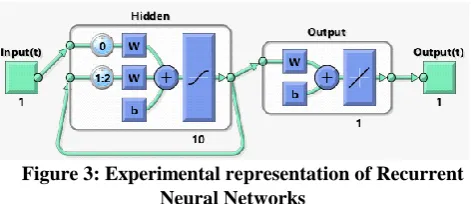
[image:4.595.307.551.49.133.2] [image:4.595.51.285.98.159.2]Working Algorithm: It works on the principle of adding immediate past knowledge to the present knowledge. On the basis of this principle, it is able to compare all the inputs and finds out the one that incurs minimum error while calculating the decision for navigating vehicle .The RNN’s have remarkable capability to use their internal state for the processing of sequential inputs which makes it possible to find out the decision on the basis of best input parameter. Figure 3 represents the working representation of RNN setup. It can be seen that the model is fed with one input at a time and weights are updated with the latest results. The resultant decision is stored in output vector.
Figure 3: Experimental representation of Recurrent Neural Networks
Output Vector: On the basis of best feature (having least mean square error), a response vector that is either to move or stop the navigating vehicle is generated. Table 1 shows the Mean Square Errors associated with all the eleven features. It shows that feature number four that is Difference Entropy has minimum error associated with it while calculating response vector
Table I: Error value of different features when passed through RNN module
S.No Feature name Error value
1 Correlation 0.040219
2 Sum Entropy 0.081771
3 Entropy 0.001292
4 Difference Entropy 3.4713e^-05
5
Information Measures of
correlation 0.14212
6 Kurtosis 0.083014
7 Contrast Measure 0.035352
8 Average Texture Energy from 0.014022
LE and EL Kernels
9
Average Texture Energy from
LS and SL kernels 0.15033
10
Fractal Dimension Texture
Analysis 2 0.0064261
11 Area 0.069365
C. Obtaining Response from Fuzzy Module:
Here, membership functions and fuzzy rules are devised on the basis of outputs generated by CNN and RNN and actual training data to take optimum decision. FL enhances the decision-making ability of a neural network system by providing more reliable out-put.
Input Vector: The outputs of CNN Model and RNN model are passed as inputs to this module
Working Algorithm: Fuzzy model generates rules to on the basis of outputs of CNN and RNN modules and the actual responses required. This hybrid model has considered all spatial features through CNN and all temporal relationships using RNN, thereby helps in generating more accurate results. The algorithm followed by the Fuzzy Module is as follows:
for (all the predicted responses) {
start counter = 0
if (actual response == predicted response) then counter++
end }
Accuracy= (Count/Total Responses) *100
Output Vector: The final decision that is Move (response-1) or stop (response-2) is generated by the end of this module
V. RESULTSANDDISCUSSIONS
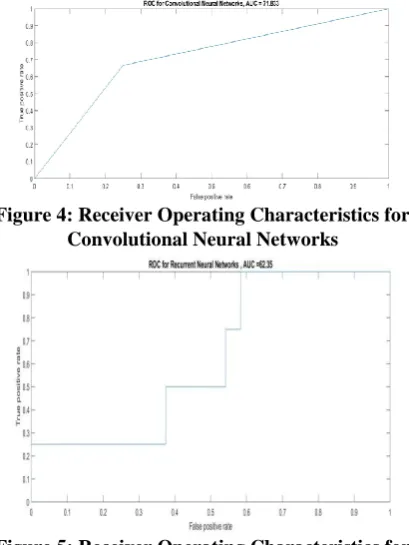
Final decision that is either to move or stop the navigating vehicle is calculated by this hybrid model. The proposed algorithm was stimulated using MATLAB. The training percentage is postulated to be ten percent only. Reason for the same has already been discussed in Section 3 of this paper. The model was tested for the rest of the dataset. Both CNN and RNN work upon specific number neurons at a time which enables the proposed model to get rid of irrelevant excess neurons. This selection of limited number of neurons is going to have direct impact on the speed of the proposed model. Fuzzy module corelates and collaborates the outputs of CNN module and RNN module. The figures 4 and 5 depict Receiver Operating Characteristics and Accuracy Under Curve for CNN and RNN respectively. The response graph of Fuzzy Module is as shown in Figure 6. The accuracy of this hybrid model comes out to be 89.28 percent which is far better than the individual accuracies of RNN model i.e. 62.35 and CNN model i.e. 71.83. The results show that the rules created by Fuzzy Module have been able to take more accurate decisions by considering the outputs of CNN model as well as RNN model against the desired response. Thus, this hybrid model paves way for
[image:4.595.52.288.430.532.2]Figure 4: Receiver Operating Characteristics for Convolutional Neural Networks
[image:5.595.63.271.368.475.2]Figure 5: Receiver Operating Characteristics for Recurrent Neural Network
Figure 6: Final response obtained by Fuzzy Module REFERENCES
1. Marwah,K. Sohal,J. (2018).“Improved Decision Making for
Navigation Scenarios” In AISC-Advanced Computational and Communication Paradigms: Proceedings Volume 2, pages 717–726. Springer.
2. Marwah,K. Sohal,J. (2019). “A unified CNN framework for intelligent
decision making related to navigation” In ICCES,2019: accepted to be published by IEEE Xplore Digital Library
3. Manning T, Sleator RD, Walsh P. (2014), “Biologically inspired
intelligent decision making: a commentary on the use of artificial neural networks in bioinformatics”, In Bioengineered, vol. 5, pp. 80-95.
4. Pomerleau,D.(1993).“Rapidly Adapting Artificial Neural Networks for
Autonomous Navigation”, In Advances in Neural Information Processing Systems.
5. Wang,J. Zhang,,Y.,(2009) .“An GPS/DR Navigation System Using
,Neural Network for Mobile Robot”, in IEEE Explore
6. Kaneko,S. Hua,B. (2015).“Neural Network based Guide Robot
Navigation: An Evolutionary Approach” ,In IEEE International
Symposium on Robotics and Intelligent Sensors (IEEE
IRIS2015),Volume 76, 2015, Pages 74–79.
7. Jefferson R Souza.(2011).“Vision-based Autonomous Navigation
Using Neural Net-works and Templates in Urban Environments”, In SAC '11 Proceedings of the 2011 ACM Symposium on Applied Computing, Pages 1376-1381
8. Kim D, Chen T.(2015).“Deep Neural Network for Real-Time
Autonomous Indoor Navigation” arXiv preprint 14 arXiv:1511.04668
9. Pradhan,S.eta.l(2009).“Fuzzy logic techniques for navigation of
several mobile robots” In Applied Soft Computing , Elsevier Volume 9, Issue 1, January 2009, Pages 290–304, Elsevier
10. Hong T.,Nakhaeinia D. , Karasfi B.(2012).“Application of Fuzzy
Logic in Mobile Ro-bot Navigation” Intech,2012
11. Raguraman S.M.(2009). “Mobile robot navigation using Fuzzy logic
controller” In Con-trol, Automation, Communication and Energy Conservation, 2009.
12. Faisal,M., etal.(2013).“Fuzzy Logic Navigation and Obstacle
Avoidance by a Mobile Robot in an Unknown Dynamic Environment” In International journal of advance robotic systems
13. Omrane,H.(2016).“Fuzzy Logic Based Control for Autonomous
Mobile Robot Navigation” In Computational Intelligence and Neuroscience Volume 2016,Article No.20 Hindawi Publishing Corp. New York, NY, United States.
14. Mohanty P. Parhi D. (2014),“Navigation of autonomous mobile robot
using adaptive network based fuzzy inference system”, In Journal of Mechanical Science and Technol-ogy , Volume 28, Issue 7, pp 2861–2868
15. Joshi M. ,Zaveri, M.(2010), “ Neuro-fuzzy based autonomous mobile
robot navigation system”, In Control Automation Robotics & Vision (ICARCV),IEEE Explore.
AUTHORSPROFILE
Khyati Marwah has done B.Tech from Kurukshetra in 2005 University ,M.Tech from IKGPTU in 2011 and now pursuing PhD from IKGPTU .Her research domain comprises of neural networks ,soft computing techniques. She has her publications in the field of Intelligent Systems and Navigation Systems. She has around 14 years of teaching experience. She has been teaching Computer Science Engineering graduate and post graduate students. She has been guiding B.Tech students in their project work and M.Tech students in their research work in the field of Neural Networks and Soft computing techniques
Dr.J.S.Sohal is former director of Ludhiana College of Engineering and Technology. , Ludhiana ,India. He is also Ex-Chairman of Board of Studies for the
Computer Science Division under Punjab