International Journal of Innovative Technology and Exploring Engineering (IJITEE) ISSN: 2278-3075,Volume-8 Issue-3C, January 2019
Abstract: Background/Objectives: Due to dynamic topology change, network partitioning happens frequently in military ad hoc networks. To provide communications between partitioned networks, relay node is required to maintain connectivity in this network. Methods/Statistical analysis: As the candidate for relay node, an unmanned aerial vehicle is concerned while taking into connectivity and mobility account. In order to act as relay node, it is very important to place unmanned aerial vehicle in appropriate position. Also, since military ad hoc networks are generally constructed in hierarchical structure, an new positioning algorithm should take this issue in design. Findings: Unlike the previous positioning algorithms, which take flat network architecture, our approach is based on the clustering. The first positioning algorithm is proposed for the partitioning case with two cluster heads. According to the distance between cluster head and unmanned aerial vehicle, initial position of relay node is set. In addition, this algorithm is extended to cover case of multiple cluster heads. Simulation result demonstrates that the proposed algorithm works properly by maintaining connectivity over 98 percent as the number of cluster heads increases. Improvements/Applications: The proposed algorithm can be applied into other mobile ad hoc networks such as vehicular ad hoc networks by being integrated with the localization algorithm.
Keywords: military ad hoc networks, unmanned aerial vehicle, relay node, positioning, mobility model
I.INTRODUCTION
Recently, research for typical ad hoc networks is mostly conducted to apply the current protocols in specific applications such as military or tactical ad hoc networks [1], flying ad hoc networks and so on. The main objective of these research projects are to evaluate the performance of the existing protocols in specific mobility model and network architecture. And, according to evaluation of suitability, the parameter and operation of each protocol are slightly modified and adjusted for the specific objectives.
More detailed, military ad hoc networks reveal specific architecture, which consist of military vehicles and soldiers. Their mobility pattern is not the same as the typical one in that mobility pattern is characterized by group movement. Also, the network architecture for military ad hoc networks is based on clustering which consists of cluster head and members. In this network, connectivity between nodes may be broken when there is no relay node between clusters. To provide
Revised Manuscript Received on January 03, 2019.
SangWoo Jung, Department of Computer Science and Engineering, Chungnam National University, 99 Daehak-ro Yuseong-gu, Daejeon, 34314, Korea.
Ki-Il Kim, Corresponding author, Department of Computer Science and Engineering, Chungnam National University, 99 Daehak-ro Yuseong-gu Daejeon, 34314, Korea.
BongSooRoh, Jae-Hyun Ham, The 2nd R&D Institute, Agency for Defense Development, Daejeon, 34186, Korea.
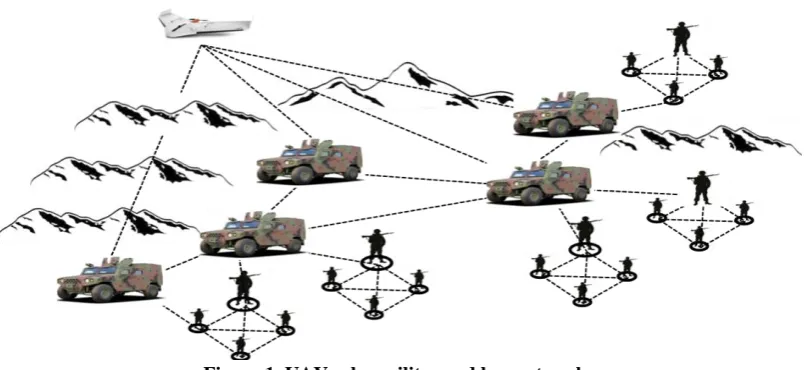
seamless connection, many research literatures tend to employ relay node in military ad hoc networks. As candidate for relay node, a Unmanned Aerial Vehicle (UAV) becomes popular with benefit of coverage, easy and quick deployment and low cost as shown in Figure 1.
The technical challenges and issues for UAV relay node are well described and analyzed in [2-3]. First, three important typical cases such as UAV-coverage, UAV-relay and UAV data collection and dissemination are introduced in [2]. Not only data link protocol and channel information but also further research challenges like energy efficiency are studied and discussed. Also, mobility model for UAV for relay and dissemination is addressed. In addition, detailed and in-depth analyses for UAV communications are surveyed in [3]. In this survey, a UAV network is defined as one of mobile ad hoc networks. Moreover, unique characteristics and features of UAV networks are explained. In addition, routing issue through analysis of suitability of existing protocols is clearly mentioned. In the other hand, energy efficiency issue in UAV networks is also analyzed. Finally, research approaches for energy efficiency in UAV networks are compared in layered architecture.
In addition to wireless communication in UAV networks, it is required to develop mobility pattern for the performance evaluation on diverse scenarios. Specially, since military ad hoc networks aided by UAV reveal the many different network environments as compared to typical ad hoc networks, it is important to decide the positioning of relay nodes accordingly. However, there is no research work to focus on UAV positioning algorithm in military ad hoc networks yet. To defeat this problem, in this paper, we present a new positioning algorithm in military ad hoc networks under clustering architecture. A new algorithm is based on practical deployment cases where network partition is handled by the UAV relay. The UAV position is determined by considering the distance and UAV transmission range together.
The rest of this paper is organized as follows. Followed by the introduction, we describe the related work, UAV positioning mechanism in existing literatures. Then, we explain a new algorithm in the section 3. In the section 4, we explain the simulation results and analysis. Finally, we make a conclusion and further study.
A New Positioning Algorithm of UAV in
Military Ad Hoc Networks
1
Figure 1. UAV relay military ad hoc networks
II.MOBILITYMODELFORUAV
In typical ad hoc network, many mobility models are discussed and developed. However, mobility model should reflect the network environment and node feature at the same time. Thus, according to mission of UAV, different mobility models are employed and introduced in UAV networks. In this section, we describe the related work to focus on mobility model for UAV.
First, practical mobility model called Paparazzi UAV movements[4] is introduced. In order to obtain realistic UAV movement, a popular UAV system based on Pararazzi is employed. Paparazzi Mobility Model (PPRZM) consists of five status, that is, stay-At, way-point, eight, scan and oval. In this model, it is assumed that a UAV belongs to one status and changes its status according to stochastic mobility model. More mobility models are explained and surveyed in [5]. Specially, A. Bujari et al. present the UAV ad hoc networks scenarios and mobility model, which is able to overcome the single UAV scenario and mobility model. In this article, five mobility models, that is, pure randomized mobility models, time-dependent mobility models. Path-planned mobility models, group mobility models, and topology-control–based mobility models are presented. Moreover, each mobility model is mapped to realistic UAV movement scenario.
If the above two literatures focus on the general mobility model, mobility model for UAV relay model is addressed in some papers. Li B et al. present communication relay system as quadrotor and implementation of hardware and software platform for experimental evaluation in [6]. However, this work does not mention the UAV positioning algorithm for relay. UAV relay system for surveillance [7] is presented to overcome limited communication range and achieve communication to distant targets. To accomplish the mission, positioning problem to take into quality measure account is addressed by defining Pareto-optimal chains. This is based on graph search and label-correcting algorithm for multiple intermediate relay UAVs. In addition, a new dual ascent algorithm for specific tasks is also proposed. However, the proposed scheme is not concerned for the military ad hoc networks and clustering architecture. Next literature is to address positioning problem on a multiple-access
multiple antennas UAV are assumed. The simulation results prove that UAV positioning leads to better uplink communications performance.
Another paper [9] is to address the positioning of UAV in a three-dimensional complex urban environment with team of ground nodes and vehicles. The particle swarm optimization is used to find the UAV position to meet the requirement. Simulation results are given to benefit and feasibility of relay UAVs. P. Ladosz et al. [10] propose how to meet user experience on watching live videos through UAV by controlling the positioning of UAV. To avoid the disruption caused by the UAV movement, UAV acts as relay node. Thus, it is very critical and important problem to decide the position of relay node. The authors propose a relay placement mechanism called MobiFANET to meet the Quality of Experience (QoE) by making use of location information and predicting route failures. Simulation results demonstrate the satisfaction of multimedia requirement on several FANET scenarios. Another literature [11] based on case studies in FANET is to address positioning problem by proposing a flight path planning model. The proposed scheme is based on artificial neural networks to obtain the most optimized positioning of relay node in order to increase the throughput. The last paper is very similar to [12] in that the main objective of research is to maximize the throughput. The two models, a heuristic method and an approximation algorithm, are proposed in this work. Extensive simulation through MATLAB and ns-2 simulator is given to demonstrate the impact of UAV positioning. According to simulation, throughput can be enhanced by placing UAV when user positions are unevenly distributed and/or data rate demands are widely spread.
III.PROPOSEDSCHEME
International Journal of Innovative Technology and Exploring Engineering (IJITEE) ISSN: 2278-3075,Volume-8 Issue-3C, January 2019
the group mobility model such as Reference Point Group Model controls the movement within a cluster. The proposed algorithm is explained by cases for network partitioning.
3.1.Relay between two clusters
[image:3.595.91.508.105.216.2]When two clusters are disconnected in military ad hoc networks, UAV acts as relay node to provide connectivity. An example of this scenario is illustrated in Figure 2.
Figure 2. Scenario for relay between two clusters The positioning algorithm starts by determining the
position of UAV1. If the UAV1 is enough to connect CH1 and CH2, the algorithm is terminated. However, if it is not available, another UAV, UAV2, is placed. It is repeated until the two cluster heads are connected by relay UAVs. The detail of algorithm is below.
Algorithm 1UAV positioning algorithm in case of two clusters
1: UAV(i)x,y,z: ith UAV position in three dimensional space
2: CH(i)x,y,z: ithcluster head position in three dimensional
space
3: Dis(a,b) : Euclidean distance between a and b 4: TR(a) : Transmission range of a
5: i = 0, j = 0 6: flag = 0
7: if(Dis(CH(j), CH(j+1)) >TR(CH(j)) then
8: UAV(i)x = CH(j)x + TR(CH(j))
9: UAV(i)y = CH(j)y
10: UAV(i)z = RANGE(0,
) 11: while (flag == 0)
12: if(Dis(UAV(i), CH(j+1)) <TR(UAV(i)) then 13: flag = 1
14: else
15: UAV(i+1)x = UAV(i)x + TR(UAV(i)) 16: UAV(i+1)y = UAV(i)y
17: UAV(i+1)z = UAV(i)z 18: i++
19: end if 20: end while 21: end if
Algorithm 1 starts checking whether two clusters are disconnected. In the case of disconnection in line 7, UAV(0) need to be acted as relay node. To determine the position, x axis value is computed by adding CH(i)x and its transmission range. While y axis value is maintained, z axis value is ranged from 0 to any possible value to meet the condition, that is, distance should be less than the transmission range of UAV(i).
If the UAV(i) is enough to connect two cluster heads, the algorithm is terminated. However, if the transmission range of UAV(i) cannot reach to CH(i+1), it is required to add UAV(i+1) by determining the position of UAV(i+1). The position of UAV(i+1) set to new position as described in line 14– 19. Similar to UAV(i), the position is computed by the referring to UAV(i) position instead of CH(i). This procedure will be repeated until distance between a new UAV and CH(i+1) is bounded from the UAV transmission range.
3.2.Relay between multiple clusters
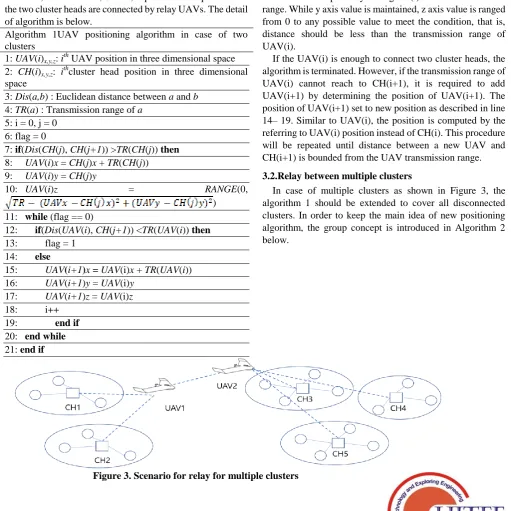
In case of multiple clusters as shown in Figure 3, the algorithm 1 should be extended to cover all disconnected clusters. In order to keep the main idea of new positioning algorithm, the group concept is introduced in Algorithm 2 below.
[image:3.595.42.554.275.786.2]Algorithm 2UAV positioning algorithm in case of multiple clusters
1: UAV(i)x,y,z: ith UAV position in three dimensional space
2: CH(i)x,y,z: i th
cluster head position in three dimensional space
3: GROUP(i)x,y,z: ithvirtual group position in three
dimensional space
4: Dis(a,b) : Euclidean distance between a and b 5: TR(a) : Transmission range of a
6: NUM_CH : Number of cluster heads 7: NUM_GROUP : Number of groups 8: i= 0, k = 0
9: whilek<NUM_CH
10: if(Dis(CH(k), CH(k+1)) <TR(UAV(i)) then 11: CH(k), CH(k+1) belongs to GROUP(i)
12: GROUPx,y,z = (CH(k)x+CH(k+1)x)/2,
(CH(k)y+CH(k+1)y)/2, (CH(k)z+CH(k+1)z/2) 13: UAV(k)x,y,z = GROUPx,y,z
14: end if 15: k++ 16: end while 17: k = 0
18: whilek<NUM_GROUP
19: perform algorithm 1 for two groups
20: perform algorithm 1 for GROUP and its CH 21: end while
Algorithm 2 starts grouping for each cluster. The grouping is accomplished by measuring the distance between clusters. If the distance between two clusters is less than the transmission range of UAV, new group is created with two clusters. In addition, if the group is newly made, a group position is computed by mean of two clusters. If the grouping procedure is done for all clusters, algorithm 1 is performed for two groups. This implies that two groups in algorithm 2 replace two clusters. Then, relay node between GROUP and CH is required, a UAV is placed between them by the algorithm 1 in recursive way.
IV.PERFORMANCEEVALUATION
In this section, we present the simulation results for the proposed algorithm for connectivity through simulation, which was implemented in C. We measure the connectivity as the number of cluster heads increases. All nodes move according to RPGM models with different mobility speeds. The network size is set to 500 m x 500 m and transmission range of UAV sets to 30 m. Maximum number of each cluster member in one cluster is set to 4.
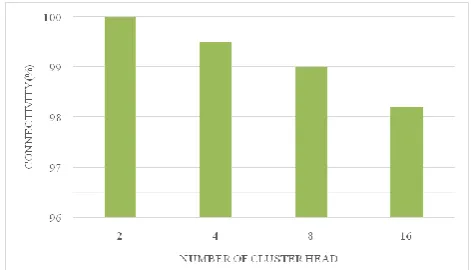
Figure 4. Connectivity as a function of number of cluster head
Figure 4 illustrates the connectivity between cluster heads. It is computed by dividing sum of disconnected time of all nodes and simulation time. In case of the small number of cluster head, connectivity is maintained as 100 percent without regards to mobility. However, as the number of cluster heads increases, the connectivity is slightly reduced. This is mainly because the setup time in algorithm 2 to make groups in sequential way. In addition, mobility causes the topology changes, more time is taken to set relay node. If the number of relay nodes increases, the more time is demanded. In this time, the connectivity is not guaranteed so less connectivity is observed in Figure 4. However, it is less than 2 percent so it does not hurt greatly for the performance.
V.CONCLUSION
In this paper, we proposed a UAV relay positioning algorithm in military ad hoc networks where the clustering network architecture is assumed. The proposed scheme is based on simple model with two cluster heads and extended to cover multiple cluster heads. Simulation results are given to demonstrate the connectivity is well maintained without regard to mobility and number of cluster heads.
Related to this scheme, more analysis for diverse performance evaluations will be performed. In addition, we will focus on the reducing the number of UAV relay nodes in the case of multiple cluster heads. Since this is related to group algorithm, more intelligent grouping algorithm will be studied.
ACKNOWLEDGMENT
This work has been supported by the Small-scale Mobile Adhoc Network with Bio-networking Technology Project of Agency for Defense Development(UD170097ED).
REFERENCES
1. KangT, Lee J. A study on qos routing scheme for tactical adhoc network. Paper presented at the Proceedings of International Congress on Computer Applications andComputational Science. 2012.
[image:4.595.313.549.61.196.2]International Journal of Innovative Technology and Exploring Engineering (IJITEE) ISSN: 2278-3075,Volume-8 Issue-3C, January 2019
3. Gupta L, Jain R, Vaszkun G. Survey of important issues in UAV communication networks. IEEE Communications Surveys & Tutorials. 2016; 18(2): 1123-52.
4. Bouachir O, Abrassart A, Garcia F, Larrieu N. A mobility model for UAV ad hoc network", Paper presented at the Proceedings of International Conference on Unmanned Aircraft Systems. 2014. 5. BujariA, Calafate C, Cano J, Manzoni P, Palazzi C, Ronzani D. Flying
ad-hoc network application scenarios and mobility models. 2017; 13(10).
6. Li B, Jiang Y, Sun J, Cai L, Wen C. Development and testing of a two-UAV communication relay system. MDPI Sensors. 2016. 16(10). 7. Burdakov O, Doherty P, Holmberg K, Kvarnstrom J, Olsson P. Relay
positioning for unmanned aerial vehicle surveillance. The International Journal of Robotics Research. 2010; 29(8): 1069-87.
8. Jiang F, Swindlehurst A. Dynamic UAV relay positioning for the ground-to-air uplink. Paper presented at the Proceedings of IEEE Globecom Workshop. 2010.
9. Ladosz P, Oh H, Chen W. Optimal positioning of communication relay unmanned aerial vehicles in urban environments. Paper presented at the Proceedings of International Conference on Unmanned Aircraft Systems. 2016.
10. Rosario D, Filho J, Rosario D, Santosy A, Gerla M. A relay placement mechanism based on UAV mobility for satisfactory video transmissions. Paper presented at the Proceedings of 16th Annual Mediterranean Ad Hoc Networking Workshop. 2017.
11. Jailton J, Carvalho T, Araújo J, Francês R. Relay positioning strategy for traffic data collection of multiple unmanned aerial vehicles using hybrid optimization systems: a FANET-based case study. Wireless
Communications and Mobile Computing, 2017. DOI:
10.1155/2017/2865482.