http://www.scirp.org/journal/cweee ISSN Online: 2168-1570
ISSN Print: 2168-1562
A Study on Importance and Role of Irrigation and
Hydropower Plant Operation in Integrated River
Basin Management
Cengiz Koç
Department of City and Regional Planning, Faculty of Architecture, Muğla Sıtkı Koçman University, Muğla, Turkey
Abstract
In this study, 16 irrigation schemes (Baklan, Irgıllı, Sütlaç, Çal, Çürüksu, Nazilli, Sarayköy, Pamukkale, Sultanhisar, Akçay, Aydın, Topçam, Karpuzlu, Işıklı, Gümüşsu ve Söke) having 166,381 hectares, built by State Hydraulic Works (DSI), and operat-ed by participatory irrigation managements, and 14 hydroelectric power plants (HPP) operated and built on dams, canals and rivers by the public and private sec-tors are examined in the Büyük Menderes basin which is an important basin in terms of the agriculture, energy and ecology projects. Integrated basin management prac-tices and the importance and role of irrigation and hydropower plant operation in integrated basin management, how it should be, optimal use of available water re-sources for irrigation and hydroelectric power plant operation, irrigation relationship with canal hydropower plants, operated under integrated basin management of irri-gation and hydropower plants, environment and the ecological effects have been stu-died, and integrated basin management with the existing basin management condi-tions in terms of hydropower plant and irrigation operation on the basis of data of 2015 have been compared, reached important conclusions, and made recommenda-tions on the subject.
Keywords
Hydropower Plant, Irrigation, Integrated Basin Management, Operation, Büyük Menderes Basin, Turkey
1. Introduction
Integrated River Basin Management (IRBM), dealing with surface and ground water, soil and water resources in the basin boundaries, relationship between upstream and downstream of the basin, the relationship water using for different places and different purposes, and management, the determination of the basic relationships with water How to cite this paper: Koç, C. (2017) A
Study on Importance and Role of Irrigation and Hydropower Plant Operation in Inte-grated River Basin Management. Computa-tional Water, Energy, and Environmental Engineering, 6, 1-10.
http://dx.doi.org/10.4236/cweee.2017.61001
Received: September 21, 2016 Accepted: November 18, 2016 Published: November 21, 2016
Copyright © 2017 by author and Scientific Research Publishing Inc. This work is licensed under the Creative Commons Attribution International License (CC BY 4.0).
ecosystems in need of water, and to ensure cooperation between these relationships mentioned is to establish the legal and institutional mechanisms. When considering the concept of sustainable development, IRBM offers the most convenient way and assur-ance to ensure multi-purpose use of water systems reacting environmental functions for present and future generations.
The concept of integrated basin water management is considered the possibilities cycle, re-use, water demand, benefits, relations between human activities and the natu-ral environment that supports the deterioration in water quality due to pollution [1]. Integrated river basin management, according to the traditional water management is to use of a broader perspective, and includes pollution control and prevention, land use planning, agriculture policy, erosion control, environmental management and other political elements.
Integrated management is described as the planning of activities including manage-ment and use of natural resources existence of social, political, economic and institu-tional factors, taking into account for sustainable management and planned of natural resources in the basin [2]. With integrated basin management, conservation and sus-tainable use of the basins, which is effective in all institutions, policies and activities of the authorities and individuals, are given the provision of effective and regular coordi-nation [3]. Hydroelectric production meets 19% of the world’s energy requirements and constitutes one of the major driving forces behind the construction of the 45,000 large dams available in the world [4]. Electricity generation is very small effect on the amount of water (limited losses by evaporation from dams), but the release time of wa-ter for electric production according to demand curve is to change the hydrograph of river flows.
This situation is the cause of conflicts between the downstream user including eco-logical systems and hydroelectric, irrigation [5]. Integrated river basin management is composed of four independent elements. These are legal-institutional framework, plan-ning, operation management and analytical support [6]. Each element reveals funda-mental operable above the other. Four elements are important for integrated river basin management; however, management, because it directly affects the river basin is be-coming much more important.
In this study, integrated basin management practices, the importance and role of ir-rigation and hydropower plant operation in integrated basin management, how it should be, optimal use of available water resources for irrigation and hydropower plant operation, irrigation relationship with canal hydropower plants, operated under inte-grated basin management of irrigation and hydropower plants, environment and the ecological effects have been studied.
2. Material and Method
Figure 1. The location of Büyük Menderes Basin in Turkey.
by a number of streams in the basin. In summer, a great number of these tributaries dry. In Büyük Menderes Basin, effects of both Mediterranean and continental climates are visible. The average flow rate of Büyük Menderes River is 110 m³∙s−1[7]. Basin- across, average annual rainfall is 650 mm; more than 70% of the precipitation falls in winter and spring. Annual average water potential of the Büyük Menderes river is 3 bil-lion 30 milbil-lion∙m3, of this amount, 2.7 billion∙m3 (90%) is controlled by storage facilities (dams) built in the basin. The most important storage facilities in Büyük Menderes ba-sin are Isıklı Lake, Adıgüzel, Cindere, Gökpınar, Kemer, Çine, İkizdere, Yenidere, Topçam and Karpuzlu dams. Approximately 90% of the basin water resources, agricul-ture, the rest of the potable, tourism, industry and ecology are used.
Project irrigation area, type of irrigation schemes, water intake structure, the date of operation, water supply way of irrigation schemes located in Great Menderes basin are given in Table 1 [8]. All irrigation schemes of the basin are managed by Water User Associations. Land use in the basin consists of 44% agricultural, 33% semi-natural areas, 20% forested, 2% rural and urban areas and 1% in surface waters.
The amount of water used per hectare irrigation rate and irrigation efficiency in the irrigation schemes studied is calculated by the computer program Excel. The amount of water used per hectare (m³∙ha−1) is calculated the total amount of water taken into the scheme divided by total irrigated area; irrigation rate (%), the actual irrigated area di-vided by the net irrigation; irrigation efficiency (%), total net water consumption of the crop grown in irrigated area divided by the total amount of water taken into the scheme. 14 HPPs in Büyük Menderes basin were built and under operation services (Figure 2).
Table 1. Characteristics of the Büyük Menderes basin irrigation schemes [11].
Name of
irrigation scheme operation Date of
Irrigation area (ha) Type of irrigation scheme Water supply type
Water intake structure Brut Net Classic Flume Pipe Gravity Pump
Pamukkale 1946 10.556 8.593 Classic Pump Pump Sta.
Sarayköy 1961 10.582 8.245 Classic Gravity Regulator
Nazilli 1943 18.485 15.000 Classic Flume Gravity Regulator
Sultanhisar 1998 7.360 4.740 Classic Pipe Gravity Regulator
Akçay 1965 18.493 14.900 Classic Flume Gravity Regulator
Aydın 1991 18.500 16.500 Classic Flume Gravity Pump Regulator
Söke 1981 29.135 26.000 Classic Gravity Regulator
Topçam 1985 4.980 4.300 Classic Flume Gravity Pump Dam + Pump
Karpuzlu 1998 3.600 2.800 Classic Pipe Gravity Dam
Çürüksu 1986 12.250 9.212 Classic Flume Gravity Regulator
Irgıllı 1964 5.410 2.900 Classic Gravity Regulator
Sütlaç 1996 3.000 2.880 Classic Gravity Pump Regulator
Baklan 1991 47.400 42.421 Classic Flume Pipe Pump Pump Sta.
Gümüşsu 1992 2.200 1.600 Classic Pump Pump Sta.
Çal 1996 1.840 1.730 Classic Flume Gravity Regulator
Işıklı 1965 2.700 1.660 Classic Gravity Regulator
[image:4.595.49.557.101.713.2]Table 2. Characteristics of the Büyük Menderes Basin Hydroelectric power plants.
Name of
HPP Province Date of operation Name of operation organization Location of HPP Total installed capacity MW Project production value GWh∙year−1 Production year of 2015 GWh∙year−1 Realization rate %
Feslek Aydın 2004 Production Company Bereket Energy Irrigation Channel Nazilli Right Bank 8.84 41.00 18.56 45
Başaran Aydın 2006 Production Company Ekin Energy Irrigation Channel Nazilli Left Bank 0.60 4.27 0.91 21
Akçay Aydın 2009 Production Company Akçay Energy Akçay Irrigation Main Channel 28.78 94.88 78.46 82
Sırma Aydın 2009 Production Company Beyobası Energy Akçay Irrigation Main Channel 5.88 23.20 20.23 89
Kemer Aydın 1958 EÜAŞ (Public) Kemer Dam 48.00 143.00 122.21 85
Cindere Denizli 2008 Production Company Entek Energy Cindere Dam 28.50 88.10 53.31 61
Adıgüzel Denizli 1990 EÜAS (Public) Adıgüzel Dam 62.00 280.00 128.53 46
Çal Denizli 2001 Production Company Limak Energy Main Channel Çal Irrigation 2.20 11.75 12.90 110
Bereket I-II Denizli 1998 Production Company Bereket Energy Çürüksu Right Bank Channel 3.15 12.00 13.05 109
Dodurgalar I-II Denizli 2004 Production Company Elta Energy I-II Channel Dodurgalar 4.14 12.00 11.66 97
Ege I Denizli 2009 Production Company Denizli Energy Bank Channel Çürüksu Left 0.92 4.38 3.11 71
Bekilli Denizli 1954 Bekilli municipality Main Channel Çal Irrigation 0.33 0.40 0.33 83
(State Hydraulic Works) and the Energy Market Regulatory Authority (EMRA), private sector investment especially starting from 2007 showed a large increase. The first stage of the application and licensing process for HPP facilities is delivered to DSI the feasi-bility report prepared for the project in question. Reviewed of reports by the DSI and with accepted companies the Water Use Right Agreement is signed and sent to EMRA to receive electricity generation license. After the receiving of Environmental Impact Assessment (EIA) Positive Certificate and HPP construction license, HPP facility is es-tablished and operated [9][10]. To enable comparisons across countries and time, local unit’s currencies were converted to international standard units and constant US$ dol-lar prices.
3. Conclusions
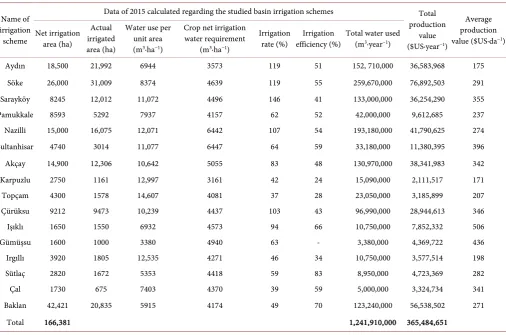
calculated. For the year 2015 that the study was conducted in the irrigation scheme, ir-rigation water used in unit area (ha) amount, net irir-rigation water requirements of plants, irrigation rate, irrigation efficiencies, total irrigation water used in the scheme, the total production value and average production values belonging to the irrigation schemes is given in Table 3. Settlement system and position of irrigation schemes op-erated according to the principle of integrated river basin management are arranged from downstream to upstream in the basin. Water, returning from an irrigation scheme is the water source of the other scheme. Total net irrigation area of 16 irrigation schemes operated in the basin is 166,381 hectares; total irrigated area is calculated as 141,449 hectares. Approximately 85% of net irrigation area is irrigated virtually. Irriga-tion water used unit area (ha) varies 3380 to 14,607 m3∙ha−1 in the basin irrigation schemes. Showing differences of irrigation water used unit area (ha) in the basin irriga-tion schemes stem from differences of soil structure in their irrigairriga-tion area, climatic conditions, crop pattern, irrigation season length, field irrigation methods used in the irrigation area, and the inability to serve irrigation management organizations engaged in water distribution. Therefore, using an average value in calculations is not appropri-ate. Irrigation rate varies between 37% and 146%.
Irrigation rates in irrigation scheme studied vary quite a different and wide range.
[image:6.595.46.553.404.739.2][12], the irrigation schemes operated by State Hydraulic Works the in the years 1979 to 1990, irrigation rates show a quite different ranging from 117% to 32%. Irrigation rates,
Table 3. The calculated 2015 data of Büyük Menderes basin irrigation schemes.
Name of irrigation
scheme
Data of 2015 calculated regarding the studied basin irrigation schemes Total production
value ($US∙year−1)
Average production value ($US∙da−1) Net irrigation
area (ha)
Actual irrigated area (ha)
Water use per unit area (m3∙ha−1)
Crop net irrigation water requirement
(m3∙ha−1)
Irrigation
rate (%) efficiency (%) Irrigation Total water used (m3∙year−1)
Aydın 18,500 21,992 6944 3573 119 51 152, 710,000 36,583,968 175
Söke 26,000 31,009 8374 4639 119 55 259,670,000 76,892,503 291
Sarayköy 8245 12,012 11,072 4496 146 41 133,000,000 36,254,290 355
Pamukkale 8593 5292 7937 4157 62 52 42,000,000 9,612,685 237
Nazilli 15,000 16,075 12,071 6442 107 54 193,180,000 41,790,625 274
Sultanhisar 4740 3014 11,077 6447 64 59 33,180,000 11,380,395 396
Akçay 14,900 12,306 10,642 5055 83 48 130,970,000 38,341,983 342
Karpuzlu 2750 1161 12,997 3161 42 24 15,090,000 2,111,517 171
Topçam 4300 1578 14,607 4081 37 28 23,050,000 3,185,899 207
Çürüksu 9212 9473 10,239 4437 103 43 96,990,000 28,944,613 346
Işıklı 1650 1550 6932 4573 94 66 10,750,000 7,852,332 506
Gümüşsu 1600 1000 3380 4940 63 - 3,380,000 4,369,722 436
Irgıllı 3920 1805 12,535 4271 46 34 10,750,000 3,577,514 198
Sütlaç 2820 1672 5353 4418 59 83 8,950,000 4,723,369 282
Çal 1730 675 7403 4370 39 59 5,000,000 3,324,734 341
Baklan 42,421 20,835 5915 4174 49 70 123,240,000 56,538,502 271
actualized between 146% and 37% in the basin irrigation schemes as well as in other irrigation schemes operated in our country show quite wide and different distribution. Irrigation ratios are realized at high levels in the irrigation schemes that cotton, vegeta-bles and citrus are grown extensively. Reasons of the low irrigation rate in the irrigation schemes are the scheme physical deficiencies, lack of water resources, and no irrigation of grain sowing areas. In order to increase irrigation rate in the irrigation scheme, it is increasing proportionally with the increase of production value. Low irrigation rates in the irrigation schemes lead to a reduction of the value of project production.
Irrigation efficiency which is an indicator whether used effective in line with the re-quirements of the water in the irrigation scheme, varies between 24% and 70%. Irriga-tion efficiency is the rate of meet the requirements of the existing water resources. Plasquellec et al. (1990) stated that Asia, Africa and in their study in some of the larger- scale gravity irrigation schemes in Latin America project, irrigation efficiencies vary between 26% and 70%, and often close to 40% [13]. Irrigation efficiencies of irrigation schemes studied are also consistent with these values. Irrigation efficiency is directly related to the amount of water taken into the scheme. Irrigation efficiency increase re-sulting from the use of technology in the basin irrigation scheme is not seen too much. The total amount of water used in the basin irrigation scheme is 1,241,910,000 m3∙year−1, which is about half of the basin water resources used for irrigation. The total production value obtained by the cultivation of the plants in irrigation schemes is actu-alized as 365,484,651 $US∙year−1. Production value obtained per unit area in the irriga-tion scheme ranges between 171 and 506 $US∙da−1, and average production value of per unit area is calculated as 302 $US∙da−1. The average production value of unit water in the examined basin irrigation schemes is calculated as 0.40 $US∙m−3. The highest pro-duction value of unit water is realized Gümüşsu, Işıklı, Çal, Sütlaç, Baklan and Irgıllı ir-rigation schemes; the calculated values are 1.29, 0.73, 0.66, 0.53, 0.47 and 0.33 $US∙m−3 respectively. Other irrigation schemes range 0.14 to 0.30 $US∙m−3. The data on project production value and production values in year of 2015 of hydroelectric power plants operated in the basin are presented in Table 2. Realization rate of energy production based on the project production value of HPPs ranged from 21% to 110%.
optimum energy production that HPPs studied is linked or above the irrigation schemes; Basin General Irrigation Scheduling should be prepared with a technical study by stakeholder used water and operation stage should be carried out with the same care and stakeholders. Total production value of energy derived from hydroelectric power plants is calculated as 33,918,139 $US∙year−1 (average electricity sales price 7.32 cen-tUS∙kWh−1). Unit water production value of hydroelectric power plants could not be assessed because of the amount of water used cannot be determined reliably.
Total production value obtained from irrigation and hydroelectric production is rea-lized as 399,402,790 $US. The production value derived from agricultural production depends on irrigation is higher than obtained from energy. Especially, examined basin irrigation schemes and hydroelectric power plants built in conjunction, as they run to-gether, the amount of water used should be planned so as to make optimum benefits from both sectors.
4. Recommendations
Recommendations for operation at the desired level with irrigation systems and hy-droelectric power plants in the examined basin are given below.
Dry period being the lack of water resources, managers of the irrigation system should use simulation models and irrigation programs to provide assistance to water users as Basin General Irrigation Plan is prepared.
In order to save water and improve field irrigation efficiency, the using of pressure field irrigation systems (sprinkler, drip) should be expanded in medium pressure closed (pipe) systems built by DSI.
Water-saving irrigation techniques to reduce amount of water used per unit of land should be used and irrigation wage policy, encouraging water users should be deter-mined in the exadeter-mined basin irrigation schemes. Focusing on the amount of water used in irrigation charge methods (volume, time or number of irrigation) should be identi-fied. This will increase the amount of water used in hydroelectric power plants, the management in the preparation of the necessary plans for the hydroelectric operations and irrigation will provide the necessary flexibility. [14], South Sri Lanka are reported the amount of water used per unit area is higher than the standard, this stem from deep infiltration that occurs in agricultural areas, incompetence of the staff with the current water management organization, the use of continuous flow operation method in the period when there is plenty of water.
Hydroelectric Power Plant projects to be developed in the areas should be planned to the integrated river basin management. Integrated basin planning should be established by including representatives of various professional disciplines, local governments and civil society organizations.
Ap-proaches based sector for water resources (only irrigation/energy) were effective in the past and still continues its activities. This type of approach leads to division and lack of coordination to the development and management of resources [16]. All planning to be made related to water resources in the basin; To be determined the present water po-tential and to be able to do the correct calculations of future, data of collected with ap-propriate method and presented to service of the user should be based.
In the preparation phase of the hydroelectric power plant projects in the basin; the people living in the area, the river inside live life, the water requirement of flora and fauna, sustainability of ecological systems, degradation status of forest, pasture, and in land, region-specific facility type selection, geological, topographic, climatic conditions of the facility areas, projects social and cultural effects, should be adequately assessed.
Early detection of regional water needs, to be regulated in a position to prevent the use of the water, to arrange conditions such as unwillingness to produce at the same time of upstream and downstream hydroelectric power plants, to ensure the up-stream-downstream relations and control of water; necessary work and basin manage-ment system must be planned.
National methods for the determination of water released into the river bed from HPP to ecological should be developed. Determining this method, its own characteris-tics and characterischaracteris-tics of the surrounding ecosystem of each stream should be consi-dered and must be based on scientific studies. Timing of release of life water and which institutions will control and enforcement mechanisms should be clarified.
References
[1] Teodosiu, C., Barjoveanu, G. and Teleman, D. (2003) Sustainable Water Resources Man-agement 1. River Basin ManMan-agement and the EC Water Framework Directive. Environ-mental Engineering and Management Journal, 2, 377-394.
[2] He, D.W. and Chen, J.S. (2001) Issues, Perspectives and Need for Integrated Watershed Management in China. Environmental Conservation, 28, 368-377.
[3] UN (2006) Water a Shared Responsibility, UNESCO Publishing, World Water Develop-ment Report 2.
[4] WCD (World Commission on Dams) (2000) Dams and Development: A New Framework for Decision-Making. Earthscan, London.
[5] Briscoe, J. (1999) The Financing of Hydropower, Irrigation and Water Supply Infrastruc-ture in Developing Countries. Water Resources Development, 15, 459-491.
https:/doi.org/10.1080/07900629948718
[6] Moeset, E., Van Beek, Bouman, E., Hez, E. and Savenije, H. (1999) River Basin Manage-ment and Planning. Keynote Paper for the International Workshop on River Basin Man-agement, Hague.
[7] Anonymous (1994) Büyük Menderes Havzası I. Merhale Planlama Raporu. Bayındırlık ve İskân Bakanlığı. DSİ Genel Müdürlüğü, XXI. Bölge Müdürlüğü, Aydın, 235s.
[8] Anonymous (2007) DSİ Tarafından İnşa Edilen Sulama Şebekeleri İzleme ve Değerlendirme Raporu. DSİ Genel Müdürlüğü, DSİ XXI. Bölge Müdürlüğü, Aydın.
[9] Avcı, İ. (2008) Hedefler, Beklentiler ve Uygulamadaki Gerçekler. Türkiye’de Stratejik Bir Kaynak Olan Su ve Hidroelektrik Potansiyelin Değerlendirilmesi ve Yönetilmesinde Yeni Küresel Yaklaşımlar. Mühendislikte, Mimarlıkta ve Planlamada Ölçü,
Şirketi. http://www.euas.gov.tr/
[11] Anonymous (1997-2014) Sulama Şebekeleri Değerlendirme Raporları. Orman ve Su İşleri Bakanlığı, Devlet Su İşleri Genel Müdürlüğü, DSİ XXI. Bölge Müdürlüğü, Aydın.
[12] Erözel, Z. and Alibiglouei, H.M. (1991) Devlet Sulama Şebekelerinde Sulama Oranları. AÜ. Ziraat Fakültesi Yayınları 1219, Bilimsel Araştırma ve inceleme: 668, Ankara, 17s.
[13] Rao, P.S. (1993) Review of Selected Literature on Indicators of Irrigation Performance. In-ternational Irrigation Management Institute, Colombo, 75 p.
[14] Molle, F., Jayakody, P., Ariyaratne, R. and Somatilake, H.S. (2005) Balancing Irrigation and Hydropower: Case Study from Southern Sri Lanka. International Water Management In-stitute, Research Report, 38 p.
[15] Koç, C., Özdemir, K. and Fayrap, A. (2010) Entegre Nehir Havza Yönetiminde Sulama İşletme Hizmetlerinin Yeri ve Önemi Üzerine Büyük Menderes Havzasında Yürütülen Bir Çalışma. I. Ulusal Sulama ve Tarımsal Yapılar Sempozyumu 27-29 Mayıs, Kahraman Maraş, Bildiriler Kitabı, 187-200.
[16] Cap-Net (2008) Performance and Capacity of River Basin Organizations, Cross-Case Com- parison of Four RBOs.
http://cap-net.org/sites/cap-netorg/files/RBO%20performance.doc
Submit or recommend next manuscript to SCIRP and we will provide best service for you:
Accepting pre-submission inquiries through Email, Facebook, LinkedIn, Twitter, etc. A wide selection of journals (inclusive of 9 subjects, more than 200 journals)
Providing 24-hour high-quality service User-friendly online submission system Fair and swift peer-review system
Efficient typesetting and proofreading procedure
Display of the result of downloads and visits, as well as the number of cited articles Maximum dissemination of your research work

![Table 1. Characteristics of the Büyük Menderes basin irrigation schemes [11].](https://thumb-us.123doks.com/thumbv2/123dok_us/7816770.731017/4.595.49.557.101.713/table-characteristics-buyuk-menderes-basin-irrigation-schemes.webp)