International Journal of Innovative Technology and Exploring Engineering (IJITEE) ISSN: 2278-3075, Volume-9 Issue-2, December 2019
Abstract: Internet of Things (IoT) is an advanced technology for monitoring and controlling device anywhere in the world. It can connect devices with living things. Agriculture is one of the major sectors which contribute a lot to the financial of India and to get quality product, proper irrigation has to be performed, to reduce man power using modern technology of internet of things IoT in today’s life. Soil moisture is an integral part of plant life, which directly affects crop growth and yield, as well as irrigation scheduling. This system will be a substitute to traditional farming method. We will develop such a system that will help a farmer to know his field status in his home or he may be residing in any part of the world. It proposes an automatic irrigation system for the agricultural lands. Currently the automation is one of the important roles in the human life. It is not only provides comfort but also efficiency and time saving. So here it is also designs a smart irrigation technology by using raspberry pi and connecting to the weather API. Raspberry-pi is the main heart of the whole system. An automated irrigation system was developed to optimize water use for agricultural crops. Automation allows us to control appliances automatically.
The objectives of this to control the water motor automatically, To monitor the soil, water level using weather API.A robotized irrigation system framework might have been created should streamline water utilize to agriculture crops. Mechanization permits us with control appliances naturally. Those targets for this on control those water motor naturally monitor the soil, water level utilizing weather API
In previously we are using the soil moisture control by using some set of sensors by this water is pumping continuously even though it is rainy.so by this over flow of the water is taken place to overcome this problem we are using the cloud monitoring system based on the weather conditions.
Keywords:- soil moisture, weather-api, Internet of things
Revised Manuscript Received on December 05, 2019.
Raju Anitha, Associate Professor, Department of Computer Science and Engineering, Koneru Lakshmaiah Educational Foundation, vaddeswaram, Guntur, India
D.Suresh, Department of Computer Science and Engineering, Koneru Lakshmaiah, Educational Foundation, vaddeswaram ,Guntur , India
P.Gnaneswar, Department of Computer Science and Engineering, Koneru Lakshmaiah, Educational Foundation, vaddeswaram ,Guntur , India
M.M.Puneeth, Department of Computer Science and Engineering, Koneru Lakshmaiah, Educational Foundation, vaddeswaram ,Guntur , India
I. INTRODUCTION
India is the biggest freshwater client on the planet, and the nation's complete water use is more prominent than some other landmass. The rural division is the greatest client of water, trailed by the household part and the mechanical segment. Groundwater adds to around 65% of the nation's absolute water request, and assumes a significant job in molding the country's financial and social improvement the prerequisite of building a robotization framework for an office or home is expanding step by step. Mechanization utilizes the power and water and decreases a great part of the wastage. Savvy water system framework utilizes water. This paper introduces a shrewd water system framework for agribusiness ranch with the utilization of gadgets like raspberry pi. Python programming language is utilized for robotization reason.
This paper contributes a proficient and genuinely modest robotization water system framework. Framework once introduced has less support cost and is anything but difficult to use .This paper centers around internet observing of farming field with the assistance of wi-fi on android mobiles and parameters, for example, temperature and soil moisture. For instance, temperature and soil wetness. It’s additional worthy than the traditional business methods.
an already we are utilizing the dirt moisture control by utilizing some arrangement of sensors by this water is siphoning ceaselessly despite the fact that it is rainy.so by this over progression of the water is occurred to beat this issue we are utilizing the cloud observing framework dependent on the climate conditions.
Nowadays device technology is one in all the quickest growing technologies. A device could be a device capable of detective work a amendment within the physical or chemical setting that then converts it into electrical signals each electrical phenomenon and voltage . device technology is additionally associated with wireless technology, this technology is understood as wireless device network (WSN). Wireless sensors are normal activity devices that measure one or additional physical quantities and use transmitters equipped with the conversion of measured physical quantities into radio signals and transmit radio signals through a communication model. The radio wave is taken by the receiver or instrument that then converts the wireless radio signal into the specified output. The role of wireless device technology are often applied in human life to assist individuals get info quickly and additional accurately. One application that may be done by this technology is within the application of soil wetness sensors.
IoT Based Automatic Soil Moisture Monitoring
System using Raspberry PI
This device can offer info regarding the wetness content within the soil.ement while ensuring yield by methods for innovation. With the quick advancement of Internet innovation, the Internet of Things innovation (IoT innovation) has likewise risen.
Additionally, the data sharing has been acknowledged by connecting items and individuals with the Internet through the elements of identification, acceptance, situating and detecting. From one perspective, it can improve monetary benefits and spare expenses to the best degree; then again, it can provide technical impetus for the recovery of the global economy. These days, the IoT innovation has been applied to numerous fields, for example, transportation and coordination’s, mechanical assembling, human services, canny condition, people and society .
It additionally tackles numerous difficult issues. The mix of Internet of Things and agribusiness will certainly help to solve the existing problems of low efficiency of horticultural framework, and help to accomplish the quick and efficient improvement of farming.
The IoT innovation is utilized to oversee agribusiness precisely and shrewdly. Agrarian information can likewise be gathered by means of the Internet of Things, and the huge information handling innovation is utilized to scientifically oversee crops and related resources and equipment, there by achieving efficient production process. One example of manual observation is finished in watching wetness levels by employing a tensiometer. Tensiometer could be a live of water pressure within the soil with centibar (cb). Watching results from soil wetness are obtained inside 24 hours.
This tool is planted within the ground inside 24hours to envision the reaction of water pressure in the soil and await changes to the results that occur. Once the tensiometer is planted, the primary needle on the tool can purpose to 1 unit of pressure live, and once 24hours the needle can amendment. Measurement soil wetness manually as mistreatment this tensiometer can take a protracted time. So we'd like a system that may monitor the water content (moisture) within the soil with a
Comparatively shorter time and easier to use.
II. LITTERATURE REVIEW
Here we provide a common survey of the domain ( as carried out in [4-8] and a important analysis of the work is provide. In [4], the authors describe IoT as being the gateway of communication among things. It also highlights the importance of agriculture in Thai economy. The main target of the authors was to develop a watering and roofing system for outdoor agricultural sites. The system comprised mainly of data where physical factors such as moisture are provided by sensors. The system focuses more on the concept of Kalman filtering to remove noise from one sensor to another for obtaining more accurate values. The authors make use of a decision tree model to determine when it is appropriate to start watering using certain standards as shown in Table 1. A mobile application has been developed where the user can see the sensor data from the cultivation field, and can control the watering and roofing system directly from his phone.
Any examination on soil moisture maintenance and its accessibility in the underlying phases of the period of the harvest foundation must contemplate the accompanying. (I) The event of precipitation, downpour water accessibility and its changeability.
(ii) the properties of the dirt with respect to its water holding and discharging for harvests and (iii) effective administration practice, for example, culturing framework/strategies. A total and mystic assessment will be conceivable just when all these three parameters are considered and represented at the same time.
Critics: This paper assesses mainly the physical data from sensors and then compares them with weather forecast by the use of them whose results are shown in Table 1.
Table1: physical data from sensors and compare with weather forecast
From Table 1, it can be observed that an optimum value of 70% has been used for moisture, 2000 lux for light and 35 degrees Celsius for temperature. As stated in the paper, these values are that of cabbage. Therefore, different plants have different optimum conditions. The decision tree model has been devised to allow the author to take decision for watering the crops. The author uses node.js library in order to compute the decision. The node.js library used by the authors is an integration of machine learning libraries. However, the node.js library cannot be considered as a full-fledged processing system like Machine learning since it does not provide an array of algorithms which can be used to generate the prediction.
Microsoft machine learning provides different algorithms that are readily available and the appropriate one can be chosen and configured or adapted to suit the requirement. Furthermore, the author has not mentioned the type of soil on which they are experimenting. The type of soil is important since different type of soils requires different types of irrigation process. A notification alert could also have been implemented so as
International Journal of Innovative Technology and Exploring Engineering (IJITEE) ISSN: 2278-3075, Volume-9 Issue-2, December 2019
area. Since the author is dealing with graphs, a web application could have been developed to have a better view of the sensor values.
In [5], the paper proposes a smart irrigation system with the use of IoT together with smart technologies. Taking into consideration the wrong usage of water in the southern Algeria, a smart irrigation system that can be controlled and monitored has been devised to manage the usage of water more efficiently. The irrigation system is ensured to be cost-effective and detailed. Wireless Sensor Network (WSN) and IoT technologies have been used to develop the system. Constrained Application protocol (CoAP) and web application has been used to complete the implementation of the system where the web application was mainly for controlling the irrigation through the Internet.
Critics: The project was mostly based on the network connections, that is, it has focused more on establishing the WSN. Though it is good to explore different kinds of ICT technologies, the system could have been simpler. This is because the system can target the majority of the population with its simplicity. A database system could also have been established if historical sensor data need to be reviewed later on. In addition, the system could have used microcontrollers or microprocessors to make the connection between the irrigation area and the mobile application easier.
In [6], the work is based upon an efficient and friendly-based automatic irrigation system which makes use of Android smart phone for remote control. The prototype consists of a soil moisture sensor that gives a voltage signal proportional to the moisture content in the soil which is correlated with a fixed threshold value retrieved by inspecting various soils and explicit crops. As a result, the convenient data are sent to the Raspberry pi processor which is connected wirelessly through the HC05 module to an Android smart phone. The data obtained is displayed on the User Interface of the Android smart phone. In this case, the remote control in the Android smart phone is used to manage the irrigation drive system by switching it on and off. The system has proven to be feasible and can be readily used for real time application.
Critics: The system was based upon an automated
irrigation system by using mainly a soil moisture sensor and an Android smart phone. With this system, people can have a better control on their irrigation time and can also save water. In this prototype, different soil samples and crops for calibration at various moisture levels was tested. However, to improve this analysis, various soil samples from different places could have been tested and also during different weather conditions.
Apart from soil moisture, other factors of the soil could have also been monitored.
In [7], IoT has been used in order to analyze sensor devices which take in some physical information and address it back to the user. The paper is based on highlighting the methods used to solve problems such as recognition of rodents, risks to crops, and transfer of real time notification without the interference of human beings. Python scripts were used to incorporate the sensors and electronic devices. Critics: In this paper, IoT was used to improve the security of crops from pests and insects in grain stores. IoT together with the security devices were beneficial in the sense that they allowed information transmission and data analysis in order to get adequate food preservation and productivity.
Machine to machine (M2M) framework, sensor network, and database management are the root factors behind this IoT based intelligent security device. M2M is beneficial in the way that it has a strong industrial significance. M2M is a platform that works considerably well with IoT and there are also lots of resources available for the combination of M2M/IoT. Extended “as-a-Service” framework has also been suggested to work together with IoT in order to provide a more cost efficient project. PIR sensors (used mainly to sense motion) have been used in this project to detect heat. However, this sensor does not get along well with raspberry pi. Raspberry pi could have been used instead of the raspberry pi to cater for the compatibility with the sensor and in addition Raspberry piis cheaper as compared to raspberry pi.
In [8], the concept of IoT and web services have been used in order to professionally handle the huge data involved in the cultivation of land. Using the combination of IoT and cloud computing, modern agriculture has evolved quickly and has also contributed to develop smart solutions for agriculture. It also caters for the problems face by farmers productively.
Critics: The paper gives a brief idea of an experimental model of how IoT can be used to enhance agriculture field. A model blueprint of how IoT concepts have been suggested to be used in agriculture for better productivity. DHT11 sensors have been used in this system to predict both temperature and humidity simultaneously. ZigBee is a system that caters for the standardization of IoT by providing an authoritative standard to the equipment used in WSNs. The ZigBee sensor nodes which have been used in the prototype can detect natural factors such as temperature, humidity and light which are then addressed to the remote monitoring center. The sensor nodes and the data centers are connected by the CDMA, 3G, and 2G wireless broadband networks. WLAN 802.11 and Bluetooth are used for communications of nearest node. The sensor control module is liable for tracking the incoming information and process appropriately. Apart from all these, a cloud system could have been implemented in this prototype in order to have a better analytics and control on the system.
III. PROPOSED SYSTEM ARCHITECTURE Proposed model
Internet of Things could be a network that links all objects to realize interconnection and ability keen about net and traditional media transmission prepare. Afterward, people translated it as a vast variety of finish gadgets and offices that weren't affected by district. It enclosed ''interior intelligence'' and ‘‘external enablement’’.
Internal intelligence is chiefly created out of sensors, moveable terminals, mechanical frameworks, numerical management frameworks, home shrewd offices, video intelligence operation frameworks, etc. Outside enablement alludes to a good vary of advantages, for instance, labeled with RFID (Radio Frequency Identification), shrewd things like people and vehicles with wireless terminals.
Physical Environment
The first part is the plant section where sensors (DHT11, YL100 Soil Moisture) are connected on a We MOs Board [10] for sensing the plant‟s surroundings. The DHT11 is a cost effective sensor that is used for monitoring both the air temperature and the humidity of air [11]. YL-100 soil moisture sensor [12] is used to measure the soil moisture content. The moisture sensor outputs a high level when the soil lacks water otherwise it outputs a low level. Besides, the sensitivity of the soil moisture sensor is flexible and unlike other soil moisture sensors, the YL-100 sensor does not require any additional convertor to operate. As illustrated in figure 1, the sensors feed in raw data from the plant‟s environment to the We Mos Board which then sends the raw data from sensors to IoT Hub.
IoT Hub
The IoT Hub is a service that allows bi-directional communication among devices. The IoT hub acts as a middleman between different services and the physical environment, that is, device to cloud communication and vice versa. It receives updated data from sensors regularly. In general, the job of the IoT Hub is mainly for monitoring every IoT devices and links them together.
Stream Analytics
Stream Analytics is a service offered by and is a mandatory path to pass on data from the IoT Hub to the SQL Database. Intrinsically, the core feature of this service is to provide the flexibility of streaming millions of records per second. The raw data is sent in the form of JSON format and is structured into a tabular form so that it can be stored into the SQL Database.
Machine Learning
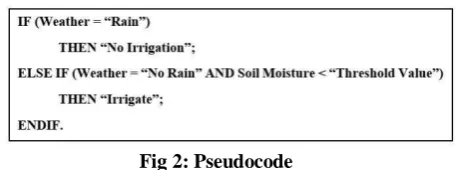
The machinelearning is the core logic of the proposed system. In general, a dataset is needed to train the machine to find patterns in the data in order to decide whether to irrigate or not. For better precision, a Openweathermap.com API is included with the aim of knowing when the water pump needs to be opened. The
[image:4.595.317.545.82.167.2]pseudocode in figure 2 gives a simple illustration on how the machine learning system works.
Fig 2: Pseudocode
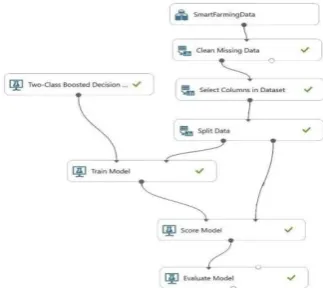
In machine learning, everything is about modules, that is, machine learning works through a chain of modules. For machine learning to work, it should be trained through data and patterns. In the proposed machine learning system, a “training experiment” has been used and figure 3 shows this concept.
3.4.1SmartFarmingData Module
The dataset is input in this module. Basically, it contains a variety of data and need to be clarified to obtain the desired data, that is, the data for soil moisture, air humidity, and air temperature. The clarification is performed by removing null dataset. The dataset chosen is based on a chart.
3.4.2Select Column in Dataset Module
This module is implemented in the chain so as to be able to train the machine. Specific column has to be selected in order to do the prediction on a specific parameter.
3.4.3Split Data Module
The split data module is divided into two parts: mainly the Train Model and The Score Model (See section 3.5.4).
The Train Model module contains 70% of the dataset for the machine learning. The required pattern is trained in this area and to do so, an algorithm needs to be derived for it to know which data the pattern should consist of. The algorithm used is known as a „Two-class boosted decision tree‟ and lies under the „two-class classification‟ algorithm structure. Figure 4 shows the different algorithms for the „twoclass classification‟ algorithms. It can be observed that there are nine types of algorithms in this category and they differ from each other. As illustrated in figure 4, the „Two-class
International Journal of Innovative Technology and Exploring Engineering (IJITEE) ISSN: 2278-3075, Volume-9 Issue-2, December 2019
Fig 3: Training Experiment of Machine Learning
Fig 4: Two-class Classification (Microsoft, 2017) 3.5.3.1How the machine learning process the prediction?
The machine learning process occurs in two steps; first being the comparison between the raw data with that of a threshold value and the second is comparing the result from the first step with that of weather forecast. Normally, a threshold value is a value which on exceeded will cause a change in the action of a particular thing. In this instance, the threshold value should base on the soil moisture. That is the moment at which the soil requires watering. In general, the threshold value could be set based on the graph as suggested in [14]. The latter provides a range of soil moisture value which can used for the threshold value, upon which irrigation can start. However, the value suggested in [14] is not appropriate for soil.
According to [15], there are six main types of soil namely: Sandy, Peaty, Loamy, Clay, Silty and Chalky. The type of soil present in India is considered to be thick clay or basalt soil [17] [18]. Clay soil is known to be lumpy and sticky when very wet and hard like rock when dry. It also drains poorly and contains little air space. It is also heavy to cultivate into clay soil and if drainage is properly managed, the plants are considered to grow well. Hence according to [14], the threshold value for irrigation for clay soil is 33.0%. However, after having collected soil moisture value in the region of Coromandel, the threshold value for irrigation for this region is 27.0%. Hence, the threshold value needs to be adapted based on the region’s soil moisture.
IV. CONCLUSION
A Smart Irrigation and Monitoring System has been proposed so as to reduce wastage of water and to automate the irrigation structure of large areas of crops. The system mainly monitors the behavior of soil moisture, air humidity, and air temperature and sees how it contributes to evaluate the needs of water in a plant. The system uses machine learning and compares actual values obtained from sensors with a threshold value that has been fed to the machine learning for analysis. After this process, the machine learning cross checks the result obtained with weather forecast and then decides whether irrigation needs to be done or not. The farmer receives a notification on his smart phone and he can choose to turn on the water pump with a button click. Moreover, the system has a web app and is helpful if ever the farmer wants to see the statistical sensor data and assess the change in sensor readings throughout a time period. Furthermore, the system can be calibrated for different type of plants, that is, the user is provided with a list of plants choices in his web app and mobile app. With this the user can choose the specific type of plant that is being cultivated and obtain a more precise threshold value and thus a more accurate irrigation prediction
REFERENCES
1. Development of a Low-cost Multi-Depth RealTime Soil Moisture
Sensor Using Time Division Multiplexing Approach Iftikhar Ahmed Saeed1, Wang Minjuan1, Salman Latif Butt2, Shi Qinglan1, Zheng Li Hua1, Vu Ngoc Tuan1, Gao Wanlin1
2. Intelligent Agriculture and Its Key Technologies Based on Internet of
Things ArchitectureReceived May 19, 2019, accepted June 4, 2019, date of publication June 6, 2019, date of current version June 26, 2019.
3. IoT based water level meter ,Yellamma, P., Nagaraju, C., Anitha, R.,
(...), Karthik,
K., Surendra, P.,2018, Proceedings of the International Conference on Smart Systems and Inventive Technology, ICSSIT 2018
4. Openweathermap.com 2012-2016, [Online]
http://openweathermap.org/api
5. IoT based smart and flexible lightning in streets Anitha, R., Nishitha,
M., Akhila, K., Sai
6. Detection of noxious gases by implementing internet of things
technology ArunSai, G., BharatKumar, B., Likhitha, K.S., Anitha, R. 2018 International Journal of Engineering and Technology(UAE)
7. A smart industrial pollution monitoring system using Iot,Vardhan,
[image:5.595.51.284.235.387.2]