Abstract: This research explores the function of Customer Service (CS) in Third-Party Logistics (3PL) companies and their efficiency levels. Many 3PL companies rely on the performance of its CS department as the windows of contact between external customers and internal customers. Despite the critical function of CS in 3PL companies, less attention is given on the development and progress of the CS area. Poor CS performance leads to miscommunication among internal departments, suppliers and worst its customers. This situation, if prolonged, will give a high toll in operations cost and the company’s reputation in the industry. While companies with excellent CS team retain, more extended customers’ relationship and support derived from reliable services and trust experienced by customers with less additional or unexpected operations cost occurrence. The first objective of this study is to identify the factors influencing the CS efficiency and the second objective determined the level of efficiency of CS in 3PL companies. A thorough archival data were compiled and observed from previous studies conducted in this field. Interviews were conducted with selective respondents from 3PL companies located in Johor Bahru to measure CS efficiency. The findings of this research revealed each companies’ CS team performance and recommended areas for future improvements.
Keywords: 3PL, Customer Service, The Efficiency level
I.INTRODUCTION
Customer service (CS) play a significant role in logistics activities. It is one of the logistics elements aside from procurement, warehousing, transportation and inventory management [1][2] whereby each logistics movement require the support of verbal, visual and written communication activities[3]. In a third-party logistics (3PL) company, CS is the first focal point of contact between the company’s clients and internal departments. CS is the department receiving new shipment orders, documentation and customer requirement.
Revised Manuscript Received on October 05, 2019.
Rozelin Abdullah*, Industrial Logistics, Malaysian Industrial Technology, Universiti Kuala Lumpur, Johor Bahru, Malaysia. Email: [email protected]
Muhammad Amirul Razi, Industrial Logistics, Malaysian Industrial Technology, Universiti Kuala Lumpur, Johor Bahru, Malaysia. Email: [email protected]
Mohd Yazid Md Taib, Industrial Logistics, Malaysian Industrial Technology, Universiti Kuala Lumpur, Johor Bahru, Malaysia. Email: [email protected]
Mazilah Abdullah, Industrial Logistics, Malaysian Industrial Technology, Universiti Kuala Lumpur, Johor Bahru, Malaysia. Email: [email protected]
Mimi Suriani Mat Daud, Industrial Logistics, Malaysian Industrial Technology, Universiti Kuala Lumpur, Johor Bahru, Malaysia. Email: [email protected]
This department filters the order according to the terms of shipment, nature of cargo and urgency of the shipment before relaying the information to respective internal departments or suppliers. Main customers of 3PL companies are those in manufacturing, suppliers and distributor, who seek lower logistics cost with added value in logistics service. This is one of the efforts to control logistics cost to remain competitive in the market. In such, 3PL companies expand the content of its services which involves more complex activities will significantly require more CS support than before to compete with rival companies and remain relevant in the market. Today, many 3PL companies offering complete logistics services to its customers. Total logistics services consist of not only warehousing and transportation but inventory management, procurement and distribution. Total logistics services require CS as the call centres managing logistics movement. One of the reasons for companies to outsource “in-house’ businesses to 3PL companies is to improve the integration of the entire supply chain activities through CS [4].
3PL companies not only focus on satisfying their customers with excellent reliable logistics service but motivate customers’ loyalty through repeating orders and maintain long term business relationship. On the other hand, 3PL companies continue to face challenges in maintaining their business [4]. Although the Malaysian manufacturing industry progressing well in its exports segment, CS in many 3PL companies face limited development due to the lack of skill and technology support [5]. This situation influence the performance of logistics services as demand for rapid and excellent logistics service supersede the capacity and capability of a 3PL company in rendering its services to customers [6]. Personnel in CS deprived of initiatives to integrate empirical information and documentation between customers and logistics operations departments effectively, especially without technology support in communication [7]. Therefore, it is crucial for a company to objectively measure the performance of its CS in order to retain existing customers’ loyalty and secure new customers on board. The first objective of this study was to identify the factors influencing effective CS of 3PL companies and secondly to measure the efficiency of CS level. These set of objectives allow 3PL companies to review areas of improvement in CS progressively through the initiatives identified.
Customer Services and Its Efficiency Level of
3
rd
Party Logistics Companies
II. CUSTOMER SERVICE EFFECTIVENESS
Communication Infrastructure
Customers in logistics service businesses expect excellent quality service, fast and on-time delivery with fewer logistics costs [8]. One of the ways to achieve customer satisfaction in logistics service is to deliver goods according to customer’s requirement without any delay, and additional cost incurred. Thus, integration between CS and operations team is crucial. Multiple information passes through between customers, CS and operations department on a rapid basis [9] [10]. Information flow not only limited to verbal but also written communication through emails and documentation. Typically, CS in logistics companies receive calls and emails from customers, screen the shipment orders according to the mode of transportation and terms of shipment then process job order numbers before assigning the shipment to another operation department. Therefore, the information gathering process at CS is crucial. Another crucial aspect in CS is accuracy, this is to make sure the flow of the information to the next logistics procedure are well-executed [11] [12]. The support of technology advancement and precise information flow permits effective CS communication [13].
Training Development
A good CS can understand logistics documents, terms of shipment or Incoterm and the urgency level before processing the shipment from one logistics process to another [14][15]. Failure to gasp accurate input at CS stage jeopardize the safety of the cargo in transit, prolong the duration of delivery and tarnish the company’s reputation. Repetition of such cases eventually taxing 3PL company with additional unexpected operation cost not to mention the loss of customers [16].
Another essential area in communication is the ability to be calm and diligent during a conversation with the customers. Excellent communication skills of the CS can withstand harassing customers in due urgency of shipment or complain situation. It is not easy to handle aggressive customers; however, good CS can tackle the situation well and eventually win customer heart even at the most critical time during the operation of the logistics activities[17][18][19].
MNC 3PL companies such as DHL and ahartrodt, to name a few engage the company’s CS team with internal and external training as part of the effort to improve CS performance. However, due to limited capital and resources, some companies are unable to provide training to its CS team members [20] [21].
Value Added Service
3PL services are just as intangible as hospitality businesses. A customer experiences the product rather than have the opportunity to touch, see or taste the product on the shelf. Due to these amenities, it is crucial for 3PL service providers to focuses on its value-added services to swirl customers into its service offerings. Value-added service is additional services provided to customers on top of the actual service purchase by the customer [22]. Shipment track and trace is one of the service customer preferred. It provides the customer with peace of mind during shipment transit from pick up location up to delivery site. Customers can find out goods whereabouts within the touch of a finger with a
smartphone. Another value-added service is automatic updates on shipment status from a 3PL company to its customer. It allows the customer to build a higher confidence level of the service purchased. Especially when the value of goods in transit is high and in some cases in fragile form. Besides feeling secured, the customer gains deeper trust in the service and remain loyal to the company [24].
Some 3PL company provide value-added service to its customer by providing logistics assistance at the customer premise or store to monitor and assist inventory management, cargo receiving or outgoing, fumigations or special packing activities. This personnel is referred to as an In-plant officer that ensure the customer received firsthand information on logistics movement of its cargo and is well taken cared for [25].
Service Quality
Safe and timely delivered goods at consignee door are often related to quality logistics service. Once a 3PL commit delivery timeline with its customer, it is a contract to oblige [26]. Failing to do so will lead to customer complains. It is because logistics support the supply chain the customer it serves. Delay in delivery of cargo breaks the supply chain, which causes production halt and export delay to a manufacturing company. Goods in transit are under the liability of the 3PL carrying it. Damage of goods due to mishandling, accident or pilferage reflect the service quality of a 3PL company. In such, it is clear that the role of CS in processing information about customer goods are undeniably important [27].
One-stop service or one window contact person is one of the efforts to enhance the quality of service. Due to the many stages of logistics activities involved in a shipment, it is easier for customers only to call one person to arrange a shipment rather than speaking to different person from different department of one 3PL company. This cause miscommunication and distress logistics operations activities [28].
Relationship with Customer
Besides that, an excellent quality service lies in the relationship between 3PL’s CS with its customers. The customer relies on CS personnel once goods are already in transit. Goods in transit is a situation during documentation procedures such as customs brokerage and uplifting cargo freighter or loading vessels. Excellent service quality of 3PL is a logistics service with well updated on goods in transit status by CS personnel, friendly and experience CS. It includes 3PL uses of friendly booking and track and trace systems [29].
Maintaining a good relationship between a 3PL company and its customers require more than just forward logistics. It involves reverse logistics as well. In the occasion of cargo damaged or wrong delivery, CS responsible for conveying to customers on the bad news and action should be taken in the reverse logistics procedures.
catastrophic situation into potential trust out of the situation. It is not easy, but workable where customer trust and loyalty is developed [30].
III. METHODOLOGY
This research is conducted in a qualitative method, through secondary data content analysis and interview, which are then represented in the form of a rubric.
Inclusive and exclusive of data selection
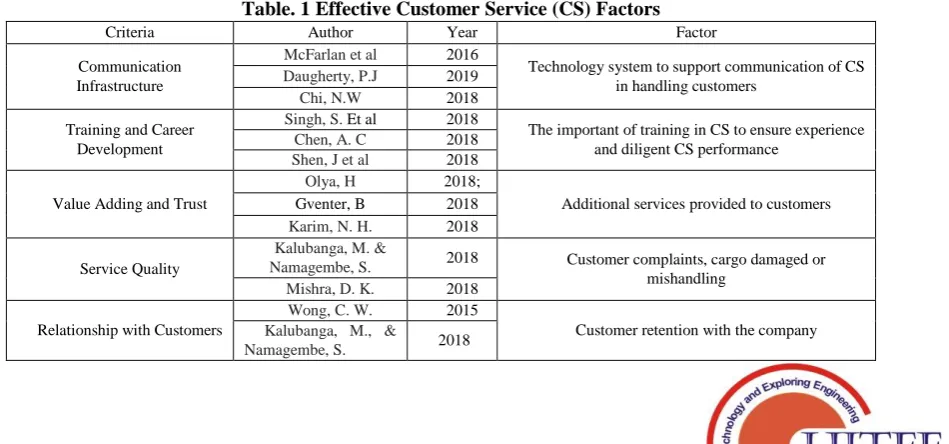
The first objective is conducted through a thorough compiling of input from archival data of previous journals from 2000 to 2018. Observation of literature compilation was based on inclusion inputs and identifying selected themes on effective Customer Service, integration in communication and technology supports. The data screening of literature was sorted by the exclusion of data through coding techniques [31]. The summary of the findings is represented in below Table I.
Rubric Development and Validation
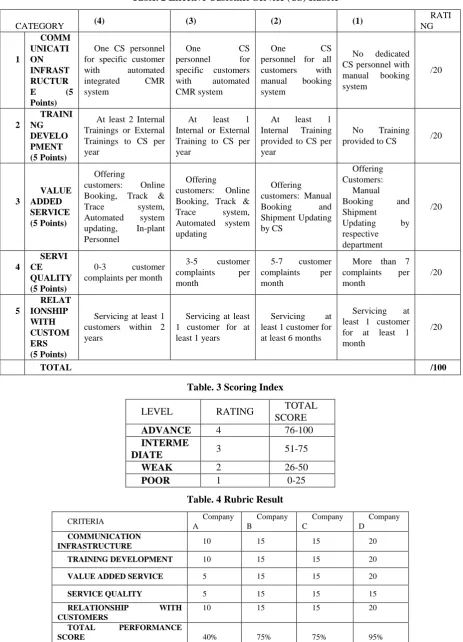
Instead of adopting a set of interview questions, this study developed an Index Rubric to measure the CS efficiency of 3PL companies. A rubric is an ideal instrument to measure standards due to its descriptive nature and systematic scale [32]. It enables the researcher to describe CS criteria based on the appropriate scale [33]. Besides, respondents were able to relate the CS criteria set in the rubric based on the actual situation. The rubric consists of 5 categories of efficient CS
factors namely Communication Skills, Training
Development, Value Added Service, Service Quality and Relationship with Customer which have been identified in the first research objective and represented in Table II.
The scoring level was based on an interval scale measurement which represented via four scoring levels as the weight [34]. Scoring marks had been set to carry from 1 mark to 4 marks indicating four-level of performance from Poor, Weak, Intermediate and Advance (Table III). There are five measurement criteria reflecting CS factors influencing CS performance. Each criteria carry 5 points. Total performance scoring marks were 100 percent at the Advance level.
The rubric and scoring Index were validated by 2 Subject
Matter Experts (SME) in the logistics industry, holding the position of Logistics Specialist and Senior Lecturer in Industrial Logistics faculty before final testing began. The summary of the process is classified in Figure I.
dentifying the Criteria
Identifying the Scoring & Index Criteria
Designing the Rubric
Rubric Validation
[image:3.595.347.517.101.243.2]Rubric Testing
Fig. 1 Rubric Design Framework
Rubric Testing
The final rubric then tested by four experts in logistics services personnel with more than five years of working experiences in international 3PL operations. The companies refused to be named due to the competitive and private confidential issues, which were later categorized as Company A, Company B, Company C and Company D. The determination of sample size for exploratory research strongly argued among scholars however, the sample size should be allocated according to the research objectives, demographic and depth of the case study [36]. According to [37], one respondent with appropriate criteria is adequate for exploratory research and are referred to in the current study. Each criterion was chosen by the respondent computed and indexed based on actual implementation applied by each company in its CS area. It took an average of 20 minutes per each respondent to complete the rubric. The scoring input were then compiled and calculated based on the designed index. The scoring details were tabulated in Table-IV.
Table. 1 Effective Customer Service (CS) Factors
Criteria Author Year Factor Communication
Infrastructure
McFarlan et al 2016
Technology system to support communication of CS in handling customers
Daugherty, P.J 2019
Chi, N.W 2018
Training and Career Development
Singh, S. Et al 2018
The important of training in CS to ensure experience and diligent CS performance
Chen, A. C 2018
Shen, J et al 2018
Value Adding and Trust
Olya, H 2018;
Additional services provided to customers Gventer, B 2018
Karim, N. H. 2018
Service Quality
Kalubanga, M. &
Namagembe, S. 2018 Customer complaints, cargo damaged or
mishandling
Mishra, D. K. 2018
Relationship with Customers
Wong, C. W. 2015
Customer retention with the company
Kalubanga, M., &
[image:3.595.77.552.565.787.2]Table. 2 Effective Customer Service (CS) Rubric
CATEGORY (4) (3) (2) (1)
RATI NG
1
COMM UNICATI ON INFRAST RUCTUR E (5 Points)
One CS personnel for specific customer
with automated
integrated CMR
system
One CS
personnel for specific customers with automated CMR system
One CS
personnel for all customers with manual booking system
No dedicated CS personnel with manual booking system
/20
2
TRAINI NG DEVELO PMENT (5 Points)
At least 2 Internal Trainings or External Trainings to CS per year
At least 1 Internal or External Training to CS per year
At least 1 Internal Training provided to CS per year
No Training
provided to CS /20
3
VALUE ADDED SERVICE (5 Points)
Offering
customers: Online Booking, Track &
Trace system,
Automated system updating, In-plant Personnel
Offering customers: Online Booking, Track & Trace system, Automated system updating
Offering customers: Manual
Booking and
Shipment Updating by CS
Offering Customers: Manual
Booking and
Shipment
Updating by
respective department
/20
4
SERVI CE QUALITY (5 Points)
0-3 customer
complaints per month
3-5 customer complaints per month
5-7 customer complaints per month
More than 7 complaints per month
/20
5
RELAT IONSHIP WITH CUSTOM ERS (5 Points)
Servicing at least 1 customers within 2 years
Servicing at least 1 customer for at least 1 years
Servicing at least 1 customer for at least 6 months
Servicing at least 1 customer for at least 1 month
/20
TOTAL /100
Table. 3 Scoring Index
LEVEL RATING TOTAL
SCORE
ADVANCE 4 76-100
INTERME
DIATE 3 51-75
WEAK 2 26-50
POOR 1 0-25
Table. 4 Rubric Result
CRITERIA Company A
Company B
Company C
Company D
COMMUNICATION
INFRASTRUCTURE 10 15 15 20
TRAINING DEVELOPMENT 10 15 15 20
VALUE ADDED SERVICE 5 15 15 20
SERVICE QUALITY 5 15 15 15
RELATIONSHIP WITH CUSTOMERS
10 15 15 20
TOTAL PERFORMANCE
SCORE 40% 75% 75% 95%
IV. RESULTANDDISCUSSION
The factors of effective CS were identified through secondary data observation of previous research compilation. Based on the findings, a template of the criteria had been outlined in Table- I. While the complete rubric template were
2)Company B and Company C both shared the same percentage of 75%, which had been classified in the Intermediate level in CS performance Index.
3)Company D scored the highest percentage score at 95%, which was classified in Advance CS performance score.
The result indicated that 3PL companies highly rely on CS support towards their businesses performances. Based on the result, Company “A” performance level were weak due to low score in Communication Infrastructure and Training Development. This had resulted to low score in Values Added Service and Quality of Service and eventually took toll on the relationship between the company and its customers. Company “D” had been classified Advance in its CS performance especially under CS Category 1, 2 and 3. As a result, the relationship with customers remains secure.
V. CONCLUSION
This research discovers the importance of CS in the 3PL business. Even though the attention given to CS development were argumentative in several previous researches, based from this study, most 3PL companies did not ignore the development of CS. The result from this study shown that the role of CS in logistics activities remain significant. 3PL companies need to upgrade their CS skills through training, infrastructure upgrades and value-added service continuously in order to sustain the rapid development of logistics market.
Although the validation and testing of the rubric were carried out in a qualitative method, in the future, it can be done via a quantitative instrument to further support the findings.
ACKNOWLEDGMENT
The research could not be completed without the effort of Mohammed Amirul Razi Mohd Noor, an Undergraduate Students of Bachelor of Industrial Logistics, UniKL MITEC (July 2018). The research was conducted in a short timeframe but eventually managed to be materialized. A special thank you goes to those 3PL companies and SMEs on the support and contribution towards this study.
REFERENCES
1. Dau, M. M., Shukt, A. A., Ahmad, F., & Abdullah, R. (2016). Green Logistics Adoption among 3PL Companies.
2. Shaharudin, M. R., Akbar, J., Zainal, N. N., Hassam, S. F., Zainoddin, A. I., & Nizam, M. F. M. (2018). Factors That Influence Green Practices Adoption Amongst Logistics Services Providers. Int. J Sup. Chain. Mgt Vol, 7(6), 242.
3. Büyüközkan, G., Güler, M., & Uztürk, D. (2016, December). Selection of wearable glasses in the logistics sector. In Proceedings from the 14th international logistics and supply chain congress (p. 377).
4. Von Nitzsch, R., Braun, D., & Bons, R. W. (2017). Success Factors for Effective Customer Interaction in Digital Sales: A Case from the Digital Investment Service Industry. In Bled eConference (p. 7).
5. Thai, V. V. (2016). The impact of port service quality on customer satisfaction: The case of Singapore. Maritime Economics & Logistics, 18(4), 458-475.
6. Wong, C. W., Lai, K. H., Cheng, T. C. E., & Lun, Y. V. (2015). The role of IT-enabled collaborative decision making in inter-organisational information integration to improve customer service performance. International Journal of Production Economics, 159, 56-65.
7. Witkowski, K. (2017). Internet of things, big data, industry 4.0–innovative solutions in logistics and supply chains management. Procedia Engineering, 182, 763-769.
8. McFarlane, D., Giannikas, V., & Lu, W. (2016). Intelligent logistics: Involving the customer. Computers in Industry, 81, 105-115.
9. Daugherty, P. J., Bolumole, Y., & Grawe, S. J. (2019). The new age of customer impatience: an agenda for reawakening logistics customer service research. International Journal of Physical Distribution & Logistics Management, 49(1), 4-32.
10. Liautaud, B., & Hammond, M. (2000). e-Business intelligence: turning information into knowledge into profit. McGraw-Hill, Inc.
11. Wei, M. (2010). Construction of marketing management information system of a travel agency based on customer relationship management. In Advanced Materials Research (Vol. 136, pp. 69-76). Trans Tech Publications.
12. Lim, D., & Palvia, P. C. (2001). EDI in the strategic supply chain: impact on customer service. International Journal of Information Management, 21(3), 193-211.
13. Heyes, G., Sharmina, M., Mendoza, J. M. F., Gallego-Schmid, A., & Azapagic, A. (2018). Developing and implementing circular economy business models in service-oriented technology companies. Journal of Cleaner Production, 177, 621-632.
14. Yaakub, S., Szu, L. Y., Arbak, S., & Ab Halim, N. (2018). INCOTERMS Selection Factors and Its Effect on Export Performance.
15. Mimoso, M. J., do Rosario Anjos, M., Sousa, C., & Silva, S. (2019).
UNIDROIT PRINCIPLES IN INTERNATIONAL TRADE
CONTRACTS'REGULATION. Economic and Social Development: Book of Proceedings, 138-143.
16. Hsu, P. Y., Angeloudis, P., & Aurisicchio, M. (2018). Optimal logistics planning for modular construction using two-stage stochastic programming. Automation in Construction, 94, 47-61.
17. Singh, S., Marinova, D., Singh, J., & Evans, K. R. (2018). Customer query handling in sales interactions. Journal of the Academy of Marketing Science, 46(5), 837-856.
18. Maponya, G. S. (2018). Towards an incentive-driven local government customer management policy: Lessons learnt from piloting of the CSIR's CARRS system.
19. Chen, A. C. (2018). Human Error Analysis to Customer Communication for Realtor Service Quality and The Implications to Personnel Training. International Journal of Innovation Education and Research, 6(12), 139-148.
20. Shen, J., & Tang, C. (2018). How does training improve customer service quality? The roles of transfer of training and job satisfaction. European Management Journal, 36(6), 708-716.
21. Chi, N. W., Yang, J., & Lin, C. Y. (2018). Service workers’ chain
reactions to daily customer mistreatment: Behavioral linkages, mechanisms, and boundary conditions. Journal of Occupational Health Psychology, 23(1), 58.
22. Chen, A. C. (2018). Human Error Analysis to Customer Communication for Realtor Service Quality and The Implications to Personnel Training. International Journal of Innovation Education and Research, 6(12), 139-148.
23. Olya, H., Altinay, L., & De Vita, G. (2018). An exploratory study of value-added services. Journal of Services Marketing, 32(3), 334-345.
24. Gventer, B., Nguyen, K., Asbury, K., McCarty, J., & Lowry, M. (2018). U.S. Patent No. 9,921,923. Washington, DC: U.S. Patent and Trademark Office.
25. Cheng, Y., Kuang, Y., Shi, X., & Dong, C. (2018). Sustainable investment in a supply chain in the big data era: An information updating approach. Sustainability, 10(2), 403.
26. Sinkovics, R. R., Kuivalainen, O., & Roath, A. S. (2018). Value co-creation in an outsourcing arrangement between manufacturers and third-party logistics providers: resource commitment, innovation and collaboration. Journal of Business & Industrial Marketing, 33(4), 563-573.
27. Chen, A. C. (2018). Human Error Analysis to Customer Communication for Realtor Service Quality and The Implications to Personnel Training. International Journal of Innovation Education and Research, 6(12), 139-148
29. Mishra, D. K., Henry, S., Sekhari, A., & Ouzrout, Y. (2018). Traceability is an integral part of supply chain logistics management and analytical review. arXiv preprint arXiv:1811.06358.
30. Kalubanga, M., & Namagembe, S. (2018). Trust, Commitment, Satisfaction, Strategy Alignment, Logistics Outsourcing Relationships Quality and Logistics Performance: A Case of Selected Manufacturing and Distribution Firms in Uganda. ORSEA JOURNAL.
31. Palmeirim, M. S., Hürlimann, E., Knopp, S., Speich, B., Belizario Jr, V., Joseph, S. A., ... & Keiser, J. (2018). Efficacy and safety of co-administered ivermectin plus albendazole for treating soil-transmitted helminths: A systematic review, meta-analysis and individual patient data analysis. PLoS neglected tropical diseases, 12(4), e0006458.
32. Watson, M. K., Barrella, E., Wall, T. A., Noyes, C., & Rodgers, M. (2017). A Rubric to Analyze Student Abilities to Engage in Sustainable Design. Advances in Engineering Education, 6(1), n1.
33. Von Eye, A., & Wiedermann, W. (2018). Strengthening arguments based on scale levels?. Journal for Person-Oriented Research, 4(1), 45-46.
34. Von Eye, A., & Wiedermann, W. (2018). Strengthening arguments based on scale levels?. Journal for Person-Oriented Research, 4(1), 45-46.
35. Carpenter, S. (2018). Ten steps in scale development and reporting: A guide for researchers. Communication Methods and Measures, 12(1), 25-44.
36. Sim, J., Saunders, B., Waterfield, J., & Kingstone, T. (2018). Can sample size in qualitative research be determined a priori?. International Journal of Social Research Methodology, 21(5), 619-634.
37. Cook, D. A., Brydges, R., Ginsburg, S., & Hatala, R. (2015). A contemporary approach to validity arguments: a practical guide to K ane's framework. Medical education, 49(6), 560-575.
38. Konstantinos Selviaridis and Martin Spring (2007)
39. Gunarathne, P., Rui, H., & Seidmann, A. (2018). When social media delivers customer service: Differential customer treatment in the airline industry. MIS Quarterly, 42(2), 489-520.
40. Ali et al. (2008)
41. Malaysian Logistics Council and MITRANS (2013)
AUTHORSPROFILE
Rozelin Abdullah is currently a lecturer in the Department of Industrial Logistics at Universiti Kuala Lumpur Malaysian Institute of Technology (MITEC) (Johor, Malaysia), where she teaches courses in Elements of Logistics and Fundamentals of International Logistics. She obtained her Master Degree in Business Management from Universiti Teknologi MARA. Prior to becoming a lecturer, she served in Japanese and German freight forwarding companies for 15 years. A chartered member of Chartered Institute of Logistics and Transport (CILT) Malaysia and she is currently pursuing her PhD degree in Green Logistics.
Mohammed Amirul Razi Mohd Noor was a final year student from Industrial Logistics Program at Universiti Kuala Lumpur Malaysian Institute of Technology (MITEC) (Johor, Malaysia). He is now running own company, Rich 3 Energy Enterprise Sdn Bhd supplying labor, transportation and cleaning services in Senai, Johor, Malaysia.
Mohd Yazid Md is a Senior Lecturer in the Department of Industrial Logistics at Universiti Kuala Lumpur Malaysian Institute of Technology (MITEC) (Johor, Malaysia), where he teaches courses in Supply Chain Management, Industrial Logistics and Marketing. He obtained PhD from University Utara Malaysia. Additionally, he has vast experience in American and Japanese Manufacturing before venturing into academics world. A Chartered Member of Chartered Institute of Logistics and Transportation Malaysia (CILT), Holding a Degree in Philosophy (PhD), Northern University of Malaysia, Book publication on A Review of Halal Supply Chain in Malaysia: Pharmaceutical & Cosmetics, Springer Gabler, Book Chapter, Pharmalogistik, Christopher W. Stoller, Springer Gabler, 65189 Wiesbaden, Germany. ISBN 978-3-658-15263-5 and Supply Chain Management: Introductory. Pustaka Negara, Kuala Lumpur, Malaysia. ISBN 978-967-0626-92-9. Research work mostly covers Green
Management. Coordinating a Research Grant from Lembaga Pelabuhan Johor.
Mazilah Abdullah holds a PhD in Management, Master in Management (Technology) and Bachelor Degree in Management (Marketing) from Faculty of Management, Universiti Teknologi Malaysia (UTM). Her involvement in the field of business management in Food and Beverages (F&B) line of over five years and linkage with the entrepreneurial line since yesteryears have provided her with the opportunity to apply the related theories and concepts into practice. She is also a highly determined academician with over four years of substantial hands-on experience in giving lectures to vast subjects related to Management, Marketing, and Business Management fields. She is currently attached with the Industrial Logistics Section, Universiti Kuala Lumpur (MITEC) (Johor, Malaysia).