promoting access to White Rose research papers
White Rose Research Online
[email protected]
Universities of Leeds, Sheffield and York
http://eprints.whiterose.ac.uk/
This is an author produced version of a paper accepted for publication in the
journal
Physiotherapy
.
White Rose Research Online URL for this paper:
http://eprints.whiterose.ac.uk/76263
Published paper
Littlewood, C., Malliaras, P., Mawson, S., May, S. and Walters, S. (2013)
1
Development of a self-managed loaded
1
exercise programme for rotator cuff
2
tendinopathy
3
Chris Littlewood BHSc (Hons), MSc (ª) * Corresponding author
4
a. School of Health & Related Research, University of Sheffield, Regent Court, 30 Regent
5
Street, Sheffield, S1 4DA, UK.
6
E-mail: [email protected]
7
Tel: +44 114 222 0888/ Fax: +44 114 272 4095
8
9
Peter Malliaras PhD (b)
10
b. Centre for Sports and Exercise Medicine, Queen Mary, University of London, Mile End
11
Hospital, London, UK.
12
E-mail: [email protected]
13
14
Sue Mawson PhD (a)
15
E-mail: [email protected]
16
17
Stephen May PhD (c)
18
c. Faculty of Health & Wellbeing, Sheffield Hallam University, Sheffield, S10 2BP, UK.
19
E-mail: [email protected]
20
21
Stephen Walters PhD (a)
22
E-mail: [email protected]
23 24
25
2
Abstract
27
This paper describes a self-managed loaded exercise programme which has been
28
designed to address the pain and disability associated with rotator cuff tendinopathy. The
29
intervention has been developed with reference to current self-management theory and with
30
reference to the emerging benefit of loaded exercise for tendinopathy. This self-managed
31
loaded exercise programme is being evaluated within the mixed methods SELF study
32
(ISRCTN 84709751) which includes a pragmatic randomised controlled trial conducted
33
within the UK National Health Service.
34
35
36
Word count 2000
37
Key words: rotator cuff tendinopathy, exercise, rehabilitation, self-management
38
39
40
41
42
43
44
45
46
3
Introduction
48
In 2010, the UK government published its’ white paper Equity & Excellence: Liberating the
49
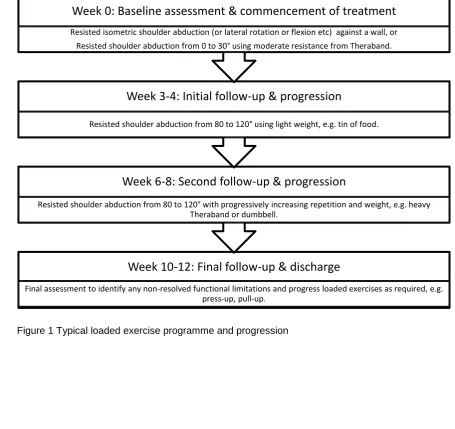
National Health Service (NHS) [1]. The emphasis of this paper was towards improving the
50
outcomes of healthcare with the patient at the centre of every decision that is taken.
51
However, this proposition is in the face of significant financial challenges and the need for
52
the NHS to deliver unprecedented efficiency gains.
53
Self-management has been proffered by some as one solution to this increasingly untenable
54
situation [2]. In a situation of rising demand and falling supply, strategies to facilitate
self-55
managed behaviour offer an opportunity to redress the balance by reducing the requirement
56
and hence demand for regular contact with health care professionals.
57
As well as offering a pragmatic solution to an organisational issue, self-management offers
58
opportunities to individualise care and there is evidence to suggest that an approach where
59
patients are encouraged to take responsibility for their own care is at least comparable to
60
treatment requiring regular clinic attendance [3,4]. Upon this background, this paper
61
describes a self-managed exercise programme for rotator cuff tendinopathy.
62
Rotator cuff tendinopathy is a common problem with increasing prevalence as age increases
63
[5,6]. Hence it is expected that the demand for health care in this area will increase as the
64
population ages. It has also been identified that this condition is resistant to treatment and
65
possibly recurrent in nature in certain populations [7-9] and so it is hypothesised that
66
outcomes will be superior where the patients are equipped to deal with this condition on an
67
on-going basis. Additionally, over recent years, there has been growing recognition of the
68
benefit of loaded exercise for rotator cuff tendinopathy [3,10-12] and in 2012, the National
69
Institute for Health Research funded a mixed methods study to evaluate the clinical and
70
cost-effectiveness of a self-managed exercise programme versus usual physiotherapy for
71
chronic rotator cuff disorders: the SELF study (ISRCTN 84709751)[13].
4
According to the guidance offered by Craig et al [14] self-managed loaded exercise should
73
be regarded as a complex intervention because of the number of potential interactions
74
between the components of the intervention. To facilitate the process of appraisal and
75
implementation, an evaluation of a complex intervention should include a description of the
76
intervention as an essential step of reporting [14,15]. Thus, the purpose of this paper is to
77
offer a full description of the experimental self-managed exercise intervention for the SELF
78
study.
79
Overview of the SELF study
80
The SELF study is a mixed methods study to evaluate the clinical and cost-effectiveness
81
of a self-managed exercise programme versus usual physiotherapy for chronic rotator cuff
82
disorders. The study includes a randomised controlled trial (RCT) where participants will be
83
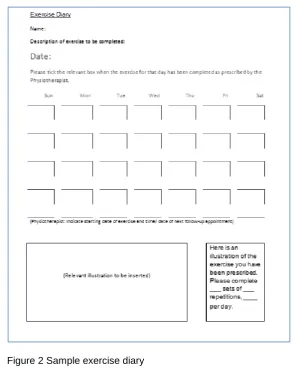
allocated to self-managed loaded exercise (experimental) or usual physiotherapy (control)
84
and followed-up after three, six and 12 months. The primary outcome measure for the RCT
85
is the shoulder pain and disability index (SPADI). The full protocol has been published [13].
86
An introduction to the technology
87The intervention is self-managed loaded exercise. The exercise, prescribed by the
88
physiotherapist but completed by the patient, involves exercising the affected shoulder
89
against gravity, a resistive therapeutic band or hand weight over three sets of ten to 15
90
repetitions twice per day. This exercise can be uncomfortable but is prescribed to ensure
91
that this is manageable. Exercise prescription is guided by symptomatic response requiring
92
that pain is produced during exercise but symptoms are no worse upon cessation [16,17].
93
Participants with more severe symptoms tend to commence a lighter regime initially and a
94
typical outline programme is presented in figure 1 which is adapted to meet individual needs.
95
Although there is emerging evidence supporting loaded exercise as the type of exercise to
96
be prescribed [11] the optimal dose is unknown. In reporting favourable outcomes in people
97
complaining of shoulder pain, Bernhardsson et al [10], Holmgren et al [11] and Jonsson et al
5
[12] prescribed three sets of 15 repetitions completed twice per day. Bernhardsson et al [10]
99
and Jonsson et al [12] maintained this programme for 12 weeks whilst Holmgren et al [11]
100
maintained their programme for eight weeks before reducing to one set of exercise per day
101
between weeks eight to 12. As well as consistency in terms of sets and repetitions all of
102
these studies required the exercise to be uncomfortable. These parameters are consistent
103
with those proposed here. However, in contrast to these studies a time-frame for the
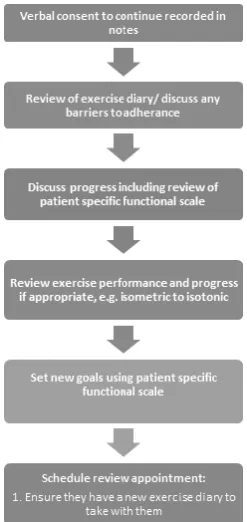
104
intervention has not been pre-specified. Instead the treating physiotherapist and patient will
105
determine the point of treatment cessation. It is recognised that a favourable response might
106
require a minimum of three months [16] but the choice to omit a pre-specified time frame
107
reflects the nature and response times of individual patients [18] and thus is more pragmatic
108
in nature.
109
In keeping with Jonsson et al [12] the intervention comprises only one exercise. This is in
110
contrast to Berharddson et al [10] and Holmgren et al [11] who prescribed multiple exercises.
111
A single exercise approach is preferred here for two reasons: First, as a pragmatic
time-112
saving solution [19]. Low levels of engagement with exercise programmes are a widely
113
recognised problem and it is suggested that single exercise prescription minimises some of
114
the barriers in terms of time to complete and recall. Secondly, the incremental benefit of
115
adding more exercises that are theoretically stressing the same tissue is unknown and
116
possibly unnecessary.
117
The self-managed framework
118The exercise is operationalized within a self-managed framework. Here self-management
119
refers to situations where people are encouraged to actively manage their symptoms,
120
treatment, consequences and life-style changes associated with their condition [2,20]. This
121
process is facilitated through an equal therapeutic alliance, or partnership, between patient
122
and therapist. The self-managed framework consists of components currently regarded as
6
effective mechanisms by which to enhance self-efficacy and facilitate self-management
124
[21,22] including:
125
Knowledge translation
126
Exercise/ skill acquisition
127
Self-monitoring
128
Goal setting
129
Problem solving
130
Pro-active follow-up
131
132
In line with the Common Sense Model of self-regulation of health and illness [23-26], how
133
the patient perceives the problem is pivotal. Success of the intervention is dependent upon
134
the patient interpreting their pain response in a way that facilitates the use of exercise as a
135
management strategy. If beliefs persist that the pain is a sign of tissue damage and that rest
136
is required to enable the tissue to recover then it is doubtful that the programme could be
137
implemented successfully. Such an appraisal would result in avoidance behaviour and would
138
preclude any level of engagement. To address this concern, the patient is encouraged to
139
communicate their understanding of the problem and the therapist is encouraged to frame
140
the discussion from the perspective that the muscles and tendons are de-conditioned (or
141
weakened or lacking fitness) and need a progressive programme of exercise to restore
142
condition and function. Description of tissue based pathology, e.g. rotator cuff tear, is
143
avoided, or challenged. In this situation, reliance is placed upon the development of a
144
therapeutic alliance where doubts and concerns can be expressed by the patient and
145
reassurance offered by the physiotherapist along with an acceptable explanation of the
146
cause of the problem. The purpose of this knowledge translation is to facilitate
147
understanding upon which a successful partnership can be developed. Understanding is
re-148
visited using simple questions such as: What do you understand is the cause of your
149
problem? Why could exercise help?
7
Enhancement of self-efficacy, defined as the confidence to perform a specific task or
151
behaviour [25], which is one of the major constructs of Bandura’s Social Cognitive Theory of
152
behaviour change [25], is a key goal of this self-management programme. Four potential
153
strategies to enhance self-efficacy have been suggested; mastery, modelling, interpreting
154
physiological signs and feedback/ persuasion [22]. Enhancement of self-efficacy is seen as a
155
key component to facilitate regular engagement with the programme. A single exercise is
156
prescribed and although progressions and regressions of the exercise are discussed, only
157
one exercise is completed at any one time. The reason for this restricted prescription is
158
pragmatic in nature, as discussed previously, but it is expected that a simple prescription will
159
also facilitate mastery of the task [25]. The patients have the opportunity to observe the
160
therapist undertaking the exercise and will subsequently model their behaviour on that of the
161
therapist whilst repeating the exercise themselves. This will be re-enforced by a diagram,
162
drawn by the patient, on an exercise diary (figure 2) which will serve as a visual memory
163
stimulus.
164
165
Self-monitoring and appropriate interpretation of physiological signs is regarded as a
166
cornerstone of successful self-management [25]. Within this programme the patients are
167
encouraged to monitor their pain response whilst exercising, which is recorded in the
self-168
report diary, in the knowledge that pain should be produced whilst the exercising but should
169
be no worse upon cessation [17]. When the pain response abates this is the stimulus to
170
progress the exercise. Such a response is in line with others who advocate loaded exercise
171
[10-12,16,17,27]. In contrast to others who have used a numeric pain rating scale, for
172
example pain no greater than 5/10 [11], to guide exercise progression, the intervention
173
described here enables the patient to judge what is manageable in terms of symptom
174
response. This decision reflects individual perceptions of what constitutes acceptability in
175
terms of pain. Some patients might be more tolerant and more willing than others to provoke
176
pain whilst exercising and it is felt unwise to limit the potential of some because of
177
unsubstantiated fears relating to potential tissue damage.
8
At the initial meeting between physiotherapist and patient, goals are set using the patient
179
specific functional scale [28] as a guide. A goal is negotiated, for example being able to
180
reach into a cupboard, and the current level of difficulty is established. This is monitored,
181
discussed at follow-up appointments and new goals set as appropriate. Such a component
182
has the capacity to be a useful form of mid- to long term self-monitoring by offering
183
reassurance regarding progress. The primary aim of the self-managed exercise programme
184
is to facilitate movement and functional restoration and goal setting is encouraged along
185
these lines.
186
Following this the patients are encouraged to consider any barriers to implementation. Some
187
pragmatic solutions to common problems, particularly time limitations, are factored in to the
188
intervention but the idea is raised pro-actively by the physiotherapist at the initial meeting by
189
asking the patient how confident they are that they will be able to complete the task in hand.
190
Any uncertainty is discussed and the patient is encouraged to consider potential solutions.
191
Barriers to implementations are also raised and discussed with reference to the exercise
192
diary at subsequent follow-up appointments.
193
The patients are offered the opportunity to return to the clinic at a convenient and
194
appropriate time with the intention that this meeting will offer the opportunity for useful
195
feedback and possibly the opportunity for persuasive intervention by the therapist if
196
difficulties have been encountered [22]. Typically follow-up appointments are scheduled on a
197
monthly basis to begin with but the needs of the patients inform this decision. For example,
198
some patients feel confident and able following the initial meeting and do not require a
199
scheduled follow-up appointment, only the opportunity to contact the physiotherapist should
200
things not go to plan. Conversely some patients will return to the physiotherapist within a few
201
days to seek re-assurance and guidance where necessary. The flow of a typical follow-up
202
session is displayed in figure 3.
9
This intervention has been designed with practice context in mind where typical
204
physiotherapy appointments consist of an initial session lasting 40 minutes and subsequent
205
sessions lasting 20 minutes. The intervention requires minimal training and can be adopted
206
in the current practice context from a logistical perspective.
207
Conclusion
208This paper has described a self-managed loaded exercise programme which has been
209
designed to address the pain and disability associated with rotator cuff tendinopathy. This
210
intervention is being evaluated within the mixed methods SELF study which includes a
211
pragmatic randomised controlled trial conducted within the UK NHS. The clinical and
cost-212
effectiveness of the self-managed exercise programme compared to usual physiotherapy will
213
be reported at the conclusion of the SELF study.
214
Acknowledgements
215
This work was produced by CLunder the terms of a Doctoral Research Fellowship issued by
216
the Secretary of State for Health.
217
This work has been developed in association with the NIHR Collaboration for Leadership in
218
Applied Health Research & Care (CLAHRC) for South Yorkshire. The NIHR CLAHRC for
219
South Yorkshire acknowledges funding from the NIHR. The views and opinions expressed
220
are those of the authors, and not necessarily those of the NHS, the NIHR or the Department
221
of Health.
222
CLAHRC SY would also like to acknowledge the participation and resources of our partner
223
organisations. Further details can be found at www.clahrc-sy.nihr.ac.uk.
224
Conflict of Interest Statement
225
The authors report no conflicts of interest.
10
Role of the funding source
227
The funding body have played no role in the design, writing of the manuscript or decision to
228
submit for publication.
229
230
231
232
233
234
235
236
237
238
239
240
241
242
243
244
245
246
247
248
249
11
Reference List
251
1. Department of Health. Equity & Excellence: Liberating the NHS. 2010. 252
253
2. Barlow J, Wright C, Sheasby J, Turner A, Hainsworth J. Self-management approaches for 254
people with chronic conditions. Patient Education and Counselling 2002;48:177-187. 255
3. Littlewood C, Ashton J, Chance-Larsen K, May S, Sturrock B. Exercise for rotator cuff 256
tendinopathy: a systematic review. Physiotherapy 2012;98:101-109. 257
4. Singh D, Ham C. Improving care for people with long-term conditions: A review of UK and 258
international frameworks. 2006. Birmingham, University of Birmingham. 259
260
5. Chard M, Hazleman B. Shoulder disorders in the elderly ( a hospital study). Annals of the 261
Rheumatic Diseases 1987;46:684-687. 262
6. Chard M, Hazleman R, Hazleman B, King R, Reiss B. Shoulder disorders in the elderly: a 263
community survey. Arthritis & Rheumatism 1991;34:766-769. 264
7. Chard M, Sattelle L, Hazleman B. The long-term outcome of rotator cuff tendinitis - a review 265
study. British Journal of Rheumatology 1988;27:385-389. 266
8. Croft P, Pope D, Silman A. The clinical course of shoulder pain: prospective cohort study in 267
primary care. British Medical Journal 1996;313:601-602. 268
9. Luime JJ, Koes BW, Miedem HS, Verhaar JA, Burdorf A. High incidence and recurrence of 269
shoulder and neck pain in nursing home employees was demonstrated during a 2-year 270
follow-up. Journal of Clinical Epidemiology 2005;58:407-413. 271
10. Bernhardsson S, Klintberg I, Wendt G. Evaluation of an exercise concept focusing on 272
eccentric strength training of the rotator cuff for patients with subacromial impingement 273
syndrome. Clinical Rehabilitation 2010;25:69-78. 274
11. Holmgren T, Bjornsson H, Oberg B, Adolfsson L, Johansson K. Effect of specific exercise 275
strategy on need for surgery in patients with subacromial impingement syndrome: 276
randomised controlled study. British Medical Journal 2012;344:e787. 277
12. Jonsson P, Wahlstrom P, Ohberg L, Alfredson H. Eccentric training in chronic painful 278
impingement syndrome of the shoulder: Results of a pilot study. Knee surgery, sports 279
traumatology, arthroscopy 2005;14:76-81. 280
13. Littlewood C, Ashton J, Mawson S, May S, Walters S. A mixed methods study to evaluate the 281
clinical and cost-effectiveness of a self-managed exercise programme versus usual 282
physiotherapy for chronic rotator cuff disorders: protocol for the SELF study. BMC 283
Musculoskeletal Disorders 2012;13:62. 284
14. Craig P, Dieppe P, Macintyre S, Mitchie S, Nazareth I, Petticrew M. Developing and 285
evaluating complex interventions: the new Medical Research Council guidance. British 286
12
15. Heine P, Williams M, Williamson E, Bridle C, Adams J, O'Brien A et al. Development and 288
delivery of an exercise intervention for rheumatoid arthritis: strengthening and stretching 289
for rheumatoid arthritis of the hand (SARAH) trial. Physiotherapy 2012;98:121-130. 290
16. Littlewood C, May S: A contractile dysfunction of the shoulder. Manual Therapy 2007;12:80-291
83. 292
17. McKenzie R, May S. The Human Extremities: Mechanical Diagnosis & Therapy. Waikanee; 293
New Zealand: Spinal Publications; 2000. 294
18. Abate M, Silbernagel K, Siljeholm C, Di lorio A, De Amicis D, Salini V et al. Pathogenesis of 295
tendinopathies: inflammation or degeneration? Arthritis Research & Therapy 2009;11:235. 296
19. McLean S, Burton M, Bradley L, Littlewood C. Interventions for enhancing adherence with 297
physiotherapy: A systematic review. Manual Therapy 2010;15:514-521. 298
20. Lorig K, Holman H. Self-management education: history, definition, outcomes and 299
mechanisms. Annals of Behavioral Medicine 2003;26:1-7. 300
21. de Silva D. Evidence: Helping people help themselves. 2011. London, Health Foundation. 301
302
22. Jones F. Strategies to enhance chronic disease self-management: How can we apply this to 303
stroke? Disability and Rehabilitation 2006;28:841-847. 304
23. Hale E, Treharne G, Kitas G. The common sense model of self-regulation of health and 305
illness: how can we use it to understand and respond to our patients' needs? Rheumatology 306
2007;46:904-906. 307
24. McAndrew L, Musumeci-Szabo T, Mora P, Vileikyte L, Burns E, Halm E et al. Using the 308
common sense model to design interventions for the prevention and management of 309
chronic illness threats: from description to process. British Journal of Health Psychology 310
2008;13:195-204. 311
25. Newman S, Steed L, Mulligan K. Chronic physical illness: self-management and behavioural 312
interventions. Maidenhead: Open University Press;2009. 313
314
26. Phillips L, Leventhal H, Leventhal E. Physicians' communication of the common-sense self-315
regulation model results in greater reported adherence than physicians' use of interpersonal 316
skills. British Journal of Health Psychology 2011;17:244-257. 317
27. Littlewood C: Contractile dysfunction of the shoulder (rotator cuff tendinopathy): an 318
overview. Journal of Manual & Manipulative Therapy 2012;20:209-213. 319
28. Stratford P, Gill C, Westaway M, Binkley J. Assessing disability and change of individual 320
patients: a report of a patient specific measure. Physiotherapy Canada 1995;47:258-263. 321
13 323
Figure 1 Typical loaded exercise programme and progression 324
325
326
327
328
329
330
331
332
333
334
335
336
337
338
Week 10-12: Final follow-up & discharge
Final assessment to identify any non-resolved functional limitations and progress loaded exercises as required, e.g. press-up, pull-up.
Week 6-8: Second follow-up & progression
Resisted shoulder abduction from 80 to 120° with progressively increasing repetition and weight, e.g. heavy Theraband or dumbbell.
Week 3-4: Initial follow-up & progression
Resisted shoulder abduction from 80 to 120° using light weight, e.g. tin of food.
Week 0: Baseline assessment & commencement of treatment
14 339
Figure 2 Sample exercise diary 340
341
342
343
344
345
346
347
348
349
350
15 352
Figure 3 The flow of a typical follow-up appointment 353