A QUASI EXPERIMENTAL STUDY TO EVALUATE THE
EFFECTIVENESS
OF
REMINISCENCE
THERAPY
ON
DEPRESSION AMONG ELDERLY IN SELECTED OLD AGE
HOMES AT MADURAI.
BY
KIRUBAKARAN. S
A dissertation submitted to the Tamil Nadu Dr. M.G.R. Medical University, Chennai.
In partial fulfillment of the requirements for the degree of Master of Science in
Mental Health Nursing
UNDER THE GUIDANCE OF
PROF. (MRS).R. JANCY RACHEL DAISY, M.Sc (N)., (Ph.D)., H.O.D of Mental Health Nursing Department,
This is to certify that the dissertation entitled
“A quasi
experimental study to evaluate the effectiveness of Reminiscence
therapy on depression among elderly in selected old age homes at
Madurai”
is a bonafide work done by KIRUBAKARAN.S,
C.S.I.
Jeyaraj Annapackiam College of Nursing, Madurai, submitted in partial
fulfillment for the degree of Master of Science in Nursing.
Signature of the Principal :
PROF .DR. C. JOTHI SOPHIA, M.Sc. (N)., Ph.D.,
DEPRESSION AMONG ELDERLY IN SELECTED OLD AGE
HOMES AT MADURAI.
Approved by the dissertation committee on...
RESEARCH CO-ORDINATOR ... Prof. Dr. C.JOTHI SOPHIA, M.Sc. (N)., Ph.D.,
Professor cum Principal,
C.S.I. Jeyaraj Annapackiam College of Nursing, Madurai- 4.
RESEARCH GUIDE ………..
Prof.(Mrs.). R.JANCY RACHEL DAISY, M.Sc(N).,(Ph.D.)., H.O.D OF PSYCHIATRIC NURSING DEPARTMENT, C.S.I. Jeyaraj Annapackiam College of Nursing,
Madurai- 625004.
CLINICAL CO-GUIDE ………. Dr. M.V. PREETHI, M.D., (PSYCH),
CONSULTANT CHILD PSYCHIATRIST, Preethi Child guidance clinic,
Madurai. 1
A dissertation submitted to
The Tamil Nadu Dr. M.G.R. Medical University, Chennai.
In partial fulfillment of the requirement for the Degree of Master of Science in Nursing
This is to certify that the dissertation entitled
“Evaluate the
effectiveness of Reminiscence therapy on depression among elderly in
selected old age homes at Madurai” is a bonafide work done by
KIRUBAKARAN. S, C.S.I. Jeyaraj Annapackiam College of Nursing,
Madurai, submitted in partial fulfillment for the degree of Master of
Science in Nursing from The Tamil Nadu Dr. M.G.R. Medical
University, Chennai.
Signature of the Examiners:
1. External:
2. Internal:
“Life moves pretty fast if you don’t stop and look around once in a while, you could miss prettier moments.”
I praise and offer my sincere thanks to God Almighty for giving me strength and abundant blessing throughout my career.
Its my great privilege to take this moment to show gratitude to my parents, teachers, friends and relatives who made this thesis the successful one
‘Joy is thankfulness’;
‘Gratitude is not only the greatest of all virtues but the parent of all others’
I can’t explain my gratitude in words but it’s the opportunity for me to express my sincere indebtedness to renowned institution C.S.I Jeyaraj Annapackiam College of Nursing for giving me a opportunity to do my post graduate in nursing.
I wish to express my gratitude and sincerity to our college Principal Prof. Dr. C. Jothi Sophia, M.Sc (N)., Ph.D., for her support in the successful completion of the research work.
I convey my heartfelt thank to Prof. Mrs. Merlin Jeyapaul M.Sc(N)., [Ph.D]., Vice Principal for her support and valuable opinion during my research study.
throughout the study.
I extend my gratitude and grateful acknowledgement to Prof. Dr. G.Jaya Thanga Selvi M.Sc (N)., Ph.D., and Prof. Mr. John sam arun prabhu M.Sc(N)., (PhD)., professor for their constant help, moral support, detailing about research process and encouragement to finish this study successfully.
In my first experience in the clinical research I thank Dr.Charles Medical director, Christian mission hospital for his great support and encouragement who permitted me to give the interventions for the elderly people in his esteemed institution.
My sincere gratitude and thankfulness to the inmates of Inba illam and Christian Mission Geriatric Home for their patience co-operation throughout the study without whom I cant finish my thesis successfully.
I extend my awful gratitude to Dr. M.V. Preethi, M.D., (psych), Prof Mrs.Sreevani MSc (N)., Prof Mrs. Rajamani MSc(N)., Prof Mrs. Jesinda Vedanayagi MSc(N)., and all experts who gave their valuable suggestions and for validating the tool as well as the content which help me to improve the quality of my research work.
Mrs. Priya David for their endless love and supporting me financially in studies as well as in designing my career in a beautiful way. I want to extend my heartful thanks to my grandparents Rev.P.Dhavamani, Mrs.Jeyaseeli for their prayer and blessings.
I want to extend my gratitude to my friend Mr.John Jeba Sunder, Mr.Prasath babu for their timely help, who spare her valuable time and put their efforts and made this research as a complete one.
I want to express my heartfelt gratitude to my friends Mr.John Britto, Miss.Priyanka and Miss.Priya for their effective guidance in the analysis chapters The encouragement, support given by them made this research to greater heights.
I want to extend my special thanks to my classmates Valentians’ 13 for their support and encouragement throughout my research work.
Last but not least I want to express my gratitude to my friend Mrs.Sheeba Christy who rendered her valuable time and effort during my research work is unforgettable one
I submit my deepest gratitude to all persons who rendered their valuable time and efforts either directly or indirectly in my research work.
Introduction
The old age is an integral part of human life. It is the evening of life. It is unavoidable, undesirable, unwelcome and problem ridden phase of life. But it is really interesting to note that everybody likes to live a long life, but not to be old. It is ironical that however undesirable the old age that is bound to life. A man is compelled to go through the pains and pleasure of this age as like other phases in life, before making exit from this mortal world. Reminiscence therapy for depression consists of recollecting of past life experiences which implicates the principles of cognitive therapy. However there are inherent difficulties in assuming from these studies that reminiscence therapy for depression is an effective treatment with the general adult population.
Research hypotheses were formulated to find the significant difference between control and experimental group. The review of literature was done and organized based on Studies related to ageing and level of depression among geriatrics. Studies related to effectiveness of reminiscence therapy on the level of depression among geriatrics. The conceptual framework of this study was based on Widenbach’s helping art clinical nursing theory.
Methodology
probability – purposive sampling technique. Yesavage geriatric depression scale was used as a tool for data collection after confirming the validity and reliability. Reminiscence therapy was demonstrated to the experimental group only for 21 days in both morning and evening. The data obtained were analyzed and interpreted using descriptive and inferential statistics.
Results
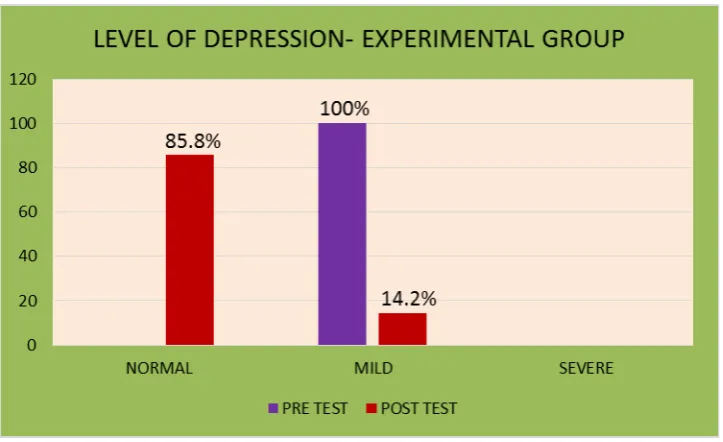
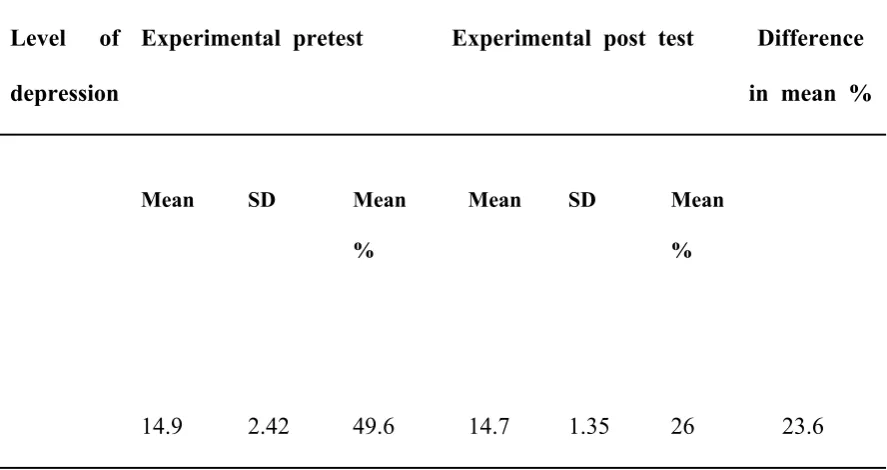
Regarding the pretest level of depression among elderly in experimental group , 31(100%) had mild depression and in posttest 5(14.2%) had mild depression and rest of them falls in normal.
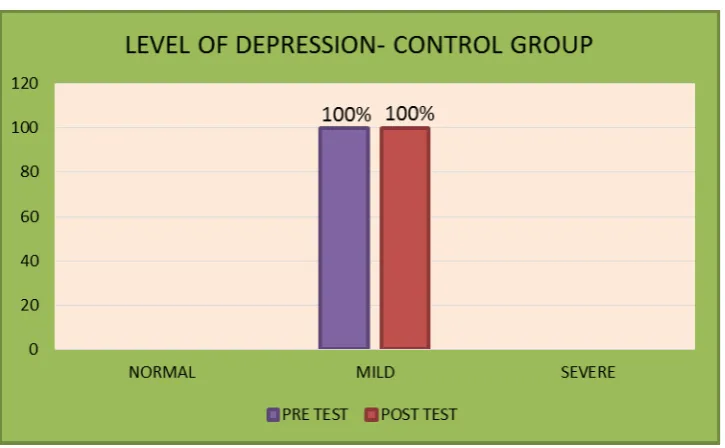
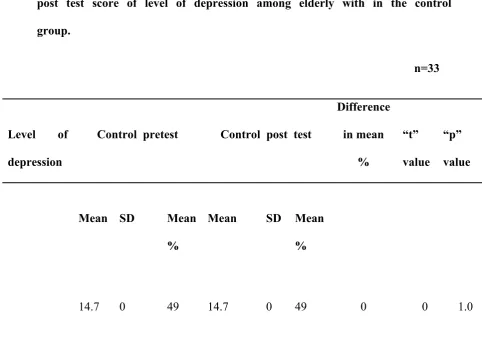
Regarding the pretest level of depression among elderly in control group,33(100%) had mild depression and post level of depression level of depression among elderly in control group 33(100%) had mild depression.
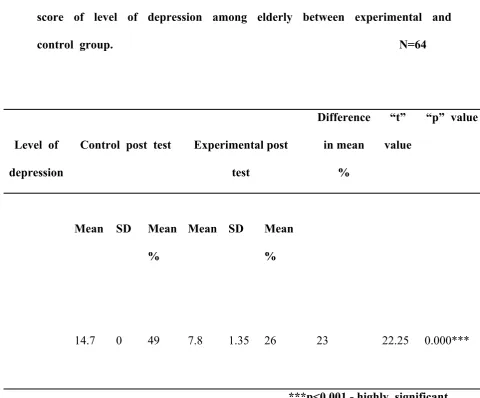
between experimental and control group using unpaired ‘t’ test revealed that the ‘t’ value was 22.25 which showed a statistical significance at p<0.001 level. It was inferred that the reminiscence therapy was significantly effective to decrease the level of depression among elderly in experimental group.
The chi square test revealed that there was significant association between pretest level of depression among elderly with the selected demographic variables like gender(p=0.0102), marital status(p=0.0051) and any medical illness (p=0.0012) in experimental group and control group and remaining was not associated with demographic variables at p < 0.05 level.
Conclusion
Reminiscence therapy is a non-pharmacological psychosocial intervention for the treatment of depression. The study results revealed that, there is significant difference on the level of depression among elderly in experimental and control group. The study concluded that reminiscence therapy will decrease the level of depression and enhances comfort in elderly.
Discussion
Further studies should be planned in such a manner to generalize the study findings and the use of other complementary therapies will decrease the level of depression.
NO CONTENTS NO
I INTRODUCTION
Background of the study
1
Significance and need for the study 4
Statement of the problem 6
Objectives of the study 6
Research Hypotheses 6
Operational definition 7
Assumptions 7
Delimitations 8
Projected outcome 8
II REVIEW OF LITERATURE
Review related to old age depression. 9
Review related to reminiscence therapy 14
Review related to effectiveness of reminiscence therapy among elderly.
16
Conceptual framework 23
III METHODOLOGY
Research approach 27
Research design 27
Population 28
Method of Sampling 28
Criteria for sample selection 28
Description of the tool 29
Scoring procedure 30
Validity of the tool 30
Reliability of the tool 31
Pilot study 31
Method of data collection 31
Plan for data analysis 36
Ethical consideration 37
IV ANALYSIS AND INTERPRETATION 38-54
V DISCUSSION 55-60
VI SUMMARY AND RECOMMENDATIONS
Summary 61
Main findings 63-64
Nursing Implications 64-66
Conclusion 66
Recommendations 67
LIST OF TABLES
Table No
Title Page
No 4.A.1 Frequency and percentage distribution of elderly based on
demographic variables in experimental and control group
39-41
4.C.1
Comparison of pretest and post test level of depression mean scores among elderly in control group46
4.C.2
Comparison of pretest and posttest level of depression mean scores among elderly in experimental group47
4.C.3
Paired ‘t’ test showing the comparison of mean pre test and post test score of level of depression among elderly within the control group48
4.C.4
Paired ‘t’ test showing the comparison of mean pre test and post test score of level of depression among elderly within the experimental group49
4.C.5
Un paired‘t’ test showing the comparison of post test mean score of level of depression among elderly between experimental and control group.50
4.D.1
Association between pretest level of depression in experimental group and control group with selected demographic variablesLIST OF FIGURES
Figure No
Title Page
No
2.1 Conceptual framework 25
3.1 Schematic representation of research design 26
4.1 Frequency and percentage distribution of pretest and post test level of depression among elderly in control group
44
4.2 Frequency and percentage distribution of pretest and post test level of depression among elderly in experimental group
LIST OF APPENDICES Appendix
No
Title
A Letter seeking experts opinion for content validity
B Permission letter for conducting pilot study C Permission letter for conducting research
study
D List of experts for content and tool validity E Research Tool ( English, Tamil)
F Reminiscence therapy Guide G Reminiscence therapy kit
H Snap shots
I CD Package
CHAPTER I
INTRODUCTION
“Life isn’t matter of milestones, but of moments”
BACKGROUND OF THE STUDY
The old age is an integral part of human life. It is the evening of life. It is
unavoidable, undesirable, unwelcome and problem ridden phase of life. But it is really
interesting to note that everybody likes to live a long life, but not to be old. It is
ironical that however undesirable the old age that is bound to life. A man is compelled
to go through the pains and pleasure of this age as like other phases in life, before
making exit from this mortal world.
Though it is true that no stage of life has its ever smooth sailing and every
stage has its attendant problems, those of old age are more difficult because the
physical strength and mental capability required to cope up with the adverse situations
of life are immensely reduced. The situation becomes all the more difficult when one
finds himself/herself left alone without anyone to attend him.
Indeed the loneliness and neglect associated with the old age is a rather recent
phenomenon. It is the outcome of breakup of the tradition of joint family system.
Growing urbanization and fast moving modern life have contributed to the problem.
Furthermore, the erosion of moral values has also aggravated the situation. Earlier,
when life was simpler and values counted for more, those who reached a ripe old age
held an enviable place in society where they could really release and enjoy the
twilight years of life.
They commanded great respect, regard, love and attention and were taken as
words of Elbert Hubbard are true to the situation, “where parents do too much for
their children, the children will do not much for themselves.”
Debilitating body and failing health, make things worse. Having rendered
service for a lifetime, the body parts appear to have become tired and weak. He
becomes highly vulnerable to ailments-minor or major. Diseases both minor and
major always follow them and their waking hours are preoccupied with symptoms and
pills, diets and therapies. Regular medical aid and assistance becomes routine at this
stage of life.
Besides, social security and emotional support are terribly needed. A feeling
of loneliness adversely affects their mental health which shows through some physical
problems. In recent times, insecurity of the old, particularly in metropolitan cities, has
emerged as a matter of grave concern. Usually, they are alone with servants to take
care of them. After some time, the servants become familiar with everything in the
household, they rob them of all their belongings, often become cruel enough to kill
them and ran away. The news of such incidents are frequent in national dailies.
The problem of loneliness and isolation is the gift of modern society. The
society forces an old person to live like an island. Often he faces the loss of spouse
and old friends. In fact, during the old age one is faced with multi-dimensional
problems. One of the major problems is the financial constraint which is really more
difficult in case of those old persons who are not entitled to any social security and
have no source of income, completely depending on their spouse or children. People
of this consumer culture do not have sufficient money to provide financial support to
their parents; neither do they take it as their moral responsibility. This situation is
Added to this is the depressing anxiety of not knowing just how far ahead one
must plan or for how long one is forced to dependent financially on his children to
meet his requirements. This brings more despondency to him. This plays havoc with
the lives of the elderly. The picture is really grim in the twilight years of the life
which ought to have been the best years of a person’s life, when man is free from
every kind of responsibilities.
In fact, it is an appropriate time for him to enjoy life without care and concern.
He finally has time to live-”sit in shade/reliving the good old times/letting bad
memories fade.” Keeping in mind these words of Henry Ward Beecher, “There is no
friendship, no love, like that of the parent for the child,” we should be sincere and
caring enough to take care of them when they most need it, but not pamper them.
Depression is common among the elderly. Depression is the most common
diagnosis in older adults ,who have attempted suicide and suicidal rate due to
depression among persons older than age of 65 is doubled compared with suicide
rates of persons younger than 65.
According to the National institute of mental health (NIMH), 2010 major
depression is a significant predictor of suicide in the elderly. The elderly (age 65 and
older) accounts for over 18% of all suicides, frequently depression goes unrecognized
and there for untreated in the older population.
It is difficult to imagine how families who bear the burden manage to meet the
needs of their depressed and suicidal loved one at home. Because the family members
become the primary care givers, strategies to promote optimal family functioning
Reminiscence therapy for depression consists of reading a self-help book for
depression that uses the principles of cognitive therapy. However there are inherent
difficulties in assuming from these studies that reminiscence therapy for depression is
an effective treatment with the general adult population.
Depression is not only a state of being sad, it is a disease that conquers the
ability to feel emotion, whether good or bad, whatsoever. Depression not only
involves the mind, it also involves the body and thoughts. In different cultures some
complain of excessive headaches and extreme pain and this is identified as
depression, moderate or otherwise. This disease can be passed down through genes or
can follow external events or can be caused by a chemical imbalance in the brain.
Several studies (Scogin,Hamblin andBeutler,1987,Scogin,Jamison and
Gochneaur 2007) have found cognitive reminiscence therapy to be an effective
treatment for depression with older adults samples.(adult age 60 and over).
Assuming a Reminiscence therapy for depression consists of recalling the past
experiences and memories for depression that uses the principles of cognitive therapy.
However there are inherent difficulties in assuming from these studies that
reminiscence therapy for depression is an effective treatment with the general adult
population
NEED FOR THE STUDY
An old man is full of experience are an immense help to the younger
generation, he is taken as an unwanted burden. Thinking of old age visions terrible
loneliness and neglect emerge in mind. A sense of despair glooms over all his
Globally 10% to 30% of elderly has the problem of depression and in India
13% - 15% of old age are affected with depression.
In Tamilnadu 47% to 49.5% of elderly have depression and in Madurai
25% to 27% of old age are affected with depression.
Scogin, Hamblin and Beutler (1987) used three treatment conditions to
investigate the efficacy of reminiscence therapy for the amelioration of symptoms in
mild to moderately depressed older adults. The reminiscence therapy treatment
condition was assessed three times over a two-month program. The first month was
active treatment and there was a post treatment follow-up one month later. The other
two conditions consisted of a delayed condition which received the same treatment
staggered one month behind the immediate treatment condition and an attention
control treatment group. Of 29 original participants 60 years of age or older, only 20
completed the study – a sample too small to be generalizable. Although there was no
significant relationship found between age and severity of depression on completion
of the program, there was a correlation found between less education and lower
socio-economic status and likelihood of dropping out of the study. This suggests
characteristics that warrant further study as possible predictors of a candidate’s
potential success in using reminiscence therapy for depression.
During the researcher’s visit to old age home, all the patients expressed their
feelings of isolation from their family and felt their depressive state. To eliminate
their feelings of depression, the researcher decided to do his research work for the
wellness of elderly clients.
The researcher viewed that depression will lead a person’s life to a
reminiscence therapy so that the researcher has chosen reminiscence therapy to
eliminate the elderly depression.
STATEMENT
A quasi experimental study to evaluate the effectiveness of reminiscence
therapy on depression among elderly in selected old age homes at Madurai.
OBJECTIVES
1. To assess the pretest and posttest level of depression among elderly in
both control and experimental groups.
2. To compare the pretest and posttest level of depression scores among
elderly in experimental and control groups.
3. To determine the effectiveness of reminiscence therapy on depression
among elderly by comparing the post test scores between control and
experimental groups.
4. To find out the association between pretest level of depression among
elderly with selected demographic variables in both experimental and
control groups.
RESEARCH HYPOTHESES:
H1- The mean post test depression scores of experimental group is
significantly lower than the mean post test depression scores of control group.
H2- The mean post test depression scores are significantly lower than the mean
pre test depression score of experimental group.
H3- There is a statistically significant association between pretest depression
OPERATIONAL DEFINITION:
Reminiscence therapy: In this study, it refers to an intervention which
includes the active recollection of life experiences. Vocally recall episodic memories
from their past with cues like visual, tactile, audio, smell and taste.
Effectiveness: In this study, it refers to the degree to which the reminiscence
therapy is achieved and the extent to which the depression is improved among elderly
in experimental group.
Depression: In this study, it refers to any change in an individual life that
causes alteration in the physical, mental, or emotional states which is assessed through
Geriatric depression scale.
Elderly: The people who are in the age of 60 and above living in a selected
old age home at Madurai.
Old-age home: It refers to the place where the elderly people residing to the
institution where their basic needs and geriatric care were met.
ASSUMPTIONS
1. Depression is common among elderly.
2. Depression leads to unfavorable consequences.
3. Reminiscence therapy is one of the mind and body relaxation techniques.
4. Reminiscence therapy is a non pharmacological treatment and it is an
DELIMITATIONS:
1. The findings of the study are limited to elderly people affected with
depression in selected old age homes at Madurai.
2. This study is delimited to elderly selected by screening depression scale.
3. The study was delimited to a period of 6 weeks.
PROJECTED OUTCOME:
The findings of the study will help to:
1. assess the level of depression among elderly in selected old age homes at
Madurai.
2. identify the effectiveness of reminiscence therapy.
3. improve the quality of life among elderly.
4. administer reminiscence therapy as a mind and body relaxation technique
CHAPTER II
REVIEW OF LITERATURE
Review of literature is used to designate a written summary of the act on a
research problem. Literature review can search a number of important functions like
identification of the topic, ascertaining what is already known in relation to a problem
of interest, developing a broad conceptual context into which research problem will fit
and suggesting way to go about the business of conducting a study on topic of
interest.
An extensive literature was done for the present study and was presented
under the following headings:
1. Studies related to old age depression
2. Studies related to reminiscence therapy
3. Studies related toreminiscence therapy on old age depression
1. STUDIES RELATED TO OLDAGE DEPRESSION
AT Beekman, JR Copeland and MJ Prince (2008) conducted a study
to assess the prevalence of late-life depression in the community. The reported
prevalence rates vary enormously (0.4-35%). Arranged according to level of
casernes, major depression is relatively rare among the elderly (weighted average
prevalence 1.8%), minor depression is more common (weighted average prevalence
9.8%), while all depressive syndromes deemed clinically relevant yield an average
prevalence of 13.5%. There is consistent evidence for higher prevalence rates for
Charles F. Reynolds .et. al., (2006) conducted a study on maintenance
treatment of major depression in old age in rural area of udupi taluk. Among patients
with a response to treatment with paroxetine and reminiscence therapy, 116 were
randomly assigned to one of four maintenance-treatment programs for two years
or until the recurrence of major depression. The result was the major depression
recurred within two years in 35 percent of the patients receiving paroxetine and
reminiscence therapy, 37 percent of those receiving paroxetine and clinical
management sessions, 68 percent of those receiving placebo and reminiscence
therapy, and 58 percent of those receiving placebo and clinical management
sessions (P=0.02). This study concluded that the patients 70 years of age or older
with major depression who had a response to initial treatment with paroxetine and
reminiscence therapy were less likely to have recurrent depression if they received
two years of maintenance therapy with paroxetine.
Deborah Mitchell (2009) conducted a study in Australia on depressive
symptoms and treatment. Depressive symptoms and disorders were identified by
structured psychiatric interview in 130 consecutively admitted male inpatients aged
70 years and over. Major depression was found in 11.5% and other depressive
syndromes in 23%. While depressive symptoms and syndromes are common among
the medically ill, this study demonstrated the need for careful diagnostic assessment
of older patients with depressive symptoms before initiating treatment that may itself
convey significant risk. Socio demographic and health characteristics of older men at
higher risk for depression were also identified. Patients more likely to be depressed
dysfunction, suffered from more severe medical illness (particularly recent
myocardial infarction), and had a history of psychiatric illness.
Ellen L. Brown. et. al., (2003) conducted a study on recognition of
depression among elderly recipients of home care services. The methods used
forty-two nurses were surveyed about the presence of depressive symptoms among
patients who had been evaluated independently for depressive disorders by
research staff using the Structured Clinical Interview for Axis I DSM-IV
Disorder. A sample of newly admitted home health care patients who were aged 65
years or older was randomly selected for this evaluation on a weekly basis from
December 1997 to December 1999. The concluded that home health nurses have
difficulty making accurate assessments of depression among older home care patients.
Inaccuracy in assessment of depression by home health nurses is a significant barrier
to treatment in this elderly homebound population.
Jane McCusker . et al., (2007) conducted study on major depression
among medically ill elders contributes to sustained poor mental health in their
informal caregivers in chevvayur. The longitudinal observational study with 6-month
follow-upconducted in two Montreal acute-care hospitals. A sample of 97 cognitively
intact medical inpatients aged 65 and over and their informal caregivers, with
oversampling of patients with a diagnosis of major or minor depression. Thepatient
characteristics included: mean age 79.3, 62% female, 46% major depression, 18%
minor depression, 36% no depression. Caregiver characteristics included: 73%
female, 35% co-resident spouse, 15% other co- resident relation, 50% not residing
with the patient. Results of the multivariate analyses showed that in comparison
those with major depression had a lower mental health score at follow-up (–9.54,
95% CI –16.66, –2.43), even though their physical health was slightly better (5.42
95% CI 0.04, 10.81).
Kapp (2002) conducted a study in Andhra Pradesh on older
individuals with depression of varying degrees of severity and other chronic as
well as acute medical problems are being more prevalent as the population
ages dramatically. The care of these individuals rises plethora of legal and
ethical issues , as professional care givers, advocates, and society endeavor to
balance compassion and benevolence for suffering persons, on one hand, with
respect for the autonomous right to control vital facets of one’s own life, on
the other. We must continue to grapple, from legal, ethical, and practical
perspectives, with complex questions about when, how, and with whom we
ought to be using the tools in our modern scientific armamentarium to
intervene against the wishes of older persons who purport to choose to be
miserable and to act accordingly
Sambamoothi U. et. al., (2003) conducted a study on reminiscence
therapy treatment among elderly diagnosed with depression in new Orleans. The
research design used is linked Medicare claims and survey data from the 1992
- 1999 Medicare Current. Between 1992 and 1998, we identified 1167
depressed elderly Medicare beneficiaries with 1829 episodes. The findings are,
overall reminiscence therapy was used in 32% (n = 534) of the episodes of
depression treatment. Reminiscence therapy use was correlated with younger
age, higher educational attainment, chronically illness and urban residence.
likely to receive reminiscence therapy. Results suggest a low level of adherence
with published guidelines for persistence treatment.
Niamadhab khar, et al, (2007) identified the point prevalence of depressive
Disorders in the elderly population in India, conducted a cross sectional study over a
Period of eight months in the three taluks of Udupi, Kundapura and Karkala. They
Selected 627 people in the age group of 60 years and above for the study. Simple
Random sampling without replacement method using the probability proportionate to
Size (PPS) technique was used. The results shown the rate of depression in elderly
Population was determined to be 21.7%. The Indian version of WHO – five well
being index (1998 version) showed a sensitivity of 97% specificity of 86.4% positive
Predictive value of 66.3% and an overall accuracy of 0.89%. They finalized the result
that the Indian version of WHO (five) well being Index was found to be an effective
Instrument for identifying depression in elderly Indian community.
Eisses, et al, (2004) conducted a cross- sectional and longitudinal study on
Prevalence and incidence of depression in residential homes for the elderly in
Drenthe, Netherland. Out of 479, 295 non- depressed subjects were estimated the
incidence rate after six months. The results showed the prevailing of major
Depression was 4.1% and the same rate was found for minor depression. The 6 month
Incidence of major and minor depression combined was 2.1%. The prevalence rate for
Depressive disorders obtained was twice as high as reported for the advance elderly in
The general population, where as the rate were lower than those usually found in
Residential homes.
Aman Sood, Parsotham.D. (2006) conducted a study to evaluate the profile of
Criteria were used for psychiatric diagnoses. General medical conditions were
Diagnosed by consultants of the respective departments. The patients were finally
Assessed by the consultant of the Department of Psychiatry. The obtained data were
Analyzed using the chi-square test. Results showed that 260 (49%) had psychiatric co
morbidity. The most common psychiatric disorder was depression (25.94%), and the
Above findings emphasized the importance of consultation-liaison psychiatry,
Especially in geriatric patients.
2. STUDIES RELATED TO REMINSCENCE THERAPY
Rabbi Bernard Cohen (2000), conducted an experimental study in Canada,
to assess the effectiveness of reminiscence therapy on psychosocial distress in lung
transplant patients and their families. 36 lung transplant clients and their support
people were examined for psychosocial distress, coping style and orientation to
independent learning before and after self help book in a programme to alleviate
distress and encourage adaptive coping. Subjects rated the books as highly acceptable
and none complained as increased distress. Results revealed as the changes in coping
strategies.
Pameetha .K (2000), conducted a study to assess the role of reminiscence
therapy in health anxiety. This experimental study investigated the patients who had
been identified as demonstrating health concerns. 40 patients were randomly allocated
to experimental and control group. Anxiety was assessed before and after
reminiscence therapy. Patients in the reminiscence therapy group showed reduced
level of anxiety at post test even when they also had identifiable physical problem.
These results are consistent with the ideas that reminiscence therapy can be an
Furroda (1999), conducted a study in Great Britain revealed that the assisted
reminiscence therapy is an effective and efficient treatment for reducing moderate
anxiety. In this study selected patients were supported in learning skills to manage
their symptoms. This approach was efficient acceptable and led to clinically
significant symptom reduction for a high proportion of patient.
Robert (1998), conducted a study in Tusculoosa, USA to assess the
effectiveness of minimal contact cognitive reminiscence therapy with group of 80
depressed adults who were recruited from the community. Minimal contact
reminiscence therapy was found to be superior for the control group. The results were
both statistically and clinically significant and the treatment group improved their
level of improvement at 3 month follow up. The results also indicated significant
decrease in dysfunctional attitude and automatic negative thoughts after treatment. It
appeared that the treatment also served a psycho educational function.
Kenninger (1998), conducted a comparative study regarding outcome of
individual psychotherapy and reminiscence therapy for depressed older adults. 31
community residing older adults aged 60yrs are over either received 16 sessions of
individual cognitive psychotherapy or read feeling good for reminiscence therapy.
Post treatment comparison with the delayed treatment control indicated that both the
treatments were superior to delayed treatment control. There were no difference
between individual psychotherapy and clinician rated depression. Further,
reminiscence therapy participants will continued to after post treatment. And there
were no difference between the treatments at 3 month follow up. Result suggests that
reminiscence therapy and individual psychotherapy are both viable treatment options
Cumero.et.al, (1996), conducted a meta-analysis of reminiscence therapy
studies in Illinois, to examine the efficacy of reminiscence therapy. Reminiscence
therapy treatments were compared to the control groups and therapist administered
treatment. The estimated effect size of 70 samples were analyzed and found to be
0.565. There was no significant difference between the effects reminiscence therapy
and therapist administered treatment. However reminiscence therapy did appeared
more effective for certain problems like assertion, training, anxiety and sexual
dysfunction. Recommendation for further research were given, specially for more
research on the commonly purchased books and moderator analysis by personality
type and reading book.
Jagatheesan, (1996), conducted a study to identify the efficacy of
reminiscence therapy for mildly and moderately depressed older adults. Cognitive
reminiscence therapy and behavior reminiscence therapy were compared with a
delayed treatment control condition but that the cognitive and behavioral
reminiscence therapy were non differently efficacious. 60 percent of subjects
demonstrated clinically significant changes. There were no specific effects associated
with either the cognitive or the behavioral intervention. Treatment gains were
maintained at 6 months follow up.
3.STUDIES RELATED TO REMINISCENCE THERAPY ON OLDAGE
DEPRESSION
Scoggin, et.al(2008), conducted a study to examine long term benefits of
participation in a reminiscence therapy program for depressed older adults. 30 of
original 44 participants (68%) were assessed to approximately 2 years following
index suggesting the improvements were maintained. Follow up questions revealed
that most participants 77% had not received other treatments most 73% felt their
depression reduced and over half 53% had read at least parts of their assigned book
during the 2 year interval.
Gregory Robert, (2006), meta-analysis of 29 outcome studies of cognitive
forms of reminiscence therapy for depression. Seventeen studies with stronger
research designs (pretest-posttest waiting list control group) yielded a respectable
effect size of 0.77, considered the best estimate of effect size from this study. This
result compares favorably with outcomes from individual psychotherapy. In light of
the substantial positive effects associated with reminiscence therapy for depression,
the authors discuss clinically relevant questions related to the use of cognitive
reminiscence therapy.
Beck, et.al (1979) conducted a study among Thirty-one community-residing
older adults age 60 or over either received 16 sessions of individual cognitive
psychotherapy (Beck, Rush, Shaw, & Emery, 1979) or read Feeling Good (Burns,
1980) for reminiscence therapy. Post treatment comparisons with the
delayed-treatment control indicated that both delayed-treatments were superior to a delayed-delayed-treatment
control. Individual psychotherapy was superior to reminiscence therapy at post
treatment on self-reported depression, but there were no differences on clinician-rated
depression. Further, reminiscence therapy participants continued to improve after post
treatment, and there were no differences between treatments at 3-month follow-up.
Results suggest that reminiscence therapy are viable treatment options for depression
Jones ED (2008), conducted A study to determine the effects of a 3- week,
six session Reminiscence intervention on the level of depression among elderly
women residing in one assisted living long term care facility using a pre test- post test,
quasi experimental design. The convenience sample of women 30 women (M=81.7
years). Depression was measured using geriatric depression scale. The findings of this
study suggest that Reminiscence therapy, was an effective treatment in reducing
symptoms of depression among elderly women.
Cully, Lavoie (2006) explored the effectiveness of reminiscence therapy as
an Effective means of reducing depression among institutionalized, rural dwelling
elderly women. Single group pre test and post test design (N= 31) was used and level
of depression was assessed by geriatric depression scale. Results have shown
statistically significant reduction in depression score. The author concluded that
individual reminiscence therapy contributes to the improvement of older adult’s
quality of life, reduces their depression, and enhances their morale.
Fillip Smit, Erast Buhlmejjer (2004) aimed to assess the effectiveness of
Reminiscence on depression among different target groups and treatment modalities.
They retrieved twenty controlled outcome studies and conducted a Meta analysis.
Results showed that reminiscence and life review are effective interventions for
depressive symptoms in the elderly.
Chao Shu, Tsung et al (2006) conducted a quasi experimental study to find
Out the effect of group reminiscence therapy on older nursing home resident’s
Depression (N=24) with 12 control group and 12 experimental group. Geriatric
Reminiscence therapy could enhance elder’s social interaction with one another in
Nursing home settings.
Wang JJ Cheng Kung (2007) conducted a randomized control trial to
assess the effectiveness of group reminiscence in reduction of cognitive impairment
Depressed mood (N=102). MMSE, GDS were used to assess the depression. Results
have shown that the intervention has significant effect on cognitive function and
affective function. The author concluded that the reminiscence therapy is a positive
and valuable intervention in reducing depression among elderly residing at long term
care settings.
Ellen Klaussner J, George S. et al (2006) conducted a randomized control
trial Study on institutionalized elderly. (N=481). Two RCTs compared treatment
groups. Six RCTs compared treatment with a placebo group. Eight RCTs compared
treatment with a standard care group. Three RCTs found significant reduction in
depression score. Study findings revealed RCT has a significant effect of
reminiscence therapy in the age group of 65-74, but not in the age over 74 years of
depressed elderly.
Wang Jing Jy (2005) in his quasi experimental study he assessed the
Comparative effects of reminiscence on elderly people€ residing in long term care
Facilities and at home. (N=48). Purposive sampling technique was used. The results
showed significant reduction of depression score after reminiscence. The author
suggested that reminiscence is appropriate intervention for depressed older people
Ya- Chan Hsu (2005) conducted a longitudinal study to find out the
Effectiveness of reminiscence therapy on depressed elderly. (N=40). Face to face
Interview and study instruments were administered. Results have shown that longer
the duration reminiscence therapy played a significant role in the reduction of
depression level among elderly. The author suggested that reminiscence is an
effective nursing intervention to reduce depression and to promote quality of life for
elderly Population.
Herieh, Wang Lin et al (2007) conducted a true experimental study to find
out the effect of group reminiscence and increasing self transcendence in older
women. (N=24). Result showed a positive effect of group reminiscence. Study
revealed that Group reminiscence offers a possible intervention for treatment of
depression in older women.
Pillemer et al (2008) In their cohort study (N=157) found the gender
Difference in reminiscence behavior across the life span. The sample consisted of two
cohorts. Younger cohort 68-71 years, older cohort 76-79 years. Interview technique
was used. Findings showed women had significantly higher scores. Study revealed
that the higher frequency of recounting specific memories by women was due to the
fact women placed greater value on reminiscing.
Eller L.s et al (2007) a part of the larger study of symptoms of self
Management examined the prevalence correlates and characteristics of depressive
Symptoms and self care activities used to manage those symptoms in old age home
Elderly. (N=1217) epidemiologic studies depression scale was a self care
interventions for depressive to find out the depressive symptoms. Results revealed 19
symptoms which fill in to six categories. 1. Complementary therapy 2. Reminiscence
therapy 3.Distraction techniques 4. Physical activity 5. Meditation 6.avoidant coping.
Results showed reminiscence has significant association.
Jing-Jy Wanga Ya et al, (2004) they assessed the effects of reminiscence on
Four selected mental health indicators, including depressive symptoms, mood status,
self-esteem, and self-health perception of elderly people residing in community care
facilities and at home. A longitudinal quasi-experimental design was conducted, using
two equivalent groups for pre–post test and purposive sampling with random
assignment. Each subject was administered pre- and post- tests at a 4 month interval
but subjects in the experimental group underwent weekly intervention. (n=94), a
statistically significant difference (p=0.041) was found between the pre–post tests on
the dependent variable, depressive symptoms. However, no statistical significance
was found in subjects’ level of mood status, self-esteem, and self-health perception
after the intervention in the experimental group, but slightly improvement was found.
Reminiscence not only supports depression of the elderly but also empower nurses to
become proactive in their daily nursing care.
Afonso R, et al, (2008) study analyzed the effectiveness of an individual,
delimited, semi-structured reminiscence program as an intervention strategy to reduce
depressive symptomatology in a population of Portuguese old people. A semi
structured reminiscence program was developed in 5 individual sessions. The
Program’s impact on depressive symptomatology was tested in 90 subjects aged over
65 years with depressive symptoms, no antidepressive medication, and no signs of
dementia. In a randomized experimental design, participants were assigned to one of 3
placebo-control group (with weekly relaxation sessions). Pre and post-test score
differences in Center for Epidemiologic Studies Depression Scale (CES-D) (adapted
by Gonçalves and Fagulha, 2000-2001, from the original developed by Radloff,
1977), were analyzed in all participants at the same time intervals. As per findings in
the experimental group, significant improvements were found in depressive
symptomatology. The results suggest that elaboration of positive and negative
autobiographical memories, stimulation of instrumental and integrative reminiscences
and narration of specific and positive autobiographical memories using the
reminiscence program, as designed and analyzed in this study, may be a tool for
psychological intervention to reduce depressive symptomatology in old age.
METHODOLOGY
It includes the research approach, research design, setting of the study,
population, sample, sample size, method of sampling, criteria for sample selection,
development and description of the tool, validity and reliability of tool, procedure for
[image:38.595.70.578.314.751.2]data collection and plan for data analysis, pilot study and ethical consideration.
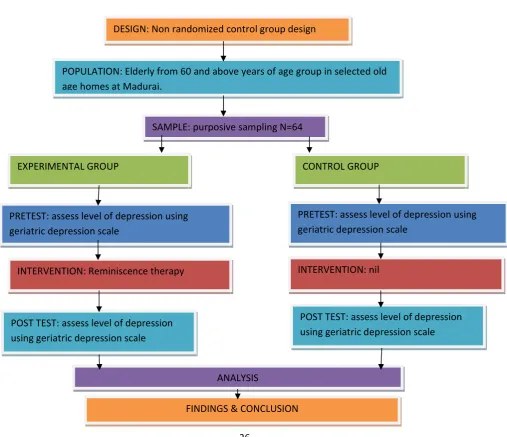
Figure 3.1SCHEMATIC PRESENTATION OF RESEARCH
DESIGN: Non randomized control group design
POPULATION: Elderly from 60 and above years of age group in selected old
age homes at Madurai.
SAMPLE: purposive sampling N=64
EXPERIMENTAL GROUP CONTROL GROUP
PRETEST: assess level of depression using
geriatric depression scale
PRETEST: assess level of depression using
geriatric depression scale
INTERVENTION: Reminiscence therapy INTERVENTION: nil
POST TEST: assess level of depression
using geriatric depression scale
POST TEST: assess level of depression
using geriatric depression scale
ANALYSIS
An experimental approach was selected for this study
RESEARCH DESIGN
In this study, NON RANDOMIZED CONTROL GROUP DESIGN (non equivalent control group design), was adopted.
GROUP PRE-TEST INTERVENTION POST-TEST E (non randomized) O1 X O2
C(non randomized) O1 - O2
E- Experimental group
C- Control group
X- Intervention (reminiscence therapy)
O1- Pretest level of depression among elderly
O2- Post test level of depression among elderly
SETTING OF THE STUDY:
Experimental group: The setting selected for the present study is Christian Mission Hospital, Keelavaasal which is run by C.S.I Diocease of Madurai and Ramnad, 8 kms
away from C.S.I. Jeyaraj Annapackiam College of Nursing
The target population includes elderly, above 60 yrs of age in Madurai.
The accessible population is elderly people with depression in Christian Mission
hospital and Inba Illam at madurai.
SAMPLE SIZE:
The total sample for this study will be 64 in number in which
33-belongs to Control group
31-belongs to Experimental group
SAMPLING TECHNIQUE:
Samples for this study were selected through non probability purposive sampling
technique.
SAMPLING CRITERIA:
Inclusion criteria
1. Who are of 60 and above 60 yrs of age
2. Who are identified with mild depression (by Geriatric depression scale) Both
male and female
Exclusion criteria
1. Who are ill at the time of data collection.
2. Who underwent reminiscence therapy previously.
After obtaining permission from the concerned authority and informed consent
from the samples, the researcher will collect the data. It consists of the following phases.
Phase I- Pretest was conducted to assess the level of self esteem using Geriatric Depression scale.
Phase II- Reminiscence therapy was given for 21 days (four hour per day).
Phase III- Post test was conducted to assess the level of Depression using the same scale in the following week.
TOOL DESCRIPTION:
The tool used in this study was standardized tool to assess the level of Depression
among elderly.
The research tool consists of
Part I: Demographic data
Part II: Geriatric depression scale( Yesavage J.A)
Part I: Demographic variable Performa
It consists of demographic variables of old age people which includes,
age, sex, marital status, number of children, religion, education, previous
occupation, pensioner, family support, duration of stay, mode of admission,
options was used for the study to collect the data. Reliability score was (0.83)
,established by split half method.
Scoring procedure
Scoring was based on the responses of the client. Each depressive answer
count one. Positive and negative items were scored based on the framing of
questions. If Q 1, 5,7,9,15,19,21,27,29 and 30 has “No” responses scored as one
for each question and for the rest if responses were ‘Yes” it was scored as one
and then the total scores were obtained. Thus the total obtainable score is 0-30.
Obtained score is interpreted as follows: Normal 0-09
Mild depression10-19. Severe depression 20-30.
VALIDITY
Content validity is the degree to which an instrument measures what it is
supposed to measure. Content validity is the sampling adequacy of the content
being measured (Polit and Hungler 2007). The content validity of the tool was
obtained by getting opinion from several experts. The experts have suggested
some specific modifications in the demographic and clinical variables performa
and rating scale. The modifications and suggestions of experts were incorporated
RELIABILITY
Reliability is the degree of consistency with which an instrument measures
the attribute which is designed to measure (Polit & Hungler 2007). Original
version of GDS has internal consistency (alpha 0.94), split half reliability (0.94)
and test retest correlation of 0.85 over a week. The reliability of translated
version in Tamil is established by split half method and the reliability score was
(0.83).
PILOT STUDY
Pilot study was conducted at Nesam trust old age home, Thirunagar Madurai.
After obtaining approval from the concern authorities, the researcher was clearly
explained about reminiscence therapy and verbal consent was obtained from samples.
Pre- test was conducted among both experimental and control group. Reminiscence
therapy was given to experimental group and post test was conducted both experimental
and control groups. The study was found to be feasible with regard to time, availability of
subjects and cooperation of samples. The pilot study revealed that the study was feasible
. Data was analyzed to find out the suitability of statistics and found to be
significant.
DATA COLLECTION PROCEDURE
The main study was conducted after obtaining the formal permission from
collection was six weeks in which the investigator selected 64 samples , who fulfilled
the inclusion criteria using non – probability purposive sampling method. In that 31
elderly of Christian mission hospital old age home were in experimental group and 33
elderly of inba illam were in control group. Pre -test assessment for experimental group
and control group was done.
Following week, the eldely in experimental group was given reminiscence
therapy. The duration for reminiscence therapy given 2hr in forenoon and 2 hr in
afternoon daily for 3weeks. Schedule was made for each week. It includes, a
reminiscence kit which helps in recollecting of life experience for the elderly, the kit was
designed based on stimulating sensory stimuli (visual, auditory, tactile taste/smell),
through the sharing of their life experience and memories their depression will get
reduced. After 2weeks, posttest was done with the same questionnaire. Effects were
determined and compared with experimental group and control group before and
after reminiscence therapy. All the elderly were co – operative and the investigator
expressed her gratitude for their co – operation. In all sessions the elderly people in
old age home ventilate their experience and memories
.
STEPS OF DATA COLLECTION STEP I
Conduction of Pre - test among both experimental and control group.
STEP III
Administration of Reminiscence therapy to the experimental group with the help of a kit.
STEP IV
Post – test assessment among experimental and control group with Geriatric Depression Scale.
SCHEDULE FOR DATA COLLECTION PROCEDURE:
WEEKS SETTINGS ACTIVITY
Ist Week Christian mission hospital old age home home & Inba Illam Madurai.
Pre-test was conducted.
II , III & IV Week Christian mission hospital old age home keelavasal, Madurai
Reminiscence therapy was
administered.
V &VI Week Christian mission hospital old age home & Inba illam.Madurai
Post-test was conducted
followed by Reminiscence
therapy administration to
WEEK 1
FORENOON:
INDIVIDUAL SESSION:
Visual- pictures of leaders (e.g. Mahatma Gandhi, Pandit Nehru)
Tactile- clothes walk stick (things used by clients at present)
Taste & smell- coffee/tea powder for smell. Salt and sugar for taste
Audio- old movie songs
AFTERNOON:
GROUP SESSION:
Visual cues of political leaders of earlier ( 60’s & 70’s) and current political leaders. Conducting a discussion regarding political transformation in Tamilnadu.
WEEK 2
FORENOON
INDIVIDUAL SESSION:
Visual- pictures of food items
piece fountain pen etc)
Smell- sandal powder fragrance sticks. Taste: sour tamarind, sweet mango according to client likes & dislikes. Encouraging them to share the recipes they
like.
AFTERNOON
GROUP SESSION
Old movie actor & actress musician pictures; sharing their ideas about their favorite movie stars
WEEK 3
FORENOON
INDIVIDUAL SESSION
Visual- pictures of famous places around Madurai (Meenakshi temple, Naicker mahal etc)
Audio- old Tamil songs
Tactile- dresses (silk, woolen, cotton) ornaments, jewels.
Smell & taste- betel nuts aromatic curry leaves flavoring agents of food for smell. Snacks & dishes in which clients expertise in preparation as well as their like
GROUP SESSION:
Encourage the clients to share their life experience & achievements.
Screening of a Tamil movie
Plan for data analysis
Data analysis helps the researcher to organize, summarize, evaluate, interpret
and communicate the numerical facts. For the present study the collected data from
the participants was grouped and analyzed using both descriptive and inferential
statistical methods. Statistical analysis was done by using SPSS 17.0 software. Data
was analyzed using both descriptive and inferential statistics.
Organize the data in master sheet:
Descriptive statistics application:
Frequency and percentage distribution to analyze the demographic variables
Mean and Standard deviation to compare pre – test and post – test level of depression among elderly.
Inferential statistics application:
Paired ‘t’test and Unpaired ‘t’ test to compare the pre – test and post - test level of depression among lderly in experimental and control
depression among elderly was analyzed by using chi -square test .
Ethical consideration
Approval from the research committee and concerned authorities was obtained.
Each individual was informed about the purpose of the study and confidentiality
was promised and ensured. The client has the freedom to leave the study at their wish
without assigning any reason. Thus the ethical issues were ensured in this study.
PROTECTION OF HUMAN RIGHTS:
The pilot study and main study were conducted after the approval of the research
and ethical committee. Permission will be sought from the concerned authorities of the
institution. Assurance was given to the study subjects of their anonymity and
CHAPTER IV
DATA ANALYSIS AND INTERPTRETATION
This chapter deals with analysis and interpretation of the present study
involves compilation, editing, coding, classification and presentation of the data
for statistical calculation in order to draw inferences and conclusions, Using
descriptive and inferential statistic, the study objectives were computed. The
data collected from the samples to evaluate the effectiveness of reminiscence
therapy on the level of depression among elderly were organized, analyzed,
tabulated and interpreted.
ORGANIZATION OF STUDY FINDINGS
Section A: Data on description of demographic variables of elderly in
experimental and control group.
Section B: Data on assessment of level of depression among elderly in
experimental and control group.
Section C: Data on effectiveness of reminiscence therapy on the level of
depression among elderly in experimental and control group.
Section D: Data on association between the levels of depression with the
SECTION A: DATA ON DESCRIPTION OF DEMOGRAPHIC
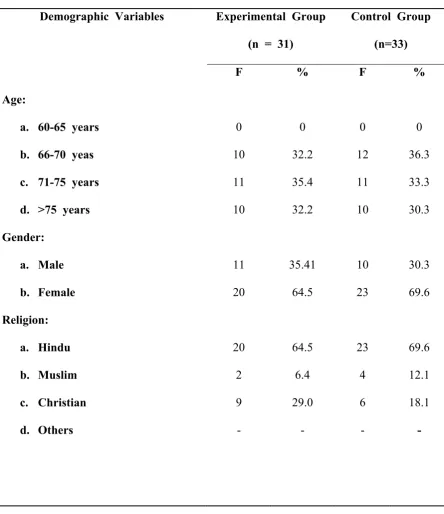
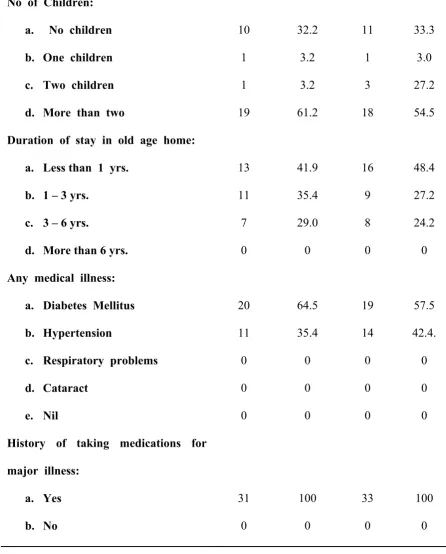
VARIABLES OF ELDERLY IN EXPERIMENTAL AND CONTROL GROUP:Table 4.A.1: Frequency and percentage distribution of elderly based on
demographic variables in the experimental and control group.
N=64
Demographic Variables Experimental Group
(n = 31)
Control Group
(n=33)
F % F %
Age:
a. 60-65 years
b. 66-70 yeas
c. 71-75 years
d. >75 years
Educational status:
a. Illiterate
b. Primary education
c. middle
d. Graduate and Above
25 2 2 2 80.64 6.4 6.4 6.4 23 6 1 3 69.6 18.1 3.0 9.09
Marital status:
a. Married
b. Unmarried
c. Widow
d. Separated/ Divorced
Monthly Income:
a. Below 5000
b. 5000-10000
c. Above 10000
d. Nil 11 10 5 5 22 7 2 0 35.4 32.2 16.1 16.1 70.9 22.5 6.4 0 10 11 7 5 21 7 5 0 30.3 33.3 21.2 16.1 63.6 21.2 16.1 0
Source of income:
a. Family
b. Friends
c. Pension
d. Interest from savings
No of Children:
a. No children
b. One children
c. Two children
d. More than two
10 1 1 19 32.2 3.2 3.2 61.2 11 1 3 18 33.3 3.0 27.2 54.5
Duration of stay in old age home:
a. Less than 1 yrs.
b. 1 – 3 yrs.
c. 3 – 6 yrs.
d. More than 6 yrs.
13 11 7 0 41.9 35.4 29.0 0 16 9 8 0 48.4 27.2 24.2 0
Any medical illness:
a. Diabetes Mellitus
b. Hypertension
c. Respiratory problems
d. Cataract e. Nil 20 11 0 0 0 64.5 35.4 0 0 0 19 14 0 0 0 57.5 42.4. 0 0 0
History of taking medications for
major illness:
[image:53.595.101.548.90.645.2]a. Yes b. No 31 0 100 0 33 0 100 0
Table 4.A.1 shows the frequency and percentage distribution of elderly
based on the demographic variables such as age, gender, religion, education,
of stay in old age home, any medical illness, history of taking medication for
major illness in experimental and control group.
Regarding age, majority 12(36.3 %) belonged to the age group of
66-70years in control and 11(35..4%) belonged to the age group 71-75 years in
experimental group . Regarding gender in control group, both male and female
constituted as 10(30.3%) and 23 (69.6%) respectively. In experimental group,
both male and female constituted as 11(35.4%) and 20(64.5%) respectively.
Regarding religion, majority 23(69.6%) of elderly were from the Hindu
back ground and rest of them were Christians and Muslims in control group,
and in experimental group most 20(64.5%) of them were Hindus and
remaining were Christians and Muslims.
Regarding educational status, Majority