Identity and text:
Developing self-conscious readers
■
Mary Ryan & Michele Anstey
UN I V E R S I T Y O FSO U T H E R NQU E E N S L A N D
Globalisation and societal change suggest the language and literacy skills needed to make meaning in our lives are increasing and changing radically. Multiliteracies are influencing the future of literacy teaching. One aspect of the pedagogy of multiliteracies is recruiting learners’ previous and current experiences as an integral part of the learning experience.
This paper examines the implications of results from a project that examined student responses to a postmodern picture book, in particular, ways teachers might develop students’ self-knowledge about reading. It draws on Freebody and Luke’s Four Resources Model of Reading and recently developed models for teaching multiliteracies.
‘If we weren’t doing any sessions, I probably wouldn’t have thought much about the book being about Europeans and Aboriginals. I probably just thought it was like … It probably just meant to be like one of the others; that they just have no meaning to it. They’re just basically there, like Spot or
something.’ Susan (pseudonym) age 11
This quote from Susan was from the last of four sessions in which a small group of Year Six students read and discussed The Rabbitsby John Marsden and Shaun Tan. The lessons formed part of a small case study, originally conceptualised to explore the notion that students from different backgrounds, cultures and countries might interpret the book differently. The study was conducted in parallel with a similar group of students in the UK and findings were to be compared.
However, when the sessions were complete it became apparent that there were implications beyond simply ascertaining that students drew on different socio-cultural resources in order to make meaning. As Susan herself said if there ‘hadn’t been any sessions’ then she would never have accessed other possible meanings in this text. It was this comment that led us to re-examine the transcripts of the sessions with other questions in mind. The re-examination of the transcripts focused on the role ‘knowledge about reading’ plays in assisting students to make meaning, This time we considered students’ identity in terms of both their socio-cultural characteristics andtheir knowledge and experiences
9 Australian
Journal of Language and Literacy
R
Y
AN &
ANSTEY
•
A
USTRALIAN JOURNAL OF LANGU
A
GE
AND LITERA
CY
,
V
ol.
26,
No
.1
,2003,
pp
.
as readers. Consequently we began to think more carefully about how we, as teachers
• identify and use pedagogy to teach students how to use their identity as a reader more strategically, and
• identify knowledge and strategies, which will aid students in using their identity to read more strategically.
The purpose of this paper is to explore our findings in terms of current trends and issues in literacy pedagogy. We also offer suggestions on explicit teaching strategies that will assist development of students’ awareness and use of allthe resources that influence their identity as a reader to make meaning from text.
Current beliefs about literacy and literacy pedagogy
The changing nature of our domestic, public and working lives as a result of globalisation and societal change means that views of literacy as simply being able to read and write traditional texts are no longer adequate. The language and literacy skills needed to make meaning are increasing and continually changing; consequently the term ‘multiliterate’ has been developed to describe the characteristics of the literate person in these new times. Multiliteracies include not only the traditional print literacies, but also the many modes of representation and forms of text that have been made available through multimedia and technological change. A multiliterate person needs a repertoire of practices that can be used for
• making meaning and communicating in a variety of modes and media
• critical analysis of texts in all representational forms and
• engaging in the social responsibilities of interaction associated with texts.
Reading, as one of the multiliteracies, must also be defined in new ways. Readers in new times need to be active readers, with the self-confidence to form and venture opinions about texts and their contexts. Readers need to know how to read the text both for their own purposes and for the purposes defined by the cultural context in which the text is operating. In other words readers need to be as much in control of the text as they are controlled by it (Courts, 1991).
Within the context of change that has resulted in new definitions of literacy and reading, literacy pedagogy itself must be viewed differently. Multiliteracies focus on the multiplicity of technologies, cultures, experi-ences, ways of making meaning and ways of thinking that are available to the learner. Consequently literacy pedagogy must focus on enabling the reader to use any or all of the resources available to them, to trans-form the meaning of text, so that it makes sense to them. Lave (1996, p. 10
Volume 26 Number 1 February 2003
R
Y
AN &
ANSTEY
•
A
USTRALIAN JOURNAL OF LANGU
A
GE
AND LITERA
CY
,
V
ol.
26,
No
.1
,2003,
pp
.
9
–
161) refers to this as ‘changing participation in changing practices’. In other words, we must teach students to recruit previous and current expe-riences as an integral part of learning to make meaning, or reading (Cope and Kalantzis, 2000).
The resources a reader uses to make meaning
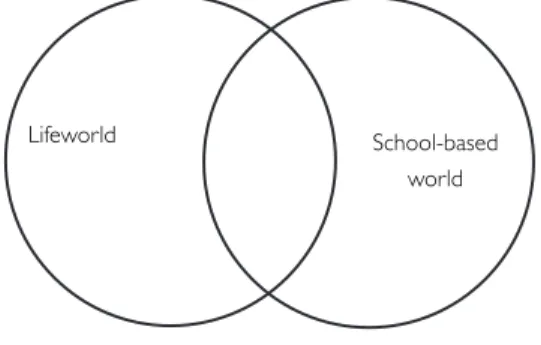
Reading does not occur in a vacuum. All literacy practices are a reflec-tion of the socio-cultural processes and knowledge of the learner, and are not static, but dynamic and ever changing (Tusting, 2000). All readers have an identity which is derived from their life experiences and which provides them with resources as a reader. The readers may draw on dif-ferent domainsof their identity to make meaning. ‘Domains are structured, patterned contexts within which literacy is used and learned’ (Barton & Hamilton, 2000, p. 11). Cope and Kalantzis (2000), identify these different domains or identities collectively as Discourse Worlds, and suggest that students draw on two in particular to make meaning, their Lifeworld and their School-Based World. We have represented this concept visually in Figure 1, which indicates that these worlds overlap and inform one another.
Figure 1. Discourse worlds in a reader’s identity
Part of readers’ Lifeworlds and School-based Worlds is their knowledge and experience as readers. Freebody and Luke (1990) developed a model that describes the different reading practices (experiences) a person engages in as part of everyday life. They suggest that in order to engage in these practices readers draw on a set of resources, some of which intersect and overlap. The four practices and their associated resources are:
• Coding Practice(Code breaker) – resources which enable the reader to crack the code of the written and visual text, determine how it works and what its patterns and conventions are;
11 Australian
Journal of Language and Literacy
R
Y
AN &
ANSTEY
•
A
USTRALIAN JOURNAL OF LANGU
A
GE
AND LITERA
CY
,
V
ol.
26,
No
.1
,2003,
pp
.
9
–
22
Lifeworld School-based
Semantic Practice (Meaning-maker) – resources which enable the reader to access the literal or implied meaning of the text, and utilise his/her sociocultural background to make meaning;
Pragmatic Practice(Text user) – resources which enable the reader to determine and fulfil their role in usingthe text; and
Critical Practice(Text analyst) – resources which enable the reader to critically analyse the construction of the text in terms of the author’s intentions, ideologies, inclusions and omissions.
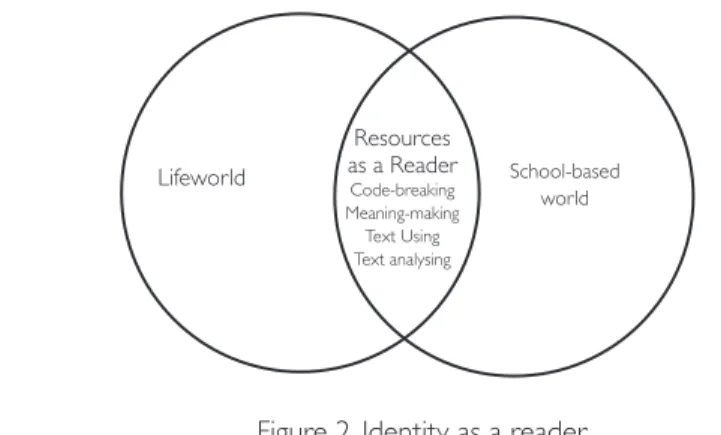
Figure 2 represents how students’ reading resources may arise from the reading practices and experiences in both their Lifeworld and School-based world. The intersection of reading practices and experiences in both these worlds represents the students’ identity as readers. This identity comprises the resources that readers may consciously or uncon-sciously draw upon as they read. It is at this point of intersection that we as teachers can have most influence, helping students to consciously access the resources of both these worldsto make meaning for different purposes and in different contexts. In other words we need to develop readers’ ability to be strategic about their reading, to ensure that they identify and use all available and appropriate resources.
Figure 2. Identity as a reader
Intersection of lifeworld, school-based world and resources as a reader
Overview of study
The study was initially undertaken to examine ways in which culture and identity influence the analysis and interpretation of text. Therefore it was important to select a text that was open to multiple interpretations which might be influenced by one’s socio-cultural background and expe-rience. The text selected was a postmodern picture book – The Rabbitsby John Marsden and Shaun Tan. It is a book open to many readings; one of which might be that it depicts European settlement of Australia from an Aboriginal viewpoint.
12 Volume 26 Number 1 February 2003
R
Y
AN &
ANSTEY
•
A
USTRALIAN JOURNAL OF LANGU
A
GE
AND LITERA
CY
,
V
ol.
26,
No
.1
,2003,
pp
.
9
–
22
Lifeworld
Resources as a Reader
Code-breaking Meaning-making
Text Using Text analysing
13 Australian
Journal of Language and Literacy
R
Y
AN &
ANSTEY
•
A
USTRALIAN JOURNAL OF LANGU
A
GE
AND LITERA
CY
,
V
ol.
26,
No
.1
,2003,
pp
.
9
–
22
We conducted four sessions, the aim of which was to determine which resources students ‘naturally’ draw upon when reading and making meaning. Consequently we did not engage in active teaching as this might have influenced students’ reading of the text. Instead we engaged students in reading and re-reading the book and used a set of questions to prompt responses. The questions used to facilitate responses to the text were based on a framework developed by Chambers (1993), which focuses on using questions to aid students in articulating their responses to text. We purposely refrained from comment on the possible meanings in the text until the students themselves suggested various meanings or ideas. Even then we only interrupted to seek clarification. The sessions were planned in the following manner.
• Session One focused on an initial reaction to the book – what the students thought it was about, what they thought it meant, what they liked or disliked about it.
• Session Two focused on the storyteller(s) – the ‘we’ characters
through examination and discussion of the written and illustrative text.
• Session Threefocused on the ‘rabbit’ characters in the story, through
examination and discussion of the written and illustrative text.
• Session Fourfocused on the author’s and illustrator’s intentions and
purposes, and the students’ opinions or views about aspects of the story.
The sessions were audio-taped and transcripts were made. Student responses were coded in terms of the discourse worlds that appeared to be drawn upon and the reading resources/practices used.
Results and discussion
It is important when considering our results that we think about what we mean by ‘focusing on students’ naturaluse of resources for reading.’ Their ‘natural use’ includes not only drawing upon their general experi-ences as readers but their experiexperi-ences of learning to read in formal and informal settings. Therefore some of their ‘natural’ reading behaviours will have been influenced by prior teaching and learning experiences.
14 Volume 26 Number 1 February 2003
R
Y
AN &
ANSTEY
•
A
USTRALIAN JOURNAL OF LANGU
A
GE
AND LITERA
CY
,
V
ol.
26,
No
.1
,2003,
pp
.
9
–
22
Implications for teaching
The natural predisposition to one practice (Semantic Practice) is of some concern, given what we know about the demands of reading in the 21st century. We would suggest that a combination of prior reading experi-ences and prior teaching and learning experiexperi-ences in reading may have led to this practice being favoured over others. Because this study is small it would be inappropriate to make generalisations from the results. However we feel the trends are strong and therefore it is appropriate to consider the implications for teaching. It may be that students naturally focus on prior knowledge and experience to make sense of the world, and that our current teaching practices reinforce this use of reading resources. Therefore, if we are to aid students in engaging in all four reading practices (coding, semantic, pragmatic and critical) and access-ing appropriate readaccess-ing resources in order to do this, our readaccess-ing peda-gogy may need to change. It would seem there is a need for teachers to focus on two aspects of literacy (and reading) pedagogy. These are
• identifying and using appropriate pedagogy for developing strategic readers, and
• identifying appropriate knowledge and skills for developing strategic readers.
1. Identifying Appropriate Pedagogy for Developing Strategic Readers
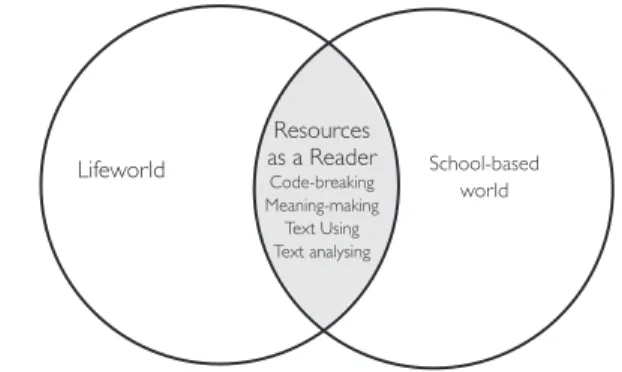
Examination of the transcripts from a pedagogical viewpoint led us to conclude that there is a need to identify specific pedagogies that encour-age students to consciously use their identity as a reader. In other words, it is important to empower students by teaching them how to access and use knowledge and resources available for reading. These resources are represented in the shaded section of Figure 3, that is, the intersection of Lifeworld, School-based world and Resources as a Reader.
Figure 3. Focus of pedagogy for developing strategic readers
Lifeworld
Resources as a Reader
Code-breaking Meaning-making
Text Using Text analysing
As discussed earlier in the paper current beliefs about the pedagogy of literacy focus on teaching multiliteracies (The New London Group, 1996). Cope and Kalantzis (2000, p. 239) report on a multiliteracies peda-gogy, which is a cyclical view of literacy learning that draws on historical and methodological perspectives in literacy teaching to inform current practice. Cope and Kalantzis stress that there is nothing radically new in any of the four aspects they describe; prevailing pedagogy has simply been repackaged in order to extend (rather than replace) existing literacy pedagogy. The four aspects of the multiliteracy pedagogy are:
• Situated Practice: which draws on progressive pedagogies such as
whole language and process writing. For example, pedagogy would engage and immerse students in reading practices and topics that are part of their community context.
• Overt Instruction: which draws upon teacher-centred transmission
pedagogies such as traditional grammar and direct instruction. For example, pedagogy would engage students in explicit deconstruction of the linguistic features and structural aspects texts in order to understand how the text has been constructed to achieve particular purposes and convey meanings.
• Critical Framing: which draws upon the paradigm of critical
litera-cy. For example, pedagogy might engage students in comparing two texts on the same topic written from a different point of view, con-sidering how the texts convey the points of view and why they may have been written from these different perspectives.
• Transformed Practice: which draws upon the transfer of strategies
from one context to another. For example, pedagogy might engage students in writing a letter for the local community newspaper expressing their views on a topic they have been reading about in the paper and upon which there have been several points of view.
In a multiliteracies pedagogy teachers consciously select and use teaching strategies and content best suited to teaching the specific of lit-eracy being taught. In a Situated Practicepedagogy, students are encour-aged to draw on their previous and current experiences, and access the experience and knowledge of ‘experts’ or ‘expert novices’ who have a knowledge of the topic. In an Overt Instructionpedagogy students are guided in systematic, analytic and conscious understanding of how they make meaning. They are encouraged to consider what they are drawing on, how meanings change as new understandings are brought to bear, and how to talk about it; that is, they are taught an explicit metalan-guage to discuss the reading process. In a lesson where Critical Framing pedagogy is focused upon, students would be engaged in the interpreta-tion of the social and cultural contexts of the text, a critical analysis of its construction and examination of its underlying ideologies. Students in a lesson that is which is focused on Transformed Practicewould engage in
15 Australian
Journal of Language and Literacy
R
Y
AN &
ANSTEY
•
A
USTRALIAN JOURNAL OF LANGU
A
GE
AND LITERA
CY
,
V
ol.
26,
No
.1
,2003,
pp
.
9
–
tasks that encouraged them to utilise known skills and knowledge in new contexts.
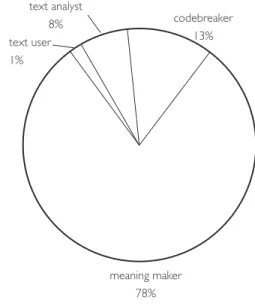
Because this case study was initially focused upon identifying students’ ‘natural’ use of identity to construct meaning, there was no overt instruction. In fact, the lack of explicit instruction and application to other contexts, and the use of Chambers’ questioning sequence means that it was similar to the pedagogies associated with whole language, child-centred response type lessons, where students’ own background knowledge and experience is the focus of making meaning. It was there-fore similar to the Situated Practice aspect of multiliteracy pedagogies. Students were encouraged to draw meaning from their Lifeworld and School-based world through the questioning of an ‘expert’ (teacher). Analyses indicate that such pedagogy encouraged engagement in Semantic Practice (role of meaning maker), but did not necessarily develop or engage the other reading practices. This is reinforced in Figure 4, which shows which reading practice resources were drawn on by students. The distribution is typical of the reading practices drawn upon in the first three sessions. It can be seen that semantic practice accounts for 78% of responses, and although the other practices are evident, they are in minimal amounts, and show existing knowledge, rather than development of these practices. The implication of such data is that Situated Practice is an appropriate pedagogy if the focus is on utilising student background experiences to aid meaning-making, but it will not necessarily encourage the use of other reading practices.
Figure 4: Dominance of semantic practice in situated practice pedagogy
16 Volume 26 Number 1 February 2003
R
Y
AN &
ANSTEY
•
A
USTRALIAN JOURNAL OF LANGU
A
GE
AND LITERA
CY
,
V
ol.
26,
No
.1
,2003,
pp
.
9
–
22
text analyst 8% text user 1%
codebreaker 13%
As we have indicated previously there was no Overt Instructionin these sessions. Examination of the transcripts drew attention to the consequence of not including this type of explicit instruction as part of a balanced program. In Figure 5, we have represented the use of the four practices, Coding (code-breaker), Sematic (meaning-maker), Pragmatic (text user) and Critical (text analyst) in terms of the two worlds drawn upon to engage in these practices (Lifeworld and School-based world). It is inter-esting to note that when engaging in Pragmatic Practice (role of text user) students only drew on the school-based world. This is even more interesting when one considers the focus of Pragmatic Practice, which is the use of texts in the real world. It would be expected that engaging in Pragmatic Practice or text use would necessitate students drawing on their Lifeworld (as this is where they usetexts). It was particularly inter-esting in this case as parts of the book addressed rabbits and environ-mental impact, which was very much part of these students’ farming Lifeworld. It would seem therefore that students need to be explicitly taught how to access appropriate resources when engaging in each reading practice. The pedagogies associated with Overt Instruction would assist teachers in accomplishing this.
Figure 5
The questions in all the sessions provided scope for engaging in Critical Practice and the associated pedagogies of Critical Framing. However, in three out of the four sessions the focus was implicit. For example, in Session One students were asked to explain what they liked or disliked about the book (make a judgement). In Session Two they had to consider how they would feel at various points in the story if they were the ‘we’
17 Australian
Journal of Language and Literacy
R
Y
AN &
ANSTEY
•
A
USTRALIAN JOURNAL OF LANGU
A
GE
AND LITERA
CY
,
V
ol.
26,
No
.1
,2003,
pp
.
9
–
22
meaning maker
18 Volume 26 Number 1 February 2003
R
Y
AN &
ANSTEY
•
A
USTRALIAN JOURNAL OF LANGU
A
GE
AND LITERA
CY
,
V
ol.
26,
No
.1
,2003,
pp
.
9
–
22 characters and in Session Three, if they were the Rabbit characters (point
of view). The reason the Critical Literacy component remained implicit in these sessions was because of our desire to remain neutral and not influence students’ interpretation of the book. Therefore our pedagogy allowed the focus of the learning to come from the students; it learning was child-centred and built on the students’ experiences. As we have said previously it was therefore similar to pedagogies associated with Situated Practice. It was only if students explicitly made a critical judge-ment or talked about point of view that it was addressed. For example, in Session One when asked what they liked or disliked about the book one student suggested there was more detail needed in the story (there were too many gaps). However, another student countered that this was not necessary because the illustrations provided extra detail and informa-tion. This student had engaged in Critical Practice, considering the role of illustrative and written text in telling story and the use of gaps and silences. However this was purely serendipitous as the lesson had not drawn on the pedagogies associated with Critical Framingthat foster the learning of Critical Practice. In Session Four however, the students were explicitly asked to engage in Critical Literacy through the questions which that focused the lesson (What do you think the author’s/illustrator’s intention was in writing/illustrating this book?).
In Figure 6 we have plotted the engagement with the four practices of reading over the four lessons. As can be seen, Critical Practice increases sharply in Session Four when the students were explicitly engaged in a Critical Practice task.
Figure 6
Because the sessions were focused on students’ responses to The Rabbitsthere was no opportunity for students to take the transformed meaning of the text, and apply it to other contexts or cultural sites; that is, to make new meaning. Therefore there was no opportunity to examine the transcripts in terms of pedagogies associated with Transformed Practice. However, it is worth considering that when teach-ing Pragmatic Practice (text user), which engages the reader in the use of text in real life, the pedagogies of Transformed Practicewould be highly appropriate.
The preceding discussion in which we reconsidered the transcripts of these sessions in terms of recent trends in literacy and literacy pedagogy, show how knowledge about and strategic use of the Multiliteracies Pedagogy can inform the teaching of reading. In the words of Wells,
…it is not the reading of stories on its own that leads children towards the reflective, disembedded thinking that is so necessary for success in school, but the total interaction in which the story is embedded. At first they need a competent adult to mediate, as reader and writer, between themselves and the text; but even when they can perform the decoding and encoding for themselves, they continue to need help in interpreting the stories they hear and read and in shaping those that they create for themselves. (Wells, 1985 in Hassall, 1999, p. 1)
2. Identifying appropriate knowledge and skills for developing strategic readers
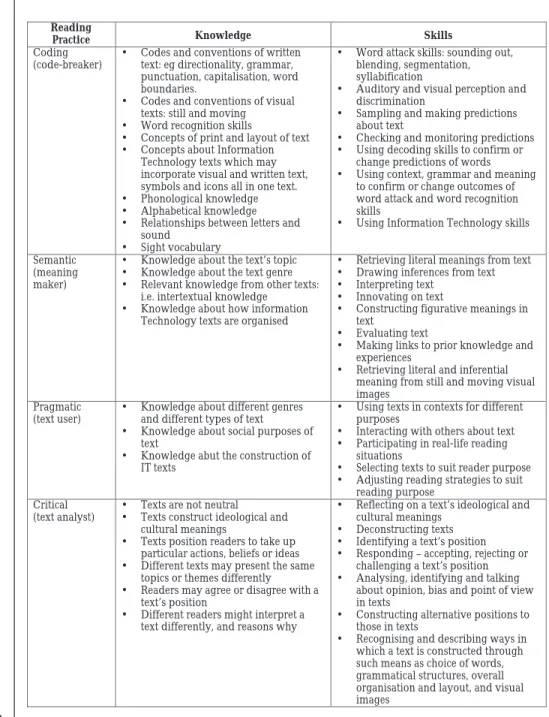
In the preceding section we rethought our pedagogy, drawing on what we already knew and aligning it with current views of reading as a social practice in a climate of change. We identified pedagogies which that were best suited to teaching particular reading practices and access-ing the resources associated with them. Havaccess-ing identified appropriate pedagogy it is important to identify what to teach; that is, the appropriate knowledge and skills. New constructions of reading necessitate new ways of viewing content. Recently Harris, Turbill, Fitzsimmons and McKenzie (2001) have identified knowledge and skills associated with each of the four practices of reading. In Table 1 we have drawn on their work to provide a summary of the knowledge and skills that need to be available as resourceswhen using each of the four reading practices. The emphasis here is on the knowledge and skills as available resources. That is, knowledge and skills are to be used strategically to complete particular reading tasks. It may be that a reader uses resources from several of these practices to assist in successful engagement with one of them. For example visual literacy code-breaking skills (elements of line, colour, layout, viewpoint) may be used to examine an illustration; and then these same skills might then be used to engage in critical practice as the reader consider s how these elements have been combined to present a particular point of view or meaning. Thus the reader draws on
code-19 Australian
Journal of Language and Literacy
R
Y
AN &
ANSTEY
•
A
USTRALIAN JOURNAL OF LANGU
A
GE
AND LITERA
CY
,
V
ol.
26,
No
.1
,2003,
pp
.
9
–
20 Volume 26 Number 1 February 2003 R Y AN & ANSTEY • A
USTRALIAN JOURNAL OF LANGU
A GE AND LITERA CY , V ol. 26, No .1 ,2003, pp . 9 – 22 Reading
Practice Knowledge Skills
Coding (code-breaker)
• Codes and conventions of written text: eg directionality, grammar, punctuation, capitalisation, word boundaries.
• Codes and conventions of visual texts: still and moving • Word recognition skills
• Concepts of print and layout of text • Concepts about Information
Technology texts which may incorporate visual and written text, symbols and icons all in one text. • Phonological knowledge • Alphabetical knowledge • Relationships between letters and
sound • Sight vocabulary
• Word attack skills: sounding out, blending, segmentation, syllabification
• Auditory and visual perception and discrimination
• Sampling and making predictions about text
• Checking and monitoring predictions • Using decoding skills to confirm or
change predictions of words • Using context, grammar and meaning
to confirm or change outcomes of word attack and word recognition skills
• Using Information Technology skills
Semantic (meaning maker)
• Knowledge about the text’s topic • Knowledge about the text genre • Relevant knowledge from other texts:
i.e. intertextual knowledge • Knowledge about how information
Technology texts are organised
• Retrieving literal meanings from text • Drawing inferences from text • Interpreting text
• Innovating on text
• Constructing figurative meanings in text
• Evaluating text
• Making links to prior knowledge and experiences
• Retrieving literal and inferential meaning from still and moving visual images
Pragmatic (text user)
• Knowledge about different genres and different types of text • Knowledge about social purposes of
text
• Knowledge abut the construction of IT texts
• Using texts in contexts for different purposes
• Interacting with others about text • Participating in real-life reading
situations
• Selecting texts to suit reader purpose • Adjusting reading strategies to suit
reading purpose Critical
(text analyst)
• Texts are not neutral • Texts construct ideological and
cultural meanings
• Texts position readers to take up particular actions, beliefs or ideas • Different texts may present the same
topics or themes differently • Readers may agree or disagree with a
text’s position
• Different readers might interpret a text differently, and reasons why
• Reflecting on a text’s ideological and cultural meanings
• Deconstructing texts • Identifying a text’s position • Responding – accepting, rejecting or
challenging a text’s position • Analysing, identifying and talking
about opinion, bias and point of view in texts
• Constructing alternative positions to those in texts
• Recognising and describing ways in which a text is constructed through such means as choice of words, grammatical structures, overall organisation and layout, and visual images
Table 1. Knowledge and skills as resources for the four reading practices.
breaking skills and then uses them in a particular way to engage in critical literacy (text analysis).
Conclusion
As we indicated at the beginning of this paper, this study began with an interest in the resources students draw upon when reading; how aspects of their identity influence their reading and meaning making. However it became apparent that students’ identity as readers was more than the sum of their Lifeworld and School-based world, but included their knowledge and experience as readers. Thus our analyses began to focus on their identity as readers and the resources which they used as part of their reader identity. Our attempts to remain neutral in the sessions where we asked students to respond to The Rabbits, in order to observe ‘natural’ use of their reading resources caused us to think more carefully about pedagogy generally and to re-examine current literature on litera-cy and literalitera-cy pedagogy. We learned that new literacies require the rethinking and re-shaping of our pedagogy. However we can draw on what we already know about literacy pedagogy and content as long as we reconsider and add to it when applying it to the teaching of new lit-eracies. The ways in which we might reconsider and reshape our peda-gogies and content in the teaching of reading can be focused by decisions about the following:
• Using specific pedagogies to teach students how to use their identity as a reader more strategically, and
• Identification of knowledge and strategies which students learn to use as resources in order to read more strategically.
References
Anstey, M. & Bull, G. (2000) Reading the Visual: Written and Illustrated Children’s Literature. Sydney, Harcourt.
Barton, D. & Hamilton, M. (2000) Literacy practices. In D. Barton, M. Hamilton & R. Ivanic (eds), Situated Literacies: Reading and Writing in Context, London. Routledge.
Chambers, A. (1993) Tell Me: Children, Reading and Talk.Newtown, NSW, PETA. Cope, B. & Kalantzis, M. (eds) (2000) Multiliteracies: Literacy Learning and the
Design of Social Futures.London, Routledge.
Cope, B. & Kalantzis, M. (2001) Putting Multiliteracies to the Test. ALEA Publications Page. (http://www.alea.edu.au/multlit.htm)
Courts, P. (1991) Literacy and Empowerment: The Meaning Makers, New York, Bergin & Garvey.
Fairclough, N. (2000) Multiliteracies and language: Orders of discourse and intertextuality. In B. Cope & M. Kalantzis, Multiliteracies: Literacy Learning and the Design of Social Futures. London, Routledge.
Freebody, P. & Luke, A. (1990) Literacies programmes: Debates and demands in cultural context. Prospect: A Journal of Australian TESOL, 11, pp. 7-16.
21 Australian
Journal of Language and Literacy
R
Y
AN &
ANSTEY
•
A
USTRALIAN JOURNAL OF LANGU
A
GE
AND LITERA
CY
,
V
ol.
26,
No
.1
,2003,
pp
.
9
–
Harris, P., Turbill, J., Fitzsimmons, P. & McKenzie, B. (2001) Reading in the Primary School Years. Sydney, Social Science Press.
Hassall, S. (2000) Reading visual and verbal texts: Children’s responses to picture books. Paper presented at Reading Pictures: Art Narrative and Childhood, Homerton College Cambridge, United Kingdom, September 1-4.
Lave, J. (1996) Teaching, as Learning, in Practice. Mind, Culture, and Activity3, pp. 149-64.
Tusting, K. (2000) The New Literacy Studies and Time: An Exploration. In D. Barton, M. Hamilton & R. Ivanic (eds), Situated Literacies: Reading and Writing in Context. London, Routledge.
22 Volume 26 Number 1 February 2003
R
Y
AN &
ANSTEY
•
A
USTRALIAN JOURNAL OF LANGU
A
GE
AND LITERA
CY
,
V
ol.
26,
No
.1
,2003,
pp
.
9
–