Testing a Model of the Predictors of Change Success
M. Anthony Machin ([email protected])
Department of Psychology
University of Southern Queensland, Toowoomba QLD 4350 Australia
Majella J. Albion ([email protected])
Department of Psychology
University of Southern Queensland, Toowoomba QLD 4350 Australia
Abstract
Research has suggested that commitment to organisational change is a mediator between employees’ perceptions of organisational climate and change-related outcomes such as behavioural support for change. This study sought to further clarify the role of one component of commitment to organisational change (affective commitment) in mediating the relationships between two aspect of organisational climate, perceptions of change management and change success. We used structural equation modelling to examine a structural model using two large data sets (N = 2549 and 2737 respectively). We
also conducted a subgroups analysis which examined whether the one structural model was suitable across four separate organisations which comprised the second data set. The overall structural model confirmed that affective commitment to organisational change was a mediator of the relationships between the two aspect of organisational climate, perceptions of change management and change success. The structural model was also similar for the four organisations. These results suggest that while the role of affective commitment to organisational change was similar across the four organisations, perceptions of change management and positive organisational climate were the most important predictors of change success.
Introduction
Interest in employees’ commitment to organisational change is justified by the extensive research demonstrating that employees’ commitment levels are related to a range of important work-related outcomes such as job satisfaction, work performance, turnover intentions, and actual turnover (Cooper-Hakim & Viswesvaran, 2005). Previous research (Herscovitch & Meyer, 2002; Machin & Bannon, 2005) has demonstrated that the components of commitment to organisational change are differentially related to employees’ level of support for those changes and may mediate the influence of organisational climate on the level of support for change. For example, Machin and Bannon found that positive work climate was a significant contributor to
the prediction of behavioural support for change even after controlling for affective, normative, and continuance commitment to organisational change. However, the majority of the variance in behavioural support for change (33% in Study 1 and 55% in Study 2) was accounted for by the commitment to organisational change variables. While employees’ level of support for organisational change is regarded as an important indicator of the likelihood of the change succeeding, a better outcome measure may in fact be perceptions of change success.
Wall and Wood (2005) described the importance of differentiating between universalistic, contingency, and configurational theories of management which provide different explanations for the benefits of human resource management (HRM) practices. For example, the contingency theory is that a working environment that aligns all elements of workforce planning, performance management, and business strategies with organisational objectives will be most conducive to coping with the changes taking place in management processes and methods of service delivery. However, it is still unclear which approach is better suited to the management of organisational change.
Rafferty and Griffin (2006) examined public sector employees’ perceptions of change from a stress and coping perspective and differentiated between change frequency, the degree of planning for change, and the degree to which change transformed the workplace. Of these three characteristics, change frequency was most strongly related to uncertainty (β = .55, p <
.001) which in turn was related to job satisfaction (β
= -.16, p < .01) and turnover intentions (β = .17, p <
.01). One aspect of the organisational climate (leader support) was related to all three aspects of change confirming that positive work climate is one of the key antecedents for successfully managing change.
was affective commitment to change while coping with change in turn predicted turnover intentions. The importance of examining factors which can influence employees’ commitment to change and reactions to change is clear and Cunningham supports the need for employees to be involved in the change process. Organisational climate factors that influence commitment to organisational change have already been identified by Machin and Bannon (2005).
Cotton (2006) developed both preventative and early intervention strategies with Comcare (a national insurer) that focused on work-related psychological injuries. These initiatives were also based on the organisational health research framework (Cotton & Hart, 2003; Hart & Cooper, 2001) which expands on the traditional approaches to management of work-related stress to include both positive and negative work experiences and reactions. The role of commitment to organisational changes within this framework is still unclear but it has already been linked to positive work climate and level of support for change. This study will include both positive and negative work experiences, perceptions of the change management, affective commitment to change, and change success. The initial model to be tested allows for affective commitment to change to mediate the relationships between the other predictors and change success in line with previous research indicating that that organisational climate factors are antecedents to employees’ commitment to change.
Method
Participants
The data for Study 1 were conducted from 2549 public service personnel (1549 females, 998 males, 2 didn’t indicate) from six organisations, which had been recently established as a result of a restructuring and amalgamation of corporate services within Queensland State Government departments. The change process commenced just over 18 months before Study 1 was conducted and was estimated to take place over four years, with changes being progressively rolled out across the groups over that period. The data for Study 2 were collected 1 year after the Study 1 data with 2737 respondents (1693 females and 1044 males). The response rate for Study 1 was 53% which improved to 57.4% for Study 2.
Questionnaires
Organisational climate was assessed using 50 items from the QPASS (Hart, Griffin, Wearing & Cooper, 1996). The QPASS authors cited Cronbach alphas ranging from .88 for Appraisal and Recognition, to .73 for Goal Congruence (Hart et al.). Factor loadings
for individual items were also provided, with most items having loading values > .7. The 10 organisational climate (OC) scales as defined by Hart et al. are: Workplace Morale, Workplace Distress, Supportive Leadership, Participative Decision-Making, Role Clarity, Professional Interaction, Appraisal and Recognition, Professional Growth, Goal Congruence, and Excessive Work Demands.
A shortened 10 item-version of the Commitment to Organisational Change Scale (Herscovitch & Meyer,
2002) was used to measure the three separate commitment constructs. Affective Commitment to Change (4 items) assessed the extent to which people believe in the usefulness of the change; Continuance Commitment to Change (3 items) measured the extent to which people feel they have no choice but to go along with the change; and Normative Commitment to Change (3 items) measured the level of perceived obligation to go along with the change. Responses to all items were made on a 7-point Likert scale, ranging from 1 (Strongly disagree) to 7 (Strongly agree). Note that the focus of this study was on the role of Affective Commitment to Change as a potential mediator.
Change Management Factors. Five single-item
measures were used to evaluate respondents’ assessment of their organisation’s management of the change process. They were asked to consider their personal experience of the following five change-facilitating factors: (a) leadership, (b) communication and consultation, (c) planning, (d) implementation, and (e) training and capability development. Responses were made on a 5-point scale ranging from 1 (Needs significant improvement) to 5 (Very good).
Change Success. Respondents were asked to
Procedure
The data for Studies 1 and 2 were gathered by a consultancy team from the Community and Organisational Research Unit at the University of Southern Queensland (USQ). Study 2 was conducted one year after Study 1. All information provided on the surveys was confidential and at no time were completed forms seen by personnel from the participating organisations. Only group level data were reported back to the organisations.
Results
In order to assess the dimensionality of organisational climate and the degree of overlap between these variables and the five change management items, the combined data from the 10 subscales in Study 1 were subjected to Principal Axis factor analysis (PAF) using SPSS. Principal axis factoring revealed the presence of three factors, explaining 56.05%, 10.16%, and 6.15% of the variance respectively. After orthogonal rotation, these percentages were 34.76%, 26.93%, and 10.67%. The first factor was defined by the organisational climate variables with a positive valence (Workplace Morale, Supportive Leadership, Participative Decision Making, Role Clarity, Professional Interaction, Appraisal & Recognition, Professional Growth, and Goal Congruence), while the second factor was defined by the five change management items. The third factor was defined by the organisational climate variables with a negative valence (Workplace Distress and Excessive Work Demands). Therefore, the factors were labeled Positive Work Climate, Change Management, and Negative Work Climate respectively. Factor analysis of the Study 2 data resulted in an almost identical result. A summary of the results of the factor analysis, the descriptive statistics for all variables, and the correlations between variables are available from the first author.
In order to assess whether Affective Commitment to Change was a mediator of the influence of Positive Work Climate, Change Management, and Negative Work Climate on Change Success, a structural model was specified with direct links from Positive Work Climate Æ Change Success, Change Management Æ
Change Success, Negative Work Climate Æ Change Success, and Affective Commitment to Change Æ
Change Success. Links were also specified from Positive Work Climate Æ Affective Commitment to
Change, Change Management Æ Affective
Commitment to Change, and Negative Work Climate
Æ Affective Commitment to Change, allowing Affective Commitment to Change to mediate the other relationships. Also, a multiple groups model was specified in which the parameter estimates for
the paths in the Study 1 data were constrained to be equal to those for the Study 2 data (note that means and intercepts were not constrained).
While the overall model was a reasonable fit to the data, it was significantly improved if the parameter for the path from Affective Commitment to Change
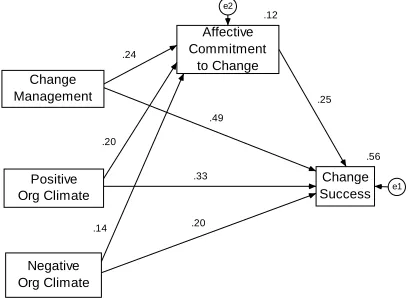
Æ Change Success was not constrained. Figure 1 displays the standardised path coefficients for the Study 1 data with only the one path (as well as the means and intercepts) not constrained to be equal to the Study 2 data. For this model, χ2 = 30.27,
df = 12, p = .003, CFI = .996, RMSEA = .02. All paths in
Figure 1 were significant indicating the Affective Commitment to Change partially mediated the influence of the other predictors on Change Success. The standardised total effects for each predictor were .55 for Change Management, .38 for Positive Organisational Climate, .25 for Affective Commitment to Change, and .23 for Negative Organisational Climate.
.56
Change Success e1 Positive
Org Climate
.33
.12
Affective Commitment
to Change
e2
.25
Negative Org Climate
Change Management
.24
.49
.20
[image:3.612.333.539.299.448.2].20 .14
Figure 1: Model of the predictors of Change Success based on Study 1 data (N = 2,549).
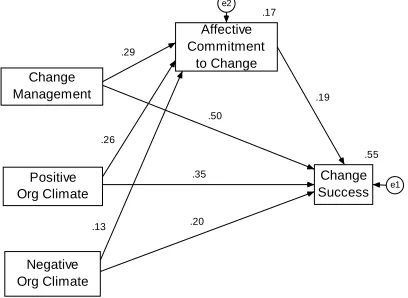
Further subgroup analysis was undertaken in order to assess whether the model would fit equally well for four main organisations that contributed data for Study 2. In this analysis, initially all the parameter estimates for the paths in the Organisation 1 subgroup (N = 655) were constrained to be equal to those for the Organisation 2 subgroup (N = 346), the Organisation 3 subgroup (N = 326), and the Organisation 4 subgroup (N = 1410). Note that means and intercepts were not constrained. While this model was also a reasonable fit to the data, significant improvements in fit were obtained when the paths from Positive Work Climate Æ Affective Commitment to Change and Change Management Æ
coefficients for one of the subgroups (Organisation 1). For this model, χ2 = 49.84,
df = 27, p = .005, CFI
= .991, RMSEA = .02. All paths in Figure 2 were
significant indicating the Affective Commitment to Change partially mediated the influence of the other predictors on Change Success for Organisation 1. The standardised total effects for each predictor were .58 for Change Management, .40 for Positive Organisational Climate, .22 for Negative Organisational Climate, and .19 for Affective Commitment to Change. In the models for the other organisations, identical results were obtained for Organisation 4, while the path from Positive Work Climate Æ Affective Commitment to Change was not significant in the model for Organisation 2, and the path from Change Management Æ Affective Commitment to Change was not significant in the model for Organisation 3.
.55
Change Success e1 Positive
Org Climate
.35
.17
Affective Commitment
to Change
e2
.19
Negative Org Climate
Change Management
.29
.50
.26
[image:4.612.96.300.268.417.2].20 .13
Figure 2: Model of the predictors of Change Success based on Organisation 1 data (N = 655).
Discussion
The results for Studies 1 and 2 support the inclusion of Change Management as well as aspects of organisational climate as important predictors of Change Success. Affective Commitment to Change plays a smaller role than both Change Management and Positive Organisational Climate in predicting Change Success while Change Management and both aspects of organisational climate were also predictors of Affective Commitment to Change. The model was tested for invariance of the path coefficients and similar results were obtained for Study 1 and Study 2. We also found that the model was similar across the four organisations in Study 2 confirming that both Change management and Positive Organisational Climate account for most of the variance in Change Success.
These results suggest that organisations will benefit the most during periods of change by investing in
specific change management strategies such as showing support for employees affected by change, clarifying employees concerns, involving employees in change-related decisions, consulting employees about the implementation of change, and providing opportunities for further training and capability development to assist employees to cope with role changes. In addition to these specific strategies, organisations also can improve the impact of change by addressing more generic aspects of the organisational climate such as provision of adequate feedback about employees’ performance, recognition of superior performance, improving teamwork, managing workload demands, and identifying individuals in need of support.
The importance of work climate was also reported by Patterson, Warr, and West (2004), who examined the influence of organisational climate on company performance. Eight aspects of climate were significantly associated with company performance in the following year, including supervisor support, concern for employee welfare, skill development, effort, innovation and flexibility, quality, performance feedback, and formalization. However, after controlling for job satisfaction, none of these climate dimensions added to the prediction of company performance, showing a complete mediation effect by job satisfaction. Interestingly, job satisfaction was highly correlated with organisational commitment (r = .88) indicating that other measures
of employee’s affect such as commitment may play a similar role to that found for job satisfaction. Patterson et al. also examined whether differences in employee level were an important factor in explaining the strength of climate-performance linkages. This was not the case with results for managers similar to those of non-managers.
Conclusion
This research has highlighted the impact of change management processes on both level of affective commitment to change and the success of organisational change. We also determined that a positive organisational climate contributes to higher affective commitment to change and greater change success. Affective reactions to work-related changes clearly have a role in explaining important change outcomes and further investigation should include the group-level effects using independent measures of group-level variables.
References
Cooper-Hakim, A., & Viswesvaran, C. (2005). The construct of work commitment: Testing an integrative framework. Psychological Bulletin, 131, 241-259.
Cotton, P. (2006). Preventing psychological injury: A report for Comcare. Canberra: Comcare.
Cotton, P., & Hart, P. M. (2003). Occupational wellbeing and performance: A review of organisational health research. Australian Journal of Psychology, 38(2), 118-127.
Cunningham, G. B. (2006). The relationships among commitment to change, coping with change, and turnover intentions. European Journal of Work and Organizational Psychology, 15(1), 29-45.
Fedor, D. B., Caldwell, S., & Herold, D. M. (2006). The effects of organizational changes on employee commitment: A multilevel investigation. Personnel Psychology, 59, 1–29.
Hart, P. M., & Cooper, C. L. (2001). Occupational stress: Toward a more integrated framework. In N. Anderson, D.S. Ones, H.K. Sinangil & C. Viswesvaran (Eds.), Handbook of industrial, work and organisational psychology (Vol 2., pp.
93-114). Sage: London.
Hart, P. M., Griffin, M. A., Wearing, A. J., & Cooper, C. L. (1996). Manual for the QPASS Survey. Brisbane: Public Sector Management
Commission.
Herscovitch, L., & Meyer, J. P. (2002). Commitment to organisational change: Extension of a Three-Component Model. Journal of Applied Psychology, 87, 474-487.
Machin, M. A. & Bannon, S. F. (2005). Australian Public Sector employees’ commitment to organisational change. In M. Katsikitis (Ed.),
Proceedings of the 40th APS Annual Conference (pp. 163-167). Melbourne, Victoria: Australian Psychological Society.
Patterson, M., Warr, P., & West, M. (2004). Organizational climate and company productivity: The role of employee affect and employee level.
Journal of Occupational and Organizational Psychology, 77, 193-216.
Rafferty, A. E., & Griffin, M. A. (2006). Perceptions of organizational change: A stress and coping perspective. Journal of Applied Psychology, 91(5),
1154-1162.