Rochester Institute of Technology
RIT Scholar Works
Theses
Thesis/Dissertation Collections
11-1-2001
Rhythm
Yi-Chia Huang
Follow this and additional works at:
http://scholarworks.rit.edu/theses
This Thesis is brought to you for free and open access by the Thesis/Dissertation Collections at RIT Scholar Works. It has been accepted for inclusion
in Theses by an authorized administrator of RIT Scholar Works. For more information, please contact
Recommended Citation
Rochester
Institute
of
Technology
A
Thesis
Submitted
to the
Faculty
of
The
College
of
Imaging
Art
and
Sciences
In
Candidacy
for
the
Degree
of
MASTER
OF FINE ARTS
RHYTHM
By
Yi-Chia
Huang
APPROVALS
Chief Advisor: Leonard Urso
Date:
~-
1;<
-:2
00:<
Associate Advisor: Mark Stanitz
Date:
Associate Advisor: Linda Hightower
Date:
c::9-j \
Q..., ) 0
~
Chairperson,
School for American Crafts: Rich Tannen
Date:
3
Jf /
0
\..-I,
hereby grant permission to the Wallace Memorial
Library of RIT to reproduce my thesis in whole or in part. Any reproduction
will not be for commercial use or profit.
Date:
2/
/6102
Table
of
Contents
Title
i
Approvals
ii
Acknowledgements
iii
List
ofIllustrations
iv
Overview.
I.
II.
Design
andInfluence
2III.
The Rhythms
Rhythm
ofVenus
4
Rhythm
ofStars
6
Rhythm
ofCorals
8
Rhythm
ofLeaves
11IV.
Conclusion
13
Acknowledgements
Sincere
appreciationis
expressedto
all whohave
contributedto
the
development
ofthis
thesis.
Special
thanks
to
Mr. Leonard
Urso,
Mr. Mark
Stanitz,
andDr. Linda Hightower
for
their
specifichelp,
encouragementand suggestions.
I
am also gratefulto
my
friend
Miss
Virginia
Martin
for
helping
withmy
thesis
writing
andMiss
Mary
Lewis
for
modeling my
jewelry
piece.My
gratitude also goes
to the
students ofRIT,
Metal
department for
their
encouragement and
keeping
me optimistic andfocused
during
my
thesis
study.
Finally,
thanks
to
my
family
in
Taiwan
for
supporting
this
greatopportunity
to
expandmy
views and pursuemy
master'sdegree
in
the
USA.
LIST OF
ILLUSTRATIONS
Fig.
lArt Nouveau
Jewelry-by
Lucien Gaillard
15
Fig.
2Art Nouveau
Jewelry-by
Henri Vever
15
Fig. 3
Rene Lalique's
Jewelry
16Fig. 4
Rene Lalique's
Jewelry
16Fig. 5
Venus
flytrap
17
Fig.
6
Venus
flytrap
...17Fig. 7
Rhythm
ofVenus-necklace
18Fig.
8
Rhythm
ofVenus-earrings
19
Fig. 9
Rhythm
ofVenus (on
model)
20Fig.
10Star
fish-sea
star 21Fig.
11Star
fish-brittle
star 21Fig.
12Rhythm
ofStars
22Fig. 13
Brain
coral23
Fig. 14
Brain
coral(Close-up)
23
Fig. 15
Rhythm
ofCorals
i-necklace24
Fig.
16Rhythm
ofCorals
l-earrings25
Fig. 17
Rhythm
ofCorals
l-brooch 26 [image:6.545.77.474.93.684.2]Fig.
18Star
coral'.
27
Fig. 19
Flower
coral27
Fig.
20Star
coral(Close-up)
27
Fig.
21Rhythm
ofCorals
2-necklace 28Fig.
22Rhythm
ofCorals
2-earrings29
Fig. 23
Rhythm
ofCorals
2-brooch 30Fig. 24
Rhythm
ofLeaves-necklace
31Fig. 25
Rhythm
ofLeaves-brooch
32Fig.
26Trumpet
pitcher plant33
OVERVIEW
I
believe
that there
is
anintegral ingredient found
among
all nature'screations,
whichexistsin
theuniverse.I
callthis
ingredient
"rhythm". I
believe
that
it
givesthe
creationsofnaturelife
by inducing
the
reactionsbetween life forms enabling
them
to
keep
growing
andliving.
In
this
thesis,
elementswill alsomeanall creations of nature.I
can alsosay
that
an elementwithout rhythmcannot
have
reactionswithothers,
nor canit
live.
Each
of aliving
form is dependent
onthe
nextone;
allelementsareinterrelated.
According
to
Oxford Reference
English
Dictionary,
"rhythm"is
defined
asA
measuredflow
of words and phrasesin
verse or prosedetermined
by
various relations of
long
and shortoraccented andunaccentedsyllables.Physical
movement with a regular successionofstrong
and weak elements.A
patternofregularly recurring
events oractions.Art,
aharmonious
correlation ofparts.For
meas anartist,
rhythm canbe felt
orseen,
not explainedby
words.Rhythm
canbe found in
movement,
such asjellyfish
swimming,
windblowing,
leaves
floating,
orin
static/motionless patterns withdifferent
arrangements of combinations ofsize, color,
shape andtexture...,
suchashoneycomb,
the
skeleton of coral.No
matterin
whatform
rhythmappears
in
nature, the
occurrence of rhythm always relatesto time.
From
the
growing
process of nature'screations,
whichcantake
along
time,
to
the
ripples onthe
surface ofwater,
whichrequire ashorttime,
rhythmis
acontinually
recurring
sequence of events.Rhythm
strengthensthe
relationship
among
naturalelements,
aswell asthe
relationship between
nature'srhythm andme.
The
rhythmI
selectfor
my
workalsopreselects me.The vitality
of rhythm enlightensmy creativity
anddraws
meto
translate that
rhythminto
artworks.In
this
thesis,
I
madeartworkthat
investigates
the
different
rhythmsof
nature as well as
the
inherent,
similar rhythmsin
nature.I
took metal,
whichis
hard,
cold,
firm,
andlifeless,
andinfused
it
withsoft,
irregular,
warm,
and organicqualities,
as well asthe
replicating moving
rhythmsDESIGN AND
INFLUENCE
In
the
spring
of2000, 1
began
a projectto
observe naturalforms
andto
makeseveral natural shapedmodels
in
copper.At
that
time,
I
learned
how
to
useahammer
asadrawing
tool
to
makebeautiful,
organic naturalelementsand
how
to
design
andfabricate
artworkby
arranging
those
shapes
together.
I
felt
very
excited aboutthe
possibility
ofhammer
forming,
because
I
knew
that I
could usethis technique
to
explorerecurrent
ideas,
whichI
have
always wantedto
achieve.This
methodcompelled me
to
begin
investigating
my
deep
interests
in
nature.In
the
course ofthis
thesis,
two
things
influenced
my
thoughtDaosim
ofmy Chinese
culturedbackground
andArt
Nouveau Jewelry. The
former
inspired
meon a spirituallevel,
andthe
latter influenced
mein
idea
development
anddesign
concept.Although
these two
arederived from
different
cultures,
both
centertheir thought
processin
nature.Daoism
has been
one ofthe
centralthoughts
in Chinese
culturefor
morethan
onethousand
years.It is
akind
of nature mysticismthat
brings
together
many
ancientChinese
ideas
regarding
humankind
andthe
universe.
Daosim
is
anintuitive
philosophy
that
emphasizesindividualism,
non-conformity,
and areturnto
nature.It
is
concerned withbringing
the
According
to
Daodejing
the
way
andits
power1A
dao is
away
or apath.The
Dao
is
the
Ultimate
Way,
the
way of
the
universe.
The
way
cannotbe
namedordescribed,
but it
canbe hinted
at.It
is
like
water.Nothing
is
moreflexible
andyielding,
yetwater can weardown
the
hardest
stone.Water
flows
downward,
seeking
the
lowest
ground. ...Torecover
the
Way,
we mustunlearn,
andwemust returnto
astate
of
nature.Daosim
sparkedmy
imagination
andhelped
meachieve adeeper
spiritualconnection withouruniverse.
This
inspiration
stimulatedthe
body
ofcreated art works and
information
containedin
this
thesis.Another
influence for
meis
Art Nouveau
Jewelry
(Fig.
l, 2)
from
the
late
19th
century.
Nature
is its
principal source ofinspiration.
Of
allArt
Nouveau
jewelers,
Rene'Lalique,
a master ofFrench
artjewelry,
inspired
me
the
most.He
introduced
materialsthat
had
neverbeen
usedbefore in
Western
jewelry,
such asivory,
glass,
horn,
tortoiseshell,
andingeniously
incorporated
them
in
his
spectacular artworks(Fig.
3,
4).Also
he
wasanexpert at
using
the
color value ofhis
chosen natural materials andcreating stunning
new combinationsin his
originaljewelry.
A
lifelong
love
of nature enabled
him
to turn
natural shapesinto
decorative
matchlessornamental
forms
withoutlosing
their
inherent
aesthetic qualities.The
jeweler
andhistorian
Henri Vever
recountedhow
Lalique
loved
nature:
"He
would spendlong
hours
contemplating
the plants,
flowers,
and
trees,
admiring
their
elegantforms,
their
variedcolor andexquisiteharmony
captivatedanddeeply
movedby
the
constantly changing
spectacle of
nature."2
Lalique's
vividimagination inspired
meto
observeand analyze natural
forms,
andconvertthem
into ideal forms.
1
Aslim volume was written
by
aDaosimphilosopher-Laozi.2
Vever
(1908),
pp.690-91. Thesequotationsin
Englisharetakenfrom
theforthcoming
THE
RHYTHMS
"Rhythmicform
cannotbe
simply
mechanicalbeat;
it
must resultfromatiming
of
change controlledby
the
unitary
qualitiesof
the
creativeact."
Ernest
Mundt
Artr Form,
andCivilization3As
mentionedin
the
last
chapter,
rhythm giveslife
to the
elements ofnature,
andexistsin
all elementsin
the
universe.It
canbe found in
movements or
in
the
growing
process.I
chosedifferent
rhythmsin
or ofnature
randomly
andcreatedthe
body
ofmy
thesis
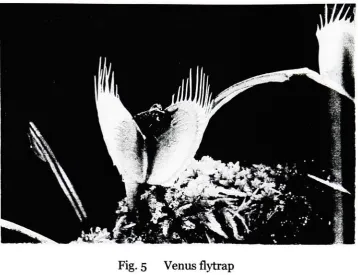
artworks.Rhythm
of
Venus
The Venus
flytrap
(Fig.
5,
6)
is
a rareinsectivorous
plant,
which attractsflies
and otherinsects
to
its
inner
leaf lobes
andthen
closes andimprisons
them.
The
plantdigests its
prey
andthen
re-opens againto
setits
trap.
In
orderto
researchthe
Venus'flytrap,
I
bought
onefrom
the
local
hardware
storefor
daily
observation.It
is
quitesmall,
andit is
really
adelicate
creature.It
consists oftwo reddish,
kidney-shaped
leaf
lobes,
andthe
edge of eachlobe is fringed
with a numbers of spikes.It
growsin
amixtureofpeatand sphagnum moss
very
well,
andgets extra nutritionfrom its
prey.It
wasamazing
to
observehow
aVenus
flytrap
growsandhow it
snapsits
two
lobes
together to
catchthe
insect.
This
spectacularscene
that takes
just
athird
of asecondreally impressed
me.I
wastouched
by
the
rhythminherent in its
unique shapes andmovements,
andbegan
to
design
andannotatemy
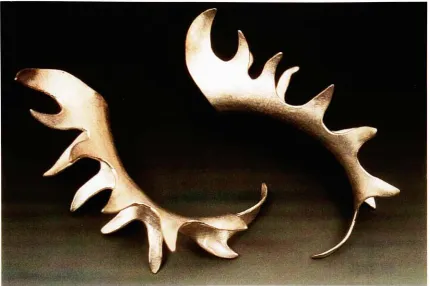
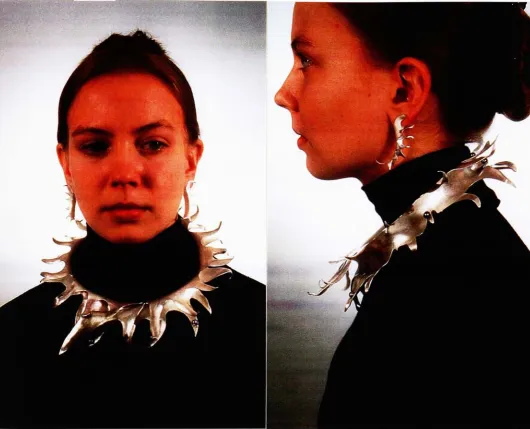
workRhythm of Venus
(Fig.
7,
8,
9).The
workis
a setofjewelry
withone necklace andone pair of earrings.The
piecesweremadeby forming
flat
silversheets.Two
formed
silverparts
hinged
together
withblack
pearls onthem
composethe
necklace.The
surfaceofthe
silveris
matte,
because
ahighly
polished metal surfacewouldcompetewith
the
dynamic
shapeandform.
In
orderto
expressthe
movement, I
overstated and exaggeratedthe
shape.The
purposeofusing black
pearlsis
notonly
to
enhancethe
visual effectbut
alsoto
indicate
the
ability
to
trap
prey
ofVenus'
flytrap.
The
variouspositionsof
the
spikes representthe movement,
whichmay
occur whenthe
" insects"(pearls)
land in
them.
The
piecefreeze-stops
that
splitsecond of
catching
the
insect
and showsthe
danger
which existsin
this
rhythmic
form.
Making
the
hinge
andclasp
for
the
necklace was a challengefor
me.However,
it
focused
my
attention onthe
functional
aspect ofthe
jewelry
piece.
After
successfully completing
the
Venus'flytrap
jewelry
series,
I
realizethat
to
be
agooddesigner
requires soundengineering
skills.This
Rhythm
of
Stars
"Rhythm
relatesto
movement,
as movement relatesto
change andchange
is
the
essenceof
atime
of
transition
suchasthe
present."
Ernest Mundt
Art.
Form,
andCivilization4Speaking
ofstars, the
first image
that
comesto
people's minds willnormally
be
the
starsin
the
sky.Stars
arebeautiful,
shiny,
andtheir
radiance
inspires
many
peopleto
imagine
their
shapes as pentagons.Although this
impression is
notreality,
thereare real"star
shapes"
under
the sea,
called starfish.Pentagonal
shapes are unusualin
nature,
andthe
starfish
is
one creaturethat
has
thisfeature.
These
pentagonalforms
sparked
my curiosity
aboutthis
special creature.There
arehundreds
of starfishin
the world,
andmostofthem
arepentagonal
in
shape withfive
arms.They
aredivided into
the
following
orders:
feather
stars,
seastars,
brittle
stars andbasket
stars.Most
ofthem
are
brightly-colored
andhave
incredibly
beautiful
surfaces andfine
structure.
The
most common of allstarfish,
seastars(Fig.
10),
have
five-pointsand are star shaped.
Brittle
stars(Fig.
11)
andbasket
starsaregraceful,
agilerelativesofthe
sluggishsea star.The
disk
andarms ofbrittle
stars are welldemarcated,
andthe
brittle
stars owetheir
nameto
aself-protecting
reflexfor
voluntarily
breaking
their
arms whenapredatorattacks
them.
The brittle
starshave
aflattened,
circularor pentagonalbody,
calledthe
disk,
withfive
very
slenderflexible jointed
arms whichtaper
gradually
toward the tip.
They
usetheir
armsskillfully
to
moverapidly,
just like
a gracefuldancer
underthe
sea.The
uniqueshape,
surface,
andmovementofthe
starfish reveal perfectrhythms and givethis
creature
life.
Transforming
this
complex rhythminto
a singlemetalform was achallenge.
The
characteristicsofstarfish,
suchastheir color,
texture,
anddance-like
movement,
areallessential elementsin
the
vitality
oftheir
rhythm.
My
starfishinspired
workis
entitledRhythm ofStars (Fig.
12).It
is
anecklace
consisting
ofvarying
sizes offormed
pentagonal shapes withdifferent
textures,
which arehinged
to
each other.A
silver woven chainconnectsthese
forms from
onesideto
another with a pair of pearlhinges.
The
pentagonalbody
ofthe
sea staris
aflawless form
andits
contourimparts
a sense of rhythmin
the
spacing
and movement ofthe
arms.I
repeated and arranged
these
pentagonal shapesto
representthe
continuousmovementmade
by
starfish.The
flexible,
tapered
wovenchain was
inspired
by
the
brittle
stars'slimarms.
The
chaincreatesarhythm
that
flows
through the
entire piece and completesthe
work as anintegrated
concept.Different
textures
on each pentagon were madeby
roll
printing
and chasing.The
textures
expressedthe
body
construction ofthe
individual
starfish.The
use of copper and silver addsmorecolorto
this
piece and strengthensthe
visionalrhythmin
the
work.I
usedanumber of
hinges
in
this
pieceto
allowthis
necklaceto move,
sothe
rhythm
becomes
time-based
as well as visual.As
Ernest
Mundt
notes,"Rhythmrelatesto movement,
asmovementrelates
to
change"(n6).Rhythm ofStars
is
based
uponthe
unique shapesand
the
elegantmovement of starfish.The
pentagonalforms
andthe
wovenchain
that
they
connect worktogether
to
produceafeeling
ofthe
ocean,
as wellasthe
feeling
of actual starfish.The
red color ofthe
copperand
the
brightness
ofthe
silverinteract,
creating
the
illusion
ofdripping
Rhythm
ofCorals
Another
jewelry
series ofseaforms
wasbased
onthe
reef coral.The
corals arebeautiful
and spectacular animals ofthe tropical
seas.For
me,
as a girlgrowing
up
on atropical
island,
they
undoubtedly
have been
my
favorite
ocean
life
since childhood.The
beautiful
white coralsthat
aresoldfor
ornamentsin
curioshopsbear
little
resemblanceto
the
living
green,
gold and orangecorals;
they
aremerely
the
bleached
skeletons oftheir
former
selves.The
creature,
whichforms
the skeletons,
is
an animalvery
low in
the
scale of evolution andis
very
similarin
generalstructureto
a seaanemone.5In
its
purestform,
the
coralis
the
skeletonofasimple anemone-likecreatureknown
as apolyp.
A
coral reefis
notoneindividual
creature,
but
acolony
ofhundreds
oftiny
polypsbuilt
up
onthe
skeletons of previousgenerations.An
actual coralpolyp
is
almosttoo
smallto
see.Its
beauty
lies in
the
cumulative effectoftexture
built
up
by
the
skeletons ofmany
individuals.
Many
small unitsforms
the
structureofcorals;
it
appearsto
be
an arrangementof similar shapes.I
divided
these
shapesinto
severalsections,
andinvestigated
forms
that
represent sectional parts of a reef coral.By
repeating
andarranging
numbersofthese shapes,
I
wasableto
replicate
the
rhythmof and rhythm withinthe
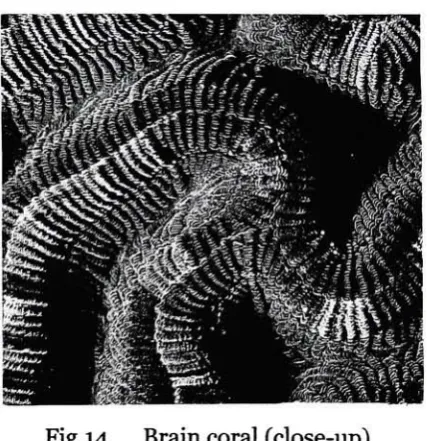
corals.Brain
coral(Fig.
13, 14)
inspired
meto
createRhythm of
Corals
1(Fig.
15,
16,
17).Structural
patternsofthe
brain
coralresemblethe
meandering
pathways of
the
human brain.
Unlike
arealbrain,
the
coral'sonly
living
parts areon
the
surface.The colony
growsby budding
anddividing
untilhuge
boulders
areformed.
Rhythm of
Corals
lis
ajewelry
set,
whichincludes
anecklace,
2pairs ofearrings,
and abrooch.
For
the
necklace,
sterling
silverand 18K
Bl-metal
were utilized
to
makethe shapesandthey
werethen
connected withhinges
and a clasp.The
jewelry
began
asirregular
wavy-edgedstrips,
whichwere
formed
by hammering
forms,
andthen their
surfaces werechased.
These
hammered forms
graduatedfrom
the
largest in
thecenterto
the
smallestat either end ofthe
necklace.The
hinges
allowfunctional
movement;
I
wantthe
necklaceto
comfortably
sit onthe
wearer'sbody
just
asthe
coralpolypsgrowsmoothly
ontheir
own skeletons.Rhythm ofCorals
2(Fig.
21,
22,
23)
is
another pieceinspired
by
thecorals.
There
aremany
different kinds
ofcorals,
but
the
two that
influenced
meto
createthis
work are star coral andflower
coral(Fig.
18,
19,
20).Different than
brain
coral, their
structural patternis
composed ofmillions of
rhythmically
arranged circular units.The
polypsofthis
distinctive
coralform build
up
star-likepatternscovering
the
surface.For
Rhythm
ofCorals 2, I
developed
concaveovalbeads
with continuousopenslitsaround
the
rim.
Similar
to
Rhythm ofCorals 1, 1
arrangedthese
forms
to
create a series ofjewelry.
The Rhythm ofCorals
2-necklace consists of
different
sizedbead forms.
A
tapered
silver wireis
threaded through
the
beads
and ends withtwo
smallerbeads
at each endof
the
wire.I
exploreddifferent
waysto
representthese
bead
forms,
andI
found
that
the
same shapes might createdifferent
visualeffectsin
different
positions.In
the
Rhythm ofCorals
2-necklace(Fig.21),
I
mountedthe
bead
unitsvertically
with narrowslitsfacing
outward.All
ofthe
beads
areshiny
Because
the
slitsareplacedin
opposing
andalternating
directions, they
give
the
visual sensationofundulating
waves.The
earrings andthe
brooch
(Fig.22,23)
emphasizethe
concave surface ofthe
beads,
whichresting
horizontally
onthe
earsandthe
chest.These
concave surfaces ofthe
beads
are asoft, matte, textured
silverfinish.
This
work capturesthe
lush,
soothing,
rocking
rhythmofthe
sea.It is
the
arrangement ofelementsand
shapes,
which createsdifferent
rhythmsthrough
outthis
samecollection.
In
the
Rhythm
ofCorals
series, I
developed
another styleofexpressing
rhythm
in
my
work.Rhythm
always relatesto repetition;
therefore,
I
created single
units,
andtried to
combine andrepeatthem
in
variouscombinations,
sizes orcolors.This
effectstrongly
represents rhythmicforms
and rhythmin
nature.As
I
madethis work,
I
realizedthat
I
workedin
a measured andtime-based
way.Perhaps
the
rhythmofmy
owncreative process and work-pace
is really
whatI
hoped
to
discover.
Rhvthm
ofLeaves
Leaves
areamong
the
most common naturalelementsthat
surround us.In
additionto
coloring
ourworld,
they
alsoplay
aninvaluable
rolein
ourliving
environmentby
producing
oxygenthrough
the
processofphotosynthesis.
Since
ancienttimes,
leaves have inspired
countlessWestern
andAsian
artiststo
create realistic or abstract works.Leaves
areamong
the
simplest yet complex plant-lifefound in
nature.They
are multi-shaped."Some
areslender, smooth,
andelegant;
othersare
stubby
andthick.
Some
have
edgeslike
raggedteeth;
others arelike
thepaw print of a
large
animal.They
may
be
pointed orrounded,
andto
add
to
theprofusionthey
arearrangedin
avariety
of ways onthe
plant.They
may
occurin
pairs,
ortwisted
like
a spiral staircase aroundthe
stem."6
Each
species ofleaf has
auniqueshape,
arrangement and veining.For
me,
the
mostinteresting
partaboutleaves
is
their
arrangement,
whichis
oneof
the
characteristics usedfor
the
identification
ofthe
plant.Arrangement
means
how
the
leaves
are connectedto
thebranch.
According
to
Phyllotary7,
someleaves branch
alternately
out ofthe
stem and areneveropposite each
other;
someleaves
always grow opposite each other onthe
stem;
someleaves
are arrangedin
a whorl orin
spirals.8The
rationalebehind
this
is because
oflight
andspace;
oneleaf
will notshadethe
leaf
below it for
growing
purposes.As
Day
notes,
"Leaves
occur ontheir
stalksat orderedintervals,
but
their
distance
apartis
notmathematically
measured;
they
grow,
and witha6
Prance
[1984],
p.5 7The studyof
leaf
arrangement ontheplant 8ibid.,
p.6variety
andgo,
whichlooks
asif
they
had
something
like
awill oftheir
own".9
The
vitality
ofleaves drives
them to
growin
a certainway
onenext
to the
otheror onecradling
the
other.This
arrangement provides apotent sense ofrhythm.
In
orderto
presentthe
beautiful
rhythm ofleaves,
I
made several assortedleaf
forms,
andcombinedthem
in
different
arrangements andorientationsto
create a necklace with an attached pendant and abrooch
(Fig. 24,
25).The
pendantconsistsof sixleaf
shapesmadeofsilver,
Bl-metal,
andcopper which
overlap
and areheld
together
attheir
stem.Two
bigger,
curvedpiecesof
sterling
silver whichform
the
necklace are exaggeratedleaf
shapes and are connectedtogether.
One
side ofthe
necklace curvesat
the
endlike
atendril
andacts as ahook
to
clasp
the
pendent.The
pendant represents
the
rhythmicgrowing
process,
the arrangement,
andthe vitality
ofleaves.
In
thispendantlike
nature,
eachleaf
growssoit
willnot shade
the
others.The
rhythm revealedby
the
leaf
shapes and shapeplacement of
this
jewelry
piece create aharmonious
relationship
similarto
what
is
actually
found
in
nature.'Day
[1910],
p.92CONCLUSION
This
thesis
is
apersonal explorationofdifferent
rhythmsthat
appearin
nature as well as
inherent,
similarrhythmsinspired
from
nature.In
the
courseof
the
thesis,
I
have been
challengedby
the relationship
between
rhythms and
my
works.I
have
to
stressthat
I
have
notcompletely
resolved
the
rhythmsthat
affectmy
creations,
andI
amnot certainthat
I
willever
be
ableto
do
this.
However,
it may
be
a part ofmy
continuing
creative work.
This
thesis
helped
meto
realizemany
things,
whichI
took
for
granted,
andled
meto
investigate
those
ideas
which reoccurin
my
mind.At
the
final
stage of
developing
this
thesis,
I
createdmy
workRhythm of
Pitchers (Fig.
27),
which wasinspired
by
the trumpet
pitcher(Fig.
26).Rhythm
of
Pitchers is
a sculptural andinstallation
work.This
piece canbe
presentedin different
ways andin
different
positions.In my
thesis proposal,
I
didn't
limit
myselfto
only creating
jewelry
pieces.As
a sculptor anddesigner,
I
wouldlike
to
try
to
develop
thesameideas into
non-functionalart works and
functional
art pieces.Although
I
didn't include
Rhythm of
Pitchers
in
my
thesis
show,
I
believe it is
animportant
piecefor
the
development
ofmy
work.I
can pictureit
as a springboardfor
one ofmy
future
creations.After
creating
andachieving
allmy
goals, I
found
that
graduateschoolprovided me with
the time
to explore, to grow,
andto
expressmyselfin
art.It
is
an unusual experience and a greatfeeling
to
accomplishthese
goals.The completing
ofmy
thesis
does
not meanit is
anending
for
my
investigation.
Natural
rhythms continueto
surroundme.These
opulentrhythmsof nature compel me
to
continuetranslating
them
into
my
worksof art.
Bibliography
Amos,
William H.
andStephen
H. Amos.
Atlantic
& Gulf
Coasts. New
York: Alfred A.
Knopf, Inc.,
1921Attenborough,
David. The Private Life
ofPlants.
New Jersey: Princeton
University,
1995
Day,
Lewis F. Nature
andOrnament
I. New York: B.T.
Batsford, London,
1909
.Natureand
Ornament II.
New York: B.T.
Batsford, London,
1909
Falk,
Fritz.
Schmuck-Kunst im
JugendstilArt Nouveau Jewellery.
Europe:
Arnoldsche,
1999
Handler,
G.,
J. E.
Miller,
D. Pawson
andP.
M. Kier.
Sea Stars. Sea Urchins.
andSea
Allies.
Washington
andLondon: Smithsonian
institution,
1995
Meinkoth,
Norman A.
The
Audubon
Society
Field
Guide
to
North
American
Seashore Creatures.
New York: Alfred A.
Knopf, Inc.,
1981Mundt,
Ernest.
Art. Form,
andCivilization.
Berkeley
andLos
Angeles:
University
ofCalifornia,
1952Smith,
Walton F.
G.
Atlantic Reef Corals. Florida:
University
ofMaimi,
1971
Prance,
Ghillean
Tolmie.
Leaves.
New
York:
Crown
Publishers,
Inc.,
1985
Sefton,
Nancy
andSteven
K. Webster.
A
Field
Guide
to
Caribbean Reef
Invertebrates.
California: E. J.
Brill
Leiden,
1986Fig.
lArt Nouveau
Jewelry-By
Lucien
Gaillard
Fig.
2Art Nouveau
Jewelry-By
Henri Vever
[image:22.545.84.432.89.632.2]Fig. 3
Rene Lalique's
Jewelry
Fig.4
Rene
Lalique's
Jewelry
[image:23.545.109.353.67.655.2]Fig. 5
Venus
flytrap
Fig.
6
Venus
flytrap
[image:24.545.87.446.57.332.2]Fig. 7
Rhythm
ofVenus
-necklace [image:25.545.115.366.132.530.2]Fig.
8
Rhythm
ofVenus
-earrings [image:26.545.58.489.188.474.2]Fig.
9
Rhythm
ofVenus
(on
model)
[image:27.545.8.539.113.542.2]Fig.
10Star
fish-sea
star%
\
V
#*%.r'
^!!w*gB -yy.
[
*.:ryms^
\
"^
\^#
/
->>
^i^l!
V*
pus
|r
#
^
1
is
^0gl0%
Fig.
nStar
fish-brittle
star [image:28.545.99.445.92.315.2] [image:28.545.89.448.157.623.2]Fig.12
Rhythm
ofStars
[image:29.545.110.397.114.566.2]Fig. 13
Brain
coralFig. 14
Brain
coral(close-up)
[image:30.545.114.356.146.317.2] [image:30.545.132.346.425.646.2]Fig.15
Rhythm
ofCorals
l-necklace [image:31.545.108.392.114.554.2]Fig.16
Rhythm
ofCorals
i-earrings [image:32.545.59.489.186.471.2]Fig.17
Rhythm
ofCorals
l-brooch [image:33.545.60.491.192.477.2]Fig.18
Star
coralFig.
19
Flower
coralit '*
Fig.20
Star
coral(close-up)
[image:34.545.46.267.100.330.2] [image:34.545.331.503.146.307.2] [image:34.545.194.396.452.630.2]4
41
\
1
^V . .N
\ :.'
--y |
f
'
>
-it*
Fig.2i
Rhythm
ofCorals
2-necklace
[image:35.545.73.474.205.463.2]Fig.22
Rhythm
ofCorals
2-earrings [image:36.545.61.489.185.475.2]Fig.23
Rhythm
ofCorals
2-brooch
[image:37.545.60.489.189.472.2]Fig.24
Rhythm
ofLeaves-necklace
[image:38.545.115.367.131.525.2]Fig.25
Rhythm
ofLeaves
-brooch [image:39.545.106.392.112.553.2]Fig.26
Trumpet
pitcher plant [image:40.545.97.431.90.542.2]Fig.27
Rhythm
ofPitcher
[image:41.545.61.489.190.441.2]