Data Allocation for Achieving Perfect Secrecy
in Multiple Clouds using Optimal Coding
Deepa R. Nalage, Prof. Prashant Mane
M. E Student, Department of Computer Engineering, Zeal College of Engineering and Research, Pune, India
Professor, Department of Computer Engineering, Zeal College of Engineering and Research, Pune, India
ABSTRACT: For a client to store information in the cloud, utilizing administrations gave by different distributed storage suppliers is a promising way to deal with increment the level of information accessibility furthermore, classification, as it is impossible that diverse CSPs are out of administration in the meantime or plot with each other to concentrate data of a client. This paper researches the issue of putting away information dependably and safely in different CSPs
Obliged by given spending plans with least cost. Past works, with varieties in issue definitions, commonly handle the issue by decoupling it into sub-issues and explain them independently. While such a decoupling methodology is straightforward, the resultant arrangement is problematic. This paper is the first which considers the issue all in all and determines a together ideal coding and capacity portion plan, which accomplishes great secrecy with least cost. The analytical result uncovers that the optimal coding plan is the nested maximum-distance-separable code and the ideal measure of information to be put away in the CSPs displays a specific structure.
KEYWORDS: Cloud storage, perfect secrecy, information theoretic security, storage allocation.
I. INTRODUCTION
solutions to point the safety of cloud computing, as well as probing their restrictions. Current proposals for future work. NIST defines cloud computing as “a model for allowing appropriate, on-demand network access to a shared pool of configurable computing assets (e.g., networks, storage, servers, services and applications) that can be quickly provisioned and released with nominal management strength or service provider interface”. This model consists of five features, three distribution models, and four arrangement models. The five key features of cloud computing are: on-demand self-service, location independent supply pooling, broad complex access, quick elasticity, and measured service.
II. LITERATURE SURVEY
No Paper Name Author Name Proposed System Referred Point
1. A View of
Cloud Computing
Michael Armbrust, Armando Fox, Rean Griffith, Anthony D. Joseph, Randy Katz,
In this paper to reduce
that confusion by
clarifying
terms, providing
simple figures to
quantify comparisons between
of cloud and
conventional
Computing, and
identifying the top
technical and
non-technical obstacles and opportunities of Cloud Computing.
1. In this Paper
we have
referred the
solution On
Cloud Computing Storage.
2. SeDaSC: Secure
Data Sharing in Clouds
Mazhar Ali, Athanasios V. Vasilakos We proposed the
SeDaSC methodology, which is a cloud
storage security
scheme for group data.
The proposed
methodology
provides data
confidentiality, secure data sharing without
reencryption, access
control for malicious insiders, and
forward and backward access control.
1. In this paper,
we have
referred the
solution for
Methodology proposedsecu res the data against insider threats
among a
groupof users.
3. Wireless
Device-to-Device
Communications with Distributed Caching
NeginGolrezaei, Alexandros G. Dimakis, Andreas F. Molisch we identify the best
possible scaling in the
number of D2D
collaborating links.
Surprisingly, a very simple
distributed caching
policy achieves the
1. In this Paper,
we have
referred the
solution our proposed algorithm has
low time
optimal scaling behavior
and therefore there is no need to centrally coordinate what each node is caching.
can be
applied to
systems involving large number of
storagenodes.
2. Apart from
the
multi-cloud storage scenario, our workmay also find
applications
to other
DSSs, such as wireless device-to-devicesystem
s as the
capacitiesof
the storage
nodes in
these systems are different.
4. A Secured Cost
Effective Multi-Cloud Storage in Cloud
Computing
Prof.V.N.Dhawas,PranaliJuikar,NehaPatekar,NehaLendghar,Susha ntVartak
In this paper, we
propose a secured
cost-effective multi-cloud
storage model in cloud computing which holds
an economical
distribution of data
among the available Service Providers in the market, to provide customers with data availability as well as secure storage.
1. In this paper,
we have
referred the
solution our
proposed a
secured cost-effective
multi cloud
storage in
cloud computing.
5. Communication
theory of
secrecy systems
C. E. Shannon In this paper a theory
of secrecy systems
is developed. The
approach is on a
theoretical level and is
intended to
complement
the treatment found in
standard works on
cryptography.
1. In this paper,
we have
referred the
6. A Comparative
Survey on
Availability and Integrity
Verification in
Multi-Cloud
Ms.V.Mangaiyarkkarasiand Mr.K.A.Dhamodaran This survey paper
provides overview
about
various Provable Data Possession techniques in cloud..
1. In this Paper,
we have
referred the
solution of variousavaila
bility and
integrity verification schemes and itsmethodolo
gy are
classified
along with
their adaptation tosingle/multi cloud environment.
7. Cloud
Computing Security Using Shamir’s Secret Sharing
Algorithm From Single Cloud To Multi Cloud
Monica G. Charate1, Dr. Savita R. Bhosale This paper is carried
out to design single and multi-cloud using
secret key sharing
algorithm which will result in
deduction of the cost
for the physical
infrastructure, reducing the cost entry and execution as well as the
response time for
various associated
applications.
1. In this paper,
we have
referred the
solution for
performance
of the
Shamir’s secret sharing
scheme, is
used in a
multicloud environment.
8. CloudCmp:
Comparing
Public Cloud
Providers
AngLi,Xiaowei Yang In this paper, this work
presents the first tool, CloudCmp,
to systematically
compare the
performance and cost of cloud
providers along
dimensions that matter to customers.
1. In this Paper,
we have
referred the
solution for
the
best-performing provider for their
applications.
9. On the
Impossibility of Cryptography
Alone for
Privacy-Preserving Cloud Computing
Marten van Dijk, Ari Juels Cryptography
is an oft-touted
remedy. Among its
most powerful
primitives
is fully homomorphic
encryption (FHE),
dubbed by some the
1. In this Paper ,
we have
referred the
solution formally
define a
III. EXISTING SYSTEM APPROACH
In that system Cloud is Single which at created time cloud are not accessible and cost are very high. mainly In cloud is single means if at certain time cloud are no accessible. This paper is the first one which considers the problem as a whole and derives a jointly optimal coding and storage allocation scheme, which achieves perfect secrecy with minimum cost.
Disadvantages:- 1.Data Integrity. 2.Security are less.
3.Single cloud are not accessible at that time Data are loss. 4.Data losses condition.
field’s and recently realized as a fully functional construct with seeming promise for cloud privacy.
classesof private cloud applications, and show that no
cryptographic protocolcan implement those classes where data is shared among clients.
10. Secure and
Reliable Cloud
Security from
Single to Multi Clouds
AdlaShekhar, JanapatiVenkata Krishna This paper studies
recent investigation
related to
single and multi-cloud security and addresses . It is found that the investigation into the use of
multi-cloud service
providers to keep
security has received less attention from the study community than has the use
of single clouds. This effort aims to help the use of multiclouds due to its capability to reduce security threats that
move the cloud
computing user.
1. In this Paper,
we have
referred the
solution We
have to
support migration to multi-clouds
due to
itsskills to
reduce safety
risks that
affect the
IV. PROPOSED SYSTEM APPROACH
In this proposed system Shamir’s secret sharing algorithm is extremely effective for storing the client data securely. It provides authentication to clients and also provide security by encryption and decryption using secret key. Our proposed system can be enhanced by providing effective security by using stronger encryption algorithm. It also provides fast service to store data on server. It also giving proof of integrity of the data to client. This scheme reduce storage overhead of the customer by compressing the data and reduce computational overhead of the cloud storage server.
Advantages:- 1. Data Integrity 2. Service Availability.
3. The user runs custom applications using the service provider’s resources
4. Cloud service providers should ensure the security of their customers‟ data and should be responsible if any
security risk affects their customers‟ service infrastructure
V. SYSTEM ARCHITECTURE
Fig No 01 System Architecture
Client
Security Sharing Algorithm and Kay Generater
Cloud 1 Cloud 2 Cloud 3
Service Provider
Cloud Owner
VI. ALGORITHM USED
1. Fragment Algorithm
Considering the existing massive volumes of data processed nowadays and the distributed nature of many organizations, there is no doubt how vital the need is for distributed database systems. In such systems, the response time to a transaction or a query is highly affected by the distribution design of the database system, particularly its
methods for fragmentation, replication, and allocation data fragmentation is a phenomenon in which storage space is
used inefficiently, reducing capacity or performance and often both.
Algorithm for fragmentation:
1. file is to be split go to step 2
2. Input source path, destination path, Source File, no.of fragments 3. Nof= no.of fragments
3. Size= size of source file 4. Fragments=size/Nof 10.End
Purpose :Splits the file into number of block.
2. RSA Algorithm
RSA is an algorithm used by modern computers to encrypt and decrypt messages. It is an asymmetric cryptographic algorithm. Asymmetric means that there are two different keys. This is also called public key cryptography, because one of them can be given to everyone. RSA was first described in 1977 by Ron Rivest, Adi Shamir and Leonard Adleman of the Massachusetts Institute of Technology. Public-key cryptography, also known as asymmetric cryptography, uses two different but mathematically linked keys, one public and one private. The public key can be shared with everyone, whereas the private key must be kept secret. In RSA cryptography, both the public and the private keys can encrypt a message; the opposite key from the one used to encrypt a message is used to decrypt it.
1. Choose p = 3 and q = 11
2. Compute n = p * q = 3 * 11 = 33
3. Compute φ(n) = (p - 1) * (q - 1) = 2 * 10 = 20
4. Choose e such that 1 < e <φ(n) and e and n are coprime. Let e = 7
5. Compute a value for d such that (d * e) % φ(n) = 1. One solution is d = 3 [(3 * 7) % 20 = 1]
6. Public key is (e, n) => (7, 33) 7. Private key is (d, n) => (3, 33)
8. The encryption of m = 2 is c = 27 % 33 = 29
9. The decryption of c = 29 is m = 293 % 33 = 2
3. Secret sharing Algorithm
• Goal is to divide some data D (e.g., the safe combination) into n pieces D1,D2….Dn in such a way that: – Knowledge of any k or more D pieces makes D easily computable.
– Knowledge of any k -1 or fewer pieces leaves D completely undetermined (in the sense that all its possible values are equally likely).
• This scheme is called (k,n) threshold scheme. If k=n then all participants are required together to reconstruct the secret.
• Choose at random (k-1) coefficients a1,a2,a3…ak-1 , and let S be the a0
• Suppose we want to use (k,n) threshold scheme to share our secret S where k < n. • Construct n points (i,f(i)) where i=1,2…..n
• Given any subset of k of these pairs, we can find the coefficients of the polynomial by interpolation, and then evaluate a0=S , which is the secret.
Shamir's Secret Sharing is an algorithm in cryptography created by Adi Shamir. It is a form of secret sharing, where a secret is divided into parts, giving each participant its own unique part, where some of the parts or all of them are needed in order to reconstruct the secret.
• Let S=1234
• n=6 and k=3 and obtain random integers a1=166 and a2=94
• Secret share points
(1,1494),(2,1942)(3,2598)(4,3402)(5,4414)(6,5614)
• We give each participant a different single point (both x and f(x) ).
VII. PERFORMANCES MEASUREMENT
1: Confidentiality - Outsourced information has to be protected from users which are not allowed access, the CSP. 2: Integrity - Outsourced data must keep undamaged on cloud servers. Authorized users and the information owner should be empowered to recognize information corruption.
3: Access control – Authorized users only have to be permitted to gain access to the information that was outsourced. 4: The defense of CSP - The CSP has to be safeguarded against fake accusations that could be stated by owner/users that were dishonest, and this type of malicious conduct is needed to be disclosed.
VIII. MATHEMATICAL MODEL
X=(x1,x2,x3,x4……….xB)
Here B block of data
H(x)=B log2 q bits.
Let N be the number of available CSPs for the user to store data. Before storing the file, the user encodes the B blocks
of data into n blocks. We use
: B
=Fn
which maps x into y, to denote the encoding function
y=(y1,y2,y3,……….yn)
for i=1,2,3………N
here N is sub-vectors
let yi=(yi,1,yi,2,………..yi,ni) € Fni
Be the data stored on CSP(Cloud Services provider)
n=∑ I (1)
n= total number of encoded block
∑ I =sum of Number of Encoded block stored in each CSp.
Let,
Vi for i € N be the amount of blocks which can be downloaded from CSP i within a predefined time delay, it is
required that
In this work we assume Vi ’s are integers, Vi ≥ 1 and distinct for i ∈N. We call Vithe budget of the stored data on CSP i. Let Cibe the cost for storing one block of data on CSP i and Ci’s are all distinct. The total storage cost is given by
C=∑ ini (3)
H(x|y(S)) =0, ∀ ∩k N (4)
The Above bound on H(x) holds for any S ∩k N and any T is a subset of S.
Therefore (5) can be re-written as
H(x)≤log2 q min(∑ i-∑ i) (5)
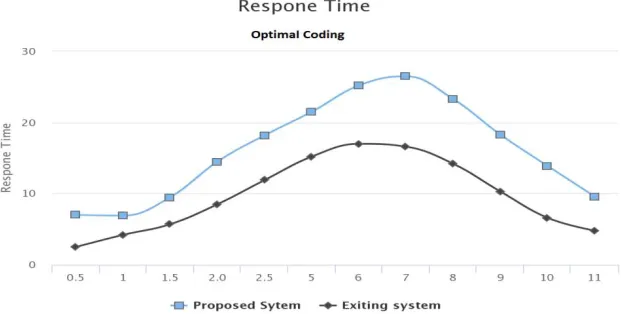
Fig No 02 Comparison of Existing and Proposed System
IX. CONCLUSION
In this paper, we research the minimization of capacity taken a toll when the client stores its information in different untruthful what's more, temperamental mists. We give a lower bound on the expense what's more; present a coding plan that can accomplish this bound. This ideal plan can be comprehended through two-dimensional seek, which has low computational multifaceted nature. Since the computational multifaceted nature is low, the outcome is additionally relevant to extensive scale stockpiling frameworks.
REFERENCES
[1] Ping Hu, Chi Wan Sung “Optimal Coding and Allocation for Perfect Secrecy in Multiple Clouds” IEEE TRANSACTIONS ON INFORMATION FORENSICS AND SECURITY, VOL. 11, NO. 2, FEBRUARY 2016
[2] M. Armbrustet al., “A view of cloud computing,” Commun. ACM, vol. 53, no. 4, pp. 50–58, Apr. 2010.
[3] Mazhar Ali, Athanasios V. Vasilakos,“SeDaSC: Secure Data Sharing in Clouds”, Fellow IEEE Syst. J.,to be published, doi:10.1109/JSYST.2014.2379646.
[4] NeginGolrezaei, Alexandros G. Dimakis, Andreas F. Molisch,” Wireless Device-to-Device Communications with Distributed Caching”, 2012 IEEE.
[5] Prof.V.N.Dhawas,PranaliJuikar,NehaPatekar,NehaLendghar,SushantVartak,” A Secured Cost Effective Multi-Cloud Storage in Cloud Computing”, Volume 4, Issue 5, May-2013.
[7] Ms.V.Mangaiyarkkarasiand Mr.K.A.Dhamodaran,” A Comparative Survey on Availability and Integrity Verification in Multi-Cloud”, Volume 1, Issue 10, December 2012.
[8] Monica G. Charate1, Dr. Savita R. Bhosale,” Cloud Computing Security Using Shamir’s Secret Sharing Algorithm From Single Cloud To Multi Cloud”, Volume No 03, Special Issue No. 01, April 2015.
[9]AngLi,Xiaowei Yang ,”CloudCmp: Comparing Public Cloud Providers”, November 1–3, 2010, Melbourne, Australia.