City, University of London Institutional Repository
Citation
:
Fahey, E. ORCID: 0000-0003-2603-5300 (2018). The Global Dimension of theEU’s AFSJ: On Internal Transparency and External Practice. New York, USA: NYU Jean Monnet Centre.
This is the accepted version of the paper.
This version of the publication may differ from the final published
version.
Permanent repository link: http://openaccess.city.ac.uk/21170/
Link to published version
:
Copyright and reuse:
City Research Online aims to make research
outputs of City, University of London available to a wider audience.
Copyright and Moral Rights remain with the author(s) and/or copyright
holders. URLs from City Research Online may be freely distributed and
linked to.
City Research Online: http://openaccess.city.ac.uk/ [email protected]
T
HE
J
EAN
M
ONNET
P
ROGRAM
J.H.H. Weiler, Director Gráinne de Burca, Director
Jean Monnet Working Paper 4/18
Elaine Fahey
THE GLOBAL DIMENSION OF THE EU’S AFSJ:
ON INTERNAL TRANSPARENCY AND EXTERNAL PRACTICE
NYU School of Law • New York, NY 10011 The Jean Monnet Working Paper Series can be found at
All rights reserved.
No part of this paper may be reproduced in any form without permission of the author.
ISSN 2161-0320 (online) Copy Editor: Danielle Leeds Kim
© Elaine Fahey2018
New York University School of Law New York, NY 10011
USA
Publications in the Series should be cited as:
TRANSPARENCY AND EXTERNAL PRACTICE
Elaine Fahey*
ABSTRACT
The ‘global’ forms an increasingly regular, active and explicit part of the daily business of the EU. The paper argues that there is a specific mismatch between the commitment to transparency on a daily level in international and external fields and practices of EU law and the actual substantive law-making practice evolving. While the EU’s vision of the global is to a degree the most transparent ever, the converse is not necessarily the case as to its legal content. The global dimension to EU law has increasingly expansive subjects and objectives, in areas of existing strength in global actorness (e.g. trade) and in more evolving competences (e.g. security). It argues that while the EU is a significant soft power in trade, it is arguably less so in the Area of Freedom, Security and Justice (AFSJ) where its global reach becomes more challenging. The relative weakness of the EU’s global approach in the AFSJ is usually or acutely felt by individuals who face challenges in seeking redress increasingly as to aspects of transparency. The paper argues that there is a significant mismatch of internal transparency practices concerning the EU’s global law-making. Ultimately, mismatches between internal procedures and external law-making as to transparency operate adversely upon the global in a variety of ways, e.g. as to transparency and clarity, good administration and territoriality claims taken by individuals. It outlines the express approach to the global in EU policy in (i) migration (ii) passenger name records and the non-express approach to the ‘global’ in EU data protection and data transfers.
_______
INTRODUCTION
Internal law-making within the European Union (EU) is now conducted with one of the highest possible levels of transparency and openness of legislative procedures in contrast with many international organisations.1 Externally, the EU’s international relations are increasingly conducted with higher levels of transparency, openness and participation, making a sharp break with conventional international practices. Yet, significant transparency law exceptions remain as to EU international affairs which arguably reflect a tension and mismatch at the heart thereof. As a significant global soft power, the EU increasingly has global reach and effects through its laws, predominantly in trade. In fields at the outskirts of trade such as migration, aviation security or the internet, the EU increasingly engages more directly with challenging aspects of globalisation and global governance. In such domains, the EU is arguably less of a soft power globally in non-trade issues, where its voice and actions are embryonic. There, its global reach, effects and significance are often more complex and multifarious in how it manifests itself.
This paper argues that there is a significant mismatch of transparency in internal law-making and external practice which increasingly obscures its distinctive ‘globalness’. This is arguably especially so where the EU is a more reticent or weaker global actor or simply acts in a more complex domain. The Area of Freedom, Security and Justice (AFSJ) exemplifies the challenges of the EU as a global actor battling the most complex contemporary elements of globalisation or global governance regimes, beyond areas of EU global strength, for example, in trade. Here, EU global action impacts significantly upon the individual, perhaps even more distinctively than trade. It is a more complex area of the EU to adopt a ‘global’ approach because of its multifarious subjects and objects. It is also an area significant causal or consequential effects can result for the individual where there are transparency and openness shortcomings and a lack of clarity as to the meaning of the EU’s global approach. The AFSJ thus forms a useful emerging study where the subjects and objects of its global remit increasingly seek remedies. The remedies
3
sought relate more often to foundational elements of transparency, particularly clarity and access. The complexity of the global regimes addressed by the EU in this domain are self-evident. The capacity of individuals to challenge the clarity dimension of transparency therein will likely rise and so the AFSJ provides for a compelling example. The mismatch between internal practices and external action is here magnified where the global dimension thereof renders their scrutiny increasingly problematic and difficult for an individual. It aggravates the incoherence in the internal and external uses of the term ‘global’ despite its rising banal incidence as regular business of the EU. It also raises the question as to the clarity of knowledge and expression about the global on a daily basis in the EU. There are important information trade-offs involved in law-making with global effects which the EU has sought to radically transcend.2 This increasingly has implications for the distinctiveness of the EU’s boundless vision of the global as well as its proliferation of subjects and objects.
The paper deploys three case studies of the EU’s AFSJ, its most sensitive and burgeoning area of law-making, with significant internal and external intersections in most of its law and policy. It considers migration, passenger name records (PNR) and data transfers and their ‘global’ component, with transparency and openness issues arising in three areas.
Section I examines the distinctiveness of the ‘global’ in EU policy and law; Section II
considers international relations as an exception in EU transparency law; Section III assesses the express approach to the global in EU policy in (i) migration (ii) passenger name records; the non-express global approach to data protection, followed by Analysis and Reflections.
I. THE EU’S VISION OF THE GLOBAL
(i) The ‘Global’ in Policy
The EU is explicitly committed in its treaties to being a distinctive ‘globalist’ as a matter of law and to pursuing multilateral solutions.3 Significant entities in the world currently wish to leave or threaten to leave or defund several international organisations (e.g. African Union from the International Criminal Court (ICC), UK from the Council of Europe and EU, US from the WTO, NATO or UN, amongst others).4 The EU, by contrast, has and continues to support the development of both existing and new international organisations through institutionalisation. For example, the EU has a recent history of promoting and ‘nudging’ institutional multilateral innovations in a range of trade and security fields, from the International Criminal Court,5 a UN Ombudsman6 to a Multilateral Investment Court,7 promoting a distinctive global vision accountability, legitimacy and the rule of law.
The EU’s vision of the ‘global’ in its policies is also ostensibly distinctive. Many leading EU policy documents across a range of policies have an explicitly global dimension and span ranges of EU international relations, in the pre- and post-Lisbon period: e.g. European Security Strategy,8 European Agenda on Security,9 Action Plan on Human Rights and Democracy,10 Trade and Investment Strategy-the Trade for All Strategy11 or the Joint Framework on countering hybrid threats.12 The EU’s Global Strategy for EU Foreign and Security Policy launched in 2016 is the most explicit invocation of the term ‘global’ in the EU’s policy making to date.13 The EU’s vision of the global has been argued
3 Cf. Article 21 TFEU.
4 J. Ikenberry, ‘The end of liberal international order?’ (2018) 94(1) International Affairs 7; K. Smith, ‘The European Union in an illiberal world’ (2017) 116 Current History 83.
5 See: International Criminal Court: see The Rome Statute of the International Criminal Court (1998). 6 See: UN Ombudsman: See UNSC Resolution 2083 (2012).
7 See: Multilateral Investment Court: See Council of the European Union, ‘Negotiating directives for a Convention establishing a multilateral court for the settlement of investment disputes’ 12981/17.
8 A secure Europe in a better world - European security strategy. (European Commission, Brussels, 12 December 2003).
9 See Commission, ‘Communication from the Commission: The European Agenda on Security’ COM (2015) 185 final.
10 Council, ‘Action Plan on Human Rights and Democracy 2015 -2019 as adopted by the Council on 20 July 2015’; Council Conclusions 10897/15 Brussels, 20 July 2015.
11 See ‘Trade for All: Towards a More Responsible Trade and Investment Policy’ (European Commission, 14 October 2015) <http://ec.europa.eu/trade/policy/in-focus/new-trade-strategy/> accessed 11 November 2018.
5
to be one of the most transparent and open or participatory EU strategies ever produced because it was constructed or conceived through a process of input from a range of EU think-tanks and 50 gatherings in the EU and beyond.14 It is a significant change in action given that EU foreign policies have generally been conceived within an iterative process between the EU, national and international legal orders- and is also distinctive internationally.15
The EU’s vision of the global is understood to tread a difficult line between ‘realist’ and ‘normative’ approaches to foreign policy, hovering between shared and common action with European values, albeit. The EU’s vision of a rules-based global order therein with multilateralism as its key principle contrasts sharply with emergent administrations.16 However, since parts of the Strategy appear to have lost their salience since its publication, either expressly or by implication through short-term views of the global, its attempt to fashion itself as an overarching vision is perhaps disputable.17 As a result, the EU’s vision of the global can be argued to promote certain ambiguity as to the question as to the essence of the EU’s global, despite its highly distinctive character.18 Transparency and openness aside, this multi-faceted distinctiveness is arguably reflected in the global dimension of EU law.
(ii) The ‘Global’ in EU law
As is evidenced through the EU’s global attempts to develop its strategy through openness and widespread participation, the ‘global’ features appears to be an increasingly prolific part of the daily business of the EU across fields. An ‘advanced’ search of the Eur-lex database for ‘global’ in the text in the official journal (in force) reveals across all fields over 7000 documents, out of approximately 19,000 EU legislative acts currently in force,
predecessors in length. See G. Grevi, ‘A Global Strategy for a Soul-searching European Union’ (2016) European Policy Centre 1.
14 i.e. in Turkey, Tunisia, Norway, Japan and Australia and gatherings of the Foreign Affairs Council Development Council, Defence, COREPER, Secretary divisions and Departments of Foreign Affairs. 15 See M. Cremona, ‘Values in EU Foreign Policy’ in M. Evans and P. Koutrakos (eds), Beyond the
Established Legal Order: Policy Interconnections between the EU and the Rest of the World (Hart 2011).
16 See Ikenberry ; Smith above (n 4); See Strategy 3.5.
17 It was published 48 hours after the Brexit vote in June 2016, to convey ‘business as usual’.See ‘Editorial comments, We Perfectly Know What to Work For: The EU’s Global Strategy for Foreign and Security Policy’ (2016) 53 CMLR 1199. For example, its omission of Brexit or its inclusion of the now seemingly ill-fated TTIP.
including directives, regulations, decisions and external agreements as well as other instruments e.g. resolutions, reports, guidelines, declarations, programmes, opinions, communications, conclusions and statutes, a reasonable fraction of its ongoing work.19
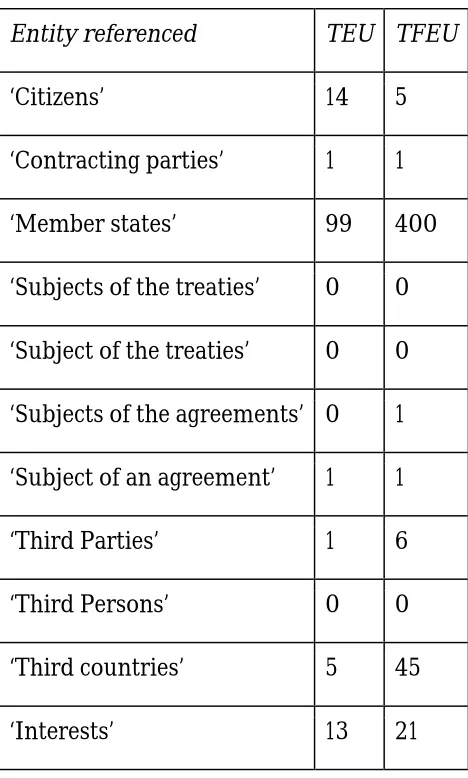
On a purely descriptive analysis, the ‘global’ is not an explicit part of the EU treaties as a regularised legal concept. Instead, the treaties reference a vast array of terms as to entities other than Member States in the treaties, e.g. citizens, third parties, interests, third countries but do not employ the generic term of global objects, or anything specific about ‘others’. The Member States of the EU are empirically and explicitly the primary ‘subjects’ of the EU treaties, receiving more references than any other entity in the treaties.20 While the CJEU in its landmark caselaw has dramatically re-interpreted subjects and objects in EU law to include citizens, beyond this there is less guidance.21 It raises the question as to the clarity of the direction of the EU as to ‘others’.
19 An ‘advanced’ search in the Eur-lex database for ‘global’ in all secondary legislation in force from 1/12/2009 to 1/11/2018 reveals 17705 documents. Where ‘global’ is delimited to the text in the official journal, the number is 7552. The time delimitation used here is from the Treaty of Lisbon to the present day, roughly 2 legislative cycles, so as to provide for a reasonable snapshot. The ‘All documents’ search range shows inter alia from regulations to budget, directives, recommendations, opinions, Guidance, Communications, Financial Regulation, Communications and Statutes, predominantly Decisions, predominantly in Competition Policy, then External relations. A search of the curia.eu database ‘searchform’ from 01/12/2009 to 1/11/2018 for the term ‘global’ in the text of closed cases reveals 609 hits in areas spanning almost every field of EU law. On the amount of EU law currently in force as part of the acquis: see House of Commons Library 4 April 2017 Briefing papers 7867, 7863, 7850 ‘Legislating for Brexit’ series and Financial Times, ‘New EU Laws make UK’s complex Brexit ever more difficult’ (21 June 2017). 20 See the calculation as follows using Eur-lex and Curia databases (at the time of writing): See S. Bardutzky and E. Fahey (eds), Framing the Subjects and Objects of EU law (Edward Elgar 2017) ch 1, Table 1. 21 I.e. Case 26/62 NV Algemene Transport- en Expeditie Onderneming van Gend & Loos v Netherlands
7 Table I:
References to entities in the EU Treaties: Source: S. Bardutzky and E. Fahey (eds),
Framing the Subjects and Objects of EU Law (Edward Elgar 2017) ch. 1, Table 1.
Entity referenced TEU TFEU
‘Citizens’ 14 5
‘Contracting parties’ 1 1
‘Member states’ 99 400
‘Subjects of the treaties’ 0 0
‘Subject of the treaties’ 0 0
‘Subjects of the agreements’ 0 1
‘Subject of an agreement’ 1 1
‘Third Parties’ 1 6
‘Third Persons’ 0 0
‘Third countries’ 5 45
‘Interests’ 13 21
The EU’s soft power as a global trade actor is self-evident. 22 The legal dimension of this soft power and its impact is viewed as a rising phenomenon.23 Third countries, parties and actors are affected by the global reach of EU law.24 From EU animal welfare law,
22 E.g. A. Young, ‘The European Union as a Global Regulator? Context and comparison’ (2015) 22(9) Journal of European Public Policy 1233; C. Damro ‘Market Power Europe’ (2012) 19(5) Journal of European Public Policy 682.
23 see A. Bradford, ‘The Brussels Effect’ (2012) 107 Northwestern University Law Review 1.
financial and banking legislation, EU Competition law, EU Environmental law to data protection, there is an asserted rise in the adoption of EU law beyond its borders, known as ‘The Brussels Effects’.25 There is also a perceived rise in ‘EU extra-territoriality,’ in a variety of forms.26 The reach of EU law is not merely unidirectional from an economic perspective but also administrative and procedural, spanning rights and obligations for the EU and its subjects and objects as others. For example, EU Administrative decisions are increasingly addressed to individuals or legal persons in third countries and sanctions regimes both widen and deepen.27 The global dimension of EU law also results in more international trade agreements post-Lisbon containing regulatory cooperation with quasi-legislative effects in a variety of fields and a range of third party participation rights.28 It raises the question as to the clarity of the global dimension of EU law and how we know and understand its expression. Here, the global dimension of EU law as ‘reach’ is not exclusively but heavily centered upon trade, which this account returns to.
SECTION II: THE CRUMBLING EXCEPTION: INTERNATIONAL RELATIONS IN EU TRANSPARENCY LAW
While the EU’s vision of the global is the most transparency ever, the converse is not necessarily the case as to its legal content. The global dimension to EU law continues to expand with increasingly expansive subjects and objectives. However, its explicit meaning and expression varies considerably. The conduct of the global dimension to EU law and knowledge of its actions are governed by a variety of law and governance, principally relating to transparency and openness. Transparency and openness are at the heart of the
Young, ‘Liberalising Trade, Not Exporting Rules: The Limits to Regulatory Co-ordination in the EU’s “New Generation” Preferential Trade Agreements’ (2015) (22) (9) Journal of European Public Policy 1253. 25 See J. Scott, ‘From Brussels with Love: The Transatlantic Travels of European Law and the Chemistry of Regulatory Attraction’ (2009) 57 American Journal of Comparative Law 897; See S. Kingston, ‘Territoriality in EU (Taxation) Law: A Sacred Principle, or Dépassé?’ in J. Englisch (ed), International Tax Law and New
Challenges from Constitutional and Legal Pluralism (IBFD 2015).
26 See E. Fahey, The Global Reach of EU Law (Routledge 2016) ch 2.
27 For example, Article 11(3) Treaty on the European Union (TEU) provides that the Commission is obliged to consult in its rule-making with ‘the parties concerned’, largely understood to encompass stakeholders irrespective of their country of origin. See E. Korkeo-aho, ‘Evolution of the Role of Third Countries in EU Law - Towards Full Legal Subjectivity?’ in S. Bardutzky & E. Fahey (eds) Framing the Subjects and Objects
of EU Law: Exploring a Research Platform (Edward Elgar Publishing 2017) 227.
9
EU’s efforts to become a nascent transnational democracy, unlike public international law, where it is more embryonic.29 Transparency also has a weak conceptualisation in international relations (IR) theory, the core study of external power, where the disclosure, dialogue and information compete within schools of thought.
A distinction exists in EU law and governance between transparency, bound up with clarity, publication and access, and openness, being understood as freedom of information and increased participation on the other hand.30 There are a plethora of
primary and secondary legal bases for transparency and openness in EU law.31
Transparency is a long-established feature of the law of the EU. It is about engendering trust in the processes which affect the citizen by enabling them to understand, and if necessary, challenge those processes.32 Article 1 of the Treaty on the European Union (TEU) requires decisions to be taken as openly a possible and Article 15 of the Treaty on the Functioning of the European Union (TFEU), emphasises the need to guarantee openness in the context of procedures that lead to the adoption of a legislative act. Article 42 of the Charter of Fundamental Rights (CFR) states that it is the right of any citizen of the Union, natural or legal person residing or having its registered office in a member state to have a right of access to documents of the institutions, bodies, and agencies of the Union whatever their medium. Articles 1 and 15 TFEU provides the legal basis for
29 A. Bianchi, ‘On Power and Illusion: The Concept of Transparency in International law’ in A. Bianchi and A. Peters (eds) Transparency in International Law (OUP 2013) 1. Transparency, however, has had a profoundly unpleasant history in the EU, sparked by the Danish vote against the Maastricht Treaty in 1992 and the resignation of the Santer Commission in the aftermath of a report in 1999. Secrecy was perceived to be the root cause of many such problems of EU governance and a highly reactive law-making process has ensued since then. See A. Von Bogdandy, ‘The European Lesson for International Democracy: The Significance of Article 9 to 12 EU Treaty for International Organizations’ (2012) 23(2) European Journal of International Law 315; See D. Curtin, ‘The Role of Judge-Made Law and EU Supranational Government: A Bumpy Road from Secrecy to Translucence’ in E. Spaventa et al (eds), Empowerment and
Disempowerment of the EU Citizen (Hart 2012); See also D. Curtin, Executive Power of the European Union (OUP 2011); See J. Mendes, Participation in EU Rulemaking (OUP 2011).
30 Transparency includes fundamentally an obligation to use clear language which supports action with reason, for reasons of visibility, explicability and predictability. See Alemanno (n 1); Mendes, ibid.
31 See generally Leino (n 1).
32 It is also an expression of the principle of fairness in relation to the processing of personal data expressed in Article 8 of the Charter of Fundamental Rights of the European Union. Under the GDPR (Article 5(1)(a)6 ), in addition to the requirements that data must be processed lawfully and fairly, transparency is now included as a fundamental aspect of these principles. 17/EN WP260 Guidelines on transparency under Regulation 2016/679 p.6.
Regulation 1049/2001 on access to documents, the EU’s fundamental framework for transparency, policy and governance.33 Recent trade legislation (e.g. on trade defence), increasingly provides for transparency and openness practices.34 Article 4 (1) (a) of the Regulation provides for an important exception in EU law for international relations, holding that ‘the institutions shall refuse access to a document where disclosure would undermine the protection of…the public interest as regard… international relations.’ However, the EU’s international relations exception in transparency regulation appears more and more redundant. While the Council appears ‘to cling on’ to its contours,35 it has been gradually eroded by the CJEU, practices of the Ombudsman and EU institutions themselves in response to public criticism.36 As it stands, the exception does not enable formal consideration of public interest in openness and institutional proposals for reform of the exceptions have not been accepted.37 However, leading caselaw has acknowledged the significance of transparency and public interest warranting disclosure in several international negotiations context, not limited to trade but rather in many key AFSJ domains.38
There are significant shifts by all EU institutions and major actors as to their conduct of the global towards openness, contrary to the actual state of the current law, and thus of significance, in a range of areas, from trade to security.39 The Council of Ministers has
33 Alongside a Treaty-based access to documents regime, the EU also has a regime for the protecting and handling of classified information, the latter lacking a clear constitutional basis.
34 Regulation (EU) 2018/825 of the European Parliament and of the Council of 30 May 2018 amending Regulation (EU) 2016/1036 on protection against dumped imports from countries not members of the European Union and Regulation (EU) 2016/1037 on protection against subsidised imports from countries not members of the European Union.
35 It has recently adopted a policy of only declassifying on a case-by-case basis: Council conclusions on the negotiation and conclusion of EU trade agreements (8 May 2018) 8622/18.
36 A. Bianchi, ‘On Power and Illusion: The Concept of Transparency in International’ in A. Bianchi and A. Peters (eds), Transparency in International Law (OUP 2013) 1.
37 Leino, above (n 1), 221.
38 T-529/09 In’t veld v. council ECLI:EU:T:2012:215; C-350/12P Council v. In’t veld ECLI:EU:C:2014:2039; T-301/10 In’t veld v. commission (In’t veld II) ECLI:EU:T:2013:135; T- 331/11
Besselink v. Council ECLI:EU:T:2013:419
39 See P. Leino, ‘Transparency, Participation and EU Institutional Practice: An Inquiry into the Limits of the Widest Possible’ (2014) 3 EUI Working Papers 2-3, 25-26 < http://cadmus.eui.eu//handle/1814/30580> accessed 11 November 2018.
11
begun to declassify negotiation mandates for international trade agreements only after individual MEPs began to illegally leak negotiation texts as part of a wave of political and local opposition toward the secrecy of the Transatlantic Trade and Investment Partnership (TTIP) and EU-Canada Economic Partnership Agreement (CETA) negotiations in particular.40 The European Commission, along with a host of other actors (from the EP to the Ombudsman) but predominantly itself, has effectively put transparency as a lead constitutional ideal in all EU international trade negotiations, reacting to political rather than legal principles.41 The European Parliament has also increased its demands for transparency in EU international relations negotiations, year upon year post-Lisbon, using a broad methodology of inter-institutional agreements, litigation and soft power (e.g. non-binding resolutions) and has voted down agreements because of transparency issues thereafter.42 The EP notoriously voted down the ACTA copyright agreement because of a lack of information using its newfound powers in the area of IR after the Treaty of Lisbon.43 In a handful of cases largely taken by NGOs and individual MEPs and an academic, the Court of Justice has gradually eroded to a very considerable extent the exception surrounding international relations in its Access to Documents Regulation in litigation against the Council and Commission in security and trade.44 From security and data transfers to migration, the Ombudsman is increasingly putting international relations at heart of work despite being excluded in her role from the Access to Documents Regulation, e.g. as to EU-US Passenger Name Records (PNR) (i.e. security), EU-Turkey relations (i.e. migration) or EU-Australia PNR (security):- an
(2006) 11 Information Polity 109, 120; See M. Hilldebrandt, D. Curtin, and A. Meijer, ‘Transparency in the EU Council of Ministers: An Institutional Analysis’ (2014) 20(1) Eur LJ 1.
40 See E. Fahey, ‘On the Benefits of the TTIP Negotiations for the EU Legal Order: A Legal Perspective’ (2016) 43(4) Legal Issues of Economic Integration 327. It has recently adopted a policy of only declassifying on a case-by-case basis: Council conclusions on the negotiation and conclusion of EU trade agreements (8 May 2018) 8622/18.
41 E.g. European Commission, Factsheet: Transparency in EU Trade negotiations (2013) <http://trade.ec.europa.eu/doclib/docs/2013/june/tradoc_151381.pdf> accessed 11 November 2018. 42 See Case C-350/12 P Council of the European Union v Sophie in ’t Veld ECLI:EU:C:2014:2039; See Vigjilenca Abazi & Martijn Hillebrandt, ‘The Legal Limits to Confidential Negotiations: Recent Case Law Developments in Council Transparency: Access Info Europe and in ‘t Veld’ (2015) 52 CML Rev 825; See Christoph Herrmann, ‘Transleakancy’ in C Herrmann, B Simma & R Streinz (eds), Trade Policy between
Law, Diplomacy and Scholarship (European Yearbook of International Economic Law Series 39, Springer
2015); Eugénia da Conceição-Heldt , Exploring the TTIP Transparency Paradox (forthcoming) .
43 See D. Curtin, ‘Official Secrets and the Negotiation of International Agreements: Is the EU Executive Unbound?’ (2013) 50(2) CML Review 423.
extraordinary array of decisions on EU international relations, despite the EU IR exception surrounding her role.45
This crumbling yet extant exception as to the intersection of the global with internal laws and processes here is of much significance because it increasingly renders the ‘global’ dimension of EU law mismatched with law and practice. Given the broader array of subjects and objects at stake, it draws much attention in particular to the ‘clarity’ dimension of transparency: is it ‘do what I do’, not ‘do what I say?’ It is also argued here to generate ambiguity as to the global and whilst also increasingly obscures its distinctiveness. Ultimately, mismatches between internal procedures and external law-making as to transparency operate adversely upon the EU’s global in a variety of ways, but increasingly also as to individuals raising or generating significant transparency issues. In particular, the AFSJ is argued to show the challenges of the EU as a global actor battling the most complex contemporary elements of globalisation or global governance regimes. As a result, the account argues that the global dimension and approach of the AFSJ remains understudied. It is an area more liable to generate adverse individual effects through misleading or simply complex uses of the term global, brought about through assertions of EU global actorness where a lack of transparency does not facilitate scrutiny or remedies. The AFSJ benefits increasingly from shifts in practices more broadly. Yet it is a more complex area of the EU to adopt a global approach, where less transparency results in significant individual effects. The account thus explores the EU’s global approach to law-making in areas where it is arguably weaker as a global actor than in trade, often self-evidently so.
The account next compiles express formulations of EU ‘Global’ approaches in law and policy, selecting internal and external areas of competence and policy, predominantly in the area of external relations and specifically in the EU’s AFSJ.
13
II. EXPRESS AND IMPLIED EU ‘GLOBAL’ APPROACHES IN AFSJ
LAW-MAKING: MIGRATION, PNR & DATA
One of the most sensitive and controversial aspects of the EU’s AFSJ is its creation of an ostensibly borderless space for freedom, security and justice, developing on from its internal market; thereby enabling deeper integration and a fuller realisation of rights and EU-wide justice. It has been institutionalised through shared competences, minimum standards legislation and the substantive institutionalisation of mutual recognition. The AFSJ as set out in Article 3(2) TEU as an ‘area’ and as expanded in Title V of the TFEU (Articles 67-89), arguably also represents one of the broadest, most controversial and perhaps complex policy fields of EU law and governance. In almost every iteration, it crosses national, regional, international law, with a vast array of sources, that increasingly overlap internal and external policies or fields. The AFSJ has no real objective or finality and has competing visions, rendering its global ambitions interesting to study. It is undoubtedly a more complex policy field for the EU to be a global actor in a variety of areas, yet which has not hindered its ambitions. It is a place where the EU’s multilateralism is somewhat weaker and more embryonic, given that many of its policy fields are some of the most complex aspects of global governance.46
The account next uses three examples of the EU’s Area of Freedom, Security and Justice (AFSJ) traversing internal and external dimensions with significant border components- either expressly or impliedly being understood as global policy: migration, PNR and data. All have significant internal and external dimension and feature high profile clashes where EU law transgresses borders, physically or virtually, as to data, people and security and are argued to be revealing of objectives, means and projected outcomes as unsolved elements of globalisation. It is obvious and predictable that there would be differences as to competences to a degree between the examples. However, all examples selected traverse the AFSJ in law and policy and demonstrate the EU as a global actor fighting elements of globalisation (e.g. migration) or battling unsolved or emerging facets of global
governance (e.g. data transfers or data surveillance). The account thus focuses upon the mismatch as to the internal practices and external law-making there, focussing upon the clarity dimension to transparency. It further considers how the mismatch generates ambiguity of the global and obscures its distinctiveness. Two examples are selected here of an extremely high-profile nature (migration) and an ongoing nature (PNR), while a third (data), is a cross-cutting subject field in a variety of ways. For the first two examples (migration and PNR), their unifying feature is the express use of the term ‘global’ in their nomenclature as policy instruments of EU law and while the third is understood to be a de facto and de jure global policy by implication. However, all three demonstrate an intent on the part of the EU to design a global reach or effect.
The account examines (i) how EU law intersects with global in three key distinct areas of EU law and policy. It critically examines (ii) why the bilateral approach here is termed a ‘global’ approach and (iii) it examines how global approach interacts with transparency and openness issues, in particular clarity.
The first example considered is thus the EU’s Global Approach to Migration.
1. EU’s Global Approach to Migration
i. How EU migration law intersects with the global
Migration remains the last unsolved puzzle of globalisation, where the interests of incoming and outgoing movements of people have never managed to align. EU law is legal obliged to intersect with the ‘global’ as to migration in its treaties. Its codes, rules and standards regularly cite public international law and intersect therewith as part of its commitment to public international law in its treaties.47 In addition, international law provides for an extremely limited yet fundamental framework for migration as to asylum
15
and immigration.48 The EU terms its own arrangements with a bloc third countries as bilateral arrangements and not multilateral as global, through their asserted consistency regionally and engagement with international norms. EU migration law is increasingly understood to communicate ambiguity as to its mixed objectives both internally and externally.49 The EU law and governance of migration has distinct internal and external facets which may be viewed as legally and constitutionally contradictory. There is legal competence for enhanced measures to combat illegal immigration but also to manage efficiently migration flows, but with fairness towards third country nationals.50 And the only external competence explicitly transferred to the EU under Title V TFEU is as to readmission and contrasts with the silence of the Treaties on other fields of migration covered by Article 79 TFEU, relying to some extent on implied external competences.51 Moreover, EU external competences to promote legal migration and integration are concurrent competences with regard to Member State powers, which poses considerable issues also for coherence in practice. The AFSJ is also supposed to remain accessible to those whose circumstances lead them justifiably to seek access to EU territory.52Although there are difficulty balancing acts embodied therein, the EU has sought to strive to be a safe haven for those fleeing persecution.53 However, unrecognised refugees and asylum seekers have been assimilated into the generic category of Third Country Nationals, rendering their entry irregular or illegal unless they demonstrate compliance with general admission criteria. On the other hand, the EU border acquis contains general references to human rights and refugee law, giving the impression that special treatment must be accorded to those in search of international protection, in accordance with international and European standards.54 Although thus a highly imperfect matrix, EU law consistently
48 See J. Hathaway, ‘A Global Solution to a Global Refugee Crisis’ (2016) 1 Eur. Papers 193; J. Hathaway, ‘Eighth Colloquium on Challenges in International Refugee Law’ (2018) 39(1) Mich. J. Int'l L. 1.
49 See S. Lavenex, ‘”Failing Forward” Towards Which Europe? Organized Hypocrisy in the Common European Asylum System’ (2018) Journal of Common Market Studies, forthcoming.
50 See D. Thym, ‘EU Migration Policy and its Constitutional Rationale’ (2013) 50 Common Market Law Review 709; J. Weiler, ‘Thou Shalt not Oppress a Stranger’ (1992) 3 European Journal of International Law 65.
51 See P.G. Andrade, ‘The Legal Feasibility of the EU's External Action on Legal Migration: The Internal and the External Intertwined’ (2013) 15(3) European Journal of Migration and law 263, 267-268.
52 Tampere Milestones, 15-16 October 1999, para 3.
53 See A European Agenda on Migration COM(2015) 240, p.1.
54 See V. Moreno-Lax, Accessing Asylum in Europe :Extraterritorial Border Controls and Refugee Rights
seeks to engage with international norms and the global in its migration law-making because it is compelled to.55 Here, to set the global agenda is arguably impossible for the EU through its own laws.
ii. Bilateral as global: the ‘global’ in the GAMM
The EU’s approach to global migration is an important statement as to the ‘others’ of EU law. It has a powerful impact upon its neighbourhood whereby it undoubtedly shapes the legal order and institutional framework in its neighbourhood, e.g. the Eastern and Southern neighbourhoods.56 Its main concern as regards third countries is said to be its desire to protect its own internal security from outside threats.57 There are considerable unintended yet disruptive and even harmful implications on migration patterns between the EU’s periphery and the rest of the world. Thus, the diffusion of EU migration norms and policy can be said to have wide-ranging consequences on migration patterns beyond its periphery. The Global Approach to Migration (GAM) is, since 2005, the overarching policy framework of the EU external migration and asylum policy.58 It has a dual objective, both to balance a control oriented external dimension and the promotion of mobility and legal migration opportunities for third country nationals. It was first published in 2005 and constructed as a comprehensive strategy to holistically address human trafficking. Since 2005, the EU continues to describe it as the overarching framework of the EU external migration and asylum policy.59 Thus in 2011 its remit was expanded and updated as the Global Approach to Mobility and Migration (GAMM) to manage more irregular migration and human trafficking and manage migration and
55 See further Fahey above (n 47).
56 See L. Delcour, ‘The EU: Shaping Migration Patterns in its Neighbourhood and Beyond’ in D. Kochenov and F. Amtenbrink (eds) The European Union’s Shaping of the International Legal Order (CUP 2013) 280; A. Betts, ‘The Global Governance of Migration and the Role of Trans-regionalism’ in R. Kunz, S. Lavenex, and M. Panizzon (eds) Multi-Layered Migration Governance: The Promise of Partnership (Routledge 2011).
57 See J. Huysmans, ‘The European Union and the Securitization of Migration’ (2000) 38 Journal of Common Market Studies 41.
58 See Commission, ‘Communication from the Commission The Global Approach to Migration and Mobility’ COM (2011) 0743 final <https://ec.europa.eu/home-affairs/what-we-do/policies/international-affairs/global-approach-to-migration_en> accessed 11 November 2018.
17
asylum cooperation with third countries. Its update saw the launch of an allegedly newer and more consolidated second phase of the GAMM. One of the cornerstones of the new framework is the organization and facilitation of mobility and migration implemented through specific forms of bilateral frameworks with a very limited range of countries (i.e. Moldova, Cape Verde, Georgia, Armenia, Morocco, Azerbaijan). While the main reason for basing the Strategy on soft law (e.g. mobility partnerships) is flexibility, this flexibility is perceived to be one of its core weaknesses.60 As a result, it is not a strategy which receives copious amount of legal coverage in migration scholarship and frequently appears as a rather minor footnote in a complex web of legal sources across a range of leading databases.61
The GAMM is criticised for its failure to adopt a rights-based approach for migrants, largely because of its basis in bilateral ‘mobility’ partnerships, misleadingly labelled given that have little to do with mobility.62 The GAMM has also come under considerable pressures during the EU’s migration crises, however, this does not appear to have constituted the foundational basis for contemporary EU action, evidence of its less than compelling vision of the global.63 As a result, the approach is a lot more about ‘push-back’ of people. This global approach to partnerships ironically does not promote mobility and instead is about country of origin readmission. The use of soft non-binding policy is seen as important there, flexible and broad enough to enable MS achieve political commitment on the negotiation of readmission to promote such an approach. 64 It has an
60 P.G. Andrade, ‘The Legal Feasibility of the EU's External Action on Legal Migration: The Internal and the External Intertwined’ (2013) 15(3) European Journal of Migration and Law 263, 277.
61 See V. Chetail and C. Bauloz (eds) Research Handbook on International Law and Migration (Edward Elgar Publishing 2014); See B. Opeskin, R. Perruchoud and J. Redpath-Cross (eds), Foundations of
International Migration Law (CUP 2012); See D. Thym, ‘’Citizens and ‘Foreigner’ in EU Law. Migration
Law and its Cosmopolitan Outlook’ (2016) 22(3) Eur LJ 296.
62 See E. Fahey, ‘Between Delegalisation and hyperlegalisation: on laws, norms and principles in the external management of migration’ In J. Santos Vara & S. Carrera (eds.), Constitutionalising the External
Dimensions of EU Migration Policies in Times of Crisis: Legality, Rule of Law and Fundamental Rights Reconsidered’ (Cheltenham: Edward Elgar forthcoming).
63 See J. Hampshire, ‘Speaking with One Voice? The European Union's Global Approach to Migration and Mobility and the Limits of International Migration Cooperation’ (2016) 42(4) Journal of Ethnic and Migration Studies 571.
extraordinarily broad meaning and is highly misleading in its nomenclature because of its manipulative utilisation of territory and the direction of movement. The use of the term ‘global’ is arguably thus misleading precisely because it is not really global but heavily bilateral and regional, but mainly bilateral:- and by that meaning a very limited partner-based range of structures with third countries in bilateral trade. Its global nature is somewhat of a misnomer where considerable gaps exist between EU law and a truly global approach e.g. as to the EU’s so-called Common European Asylum System (CEAS).65 There is little within the EU’s Global Approach here which is not heavily dependent upon cooperation with third countries and regional partnerships with considerable imbalances of power ensuing.
ii. Transparency and openness as to the EU’s global approach in migration
Significant transparency issues have occurred as to the EU global migration in recent times and show the challenges of understanding the EU’s global migration ambitions particularly for individuals, particularly as to clarity. The EU-Turkey ‘Agreement’ of 2016 is a powerful example, concerning the return of irregular migrants in Greece to Turkey, whereby for every Syrian returned to Turkey, another Syrian was to be resettled to the EU and thus stem the tide of global migration to the EU, particularly from Syria. It is one of the most notorious acts of EU external migration ever, learning ire and critique at national and international level. The General Court in its now infamous decision in NM v.
European Council,66 held the EU-Turkey agreement to be a ‘non-EU agreement’ and instead to be a European agreement between EU Member States and Turkey, made at the margins of the European Council’s meeting in March 2016. The Court held that it lacked jurisdiction to review the ‘Statement’ on the basis that the statement was not an international agreement of the EU and that the EU institutions had not sought to conclude
aesthetically, the formulation of the ‘global’ dimension is thus minimalist i.e. the High-Level dialogue on International Migration and Mobility.
65 See M. Dean, ‘Bridging the Gap: Humanitarian Protection and the Convergence of Laws in Europe’ (2014) 20 Eur LJ 34.
19
the agreement. It thus shielded the EU’s Agreement from scrutiny and review in one of its most controversial decisions of all time. The Ombudsman had also previously been involved in the EU-Turkey Statement, where she recommended that the European Commission conduct a human rights impact assessment on this thorny instance of EU external migration, thereby bringing many facets of good administration, including, transparency and openness to the fore in the face of detailed arguments from the institutions seeking to shield the agreement from scrutiny as a ‘political act’.67 The decision of the General Court is currently under appeal and its consideration of the most elementary part of clarity as to transparency and migration seems ripe. Significant litigation is also ongoing as to the public interest in access to documents as to external migration, relating to the Statement.68
Clarity as to borders and territory also goes to the heart of migration and not always in ways in which litigants can assert direct entitlements or easily seek readmission. In another recent seminal decision of the CJEU decided on the parameters of extra-territoriality and longer-term visas, the Court is viewed as having shirked a significant question relating to aspects of transparency. In X and X v. Belgium,69 the CJEU in Grand Chamber considered a preliminary ruling on the interpretation of the Visa Code Article 25(1)(a) of Regulation No. 810/2009 of the European Parliament and Council of 13 July 2009, a highly ‘legalised’ area of secondary law.70 The applicants were Syrian nationals who had been refused visas in Aleppo at the Belgian Embassy for visas with a limited territorial validity. The question arose as to the obligations arising from the Charter of Fundamental Rights and EU law and whether they should have been issued visas on humanitarian grounds. The CJEU held that the proceedings were not governed by EU law, specifically not its Charter in Articles 4 and 18 thereof.71 It is a controversial and indeed striking example of the ‘delegalisation’ of the global dimension to EU law here,
67 Decision of the European Ombudsman in the joint inquiry into complaints 506-509-674-784-927-1381/2016/MHZ against the European Commission concerning a human rights impact assessment in the context of the EU-Turkey Agreement.
68 ie T-851/16 Access Info Europe v. Commission ECLI:EU:T:2018:69. 69 Case C-638/16 PPU X and X v. Etat Belge ECLI:EU:C:2017:173.
70Regulation (EC) No 810/2009 of the European Parliament and of the Council of 13 July 2009 establishing a Community Code on Visas (Visa Code) OJ L 243, 15.9.2009, p. 1–58.
exorcising issues of clarity and openness.72 The growing extra-territoriality of EU law has entailed that many felt that the human rights dimensions of ‘others’ would be more explicitly enunciated. It is a distinctive example apart from the EU-Turkey litigation on the practical manifestations of the global ‘others’.
The GAMM is fundamental about migrant ‘pushback’ rather than mobility and exhibits a highly misleading use of the term ‘global’. It ultimately seems unlikely that any of the EU’s global approaches to migration will be adopted elsewhere and so it differs from other forms of global approach explored here next, e.g. as to ‘global PNR’. Litigation as to the transparency of the infamous EU-Turkey statement is a particularly revealing example of the challenges of access as to the global in the domain of migration where its transparency and in particular its clarity are questionable, instigated by certain NGOs. Nonetheless, it is difficult for litigants to challenge EU migration law, e.g. to have the resources and capacity to assert transparency- particularly for those outside of the EU. Transparency and clarity issues demonstrate the weaknesses at the heart of EU global action. Their absence similarly indicates significant adverse consequences for individuals in a domain where the EU attempted to decisively deal with mass migration, replicated in previous and the following example also.
The account next considers the EU’s explicitly ‘global’ approach to Passenger Name Records, as an express use of the term in AFSJ law and policy. It considers (i) how EU law intersects with global in its law as to the area of Passenger Name Records. It then (ii) examines why the EU terms a bilateral a global approach and then (iii) evaluates how EU PNR interacts with transparency and openness, particularly the clarity, publication, access dimensions thereof.
2. Global approach to Passenger Name Records (PNR)
i. How EU PNR law intersects with the global
21
Commercial airlines carried more than four billion passengers on scheduled flights globally in 2017 and aviation law increasingly interlocks with international security and terrorism laws. Global aviation law is a complex regulatory field for the EU to assert its global significance.73 The transfer of airline passenger data is nowadays innately global and has become a murky matrix of global data security and surveillance law, affecting huge swathes of passengers on a daily basis. The EU now has a policy on the transfer of Passenger Name Records (PNR) data transfer which is expressly labelled as a ‘global approach’.74 It is arguably one of the most controversial policies of internal (a Directive) and external (EU-US Passenger Name Records Agreements (PNR)) EU law which began as US law and policy. PNR law has its origins in the post 9/11 US Aviation and Transportation Security Act of 2001 requiring all airlines flying into the US to supply PNR data to the US Customs and Border Control (CBP). This, however, was not compatible with EU law, given that Article 25 of the Data Protection Directive provided that personal information originating from within Member States may be transferred to a third country only if that country ‘ensures an adequate level of protection’.75 Thus, an EU-US passenger name records agreement was reached 2004.76 However, in 2006, the Court annulled both Decisions.77 A provisional seven-year Agreement with the US was then concluded in 2007 to replace the earlier Agreement. The EP sought to postpone its approval vote thereof, in light of its new powers provided for in the Treaty of Lisbon pursuant to Article 218 TFEU, and pressed the Commission for a Global Strategy on external PNR with better redress
73 Air Transport Association of America v. Secretary of State for Energy and Climate Change, C-366/10 EU:C:2011:864.
74 See Commission, ‘Communication from the Commission on the Global Approach to Transfers of Passenger Name Record (PNR) Data to Third Countries’ COM (2010) 492 final. See E. Fahey, ‘Law and Governance as Checks and Balances in Transatlantic Security: Rights, Redress and Remedies in EU-US Passenger Name Records and the Terrorist Finance Tracking Program’ (2013) 32 Yearbook of European Law 1.
75 Directive 95/46 of the European Parliament and of the Council of 24 October 1995 on the protection of individuals with regard to the processing of personal data and on the free movement of such data [1995] OJ L 281, 31.
76 On the Agreement and its predecessors: Agreement between the European Community and the United States of America on the processing and transfer of PNR data by Air Carriers to the United States Department of Homeland Security (DHS), Bureau of Customs and Border Protection [2004] OJ L 183/ 83 and corrigendum at [2005] OJ L 255/168; Undertakings of US CBP issued on 11 May 2004 OJ [2004] L 1235/11; Decision 2004/496/EC adopted on the basis of ex Article 95 EC in conjunction with ex Article 300(2) EC.
and effective legal safeguards. Thereafter, negotiation of a revised Agreement with the US followed suit and a ‘Second Generation’ PNR Agreement was agreed upon in 2011.78 It has been described by the European Commission as an ‘improved’ PNR agreement: enhancing data protection mechanisms therein; limiting the use of data; purporting to fight crime more effectively; placing obligations on the US to share data with the EU and setting out a detailed description for the circumstances for when PNR can be used.79 It has never been litigated and remains the overarching model for all EU PNR law with all third countries.80 In 2016, the EU developed its own internal EU PNR system via a Directive which stands as the internal intersection with the global.81
ii. Bilateral as global: the EU’s global approach to PNR
The EU signed Passenger Name Records (PNR) agreements with Canada82 and
Australia83 in 2005 and 2006 respectively, on a case-by-case basis, which resulted in incoherent standards and rules for carriers. Accordingly, the European Commission proposed thereafter in 2010 that an EU law ‘global approach’ was more desirable as a rule-making solution.84 It argued that a multilateral approach e.g. a mandate to negotiate an international convention, would take too long, be too uncertain and would allow any country to join, resulting in lower data transfer standards than under EU law. As a result,
78 See Agreement between the United States of America and the European Union on the use and transfer of Passenger Name Record Data to the United States Department of Homeland Security 11.8.2012 [2012] OJ L 215/5.
79 See ‘Press Release: New EU-US Agreements on PNR Improves Data Protection and Fights Crime and Terrorism’ IP/11/1368’ (European Commission, 17 November 2011) < http://europa.eu/rapid/press-release_IP-11-1368_en.htm> accessed 11 November 2018.
80 See further Fahey, above (n 74).
81 Directive (EU) 2016/681 of the European Parliament and of the Council of 27 April 2016 on the use of passenger name record (PNR) data for the prevention, detection, investigation and prosecution of terrorist offences and serious crime [2016]OJ L 119 132–149.
82 In 2014, the EU and Canada signed a new agreement on the processing and transfer of Passenger Name Record (PNR) data by Air Carriers to the Canadian competent authorities to replace the existing agreement from 2006. Council doc. 10940/14 Brussels, 25 June 2014.
83 See Agreement between the European Union and Australia on the processing and transfer of Passenger Name Record (PNR) data by air carriers to the Australian Customs and Border Protection Service 14.7.2012 [2012] OJ L 186/4.
23
a ‘global approach’ under EU law was preferable, allowing it to ‘upload’ its rules internationally,85 predicting that the number of such agreements was likely to increase in the foreseeable future and would result in the need for general standards, content and criteria for them, particularly as to data protection principles and safeguards. These principles formed the basis of the renegotiations of the PNR Agreements with the US, Australia and Canada, leading to the conclusion of new PNR Agreements with the US and Australia, subject to regular reviews and evaluation. The European Parliament voted to seek the opinion of CJEU as to whether the EU-Canada Agreement was compatible with EU law. The CJEU recently struck down the EU-Canada Agreement for its treatment of onwards transfer of data to third countries, which bodes ill for the EU’s new Directive in its field but also the idea of a ‘global’ approach which can pass muster.86 After the negotiation of PNR agreements with the US, Canada and Australia, an increasing number of third countries have sought the transfer of PNR data from the EU without similar agreements existing: Russia, Mexico, United Arab Emirates, South Korea, Brazil, Japan, Saudi Arabia and Argentina.87
The EU’s use of the term ‘global’ here is quite a misnomer, which is in fact is arguably not global, but rather wholly bilateral. ‘Global’ as a term here is synonymous with an aggregated attitude or set of policies towards third countries and certain legal terms are repeated verbatim in Agreements (US, Canada and Australia). However, considerable differences exist between each PNR agreement. How the EU purports now to advocate a global approach to PNR is a noteworthy development on account of the manner by which the EU has acquired its norms from the US and absorbed them internally. One on level, it is highly explicit and transparent as an approach to the global. However, its origins are not so transparent or clear-cut, nor necessarily so ‘global’ either. The labelling of the ‘global’ approach here by the EU as a ‘strategy’ carries with it the intentional ambitions of the EU as a global actor. It is, however, distinctive from the global ambitions as expressed
85 New Zealand, South Korea, Saudi Arabia, South Africa, Korea and Japan are also all using or testing PNR data but have not yet entered into agreements with the EU.
86 Opinion 1/15 Draft Agreement between Canada and the European Union on the transfer and processing of Passenger Name Record data ECLI:EU:C:2017:592. Cf Article 29 Working Party, Letter to Commission on Opinion 1/15 (11 April 2018).
in, for example, internal market policies, in so far as it is an ‘inwards-out’ strategy rather than an ‘outwards-in’ one, i.e. which tries to co-opt others rather than to spread its rules more indirectly, almost by contagion yet has highly esoteric origins. Its recent internal deployment is similarly conflicted because these same origins. However, the global approach faces significant challenges from the EU judicial branch in recent times. According to recent CJEU caselaw, systemic and indiscriminate storage of personal data contradicts EU law and EU PNR increasingly falls foul thereof in each Agreement.88 As a result, global PNR is arguably a highly non-transparent policy, which has allowed third country norms to spill over into EU law and policy, with limited substantive change from their original guise. Yet is also unlikely that the EU’s rules subsequently adopted will dominate globally or become model laws as originally intended and the template varies considerably still. Instead, a ‘global approach’ appears used when the EU’s actorness is particularly weak. Here, the EU’s global approach begun as a weak replicant or reactor of/ to US policy. It saw the EU act as a different form of global actor, attempting to develop a global policy in the face of one being inflicted upon it and others.
iii. Transparency and openness as to the EU’s approach to PNR
Similar to migration, the capacity of those affected to challenge and obtain resources to litigation the global transfer of data places it further away from scrutiny. The law and governance of PNR remains highly controversial and is a complex dimension of providing checks and balances on EU external security.89 There are several recent key decisions as to transparency and PNR concerning the Ombudsman and individual MEPs have mostly unsuccessful in directly seeking their data.90 MEPs increasingly raise concerns about the transparency of reviewing governance here.91 The Ombudsman is in particular
88 See Case C-293/12 and C-594/12 Digital Rights Ireland and Seitlinger and Others ECLI:EU:C:2014:238 at 71. See also Case C-362/14 Schrems v Data Protection Commissioner ECLI:EU:C:2014:317; See Opinion 1/15 ECLI:EU:C:2016:656, Opinion of AG Mengozzi.
89 See further Fahey (n 74).
90 See S. In’t veld MEP, ‘Transparency in the legislative process’, question to the European Commission on the PNR Directive: P-007913-17 20 December 2017; E. Fahey, ‘Between One-Shotters and Repeat Hitters: A Retrospective on the Role of the European Parliament in the EU-US PNR Litigation’ in F. Nicola & B. Davies (eds), EU Law Stories (CUP 2017) (on in’ t Veld’s actions) Ch. 27.
25
increasingly involved in transparency issues as to global PNR and its governance, which is instructive as to the forms of review being sought and conducted,92 despite her express exclusion from international relations in the Access to Documents Regulation.
Fundamental rights, including aspects of transparency such as clarity and also openness, have featured prominently in the CJEU’s Opinion 1/15 on the EU-Canada PNR Agreement.93 It held that of the 19 PNR headings in the agreement, some were not sufficiently ‘clear and precise’. While retention was not problematic per se, the continued storage of PNR of all air passengers after their departure from a third country was not limited to what was strictly necessary. There, the CJEU has demonstrated the significance of good governance and public administration in international relations as to individual data transfers to third countries. Even in the absence of a plaintiff in abstract review, good administration and good governance appear as central principles. A lack of knowledge of the EU’s actions has also had adverse consequences for good governance and is instructive of the challenges of the global dimension here. Higher EU standards for the protection of data may complicate the jigsaw going forward, particularly as to enforcement, discussed further below. Still, the place of data transfer for security purposes in the absence of a global regime where de facto US dominance has set the global standard is important here. It is a good example of the complex generation of ‘global’ here, where the EU is a weaker actor and where the impact upon the individual is potentially highly significant. A lack of transparency particularly as to clarity and access masks the weaknesses underlying the EU’s approach. Nonetheless, transparency and particularly clarity and access, afford individuals important safeguards going forward as to the emerging global approach.
92 Decision in case 1959/2014/MDC on the European Commission’s refusal to grant public access to the award evaluation forms concerning applications for co-funding of mechanisms for the processing of passenger name records (2017); Recommendation in case 1959/2014/MDC on the European Commission’s refusal to grant public access to the award evaluation forms concerning applications for co-funding of mechanisms for the processing of passenger name records (2016); Decision in case 1569/2016/DR on the European Commission’s refusal to grant full access to an e-mail it received from an IT company during the preparation of the Passenger Name Record (PNR) Directive (2016); Summary of the decision in case 1959/2014/MDC on the European Commission’s refusal to grant public access to the award evaluation forms concerning applications for co-funding of mechanisms for the processing of passenger name records (2017); Follow-up to critical and further remarks - How the EU institutions responded to the Ombudsman’s recommendations in 2011 (2012).
The account next examines a commonly understood situation where EU law has at the least a de facto global approach to it. It is thus a selection of inferenced-based accounts as to data protection and data transfers. It is thus non-explicit or not express and is not derived from the EU itself as an expression of law. This entails that these are examples of the EU’s approach to law-making which has global effects, de facto intent or global reach, as understand in practice in scholarship. It selects the EU’s approach to data protection. It considers (i) how EU law intersects with global. It critically assesses (ii) the EU’s extra-territorial approach and (iii) it assesses the EU’s global approach with respect to transparency and openness.
3. Global approach to data in EU law
i. How EU data transfer law intersects with the global
There is little about the contemporary digital age that is not global irrespective of the specificities of the law. One specific legal regime that is broadly understood to have had global reach and effects is EU data protection law and the processing of data.94 Many even speak of the global reach, effects and the extra-territoriality and ‘Europeanisation’ of data protection law all as a monolithic idea, which has become all ears, eyes and arms.95 In the era of Big Data, the idea that individuals can effectively control their personal data may be viewed as simply naïve. Still, EU law has defied the odds and granted rights to those to whom it was thought fell beyond regulatory reach.96 The EU has essentially developed an approach to data protection because it is widely understood to have had extra-territorial reach and effects. This reach, both de facto and de jure, having evolved accidentally to
94 Since the Treaty of Lisbon, EU data protection law is comprised of a mix of primary and secondary law whereby Article 16 TFEU is the legal basis for EU data protection legislation while Article 8 of the Charter sets out a right to data protection [1995] OJ L 281.
95 On the territorial scope of the General Data Protection Regulation: see C. Ryngaert ‘Symposium Issue on Extraterritoriality and EU Data Protection (2015) 5(4) International Data Privacy Law 221; C. Kuner, ‘Extra Territoriality and Regulation of International Data Transfers in EU Data Protection Law’ (2015) 5 International Data Privacy Law 242.
27
being ‘by design’.97 In the case study of EU data protection, this ‘global’ dimension may be understood to comprise its norm evolution, both ‘inwards’ and ‘outwards’. The global here nudges a multitude of standards and enforcement paradigms but still faces the challenge of getting high standards in a world where the internet and data standards are segmenting along specific regional and national lines.98
The EU’s Data Protection Directive 95/46/EC on the protection of individuals with regard to the processing of personal data and the free movement of such data was adopted in an age at which the digital relocation was merely nascent. Meanwhile, the digitisation of data has led to an exponential increase in the scale of personal data processing and the ease within which it can occur. Judicial scrutiny of its provisions in EU law has managed to generate a revolution with significant global effects. After the landmark decisions of the CJEU in Google v. Spain,99 Schrems,100 Digital Rights Ireland101 and Weltimmo,102 the place of EU law as a global standard-setter has evolved with much force as an idea, which in turn has also provoked many legitimacy and accountability questions.103 In particular,
Google v. Spain generated a global debate on the parameters of the ‘right to be forgotten’
and whether it was a de facto or de jure ‘European’ or ‘global’ right enabling the EU to ‘claim’ jurisdiction over processes occurring outside of the EU borders when the data controller had a relevant revenue-generating subsidiary in the EU. The Commission has thereafter unambiguously advocated the global reach of EU data protection standards for a variety of purposes.104
97 See further Kuner (n 95).
98 E.g. China: see Mark Wu, The 'China, Inc.' Challenge to Global Trade Governance, (2016) 57 Harv. Int'l L.J. 261.
99 See Case C-131/12 Google Spain SL, Google, Inc. v Agencia Española de Protección de Datos, Mario
Costeja González ECLI:EU:C:2014:317
100 See Case C-362/14 Maximillian Schrems v Data Protection Commissioner ECLI:EU:C:2015:650. 101 See Case C-293/12 and C-594/12 Digital Rights Ireland and Others ECLI:EU:C:2014:238. 102 See Case C-230/14, ECLI:EU:C:2015:639.
103 For example, see Bradford above (n 22); Shaffer, ‘Globalisation and Social Protection: The Impact of EU and International Rules in the Ratcheting up of US Data Privacy Standards’ (2000) Yale Journal of International Law 1.