management
Juan Chiach´ıo1, Manuel Chiach´ıo2, Darren Prescott3, and John Andrews4
1,2,3,4Resilience Engineering Research Group, University of Nottingham
NG7 2RD, Nottingham (UK)
{juan.chiachioruano, manuel.chiachioruano, darren.prescott, john.andrews}@nottingham.ac.uk
ABSTRACT
Railway track geometry deterioration due to traffic loading is a complex problem with important implications in cost and safety. Without appropriate maintenance, track deterio-ration can lead to severe speed restrictions or disruptions, and in extreme cases, to train derailment. This paper proposes a physics-based reliability-based prognostics framework as a paradigm shift to approach the problem of railway track management. As key contribution, a geo-mechanical elasto-plastic model for cyclic ballast settlement is adopted and em-bedded into a particle filtering algorithm for sequential state estimation and RUL prediction. The suitability of the pro-posed methodology is investigated and discussed through a case study using published data taken from a laboratory sim-ulation of train loading and tamping on ballast carried out at the University of Nottingham (UK).
1. INTRODUCTION
Given the rampant demand of use of the railways in many de-veloped countries, there is an increasing need to better under-stand the long-term degradation of railway track systems. For ballasted tracks, which represent the vast majority of the rail-way network world-wide, geometry degradation represents the main ageing factor requiring periodic interventions to re-store the initial geometry of the track, liketamping or bal-last blowing(Selig & Waters, 1994). These interventions not only represent a significant part of the railway operation ex-penses, but also imply temporal line closures and a reduction of the effective network capacity. As a result, track geome-try maintenance typically needs to be planned with months in advance. It is in this context of anticipated maintenance where the benefits of prognostics can be fully exploited for improved and more cost-efficient maintenance decisions and
Juan Chiach´ıo-Ruano et.al. This is an open-access article distributed un-der the terms of the Creative Commons Attribution 3.0 United States Li-cense, which permits unrestricted use, distribution, and reproduction in any medium, provided the original author and source are credited.
optimum asset availability.
However, to confer the required predictability of the prognos-tics solution, a suitable model for long-term track asset degra-dation is needed, taking into consideration the current and fu-ture mechanical, loading and operational conditions. Track geometry degradation is a complex process driven by sev-eral mechanisms, like ballast settlement, fatigue of sleepers, and rail wear, among others. The settlement of the granular layers, which is a consequence of the frictional sliding and compaction between aggregate particles and the breakage of them caused by fatigue, is known to be the main controlling factor for track degradation (Selig & Waters, 1994; Suiker & Borst, 2003). Several models for track settlement have been proposed in the literature over the last decades. Section 2.1 provides a selective overview of the main models in the lit-erature, which are categorized into stochastic, phenomeno-logical, and physics-based formulations. A more systematic review can be found in (Dahlberg, 2001), and more recently in (Soleimanmeigouni, Ahmadi, & Kumar, 2016).
As evident from the literature, track degradation modelling and maintenance to date has a strong empirical retrospec-tive character, mainly based on data-based (stochastic or phe-nomenological) models. The prediction accuracy of these models depends on the quality and quantity of the available historic data, and thus they are prone to misjudgments spe-cially under uncertain (future) loading and operating scenar-ios. In contrast, physics-based models are grounded on the first principles about track degradation, they are transparent to geo-mechanical input variables, and require much less train-ing data to provide accurate predictions.
cyclic ballast densification is adopted and embedded into a particle filtering algorithm for sequential state estimation and future state prediction. Then, probability-based estimations about the remaining time to reach a predefined functional limit for track settlement are subsequently obtained using the reliability-based prognostics methodology by (Chiach´ıo, Chiach´ıo, Sankararaman, Saxena, & Goebel, 2015). This physics-based reliability-based prognostics methodology in application to the railway track asset is precisely the key contribution of this paper, in relation to a similar contribu-tion from the literature (Mishra, Odelius, Thaduri, Nissen, & Rantatalo, 2017). As a case study, the proposed methodology is tested against experimental data taken from Aursudkij, Mc-Dowell, and Collop (2009) about permanent axial strain in a ballasted railway track carried out at the Nottingham Rail-way Test Facility (Brown, Brodrick, Thom, & McDowell, 2007). Results are presented in Section 4, and discussed in Section 5.
2. RAILWAY TRACK DEGRADATION MODELLING
Several families of models for track settlement have been pro-posed in the literature. This section provides an overview of the main models in the literature, classified into stochastic, phenomenological, and physics-based formulations. Among them, a physics-based model is selected for the pro-posed filtering-based prognostics approach presented in tion 3. The key formulation of this model is given in Sec-tion 2.2.
2.1. Overview of track settlement models
2.1.1. Stochastic models
Hamid and Gross (1981) proposed an empirical approach to investigate the statistical dependencies between several track geometric defects. In addition, they developed empir-ical degradation formulations based on autoregressive math-ematical models to relate an artificially definedtrack quality index(TQI) with physical measurements, as follows:
Y =a0+bY
0
+ Nm
X
i=1
aiXi (1)
where Y0 is the previous TQI index, Xi, i = 0, . . . , Nm are the measurements, and ai, i = 0, . . . , n andb are fit-ting parameters. Bing and Gross (1983) predicted how the track quality indexdefined in Eq. (1) changes as a function of causal parameters such as traffic, track type, maintenance, etc. Shafahi and Hakhamaneshi (2009) represented the vari-ation of TQI as a Markov model, establishing a mapping between TQI and a finite number of states for the Markov chain. A similar approach has been recently proposed by Bai, Liu, Sun, Wang, and Xu (2015).
Hamid and Gross (1981) used time-series analysis techniques
to statistically represent track-geometry variations including random waviness, periodic behaviour at joints, and isolated variations. In fact, they represented some track geometry de-fects as a stationary random process, and other as periodic processes. Iyengar and Jaiswal (1995) proposed a Gaussian random field to represent the vertical irregularity of the track based on data from Indian railways. Vale and Lurdes (2013) used time-series degradation data from the Portuguese high-speed line Lisboa-Porto and fitted them to a probabilistic model (Dagum distribution), taking the standard deviation of the longitudinal level as degradation parameter.
In addition to track degradation, several authors have at-tempted to represent the interaction between track degra-dation and maintenance strategy using stochastic degrada-tion models. Meier-Hirmer, Riboulet, Sourget, and Rous-signol (2009) proposed a Gamma process to represent the track deterioration within an optimization framework in-cluding an intervention efficiency model and a cost model for various maintenance actions. The model was applied to track maintenance data from the French National Rail-ways. Quiroga and Schnieder (2012) proposed a stochastic degradation-restoration model, representing the degradation as a track quality measure that evolves following an expo-nential function. They used the Monte Carlo method to in-vestigate cost-effective maintenance strategies. Prescott and Andrews (2015) proposed a Markov model to investigate the evolution of track degradation for a given asset man-agement strategy. The model represents not only the dete-rioration of the asset, but also its dependence on the main-tenance history. Authors, however, acknowledged practical limitations of the Markov modelling approach in real life sce-narios which prevents its further development for track asset management modelling (Andrews, 2012; Andrews, Prescott, & De Rozi`eres, 2014). Notwithstanding, track degradation models embedded within the Petri net paradigm (Andrews, 2012; Prescott & Andrews, 2013; Andrews et al., 2014) have emerged as a suitable and promising modeling approach, since it allows to efficiently incorporate complex deteriora-tion processes and their dependence on the maintenance his-tory together with several intervention options for inspection, repair, and renewal.
2.1.2. Phenomenological models
Sato (1995) suggested that the settlement yof the track can be calculated as a function of the number of loading cyclesn
as
y(n) =γ(1−exp(−αn)) +βn (2)
pro-posed a logarithmic model for track settlement based on the permanent strainpafternloading cycles, as follows:
p(n) = (1 +Clogn)p(1) (3)
wherep(1)is the permanent vertical strain after the first load cycle, andC is a fitting constant. This model originally as-sumes that the loading cycles are identical. Hettler (1984) suggested also a logarithmic model for track settlement given by:
y(n) =y1(1 +clnn) (4)
wherecis a fitting parameter taking values within the inter-val[0.25,0.55], andy1 is the initial settlement after the first cycle, which is calculated asy1 = sA1P.6, withAP the am-plitude of the load andsa scaling factor. A similar logarith-mic function was presented by Indraratna, Salim, Christie, et al. (2002) to model the plastic settlement of ballast stabilised with geosynthetics, as:
y(n) =a+blogn (5)
whereaandbare empirical parameters.
Based on laboratory and fields experiments, Shenton (1984) discussed the validity of the logarithmic models explained above for large values of load cyclesN and proposed a set-tlement equation of the form:
y(n) =k1n0.2+k2n (6)
wherek1 andk2 are fitting parameters which implicitly de-pend on geometrical and mechanical inputs such as the axle loads, track and subgrade stiffness, rail section, among oth-ers. Similarly, Chrismer and Selig (1993) proposed a power function for ballast strain of the form:
p(n) =p(1)nb (7)
wherep(1)is the plastic strain after the first cycle andb is a fitting parameter. They concluded that the power equation represents track settlement better than logarithmic models.
A common limitation of the formulations given by Eqs. (2) to (7) is that they do not explicitly account for the effect of the magnitude of loads in the track degradation, only accounting for the numbernof loading cycles. In this sense, Ford (1995) investigated the effects of varying loads in the track settle-ment and suggested how the model in Eq. (3) can be extended to account for different amplitude loading cycles. In the same context, the ORE (Office for Research and Experiments of the International Union of Railways) proposed a phenomeno-logical model to predict the track settlement given by (Hecke, 1998):
y=y0+hTαPβvγ (8)
wherehis a constant, T is the traffic volume,P is the dy-namic axle load,vis the speed, andα, β, γare fitting
param-eters. As evident from Eq. (8), ORE’s model explicitly ac-counts for loading conditions, however there are no track pa-rameters (e.g., geo-mechanical papa-rameters) involved in this model, which bounds its applicability to sections with the same geo-mechanical configuration than those covered by the historic data.
2.1.3. Physics-based models
Going more in depth about the causes of track degradation, ballast densification caused by particle rearrangement pro-duced by cyclic loading immediately after tamping, and in-elastic behaviour of the ballast (due to micro-slip between particles) at long-term loading, are key elements in track set-tlement. Over the last years several authors are attempting to capture these mechanisms using physics-based models in or-der to achieve more rational and accurate long-term predic-tions. For example, Shi (2009) presented a Finite Element Model (FEM) to predict the vertical settlement of the bal-last beneath a sleeper under monotonic loading. This model was calibrated and validated using experimental measure-ments using the Nottingham Railway Test Facility (Brown et al., 2007). A limitation of this model is that it does not ac-count for cyclic loadings, only for monotonic loads. Lim and McDowell (2005) explored the suitability of the Discrete El-ement Model (DEM) to investigate the mechanisms of degra-dation underlying the settlement of the ballast for both mono-tonic and cycling loads. The method was shown to improve the limitations of the physical tests to accurately monitor the ballast response at the particle level and the mechanisms un-derlying the degradation of the ballast. However, for a real engineering application, the number of equations to be solved becomes considerably large for each model evaluation. This problem is extremely exacerbated in the context of a particle-filter prognostics framework like the one proposed herein, where thousands of model evaluations are usually required at every load cycle.
In this context, analytical or semi-analytical methods for track settlement like the those proposed by Suiker and Borst (2003) and Indraratna et al. (2012) represents an advanced step for the suitability of the physics-based approaches in the context of prognostics. Suiker and Borst (2003) developed an elasto-plastic model to simulate the cyclic accumulation of the per-manent strains in the granular substructure (ballast and sub-ballast) using the classical plasticity theory as point of de-parture. The plastic flow rule was explicitly decomposed into africtional slidingcomponent and avolumetric compaction component, leading to a governing equation of the form:
dpij
dn = dp
s
dnm
f ij+
dp v
dnm
c
ij (9)
wherepij is the plastic strain tensor, p
the plastic flow directions for frictional sliding and volumet-ric compaction, respectively. In addition, the authors propose a method to numerically integrate the differential equation in Eq. (9).
In Indraratna et al. (2012), authors proposed an elasto-plastic model based on Pender’s postulates about plastic deformation of overconsolidated soils (Pender, 1978), and on critical state soil mechanics (Roscoe, Schofield, & Wroth, 1958). This model is rigorously grounded in the geo-mechanical nature of the railway track, and it is the one selected in this re-search. Further details are provided in the next section.
2.2. Adopted track settlement model
As stated in the last section, an elasto-plastic geo-mechanical model is adopted herein to represent the evolution of the per-manent deformation of ballast with cyclic loading (Indraratna et al., 2012). To avoid literature repetition, the reader is re-ferred to Indraratna et al. (2012) for the particular details of the model, however, the key formulation is reproduced here for the sake of clarity and better readability. In essence, the adopted model predicts the cyclic accumulation of permanent deformations in the granular substructure as a function of the applied stress invariantspandq, along with some input pa-rameters (refer to Appendix), as:
dp v
dps
= 9(M −ηp/pcs) 9 + 3M −2ηM p/pcs
(10a)
dps dη =
2φκ(1−p0,i/pcs,i) (p/pcs)
M2(1 +e
0) (2p0/p−1) dps dpv
η (10b)
wherep
v and ps are the plastic volumetric and deviatoric deformation, respectively, andη =q/pis the applied stress ratio1. The rest of input parameters are defined in the
Nomen-clature Section and in the Appendix. It should be noted that the terms representing the contribution of ballast breakage in the plastic deformation of ballast proposed in Indraratna et al. (2012) have been neglected here. The reason is twofold: (1) there is empirical evidence supporting that, for the ex-pected range of confining pressures and applied stresses in a real track, the influence of ballast breakage on track set-tlement becomes negligible (Suiker, Selig, & Frenkel, 2005), and (2), if any, this contribution would be subsumed within the modelling and measurement errors in the proposed state-space model in Section 3.1.
For each loading cycle, the differential constitutive equations in Eq. (10) can be numerically integrated by finite differences,
1For the ease of notation,pis adopted instead of the most commonly usedp0
to denote the mean stress invariant in drained conditions.
as following:
ps(n) =ps(n−1) + Ns
X
j=1 dp
s
dη j
∆ηj (11a)
pv(n) =pv(n+ 1) + Ns
X
j=1 dp
v
dps j
dp s
dη j
∆ηj (11b)
wherep
s(n)andpv(n)are the remanent deviatoric and volu-metric strains after cyclen, respectively, andNsthe number of discretizing steps for the loading ramp within the cycle (the unloading ramp is regarded as elastic). The vertical plas-tic deformation, which is the management variable of interest, is straightforwardly obtained as a function of the component plastic strains in Eq. (11), as:
p1(n) =ps(n) +1 3
p
v(n) (12)
3. TRACK DEGRADATION PROGNOSTICS
Prognostics deals with the estimation of the remaining time of a system to reach a functional limit based on (uncertain) knowledge about the current damage state and an estimation of the future degradation process of the system. This time is typically referred to as the remaining useful life (RUL) by the Prognostics and Health Management (PHM) commu-nity. A complete prognostics solution requires a model for system degradation (Section 2.2), a quantifiable criterion for what constitutes an unacceptable degradation orfailure, and an algorithm to propagate the model forward in time until the degradation reaches a predefined degradation threshold, while quantifying the underlying uncertainty. In the follow-ing sections, details are provided to define the constitutive elements for prognostics in the context of the railway track geometry degradation problem investigated herein.
3.1. Stochastic embedding of physics-based model
Let assume that our physical system can be represented by a state-space I/O model, as follows (Arulampalam, Maskell, Gordon, & Clapp, 2002):
xn=g(xn−1,θn) +vn (13a)
dn=h(xn) +wn (13b)
whereg(xn−1,θn) :Rnx×
Rnθ →
Rnxis thestate transition
equationgiven by Eq. (11),h(xn) :Rnx →
Ris the obser-vation equationgiven by Eq. (12), andθ ∈ Rnθ is a model
parameter vector. It follows that the state (degradation) vari-able at time or cyclenis given byxn = (ps(n), pv(n)) ∈ R2, whereas the measurement variable is denoted by dn =
mod-eled2 as zero mean Gaussians, i.e.:,v ∼ N(0, σv),w ∼ N(0, σw). Thus, the dynamical model defined in Eq. (13) in state-space form can be probabilistically rewritten as:
p(xn|xn−1,θ) =N(g(xn−1,θn), σv) (14a)
p(dn|xn) =N(h(xn), σw) (14b)
The probabilities in Eq. (14) constitute the key elements in the proposed filtering based prognostics approach for track settlement, as shown below.
3.2. Filtering-based state estimation
Two main steps are required for prognostics, first, an esti-mation of the current degradation state of the system given a sequence of measurements (e.g., track settlement), and sec-ond, a propagation forward in time of the updated state esti-mate (in absence of new data) until a degradation threshold is reached. A methodology for these two constitutive steps for prognostics usingparticle filters is summarized in Sec-tions 3.2.1 and 3.2.2.
3.2.1. Sequential state estimation
Sequential state estimation aims at recursively obtaining an updated estimate of the actual state of the system as long as new measurements (e.g., track settlement) are col-lected. Thus, given a sequence of measurements up to time or cyclen,d1:n ={d1, . . . , dn}, wheredidenotes a track settle-ment measuresettle-ment at load cyclei, the goal is to estimate the updatedprobability density function (PDF) of the state of the system at current timen. This is given by Bayes’ Theorem as follows:3
p(x0:n|d1:n) =
p(dn|xn)p(x0:n|d1:n−1) R
Xp(dn|xn)p(x0:n|d1:n−1)dx0:n
∝p(dn|xn) | {z } Eq. (14b)
p(xn|xn−1) | {z }
Eq. (14a)
p(x0:n−1|d1:n−1)
(15) where p(x0:n−1|d1:n−1) is the last system update at cycle n −1. In Eq. (15), it is assumed that the system model is Markovian of order one, and that the observations are conditionally independents of the state (Chiach´ıo, Chiach´ıo, Sankararaman, et al., 2015). Note that Eq. (15) is analyti-cally intractable except some especial cases using linear mod-els and Gaussian uncertainties. A followed solution for the general case of both nonlinear and non-Gaussian state-space models is by the adoption ofparticle methodslike particle filters(PF) (Gordon, Salmond, & Smith, 1993; Arulampalam et al., 2002) to obtain an approximation for the required pos-terior PDF by means of a set ofKsamples orparticleswith
2The maximum-entropy PDF for the error terms is the one that produces the
most prediction uncertainty (largest Shannon entropy). 3The conditioning onθhas been dropped for simpler notation.
associated weights{ω(ni)}Ki=1, as follows:
p(x0:n|d1:n)≈ K X
i=1
ω(ni)δ(x0:n−x (i)
0:n) (16)
where δ is the Dirac delta. Given that the posterior den-sity is seldom known exactly, it is not possible to ob-tain samples from it directly. For this reason, a se-quential importance sampling (SIS) approach is adopted whereby samples are obtained from an importance density q(x0:n|d1:n)(Arulampalam et al., 2002). To compensate for the difference between the importance density and the true posterior density, the unnormalized weights are computed as follows:
ˆ
ω(ni)=
p(x0:n|d1:n)
q(x0:n|d1:n)
(17)
wherebyωn(i)= ˆ ω(i)
n
PK i=1ωˆ
(i) n
,i= 1, . . . , K. Then, by
substitut-ing Eq. (15) into Eq. (17), and by assumsubstitut-ingq(xn|xn−1) = p(xn|xn−1) (Gordon et al., 1993; Tanizaki & Mariano, 1998), the unnormalized importance weight for thei-th parti-cle at cyparti-clenrewrites as:
ˆ
ω(ni)∝ω(n−i)1p(dn|x(ni)) (18)
The sampling importance resampling (SIR) algorithm with systematic resampling (Arulampalam et al., 2002) is adopted to obtain samples from Eq. (18). A pseudocode implementa-tion for the SIR algorithm is provided as Algorithm 1.
Algorithm 1SIR algorithm
1: Atn= 0
2: Samplenx(0i)o
K
i=1from prior PDFp(x0|θ)
3: Assign the initial weights:{ω(0i)=1/K}Ki=1
4: Atn>1
5: fori= 1→Kdo
6: Sample from Eq. (14a):x(ni)∼p(·|x(n−i)1)
7: Update weights:ωˆn(i)∝ω (i)
n−1p(dn|x (i)
n )(Eq. (18))
8: end for
9: Normalize:nωn(i) oK
i=1 ← n
ˆ ω(i)n oK
i=1 /PK
k=1ωˆ (k) n
10: Resample:nx(ni) oK
i=1 ← n
x(ni), ω (i) n
oK
i=1
3.2.2. Future prediction
obtained by Total Probability Theorem, as:
p(xn+`|d1:n) = Z
X " n+`
Y
t=n+1
p(xt|xt−1) #
p(xn|d1:n)dxn:n+`−1
(19) Replacingp(xn|d1:n)in Eq. (19) by its PF approximation, a particle estimation of the predictive PDF p(xn+`|d1:n,θ) can be obtained by conditional sampling (Chiach´ıo, Chiach´ıo, Sankararaman, et al., 2015), as:
p(xn+`|d1:n)≈ N X
i=1
ω(ni)δ(xn+`−x (i)
n+`) (20)
where x(ni+)` ∈ x(ni+1:) n+`, i = 1, . . . , K, being
xn(i+1:) n+`={xn(i+1) , x(ni+2) , . . . , x(ni+)`}a conditional sample se-quence from each of the K multidimensional integrals in Eq. (19).
3.3. Reliability based prognostics
The reliability-based prognostics methodology proposed by Chiach´ıo, Chiach´ıo, Sankararaman, et al. (2015) is adopted herein to predict the remaining useful life based on sequentially updated predictions of the time-dependent reli-ability of the system. Although the key formulation is sum-marized here, the interested reader is referred to (Chiach´ıo, Chiach´ıo, Sankararaman, et al., 2015) for the particular de-tails and the foundation of such methodology.
As a first step, let us define the useful domainas the non empty subsetU ⊂ X of ”authorized” degradation states of the system, and the failure domainU¯=X \ U, the subset of states where the system turns to behave unacceptably, or sim-ply, where system failure occurs. Then, the time-dependent reliability can be defined as the probability of the system to belong to the useful domainUat general timen+`. Using the most up-to-date information about the system states at cycle
n, this reliability is shown to be given by:
Rn+`|n≈ K X
i=1
ωn(i)I(U)(x (i)
n+`) (21)
whereωn(i)is the updated weights of the state particles at cur-rent time or cyclen,x(ni+)`is a sample particle of the predicted state at cyclen+`(following Eq. (20)), andI(U)is a function defined such that:
I(U)(xn) = (
1, ifxn∈ U 0, ifxn∈U¯
(22)
Then, the interest is in predicting the minimum time`when the system enters within the failure domain, i.e.:
RU Ln=inf
`∈N:xn+`∈U¯ (23)
Table 1.Parameters adopted in calculations
Γ M λcs κ e0 α β
2.99 1.9 0.194 0.007 0.81 4.06 −0.412
Using the axioms of Probability Logic (Jaynes, 2003), Chiach´ıo, Chiach´ıo, Sankararaman, et al. (2015) demonstrated that the events zn+`∈U¯
and [RU Ln6`] occur with the same probability. Thus, the probability of RUL is shown to be given by:
P RU Ln6`|d1:n≈1− K X
i=1
ωn(i)I(U)(x (i)
n+`) (24)
Observe that it is possible to compute the entire probability distribution ofRU Lnby evaluating Eq. (24) for different val-ues of` > 1, until the valueRn+`|n = 0 is reached. The calculation of the time-dependent reliability can be updated each timennew data are collected.
4. CASE STUDY
The reliability based prognostics methodology explained be-fore is exemplified here using data about permanent axial strain in a ballasted railway track taken from the the lit-erature (Aursudkij et al., 2009). The test, as reported in Aursudkij et al. (2009), was conducted on the Railway Test Facility of the University of Nottingham (Brown et al., 2007), and simulates an axle load of approximately 20 tonnes. Ac-cording to (Aursudkij et al., 2009), the maximum applied ver-tical stress in each cycle isσ1,max= 210[KPa], and the con-fining pressureσ3 = 30[KPa], leading to a maximum stress ratio(q/p)max= 2according to Eq. (27). After some initial fitting tests, the material parameters describing the governing model in Eq. (11) were set to the values specified in Table 1.
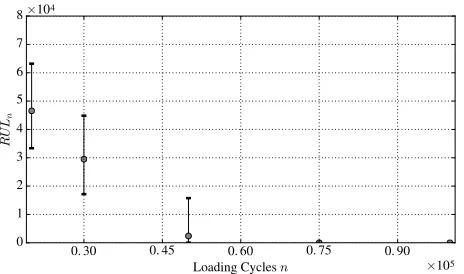
The results for sequential state estimation and reliability pre-diction are presented in Fig. 1. Every time new data is avail-able, the state variablexn = (ps(n),
p
v(n))is updated using a SIR algorithm (refer to Algorithm 1) withK = 104 parti-cles. This information is further used to propagate the model forward in time to compute the RUL using the methodology described in Section 3.3. Observe in figure 1 that the pre-diction gradually improves as more data are available. For this example, the useful domain is conveniently defined as
0.0 0.2 0.4 0.6 0.8 1.0
Loading Cycles n ×105
0.00 0.25 0.50 0.75 1.00 1.25
Ax
ial
St
rai
n
²
p 1
×102
Available data Upcoming data 25%-75% percentiles 5%-95% percentiles
(a) Sequential updating and prediction atn= 20000
0.0 0.2 0.4 0.6 0.8 1.0
Loading Cycles n ×105
0.00 0.25 0.50 0.75 1.00 1.25
Ax
ial
St
rai
n
²
p 1
×102
Available data Upcoming data 25%-75% percentiles 5%-95% percentiles
(b) Sequential updating and prediction atn= 20000
0.0 0.2 0.4 0.6 0.8 1.0
Loading Cycles n ×105
0.0 0.2 0.4 0.6 0.8 1.0
Rn
+
`
|
n
Updated reliability Predicted reliability
(c) Reliability updating and prediction atn= 20000
0.0 0.2 0.4 0.6 0.8 1.0
Loading Cycles n ×105
0.0 0.2 0.4 0.6 0.8 1.0
Rn
+
`
|
n
Updated reliability Predicted reliability
[image:7.612.313.549.88.227.2](d) Reliability updating and prediction atn= 20000
Figure 1. Sequential state estimation and prediction at different loading cycles
0.30 0.45 0.60 0.75 0.90 Loading Cycles n ×105 0
1 2 3 4 5 6 7 8
R
U
Ln
×104
Figure 2. Particle-filter estimation of RUL at different cycles
5. DISCUSSION AND CONCLUSSIONS
The degradation of the railway track geometry results into a key asset management problem with important implications in safety and cost. This degradation is driven by a complex geo-mechanical phenomenon, and has been approached by
[image:7.612.61.293.462.599.2]methodology provided in Section 3.1, and thus converted into full-probabilistic models.
A physics-based filtering-based prognostics framework for track settlement has resulted from this work. As apparent from the results in Fig. 1, the proposed methodology is able to anticipate the future evolution of the permanent axial strain with quantified uncertainty after an initial training stage with limited data. From these predictions, a sequential estima-tion of the time-dependent reliability is derived, whereby a probability-based estimation of the RUL is obtained fol-lowing the methodology by (Chiach´ıo, Chiach´ıo, Sankarara-man, et al., 2015). This information can be further embed-ded within a broader maintenance context for risk reduction in go/no-go decision, cost reduction through the scheduling of maintenance as-needed, and improved asset availability, among other asset management activities. A methodology for the integration of prognostics within an asset management framework using Petri Nets is presented by the authors as a separated piece of work in the Proceedings of the Annual Conference of the Prognostics and Health Management Soci-ety, 2017.
It should be noted that an apparent limitation of the proposed approach is that it is based on a modelling framework that predicts the plastic strains of the track, instead of other man-agement variables like the Track Geometry Index (Mundrey, 2009), more commonly used by the railway industry. How-ever, these management variables can be represented as func-tions of the plastic strains of the track over a predefined seg-ment length. Then, these functions can be readily included within the state-space model in Eq. (13), from which the pro-posed filtering-based prognostics methodology is derived.
Notwithstanding, an important theoretical and computational challenge must be highlighted, which is related to the slow-asymptotic behaviour of the temporal evolution of the perma-nent axial strain (as observed in Figs. 1a and 1b). In terms of RUL estimation, this means that the predicted particlesx(ni+)`
tend to approach the threshold asymptotically, making the
eventhx(ni+)`∈U¯ia rare event, except when` >> n. This issue takes place precisely when the system is approaching the boundary of the useful domain, which requires faster and more accurate RUL predictions. A first solution is to consid-erably increase the amount of particles (K in Algorithm 1), but it is at the cost of heavy computation. A more suitable solution is the adoption of a dedicated prognostics algorithm for rare events, like the one recently developed by the au-thors in (Chiach´ıo, Chiach´ıo, Shankararaman, & Andrews, 2017). This, together with the adoption of management vari-ables and data aligned with the current practice of the railway industry considering several maintenance cycles, constitute desirable further steps of this research.
ACKNOWLEDGMENT
The authors would like to thank the EPSRC and RSSB who jointly and equally support grant EP/M023028/1 ”Whole-life Cost Assessment of Novel Material Railway Drainage Sys-tems”, and also the Lloyd’s Register Foundation which par-tially provides support to this work. RSSB is a rail industry body. Through research, analysis, and insight, RSSB supports its members and stakeholders to deliver a safer, more effi-cient and sustainable rail system. The Lloyd’s Register Foun-dation is a charitable founFoun-dation in the U.K. helping to protect life and property by supporting engineering-related educa-tion, public engagement, and the application of research. Au-thors would also like to thank Aursudkij, B., McDowell, G. R., & Collop, A. C. (Aursudkij et al., 2009) for the experi-mental data.
NOMENCLATURE
dp
v plastic volumetric strain increment
dp
s plastic distortional strain increment
e voids ratio
e0 Initial voids ratio p mean stress invariant
p0 initial mean stress q deviatoric stress invariant
qmax in-cycle maximum deviatoric stress
qmin in-cycle minimum deviatoric stress
η stress-ratioη=q/p
M critical stress-ratio
Γ critical state model parameter
λcs critical state model parameter
κ swelling/recompression constant
σ1 applied vertical stress σ3 confining stress
α empirical factor Eq. (28)
β empirical factor Eq. (28)
REFERENCES
Alva-Hurtado, J., & Selig, E. (1981). Permanent strain be-havior of railroad ballast. InProceedings of the inter-national conference on soil mechanics and foundation engineering, 10th.(Vol. 1).
Andrews, J. (2012). A modelling approach to railway track asset management. Proceedings of the Institution of Mechanical Engineers, Part F: Journal of Rail and Rapid Transit, 0954409712452235.
Andrews, J., Prescott, D., & De Rozi`eres, F. (2014). A stochastic model for railway track asset management. Reliability Engineering & System Safety,130, 76–84. Arulampalam, M. S., Maskell, S., Gordon, N., & Clapp,
nonlinear/non-gaussian bayesian tracking. Signal Pro-cessing, IEEE Transactions on,50(2), 174–188. Aursudkij, B., McDowell, G. R., & Collop, A. C. (2009).
Cyclic loading of railway ballast under triaxial condi-tions and in a railway test facility. Granular Matter, 11(6), 391–401.
Bai, L., Liu, R., Sun, Q., Wang, F., & Xu, P. (2015). Markov-based model for the prediction of railway track irreg-ularities. Proceedings of the Institution of Mechanical Engineers, Part F: Journal of Rail and Rapid Transit, 229(2), 150-159.
Beck, J. (2010). Bayesian system identification based on probability logic. Structural Control and Health Mon-itoring,17(7), 825–847.
Bing, A. J., & Gross, A. (1983). Development of railroad track degradation models. Transportation Research Record(939).
Brown, S. F., Brodrick, B. V., Thom, N. H., & McDowell, G. R. (2007). The nottingham railway test facility, uk. Proceedings of the Institution of Civil Engineers -Transport,160(2), 59-65.
Chiach´ıo, J., Chiach´ıo, M., Sankararaman, S., Saxena, A., & Goebel, K. (2015). Condition-based prediction of time-dependent reliability in composites. Reliability Engineering & System Safety,142, 134–147.
Chiach´ıo, J., Chiach´ıo, M., Saxena, A., Sankararaman, S., Rus, G., & Goebel, K. (2015). Bayesian model selec-tion and parameter estimaselec-tion for fatigue damage pro-gression models in composites. International Journal of Fatigue,70, 361–373.
Chiach´ıo, M., Chiach´ıo, J., Shankararaman, S., & Andrews, J. (2017). A new algorithm for prognostics using Subset Simulation. Reliability Engineering & System Safety, in press.
Chrismer, S., & Selig, E. (1993). Computer model for bal-last maintenance planning. InProceedings of 5th inter-national heavy haul railway conference, beijing, china (pp. 223–227).
Dahlberg, T. (2001). Some railroad settlement modelsa crit-ical review. Proceedings of the Institution of Mechani-cal Engineers, Part F: Journal of Rail and Rapid Tran-sit,215(4), 289–300.
EC. (2011). White Paper: Roadmap to a Single European Transport Area. The European Commission. Available
fromhttps://goo.gl/mJi907
Ford, R. (1995). Differential ballast settlement, and con-sequent undulations in track, caused by vehicle-track interaction. Vehicle System Dynamics,24(sup1), 222– 233.
Gordon, N., Salmond, D., & Smith, A. (1993). Novel ap-proach to nonlinear/non-Gaussian Bayesian state esti-mation. IEEE-Proceedings-F,140, 107–113.
Hamid, A., & Gross, A. (1981). Track-quality indices and track-degradation models for maintenance-of-way
planning(No. 802).
Hecke, A. (1998). Effects of future mixed traffic on track deterioration(Tech. Rep.). Stockholm: Royal Institute of Technology. (Report TRITA-FKT 1998:30) Hettler, A. (1984). Bleibende setzungen des
schotterober-baues.Eisenbahntechnische Rundschau,33(11). Indraratna, B., Salim, W., Christie, D., et al. (2002).
Perfor-mance of recycled ballast stabilised with geosynthet-ics. CORE 2002: Cost Efficient Railways through En-gineering, 113.
Indraratna, B., Thakur, P. K., Vinod, J. S., & Salim, W. (2012). Semiempirical cyclic densification model for ballast incorporating particle breakage. International Journal of Geomechanics,12(3), 260–271.
Iyengar, R., & Jaiswal, O. (1995). Random field modeling of railway track irregularities. Journal of Transportation Engineering,121(4), 303–308.
Jaynes, E. (1957a). Information theory and statistical me-chanics.The Physical Review,106(4), 620–630. Jaynes, E. (1957b). Information theory and statistical
me-chanics. II.The Physical Review,108(2), 171–190. Jaynes, E. (2003). Probability theory: the logic of science.
Ed. Bretthorst, Cambridge University Press.
Lim, W. L., & McDowell, G. R. (2005). Discrete element modelling of railway ballast. Granular Matter, 7(1), 19-29.
Meier-Hirmer, C., Riboulet, G., Sourget, F., & Roussignol, M. (2009). Maintenance optimization for a system with a gamma deterioration process and intervention delay: application to track maintenance. Proceedings of the Institution of Mechanical Engineers, Part O: Journal of Risk and Reliability,223(3), 189–198.
Mishra, M., Odelius, J., Thaduri, A., Nissen, A., & Rantatalo, M. (2017). Particle filter-based prognostic approach for railway track geometry. Mechanical Systems and Signal Processing,96, 226 - 238.
Mroz, Z., Norris, V., & Zienkiewicz, O. (1978). An anisotropic hardening model for soils and its appli-cation to cyclic loading. International Journal for Numerical and Analytical Methods in Geomechanics, 2(3), 203–221.
Mundrey, J. (2009). Railway Track Engineering. Tata McGraw-Hill Education.
Pender, M. (1978). A model for the behaviour of overconsol-idated soil.Geotechnique,28(1), 1–25.
Prescott, D., & Andrews, J. (2013). A track ballast mainte-nance and inspection model for a rail network. Pro-ceedings of the Institution of Mechanical Engineers, Part O: Journal of risk and reliability, 227(3), 251– 266.
Part F: Journal of Rail and Rapid Transit,229(4), 402– 416.
Quiroga, L. M., & Schnieder, E. (2012). Monte carlo simulation of railway track geometry deterioration and restoration. Proceedings of the Institution of Mechani-cal Engineers, Part O: Journal of Risk and Reliability, 226(3), 274–282.
Roscoe, K. H., Schofield, A., & Wroth, C. (1958). On the yielding of soils. Geotechnique,8(1), 22–53.
Salim, M. W. (2004). Deformation and degradation aspects of ballast and constitutive modelling under cyclic load-ing. Unpublished doctoral dissertation, Faculty of En-gineering, University of Wollongong.
Sato, Y. (1995). Japanese studies on deterioration of ballasted track.Vehicle system dynamics,24(sup1), 197–208. Selig, E. T., & Waters, J. M. (1994). Track geotechnology
and substructure management. Thomas Telford. Shafahi, Y., & Hakhamaneshi, R. (2009). Application of a
maintenance management model for iranian railways based on the markov chain and probabilistic dynamic programming. International Journal of Science and Technology. Transaction A: Civil Engineering, 16(1), 87–97.
Shenton, M. (1984). Ballast deformation and track deteriora-tion. Track technology, 253–265.
Shi, X. (2009). Prediction of permanent deformation in rail-way track. Unpublished doctoral dissertation, School of Civil Engineering, the University of Nottingham, UK.
Soleimanmeigouni, I., Ahmadi, A., & Kumar, U. (2016). Track geometry degradation and maintenance mod-elling: A review. Proceedings of the Institution of Me-chanical Engineers, Part F: Journal of Rail and Rapid Transit, 0954409716657849.
Suiker, A. S., & Borst, R. de. (2003). A numerical model for the cyclic deterioration of railway tracks.International journal for numerical methods in engineering, 57(4), 441–470.
Suiker, A. S., Selig, E. T., & Frenkel, R. (2005). Static and cyclic triaxial testing of ballast and subballast. Jour-nal of geotechnical and geoenvironmental engineering, 131(6), 771–782.
Tanizaki, H., & Mariano, R. S. (1998). Nonlinear and non-gaussian state-space modeling with monte carlo simu-lations.Journal of Econometrics,83(1), 263–290. Vale, C., & Lurdes, S. M. (2013). Stochastic model for the
geometrical rail track degradation process in the por-tuguese railway northern line. Reliability Engineering & System Safety,116, 91–98.
BIOGRAPHIES
Juan Chiach´ıois a Research Fellow in Infrastructure Asset Management in the Resilience Engineering Research Group at the University of Nottingham (UK). He received his PhD
in Structural Engineering in 2014 (Summa Cum Laude, In-ternational Mention) by the University of Granada, Spain. In addition, he holds a MSc in Structural Engineering and a MSc in Civil Engineering, both by the University of Granada. His research is focused on translating reliability and prognostics methods into the life-cycle analysis of structural and infras-tructural systems subjected in-service degradation. This re-search has led to several publications in highly ranked jour-nals, a best-paper award and nominations in major confer-ences, and it has been awarded by the Spanish National Coun-cil of Education through one of the FPU annual fellowships, by the Andalusian Society of Promotion of Talent, by the Prognostics and Health Management Society with a Best Pa-per Award, and by the European Council of Civil Engineers. In addition, his work has attracted the interest of world-class institutions for collaborative research, like the Prognos-tics Center of Excellence of NASA, the California Institute of Technology, and the Hamburg University of Technology (Germany). His current research at the University of Notting-ham deals with the development of a Bayesian prognostics framework for infrastructure asset management, under EP-SRC project titled ”Whole-life cost assessment of novel ma-terial railway drainage systems (EP/M023028/1)”.
Manuel Chiach´ıois Postdoctoral Research Fellow at the Re-silience Engineering Research Group, University of Notting-ham, U.K. He holds a PhD in Structural Mechanics (Summa Cum Laud, International Mention) awarded by the Univer-sity of Granada, (Spain), and a MSc in Civil Engineering (2007), and also a MSc in Structural Engineering (2011), by the same University. His research focuses on uncertainty quantification methods and algorithms, risk and reliability analysis, and artificial intelligence methods in application to a variety of engineering problems, which range from struc-tural and mechanical engineering to bioengineering applica-tions. During the course of his PhD work, Manuel worked as guest scientist at world-class universities and institutions, like Hamburg University of Technology (Germany), Califor-nia Institute of Technology (Caltech), and NASA Ames Re-search Center (USA). This reRe-search has led to several pub-lications in highly ranked journals. It has been awarded by the National Council of Education of Spain through one of the prestigious FPU fellowships, by the Andalusian Society of promotion of the Talent, by the European Council of Civil Engineers (ECCM) with the Silver Medal prize in the 1st Eu-ropean Contest of Structural Design (2008), and also by the Prognostics and Health Management Society with a Best Pa-per Award in 2014. Prior to joining the University of Granada in 2011, Manuel worked as structural engineer for four years in top engineering companies in Spain.
as-sessment of reliability, maintenance and asset management and the impact of each of these on system or network per-formance. His current research interests include: the devel-opment of asset management models for the railway network, with particular focus on track and track drainage; aircraft fleet maintenance modelling; the application of reliability mod-elling techniques to support decision making in autonomous systems; and the asset management of ageing infrastructure in the nuclear and offshore oil and gas industries. He is the current chair of the ESRA (European Safety and Relia-bility Association) Technical Committee on Aeronautics and Aerospace.
John Andrews is Head of the Resilience Engineering Re-search Group at the University of Nottingham where he holds a Royal Academy of Engineering Research Chair in Infras-tructure Asset Management. Prior to this he worked for 20 years at Loughborough University where his final post was Professor of Systems Risk and Reliability The prime focus of his research has been on methods for evaluating the sys-tem resilience, unavailability, unreliability and risk. Much of this work has concentrated on the Fault Tree analysis tech-nique and the use of Binary Decision Diagrams (BDDs) as an efficient and accurate solution method. Recently attention has turned more the degradation modelling and the effects of maintenance, inspection and renewal on asset performance. In this context the modelling he has carried out has extended the Petri net and Bayesian Network capabilities In 2005, John founded the Proceedings of the Institution of Mechanical En-gineers, Part O: Journal of Risk and Reliability of which was the Editor-in-chief for 10 years. He is also a member of the Editorial Boards for 6 other international journals in this field .
APPENDIX
For granular materials like ballast and suballast under three-dimensional stresses, the following relationships are used to obtain the stress invariantspandq:
p=1
3σkk (25a)
q= r
3
2sijsij (25b)
whereσijis the stress tensor, andsijthe stress deviator ten-sor, defined as
sij =σij−pδij (26)
withδij the Kronecker delta function. Under the assumption of axisymmetric stress state (σ2 =σ3), the stress invariants simplify to
p= 1
3(σ1+ 2σ3) (27a)
q=kσ1−σ3k (27b)
In regards to the governing equations, the function φ in Eq. (10) is a semi-empirical factor that accounts for com-plex phenomena observed in the yielding behaviour of gran-ular materials under cyclic loading conditions, such as the Bauschinger effect, the effect of the stress ratio and load-ing history, among others (Mroz, Norris, & Zienkiewicz, 1978; Salim, 2004). In this research, the expression proposed by Indraratna et al. (2012) is adopted to account for such ef-fects, which is given by:
φ=α
1− η M
p pcs
hp−pei2+hq−qei2 (∆p)2+ (∆q)2
1/2 Nβ
(28) with∆p,∆qbeing the in-cycle total stress increments,h·ithe Macauley brackets, andαan empirical fitting parameter. The elastic mean stresspeis given by the expression
pe=pmin+
1− 1
ln(N+ 10)
∆p (29)
In Eqs. (28) and (10),pcsis the value ofpat the critical state, which can be obtained as (Roscoe et al., 1958)
pcs= exp Γ−e
λcs
(30)
where Γ, andλcs are material parameters, which, together withM andκ(see Nomenclature section), conform the pa-rameters of the model (Indraratna et al., 2012). The rest of elements are defined in the Nomenclature section.