Contents lists available atScienceDirect
Materials Science & Engineering A
journal homepage:www.elsevier.com/locate/msea
Short communication
The in
fl
uence of the microstructure morphology of two phase Ti-6Al-4V
alloy on the mechanical properties of di
ff
usion bonded joints
E. Yakushina
a,⁎, A. Reshetov
a, I. Semenova
b, V. Polyakova
b, A. Rosochowski
c, R. Valiev
b aAdvanced Forming Research Centre, Dept. of Design Manufacturing and Engineering Management, University of Strathclyde, Glasgow, Scotland, UK bInstitute of Physics of Advanced Materials, Ufa State Aviation Technical University, Ufa, RussiacDept. of Design Manufacturing and Engineering Management, University of Strathclyde, Glasgow, Scotland, UK
A R T I C L E I N F O
Keywords:
Microstructure Titanium alloy Diffusion bonding Creep
Recrystallisation
A B S T R A C T
The influence of ultrafine grained (UFG) and coarse grained (CG) microstructure of the titanium alloy Ti-6Al-4V on the strength of a diffusion bonded (DB) joint was studied using a laboratory DBfixture and a new shear test rig. The DB process was carried out at 725 °C and 825 °C during 2 and 4 h in a vacuum furnace. Coarsening of grain structure resulting from different DB cycles was quantified. The chain pores were observed at 725 °C for both microstructure conditions bonded during 2 h. The increase of bonding time up to 4 h leads to subsequent elimination of the pores. The UFG samples bonded at 725 °C showed a higher level of the shear strength than CG samples for both bonding times. The CG material demonstrated the highest shear strength after 4 h of DB bonding at 825 °C. The increase of the creep deformation of UFG samples when compared to the CG condition was observed as a result of DB at of 725 °C during 4 h.
1. Introduction
The process of diffusion bonding and superplastic forming (DB/SPF) has been successfully used for the manufacture of complex shape parts for a long time. In particular, this technology has been used by Rolls-Royce Ltd for the manufacture of hollow blades [1]. However, the process is associated with high energy consumption and cost due to high temperature and long cycle time.
The refinement of material's microstructure, down to the ultra-fine grained (UFG) level (average grain size < 1 µm) benefits the regime of diffusion bonding, i.e. thefiner microstructure the lower temperature of a DB cycle, or the shorter time of the process[2]. These effects will also have afinancial benefit for manufacturers, i.e. energy savings, cheaper forming tools and reduced tool wear. Another advantage of materials with a UFG microstructure can be realised through the low temperature superplastic forming (SPF)[2], where the temperature of the SPF pro-cess could be lowered from the typically used 927 °C[3]down to 750 °C [4]. Lowering of the hot forming temperature down to 760 °C men-tioned in[5]showed that die life could be extended to 3000 or more parts, so that no new die sets would be required over the production cycle of any particular aircraft. The lower temperature also ex-ponentially improved press platen and heater life.
The UFG microstructure can be obtained by severe plastic de-formation (SPD). There are several different types of SPD processes that
were successfully used to manufacture samples with UFG micro-structure. For example, refinement of the grain size in Ti-6Al-4V alloy was achieved through high pressure torsion (HPT) [6,7], multi-step isothermal forging[8]and equal-channel angular pressing (ECAP) as shown by Valiev in[9].
Previously, the authors[10]have shown that the application of the UFG microstructure can significantly reduce the temperature of diff u-sion bonding of Ti-6Al-4V, down to 725 °C. However, it is known, that the morphology of the formed microstructure is largely dependent on the processing conditions. In a number of studies on different micro-structure morphology, it was shown that mechanical properties depend not only on the size of the structural elements, but also on their type and shape[11].
The two main types of microstructure formed in two phase titanium alloys are lamellar and equiaxed. The lamellar microstructure consists ofα-phase lamellae colonies within a large body of theβ-phase grains, and equiaxed microstructure is characterised by a globular α-phase dispersed in the β-phase matrix [11,12]. Relatively low ductility, moderate fatigue properties, and good creep and crack growth re-sistance could be achieved by the lamellar microstructure, while a better balance of strength and ductility at room temperature, as well as fatigue properties could be expected from the refinement of the grain size down to 0.1–0.3 µm and a bimodal microstructure[13].
In paper[10], it was shown that under otherwise equal conditions,
https://doi.org/10.1016/j.msea.2018.04.052
Received 3 November 2017; Received in revised form 10 April 2018; Accepted 11 April 2018 ⁎Corresponding author.
E-mail address:[email protected](E. Yakushina).
Available online 17 April 2018
which means that small size pores might be not visible.
It is well known that refinement of the microstructure has a sig-nificant effect on the optimisation of the SPF conditions, especially applied to Ti-6V-4Al alloy[2–5]. Therefore it is important to investigate the influence of the UFG structure on the parameters of DB cycle and understand potential impact of the microstructure refinement on the combined process of DB/SPF.
According to the ideas and achievements discussed above, the pre-sent investigation will be conducted on the samples prepared with high surfacefinish (Ra = 50 nm) and will include:
–understanding of the microstructure evolution of the material with different morphology;
–evaluation of porosity in the DB area;
–influence of these factors on the shear strength of the bonded cou-ples.
2. Material and procedure
The chemical composition of a two phase Ti–6Al–4V alloy used in the experiment is presented inTable 1. Cylindrical billets, with 18 mm diameter and 150 mm length were produced at IPAM (Institute of Physics of Advanced Materials) in Ufa via the recently developed technology that included equal-channel angular pressing (ECAP) using a die-set with the channels intersection angleϕ= 120° at a temperature 700 °C, and subsequent conventional direct extrusion at 300 °C [15]. The microstructure was studied using a scanning electron microscope (SEM) Quanta FEG 250.
The CG and UFG conditions were obtained by the research group of Institute of Physics of Advanced Materials in Ufa, Russia and in-vestigations of the obtained microstructure were patented in[16]. The initial CG microstructure was transformed by heat treatment into a duplex structure. The remaining microstructure was represented by thin lamellar alpha and beta with the primaryα-phase grains (15 ± 5 µm) and areas with the plate (α+β) structure (seeFig. 1a). The volume fraction of the primaryα-phase was approximately 65%. After ECAP, the UFG microstructure was obtained after fragmentation of globular microstructure into structural elements with low angle boundaries and thin lamellar microstructure transforming into UFG structure. The UFG microstructure investigated was characterised by a mixed, partially-deformed microstructure consisting of primary α-grains with an average size of 6 ± 3 µm andα+βdeformed plates and UFGα+β
sure within an established period of time. Experiments were carried out at two temperatures, 825 °C and 725 °C, and workpieces were kept at these temperatures during 2 and 4 h.
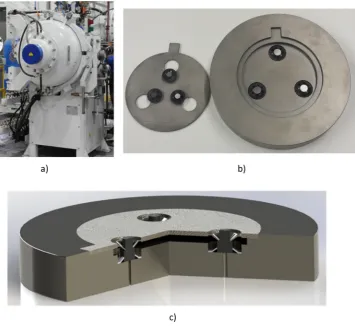
For the assessment of strength of the diffusion bonded pairs, shear experiments were carried out. A special assembly for shear testing was developed as depicted inFig. 3. The shear tool assembly was designed to induce shear as the only mode of deformation at the plane where the bonding should occur. It was assumed that bonding line would be in the plane where the samples with 5 mm and 7 mm diameter were in con-tact. The assembly consisted of a cylindrical tube and two semi-circle inserts, with lateral holes passing through them (Fig. 3). Two lateral screws (light green inFig. 3) were additionally used for the initiation of a backpressure resulting from a torque of 5 Nm and 10 Nm, applied to the 5 mm and 7 mm sample screws respectively. The shear rig has been installed in a modified servo-hydraulic laboratory press with 250 kN capacity. All shear tests were carried out at a constant velocity of the upper plate equal 0.5 mm/sec. The process parameters, namely force, velocity and displacement were recorded during the test. At least two samples were tested for each set of parameters. The maximum value of force was recorded for each sample and used afterwards for the cal-culation of the average force for a given set of DB parameters (tem-perature and time of DB). The relative measurement error of the average force for two tested samples was ± 5.86% for the confidential interval of 95%.
Three bonded couples were obtained after each bonding cycle. One couple from each test condition was used for microstructure in-vestigations and the remaining two couples were used for shear strength testing. For the investigation of microstructure, bonded cou-ples were cut in the longitudinal direction. The samcou-ples for metallo-graphic analysis were prepared following same procedure which have been used for preparation of the surface of the samples for DB experi-ments with additionalfinal polishing step using ChemoMet cloth with colloidal silica. A series of back scattered electron diffraction (BSED) images were obtained using SEM.
3. Discussion and results
3.1. Microstructure observations
To understand the microstructure evolution in the diffusion bonded samples, the size and volume fraction of the alpha and beta phases were measured for both CG and UFG samples bonded at two temperatures,
Table 1
Chemical composition.
Ti Fe C Al O V N H Si Zr
725 °C and 825 °C, during 2 and 4 h. The parameters of the micro-structure were analysed using BSED images obtained by SEM.
After the DB process was performed and samples visually assessed as bonded, the investigation of the quality of the bond was carried out. The measurements of the grain size were performed at different posi-tions through the length of the bond area, with the purpose to evaluate the microstructure homogeneity.
The quality of the bond produced at a temperature of 725 °C was initially assessed with an optical microscope and no visible defects were
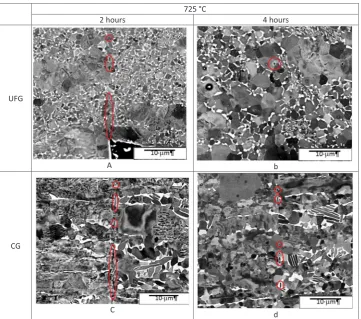
[image:3.595.83.511.57.274.2]observed. However, detailed analysis of the bonded couples using SEM shows the presence of the chain of pores in all conditions bonded at 725 °C (red circle inFig. 4). At the same time it should be noted that pores observed in the UFG condition lookfiner when compared to the CG condition. The coarsening of thefine grains was observed in the UFG Ti-6Al-4V microstructure obtained after bonding at 725 °C during 4 h. This could be clearly seen inFig. 5where the number offine grains ranging from 1 µm to 2.5 µm decreased while the number of coarser grains with size between 2.5 and 6 µm increased.
Fig. 1.Microstructure of the Ti–6Al–4V alloy: a) CG; b) UFG; (SEM).
[image:3.595.120.476.299.625.2]The analysis of the CG microstructure (Fig. 4c and d) at different durations of the DB cycle becomes more complicated due to the absence of a visible grain structure. Only several recrystallized and secondary platelet alpha grains could be identified. There was some evidence of the formation of a relatively small amount of alpha on the beta grain boundaries. Similar microstructure transformations of the samples quenched from 815 °C and 870 °C were described in[14].
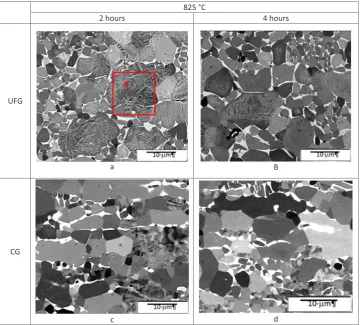
[image:4.595.118.478.61.269.2]Another fact reflecting the influence of the DB duration on the mi-crostructure of the UFG Ti-6AL-4V, when combined with higher tem-perature of the DB cycle (825 °C), is elimination of an internal sub-structure inside the body of the largest grains (the zone A inFig. 6a). The assessment of the quality of the DB couples of CG Ti-64 using op-tical and scanning microscopy does not reveal pores (Fig. 6c, d). Therefore it could be concluded that at the temperature of 825 °C a high Fig. 3.Shear test assembly: a) initial position before the test; b) positioning of the parts after the test. (For interpretation of the references to color in thisfigure legend, the reader is referred to the web version of this article.)
[image:4.595.118.480.305.624.2]quality bond of the DB couples could be obtained for both UFG and CG conditions.
Also it should be noted that the duration of the DB cycle has smaller effect on the grain size of the UFG microstructure than the temperature. Increase of the DB temperature from 725 °C to 825 °C leads to the coarsening of the average size of the alpha grains from 1.5 ± 0.2 µm up to 2.5 ± 0.2 µm.
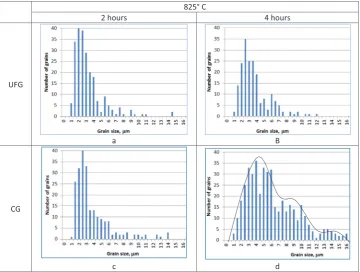
As it can be seen from the histograms depicted inFig. 7, the grain size for UFG conditions bonded at a temperature of 825 °C during 2 and 4 h was ranging between 1 and 10 µm, but several grains above this range were also observed. The average grain size for UFG condition was near 2.5 µm for both bonding times. It should also be mentioned that after bonding during four hours the number of the grains ranging from
4 to 8 µm increased as demonstrated by the second peak indicating a bimodal grain size distribution (seeFig. 7b). Another type of grain size evolution was observed for CG conditions. Similar to the UFG condi-tions, the CG sample bonded during 2 h at a temperature of 825 °C was characterised with the grain size ranging between 1 and 10 µm, where majority of grains were found in the range 1−3 µm (seeFig. 7c). A pronounced grain growth was observed in the microstructure of the material in CG condition bonded at the temperature of 825 °C during 4 h. The distribution spread of the grain size ranged between 1 and 16 µm (seeFig. 7d).
The analysis of the UFG microstructures obtained at temperatures 725 °C and 825 °C during 2 and 4 h shows that microstructure consists offine grains probably formed under the influence of recrystallisation and coarse grains with a size not exceeding 6 µm for 725 °C and 15 µm for 825 °C, respectively. Increase of the DB cycle time from 2 h to 4 h at 825 °C had a greater influence on the CG structure comparing to the UFG structure and caused widening of the peak (Fig. 7d), showing the distribution of small grains from 1 to 12 µm as well as coarsening of grains up to 12–16 µm.
3.2. Analysis of the residual porosity in the samples bonded at 825 °C
[image:5.595.41.287.56.206.2]The CG and UFG samples bonded at a temperature of 825 °C for 2 and 4 h were initially investigated by optical microscopy. It was found that the bond line was not visible but some pores were observed at the maximum magnification of optical microscope (x1000). In accordance with the industrial methodology of assessment of the bond quality, the DB couple could be estimated as bonded if the bond line and DB defects are not optically visible. To assess the size and the distribution of the fine pores along the length of the bond, SEM-based measurements were taken starting from the outer area of contact between the samples and Fig. 5.The distribution of the grain size of the bonded samples obtained at a
temperature of 725 °C for UFG condition during 2 and 4 h.
[image:5.595.118.479.394.719.2]further to the middle of the joint. Thus, the distance at which the samples were examined was 2.5 mm, which was half of the total length of the bond.
The histogram reflecting the distribution of the size of pores is shown inFig. 8. It could be observed that in all four conditions the majority of pores were found in the range of 0.2−0.8 µm. Only a few of pores have been found with a size ranging from 1 to 2 µm. The pores observed in the CG condition (DB during 2 h) are slightly larger than in UFG. Increasing of the DB cycle time reduces the pore size for both structural conditions. At the same time, the coarsening of the UFG microstructure due to a sufficiently high temperature (825 °C) leads to elimination of the diffusion rate benefits of the UFG microstructure. Accelerated pore healing caused by the development of grain boundary sliding was observed in [17,18]. The grain boundary sliding process becomes impossible at increased temperature of the DB cycle (825 °C) due to the grain growth (Fig. 7b). Therefore development of re-crystallisation at 825 °C results in coarsening of the microstructure and influences the pore elimination for both conditions at thefinal stages.
The formation of common grains in the contact area occurs due to the development of recrystallisation and could be considered as a criterion for the completion of the DB process.
3.3. Mechanical behaviour
The strength of the bonded couples was assessed via shear tests and results are summarized inTable 2. The monolithic samples were ex-amined for the evaluation of shear strength of the initial (before DB) material. The geometry of the monolithic samples was similar to the geometry of the bonded samples. The shear strength of the initial monolithic samples was 830 MPa and 850 MPa for CG and UFG con-ditions, respectively. It could be hypothesised that the close values of the shear strength obtained for the CG and UFG conditions could be explained by the peculiarities of the UFG microstructure. As it can be observed in Fig. 3c, the UFG microstructure contains the following types of microstructural elements: coarse primary alpha grains, par-tially recrystallized α+β lathes and ultrafine grains. The first two types of microstructure should not have a high impact on the shear strength.
[image:6.595.118.479.56.328.2]The strength of the CG samples bonded at the temperature 725 °C significantly depends on the duration of the cycle (Table 2). The shear strength of the material in CG condition bonded during 4 h is nearly Fig. 7.The distribution of the grain size of the bonded samples obtained at the temperature of 825 °C: a) UFG condition, bonded during 2 h; b) UFG condition, bonded during 4 h; c) CG condition, bonded during 2 h; d) CG condition, bonded during 4 h.
[image:6.595.42.287.566.719.2]Fig. 8.Distribution of the size of pores observed in the DB joint line after DB at 825 °C.
Table 2
Comparison of average values of shear strength for CG and UFG samples bonded under various conditions.
Bonding conditions 725 °C 825 °C
2 h 4 h 2 h 4 h
CG strength*, MPa/% 170/20 625/75 750/90 830/100 UFG strength*, MPa/% 615/70 735/90 725/85 760/90
[image:6.595.307.557.655.714.2]four times higher than the strength of the sample bonded during 2 h, 625 MPa and 170 MPa, respectively. At the same time the strength of the best CG sample had achieved 74% of the strength of the parent material. The strength of the CG bonded couple was affected by the influence of the large number of pores that could be seen at the images shown inFig. 4c and d.
However, the UFG condition was less sensitive to the duration of the bonding cycle and demonstrated a higher level of the properties com-paring to CG. Thus the shear strength of the UFG material bonded during 4 h reached 735 MPa which is near 90% of the strength of the initial material. Only veryfine pores could be identified in the bond line and therefore material behaviour was close to the monolithic one (Fig. 4a and b).
The difference in the level of strength between the two conditions of the material bonded during 4 h could be explained by the influence of the high temperature which leads to the transformation of initial UFG microstructure obtained via combined ECAP processing. The develop-ment of the dynamic recrystallisation and subsequent static grain growth leads to the coarsening of the microstructure and decreasing of the density of crystalline defects accumulated during combined de-formation.
Another interesting fact is an increase of the bond strength of the UFG samples bonded during 4 h when compared to 2 h. As it can be seen from the images depicted inFig. 4a and b, increasing duration of the cycle leads to the coarsening of the grain size and increasing of the volume fraction of recrystallized grains. On the one hand these mi-crostructural changes should lead to the softening of the material and reduction of the material strength, but on the other hand they positively influence the diffusion rate, healing of the pores andfinal strength of the bond. The positive influence of the diffusion rate of UFG micro-structure on the quality and strength of the DB joint was discussed in detail in[11]. Therefore it could be concluded that the coarsening of the grain size at the temperature 725 °C has smaller influence on the strength of the DB joint compared to the increased diffusion rate of the UFG condition.
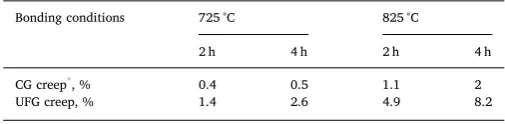
At the same time, the difference in the strength level between UFG and CG conditions bonded at a temperature 725 °C during 4 h is caused by a bigger creep deformation of UFG samples (2.6% for UFG and 0.5% for CG inTable 3). The creep values were obtained via measurements of the initial andfinal heights of the DB samples. The creep deformation developed in the UFG samples leads to the faster completion of thefirst bonding stage (interfacial boundary formation)[19]. According to the classification of the diffusion bonding stages, which was described by Fitzpatrick[19], the last stage of the DB is the volume diffusion and pore elimination. Therefore the UFG sample had more time for the diffusion stage of bonding.
The difference in the shear strength (Table 1) of CG and UFG samples bonded during 2 and 4 h becomes smaller after the DB carried out at 825 °C. It could be hypothesised that difference in the mechanical behaviour of the UFG and CG samples was caused by the re-crystallisation of the UFG structure and, as a result, UFG material lost its advantage in the diffusion rate. At the same time, the creep de-formation of the CG samples was four times smaller at a temperature of 825 °C (Table 3), while the UFG material lost its advantage of the
shorterfirst stage of bonding.
It should be noted that the highest level of the shear strength ob-tained for the CG condition bonded at 825 °C during 4 h almost reaches the strength of the monolithic material. The difference in the shear strength values is 7 MPa, which is within the error of the shear test method.
3.4. Short discussion about effect of UFG microstructure on the parameters of DB cycle
In paper[10]it was discussed that the optimisation of DB cycle parameters could be achieved via improvement of the roughness of the contacting surfaces. The present paper was aimed to investigate the effect of the microstructure refinement on the parameters of DB cycle. According to review of the parameters of DB cycle presented in[20] the temperature of the DB cycle usually ranging between 875 and 1010 °C and pressure was varied from 2 MPa up to 10 MPa. Comparison of the DB regimes applied in the present paper with results presented in literature showed that our experiments were carried out at rather low pressure (3.2 MPa) and temperatures 725 °C and 825 °C.
Low temperature and pressure conditions help to utilise such the advantage of UFG microstructure as high diffusion rate that was ex-plored in [21]. Therefore application of UFG microstructure at low temperature DB (i.e. 725 °C), leads to achieving high quality joint and only veryfine pores were observed in the joint line.
Analysis of the shear strength also reveals some advantages of the UFG microstructure. It was established that at low temperature DB si-milar level of the shear strength in UFG condition could be achieved after 2 h of bonding compared to CG condition bonded during 4 h.
Thus, significant practical benefits could be achieved with applica-tion of a UFG microstructure due to decrease in the temperature and duration of the diffusion cycle. Such optimisation will not only reduce the energy consumption and cost of the SPF/DB cycle, but also will have a positive impact on reducing wear of the forming tool. 4. Conclusions
1. A new rig for precise DB of the cylindrical samples withflat surfaces was proposed. A shear test rig was developed in order to evaluate the level of the shear strength in bonded samples.
2. The microstructure evolution of two phase titanium alloy Ti-6Al-4V, with two microstructure conditions, CG and UFG, was investigated after a DB cycle, which was carried out at two low temperatures of 725 °C and 825 °C during 2 and 4 h. The results obtained lead to the following conclusions:
–the coarsening of thefine grains was observed in the UFG Ti-6Al-4V microstructure obtained after bonding at 725 °C during 4 h. The biggest grains reached 6 µm;
–the grain size for UFG samples bonded at 825 °C during 2 and 4 h was ranging between 1 and 15 µm. At the same time only several grains with the size of 15 µm were found. The average grain size for UFG condition was near 2.5 µm for both bonding times;
–the CG sample bonded during 2 h at 825 °C was characterised by the grain size ranging between 1−14 µm, where majority of grains were found in the range 1−3 µm. Only several grains with the size of 14 µm were found. A pronounced grain growth was observed in the microstructure of the material in CG condition bonded at of 825 °C during 4 h and the size of biggest grains reached 16 µm; –development of chain pores was observed at 725 °C for both
mi-crostructure conditions bonded during 2 h. Subsequent partial elimination of the pores in the UFG microstructure occurred due to increased duration of the DB cycle up to 4 h.
[image:7.595.36.289.664.726.2]3. Evaluation of mechanical properties of the same samples produced the following results
Table 3
Average values of creep deformation for UFG and CG samples bonded under the various conditions.
Bonding conditions 725 °C 825 °C
2 h 4 h 2 h 4 h
CG creep*, % 0.4 0.5 1.1 2
UFG creep, % 1.4 2.6 4.9 8.2
This work has been partially funded by the EPSRC SAMULET Project 4 with Grant no. EP/G03477X/1.
References
[1] O. Fowler, V. Richardson, A Method of Manufacturing an Article by Superplastic Forming and Diffusion Bonding. Europe Patent 0 568 201, B21D 53/78, 1993. [2] O.R. Valiakhmetov, R.M. Galeyev, V.A. Ivan’ko, R.M. Imayev, A.A. Inozemtsev,
N.L. Koksharov, A.A. Kruglov, R.Ya Lutfullin, R.R. Mulyukov, A.A. Nazarov, R.V. Safiullin, S.A. Kharin, The use of nanostructured materials and nanotechnol-ogies for the elaboration of hollow structures, Nanotechnol. Russ. 5 (1–2) (2010) 108–122.
[3] M.W. Turner, I.J. Andrew, Proceedings of the 4th European Conference on Superplastic Forming, in 39–46, 2005.
[4] R.Y. Lutfullin, A.A. Kruglov, R.V. Safiullin, M.K. Mukhametrakhimov,
O.A. Rudenko, Processing properties of nano- and submicro-crystalline Ti–6Al–4V titanium alloy, Mater. Sci. Eng.: A 503 (1–2) (2009) 52–54.
[5] P.N. Comley, Lowering the heat - the development of reduced SPF temperature titanium alloys for aircraft production, Mater. Sci. Forum 447–448 (2004) 233–238. [6] R.S. Mishra, V.V. Stolyarov, C. Echer, R.Z. Valiev, A.K. Mukherjee, Mechanical
behaviour and superplasticity of severe plastic deformation processed non crystal-line Ti-6Al-4V alloy, Mater. Sci. Eng. A 298 (2001) 44–50.
[14] S.L. Semiatin, S.L. Knisley, P.N. Fagin, F. Zhang, D.R. Barker, Microstructure evo-lution during alpha-beta heat treatment of Ti-6Al-4V, Metall. Mater. Trans. A 34 (10) (2003) 2377–2386.
[15] Method of thermomechanical treatment of two-phase titanium alloys. Russia Patent No 2.285.740 RU C1, 20 October, 2006.
[16] R.Z. Valiev, I.V. Alexandrov, N.A. Enikeev, M.Yu Murashkin, I.P. Semenova, TOWARDS enhancement OF properties OF UFG metals AND alloys BY grain boundary engineering using SPD processing, Rev. Adv. Mater. Sci. 25 (2010) 1–10. [17] A.A. Kruglov, R. Ya Lutfullin, M. Kh Mukhametra khimov, O.A. Rudenko,
R.V. Safiullin, Average size of grains in the VT6 titanium alloy and the choice of the rational scheme for the integral process of superplastic forming/welding under pressure, J. Adv. Mater. 6 (2005) 79–85.
[18] O.A. Kaibyshev, R. Ya Lutfullin, V.K. Berdin, Mechanism for the formation of a solid state com pound in the superplastic state, Rep. Acad. Sci. (Dokl. Acad. Nauk) 319 (3) (1991) 615–618.
[19] G.A. Fitzpatrick, T. Broughton, Diffusion bonding aeroengine components, Def. Sci. J. 38 (4) (1988) 477–485.
[20] H.S. Lee, J.H. Yoon, Y.M. Yi, Fabrication of titanium parts by massive diffusion bonding, J. Mater. Process. Technol. 201 (2008) 280–284.