E
ff
ect of Monomer Solubility on the Evolution of Copolymer
Morphology during Polymerization-Induced Self-Assembly in
Aqueous Solution
Amy A. Cockram,
†Thomas J. Neal,
†Matthew J. Derry,
†Oleksandr O. Mykhaylyk,
†Neal S. J. Williams,
‡Martin W. Murray,
‡Simon N. Emmett,
‡and Steven P. Armes*
,††
Dainton Building, Department of Chemistry, The University of She
ffi
eld, Brook Hill, She
ffi
eld, South Yorkshire S3 7HF, U.K.
‡AkzoNobel Decorative Paints, Wexham Road, Slough, Berkshire SL2 5DS, U.K.
*
S Supporting InformationABSTRACT:
Polymerization-induced self-assembly (PISA) has
become a widely used technique for the rational design of diblock
copolymer nano-objects in concentrated aqueous solution.
Depend-ing on the speci
fi
c PISA formulation, reversible addition
−
fragmentation chain transfer (RAFT) aqueous dispersion
polymer-ization typically provides straightforward access to either spheres,
worms, or vesicles. In contrast, RAFT aqueous emulsion
polymer-ization formulations often lead to just kinetically-trapped spheres.
This limitation is currently not understood, and only a few empirical
exceptions have been reported in the literature. In the present work,
the e
ff
ect of monomer solubility on copolymer morphology is
explored for an aqueous PISA formulation. Using 2-hydroxybutyl methacrylate (aqueous solubility = 20 g dm
−3at 70
°
C) instead
of benzyl methacrylate (0.40 g dm
−3at 70
°
C) for the core-forming block allows access to an unusual
“
monkey nut
”
copolymer
morphology over a relatively narrow range of target degrees of polymerization when using a poly(methacrylic acid) RAFT agent
at pH 5. These new anisotropic nanoparticles have been characterized by transmission electron microscopy, dynamic light
scattering, aqueous electrophoresis, shear-induced polarized light imaging (SIPLI), and small-angle X-ray scattering.
■
INTRODUCTION
In recent years, polymerization-induced self-assembly (PISA)
has become a widely recognized route for the synthesis of many
types of diblock copolymer nano-objects.
1−5Compared to
post-polymerization processing techniques (solvent exchange,
fi
lm rehydration, or pH switch), PISA is much more e
ffi
cient
and can be performed at relatively high solids (10
−
50% w/
w).
3,6−8This approach involves growth of an insoluble block
from a soluble homopolymer in a suitable solvent to give
well-de
fi
ned sterically stabilized diblock copolymer nanoparticles.
For example, reversible addition-fragmentation chain transfer
(RAFT) aqueous
dispersion
polymerization involves
polymer-ization of a
water-miscible
monomer such as 2-hydroxypropyl
methacrylate (HPMA) from a water-soluble stabilizer, e.g.
poly(glycerol monomethacrylate).
9,10Such formulations enable
the production of various copolymer morphologies such as
spheres, worms or vesicles.
11−19RAFT aqueous
emulsion
polymerization has similarly received signi
fi
cant
atten-tion.
2,6,7,20−24In this case, a
water-immiscible
monomer is
used to produce the hydrophobic core-forming block, but
according to many literature reports only kinetically-trapped
spheres can be obtained.
6,7,24−31Exceptionally, Charleux and
co-workers reported the synthesis of diblock copolymer worms
(described as
“
nano
fi
bers
”
) and vesicles, as well as
spheres.
23,32−35Recent empirical experiments have
undoubt-edly provided some useful insights,
36but the critical synthesis
parameters that determine whether only kinetically-trapped
spheres are obtained or the full range of morphologies are
observed have not yet been established. In this context, Truong
et al. recently synthesized novel
“
fi
lomicelle nanomaterials
”
directly in water by employing RAFT aqueous emulsion
polymerization followed by temperature-induced
morpholog-ical transition. Morphologmorpholog-ical transitions from sphermorpholog-ical
micelles to
fi
lomicelles (worms) and/or vesicles were observed
on cooling in the presence of additional monomer, which
apparently acts as a plasticizer for the frustrated core-forming
block.
37However, this approach does not seem to be
particularly attractive from a commercial perspective, unless
the additional monomer can be polymerized.
The present work explores the e
ff
ect of monomer solubility
on copolymer morphology. As noted above,
water-miscible
monomers such as HPMA (aqueous solubility
∼
100 g dm
−3at
70
°
C) are required for RAFT aqueous dispersion
polymer-ization, whereas
water-immiscible
monomers such as benzyl
methacrylate (BzMA; aqueous solubility
∼
0.40 g dm
−3at 70
°
C) are required for RAFT aqueous emulsion polymerization.
Received: October 24, 2016 Revised: December 14, 2016 Published: January 26, 2017
Article
pubs.acs.org/Macromolecules
Herein we utilize 2-hydroxybutyl methacrylate (HBMA) as a
monomer of
intermediate
aqueous solubility (
∼
20 g dm
−3at 70
°
C) that has been previously reported to undergo RAFT
aqueous emulsion polymerization.
38The key question to be
addressed is whether such formulations allow access to any
copolymer morphologies other than kinetically-trapped
spheres.
■
EXPERIMENTAL SECTION
Materials. Methacrylic acid (MAA), 2-hydroxybutyl methacrylate (HBMA; actually a 1:1 molar ratio of 2- and 4-isomers as judged by1H NMR spectroscopy15), and 4,4′-azobis(4-cyanovaleric acid) (ACVA) were purchased from Sigma-Aldrich U.K. and used as received unless otherwise specified. Deionized water was used in all experiments. 4-cyano-4-(2-phenylethanesulfanylthiocarbonyl)sulfanylpentanoic acid (PETTC) was prepared as described previously.39The trimethylsilyl-diazomethane solution (2.0 M in diethyl ether), THF (HPLC,
≥99.9%), and glacial acetic acid (≥99.85%) used for the preparation and analysis of the methylated diblock copolymers were also purchased from Sigma-Aldrich U.K. Methanol-d4, dimethyl
sulfoxide-d6, and dimethylformamide-d7 used for1H NMR spectroscopy were purchased from Goss Scientific Instruments Ltd. (Cheshire, U.K.). All other solvents were purchased from Sigma-Aldrich U.K. or VWR Chemicals.
Preparation of Poly(methacrylic acid) (PMAA) Macro-CTA Agent.PETTC RAFT agent (3.169 g, 0.0093 mol), MAA (45.00 g, 0.5227 mol), ACVA (0.523 g, 0.001 mol; CTA/initiator molar ratio = 5.0), and ethanol (73.04 g, 40% w/w) were weighed into a 500 mL round-bottomflask and degassed with nitrogen for 30 min in an ice bath. The reaction solution was then heated for 3 h at 70°C in a preheated oil bath. The resulting macro-CTA was then purified by precipitation into diethyl ether (1.5 L). The polymer was collected by filtration and redissolved in the minimum amount of ethanol, before a second precipitation step. The polymer was then collected and redissolved in the minimum amount of water for isolation by lyophilization. The mean degree of polymerization was calculated to be 56 for this macro-CTA by 1H NMR. This synthesis was also performed using (4-cyano-4-(phenylcarbonothioylthio)pentanoic acid) (CPCP) as the RAFT agent.
RAFT Polymerization of HBMA in Water.A typical protocol for the synthesis of PMAA56−PHBMA500was as follows: PMAA56 CTA (0.0489 g, 0.0094 mmol), ACVA (0.6 mg, 0.0019 mmol, macro-CTA/initiator molar ratio = 5.0), and water (3.20 g, 20% w/w) were weighed into a 14 mL vial. The pH was adjusted to pH 5 using 1 M NaOH. HBMA monomer (0.7500 g, 4.70 mmol) was then added, and the reaction vial was sealed and purged for 30 min before being placed in a preheated oil bath at 70°C for 18 h.
Purification of HBMA Monomer.As-received HBMA (3.0 g) was dissolved in water (300 g). This aqueous monomer solution was extracted usingn-hexane to remove the dimethacrylate impurity. The aqueous monomer solution was then salted with NaCl (250 g/L), and HBMA was removed from the aqueous phase by extraction with diethyl ether. MgSO4was added to remove traces of water from the ether layer. Hydroquinone (0.1%) was added to prevent thermal polymerization prior to removal of the solvent by distillation under reduced pressure to afford purified HBMA monomer.
Copolymer Characterization. 1H NMR Spectroscopy. All 1H NMR spectra were recorded using a 400 MHz Bruker Advance-400 spectrometer using either methanol-d4, dimethyl sulfoxide-d6, or dimethylformamide-d7.
Exhaustive Methylation of Copolymers for GPC Analysis.Prior to gel permeation chromatography analysis, all copolymers were modified by exhaustive methylation of the carboxylic acid groups in the PMAA block. Excess trimethylsilyldiazomethane was added dropwise to a solution of copolymer (20 mg) in THF (2.0 mL), until the yellow color persisted. This reaction solution was then stirred overnight until all THF had evaporated. Degrees of methylation of the PMAA block were determined by1H NMR spectroscopy.
Gel Permeation Chromatography (GPC).THF GPC at 60°C was used to determine the molecular weights and dispersities of the modified copolymers. The GPC setup consisted of two 5μM Mixed C columns connected to a WellChrom K-2301 refractive index detector. The mobile phase was HPLC-grade THF containing 1.0% glacial acetic acid and 0.05% w/v butylhydroxytoluene (BHT) at aflow rate of 1.0 mL min−1. Molecular weights were calculated with respect to a series of near-monodisperse poly(methyl methacrylate) standards.
Dynamic Light Scattering (DLS).Aqueous copolymer dispersions (0.20% w/w) in disposable plastic cuvettes were analyzed using a Malvern Zetasizer NanoZS instrument. The mean hydrodynamic particle diameter was averaged over three consecutive runs.
Aqueous Electrophoresis. Measurements were performed using a Malvern Zetasizer instrument on dilute (0.20% w/w) copolymer dispersions containing background KCl (1 mM). The solution pH was adjusted by addition of either NaOH or HCl.
Transmission Electron Microscopy (TEM).One droplet (10μL) of a dilute copolymer dispersion (0.20% w/w) was deposited onto a carbon-coated copper grid. The grid was then stained with 10 μL uranyl formate for 10 s and dried using a vacuum hose. TEM images were then obtained using a Philips CM100 instrument operating at 100 kV and equipped with a Gatan 1 k CCD camera.
Reverse-Phase High-Performance Liquid Chromatography (HPLC).The level of dimethacrylate impurity in the HBMA monomer was quantified by HPLC. The experimental setup consisted of an autosampler (Varian model 410), a solvent delivery module (Varian Module 230), a UV detector (Varian model 310), and an Zorbax Eclipse Plus C18, 3.5μm, 4.6×100 mm HPLC column. HBMA (5.0 mg) was weighed into an autosampler vial and dissolved in acetonitrile (1.0 mL). The eluent was gradually varied from an initial composition of 5% acetonitrile in water to 95% acetonitrile in water after 15−20 min. The UV detector was set to a wavelength of 210 nm.
Shear-Induced Polarized Light Imaging (SIPLI).Shear alignment experiments were conducted using a mechano-optical rheometer (Anton Paar Physica MCR301 with SIPLI attachment). Measurements were performed using a plate−plate geometry composed of a 25 mm polished steel plate and a fused quartz plate connected to a variable temperature Peltier system. The gap between plates was set at 0.50 mm for all experiments. An additional Peltier hood was used to ensure good control of the sample temperature. Sample illumination was achieved using an Edmund Optics 150 W MI-150 high-intensityfi ber-optic white light source. The polarizer and analyzer axes were crossed at 90°in order to obtain polarized light images (PLIs), which were recorded using a color CCD camera (Lumenera Lu165c).
Small-Angle X-ray Scattering (SAXS).SAXS patterns for PMAA56− PHBMAy (y= 150, 300, and 1000) were recorded at a synchrotron source (ESRF, station ID02, Grenoble, France) using monochromatic X-ray radiation (wavelengthλ= 0.0995 nm, withqranging from 0.004 to 2.5 nm−1, whereq= 4πsinθ/λis the length of the scattering vector andθ is one-half of the scattering angle) and a Rayonix MX-170HS Kodak CCD detector. Measurements were conducted on 1.0% w/w aqueous dispersions at pH 5 using glass capillaries of 2.0 mm diameter. X-ray scattering data were reduced using standard routines from the beamline and were further analyzed using Irena SAS macros for Igor Pro.40The SAXS pattern for PMAA56−PHBMA50was obtained using a Bruker AXS Nanostar laboratory instrument modified with a microfocus X-ray tube (GeniX3D, Xenocs) and motorized scatterless slits for the beam collimation (camera length = 1.46 m, Cu Kα radiation, and HiSTAR multiwire gas detector). In this case the SAXS pattern was recorded for a 1.0 % w/w aqueous dispersion at pH 5 over aqrange of 0.08 nm−1<q> 1.6 nm−1using a glass capillary of 2.0 mm diameter and an exposure time of 1.0 h. Raw SAXS data were reduced using Nika macros for Igor Pro written by J. Ilavsky. All SAXS patterns were analyzed (background subtraction, data modeling and fitting) using Irena SAS macros for Igor Pro.40
■
RESULTS AND DISCUSSION
70
°
C conducted in aqueous solution at pH 5 (see
Scheme 1).
The target degree of polymerization (DP) for the
structure-directing PHBMA block was varied between 50 and 1500. All
polymerizations proceeded to high conversion (>96%) as
judged by
1H NMR spectroscopy studies in DMF-
d
7
. Dynamic
light scattering (DLS) and transmission electron microscopy
(TEM) studies were conducted to determine the copolymer
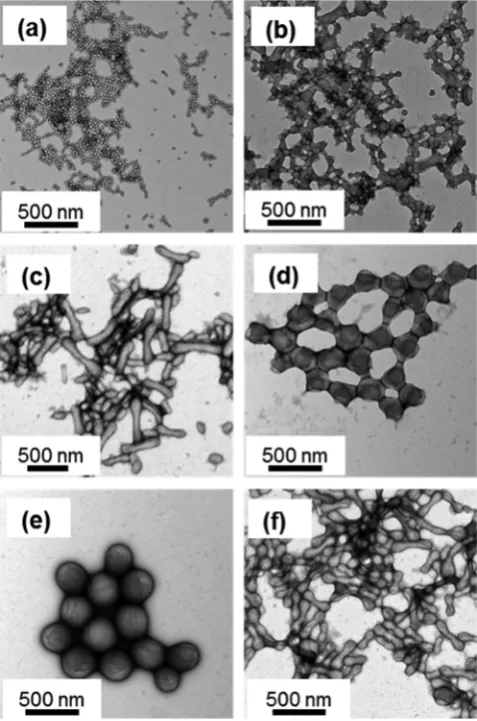
morphology (Figure 1). For target PHBMA DPs of 50
−
145,
the PMAA
56−
PHBMA
ydiblock copolymer chains
self-assembled to form well-de
fi
ned spheres of 80
−
175 nm
diameter. However, TEM studies indicated that a new
“
monkey
nut
”
morphology could be obtained over a rather narrow range
of
y
values (
y
= 150 or 155). These
“
monkey nuts
”
are
approximately 100
−
800 nm in length, with widths varying from
25 to 125 nm; thus, the mean length/width ratio (or particle
anisotropy) is approximately four. This unusual non-spherical
morphology clearly demonstrates that using a monomer of
intermediate aqueous solubility such as HBMA allows access to
morphologies other than kinetically-trapped spheres. However,
only relatively large spherical particles of 200
−
400 nm diameter
were formed when targeting higher PHBMA DPs (up to
y
=
1500).
Aqueous electrophoresis was used to assess the mobility and
zeta potential of these diblock copolymer nano-objects. The
e
ff
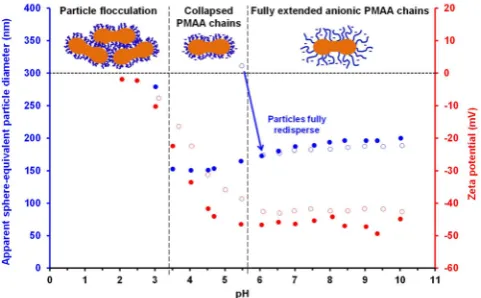
ect of varying pH on the apparent sphere-equivalent particle
diameter and zeta potential of the PMAA
56−
PHBMA
150“
monkey nut
”
nanoparticles was evaluated by DLS and aqueous
electrophoresis, respectively (see
Figure 2). Between pH 10
and pH 5.5, the PMAA stabilizer chains were highly ionized,
leading to negative zeta potentials ranging from
−
50 to
−
45
mV. The PMAA stabilizer chains remained highly anionic over
this pH range, with only a modest reduction in particle
diameter from 200 to 165 nm being observed (DLS
polydispersities ranged from 0.03 to 0.09). This is consistent
with ionized PMAA chains acting as a polyelectrolytic stabilizer
block, conferring electrosteric stabilization during the PISA
synthesis. Between pH 5.5 and pH 3.5, the zeta potential is
gradually lowered to
−
20 mV as the PMAA chains become
progressively more protonated. A concomitant reduction in
apparent hydrodynamic particle diameter to 150 nm occurs as
the PMAA chains start to collapse. However, an apparent
particle diameter of 5
μ
m is observed by DLS at approximately
pH 2.5. This is the result of
fl
occulation of the PMAA
56−
PHBMA
150nanoparticles because the near-neutral PMAA
stabilizer chains no longer confer e
ff
ective electrosteric
stabilization at this pH. Such aggregation proved to be
reversible: on raising the solution pH from pH 3.5 to pH 10.
The PMAA chains become ionized again, and approximately
the original sphere-equivalent nanoparticle diameter was
Scheme 1. Synthesis of Poly(methacrylic acid)
−
Poly(2-hydroxybutyl methacrylate) (PMAA
−
PHBMA) Diblock
Copolymer Nanoparticles via RAFT Polymerization in
Aqueous Solution
aaIncreasing the target degree of polymerization of the PHBMA
[image:3.625.325.564.69.430.2]core-forming block alters both the particle diameter and particle morphology.
Figure 1. TEM images obtained for PMAA56−PHBMAy diblock copolymer nanoparticles prepared at 20% w/w solids via RAFT aqueous emulsion polymerization at 70 °C. Polymerization-induced self-assembly (PISA) leads to the formation of small spherical nanoparticles for (a) PMAA56−PHBMA50 and (b) PMAA56− PHBMA130. Synthesis of (c) PMAA56−PHBMA150 produces a distinctive “monkey nut” morphology. However, targeting a mean degree of polymerization for the PHBMA block of either (d) 300 or (e) 1000 only leads to the formation of relatively large spheres. (f) PISA syntheses conducted using a purified batch of HBMA monomer also produce a“monkey nut”morphology when targeting PMAA56− PHBMA150, clearly indicating that this unusual morphology is not simply the result of in situ cross-linking as a result of the dimethacrylate impurity in the HBMA monomer.
obtained, with a corresponding zeta potential of around
−
40
mV.
In principle, the molecular weight distributions of such
PMAA
56−
PHBMA
ydiblock copolymers can be assessed by gel
permeation chromatography (GPC). However, in practice the
MAA residues require exhaustive methylation to prevent
adsorption onto the GPC column. Unfortunately, the original
methylated PMAA
56−
PHBMA
ydiblock copolymers proved to
be insoluble in both THF and DMF, making GPC analysis
impossible. This is believed to be the result of extensive
cross-linking caused by the
∼
4.4 mol % dimethacrylate impurity in
the HBMA monomer. Similar problems have been reported for
PISA syntheses involving HPMA.
10,13In order to address this
technical problem, the HBMA monomer was puri
fi
ed prior to
the preparation of a second series of PMAA
56−
PHBMA
ydiblock copolymers. Moreover, analysis of such diblock
copolymer nano-objects should establish whether the unusual
“
monkey nut
”
morphology is merely an artifact caused by
in situ
cross-linking. In this context, it is worth noting that Sugihara
and co-workers reported a
“
lumpy rod
”
morphology for the
synthesis of cross-linked nanoparticles prepared via RAFT
aqueous dispersion copolymerization of HPMA with EGDMA
when targeting more than six EGDMA units per copolymer
chain.
41Thus an aqueous solution of the as-supplied HBMA
monomer was extracted using
n
-hexane to remove the
dimethacrylate impurity.
42The puri
fi
ed HBMA monomer was
analyzed by reverse-phase HPLC, which indicated
approx-imately 87% removal of the original dimethacrylate impurity,
leaving around 0.57 mol % dimethacrylate still present. A series
of PMAA
56−
PHBMA
ydiblock copolymers (targeting
y
= 130
−
300) were then prepared using this puri
fi
ed HBMA monomer.
The MAA residues of the diblock copolymer chains were
exhaustively methylated using excess
trimethylsilyl-diazomethane and proved to be fully soluble in a THF eluent
containing 1.0% glacial acetic acid,
43which indicates a
substantial reduction in the degree of cross-linking. The
molecular weight of the diblock copolymer chains increased
as the target PHBMA DP was varied from 130 to 300, but
dispersities ranged from 1.18 to 6.13, which suggests substantial
branching (see Figure S1,
Supporting Information).
44,45TEM
analysis of this second series of PMAA
56−
PHBMA
ynano-objects prepared using puri
fi
ed HBMA monomer con
fi
rmed
that a
“
monkey nut
”
copolymer morphology could still be
obtained. Thus, such nano-objects do not appear to be an
artifact caused by cross-linking. Moreover, the
“
monkey nut
”
morphology is observed for PHBMA DPs of 130
−
155, which is
somewhat a somewhat broader range than that obtained when
using the as-received HBMA monomer.
[image:4.625.323.565.68.245.2] [image:4.625.60.301.71.220.2]PMAA
56−
PHBMA
150“
monkey nut
”
nanoparticles prepared
using puri
fi
ed HBMA monomer were analyzed using the
shear-induced polarized light imaging (SIPLI) technique.
46−49It is
well-known that anisotropic nanoparticles can be aligned when
subjected to an applied shear.
50,51Above a certain critical shear
rate, alignment in the direction of
fl
ow leads to shear-thinning
behavior and the observation of birefringence. In a SIPLI
experiment, linearly polarized white light is directed through a
transparent quartz plate on which an aqueous dispersion of
PMAA
56−
PHBMA
150“
monkey nuts
”
at 20% w/w solids is
placed. After transmission through the dispersion, the light is
re
fl
ected by a polished steel plate and then analyzed at 90
°
to
the plane of polarization using a CCD camera. Because the
re
fl
ected light is analyzed at 90
°
to the incident light, only
rotated light is detected. Particle alignment leads to the
observation of a characteristic Maltese cross pattern. The
PMAA
56−
PHBMA
150“
monkey nut
”
nanoparticles were
sub-jected to maximum shear rates ranging from 50 to 500 s
−1(Figure 3). There is a shear rate gradient across the polished
steel plate from its center to the periphery, with the maximum
shear rate being obtained at the plate edge. A characteristic
Maltese cross pattern was observed at maximum shear rates of
either 200 or 500 s
−1, indicating alignment of anisotropic
nanoparticles. The critical shear rate for nanoparticle alignment
can be calculated from the image at a maximum shear rate of
100 s
−1, where a partial Maltese cross pattern is obtained with a
dark circle in the center. The critical shear rate under these
conditions is 40 s
−1, which corresponds to a mean relaxation
time of approximately 25 ms. This represents the time scale
required to produce an isotropic dispersion after cessation of
the applied shear.
Figure 2.Variation in apparent sphere-equivalent particle diameter (as judged by DLS) and zeta potential with pH curves for PMAA56− PHBMA150 “monkey nut” nanoparticles prepared using purified HBMA monomer. Filled spheres (●) indicate titration from pH 10 to pH 2. Open spheres (○) indicate titration from pH 2 to pH 10. Particle flocculation is observed below pH 3.5 due to the loss of electrosteric stabilization as the PMAA chains become less anionic. Thisflocculation is reversible on addition of NaOH.
Figure 3.Shear-Induced Polarized Light Images (SIPLIs) obtained for a 20% w/w aqueous dispersion of PMAA56−PHBMA150“monkey nut” nanoparticles at maximum shear rates of 50, 100, 200, and 500 s−1. A Maltese cross is observed above a critical shear rate of 40 s−1, indicating shear-induced alignment. Thus the mean relaxation time of the“monkey nut”nanoparticles corresponds to approximately 25 ms.
Small-angle X-ray scattering (SAXS; see
Figure 4) was used
to con
fi
rm the copolymer morphologies indicated by TEM
studies. To a good
fi
rst approximation, the copolymer
morphology is indicated by the gradient in the low
q
regime.
Spherical micelles are characterized by a gradient of zero and
rigid rods possess a gradient of negative unity.
52Although they
exhibit considerable
fl
exibility, highly anisotropic diblock
copolymer worms prepared via PISA behave more or less like
rigid rods in terms of their SAXS patterns.
53,54Inspecting
Figure 4, the
I
(
q
) vs
q
scattering pattern recorded for a 1.0% w/
w dispersion of PMAA
56−
PHBMA
50diblock copolymer
nanoparticles can be satisfactorily
fi
tted to a previously reported
spherical micelle model, with a volume-average core diameter
of 19
±
3 nm.
55The same spherical micelle model also
provided good
fi
ts to the scattering patterns obtained for the
PMAA
56−
PHBMA
300and PMAA
56−
PHBMA
1000nanoparticles.
In each case, the gradient at low
q
of approximately zero
con
fi
rms the spherical morphology indicated by TEM studies,
with SAXS volume-average diameters estimated to be 262
±
26
and 330
±
22 nm, respectively. These analyses enable us to
reject our initial hypothesis that the latter nano-objects might
be thick-walled vesicles, not least because there is no evidence
for any membrane structure. Moreover, the presence of
multiple fringes in these latter two scattering patterns suggests
relatively narrow size distributions in each case. In contrast, the
scattering patterns recorded for the PMAA
56−
PHBMA
150“
monkey nut
”
nanoparticles (synthesized with either the
as-received or the puri
fi
ed HBMA monomer) cannot be
fi
tted
using the spherical model. These patterns have low
q
gradients
of
−
0.82 and
−
0.71, respectively, con
fi
rming that these
nanoparticles possess signi
fi
cant anisotropic character (as
suggested by TEM analysis). In addition, the lack of a
well-de
fi
ned local minimum at high
q
suggests that these
“
monkey
nut
”
nanoparticles are relatively polydisperse in terms of their
mean widths. Although not yet fully analyzed, these preliminary
SAXS data are important because they are much more
statistically robust than TEM analyses. They con
fi
rm a unique
evolution in copolymer morphology for this PMAA
56−
PHBMA
yRAFT aqueous emulsion formulation, from small
spheres to
“
monkey nuts
”
to large spheres with increasing
y
values. We hypothesize that a higher aqueous monomer
solubility facilitates more e
ff
ective plasticization of the
core-forming block on the time scale of the polymerization, which in
turn facilitates the stochastic 1D fusion of the growing
monomer-swollen spheres to form the
“
monkey nut
”
copolymer morphology, rather than kinetically-trapped spheres.
However, a detailed mechanistic explanation for these
morphological observations will clearly require further studies
that are beyond the scope of the present work.
In summary, the RAFT aqueous emulsion polymerization of
HBMA at pH 5 using a PMAA
56macro-CTA leads to the
formation of elongated nanoparticles with a highly unusual
“
monkey nut
”
morphology over a relatively narrow range of
core-forming block DPs. This nanoparticle anisotropy is
con
fi
rmed by SAXS analysis and is su
ffi
cient to enable
alignment under shear, as indicated by shear-induced polarized
light imaging studies. This suggests that the aqueous solubility
of the monomer can play an important role in determining the
copolymer morphology obtained during aqueous PISA
syntheses. In future work, we plan to
fi
t the SAXS scattering
patterns obtained for these
“
monkey nut
”
nanoparticles using
an appropriate new analytical model.
■
ASSOCIATED CONTENT
*
S Supporting InformationThe Supporting Information is available free of charge on the
ACS Publications website
at DOI:
10.1021/acs.macro-mol.6b02309.
THF GPC curves obtained when using the puri
fi
ed
HBMA monomer, summary table for SAXS structural
parameters, additional polymerization kinetics data, and
TEM images of diblock copolymers made using a shorter
PMAA
29macro-CTA (PDF)
■
AUTHOR INFORMATION
Corresponding Author
*
s.p.armes@she
ffi
eld.ac.uk
(S.P.A.).
ORCID
Steven P. Armes:
0000-0002-8289-6351 NotesThe authors declare no competing
fi
nancial interest.
■
ACKNOWLEDGMENTS
[image:5.625.64.304.65.335.2]EPSRC and AkzoNobel (Slough, UK) are thanked for funding
a CDT PhD CASE studentship for A.A.C. S.P.A. also
acknowledges an ERC Advanced Investigator grant (PISA
320372). Dr. C. Gonzato is thanked for preparing the PMAA
56macro-CTA. Dr. J. Madsen is thanked for his help with the
HPLC analysis of the HBMA monomer. The authors are
grateful to ESRF for providing SAXS beam-time and the
personnel of the ID02 station are thanked for their technical
Figure 4.SAXS patterns obtained from 1.0% w/w aqueous dispersions of PMAA56−PHBMAy diblock copolymer nano-objects at pH 5: (a) PMAA56−PHBMA50spheres, (b) PMAA56−PHBMA150“monkey nut” nanoparticles (prepared using purified HBMA monomer), (c) PMAA56−PHBMA150 “monkey nut” nanoparticles (prepared using as-received HBMA monomer), (d) PMAA56−PHBMA300spheres, and (e) PMAA56−PHBMA1000spheres.
assistance with the synchrotron experiments reported in this
paper.
■
REFERENCES
(1) Charleux, B.; Delaittre, G.; Rieger, J.; D’Agosto, F. Polymer-ization-Induced Self-Assembly: From Soluble Macromolecules to Block Copolymer Nano-Objects in One Step.Macromolecules 2012, 45, 6753−6765.
(2) Canning, S. L.; Smith, G. N.; Armes, S. P. A Critical Appraisal of RAFT-Mediated Polymerization-Induced Self-Assembly. Macromole-cules2016,49, 1985−2001.
(3) Derry, M. J.; Fielding, L. A.; Armes, S. P. Polymerization-Induced Self-Assembly of Block Copolymer Nanoparticles via RAFT Non-Aqueous Dispersion Polymerization.Prog. Polym. Sci.2016,52, 1−18. (4) Cai, W.; Wan, W.; Hong, C.; Huang, C.; Pan, C. Morphology Transitions in RAFT Polymerization.Soft Matter2010,6, 5554−5561. (5) Warren, N. J.; Armes, S. P. Polymerization-Induced Self-Assembly of Block Copolymer Nano-objects via RAFT Aqueous Dispersion Polymerization. J. Am. Chem. Soc. 2014, 136, 10174− 10185.
(6) Cunningham, V. J.; Alswieleh, A. M.; Thompson, K. L.; Williams, M.; Leggett, G. J.; Armes, S. P.; Musa, O. M. Poly(glycerol monomethacrylate)−Poly(benzyl methacrylate) Diblock Copolymer Nanoparticles via RAFT Emulsion Polymerization: Synthesis, Characterization, and Interfacial Activity. Macromolecules 2014, 47, 5613−5623.
(7) Rieger, J.; Zhang, W.; Stoffelbach, F.; Charleux, B. Surfactant-Free RAFT Emulsion Polymerization Using Poly(N,N-dimethylacrylamide) Trithiocarbonate Macromolecular Chain Transfer Agents. Macro-molecules2010,43, 6302−6310.
(8) Binauld, S.; Delafresnaye, L.; Charleux, B.; D’Agosto, F.; Lansalot, M. Emulsion Polymerization of Vinyl Acetate in the Presence of Different Hydrophilic Polymers Obtained by RAFT/MADIX. Macro-molecules2014,47, 3461−3472.
(9) Blanazs, A.; Armes, S. P.; Ryan, A. J. Self-Assembled Block Copolymer Aggregates: From Micelles to Vesicles and their Biological Applications.Macromol. Rapid Commun.2009,30, 267−277.
(10) Blanazs, A.; Madsen, J.; Battaglia, G.; Ryan, A. J.; Armes, S. P. Mechanistic Insights for Block Copolymer Morphologies: How Do Worms Form Vesicles?J. Am. Chem. Soc.2011,133, 16581−16587.
(11) Liu, G.; Qiu, Q.; An, Z. Development of Thermosensitive Copolymers of poly(2-methoxyethyl acrylate-co-poly(ethylene glycol) methyl ether acrylate) and their Nanogels Synthesized by RAFT Dispersion Polymerization in Water.Polym. Chem.2012,3, 504−513. (12) Liu, G.; Qiu, Q.; Shen, W.; An, Z. Aqueous Dispersion Polymerization of 2-Methoxyethyl Acrylate for the Synthesis of Biocompatible Nanoparticles Using a Hydrophilic RAFT Polymer and a Redox Initiator.Macromolecules2011,44, 5237−5245.
(13) Li, Y.; Armes, S. P. RAFT Synthesis of Sterically Stabilized Methacrylic Nanolatexes and Vesicles by Aqueous Dispersion Polymerization.Angew. Chem., Int. Ed.2010,49, 4042−4046.
(14) Blanazs, A.; Ryan, A. J.; Armes, S. P. Predictive Phase Diagrams for RAFT Aqueous Dispersion Polymerization: Effect of Block Copolymer Composition, Molecular Weight, and Copolymer Concentration.Macromolecules2012,45, 5099−5107.
(15) Ratcliffe, L. P. D.; Ryan, A. J.; Armes, S. P. From a Water-Immiscible Monomer to Block Copolymer Nano-Objects via a One-Pot RAFT Aqueous Dispersion Polymerization Formulation. Macro-molecules2013,46, 769−777.
(16) Shen, W.; Chang, Y.; Liu, G.; Wang, H.; Cao, A.; An, Z. Biocompatible, Antifouling, and Thermosensitive Core−Shell Nano-gels Synthesized by RAFT Aqueous Dispersion Polymerization. Macromolecules2011,44, 2524−2530.
(17) Zhou, W.; Qu, Q.; Xu, Y.; An, Z. Aqueous Polymerization-Induced Self-Assembly for the Synthesis of Ketone-Functionalized Nano-Objects with Low Polydispersity. ACS Macro Lett. 2015, 4, 495−499.
(18) Sugihara, S.; Ma’Radzi, A. H.; Ida, S.; Irie, S.; Kikukawa, T.; Maeda, Y. In situ nano-objects via RAFT Aqueous Dispersion
Polymerization of 2-methoxyethyl acrylate using poly(ethylene oxide) Macromolecular Chain Transfer Agent as Steric Stabilizer. Polymer2015,76, 17−24.
(19) Sugihara, S.; Blanazs, A.; Armes, S. P.; Ryan, A. J.; Lewis, A. L. Aqueous Dispersion Polymerization: A New Paradigm for in Situ Block Copolymer Self-Assembly in Concentrated Solution. J. Am. Chem. Soc.2011,133(39), 15707.
(20) Cunningham, M. F. Controlled/living Radical Polymerization in Aqueous Dispersed Systems.Prog. Polym. Sci.2008,33, 365−398.
(21) Ferguson, C. J.; Hughes, R. J.; Pham, B. T. T.; Hawkett, B. S.; Gilbert, R. G.; Serelis, A. K.; Such, C. H. Effective ab Initio Emulsion Polymerization under RAFT Control.Macromolecules2002,35, 9243− 9245.
(22) Ferguson, C. J.; Hughes, R. J.; Nguyen, D.; Pham, B. T. T.; Gilbert, R. G.; Serelis, A. K.; Such, C. H.; Hawkett, B. S. Ab Initio Emulsion Polymerization by RAFT-Controlled Self-Assembly. Macro-molecules2005,38, 2191−2204.
(23) Zhang, X.; Boisse, S.; Zhang, W.; Beaunier, P.; D’Agosto, F.;́ Rieger, J.; Charleux, B. Well-Defined Amphiphilic Block Copolymers and Nano-objects Formed in Situ via RAFT-Mediated Aqueous Emulsion Polymerization.Macromolecules2011,44, 4149−4158.
(24) Truong, N. P.; Dussert, M. V.; Whittaker, M. R.; Quinn, J. F.; Davis, T. P. Rapid Synthesis of Ultrahigh Molecular Weight and Low Polydispersity Polystyrene Diblock Copolymers by RAFT-mediated Emulsion Polymerization.Polym. Chem.2015,6, 3865−3874.
(25) Rieger, J.; Stoffelbach, F.; Bui, C.; Alaimo, D.; Jeró ̂me, C.; Charleux, B. Amphiphilic Poly(ethylene oxide) Macromolecular RAFT Agent as a Stabilizer and Control Agent in ab Initio Batch Emulsion Polymerization.Macromolecules2008,41, 4065−4068.
(26) Zhang, W.; D’Agosto, F.; Boyron, O.; Rieger, J.; Charleux, B. One-Pot Synthesis of Poly(methacrylic acid-co-poly(ethylene oxide) methyl ether methacrylate)-b-polystyrene Amphiphilic Block Copoly-mers and Their Self-Assemblies in Water via RAFT-Mediated Radical Emulsion Polymerization. A Kinetic Study.Macromolecules2011,44, 7584−7593.
(27) Chaduc, I.; Zhang, W.; Rieger, J.; Lansalot, M.; D’Agosto, F.; Charleux, B. Amphiphilic Block Copolymers from a Direct and One-pot RAFT Synthesis in Water.Macromol. Rapid Commun.2011,32, 1270−1276.
(28) Chaduc, I.; Girod, M.; Antoine, R.; Charleux, B.; D’Agosto, F.; Lansalot, M. Batch Emulsion Polymerization Mediated by Poly-(methacrylic acid) MacroRAFT Agents: One-Pot Synthesis of Self-Stabilized Particles.Macromolecules2012,45, 5881−5893.
(29) Chaduc, I.; Crepet, A.; Boyron, O.; Charleux, B.; D’Agosto, F.; Lansalot, M. Effect of the pH on the RAFT Polymerization of Acrylic Acid in Water. Application to the Synthesis of Poly(acrylic acid)-Stabilized Polystyrene Particles by RAFT Emulsion Polymerization. Macromolecules2013,46, 6013−6023.
(30) Freal-Saison, S.; Save, M.; Bui, C.; Charleux, B.; Magnet, S.́ Emulsifier-Free Controlled Free-Radical Emulsion Polymerization of Styrene via RAFT Using Dibenzyltrithiocarbonate as a Chain Transfer Agent and Acrylic Acid as an Ionogenic Comonomer: Batch and Spontaneous Phase Inversion Processes. Macromolecules 2006, 39, 8632−8638.
(31) Manguian, M.; Save, M.; Charleux, B. Batch Emulsion Polymerization of Styrene Stabilized by a Hydrophilic Macro-RAFT Agent.Macromol. Rapid Commun.2006,27, 399−404.
(32) Boissé, S.; Rieger, J.; Belal, K.; Di-Cicco, A.; Beaunier, P.; Li, M.-H.; Charleux, B. Amphiphilic Block Copolymer Nano-fibers via RAFT-mediated Polymerization in Aqueous Dispersed System. Chem. Commun.2010,46, 1950−1952.
(33) Boisse, S.; Rieger, J.; Pembouong, G.; Beaunier, P.; Charleux, B.́ Influence of the Stirring Speed and CaCl2 Concentration on the Nano-object Morphologies Obtained via RAFT-mediated Aqueous Emulsion Polymerization in the Presence of a Water-soluble macroRAFT Agent. J. Polym. Sci., Part A: Polym. Chem. 2011, 49, 3346−3354.
(34) Zhang, W.; D’Agosto, F.; Boyron, O.; Rieger, J.; Charleux, B. Toward a Better Understanding of the Parameters that Lead to the
Formation of Nonspherical Polystyrene Particles via RAFT-Mediated One-Pot Aqueous Emulsion Polymerization.Macromolecules2012,45, 4075−4084.
(35) Zhang, W.; D’Agosto, F.; Dugas, P.-Y.; Rieger, J.; Charleux, B. RAFT-mediated One-pot Aqueous Emulsion Polymerization of Methyl methacrylate in the presence ofPoly(methacrylic acid-co-poly(ethylene oxide) methacrylate) trithiocarbonate Macromolecular Chain Transfer Agent.Polymer2013,54, 2011−2019.
(36) Lesage de la Haye, J.; Zhang, X.; Chaduc, I.; Brunel, F.; Lansalot, M.; D’Agosto, F. The Effect of Hydrophile Topology in RAFT-Mediated Polymerization-Induced Self-Assembly. Angew. Chem., Int. Ed.2016,55, 3739−3743.
(37) Truong, N. P.; Quinn, J. F.; Anastasaki, A.; Haddleton, D. M.; Whittaker, M. R.; Davis, T. P. Facile Access to Thermoresponsive Filomicelles with Tuneable Cores.Chem. Commun.2016,52, 4497− 4500.
(38) Ratcliffe, L. P. D.; Blanazs, A.; Williams, C. N.; Brown, S. L.; Armes, S. P. RAFT Polymerization of Hydroxy-functional Methacrylic Monomers under Heterogeneous Conditions: Effect of Varying the Core-Forming Block.Polym. Chem.2014,5, 3643−3655.
(39) Semsarilar, M.; Ladmiral, V.; Blanazs, A.; Armes, S. P. Poly(methacrylic acid)-based AB and ABC Block Copolymer Nano-objects Prepared via RAFT Alcoholic Dispersion Polymerization. Polym. Chem.2014,5, 3466−3475.
(40) Ilavsky, J.; Jemian, P. R. Irena: Tool Suite for Modeling and Analysis of Small-Angle Scattering.J. Appl. Crystallogr.2009,42, 347− 353.
(41) Sugihara, S.; Armes, S. P.; Blanazs, A.; Lewis, A. L. Non-Spherical Morphologies from Cross-linked Biomimetic Diblock Copolymers using RAFT Aqueous Dispersion Polymerization. Soft Matter2011,7, 10787−10793.
(42) Coca, S.; Jasieczek, C. B.; Beers, K. L.; Matyjaszewski, K. Polymerization of Acrylates by Atom Transfer Radical Polymerization. Homopolymerization of 2-Hydroxyethyl Acrylate.J. Polym. Sci., Part A: Polym. Chem.1998,36, 1417−1424.
(43) Couvreur, L.; Lefay, C.; Belleney, J.; Charleux, B.; Guerret, O.; Magnet, S. First Nitroxide-Mediated Controlled Free-Radical Polymer-ization of Acrylic Acid.Macromolecules2003,36, 8260−8267.
(44) Bannister, I.; Billingham, N. C.; Armes, S. P.; Rannard, S. P.; Findlay, P. Development of Branching in Living Radical Copoly-merization of Vinyl and Divinyl Monomers.Macromolecules2006,39, 7483−7492.
(45) Rosselgong, J.; Armes, S. P.; Barton, W. R. S.; Price, D. Synthesis of Branched Methacrylic Copolymers: Comparison between RAFT and ATRP and Effect of Varying the Monomer Concentration. Macromolecules2010,43, 2145−2156.
(46) Mykhaylyk, O. O. Time-Resolved Polarized Light Imaging of Sheared Materials: Application to Polymer Crystallization.Soft Matter
2010,6, 4430−4440.
(47) Mykhaylyk, O. O.; Chambon, P.; Impradice, C.; Fairclough, J. P. A.; Terrill, N. J.; Ryan, A. J. Control of Structural Morphology in Shear-Induced Crystallization of Polymers.Macromolecules2010,43, 2389−2405.
(48) Mykhaylyk, O. O.; Parnell, A. J.; Pryke, A.; Fairclough, J. P. A. Direct Imaging of the Orientational Dynamics of Block Copolymer Lamellar Phase Subjected to Shear Flow. Macromolecules2012,45, 5260−5272.
(49) Mykhaylyk, O. O.; Warren, N. J.; Parnell, A. J.; Pfeifer, G.; Laeuger, J. Applications of Shear-Induced Polarized Light Imaging (SIPLI) Technique for Mechano-optical Rheology of Polymers and Soft Matter Materials. J. Polym. Sci., Part B: Polym. Phys. 2016,54, 2151−2170.
(50) Orts, W. J.; et al. Enhanced Ordering of Liquid Crystalline Suspensions of Cellulose Microfibrils: A Small Angle Neutron Scattering Study.Macromolecules1998,31, 5717−5725.
(51) Tang, B. Z.; Xu, H. Preparation, Alignment, and Optical Properties of Soluble Poly(phenylacetylene)-Wrapped Carbon Nano-tubes.Macromolecules1999,32, 2569−2576.
(52) Glatter, O.; Kratky, O.Small-Angle X-ray Scattering; Academic Press: London, 1982.
(53) Blanazs, A.; Verber, R.; Mykhaylyk, O. O.; Ryan, A. J.; Heath, J. Z.; Douglas, C. W. I.; Armes, S. P. Sterilizable Gels from Thermoresponsive Block Copolymer Worms. J. Am. Chem. Soc.
2012,134, 9741−9748.
(54) Fielding, L. A.; Lane, J. A.; Derry, M. J.; Mykhaylyk, O. O.; Armes, S. P. Thermo-responsive Diblock Copolymer Worm Gels in Non-polar Solvents.J. Am. Chem. Soc.2014,136, 5790−5798.
(55) Pedersen, J. S.; Gerstenberg, M. C. Scattering Form Factor of Block Copolymer Micelles.Macromolecules1996,29, 1363−1365.