(2008)
www.electrochemsci.org
Surfactant Induced Iron (II) Phthalocyanine Modified Carbon
Paste Electrode for Simultaneous Detection of Ascorbic Acid,
Dopamine And Uric Acid
R. Raghavendra Naik1, E. Niranjana1, B. E. Kumara Swamy 1,*, B. S. Sherigara 1 and H. Jayadevappa2 1 Department of Industrial Chemistry, Kuvempu University, Jnana Sahyadri, Shankaraghatta, Shimoga, Karnataka, India. 577451.
2 Department of Chemistry, Sahyadri Science College, Kuvempu University, Shimoga, Karnataka, India. 577203
*E-mail: [email protected]
Received: 16 September 2008 / Accepted: 28 October 2008 / Published: 17 November 2008
A cation surfactant (CTAB) and Iron (II) octanitro phthalocyanine modified carbon paste electrode (CTAB/Fe (II) ONTPc/CPE) was fabricated and was applied to simultaneous determination of ascorbic acid, dopamine and uric acid. The modified electrode resolved the overlapped voltammetric responses of ascorbic acid, dopamine and uric acid in to three well-defined cyclic voltammetric peaks. Our results showed that the electrocatalytic activity of CTAB/Fe (II) ONTPc/CPE is more when compared to Fe (II) ONTPc/CPE and bare CPE. This electrode can be used to allow the determination of ascorbic acid and dopamine in the presence of uric acid. The modified electrode showed good selectivity, stability and antifouling properties.
Keywords: Iron (II) phthalocyanine; CTAB; Ascorbic acid; Dopamine; Uric acid; Cyclic voltammetry.
1. INTRODUCTION
attention. [5] However, it is difficult to determine AA by direct oxidation at bare electrodes because of the high over potential and fouling effects by its oxidation products. [6] More over, waves of AA and DA are nearly the same potential and overlapped which results in poor selectivity and reproducibility.
Uric acid (UA) is a primary product of purine metabolism. Its abnormal concentration level in the human body causes many diseases, such as gout, hyperuricaemia and Lesch-Nyan disease. Elevated UA concentration in serum causes kidney damage and cardiovascular disease. Therefore, the research of UA determination is of great importance in reality. [7]Uric acid and ascorbic acid are both present in biological fluids such as blood and urine. [8]
Electrochemical techniques shows more promise compared to fluorometric [8,9], chromatographic [10], spectrophotometric[11], chemiluminescent [12,13] and capillary electrophoresis [14]. Earlier electrochemical procedures based on the oxidation of UA at carbon-based electrodes in acidic solutions suffered from interference from AA which can be oxidized at a potential close to that of UA. Various methods, such as an adsorption/medium exchange approach, [15] enzyme-based techniques, [16,17] chemically modified electrodes [18-24] were developed to solve the UA detection problem. Until now, sensitive and selective methods still needed to be developed for the detection of UA due to its clinical significance. Each of these proposed methods often offers its own set of advantages and disadvantages. Chemically modified electrodes are an active research area in many aspects of science and technology, having potential application in diverse fields. Some modified electrodes have been used to investigate electrochemical behavior of uric acid, dopamine and ascorbic acid. Ling Mei Niu et al have studied electrochemical behavior of uric acid at Meso-2, 3-Dimercaptosuccinic acid self- assembled gold electrode [7]. Zonghua Wang group have modified graphite electrode for the simultaneous determination of dopamine and ascorbic acid [8]. -alanine covalently modified glassy carbon electrode was used to study ascorbic acid and dopamine5. Simultaneous Electroanalysis of dopamine, ascorbic acid and uric acid by poly (vinyl alcohol) covalently modified glassy carbon electrode [25]. Simultaneous determination of dopamine and serotonin in presence of ascorbic acid and uric acid at poly (o- phenyl diamine) modified electrode has been studied [26]. As a part of our research work on electro- organic reactions, we extended the work on biosensors [27-29].
2. EXPERIMENTAL PART 2.1. Apparatus
Graphite powder, CTAB was obtained from sigma. Ascorbic acid and dopamine were purchased from Aldrich and Uric acid from Fluka. K3Fe(CN)6 was dissolvedin water to prepare 0.1M stock solution. The supporting electrolyte used were 0.1M KCl, phosphate buffer [pH = 7.4] and acetate buffer [pH = 4.8]. All solutions were prepared with doubly distilled water. All chemicals were of analytical grade quality and used without further purification.
Cyclic voltammetry was performed on an EA-201 Electroanalyzer [Chemilink system, Mumbai, India] linked to P-4 computer. The measurements were carried out in a conventional electrochemical cell with a S/IPc/CPE working electrode, a Pt wire as counter electrode and saturated Calomel reference electrode. The surface area of working electrode was 0.039 cm2.
2.2. Chemicals and Solution
Ascorbic acid and dopamine were purchased from Aldrich and Uric acid from Fluka. CTAB was obtained from sigma. High-purity nitrogen was used for deaeration. All solutions were prepared with doubly distilled water.
2.3. Preparation of the modified electrode
The graphite powder and silicone oil ratio was 70:30 % by weight and were mixed in an agate mortar for about 40 min. the carbon paste was packed in to the of home made carbon paste electrode and then smoothened on a tissue paper till the surface become uniform. About 0.015 g of Iron (II) octa nitro phthalocyanine was mixed in carbon paste in an agate mortar and crushed for 15 min. subsequently 9 l 1x10⁻² mol L-1 of CTAB was added on to the surface of Iron (II) octa nitro phthalocyanine modified carbon paste electrode [Fe (II) ONTPc/CPE] to prepare CTAB modified Fe (II) ONTPc/CPE.[CTAB/ Fe (II) ONTPc/CPE].
3. RESULTS AND DISCUSSION
3.1. Electrochemical modification of octanitro Iron (II) phthalocyanine at carbon paste electrode
Electrochemical stability of the electrode was examined by repetitive measurements were carried out in solution containing 1x10⁻³ mol L-1 potassium ferricyanide. Fig. 2 shows the successive voltammogram of 1x10⁻³ mol L-1 K
[image:4.612.194.419.158.356.2]3Fe(CN) 6 at Fe (II) ONTPc/CPE. The result of 20 successive measurements showed that the electrode is stable.
Figure 1. Cyclic voltammograms of K3Fe(CN)6 at Fe (II) ONTPc carbon paste electrode; supporting electrolyte, 0.1 mol L-1 KCl; scan rate 100 mV s -1 ; number of cycles are 20.
[image:4.612.185.419.450.648.2]3.2. Improvement of electrode quality of Fe (II) ONTPc/CPE with the modification of CTAB
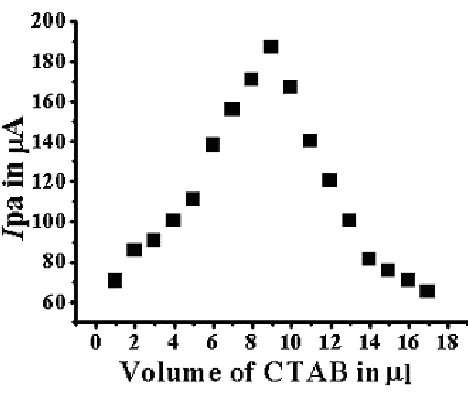
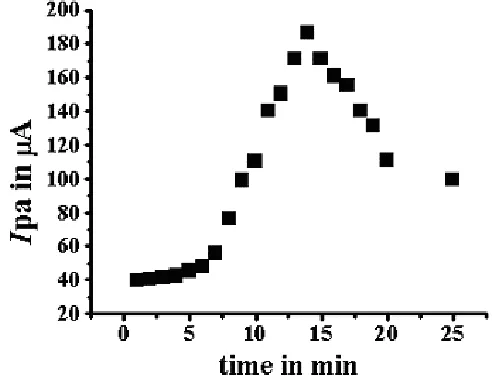
Surfactants have been widely used in electro analytical chemistry [30] and electrochemistry because of enhancement effect and the stability to improve the property of the electrode/solution interface. CTAB is a cationic surfactant. In this paper, we prepared a CTAB modified Iron (II) phthalocyanine CPE based on surface modification method. CTAB was immobilized on the surface of electrode by surface modification method using micropipette. Starting from the range of 1 l to 30 l CTAB was immobilized on the surface of electrode. As shown in Fig.2. 9 l of CAB on the surface of electrode has brought maximum ipc and Ipa and difference between the peak current is minimum. Above 9 l of CTAB peak currents decreases and attain constant up to 30 l. As can be seen, the modified electrode is electrochemically stable indicating that CTAB/Fe (II) ONTPc/CPE is not subjected to fouling by the oxidation and reduction processes, which are notorious for their surface fouling effects at bare electrodes. Fig. 3. Shows the dependence of peak currents on the immersion time of CTAB/ Fe (II) ONTPc/CPE in 1x10⁻³ mol L-1 K
[image:5.612.181.427.329.521.2]3Fe(CN)6 with the increase of immersion time, ipa is enlarged from 30 A to 150 A within 9 min. and then tends to stable.
Figure 3. A plot of peak current ipa against time in minutes. When CTAB was added on to the surface of Fe (II) ONTPc carbon paste electrode.
3.3. Electrochemical behavior of DA and UA at CTAB/Fe (II) ONTPc/CPE
From the cyclic voltammograms of CTAB/Fe (II) ONTPc/CPE in 0.02 mol L-1 phosphate buffer (pH 7.4), we observed no redox peak between 0.00 V and 1.0 V. Hence, this modified electrode provides a broad potential window to investigate the chemical behavior of dopamine and uric acid.
increased greatly and the peak potential shifted negatively to 380mV with Ep-Ep/2= 70mV. at CTAB/Fe (II) ONTPc/CPE. The obviously increased peak current and decrease in the anodic over potential for the uric acid indicates the strong electrolytic function of CTAB/Fe (II) ONTPc/CPE with respect to UA. The shift in the over potential is due to a kinetic effect, hence a substantial increase in the rate of electron transfer from UA is observed [31]. This is attributed to the reversibility of the electron transfer processes [32].
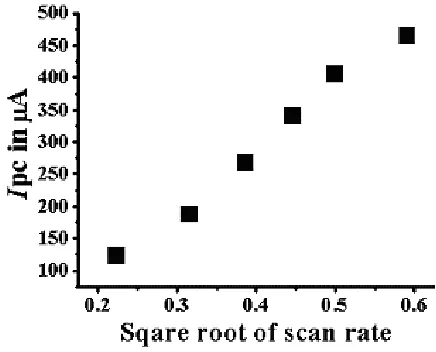
Figure 4. Plot showing diffusion controlled reaction, dependence of peak current ipa on square root of scan rate.
Cyclic voltammograms of DA at CPE, Fe (II) ONTPc/CPE and CTAB/Fe (II) ONTPc/CPE. As can be seen, the oxidation and reduction peaks of DA are broad and peak current is higher when compared to bare CPE and Fe (II) ONTPc/CPE. The increased peak current and decrease in the anodic over potential for DA indicate strong electrolytic activity of CTAB/Fe (II) ONTPc/CPE with respect to DA. Further investigations were made in to the transport characteristics of UA in the modified electrodes. The cyclic voltammetric current responses for UA at CTAB/Fe (II) ONTPc/CPE were found be linear with square root of scan rate in the range 10 mVs-1 to 300 mVs-1. This indicates that the electrode reactions are controlled by diffusion processes as shown in Fig. 4. More evidences for diffusion behavior were obtained by the following experiments. When the CTAB/Fe (II) ONTPc/CPE was switched to 0.02 mol L-1 phosphate buffer (pH 7.4) after being used in UA, there was no peak at all.
3.4. Analytical performance of the CTAB/Fe (II) ONTPc/CPE for simultaneous measurements of DA and UA
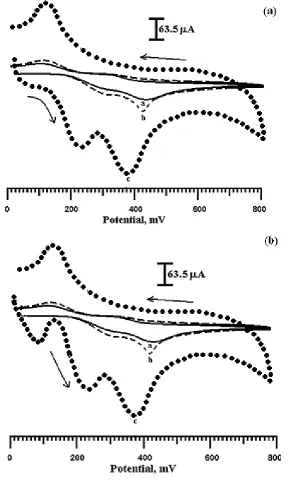
[image:6.612.189.407.193.369.2]potential and the peak current increased sharply. When CTAB/Fe (II) ONTPc/CPE was used as working electrode, the peak current increased resulting in the perfect separation of the voltammograms. This interesting aspect of CTAB/Fe (II) ONTPc/CPE in the large background current attributable to the catalytically active surface.
The oxidation peak height of UA at CTAB/Fe (II) ONTPc/CPE is highest, which means the concentration of UA at CTAB/Fe (II) ONTPc/CPE was higher than that at Fe (II) ONTPc/CPE. It can be explained that the CTAB/Fe (II) ONTPc/CPE UA apparent concentration in the CTAB/Fe (II) ONTPc/CPE was higher may be due to CTAB/Fe (II) ONTPc/CPE encapsulation effect of UA. Then, CTAB/Fe (II) ONTPc/CPE dissociated and diffused rapidly through the porous layer of Iron (II) phthalocyanine to the graphite surface. Thus phenomenon demonstrated that CTAB/Fe (II) ONTPc not only showed the advantage of Fe (II) ONTPc, but also exerted the ability of CTAB. The anodic peak current ipa exhibited a linear dependence of on the square root or 10 to 300 mVs-1, which is typical for the signal of diffusion controlled electrode process.
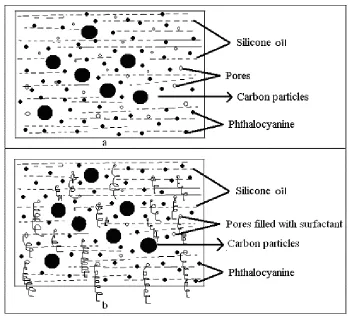
Figure 6. Schematic representation carbon paste electrode showing pores, carbon particles, phthalocyanine molecule and surfactant molecule on the surface of electrode.
3.5. Simultaneous detection of ascorbic acid, dopamine and uric acid at CTAB/Fe (II) ONTPc/CPE
[image:8.612.129.478.223.539.2]as a working electrode, the oxidation peak current greatly increased which is attributed to the catalytically active electrode surface. The mechanism for this is as shown in the Fig. 6 and discussed in detail in the Fig.7.
As shown in Fig. 6. the CTAB/Fe (II) ONTPc/CPE surface is assumed to have pores, the CTAB surfactant behave as catalytically active with polar end on one side and non polar end on other side which is responsible for the effective peak separation of AA, UA and DA.
Fugre 7. Schematic representation of carbon paste electrode comprising of surfactant molecules attached outside the electrode surface. AA, DA, and UA are getting attracted towards the surfactant modified carbon paste electrode which results in enhanced cyclic voltammograms responses.
4. CONCLUSIONS
The modification of the electrode surface by CTAB and Fe (II) ONTPc reduced the over potential of AA, UA and DA by obtaining a large peak potential difference of 25 mV and 154 mV and the modification of Fe (II) ONTPc/CPE by CTAB significantly increased the sensitivity of AA, UA and DA. The study has demonstrated that the CTAB/Fe (II) ONTPc/CPE not only exhibited a strong electro catalytic function towards the oxidation of AA, UA and DA, but also resolved the overlapping anodic peaks of AA, UA and DA in to three distinct peaks so that the UA and AA content can be detected selectively in a mixture. Importantly, this modified electrode showed good selectivity, stability and antifouling effects. With its low cost and ease of preparation, the CTAB/Fe (II) ONTPc/CPE will hopefully be of good application for further sensor development.
ACKNOWLEDGEMENT
References
1. J. B. Raoof, Ojani, and A. Kiani, J. Electroanal. Chem, 515 ( 2001) 45 2. D. R. Shankaran, K. Limura, T. Kato Sens. Actuators, B, Chem.94 ( 2003) 73. 3. Mo, J. W. and B. Ogoreve. Anal Chem. 73 ( 2001) 1196.
4. Zhao Guo-hua, Li Ming-fang, Li Ming-li CEJC 5 (4) (2007) 1114. 5. Lie Zhang, The Analyst, 126 (2001) 1760.
6. M.A Kutnik, W.C. Hawkes, E.E. Schaus and S.T. Mage, Anal.Biochem. 66 (1982) 415.
7. Lin Mei Niu, Hong Qun Luo, and Nian Bing Li, Instrumentation science and Technology, 35 (2007) 59.
8. Zhongua Wang, Yiming Wang and Guoan Luo. The Analyst,127 (2002)1353. 9. Martin-Perez, D. Ferrer, M. L, Mateo, C.R. Anal Biochem. 322(2) (2003) 238.
10. Innoue, K, Namiki. T, Iwesaki. Y, Yoshimora, Y, Nakazawa. H. J. Chromaogr. B. 785(1) (2003) 57.
11. Filisitti-Cozi, T. M. C. Carpita. N. C, Anal Biochem, 1991, 197(1), 157. 12. C. Zhang, J. Huang, Zhang, M. Alzawa, Anal Chim. Acta. 3741(1998) 105. 13. H. C. Hong, H. J. Huang. Anal. Chim. Acta, 499(1) (2003) 41.
14. Guan. Y. Q, Chu. Q. C. Anal. Bioanl. Chem, 380 (2004) 913. 15. T. Tatsuma and T. Watanabe, Anal. Chim. Acta,242 (1991) 85.
16. E. Miland, A. J. Orderes, P. T. Blanco, M. R. Smyth and C. O. Fagain, Talanta, 43 (1996) 785. 17. T. Nakaminami, S. Ito, S. Kuwabata and H. Yoneyama, Anal. Chem.,71 (1999) 4278.
18. A. M. Yu, H. L. Zhang and H. Y. Chen, Analyst, 122 (1997) 839. 19. L. Zhang and X. Q. Lin, Analyst,126 (2001) 367.
20. L. Z. Zheng, S. G. Wu, X. Q. Lin, L. Nie and L. Rui, Electroanalysis, 13 (2001) 1351. 21. J. M. Zen, J. J. Jou and G. Ilangovan, Analyst, 123 (1998) 1345.
22. J. M. Zen and P. J. Chen, Anal. Chem. 69 (1997) 5087. 23. J. M. Zen and C. T. Hsu, Talanta, 46 (1998) 1363.
24. E. Popa, Y. Kubota and D. A. Tryk, Anal. Chem., 72 (2000) 1724.
25. Yongxin Li and Xiangquin Lin, Sensors and Actuators B; Chemical, 115 (2006) 134. 26. T. Selvaraju and R. Ramaraj. J. Appl. Electrochemistry. 33 (2003) 759.
27. Umesh Chandra, Ongera Gilbert, B.E. Kumara Swamy, Yadav Bhodke and B.S. Sherigara Int. J. Electrochem. Sci., 3 (2008) 1044.
28. E. Niranjana, R. Raghavendra Naik, B.E. Kumara Swamy, Yadav D. Bodke, B.S. Sherigara, H. Jayadevappa and B.V. Badami Int. J. Electrochem. Sci., 3 (2008) 980
29. M. Panduranga Char, E. Niranjana, B.E. Kumara Swamy, B.S. Sherigara and K. Vasantakumar Pai. Int. J. Electrochem. Sci., 3 (2008) 588.
30. Chengguo Hu, Shengshui Hu, Electrochimica Acta. 49 (2004) 405.
31. Zonghua Wang, Yiming Wanga and Guoan Luoa., Analyst, 127 (2002) 1353.
32. J. Oseryoung and J. J. O, Dea, Elctcroanalytical Chemistry ed. A. J. Bard, Macel Deker, New york, 14 (1988) 86.