Reliability Ratio Based Weighted Bit-Flipping Decoding for LDPC codes
Feng Guo and Lajos Hanzo
1School. of ECS, University of Southampton, SO17 1BJ, UK.
Tel: +44-23-8059-3125, Fax: +44-23-8059-4508
Email:lh
1@ecs.soton.ac.uk
,
http://www-mobile.ecs.soton.ac.uk
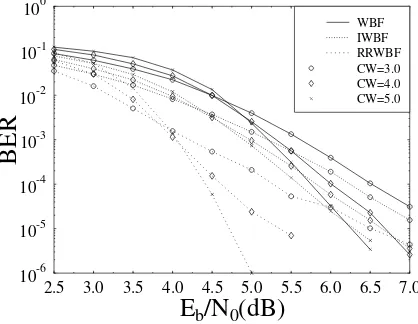
Abstract–In this contribution, a novel reliability-ratio based weighted bit-flipping(RRWBF) algorithm is proposed for decoding Low Density Parity Check (LDPC) codes. The RRWBF algorithm proposed is benchmarked against the conventional weighted bit-flipping (WBF) algorithm [1] and the improved weighted bit-flipping (IWBF) algorithm [2]. More than 1 and 2 dB coding gain was achieved at an BER of10−5 while invoking the RRWBF algorithm in compari-son to the two benchmarking schemes, when communicat-ing over an AWGN and an uncorrelated Rayleigh chan-nel, respectively. Furthermore, the decoding complexity of the proposed RRWBF algorithm is maintained at the same level as that of the conventional WBF algorithm.
1. INTRODUCTION
The family of Low-Density Parity-Check (LDPC) codes pro-posed by Gallager [3] has attracted substantial research inter-est in the information theory community. LDPC codes can be decoded using various decoding schemes [1–4] such as hard-decisions, soft-decisions and hybrid decoding schemes. The high-complexity Sum-Product Algorithm (SPA) was shown to achieve a near-capacity performance [4]. However, the Weight-ed Bit-Flipping (WBF) algorithm [1] strikes a good trade off between the associated decoding complexity and the achiev-able performance. The attractive property of the WBF algo-rithm is that during each iteration the weighted sum of the same values is computed, resulting in a significantly lower decod-ing complexity in comparison to the SPA. An improved WBF (IWBF) algorithm was proposed by Zhang and Fossorier [2].
An(N, K, j)LDPC code can be uniquely represented by
anM ×N parity check matrix (PCM), whereM =N −K
and each column of the PCM has an average weight ofj. Fur-thermore, each row has an average weight ofk, wherej/k = M/N. By representing the PCM using the Tanner graph [5], each column of the PCM corresponds to a message node in the Tanner graph and each row of the PCM is associated with a check node. We will use the notationHfor representing the PCM of the LDPC code, andHmndenotes the binary entry in themth row and the nthcolumn. We denote the set of bits participating in themthcheck byN(m) ={n: Hmn = 1}. The term{n : Hmn = 1} indicates the specific set of val-ues for the column indexn, where the value of the PCM entry
Hmn at the mth row andnth column is one. Similarly, the
set of checks in which thenth bit participates is denoted as
M(n) ={m:Hmn= 1}.
When an information block of sizeK is encoded by an LDPC encoder, a codeword cof lengthN will be produced, and the coded bits will be mapped using BPSK modulation onto the corresponding constellation pointx. When the Gaus-sian noise is added to the transmitted signal, a noise-contaminated received sequenceywill be obtained. Based on the sequence
y, an initial hard decision can be made and we arrive at a binary sequencezof lengthN.
Even though the WBF and the IWBF algorithms both strike a reasonable trade-off between the achievable coding gain and the associated decoding complexity, these two algorithms at-tribute the violation of a particular parity check to only the least reliable bit. However, the violation of a specific par-ity check could be owing to any message node participating in this check. Furthermore, the conventional WBF algorithm only considers the information provided by the check node, while the IWBF algorithm makes a judgement on the informa-tion supplied by both the check nodes and the message nodes with the aid of an optimal weighting factorα. The IWBF al-gorithm has a better BER performance compared to the WBF algorithm, subject to a properly chosen optimal weighting fac-tor. However, if the factorαis not optimum, the error cor-rection capability of the LDPC code invoking the IWBF algo-rithm may vary significantly. Hereby some pre-processing has to be carried out off-line for the sake of finding the optimal
α. Hence the RRWBF algorithm proposed in this paper re-quires no pre-processing and outperforms the WBF as well as the IWBF algorithm by 1 and 2 dB at the BER of10−5when communicating over an AWGN channel and an uncorrelated Rayleigh fading channel, respectively.
2. ALGORITHM
2.1. Conventional Weighted Bit-Flipping Algorithm
The conventional WBF algorithm was proposed by Kouet al[1]. The decoding process is as follows:
1. The first step of the conventional WBF algorithm will find the syndrome vectorsby multiplying the tentatively de-coded bit sequence z with the transpose of the PCMH, i.e.
s=zHT. If the syndrome vectorsis an all-zero vector, the de-coder will declare successful decoding and the iterations will be terminated. If not, go on to the second step.
2. During the second step, the conventional WBF algo-rithm will identify the most unreliable message node associ-ated with each individual check node by computing
yminm =min{n:n∈N(m)}|yn|. (1)
3. When the magnitude of the most unreliable message node has been identified for each check node, the quantity
ymmin calculated in Equation 1 will be used to calculate the error-termEnfor each message node as follows:
En =
m∈M(n)
(2sm−1)ymmin, (2)
wheresmis the syndrome bit associated with themthcheck node. The variablesmwill take the value of one, if themth
check is violated, or zero otherwise.
4. When the error-termsEn have been calculated for all message nodes, the value of the bit associated with the highest
En value will be inverted. Afterwards, the step 1, 3 and 4 will be repeated, until a valid codeword has been found or the maximum affordable decoding complexity has been exhausted.
2.2. Improved Weighted Bit-Flipping Algorithm
As seen from Equation 2, the error-term is calculated based on only the information provided by the check node. Zhanget al. proposed the IWBF algorithm in [2], where the information provided by the message node is also considered. The differ-ence between the conventional WBF algorithm and the IWBF algorithm is the third step in the iterative decoding process, where the error-termEnis calculated. Similar to Equation 2, the error-term will be calculated as follows, when invoking the IWBF algorithm:
En =
m∈M(n)
(2sm−1)ymmin−α· |yn|. (3)
Comparing Equation 3 to Equation 2, it can be observed that there is an extra term in Equation 3, where the information provided by the message node is taken into account. The phi-losophy of the IWBF algorithm is that it assumes that there are two message nodes having the same error-term formulated in Equation 2, thus there are two message nodes that have an equal probability of being flipped. However, if the magnitudes
|yn| of these two message nodes are different, the one hav-ing a lower magnitude is more unreliable and hence should be inverted. Therefore by using Equation 3 and incorporating the extra−α· |yn|multiplicative term in the evaluation of the error-term, a more accurate decision could be made.
2.3. Reliability Ratio Based Weighted Bit-Flipping Algorithm
As demonstrated in [2], the IWBF algorithm is capable of out-performing the conventional WBF algorithm. However, owing to the extra term at the end of Equation 3, an extra addition op-eration is needed for each calculation of the error-termEnof
Equation 3. Furthermore, it has been demonstrated in [2] that theαterm applied in Equation 3 should be carefully chosen. The performance of the IWBF algorithm depends significantly on the weighting factor α, hence αhas to be pre-computed using off-line processing.
Another drawback of both the WBF algorithm and the IWBF algorithm is that they both attribute the violation of a check to the unreliable bit. However, all the message nodes connected with a check node are liable to the violation of this particular check. In other words, all message nodes might be liable to change, if the check they participate in is violated. However, for two different message nodes participating in the same vi-olated parity check, the probability that the check is vivi-olated owing to the message node having a high soft-magnitude is lower than that associated with the message node having a low soft magnitude. Hence, hereby we would like to introduce a new quantity termed as theReliability Ratio(RR) defined as follows:
Rmn=β |yn|
|ymaxm |, (4)
where the notation|ymaxm | is used to denote the highest soft magnitude of all the message nodes participating in the mth
check. The variableβis a normalisation factor introduced for ensuring that we haven:n∈N(m)Rmn = 1. Hence, instead of calculating the error-termEnas in Equation 2 usingyminm , we propose the employment of the following formula:
En =
m∈M(n)
(2sm−1)/Rmn. (5)
The rest of the RRWBF algorithm is the same as the standard WBF algorithm and the iterations will be terminated, when the resultant syndrome vectorsbecomes an all-zero vector or when the maximum number of iterations has been reached.
3. SIMULATION RESULTS
In this section the decoding performance of the RRWBF algo-rithm advocated will be evaluated against the WBF and IWBF benchmark algorithms. The simulation parameters are sum-marised in Table 1.
3.1. Performance over AWGN Channels
Modem BPSK
Channel AWGN
Uncorrelated Rayleigh Fading
LDPC code (1000,500,3)
(1000,500,4) (1000,500,5)
Decoder WBF, IWBF, RRWBF
IWBF optimalα 0.4, 0.5, 0.6
[image:3.595.303.524.95.274.2]Maximum Number of Iteration 100
Table 1: Simulation parameters used for decoding three differ-ent half-rate LDPC codes all having a blocklength of 1000 and communicating over an AWGN channel using BPSK modu-lation. The three LDPC codes use regular PCM construction invoking an average column weight of three, four and five, re-spectively. The optimalαused during the IWBF decoding is chosen to be 0.4, 0.5 and 0.6 for the corresponding increased average column weight.
2.5 3.0 3.5 4.0 4.5 5.0 5.5 6.0 6.5 7.0
E
b/N
0(dB)
10-6 10-5 10-4 10-3 10-2 10-1 100
BER
[image:3.595.54.263.343.505.2]CW=5.0 CW=4.0 CW=3.0 RRWBF IWBF WBF
Figure 1: BER performance of the LDPC codes characterised in Table 1, when communicating over an AWGN channel using BPSK modulation.
In Figure 2, we evaluate the percentage of the frames that has been successfully decoded upon invoking the three differ-ent bit-flipping algorithms. No undetected errors were recorded during this experiment, in other words, all decoded LDPC code-words were indeed the originally transmitted codecode-words. In Figure 2, the percentage of successful decoding while using the WBF algorithm and the IWBF algorithm is about the same and codes decoded by the IWBF algorithm are merely slightly superior. However, when the RRWBF algorithm is utilised, a significant fraction of the frames may be successfully de-coded. Specifically, in the Eb/N0 = 3.5 −4.5dB region there were about eight times more successfully decoded frames for a column-weight three LDPC code when decoded by the RRWBF algorithm, than for the same LDPC code decoded by
2.5 3.0 3.5 4.0 4.5 5.0 5.5 6.0 6.5 7.0
E
b/N
0(dB)
0.0 0.1 0.2 0.3 0.4 0.5 0.6 0.7 0.8 0.9 1.0
Percentage
of
Successful
Decoding
CW=5.0 CW=4.0 CW=3.0 RRWBF IWBF WBF
Figure 2: The percentage of successful decoding for the LDPC codes characterised in Table 1 when communicating over an AWGN channel using BPSK modulation.
the IWBF algorithm.
2.5 3.0 3.5 4.0 4.5 5.0 5.5 6.0 6.5 7.0
E
b/N
0(dB)
0 10 20 30 40 50 60 70 80 90 100
A
verage
Number
of
Iterations
CW=5.0 CW=4.0 CW=3.0 RRWBF IWBF WBF
Figure 3: Average number of iterations for the LDPC codes characterised in Table 1, when communicating over an AWGN channel using BPSK modulation.
[image:3.595.316.524.387.555.2]comparison to the WBF and the IWBF algorithms.
3.2. Performance over Uncorrelated Rayleigh Fading Channels
4 6 8 10 12 14 16 18 20
E
b/N
0(dB)
10-610-5 10-4 10-3 10-2 10-1 100
BER
[image:4.595.316.524.107.274.2]CW=5.0 CW=4.0 CW=3.0 RRWBF IWBF WBF
Figure 4: BER performance of the LDPC codes characterised in Table 1, when communicating over an uncorrelated Ray-leigh fading channel using BPSK modulation.
4 6 8 10 12 14 16 18 20
E
b/N
0(dB)
0.00.1 0.2 0.3 0.4 0.5 0.6 0.7 0.8 0.9 1.0
Percentage
of
Successful
Decoding
[image:4.595.54.262.179.340.2]CW=5.0 CW=4.0 CW=3.0 RRWBF IWBF WBF
Figure 5: The percentage of successful decoding for the LDPC codes characterised in Table 1, when communicating over an uncorrelated Rayleigh fading channel using BPSK modulation.
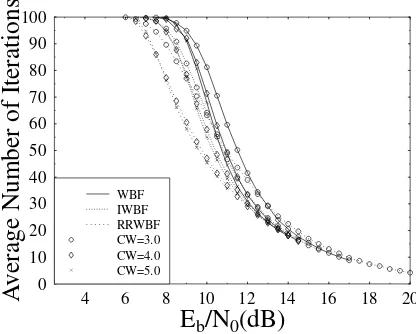
Figures 4 to 6 demonstrated the error correction capabil-ity for the three different bit-flipping algorithms, when com-municating over uncorrelated Rayleigh fading channels. Since now the channel conditions are worse than those in the AWGN channel of Section 3.1, for the column-weight three LDPC code, the performance of the RRWBF algorithm becomes in-ferior to that of the other two benchmarkers. However, for
4 6 8 10 12 14 16 18 20
E
b/N
0(dB)
010 20 30 40 50 60 70 80 90 100
A
verage
Number
of
Iterations
CW=5.0 CW=4.0 CW=3.0 RRWBF IWBF WBF
Figure 6: Average number of iterations for the LDPC codes characterised in Table 1, when communicating over an uncor-related Rayleigh fading channel using BPSK modulation.
an average column-weight higher than three, the advantages of employing the RRWBF algorithm are still explicit. A cod-ing gain of approximately 2dB is achieved at a BER of10−5, while utilising the RRWBF algorithm compared to the other benchmarking schemes at an average column weight of five. The reason for this phenomenon is that the RRWBF algorithm calculates the reliability ratio usingknumber of soft channel outputs|yn|, wherekdenotes the average row weight. When the column weight is increased, the corresponding row weight is increased accordingly. Hence, the RRWBF algorithm is capable of calculating the reliability ratio with the aid of a higher number of values. Statistically speaking, a higher num-ber of values will always results in a more accurate prediction. When transmitting over AWGN channels, the channel condi-tions were reasonably good and hence the RRWBF algorithm was capable of calculating the reliability ratio sufficiently ac-curately for the sake of outperforming the other two bench-mark schemes. However, when an uncorrelated Rayleigh chan-nel was encountered, the RRWBF algorithm was unable to ac-curately calculate the reliability ratio for a low average column weight. Hence a poorer BER performance is observed in Fig-ure 4. However, when the average column weight is increased, the RRWBF algorithm still constitutes an attractive scheme, as demonstrated in Figures 4 to 6.
4. COMPLEXITY
[image:4.595.52.263.423.603.2]transmitted over an AWGN channel. The maximum number of iterations for the sum-product decoder was set to 10, while the RRWBF decoder used a maximum number of 100 iterations. As seen in Figure 7, the RRWBF algorithm’s performance is
1 2 3 4 5 6 7
E
b/N
0(dB)
10-610-5 10-4 10-3 10-2 10-1 100
BER
[image:5.595.306.561.86.184.2]RRWBF SPA
Figure 7: BER performance for the LDPC codes decoded by RRWBF algorithm and the sum-product algorithm when com-municating over an AWGN channel using BPSK modulation.
inferior to that of the sum-product algorithm by about 1dB at a BER of10−5. However, we will quantify the achievable de-coding complexity reduction by invoking the RRWBF algo-rithm, while tolerating anEb/N0performance loss of 1dB.
As seen in Equation 5, during each iteration theEnterm of Equation 5 has to be updated. However, since the bit-flipping aided decoding only changes the state of a particular bit, hence there will be onlyjnumber of syndrome bitssmthat are flipped. Consequently, since every check node is associated withk num-ber of message bits, there is an overall maximum ofjknumber of message nodes requiring the recalculation of the error-term. The evaluation of the error-termEn in Equation 5 requiresj
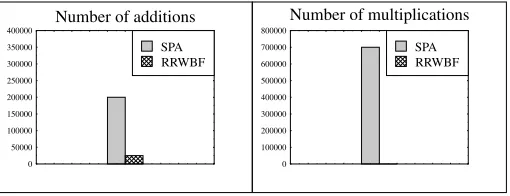
number of additions, hence during each iteration, the maxi-mum decoding complexity imposed will bej·k·jadditions. Since the average column weight was five in this experiment, thus the required decoding complexity per iteration is upper bounded by5·10·5 = 250additions. Because a maximum of 100 iterations was used by the RRWBF decoder, the overall decoding complexity was 25000 additions.
The sum-product algorithm requires2jqnumber of addi-tions and7jq/log2(q)multiplications per coded bit per itera-tion [6], whereqis the size of the decoding field, which is two in this binary scenario. For a blocklength of 1000 bits and a maximum of 10 iterations, the required number of arithmetic operations was 200,000 additions and 700,000 multiplications. The resultant complexity comparisons were shown in Figure 8.
0 50000 100000 150000 200000 250000 300000 350000 400000
Number of additions
RRWBF SPA
0 100000 200000 300000 400000 500000 600000 700000 800000
Number of multiplications
RRWBF SPA
Figure 8: Decoding complexity comparison for the (1000,500,5) LDPC code characterised in Figure 7, when in-voking the sum-product algorithm and the proposed RRWBF algorithm.
5. SUMMARY
In this contribution, a novel reliability-ratio based weighted bit-flipping algorithm was proposed. This algorithm is capa-ble of maintaining the same decoding complexity as the con-ventional weighted bit-flipping algorithm, while requiring no off-line pre-processing as needed by the IWBF algorithm. The RRWBF algorithm outperforms the benchmarking schemes for all average column weights used, when communicating over AWGN channels. For the uncorrelated Rayleigh fading chan-nel, the low-column-weight LDPC code decoded by the RRWBF algorithm was found to be inferior in comparison to the bench-marking schemes. However, when the column weight is in-creased, a significant coding gain of 2dB is achieved by the proposed RRWBF algorithm at a BER of 10−5 against the IWBF algorithm at an average column weight of five. The decoding complexity of the RRWBF algorithm was also com-pared to that of the soft-decision based sum-product algorithm. In Figure 8, the RRWBF algorithm was shown to require a significantly lower processing power compared to the sum-product algorithm, at the cost of 1dB coding gain loss observed at a BER of10−5.
6. REFERENCES
[1] Y. Kou, S. Lin and M. Fossorier, “Low-density parity-check codes based on finite geometries: a rediscovery and new results,”IEEE Transactions on Information Theory, vol. 47, pp. 2711–2736, November 2001.
[2] J. Zhang, M. P. C. Fossorier, “A Modified Weighted Bit-Flipping Decod-ing of Low-Density Parity-Check Codes,”IEEE Communications Letters, vol. 8, pp. 165–167, March 2004.
[3] R. Gallager, “Low Density Parity Check Codes,”IEEE Transaction on Information Theory, vol. 8, pp. 21–28, Jan. 1962.
[4] D. J. C MacKay, and R. M. Neal, “Near Shannon Limit Performance of Low Density Parity Check Codes,”Electronics Letters, vol. 33, pp. 457– 458, 13 March 1997.
[5] M. R. Tanner, “A Recursive Approach to Low Complexity Codes,”IEEE Transactions on Information Theory, vol. 27, September 1981.
[6] F. Guo, L. Hanzo, “Low complexity symbol-based iterative detection of serially concatenated non-binary LDPC codes and space-time codes,” in