Phare
multi-country
programmes
Phare
multi-country
programmes
published by the European Commission
Directorate General External Relations:
Introduction
Table of contents
What is Phare?
Phare multi-country programmes
Objectives Structures Programming Horizontal programmes Programme summaries Financial information Programme summaries
Action for cooperation in the field of economics (ACE) Competition protection
Consensus social protection programme Cooperation in higher education COOPME COSINE Customs cooperation Distance learning Energy Environment
Environmental legislation programme Environmental project preparation facility European integration
Fight against drugs Intellectual protection
Joint venture support scheme (JOP) Nuclear safety programmes Phare cross-border programme Programme for statistical cooperation Quality assurance/standards
Regional consumer protection programme Regional industrial property
Support for improvement in governance and management (SIGMA) Technical assistance information and exchange office
Telecommunications and posts Tempus
Trade
Transit facilitation programme Transport
Turnaround management programme Veterinary diagnosis and control
What is Phare?
The Phare Programme is a European Community initiative which supports the development of a larger democratic family of nations within a prosperous and stable Europe. Its aim is to help the countries of central and eastern Europe rejoin the mainstream of European development through future membership of the European Union.
Phare does this by providing grant finance to support its partner countries through the process of economic transfor-mation and strengthening of democracy to the stage where they are ready to assume the obligations of membership of the European Union.
In its first six years of operation to 1995, Phare has made available ECU 5,416.9 million to eleven partner countries, making Phare the largest assistance programme of its kind.
Phare works in close cooperation with its partner countries to decide how funds are to be spent, within a framework agreed with the European Community. This ensures that Phare funding is relevant to each government's own re-form policies and priorities.
Phare provides know-how from a wide range of non-commercial, public and private organisations to its partner countries. It acts as a multiplier by stimulating investment and responding to needs that cannot be met by others. Phare acts as a powerful catalyst by unlocking funds for important projects from other donors through studies, capital grants, guarantee schemes and credit lines. It also invests directly in infrastructure, which will account for more Phare funds as the integration process progresses.
The main priorities for Phare funding are common to all countries, although every one is at a different stage of transformation. The key areas include restructuring of state enterprises including agriculture, private sector development, reform of institutions, legislation and public administration, reform of social services, employment, education and health, development of energy, transport and telecommunications infrastructure, and environment and nuclear safety.
Phare multi-country programmes
Objectives
Phare multi-country programmes are an integral part of the European Union's initiatives to support the process of economic transformation and democratisation in the for-mer centrally-planned countries of central and eastern Eu-rope. Phare multi-country programmes started in 1991 and have a number of key objectives:
the promotion of regional cooperation between all 11 associated countries on issues of common concern and interest
the development of a 'demand-driven' and 'consensus-based' approach to programme formulation and project selection
the stimulation of an ongoing dialogue between the in-dividual countries themselves and between the coun-tries and Phare services
the creation of a more cohesive approach to programme formulation that addresses regional rather than national issues.
Structures
Multi-country coordination group
Following the meetings of the national aid coordinators in Brussels in November and December 1991, it was decided to establish a regional coordination group to develop a much more demand-driven approach to programme for-mulation, project selection and implementation.
Representatives in this group, which is now referred to as the multi-country coordination group, are the 11 na-tional aid coordinators for the associated countries. In 1992, the group comprised Bulgaria, the former Czecho-slovakia, Hungary, Poland and Romania. In 1993, the group was expanded to include Albania, Estonia, Latvia, Lithuania, and Slovenia together with the Czech Republic and Slovakia following the dissolution of Czechoslovakia.
The multi-country coordination group is responsible for defining, in conjunction with the European Commission, the overall strategic objectives of the multi-country programmes (MCP) embodied in the strategy paper; for agreeing on the sectoral allocation of the budget in the framework of the Multi-annual Indicative Programme; for the formulation of the annual operational programme (AOP); and for reviewing programme performance in its annual meeting.
Presidency
The presidency of this coordination group is rotated annually and in alphabetical order. In 1992, Bulgaria assumed this role, followed by the Czech Republic in 1993, Hungary in 1994, Poland in 1995 and Romania in 1996. Future presidencies will be as follows:
1996 Romania
1997 Slovakia
1998 Albania
1999 Estonia
2000 Latvia
2001 Lithuania
2002 Slovenia.
Multi-country coordinator
The multi-country coordinator is the de facto head of the coordination group in the year of its presidency. This position rotates annually with the presidency. In 1992, this position was held by Plamen Gogov, the Phare Co-ordinator at the Ministry of Finance in Bulgaria. In 1993, the role was taken over by Pavel Rozsypal, Director of the Centre for Foreign Assistance at the Ministry of Economy in Prague in the Czech Republic. In 1994, the position was held by Gabor Ivan, Head of the Assistance Coordination Secretariat at the Ministry of Industry and Trade in Hungary. In 1995, Pawel Samecki, the Director of the Foreign Assistance Bureau in Poland has assumed this responsibility. From 1 July 1996, the post passes to Mr Nicolae Idu, the Director of the Foreign Assistance Coor-dination Unit in Bucharest.
Multi-country coordination office
While there was no specific unit established for the 1992 multi-country programme, it was felt necessary given the increasing scale and complexity of the programmes to set up a coordination bureau/office and to recruit local staff to coordinate the programmes and to visit each of the countries in the coordination group. For 1995, Pawel Samecki is the Director of this office, with Mariusz Kasprzyk as Programme Manager.
Facilitator, Phare multi-country programmes
Sector coordinators
In the process of the 1992 programming exercise, the
mem-bers of the coordination group agreed to nominate specific countries to have overall coordinating responsibilities for key sectors. Further nominations were made in 1993. Sec-toral responsibilities are as follows:
Bulgaria (telecommunications)
Czech Republic (transport)
Hungary (environment)
Hungary (distance learning)
Latvia (fight against drugs)
Lithuania (statistics)
Poland (human resources)
Romania (energy)
Romania (regional industrial property) Slovakia (trade)
Slovakia (cooperation on higher education) Slovenia (customs).
It is the intention to have all countries in the coordination
group performing the role of sector coordinator. Sector
coordinators act as the interface between the national representatives in all 11 countries and the European
Commission for programme monitoring, and provide the
forum for dialogue and discussion in the bi-annual liaison group meetings held in conjunction with the European Commission.
A summary of sectoral responsibilities per country is
shown below:
Bulgaria Czech Republic Latvia
Telecommunications Transport* Fight against drugs *
and posts*
Hungary Lithuania
Environment * Statistics *
Rotating Coordination I
I Office
Romania
I
~
RIPP
,---Poland Romania Slovakia Slovenia
Human
resources Energy* Trade** Customs*
~
I* PCU established
Hungary Slovakia (Hungary liason office)
Distance learning * Higher education ** ** PCU to be established
National contacts
For each of the larger programmes where a sector
co-ordinator has been nominated, steering committees or
liaison groups have been established to monitor pro-gramme implementation and to liaise with the European Commission. These comprise representatives (national contacts) from the sectoral ministries in each of the 11
countries, and normally meet twice a year.
For some programmes, e.g. energy, small steering
mittees have been established for individual project com-ponents to introduce a more flexible and cost-effective means of monitoring programme implementation.
Programme Coordination Units
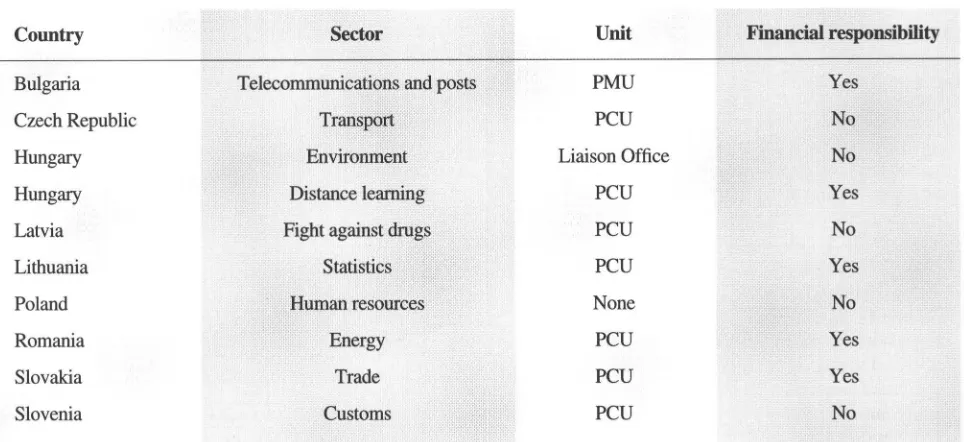
As part of the process of decentralisation, Programme Co-ordination Units (PCUs/PMUs) have been established in the countries having sector coordinating responsibilities. These units are responsible for overall programme
man-agement and project monitoring, and are staffed by
ex-perts from the associated countries and the European Union. Some have full financial responsibility. They are
shown in Table 1 overleaf.
Commission structures
Overall management of the multi-country programmes is undertaken by the Directorate General for External
Relations (DG IA/B). Overall responsibility lies with the
Director, while coordination is the responsibility of the Head of the Sectoral Unit (B5) and the Multi-country Programme Coordinator.
For each of the multi-country programmes, a task manager has been appointed within the European Commission and a full list of these is contained in the List of Contacts. Other Directorates-General of the European Commission are also involved. Their sectoral expertise is precious in programme formulation.
Other agencies
For some of the programmes, outside agencies are involved in the management of the programmes. These include:
Centre for European Normalisation (CEN) for the
standards/quality assurance programme
OECD for the SIGMA (public administration)
pro-gramme
Table 1: Phare multi-country programmes - Programme Management Country Sector
Bulgaria Telecommunications and posts Czech Republic Transport
Hungary Environment Hungary Distance learning Latvia Fight against drugs Lithuania Statistics Poland Human resources Romania Energy Slovakia Trade Slovenia Customs
Programming
In accordance with the conclusions of the Essen Summit which set out the pre-accession strategy, the multi-country programmes have adopted a multi-annual programming perspective. As a result, programming is based on the following.
Strategy paper. This document sets out the five-year perspective for the multi-country programmes (MCP) and is based on the broader context of the Europe Agreements and the Essen conclusions. For the current programming period, it will cover 1996-1999 and will provide an overall strategic framework as well as a Multi-annual Indicative Programme. This document was agreed at the multi-country coordination group meeting in Warsaw in October 1995 and endorsed by the European Commission.
Multi-annual indicative budget. The overall priorities set out in the strategy paper are translated into a multi-annual indicative budget based on the multi-multi-annual fi-nancial envelope proposed by the European Com-mission.
Annual operational programme. For each of the years in the programming period, an annual operational pro-gramme is prepared and agreed between the multi-coun-try coordination group and the European Commission. This sets out objectives, anticipated results, implemen-tation arrangements and the likely level of commitments
Unit Financial responsibility PMU Yes
PCU No Liaison Office No PCU Yes PCU No PCU Yes None No PCU Yes PCU Yes PCU No
and disbursements in the following year. This will be submitted to the Management Committee in the form of a single financing document embracing all programmes for the following year.
Annual review. This is carried out in the middle of each year and reviews progress made and assesses pro-gramme implementation in the context of the overall strategic objectives contained in the strategy paper.
Horizontal programmes
Since the pre-accession strategy has become Phare's guiding principle, there is a need for Phare actions in a number of areas which are deemed by the European Commission to be essential to the success of the strategy.
Because these actions are not necessarily requested by the partner countries themselves, the Commission must sometimes take the lead role and design some programmes on its own initiative. Such programmes are called horizontal programmes. Unlike all other Phare programmes, they are not demand-driven. They are conceived by the Commission which then invites the partner countries to participate.
[image:10.577.56.538.185.406.2]Since 1994, a number of formerly multi-country programmes have become horizontal programmes. This resulted from the changing priorities expressed by the partner countries and the Commission's belief that certain programmes were nevertheless still worth pursuing. They include ACE, Tempus, JOPP and the Industrial Property programme. By contrast, programmes such as COOPME, Standards or Intellectual Property have been horizontal from the start.
The management of horizontal programmes is more varied than that of multi-country programmes. They fall outside the remit of the multi-country coordination group,
presidency or office. Horizontal programmes can be managed directly by the Commission, by a contracted body acting on behalf of the Commission or by a body resembling the PCUs in charge of multi-country programmes.
Programme summaries
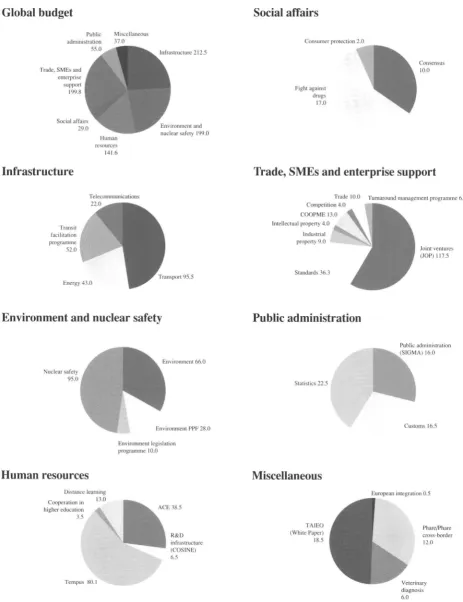
The financial information section overleaf shows the overall budgets of both multi-country and horizontal programmes for 1991 to 1996 together with their sectoral breakdown.
More detailed programme/project descriptions are given in Section 2.
In 1991, emphasis was largely placed on environment/ nuclear safety, human resources and enterprise support, with small allocations for customs, statistics and public administration.
In 1992, environment/nuclear safety and human resources continued to receive large allocations, although infrastruc-ture received ECU 35 million, with the emphasis particu-larly on transport. 1992 saw the extension of some of the 1991 programmes to additional countries together with the introduction of two small programmes for regional
in-dustrial property and the fight against drugs.
In 1993, in line with the guidelines, the programme re-ceived a higher degree of concentration with the following elements.
An extensions/consolidations programme to extend existing programmes to the five new associated countries and build on established programmes in the original countries of the coordination group. This covered the fight against drugs, transport, customs, and energy, and amounted to ECU 29 million in total.
Core area programmes for transport (ECU 20 million), nuclear safety (ECU 20 million), human resources (ECU 16 million) and an extension of the JOPPs (joint venture support scheme) valued at ECU 15 million.
Additionally, a number of preparatory studies were launched for the medium-term programming period, particularly in the areas of human resources, trade, and cross-border co-operation.
The 1994 programme largely focused on infrastructure,
with transport (ECU 30 million) and energy (ECU 13 million) taking over 50 per cent of the budget. There was also a continuation of the extensions/consolidations pro-gramme with ECU 22 million allocated to ACE, SIGMA and COSINE, and a further ECU 17 million subsequently added to the multi-country statistics programme. Finally,
there were smaller allocations for a pilot programme in distance learning (ECU 3 million) and preparatory work in the field of telecommunications (ECU 1 million).
For 1995, infrastructure was again the key area for support with transport and the new transit facilitation programme being the main recipients. Energy and telecommunications also received funding. Environment received ECU 20 million, together with smaller allocations for human re-sources and a programme to stimulate intra-regional trade.
For the 1996-1999 period, a multi-annual programming ap-proach has been provisionally adopted (subject to approval by the Management Committee) with the emphasis on
physical integration (transport, energy, environment,
transit facilitation, telecommunications)
economic, political and social integration (trade, the fight against drugs, European integration, human resources and industrial property)
Financial information
Table 2: Commitments to Phare multi-country and horizontal programmes
(ECU
million)
Sector/programme 1990 1991 1992 1993 1994 1995 1996 Total
(planned)
Infrastructure
Transport 21.0 24.0 30.0 11.5 9.0 95.5
Energy 7.0 5.0 13.0 9.0 9.0 43.0
Transit facilitation programme 30.0 22.0 52.0
Telecommunications 7.0 1.0 7.0 7.0 22.0
Subtotal 35.0 29.0 44.0 57.5 47.0 212.5
Environment/nuclear safety
Environment 20.0 16.0 20.0 10.0 66.0
Environment PPF 10.0 3.0* 15.0* 28.0
Environment legislation programme 10.0* 10.0
Nuclear safety 15.0 20.0 20.0 20.0* 20.0* 0.0# 95.0
Subtotal 35.0 46.0 20.0 23.0 40.0 35.0 199.0
Human resources
ACE 1.5 5.0 6.0 10.0 10.0* 6.0* 38.5
R&D infrastructure (COSINE) 2.5 4.0 6.5
Tempus 20.0 20.1 18.0 16.0 6.0* 80.1
Cooperation in higher education 3.5 3.5
Distance learning 3.0 5.0 5.0 13.0
Subtotal 21.5 27.6 24.0 16.0 23.0 18.5 11.0 141.6
Social affairs
Consensus 10.0* 10.0
Fight against drugs 2.0 10.0 5.0 17.0
Consumer protection 2.0* 2.0
Sector/programme 1990 1991 1992 1993 1994 1995 1996 Total
(planned)
Trade, SM& & enterprise support
Joint ventures (JOP) 20.0 27.5"' 70.0* 117.5
Standards 4.3 2.0 30.0* 36.3
Industrial property 3.0 2.0* 4.0* 9.0
Intellectual protection 2.0* 2.0* 4.0
COOPME 13.0* 13.0
Competition 2.0* 2.0* 4.0
Trade 5.0 5.0 10.0
Turnaround management programme 6.0* 6.0
Subtotal 27.3 2.0 27.5 25.0 111.0 7.0 199.8
Public administration
Customs 5.0 1.5 10.0 16.5
Statistics 3.0 2.5 17.0 22.5
Public administration (SIGMA) 3.0 8.0 5.0* 16.0
Subtotal 11.0 4.0 10.0 25.0 5.0 55.0
Miscellaneous
European integration 0.5 0.5
Phare/Phare cross border 12.0 12.0
Veterinary diagnosis 6.0* 6.0
TAIEO (White Paper) 18.5* 18.5
Subtotal 6.0 18.5 12.5 37.0
Total 21.5 100.9 113.0 112.5 148.0 255.5 122.5 873.9
* this programme is funded under the horizontal budget line
6 this programme was funded as follows: ECU 15 million as a multi-country programme and ECU 12.5 million as a horizontal programme
Table 3: Phare multi-country programmes - breakdown by
sector
1990-1996 (in ECU million)
Global budget
Public administration
Miscellaneous
37.0
Trade, SM Es and enterprise support
199.8
Infrastructure
Transit
facilitation
programme
52.0
Human
resources 141.6
Telecommunications
Environment and nuclear safety
Nuclear safety
95.0
Environment legislation
programme I 0.0
Human resources
Cooperation in
higher education
3.5
Tempus 80.1
R&D infrastructure (COSINE) 6.5
Social affairs
Consumer pro1ection 2.0
Fight against drugs 17.0
Consensus
10.0
Trade, SMEs and enterprise
support
Trade I 0.0 Turnaround management programme 6.0
COOPME 13.0
Intellectual property 4.0
Industrial
property 9.0
Standards 36.3
Public administration
Statistics 22.5
Miscellaneous
TAIEO (White Paper)
18.5
Joint ventures
(JOP) 117.5
Public adminis1ra1ion
Customs 16.5
European integration 0.5
Phare/Phare cross-border
12.0
Veterinary diagnosis
[image:14.586.49.513.208.811.2]Programme summaries
Action for cooperation in the
field of economics (ACE)
Budget
ECU
1990 1.5 million
1991 5 million
1992 6 million
1994 10 million
1995 10 million
1996 6 million
Total 38.S million
ACE was initiated in 1990 in Poland and Hungary and extended in 1991 and 1992 to the other associated countries. The basic aims are the enhancement of the intel-lectual process of reform and liberalisation by the increase and exchange of scientific and managerial knowledge between professional and academic economists. Phare is contributing to scholarships and research grants for eco-nomists from central and eastern European countries (CEECs) to stay at universities in the European Union (EU) and is supporting the organisation of high-level seminars in the associated countries for economists and senior civil servants. Grants for multinational networks are also available, as are grants for recognised CEEC centres of excellence offering students the possibility to undertake part of their course at an EU institute.
Competition protection
Budget 1994 1996 TotalECU
2 million 2 million 4millionThis programme helps to adapt and implement new competition policy in the Phare partner countries. This is required to integrate markets and to implement the Europe Agreements. The programme offers know-how for legislative and institutional reform and training to people involved in policy formulation. It also supplies documen-tation, software, hardware and translation services. Finally, it helps to promote new competition policies to economic actors and the general public.
Consensus social protection
programme
Budget
ECU
1995 10 million
Total 10 million
The Consensus programme has been created to help develop new social welfare policies in the Phare countries. The programme focuses on the administration of social protection systems and emphasises cost-effectiveness. To do so, the programme analyses existing social protection systems in the partner countries and provides examples of best practice from EU member states. Furthermore, the exchange of key staff will help demonstrate the macro
-economic and fiscal viability of new systems. Consensus, mindful of the pre-accession strategy governing the relations of the partner countries and the EU, will also fund the approximation of social welfare legislation where this is appropriate.
Cooperation
in
higher education
Budget 1995 TotalECU
3.5 million 3.5 millionCOOPME
Budget
ECU
1994 13 million
Total 13 million
COOPME (which stands for Cooperation des Petites et Moyennes Entreprises, French for Cooperation of Small and Medium-Sized Enterprises) was set up to develop the activities of small and medium-sized enterprises. The programme offers training to associations of SMEs and
Regional Development Agencies, helps to extend existing
EU schemes to the partner countries, and sets up
partnership schemes for SMEs. The kind of work typically financed by this programme includes helping Chambers of Commerce train their staff and setting up Community Networks.
COSINE
Budget 1991 1994 TotalECU
2.5 million 4 million6.5 million
The 1991 programme to support the connection of univer-sities and research centres to the COSINE (Cooperation for open systems international networking in Europe) was
designed to provide the CEECs' research and
develop-ment community with pan-European network services.
This was designed to facilitate integration with both Eu-ropean and world-wide academic, industrial and techno-logical specialists and encourage compliance with EU standards of research and technological policies. The programme was provided with additional funding in 1994 and extended to Albania, the Baltic States and Slovenia.
This programme is currently being reviewed. It may be folded into the multi-country telecoms and posts
programme, depending on the review's conclusions.
Customs cooperation
Budget 1991 1992 1993 TotalECU
5 million 1.5 million 10 million 16.5 millionThe 1991 three-year programme directed at Bulgaria, the
former Czechoslovakia and Romania was designed to help the customs administrations of the associated countries modernise and adapt to the specifications of increased trade by introducing EU-compatible customs legislation and computerisation techniques, and evaluating the need for scanning and communications equipment. The programme was extended to Albania and the Baltic States in early
1992, and to Poland and Slovenia in 1993. An integral part
of the 1993 programme is the close collaboration between the multi-country transport and multi-country customs pro-gramme on the development of a cohesive strategy to eliminate border-crossing bottle-necks through infrastruc-ture and institutional initiatives, particularly in the area of customs procedures. Another key element is a programme to combat commercial fraud. From 1995, this programme was folded into the transit facilitation programme.
Distance learning
Budget 1994 1995 1996 TotalECU
3 million 5 million 5 million13 million
Energy
Budget
ECU
1992 7 million
1993 5 million
1994 13 million
1995 9 million
1996 9 million
Total 43 million
Recognising that energy is a strategically important sector
for the economies of all European countries, fifty Euro-pean and non-EuroEuro-pean states signed the European Energy Charter in 1991. The 1992 Phare multi-country energy programme was designed to increase east-west co-operation by tackling the most important areas, such as policy formulation, supply and demand problems, efficien-cy and conservation measures, environmental and other safety measures. Gas and electricity grids, oil refining and transportation, management training and energy legislation reform are all key areas where funding will go to identify
strategies for development and help other donors to target support more effectively. In the 1994 programme, a more comprehensive approach was developed with specific pro-grammes for the coal sector, harmonisation of energy policies, twinning activities and a number of subregional programmes. Similar themes were adopted in the 1995 and 1996 programmes.
Environment
Budget
1991 1992 1995 1996
Total
ECU
20 million 16 million
20 million 10 million
66 million
The size of the environmental crises facing the CEECs is becoming increasingly evident, as are the difficulties facing national initiatives to provide adequate solutions to the many problems facing the region. The aim of the 1992 pro-gramme, which follows on from the 1991 multi-country environmental programme, was to support regional and in-tegrated programmes in the Danube river basin and the Black Sea, as well as the Baltic Sea and the Black Triangle, which tackle pollution sources and ensuing problems. The 1992 programme also targeted the development of
institu-tions which can focus, develop and express public opinion on environmental matters as part of a functioning civic so-ciety, through support to the Regional Environment Centre in Budapest. Additionally, there was continued support for the CORINE and MARS programmes and for an overall project preparation fund. In 1995, the programme focused on the harmonisation of legislation, support to conventions, regional cooperation and initiatives related to the hazardous effects of uranium mining.
Environmental legislation
programme
Budget
ECU
1996 10 million
Total 10 million
Environmental project
preparation facility
Budget 1992 1994 1996 TotalECU
10 million 3 million 15 million28million
This programme helps prepare environmental capital investment projects which are co-financed with interna-tional financing institutions. The idea is to use the funds
to prepare investment projects in such a way that the
financing of the capital required becomes feasible. To do so, it offers technical assistance or, in certain cases, seed capital. This programme builds on the success of a similar programme funded in 1992 whose funds are now
exhausted. Suitable projects can be identified in two ways:
bilaterally or, more frequently, through the Project
Preparation Committee, an environmental donor
organisa-tion with a secretariat based in London in which Phare has been very active (it allocated ECU 10 million in 1992 to
projects selected by the Committee).
European
integration
Budget
ECU
1996 0.5 million
Total 0.5 million
The aim of this programme is to encourage a constructive dialogue between the different partner countries about the issue of European integration. Unlike the Technical Assistance Information and Exchange Office, which is essentially a body dealing bilaterally with requests from
each associated country, the European integration
programme is multilateral. It will offer a forum for the
central European monitoring of the pre-accession process, trai~ diplomats, and offer seminars and workshops to seruor central European policy-makers in charge of the
integration process. It may also offer more basic help,
such as language training.
Fight against drugs
Budget 1992 1993 1996 Total
ECU
2 million 10 million 5 million 17 millionThe political changes that have taken place in the region, with the opening of borders, the poorly-equipped and trained officials and the painful social changes associated with economies in transition, have led to a large increase in both drug smuggling and drug demand in the region. This programme is designed to reduce the demand, supply and transit of drugs through a variety of measures including actions against chemical precursors and money laundering, the development of a drug information system and support
for demand-reduction programmes. Support is provided
through training, seminars, policy initiatives, legislation and strategy formulation.
Intellectual protection
Budget 1994 1995 TotalECU
2 million 2 million4 million
This programme aims to install a level of intellectual protection in the partner countries which will be
comparable to that of the EU. This is particularly
necessary in view of the currently patchy copyright protection in most countries and the ongoing battle against piracy. The existence of strong intellectual protection systems is required to further encourage investment in the partner countries and to liberalise the circulation of services and cultural works. The programme will finance know-how to help reform the legislation, train staff and exchange experts involved in this field with their
counter-parts in the EU. It will also produce and distribute
Joint venture support scheme
(JOP)
Budget
ECU
1991 20 million
1993 27 .5 million
1995 70 million
Total 117.5 million
This programme, which initially covered Hungary, Poland,
the Czech Republic, Bulgaria, Romania and Slovakia, is
aimed at stimulating small and medium-sized enterprises in the European Community, to create and expand joint ventures in central and eastern Europe. The intended result is to direct foreign investment towards those countries and facilitate the transfer of knowledge.
There are four types of scheme which can receive support including: general actions to identify projects and to pro-vide information; feasibility studies and pre-feasibility stu-dies on identified investment projects; investment support for existing and new joint ventures; and training, technical and managerial support. The scheme is being implemented through a network of Community financial institutions, which also participate with their own funds and handle all relations with investors directly. In 1993, the programme was extended to all 11 associated countries.
Nuclear
safety
programmes
Budget
ECU
1991 15 million
1992 20 million
1993 20 million
1994 20 million
1995 20 million
Total 95 million
The safety situation in the nuclear power stations in central and eastern Europe and in the former Soviet Union is a matter of increasing concern to the CEECs as well as to
the countries of western Europe. A programme has been
prepared by the World Association of Nuclear Operations (W ANO) to deal with the safety aspects of these Soviet-designed reactors, and the multi-country programmes ini-tially involving Bulgaria, the Czech Republic and Slovakia now cover all 11 associated countries. Areas covered include support to safety authorities, programmes for waste management and specific actions for the VVER 230 and 213/1000 reactors.
Phare/Phare
cross-border
programme
Budget
ECU
1996 12 million
Total 12 million
This programme was launched in 1996 and is designed to stimulate cooperation between the border regions of the associated countries. Areas of priority under this
pro-gramme include the development of commercial links,
regional economic development, cultural cooperation, sci-entific and technological exchange, etc.
Programme
for statistical
cooperation
Budget
ECU
1991 3 million
1992 2.5 million
1994 17 million
Total 22.5 million
Initiated in 1991, the statistical cooperation programme
which covered Bulgaria, the Czech Republic, Hungary,
Romania, and Slovakia was designed to develop their statistical information systems in order to support and monitor the present economic reforms. In 1992, the programme was further extended to Albania, the Baltic States, Poland and Slovenia, and in 1994, the programme received further assistance with support for a number of
Quality assurance/standards
Budget
ECU
1991 4.3 million
1992 2 million
1995 30 million
Total 36.3 million
The 1991 multi-country programme covering Bulgaria, the
former Czechoslovakia, Hungary, Poland and Romania,
co-financed with the EFTA countries, was designed to
promote quality assurance and standardisation and assist the CEECs in developing trade by enhancing the quality and marketing of their goods.
The 1992 programme continued to target the same
prior-ities, by providing know-how grants to enable national
experts from the CEECs to attend meetings and learn about European standardisation measures.
1992 also saw the programme extended to Albania, Estonia, Latvia, Lithuania and Slovenia, in order to help
these countries make the transition to a voluntary system
of standardisation with the setting up of appropriate insti-tutions to offer guidance. The Centre for European Nor-malisation (CEN) is responsible for managing the programme.
Regional consumer
protection programme
(RCPP)
Budget 1994 TotalECU
2 million 2 millionThis programme aims to improve the quality of goods
sold and the safety of services provided in the partner countries. This is necessary to protect the safety, health and economic interests of consumers in the partner
countries and encourage trade with the European Union.
The programme has three segments. Firstly, it offers
technical assistance to legislators reforming consumer policies and laws. Secondly, it provides training, education, publications, and placements in institutions in the EU. Thirdly, the programme will provide the forum for research and surveying work, carried out in collabora-tion with nacollabora-tional consumer institucollabora-tions.
Regional industrial property
(RIPP)
Budget 1991 1994 1995 TotalECU
3 million 2 million 4 million 9 millionMost CEECs have started to bring their patent legislation into line with the European Patent Convention (EPC) in
order to provide the same level of protection as in western
countries. The RIPP is based on the five-year modernisa-tion plans drawn up by the European Patent Office with all Phare countries, which are linked to detailed investment schedules. Key programme components include training and seminars, modernisation of documentation procedures, exchange programmes and a patent information dissemi-nation policy.
Support for improvement in
governance and management
(SIGMA)
Budget
ECU
1991 3 million
1994 8 million
1996 5 million
Total 16 million
The 1991 SIGMA programme was the result of an EC/
OECD venture which focused on providing long- and short-term assistance to develop coherent reform strategies to help authorities in the associated countries (Bulgaria, the Czech Republic, Hungary, Poland, Romania and Slovakia) cope with the changes resulting from institu-tional reforms and a move away from centralisation. The
programme also aims to help with central policy
coordina-tion informacoordina-tion systems and budgeting for financial
Technical assistance
information and exchange
office
Budget
ECU
1995 18.5 million
Total 18.5 million
The office, established within the Commission, acts as an information exchange designed to help the partner
countries who have signed Europe Agreements with the European Union prepare for their integration into the Single Market. The information comes from partner countries and from Member States and deals with technical assistance, progress in implementation, approxi-mation and negotiation techniques used by countries which have recently joined the Union, etc. The office helps officials in partner country ministries and government bodies dealing with the single market. The concrete help offered by the office includes texts, expertise, workshops, study visits and more. This programme complements existing Phare programmes on the approximation of legislation.
Telecommunications
and
posts
Budget 1992 1994 1995 1996ECU
7 million 1 million 7 million 7 millionTotal 22 million
A harmonised regional approach is necessary to promote closer cooperation in the field of telecommunications. The Phare Programme is intended to complement initiatives taking place at the national level and to support the identi-fication and preparation of investment-related projects at regional level. It also aims to train selected staff in both the regulatory and operational areas. Support is being pro-vided by using a modular approach combining theory and practice, so that the individual needs of the various target groups are adequately met. All associated countries are included, with the exception of Estonia, which has its own bilateral arrangements for this sector. In 1995, the pro-gramme was extended to include the postal sector.
Tempus
Budget
ECU
1990 20 million
1991 20.1 million
1992 18 million
1993 16 million
1994 6 million
Total 80.1 million
The purpose of the five-year Trans-European mobility pro-gramme for university studies (Tempus) is to help with the modernisation of higher education and the improvement of vocational training in the associated countries. In all the years of its operation, priority has been given to JEPs (joint European projects) linking central and eastern European universities with EU Member State universities as well as
with companies within the European Union. Tempus makes available grants for the renewal of study pro-grammes, for the improvement of the management of higher education institutions, for continuing training pro-grammes for teaching staff and for student mobility.
Priorities for Tempus support are agreed annually with the priorities of the associated countries. This programme is complementary to the Tempus programmes that are funded as national programmes for each partner country.
Trade
Budget 1995 1996 TotalECU
5 million 5 million 10 millionThe Phare multi-country trade programme was launched in 1995 following a detailed study of trade patterns, trading regimes and tariff/non-tariff barriers to trade. Its primary aim is to initiate policies/programmes to stimulate intra-regional trade between the CEECs to develop a more di-versified trading pattern.
The programme covers three major areas:
trade-policy, designed to monitor changing EU and world-wide policies and to provide a forum for seminars for policy-makers to exchange experiences trade finance, aimed at removing major financial obsta-cles to trade
Transit facilitation programme
Budget 1995 1996 TotalECU
30 million 22 million 52 millionThis three-year programme was initiated in 1995. There are still considerable delays at the border crossings between the CEECs themselves and between the CEECs and the Eu-ropean Union. Improving procedures and infrastructure at border crossings is a key prerequisite for closer economic and political integration not only with the Union, but also between the CEECs themselves, as recognised in the Pact
of Stability. The programme will include the modernisation
of border-crossing infrastructure, improvements in customs
procedures, measured to combat drug trafficking and to
combat trade in nuclear waste and hazardous substances. The Commission has reserved a budget of approximately ECU 90-95 million for the programming years 1995-1997.
Transport
Budget
ECU
1992 21 million
1993 24 million
1994 30 million
1995 11.5 million
1996 9 million
Total 95.5 million
Building on the national 1991 transport programmes, the 1992 programme targeted the restructuring of the sector and the upgrading of transport infrastructure to promote the on-going integration of western and eastern transport systems. The four basic elements included the implementation of solutions to border-crossing bottle-necks; studies on trans-European north-south motorways and railways; training for officials from relevant ministries to learn to adapt their countries' transport infrastructure to the requirements of a modem economy; and specific sectoral studies designed to
provide an overall policy framework. The 1993 programme
focused on the elimination of border-crossing bottle-necks
within the CEECs, supplemented by additional training
pro-grammes, pre-investment activities and complementary strategic studies. The 1994 programme primarily targeted border crossings between CEECs with a comprehensive modernisation programme linked to the multi-country cus-toms programme. For 1995, training will play a pivotal role together with specific pre-investment studies and support
for the harmonisation of the regulatory framework.
Turnaround management
programme
Budget
ECU
1994 6 million
Total 6 million
The first Turnaround management programme was established in 1993 as a cooperative effort between the United Nations Development Programme, the European Bank for Reconstruction and Development and Phare. The aim of the programme is to provide experienced managers from the EU to companies in the partner countries to help them with their restructuring efforts. The companies in question will normally be those whose restructuring is essential to ensure their unsubsidised survival.The programme consolidates this help by offering follow-up training. This version of the programme supplants the 1993 original by also offering help in those partner countries whose programmes are not yet implemented through the decentralised system.
Veterinary diagnosis and
control
Budget 1994 TotalECU
6 million 6 millionThe differences between the standards of animal disease diagnosis and control of movements in the EU and the partner countries can hinder both trade development and the pathway to accession. This programme aims to reduce these differences by improving standards and methods of
control and certification in the Phare countries. To do so,
the programme trains veterinary staff, provides
equipment, and helps monitor and control the movement
of animals. This programme is closely coordinated with