Paper
The role of acid in the formation of hydrogen-bonded networks
featuring 4,4’-dicarboxy-2,2’-bipyridine (H
2dcbp): Synthesis,
structural and magnetic characterisation of
{[Cu(H
2dcbp)Cl
2]
?
H
2O}
2and [Cu(H
2dcbp)(NO
3)
2(H
2O)]
Eithne Tynan,
aPaul Jensen,
aAnthea C. Lees,
aBoujemaa Moubaraki,
bKeith S. Murray
band Paul E. Kruger*
aa
Department of Chemistry, Trinity College, Dublin 2, Ireland. E-mail: [email protected]
b
School of Chemistry, Monash University, P.O. Box 23, Victoria 3800, Australia
Received 18th November 2004, Accepted 14th December 2004 First published as an Advance Article on the web 17th January 2005
Reported herein are the synthesis, structural and magnetic characterisation of two hydrogen-bonded networks featuring the 4,4’-dicarboxy-2,2’-bipyridine (H2dcbp) ligand: {[Cu(H2dcbp)(Cl)2]?H2O}21and
[Cu(H2dcbp)(NO3)2(H2O)]2. Compounds1and2result from the reaction of CuCl2and Cu(NO3)2, respectively,
with H2dcbp under hydrothermal conditions in the presence of either HCl or HNO3. The acid ensures that
H2dcbp remains protonated and provides the anions required for charge balance irrespective of Cu(II)
precursor. Within1and2the H2dcbp ligand performs a dual role of Cu(II) coordination,viathe 2,2’-bipyridine
moiety, and propagates the formation of chains through hydrogen-bonding involving the peripheral 4,4’ -dicarboxylic acid functionalities. Additional hydrogen bonding between the 4,4’-dicarboxylic acid groups, metal bound chloride and nitrate anions, in1and2respectively, and water molecules generate 3D networks. Variable temperature magnetic susceptibility measurements reveal very weak antiferromagnetic coupling between the Cu(II) centres across the chloride bridges in1(J~23.02 cm21).
Introduction
An important synthetic strategy currently employed in metallo-supramolecular chemistry utilises ligands that can coordinate to a metal ion through a primary coordination site, while at the same time participate in additional bonding interactions at peripheral sites.1 These supplementary sites may propagate weaker secondary connectionsviahydrogen bonding2or may act as exodentate sites allowing further metal ion coordina-tion.3An advantage of the approach is that it may combine the flexibility of the weaker interaction with the strength of coordination bonding. The strategy is best exemplified by considering the poly-carboxylate ligands, which have proven to be particularly effective in the formation of both hydrogen bonded networks and coordination polymers.4 Pyridine carboxylic acids are also especially useful in this regard, the pyridine nitrogen atom bonding to a metal ion, with the carboxylic acid forming either self-complementary hydrogen bonds to neighbouring ligands, or following deprotonation, coordinating directly to adjacent metal ions.5The extension of this approach to functionalised poly-pyridines is particularly attractive, as the coordination chemistry of these ligands is especially rich and the physicochemical properties of the compounds is extremely diverse.6 In this regard we have employed 4,4’-dicarboxy-2,2’-bipyridine (H2dcbp) as a
coordi-nating ligand in the preparation of coordination polymers and porous metal–organic frameworks.7 In principle, the
2,2’-bipyridine and carboxylate functional groups of H2dcbp
may potentially coordinate to each metal within the periodic table, either singly or in unison. We have also shown that H2dcbp may hydrogen bond through either functionality so the
preparation of hybrid networks combining the strength of coordination bonding with the flexibility of hydrogen bonding is also feasible.8
We further address this latter point in the current study as a part of our consideration of the weaker (supramolecular) interactions found within coordination clusters and polymers.9 We describe here the synthesis and structural characterisation of two hybrid networks that result from the combination of coordination and hydrogen bonding. We set out in the current study to utilise the H2dcbp ligand in combination with various
Cu(II) salts under acidic conditions. We anticipated that
deprotonation would be suppressed, which is facile under non-acidic conditions giving neutral M(II) : dcbp species,7,8and
favour the retention of the carboxylic acid, which would be available for hydrogen bonding. Various Cu(II) salts bearing
univalent anions (Cl2, NO32, AcO2) were employed in
combination with their acids (HCl, HNO3, HOAc) under
hydrothermal conditions, to observe what influence these anions would have upon the structures of the resultant com-plexes in the knowledge that they would be required for charge balance. The hydrothermal synthetic route was used as it is an attractive method for the fabrication of new materials and the isolation of novel products often different to related examples produced through more conventional syntheses.10 We report
here our success with this approach and present the synthesis and structural characterisation of {[Cu(H2dcbp)(Cl)2]?H2O}21
and [Cu(H2dcbp)(NO3)2(H2O)] 2. Aspects of the
intermole-cular interactions found in 1 and 2 are discussed, as is the temperature variable magnetic behaviour of1.
Experimental
Materials and methods
CuCl2?2H2O, CuNO3?3H2O, [Cu2(OAc)4(H2O)2], HCl, HNO3
and HOAc were purchased from Aldrich Chemicals and used as received. H2dcbp was prepared as detailed previously.11
90 CrystEngComm, 2005,7(13), 90–95 DOI: 10.1039/b417520d
Downloaded by University of Southampton on 10/04/2013 10:51:03.
Solvothermal syntheses were carried out using a Parr Instru-ment general-purpose digestion bomb employing a Teflon insert with 45 ml capacity. IR spectra were recorded as KBr pellets on a Perkin Elmer Paragon 1000 FT-IR spectro-meter in the 4000–600 cm21 region. Elemental analyses were performed at the Micro-analytical laboratories, University College Dublin.
Synthesis of {[Cu(H2dcbp)Cl2]?H2O}2(1)
CuCl2?2H2O (68 mg, 0.4 mmol) and H2dcbp (97 mg, 0.4 mmol)
were placed in a 45 ml Teflon-lined digestion bomb with 4 ml water and 2 ml concentrated HCl. The bomb was sealed and placed in the oven where it was heated to 200uC for 5 hours before slowly cooling to room temperature (3uC h21). Blue/ green crystals were obtained directly in 87% yield. Found: C, 36.07; H, 2.43; N, 6.86; Cl, 17.59%. CuC12H10N2O5Cl2
requires: C, 36.34; H, 2.54; N, 7.06; Cl, 17.88%. nmax/cm21
(KBr): 3619 w/br, 3428 w/br, 3183 m, 3085 m, 3068 m, 2518 w/br, 1729 vs, 1700 s/sh, 1618 w, 1591 w, 1560 m, 1403 vs, 1376 m, 1290 s, 1238 m, 1211 vs, 1143 s, 1124 w, 1109 w, 971 w, 931 w, 866 w, 825m, 769 m, 754 w, 713 w, 659 s.meff(295 K)~1.96mB.
Synthesis of [Cu(H2dcbp)(NO3)2(H2O)] (2)
CuNO3?3H2O (97 mg, 0.4 mmol) and H2dcbp (97 mg,
0.4 mmol) were placed in a 45 ml Teflon-lined digestion bomb with 4 ml H2O and 2 ml concentrated HNO3. After
sealing the bomb, it was placed in an oven where it was heated to 200 uC for 5 hours and then slowly cooled to room temperature (3uC h21). A blue solution was obtained from which blue crystals grew on evaporation over a period of three weeks and were isolated in 53% yield. Found: C, 31.83; H, 2.15; N, 12.20%. CuC12H10N4O11: requires: C, 32.05; H, 2.24; N,
12.46%.nmax/cm21 (KBr): 3627 w, 3471 w, 3196 br, 3079 br,
2644 br, 1732 s, 1594 w, 1560 m, 1391 vs, 1292 m, 1212 s, 1143 m, 1126 w, 1072 w, 1023 w, 931 w, 866 w, 826 m, 769 m, 753 w, 713 w, 659 m.meff(295 K)~1.90mB.
Solvothermal reaction of H2dcbp, Cu(OAc)2?H2O and HOAc
[Cu2(OAc)4(H2O)2] (0.4 mmol) and H2dcbp (0.4 mmol) were
placed in a 45 ml Teflon-lined digestion bomb with 4 ml H2O
and 1 ml glacial acetic acid. After sealing the bomb, it was placed in an oven where it was heated to 200uC for 5 hours and then slowly cooled to room temperature (3uC h21
). Small blue crystals were obtained directly in 47% yield. A single crystal X-ray diffraction experiment returned identical cell parameters to that of {[Cu(dcbp)(H2O)2]?2H2O} as previously reported by
us.8a Found: C, 37.93; H, 3.43; N, 7.25%. CuC12H14N2O8
requires C, 38.15; H, 3.74; N, 7.41%.nmax/cm21(KBr) 3398 br,
3303 s/br, 1615 vs, 1553 s, 1485 w, 1423 m, 1382 vs, 1298 m, 1070 w, 919 w, 883 w, 783 m, 706 s, 628 m cm21.
Crystallographic measurements on 1 and 2
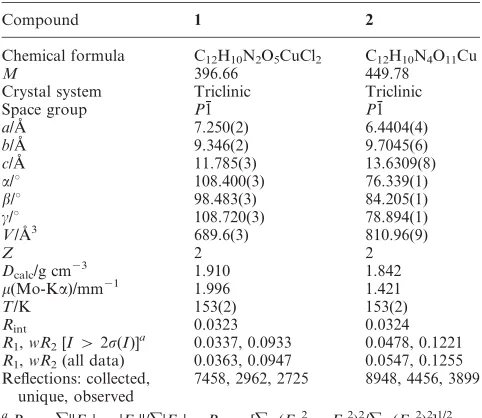
Crystal data and experimental details are summarised in Table 1. Single crystal analyses were performed at 153 K with a Bruker SMART APEX CCD diffractometer using graphite mono-chromated Mo-Ka radiation (l ~ 0.71073 A˚ ). A full sphere of data was obtained for each using the omega scan method. Data were collected, processed, and corrected for Lorentz and polarization effects using SMART and SAINT-NT software.12 Absorption corrections were applied using SADABS.12The structures were solved using direct methods
and refined with the SHELXTL program package.12All non-hydrogen atoms were refined anisotropically. Aromatic hydrogen atoms were assigned to calculated positions with isotropic thermal parameters fixed at 1.2 times that of the attached carbon atom. Carboxylic acid and water hydrogen atoms were located from difference maps and refined subject to
O–H distance restraints. Despite the quality of the refinement for2(R1~0.0478), a relatively large residual peak of 3 e A˚23
was observed in a chemically implausible position. This is most likely due to a disorder in the crystal where the 3 e A˚23residual denotes the metal atom position of a disordered component at low occupancy. Twinning might be another reason for this anomaly, however there was no evidence of a second lattice in the CCD diffraction images.
CCDC reference numbers 256268 (1) and 256269 (2). See http://www.rsc.org/suppdata/ce/b4/b417520d/ for crys-tallographic data in CIF or other electronic format.
Magnetic susceptibility measurements
Variable temperature magnetic susceptibility measurements (300–4.2 K) were performed upon powdered samples of 1at field strength of 1 T using a Quantum Design M.P.M.S. Squid magnetometer following previously reported procedures.13
Diamagnetic corrections for ligand susceptibilities were made using Pascal’s constants and a value of 6061026cm3mol21 was used for the temperature-independent paramagnetism of the Cu(II) ion.14
Results and discussion
Synthesis
As part of our ongoing studies into the coordination chemistry of H2dcbp, we were interested in the synthesis of metal
complexes of it following a procedure previously described by Pakkanen who synthesized [Ru(H2dcbp)3]Cl2.15Their interests
lay in the photophysical aspects of this compound as Ru(II)–
H2dcbp complexes have been employed as dye sensitisers in
the development of the Graetzel solar cell.16 Their synthetic method involved hydrothermal reactions under acidic condi-tions and returned the above complex with the ligand in its protonated form. Whilst we have reported unsuccessful attempts to retrieve analogous Fe(II) and Co(II) complexes
following this method,8a reactions using Cu(II) proved
successful and prompted the current study.17
CuCl2 and H2dcbp were reacted under solvothermal
conditions in aqueous hydrochloric acid solution at 200 uC for 5 hours. Blue-green crystals were obtained directly from the mother liquor in approximately 87% yield following slow cooling to room temperature. An infrared spectrum showed the presence of H2dcbp (n(CLO) 1729 cm21) and water (broad
[image:2.595.304.545.64.273.2]bands above 3100 cm21). Partial micro-analytical data were
Table 1 Crystallographic data for1and2
Compound 1 2
Chemical formula C12H10N2O5CuCl2 C12H10N4O11Cu
M 396.66 449.78
Crystal system Triclinic Triclinic
Space group P1¯ P1¯
a/A˚ 7.250(2) 6.4404(4)
b/A˚ 9.346(2) 9.7045(6)
c/A˚ 11.785(3) 13.6309(8)
a/u 108.400(3) 76.339(1)
b/u 98.483(3) 84.205(1)
c/u 108.720(3) 78.894(1)
V/A˚3 689.6(3) 810.96(9)
Z 2 2
Dcalc/g cm23 1.910 1.842
m(Mo-Ka)/mm21
1.996 1.421
T/K 153(2) 153(2)
Rint 0.0323 0.0324
R1,wR2[Iw2s(I)]a 0.0337, 0.0933 0.0478, 0.1221
R1,wR2(all data) 0.0363, 0.0947 0.0547, 0.1255
Reflections: collected, unique, observed
7458, 2962, 2725 8948, 4456, 3899
a
R1~g||Fo|2|Fc||/g|Fo|,wR2~[gw(Fo22Fc2)2/gw(Fo2)2]1/2.
CrystEngComm, 2005, (13), 90–95
Downloaded by University of Southampton on 10/04/2013 10:51:03.
consistent with a 1 : 1 Cu : H2dcbp stoichiometry which
reflected that used in the synthesis. The crystals were suitable for a single crystal X-ray diffraction study and the structure determined to be a chloride-bridged Cu(II) dimer:
{[Cu(H2dcbp)(Cl)2]?H2O}2 1. Numerous reactions were
per-formed employing various Cu(II) salts whilst maintaining the
same mineral acid (HCl). In all instances crystalline samples of the chloride-bridged dimer,1, were returned and thus, it may be concluded that the acid provides the anion regardless of the metal salt employed. Similarly, changing the Cu(II) : H2dcbp
ratio to 1 : 2 or 1 : 3 also returned crystalline samples of1as the only identifiable product.
Analogous reactions employing Cu(NO3)2 and H2dcbp in
aqueous HNO3, returned a blue solution from which small blue
crystals were isolated upon standing in 53% yield. Again IR and elemental analyses were consistent with a 1 : 1 Cu(II) :
H2dcbp composition and this was verified by a single crystal
X-ray diffraction study which determined the following formulation, [Cu(H2dcbp)(NO3)2(H2O)]2.
The same reaction was performed using [Cu2(OAc)4(H2O)2]
in aqueous glacial acetic acid in an attempt to prepare a corresponding acetate complex which again yielded a crystal-line product. Single crystal X-ray diffraction, IR and micro-analytical data identified the product as {[Cu(dcbp)(H2O)2]?
2H2O}, a 2D coordination polymer which we have previously
reported.8aDespite the presence of acetic acid, the ligand was deprotonated during the reaction, and is probably a conse-quence of the acetic acid being a weaker acid than either hydrochloric or nitric acid.
Crystal structure of 1
The atomic numbering scheme and atom connectivity for1are shown in Fig. 1. The structure of1was refined in the triclinic P1¯ space group and crystallographic details are given in Table 1. The structure of1consists of a chloride-bridged Cu(II)
dimer, in which the H2dcbp ligand remains protonated. The
geometry around the copper atom is square pyramidal with the equatorial positions occupied by the chelating H2dcbp nitrogen
atoms, a bridging chloride atom and a monodentate chloride atom, and the apical position occupied by another bridging chloride atom. Equatorial bond lengths come in sets of two, the copper to bipyridyl nitrogen, which average 2.03 A˚ , and the copper to chloride, which average 2.27 A˚ . Jahn–Teller distortion is clearly present with the axial bond length (2.6929(8) A˚ ) considerably longer than the equatorial bond lengths. Selected bond lengths and angles are presented in Table 2. Further distortion from ideal square-based pyramidal geometry, arises from the bite angle of the H2dcbp nitrogen atoms (N1–Cu1–N2 79.77(7)u). The copper
atom is only slightly shifted from the N2Cl2basal plane; being
displaced 0.053 A˚ towards the axially coordinated chloride
atom. The two halves of the dimer unit are related by inversion, with the inversion centre being at the midpoint between the two copper atoms. The Cl1 atoms bridge the two halves of the complex in a step-wise fashion; with the bipyridine rings sitting perpendicular to the Cu2Cl2bridging plane. The metal-to-metal
separation in the dimer unit is 3.4441(8) A˚ . The copper atoms and the bridging chloride atoms sit in the same plane, with no deviation from planarity, and this results in a chloride–chloride separation of 3.617(3) A˚ . The pyridine rings of H2dcbp are
virtually coplanar with a negligible ca. 0.8u torsion angle between them. The carboxylate group about C11 is coplanar with the aromatic ring to which it is attached, whereas the carboxylate group about C12 is twisted by ca. 15.0u to its corresponding aromatic ring. In contrast to those complexes that contain the deprotonated dcbp22 ligand,7a,8a and as expected for protonated carboxylic acids, there are two sets of C–O bond lengths: the carbon to hydroxyl oxygen single bond, which average 1.32 A˚ , and the carbon to carbonyl oxygen double bond, which average 1.21 A˚ .
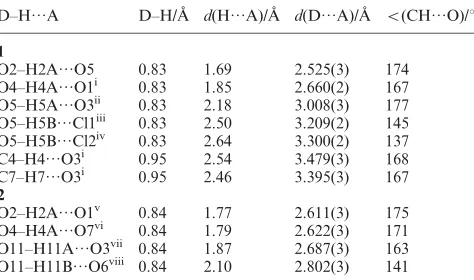
The dinuclear complexes are linked into a 3D network through hydrogen bond interactions. There are seven unique hydrogen bonds and details of these are gathered together in Table 3. The protonated carboxylic oxygen atom, O4, donates a hydrogen bond to the O1 carboxylic acid oxygen atom of an adjacent complex, while the protonated carboxylic oxygen atom, O2, donates a hydrogen bond to the lattice water molecule, O5. The lattice water molecule, O5, is a hydrogen bond donor to the O3 carboxylic acid oxygen atom on an adjacent complex, and to two chloride atoms on adjacent complexes in a bifurcated manner. The H5B proton sits between a bridging chloride atom, Cl1, and a monodentate chloride atom, Cl2, on that same complex. According to hydrogen-acceptor distances, the former is the major compo-nent of the bifurcated hydrogen bond (H5B…Cl1 2.50 A˚ , H5B…Cl2 2.64 A˚ ). The first three hydrogen bonds can be
[image:3.595.308.549.66.218.2]Fig. 1 Molecular structure and atomic labelling scheme for1. The O2–H2A…O5 hydrogen bond is highlighted in blue. Bipyridyl hydrogen atoms omitted for clarity.
Table 2 Selected bond lengths (A˚ ) and angles (u) for1and2
1
Cu1–N1 2.024(2) Cu1–Cl1i 2.2846(7)
Cu1–N2 2.035(2) Cu1–Cl2 2.2461(7)
Cu1–Cl1 2.6929(8) Cu1…Cu1i 3.4441(8)
N1–Cu1–N2 79.77(7) N2–Cu1–Cl1 94.20(6) N1–Cu1–Cl1 95.33(6) N2–Cu1–Cl2 168.98(6) N1–Cu1–Cl1i 169.97(6) Cl1–Cu1–Cl2 95.44(3) Cu1–Cl1–Cu1i 87.16(2) Cl1–Cu1–Cl1i 92.84(2) 2
Cu1–N1 1.985(2) Cu1–O10 1.984(2)
Cu1–N2 1.986(2) Cu1–O11 1.983(2)
Cu1–O7 2.231(2) Cu1…O8 2.610(2)
[image:3.595.53.289.617.749.2]N1–Cu1–N2 81.78(9) O7–Cu1–O10 78.57(8) N1–Cu1–O7 96.46(9) O7–Cu1–O11 89.41(9) N1–Cu1–O10 95.94(9) N2–Cu1–O7 112.66(8) N1–Cu1–O11 172.21(9) N2–Cu1–O10 168.69(9)
Table 3 Parameters of hydrogen bonding interactions within1and2
D–H…A D–H/A˚ d(H…A)/A˚ d(D…A)/A˚ v(CH…O)/u
1
O2–H2A…O5 0.83 1.69 2.525(3) 174
O4–H4A…O1i 0.83 1.85 2.660(2) 167 O5–H5A…O3ii 0.83 2.18 3.008(3) 177
O5–H5B…Cl1iii 0.83 2.50 3.209(2) 145 O5–H5B…Cl2iv 0.83 2.64 3.300(2) 137
C4–H4…O3i 0.95 2.54 3.479(3) 168
C7–H7…O3i 0.95 2.46 3.395(3) 167
2
O2–H2A…O1v 0.84 1.77 2.611(3) 175
O4–H4A…O7vi 0.84 1.79 2.622(3) 171
O11–H11A…O3vii 0.84 1.87 2.687(3) 163 O11–H11B…O6viii 0.84 2.10 2.802(3) 141
CrystEngComm, 2005, (13), 90–95
Downloaded by University of Southampton on 10/04/2013 10:51:03.
[image:3.595.310.547.640.780.2]described as being of moderate strength, whereas the latter fall into the weak hydrogen bond category.18
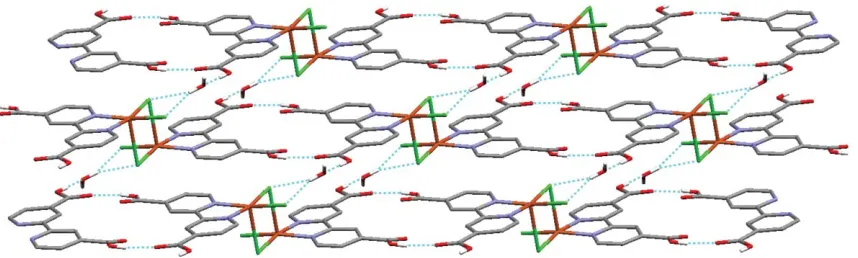
The carboxylic acid interaction (O4–H4A…O1) links the complexes into infinite 1D chains as shown in Fig. 2. These ladders are stepped due to the nature of the dinuclear species. Coplanar H2dcbp ligands on adjacent complexes are doubly
hydrogen bonded together forming a centrosymmetric R2 2(22)
motif, with the two O3 carboxylic acid oxygen atoms pointing into the middle of the ring.19This results in steric repulsion, which forces the carboxylic acid groups to twist with respect to the aromatic ring to which they are attached as noted above. By virtue of its position, O3 acts as a hydrogen bond acceptor from two pyridyl C–H groups (C4–H4…O3 and C7–H7…O3) that further support the R2
2(22) motif. Fig. 2 shows how the chains
are then hydrogen bonded through the lattice water molecule (O2…O5…Cl1/Cl2) to form stepped 2D sheets. Small overlap of the H2dcbp ligands on adjacent ladders gives rise to p–p
interactions, with a separation at closest contact of 3.277(3) A˚ , which reinforces the hydrogen bonded network. The water molecules are aligned within the 2D sheet such that H5A projects either above or below it and forms a hydrogen bond to the carboxylic acid oxygen atom, O3, within adjoining sheets. This interaction connects the sheets into a 3D hydrogen bonded network.
Crystal structure of 2
The atomic numbering scheme and atom connectivity for2are shown in Fig. 3. The structure of2was refined in the triclinic P1¯ space group and crystallographic details are given in Table 1. The structure of 2consists of discrete mononuclear [Cu(H2dcbp)(NO3)2(H2O)] species with square-pyramidal
geo-metry about Cu1. The four basal positions of the pyramid are occupied by the bipyridyl nitrogen atoms, N1 and N2, and two
oxygen atoms, one from a coordinated nitrate anion, O10, and the second, O11, from a coordinated water molecule. An oxygen atom, O7, from a second coordinated nitrate anion occupies the apical position of the pyramid. As anticipated by the Jahn–Teller theorem, the axial bond length (Cu1–O7 2.231(2) A˚ ) is longer than the basal bond lengths (average 1.985 A˚ ). The oxygen atom O8 is further distant from Cu1 (Cu1…O8 2.610(2) A˚ ) and projects over the base of the pyramid and is only weakly interacting with Cu1. Selected bond lengths and angles are given in Table 2.
The pyridyl rings of the H2dcbp ligand are slightly twisted by
ca. 2.4u to each other. More pronounced distortion from planarity arises from the twisting of the carboxylate groups with respect to the aromatic rings to which they are attached, with C11ca.13.2uand C12ca.15.2uremoved from planarity. The carboxylic acid groups remain protonated, as evident from consideration of the C–O bond lengths, with the carbon to hydroxyl oxygen distances (C11–O2 1.284(3) A˚ , C12–O4 1.314(3) A˚ ) being longer than the carbon to carbonyl oxygen ones (C11–O1 1.247(3) A˚ , C12–O3 1.213(3) A˚). The two coordinated nitrate anions provide the charge balance for the complex. Unlike that found in 1, where the chloride anions bridge between Cu(II) centres, the nitrate anions in 2adopt
monodentate coordination modes and thus only discrete metal complexes are formed. The N–O bond lengths are longer for the coordinated oxygen atoms (N3–O7 1.287(3) A˚ , N4–O10 1.293(3) A˚ ) than for the non-coordinated oxygen atoms, which have similar bond lengths to each other due to delocalisation [N3–O5 1.232(3) A˚ , N3–O6 1.235(5) A˚, N4–O9 1.231(3) A˚]. The N4–O8 bond length (1.240(3) A˚ ) is also quite short attesting to the weakness of the Cu1…O8 interaction.
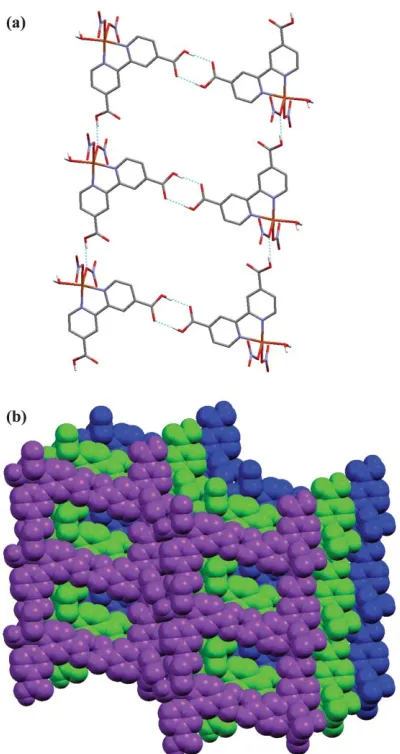
There are four unique hydrogen bonds in2and details of these are gathered together in Table 3. Each discrete complex interacts with six neighbours through hydrogen bonding. The carboxylic acid centred on C11 participates in a self-complementary hydrogen bond interaction with its neighbour such that the oxygen atom O2 is the hydrogen bond donor to O1 (O2–H2A…O1). The carboxylic acid oxygen atom, O4, is a hydrogen bond donor to the nitrate oxygen atom, O7 (O4–H4A…O7). The coordinated water molecule donates two hydrogen bonds: one to the carboxylic acid oxygen atom, O3 (O11–H11A…O3), and another to the nitrate oxygen atom, O6 (O11–H11B…O6). Two [Cu(H2dcbp)(NO3)2(H2O)] complexes
[image:4.595.84.513.51.180.2]are connected through the self-complementary carboxylic acid synthon. These extend to form a 1D ladder in combination with the hydrogen bond interaction between the other carboxylic acid and the nitrate anion of an adjacent complex, as shown in Fig. 4a. Further hydrogen bonding between the coordinated water molecule and a carboxylic acid group (O11–H11A…O3) of the ladder above, and between that water and the nitrate anion (O11–H11B…O6) of an adjacent ladder, links them into a 3D network, Fig. 4b. The apparent ‘voids’ between the steps
Fig. 2 The stepped chains in1generated through the carboxylic acid interaction (O4–H4A…O1). Hydrogen bonding between chainsviathe water molecule (O2–H2A…O5, O5–H5B…Cl1 and O5–H5B…Cl2) generates a 2D sheet. The second hydrogen atom from the water molecule, H5A, projects above and below the sheet and connects adjacent sheetsviaO5–H5A…O3 to form a 3D hydrogen bonded network. Bipyridyl hydrogen atoms omitted for clarity. Click here to access a 3D image of Fig. 2.
Fig. 3 Molecular structure and atomic labelling scheme for2. Bipyridyl hydrogen atoms omitted for clarity.
CrystEngComm, 2005, (13), 90–95
Downloaded by University of Southampton on 10/04/2013 10:51:03.
[image:4.595.52.286.599.757.2]of a ladder are filled by the interdigitation of a nitrate anion (centred on N4) from the ladders above and below. Offset face-to-face p–pinteractions also occur between the pyridyl rings (the N1 ring overlays the N2 ring) of adjacent stacked ladders with a separation at closest contact of 3.515(4) A˚ . There is no residual solvent accessible area within 2 attesting to the efficiency of the packing.
Magnetic properties of 1
The dimeric nature of1prompted us to undertake a variable temperature magnetic susceptibility study over the temperature range 4.2–300 K in order to elucidate the nature of any interaction across the chloride bridges. A plot ofmeffvs.T is
shown in Fig. 5. Compound 1 displayed typical Curie behaviour between 290 and 100 K remaining practically invariant with temperature at a value of ca. 1.95 mB, as
would be expected for two magnetically isolated spin doublets. A decrease occurred below these temperatures resulting in a value of 0.80mBat 4.2 K. This behaviour is typical of a very
weak antiferromagnetically coupled system. The data were adequately described through a simple Bleaney–Bowers20 expression for a Cu(II) dimer, derived through the isotropic
Hamiltonian H ~ 2J S1S2 where J is the exchange
coupling parameter and S1 ~ S2 ~ ½ (interacting local
spins). Least-squares fitting leads to the following parameters: J ~ 23.02 cm21, g ~ 2.21 and R ~ 5.1 6 1026 (R is
the agreement factor defined asSi[(xmT)obs(i) 2(xmT)calc(i)] 2
/ Si[(xmT)obs(i)]2).
The very weak interaction found here is best explained if we consider the magnetic orbital to be of the dx22y2 type. The
magnitude of the interaction then probably results from the fact that the chloride bridge involves an axial–equatorial orthogonal combination, so a ferromagnetic term might be anticipated, and this would offset any antiferromagnetic term and account for its weak nature.21 The magnitude of the coupling here is in accord with other Cu(II) complexes featuring
this bridging disposition.22 Indeed, Hatfield and Hodgson22 and more recently Corbella and co-workers23have summarized the magnetic data pertaining to di-chloro-bridged Cu(II) dimers
of which 1 is a new member. Hatfield has shown that the singlet–triplet gap in such compounds varies regularly with the quantityQ/R, whereQis the Cu–Cl–Cu’bridging angle andRis the longer Cu–Cl distance. If this quantity lies outside the range 32.6–34.8uA˚21the exchange interaction is anti-ferromagnetic, whereas if it lies within this range it is expected to be ferromagnetic in nature. Several other workers have also verified the validity of the relationship.24In the current instance Q/R for 1 is 32.36u A˚21 and therefore an antiferromagnetic exchange interaction is fully anticipated and indeed is observed.
Conclusion
We have shown that two polymers {[Cu(H2dcbp)(Cl)2]?H2O}2
1and [Cu(H2dcbp)(NO3)2(H2O)]2, may be readily synthesised
through the hydrothermal reaction, under the relevant acidic conditions, of Cu(II) and H2dcbp. The structures of1and 2
have been elucidated and the nature of the intermolecular interactions discussed. Very weak antiferromagnetic coupling was found to be operative within1(J~23.02 cm21
). The current study advances our knowledge of the coordinat-ing and hydrogen bondcoordinat-ing capabilities of H2dcbp. In our
previous investigations we employed neutral or basic condi-tions, whereas in the present work we deliberately used acidic solutions. It has been previously shown that pH may have an effect on the dimensionality of the resulting structure when employing acidic ligands, with low pH typically leading to low dimensional structures, while higher pH typically leads to higher dimensionality networks.25Under the acidic conditions
employed here, the H2dcbp ligand remains protonated and
therefore cannot coordinate to metal ions through the carboxylic acid groups. Thus,1and2are low dimensionality coordination complexes. However, as anticipated the H2dcbp
ligand does retain the capacity to participate in hydrogen bonding, and thus, the low dimensional complexes are linked into 3D networks through hydrogen bond interactions mediated by the carboxylic acid groups, water molecules and coordinated anions. The isolation of different coordination
Fig. 4 (a) The ladder in2generated through the carboxylic acid hydrogen bond interactions (O2–H2A…O1) and (O4–H4A…O7). Bipyridyl hydrogen atoms omitted for clarity. Click here to access a 3D image of Fig. 4a.(b)Hydrogen bonding between ladders (O11– H11A…O3 and O11–H11B…O6) forms a 3D network. Bipyridyl hydrogen atoms omitted for clarity.
Fig. 5 The magnetic moment for1(per Cu)vs. temperature. The solid line is that calculated using the parameters outlined within the text.
CrystEngComm, 2005, (13), 90–95
Downloaded by University of Southampton on 10/04/2013 10:51:03.
[image:5.595.72.272.48.425.2] [image:5.595.323.535.50.208.2]motifs in1and2(a dimervs. a discrete complex) is probably a consequence of the dissimilar coordination abilities of the anions, and the nature of the extended networks. We have also shown that it is the acid that provides the anion required for charge balance irrespective of which Cu(II) precursor is present
and this most likely stems from the acid (and therefore the anion) being present in large excess. In previous structurally characterised examples incorporating the H2dcbp ligand, the
deprotonated ligand provided charge balance and negated the requirement for additional anions. Therefore, an exploration into the various roles anions of dissimilar coordination behaviour may play in the formation of networks incorporat-ing H2dcbp should be very rewarding. We are currently
extending our studies to incorporate other transition metal ion and anion/acid combinations. The results from these studies will be reported in due course.
Acknowledgements
Financial support from Enterprise Ireland by way of a Postdoctoral Fellowship (P. J.) and Postgraduate Scholarship (E. T.) (SC/2001/227), the Trinity College Dean of Research Start-up and maintenance grants, and an Australian Research Council Discovery grant (K. S. M.) are gratefully acknowl-edged. We also thank the referees for their insightful and constructive comments.
References
1 (a) M. Eddaoudi, D. B. Moler, J. Li, B. L. Chen, T. M. Reineke, M. O’Keeffe and O. M. Yaghi,Acc. Chem. Res., 2001,34, 319; (b) S. R. Batten and R. Robson,Angew. Chem. Int. Ed., 1998,37, 1461; (c) S. R. Batten,CrystEngComm., 2001,3, 67; (d) C. Janiak, Dalton Trans., 2003, 2781; (e) B. J. Holliday and C. A. Mirkin, Angew. Chem. Int. Ed, 2001, 40, 2022; (f) G. F. Swiegers and J. Malefetse,Chem. Rev., 2000,100, 3483; (g) R. Robson,J. Chem. Soc., Dalton Trans., 2000, 3735; (h) S. Kitagawa, R. Kitaura and S. Noro,Angew. Chem. Int. Ed., 2004,43, 2334; (i) L. Brammer, Chem. Soc. Rev., 2004,33, 476.
2 (a) C. B. Aakeroy and A. M. Beatty,Aust. J. Chem., 2001,54, 409; (b) A. M. Beatty,CrystEngComm., 2001,3, 243; (c) A. D. Burrows, C. W. Chan, M. M. Chowdry, J. E. McGrady and D. M. P. Mingos, Chem. Soc. Rev., 1995, 329; (d) K. Biradha,CrystEngComm., 2003,
5, 374; (e) L. Brammer, in Crystal Design: Structure and Function, Perspectives in Supramolecular Chemistry, ed. G. R. Desiraju, Wiley, Chichester, 2003, vol. 7, pp. 1–75; (f) D. Braga, L. Maini, M. Polito, L. Scaccianoce, G. Cojazzi and F. Grepioni,Coord. Chem. Rev., 2001,216–217, 225.
3 (a) B. L. Chen, M. Eddaoudi, S. T. Hyde, M. O’Keeffe and O. M. Yaghi, Science, 2001, 291, 1021; (b) N. L. Rosi, M. Eddaoudi, J. Kim, M. O’Keeffe and O. M. Yaghi, CrystEng-Comm, 2002, 4, 401; (c) M. E. Braun, C. D. Steffek, J. Kim, P. G. Rasmussen and O. M. Yaghi,Chem. Commun., 2001, 2532; (d) S. A. Bourne, J. J. Lu, A. Mondal, B. Moulton and M. J. Zaworotko, Angew. Chem. Int. Ed., 2001, 40, 2111; (e) M. Oh, G. B. Carpenter and D. A. Sweigart, Chem. Commun., 2002, 2168.
4 (a) O. M. Yaghi, M. O’Keeffe, N. W. Ockwig, H. K. Chae, M. Eddaoudi and J. Kim,Nature, 2003,423, 705; (b) S. L. James, Chem. Soc. Rev., 2003, 32, 276; (c) B. Moulton and M. J. Zaworotko,Chem. Rev., 2001,101, 1629; (d) C. N. R. Rao, S. Natarajan and R. Vaidhyanathan,Angew. Chem. Int. Ed., 2004,
43, 1466.
5 (a) M. E. Chapman, P. Ayyappan, B. M. Foxman, G. T. Yee and W. B. Lin,Cryst. Growth Des., 2001,1, 159; (b) C. B. Aakeroy, A. M. Beatty and D. S. Leinen,Angew. Chem. Int. Ed., 1999,38, 1815; (c) R. Sekiya and S. Nishikiori,Chem. Commun., 2002, 2612; (d) C. B. Aakero¨y, A. M. Beatty, D. S. Leinen and K. R. Lorimer, Chem. Commun., 2000, 935; (e) C. B. Aakero¨y, A. M. Beatty and K. R. Lorimer,J. Chem. Soc., Dalton Trans., 2000, 3869. 6 (a) C. Kaes, A. Katz and M. W. Hosseini,Chem. Rev., 2000,100,
3553; (b) M. D. Ward, J. A. McCleverty and J. C. Jeffery,Coord. Chem. Rev., 2001,222, 251; (c) V. Balzani and A. Juris,Coord. Chem. Rev., 2001,211, 97.
7 (a) E. Tynan, P. Jensen, P. E. Kruger and A. C. Lees, Chem. Commun., 2004, 776; (b) E. Tynan, P. Jensen, N. R. Kelly, P. E. Kruger, B. Moubaraki and K. S. Murray,Dalton Trans., 2004, 3440; (c) see also T. Schareina, C. Schick and R. Kempe, Z. Anorg. Allg. Chem., 2001,627, 1711; T. Schareina, C. Schick, B. F. Abrahams and R. Kempe,Z. Anorg. Allg. Chem., 2001,627, 131; Y. H. Liu, Y. L. Lu, H. C. Wu, J. C. Wang and K. L. Lu, Inorg. Chem., 2002,41, 2592
8 (a) E. Tynan, P. Jensen, P. E. Kruger, A. C. Lees and M. Nieuwenhuyzen, Dalton Trans., 2003, 1223; (b) see also C. J. Matthews, M. R. J. Elsegood, G. Bernardinelli, W. Clegg and A. F. Williams,Dalton Trans., 2004, 492.
9 (a) P. E. Kruger, G. D. Fallon, B. Moubaraki and K. S. Murray, J. Chem. Soc., Dalton Trans., 2000, 713; (b) P. E. Kruger, N. Martin and M. Nieuwenhuyzen,J. Chem. Soc., Dalton Trans., 2001, 1966; (c) R. P. Doyle, P. E. Kruger, M. Julve, F. Lloret and M. Nieuwenhuyzen,Inorg. Chem., 2001,40, 1726; (d) P. E. Kruger, H. Grove, M. Julve, F. Lloret, K. W. Tornroos and J. Sletten, Inorg. Chim. Acta, 2001,325, 115; (e) R. P. Doyle, P. E. Kruger, M. Julve, F. Lloret and M. Nieuwenhuyzen, CrystEngComm, 2002,4, 13; (f) J. Keegan, P. E. Kruger, M. Nieuwenhuyzen and N. Martin, Cryst. Growth Des., 2002,2, 329; (g) R. P. Doyle, P. E. Kruger, B. Moubaraki, K. S. Murray and M. Nieuwenhuyzen,Dalton Trans., 2003, 4230; (h) B. Conerney, P. Jensen, P. E. Kruger, B. Moubaraki and K. S. Murray, CrystEngComm, 2003,5, 454.
10 S. Feng and R. Xu,Acc. Chem. Res., 2001,34, 239.
11 A. R. Oki and R. J. Morgan,Synth. Commun., 1995,24, 4093. 12 SMART and SAINT-NT, programs for data collection and data
reduction, Bruker-AXS, Madison, WI, 1998; G. M. Sheldrick, SHELXTL Version 5.0, A System for Structure Solution and Refinement, Bruker-AXS, Madison, WI, 1998.
13 P. E. Kruger, G. Fallon, B. Moubaraki, K. J. Berry and K. S. Murray,Inorg. Chem., 1995,34, 4808.
14 A. Earnshaw,Introduction to Magnetochemistry, Academic Press, London, 1968.
15 E. Eskelinen, S. Luukkanen, M. Haukka, M. Ahlgren and T. A. Pakkanen,J. Chem. Soc., Dalton Trans., 2000, 2745. 16 M. Gratzel,Nature, 2001,414, 338 and references therein. 17 E. Tynan,Coordination and Hydrogen Bonded Networks Featuring
4,4’-dicarboxy-2,2’-bipyridine, Ph.D. Thesis, University of Dublin, 2004.
18 T. Steiner,Angew. Chem. Int. Ed., 2002,41, 49. 19 M. C. Etter,Acc. Chem. Res., 1990,23, 120.
20 B. Bleaney and K. D. Bowers,Proc. R. Soc. London, Ser. A, 1952,
214, 451.
21 O. Kahn,Molecular Magnetism, VCH, New York, 1993. 22 (a) W. E. Marsh, W. E. Hatfield and D. J. Hodgson,Inorg. Chem.,
1982,21, 2679; (b) W. E. Marsh, K. C. Patel, W. E. Hatfield and D. J. Hodgson,Inorg. Chem., 1983,22, 511.
23 M. Rodriguez, A. Llobet and M. Corbella,Polyhedron, 2000,19, 2483.
24 (a) F. Tuna, L. Patron, Y. Journeaux, M. Andruh, W. Plass and J. C. Trombe,J. Chem. Soc., Dalton Trans., 1999, 539.
25 L. Pan, T. Frydel, M. B. Sander, X. Huang and J. Li,Inorg. Chem., 2001,40, 1271.
CrystEngComm, 2005, (13), 90–95
Downloaded by University of Southampton on 10/04/2013 10:51:03.