Rochester Institute of Technology
RIT Scholar Works
Theses Thesis/Dissertation Collections
5-16-2016
Third Eye
Nadine Longmore
Follow this and additional works at:http://scholarworks.rit.edu/theses
This Thesis is brought to you for free and open access by the Thesis/Dissertation Collections at RIT Scholar Works. It has been accepted for inclusion in Theses by an authorized administrator of RIT Scholar Works. For more information, please [email protected].
Recommended Citation
The ROCHESTER INSTITUTE OF TECHNOLOGY
A Thesis Submitted to the Faculty of
The College of Imaging Arts and Sciences
School of Art
In Candidacy for the Degree of
MASTER OF FINE ARTS in Fine Arts Studio
THIRD EYE
By
Nadine Longmore
Chief Advisor ____Luvon Sheppard_________
__________________________________
(Signature)
Date: ____________________
Associate Advisor _______Alan Singer____________
_______________________________
(Signature)
Date: ____________________
Associate Advisor _______Carole Woodlock_____________
_______________________________
(Signature)
Date: ____________________
Chair, School of Art ______Glen Hintz_____________________
___________________________
(Signature)
Contents
Title page i
Signature page ii
Table of Contents iii
Abstract iv
List of Illustrations v
Introduction 6
Section I: Discussion of Personal Background 7-12 Being A Twin 7
Eyesight 8
Discussion of Philosophical Ideas 10
Section II: Artist and Inspirations 12-13 Section III: Evolution 13-18 Section IV: The Body of Work 18-24 Monoprints 18
Acrylic paintings 22
Diptychs 23
Conclusion 26
Illustrations 28
Abstract
The artwork completed as a part of my thesis exhibition is grounded in an investigation into perception, vision, intuitive art making, and the bond experienced between twins. The work comes from a personal place because art making, for me, has always been about self-understanding. For that comprehension to be holistic and far-reaching, I seek to recognize the sentimental, phenomenal, and physical ties created by being a twin.
This thesis exploration also creates an opportunity for the viewer to experience my visual inquiries into being a twin and my loss of eyesight. Seven years ago, I had a traumatic eye injury, which affected my lens and retina. The damage done was permanent, but it has given me a unique way of seeing the world. This new perception of double vision and blurriness is used as a language for art making, allowing my artwork to live in a place both real and unreal.
List of illustrations
Fig 1. Tumbling Down, Oil on Canvas, 2015 Fig 2. Chimera, halftone intaglio print, 2015 Fig 3. In the Green, Mezzotype, 2015
Fig 4. Monoprint I, Monotype with Chine-collé, 2015 Fig 5. Monoprint II, Monotype, 2015
Fig 6. Monoprint III, Monotype with Chine-collé, 2015 Fig 7. Monoprint IV, Monotype with Chine-collé, 2015 Fig 8. Cascade, Monotype, 2015
Fig 9. Monoprint in Yellow, Monotype, 2015 Fig 10. Lifted, Acrylic on oak plywood, 2016
Introduction
The goal within my thesis body of work was to create a series of abstract paintings and prints that explore the concepts of inner reflection, intuitive art making, sight, and emotive form. These visual elements, like line and shape, would reflect my sight, which deals with unclear and distorted imagery. These formal aspects of sight correlate with my experience as a twin. Blurred lines emulate the cohesive nature of our personalities and double vision shows the duality of being a twin, — always being grouped together, yet having contrasting opinions.
The challenge was found in translating my inner voice onto canvas or paper, and allowing the work to steer the viewer into state reflecting how I feel as a twin. The intent of both the paintings and prints is to transverse my mind, using my sight to create works that depict my phenomenal ties of being twin. I use diptychs and triptychs to spark conversations of why particular pieces were paired. This allows the audience to find the incorporeal and corporeal side of my relationship.
My vision reflects things that are real and unreal, both physical and
Section I:
Personal Background: Being a Twin
The two main points expressed in my artwork are my experience as a twin, and the ways in which my eyesight affects my perspective. These two things have been influential in my studio practice. Exploring my emotional bond as a twin manifests itself in my artwork through my altered sight. Knowing more about myself as twin and how my eyesight came to be is essential for deeper
understanding. The forms created my by sight have worked there way into many facets of my art, allowing me to articulate the bond I have as a twin.
Contrary to what most people think, my sister and I are fraternal (as opposed to identical) twins. Identical twins are one fertilized egg that splits and develops into two separate fetuses. These fetuses have the same genetic information. Fraternal twins, on the other hand, are two eggs fertilized by two sperm, which produce two genetically unique children. For my sister and me this has little influence on the connection we share.1.
In fact, most of the time we are mistaken for identical twins because we look so similar. Identical twins share the same genetics, so they often look
indistinguishable. Fraternal twins are genetically more like siblings and because of this will not resemble each other perfectly2. My sister and I share the same gender and an uncanny resemblance. Strangely enough, our identity as twins was
challenged even from an early age.
In one experience during our childhood, a stranger asked my sister and me if we were twins, and, if so, whether or not we were identical or fraternal. We
obviously replied fraternal, and she exclaimed, “No, you couldn’t be because you look so alike!” The woman walked away without believing us, and this happens a lot
1 “Twins: Identical and Fraternal,” www.betterhealth.vic.gov. Last modified August 2014,
with twins; it is all about how similar or dissimilar you look that holds significance in people’s minds.
Being called identical and being mistaken for each other is a common occurrence when you are a twin, but many factors other than genetic similarity go into our closeness. I have shared this world with someone for twenty-six years. We have lost our teeth, gotten the flu, and scraped our knees together. I have always had a best friend and sister by my side; she is a part of me as much as I am a part of her.
Eyesight
The secondary theme within my thesis is my eyesight. In October 2009, a knife glanced my eye, and sent me to the emergency room. I was working with a steak knife, cutting up a snack for my roommates, in our dorm room. I accidently dropped the knife and went to pick it up. As I stood up, knife in hand, my roommate grabbed my wrists, and shook me. She was excited about something and did not realize I was holding anything sharp. The knife hit my face, just barely glancing my eye.
The momentum of her shaking me or perhaps the shock of being hit in the face, made me stumble and fall. I clapped a hand over my face and as I stood my twin demanded to see my eye. I thought it was just a scratch because it didn’t seem bad. What was clear to my sister is that we needed to get to the hospital fast because my eye had fluid and blood streaming out.
Without my lens, my eyesight has had a drastic change because my eye
cannot process light and images as it used to. Typically, light moves from the front of the eye through the cornea to the lens. The lens focuses light to the retina. Then, the retina absorbs this information and transfers it to the brain through electrochemical impulses. The iris and pupil control how much light enters the eye and acts like the shutter in a camera. The shutter controls how much light can pass through the eye. When it is dark, the shutter allows in more light by expanding, and when it is bright it contracts to let in less light 3. The accident with the knife elongated my pupil and iris, irreparably damaging the cornea and lens.
Ostensibly, this means I have trouble controlling how much light is let into my left eye, making the world seem overly bright and unfocused. If you held two fingers in front of my face I could not see how many fingers you are holding up. I most likely could not see your hand, but seeing the color of your skin might be conceivable.
The redeeming quality here is that my right eye is healthy and has perfect vision, but still my overall sight is blurry. Our eyes work together to send images to our brain, which takes the two images and converts it into one. This is how we are able to have depth perception. When one eye is out of alignment or damaged your brain usually uses the better image and this means losing some depth perception and developing double vision.4 The specific nature of my injury means I have double vision, but it is too blurry to distinguish. Most of the time ignoring it is the best answer and this altered sight has become my new normal.
My eyesight affects my art directly. Upon close inspection, strategies and modes of creating imagery become clear to the viewer. Painting techniques that exploit blurring lines in a variety of ways are utilized, like dry brushing and scumbling. Many times forms within my vision become blown out, and blurriness occurs because of the two images I am seeing. This double vision allows me to
decide what reality I want to put into my artwork. At times, my vision is unfocused to the point of only perceiving traces of form, shape, and volume. This new sight allows me to create artwork differently than if I had 20/20 vision. I am able to gain a new perspective on the world and create arrangements in my work out of soft and hard shapes. I exploit my sight and use it to my advantage.
Discussion of Philosophical Ideas:
Third Eye is one of the first philosophical ideas applied to my work process. My thesis Third Eye, is a concept chosen for its connotation with sight – both actual and spiritual. Third Eye is a term also known as the inner eye, an invisible third eye that allows you to perceive things beyond your normal sight. In Hinduism, it has many spiritual connections and can refer to an energy point called a chakra. It is also used in New Age spirituality to symbolize enlightenment. Third Eye in New Age spirituality has links to mental visions that can reveal to people emotional and psychological images5.
In a way, I believe Third Eye is a state of mind I can enter while working on my artwork, to more fully experience my feelings. This belief analyzes my bond as a twin, almost like an outside viewer looking in. Gaining a new viewpoint is significant because much of what I am dealing with is indescribable. Enlisting the Third Eye as a philosophical inquiry supports my discovery of personal emotions and memories. Inner reflection with awareness helps discover what connections matter. The end goal is to reach a state of enlightenment. What I mean by this is an enlightenment of self, to become conscious of how my mind works; therefore, painting my sisterly bond becomes more attainable.
The second philosophical idea active in exploring my thesis work is intuition and intuitive art making. The nature of how I work is intuitive, which usually means meditating with the brush in hand, and in this way judgments or stress can be
5“Third Eye,” omicsgroup.org, last modified 2014,
released. The main use in my art for intuition is to become more open and receptive of my sensations. By sensations I mean mood, feelings, memories, and my
physical/mental state. This clarification allows for moments of self-examination, and it is at precisely this point I can ask myself the most important questions: Why am I feeling a certain way? What is the emotion I am feeling? What caused it? Who caused it? How did it happen? Where did it happen? From answering these questions, I find more meaning in something that seems otherwise spontaneous or habitual.
Introspection is another term for Third Eye. Introspection is used to learn about your current or recent past, as well as mental processes. Introspection looks deeper into the duality of a person’s physical states, and the human consciousness6. I find direct links of these contrasting concepts in my work. Using introspection and the Third Eye allows me to comprehend emotions and memories that are tied to my sister. Focusing all my energy on traversing my relationship with my twin is at the core of each painting. Within this body of work, each piece has complementary and opposing elements in which duality is at the heart. I use this physically and mentally in the work to mirror the nature introspection, but also the nature of what is factual in my sight and what is unreal. Using abstraction and intuitive art making along with a painterly hand creates a layered affect, in which a description of what it means to be a twin and the feelings associated with being a twin are located within the piece.
The last philosophical idea researched and applied to my thesis work is tacit knowledge. Tacit knowledge is a type of knowing in which you have known
someone for so long that thoughts or ideas can pass between you unsaid. This is something that can be observed and seen between two people, like the ability to finish another’s sentence, reading someone’s body language, and emotions. A good analogy to describe tacit knowledge is a perfect dance, and this can be applied to anyone who has this kind of long-term association and bond. Tacit knowledge is a part of the language I have found to describe what I share with my twin. This
concept shows the strength of our emotional and familial bond. This idea of personality or mannerisms mingling with another makes perfect sense to me because it happens daily with my sister. We share so many qualities that despite being individuals, we could almost be the same person finishing each other’s sentences and thoughts.
I am able to see this connection and use tacit knowledge in my work by employing intuition, introspection, and the Third Eye into my studio practice. I reflect on my thoughts and actions while making my work. I am able to come to conclusions of when my artwork represents how I feel as a twin through this
process. These philosophical ideas allow me to understand myself better as a visual artist. My work is communicating that being a twin lives in a state that is more than physical.
Section II
Artist and Inspirations
I am influenced by art from the past and present. The artists of the
Impressionist Movement have been great teachers. How the Impressionists read and captured light is exquisite. Impressionism deals with the transient effects of light and atmosphere. This movement of art allowed for fleeting moments within the landscape, giving a striking sensation within the scene7. My methods of painting are similar to the artists of this movement. My eyesight allows for vague color and shape, so I use this to my advantage and give a sensation of what could be a place or form. Painting this way allows me to visualize intangible aspects of being a twin. Formally this helps me create a scene within the creation. This is similar to
Impressionism because instead of evanescent moments within a landscape, I give the viewer a brief glimpse into my emotional connection as a twin.
Another movement of art that has resonated with me is Fauvism. Fauvists were interested in flatness and drawing attention to the surface where they laid the
paint on their support. They were also interested in recording light and atmosphere. The Fauvists rendering of the alteration of light throughout the day was similar to that of the Impressionists, but Fauvists focused more on the sensation caused by light. Cezanne was said to paint with his sensations. This means instead of painting what he saw in the landscape he painted how the landscape made him feel8.
Developing these aspects within my artwork draws attention to the surface of the painting. I use thick and thin paint. This dichotomy of textures brings
awareness to the surface quality of the work. I use both atmospheric and indoor perspective; certain areas of my paintings recede because they become lighter, and other times they look as if they recede because they become darker. The objective is to produce depth that pushes forwards and back. The physical movement in and out of the piece symbolizes how interwoven my sister and I are.
Both Impressionism and Fauvism are relevant today. The artists within these movements had a determination to create a new style in the face of opposition. These artists were dissatisfied with the classical training given at the time. The training that emphasized historical and mythological subject matter was not the art they wanted to explore and create9. Contemporary art is indebted to these artists for inspiring the notion that an artist can create whatever type of art they want. They showed that experimentation and going down paths that are lightly tread is okay. Because of these pioneers of art, I am allowed to create abstract paintings about sentimental bonds and psychological ties.
Section III: Evolution
8 Nikos Stangos, Concepts of Modern art : From Fauvism to Postmodernism ( London; Thames and Hudson Ltd., 1981), 11.
The ability to accept change is one of the greatest skills an artist can have. To keep growing means evolving, and learning something new. Stagnant art can lead to stopping art altogether. David Bayles writes10:
“What separates artists from ex-artists is that those who challenge their fears, continue; those who don’t quit… Art is like a sentence before you know it's ending. The risks are obvious: you may never get to the end of the
sentence at all-or having gotten there, you may not have said anything.”
My artistic practice is one that allows for growth and feedback in every direction. I do not want my artwork to become stale and boring. The book Art of Fear by David Bayles was a part of my research method for growth. Whenever I had self-doubt I would remember passages from this book. I engaged this with my artwork early on and started to try new things. Exploration, experimentation, and even failures affected the concepts I finally decided to work with.
Before this body of work, I did not consider myself an abstract painter. My previous paintings and drawings were all representational. My work was a true depiction of how a person or object looked in real life. I had no way of grasping how to make abstract art, but I felt led to make more art based on personal concepts. This new venture of art was uncomfortable but stimulating.
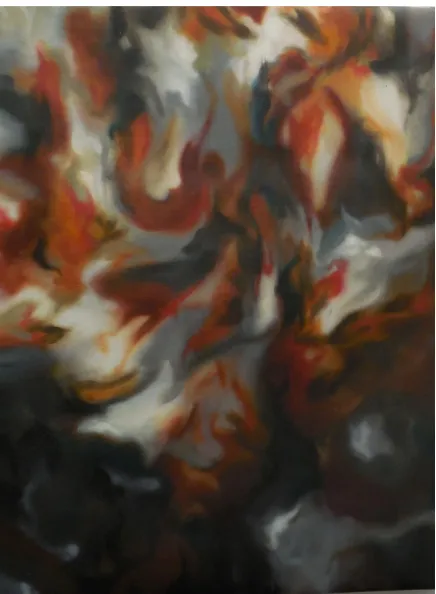
At the beginning of graduate school, I wanted to create impressions of personal feelings and memories. Communicating my own feelings and thoughts to others is challenging. When I was a child, artwork allowed me to articulate what I could not or would not vocalize. I am a passionate and empathetic person, so nostalgic paintings inspired by my emotions seemed right. The paintings made in the first year of graduate school were completed with oil on canvas. I used a soft blending technique called dry brushing to force the colors to bleed into each other, creating soft amorphous landscapes (fig 1). In these artworks, there are little to no hard edges. The discovery of what each piece meant occurred after the piece was completed. Whatever the painting brought to mind dictated how I assigned
significance. Some reminded me of childhood events, and others gave impressions of feelings. These components created context, but it was not personal enough. The themes within each piece were too broad. This created dissatisfaction and I went forward from this body of work ready to create something more unique.
Fig 1. Tumbling Down, Oil on Canvas, 2015
During the first semester, I also worked toward investigating and clarifying my art based on its concept. For most of my schooling and artistic career, I have been taught to speak of art formally. This means color, symmetry, balance, tone, value and focal point of a piece of art are talked about instead of what the art is supposed to express. It is crucial to have strong formal skills to make successful art.
However, I have found through conversation with others, that form alone is not enough. I did not contemplate the meaning of a piece before beginning.
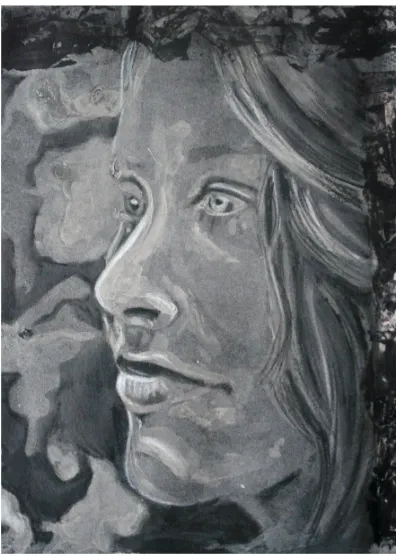
During the second semester of graduate school, I found myself drawn to printmaking. The opportunities to start making work on my own arose and it was intriguing that many processes allowed for a painterly hand. Almost immediately, a dichotomy became clear: I was both a painter and a printmaker. I decided that I was going to make a series of prints based on being a twin. This series would involve themes of repetition concerning our faces. Most of these prints were
representational, and dealt with how twins look. As I mentioned, the inherent similarities in appearance between my twin and me seemed to hold importance to others. I gave it prominence in the art by using the same pictures multiple times. Through playing with this motif, a transformation was taking place through intaglio printmaking processes. A versatility of image was starting to emerge. I started creating works that were less representational.
One moment that spurred me to pursue abstraction for my Thesis was a conversation with my printmaking professor. Keith Howard recognized my need to explore myself as a twin because he himself was a twin. He was close to his brother who had recently passed away. There were times when I talked about my
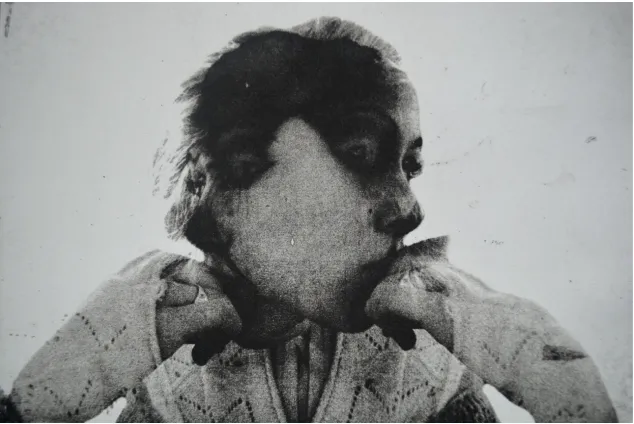
Fig 3. In the Green, Mezzotype, 2015
I came to the determination that through my art I was trying to bring my twin closer. Obviously, I missed her because it was only recently that I moved away from home. I no longer have the opportunity to see her or talk with her everyday. The less obvious reason (and the reason why my thesis came to fruition) is that Keith Howard made me realize that there would be a point in my life where my sister would no longer be with me. This idea of separation and the notion that she would no longer be there was difficult to bear, leaving my chest hurting and eyes stinging.
I started to create abstract monoprints to produce work that would allow the viewer to see more than just a face or faces. Most of the prints came in pairs or trios. These diptychs and triptychs were about comparing what was within each piece. The colors and forms themselves became more emotive; my vocabulary of abstraction was growing. The abstraction of our faces started to replace
Fig 2. Chimera, halftone intaglio print, 2015
During the summer before my thesis year, a lot of experimentation
transpired based on my experience as a twin. Even though the idea was understood, I lacked the artistic language to fully describe it. I was still torn between abstract and representational art even after my revelations in printmaking. Being new to abstract art meant falling back on creating portraits because they were familiar.
To overcome this, I started to produce many small abstract paintings. These paintings were no larger than 8”x10”. At the same time portraits were being made showcasing my twin and me. The idea was to create a repetitive style of portraiture, and for a long time, this is the concept I was going to pursue for my thesis.
Immediately it was clear that the abstract paintings were more expressive than the representational images of my sister and me. The realistic portraits left nothing open to search for. These portraits were completely about superficial looks. Based on the superficiality of a twin’s outward appearance, I knew abstraction was the better idea.
This body of work is the embodiment of the bond I share with my sister. This group of paintings and prints shows my love for her and the beauty of our
relationship. Many works were formed in the pursuit of the perfect incarnation of my thesis. My first successful pieces were small monoprints. These prints were the size of bookmarks, and like bookmarks they were long vertically. The small scale of these prints, and the configuration of the plate allowed for wondrous compositions. This size allowed me to reach every square inch, and dance across the plate with painterly dabs (fig. 4).
The process for creating these monoprints included using a small brush to paint on a plastic PETG plate. My medium of choice was akua soy-based ink. I mixed my colors using a limited palette and with quick, confident strokes, painted the plate. A monoprint is exactly as the name describes because with this process you can print only once. This is unlike most other printmaking processes in which multiples can be made. The nature of a monoprint means you must have deliberate marks. I had to be confident otherwise, my prints would look hesitant.
There are variables that allow for spontaneity. When the print is passing through the press, the ink moves outward, becoming squashed by pressure.
Depending on how thickly or thinly, the application of ink is, more or less spreading occurs. This part of the monoprint process creates a print that has a fresh and loose composition. The press plays a huge role in how a print will look and the aesthetics of a print are hard to recreate by hand (fig. 5). One of the most exciting parts of making a monoprint is peeling the plate away from the paper, and revealing the whimsical creation.
Fig 4. Monoprint I, Monotype with Chine-collé, 2015
The prints are made with akua ink, and painted on top with various
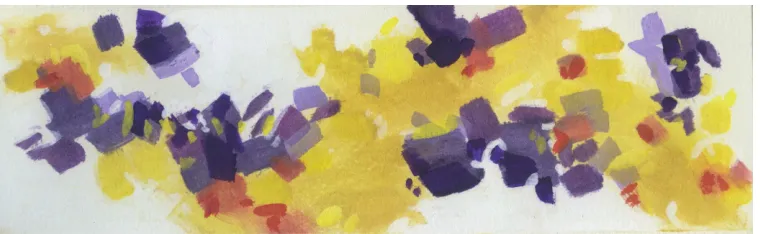
thicknesses of acrylic paint. Some prints use a process called Chine-collé, in which paper is glued to the print with rice starch. The rice starch creates a bond between the paper and print. The act of running the print through the press, activates the rice starch when it comes into contact with the wet paper. This reaction glues the paper pieces to the print. Chine-collé usually is a process used to add color. The small monoprints use the technique to create texture and form. Applying different
printmaking processes allows the print to have layers. This layering adds interest to something so small (fig. 6). The small prints, are only2”x7”, but multifaceted. The goal is to be playful and create prints that show ease and contentment. The same feelings my sister and I experience (fig. 7).
[image:21.612.125.508.505.610.2]Fig 6. Monoprint III, Monotype with Chine-collé, 2015
Fig 7. Monoprint IV, Monotype with Chine-collé, 2015
Larger scale prints were made even as I completed the little monoprints and paintings. The larger monoprints have the same sense of ease and freshness. They also use a monochromatic color scheme, which greatly differs from the small prints. Within these larger prints, I was psychologically and visually finding my sister, and acknowledging what she means to me.
The physical nature of having someone with me is important. There are not many moments of loneliness when you are a twin. Growing up, my sister and I shared the same room, and went to bed at the same time. When I went for a walk, she went for a walk, and when I wanted to read, she read. These moments are about being solitary, but not being alone. These pieces represent her always being there at times when I feel alone.
[image:22.612.128.508.252.369.2]“Are you still awake?” and her replying, “yes” in dark. This was a nightly occurrence, which reinforces a feeling of security. I am never alone, and that is one of the
[image:23.612.128.507.173.326.2]immense privileges of being a twin. I always know I have someone there for me.
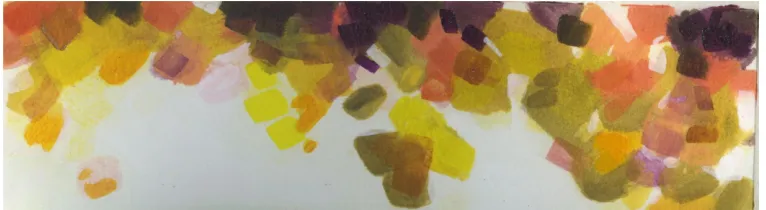
Fig 8. Cascade, Monotype, 2015 Fig 9. Monoprint in Yellow, Monotype, 2015
Acrylic Painting
The miniature prints are dynamic, so they became studies to scale up the work to larger paintings. The first painting created in this series is “Lifted”. Within the painting itself I sought to cleanly define my relationship. It seemed that only a curtain separated me from something profound. Visually, the semblance of a swaying curtain finds itself within the painting. The marks simulate a curtain of foliage and leaves, creating depth and suggesting forms in the distance. This painting develops repetitious marks, square-like marks, color, harmony, and flatness creating a sense of stillness, or a pause in the action. This curtain of color sits close to the viewer and obscures whatever is behind it. Shapes disappear into the background, giving hints that there is something more to see, but the curtain blocks the view (fig. 10).
saturated purple at the top to create a sense of lifting upward. The airiness of the open space acts as force that rises and mingles with abstract foliage. Each point of the painting has a counterpoint, which reinforces harmony with a sense of
symmetry.
[image:24.612.127.525.253.399.2]Many of these formal aspects mirror my twin and I. We are both female and my artwork celebrates our gender. Many fraternal twins are boy/girl instead of girl/girl. This is one factor I can attribute to being so close as a twin. I give it prominence here with a typically feminine color palette.
Fig 10. Lifted, Acrylic on oak plywood, 2016
The second piece in this series is still about contemplation and searching. Entitled “Meandering Pathways”, this piece portrays a long horizontal style. This style is seen throughout my thesis work. Within this piece, a progression from left to right occurs. I invite the viewer to proceed down my bright red violet path. The viewer can follow this path of color because moments of rest have been created. The yellow background at certain areas within the work breaks the red violet line, and these disruptions provide a chance for the viewer to contemplate the painting (fig. 11). These instances of rest can bring forth memories or emotions of loved ones. The other alternative is to follow my brush marks like pavers to the end of the path, where what you are searching for will be waiting.
other; so much so that we do not talk in complete sentences. This vivacious personality within the painting captures our zip and our zing.
Fig 11. Meandering Pathways, Acrylic on oak plywood, 2016
Diptychs
These next two works are both diptychs. Just like the ones before they are acrylic on oak plywood. My artwork relies on the idea of comparisons drawn between a set of two. By using a diptych a narrative is born. The audience can continue with their thoughts from one panel to the next, expounding memories and feelings. Diptychs allow for the expansive growth of an idea. They challenge us to ask questions of ourselves and then to find answers. Eric Dean Wilson, a critic for “The American Reader”, wrote an article called “Regarding Diptychs”. His insights to the structural working of a diptych are very informative. He says:
“This perpetual motion drives the diptych. A dialogue emerges, something like a silent Platonic dialogue, in which ideas are presented, expounded with evidence, challenged, and left unresolved. The diptych is wrestling,11”
What Mr. Wilson is saying here is that each panel throws energy at one another. This riveting aspect of diptychs causes the viewer to grapple and struggle within. A struggle within my work occurs, but differently than the description of Mr. Wilson. I
want my audience to ask questions. Why are these paintings paired? What are their similarities and differences? Does color choice or symmetry have anything to do with the meaning? Is the number two important?
[image:26.612.142.509.274.483.2]What is important is each diptych is a portrait, and each painting represents us both equally. We are interwoven into each painting. The emotional bond takes shape within each, which is why this piece is called “Expansive light”. It illustrates the eternal bond my sister and I have (fig. 12). It also reflects the ever-expansive meaning that lies within for the viewer.
Fig 12. Expansive Light, Acrylic on oak plywood, 2016
sight because I see double vision. Diptychs allow freedom to create whatever reality I want, and each painting containing metaphysical and corporeal meaning. Many pieces within this body of work emphasize topics such as unity, wholeness, and sameness. This piece differs and does the opposite, showing the viewer that although my sister I are close, and we are individuals. This piece allows for the sentimental ties as a twin to shine through, but also distinctiveness. The audience has to actively engage in these artworks, as by the nature of a diptych, the viewer cannot be idle. Eric Dean Wilson also speaks of this, saying:
“The transaction is silent, but the viewer receives responsibility in the investigation. The viewer is needed. The viewer completes the diptych. The viewer of the diptych becomes maker.12”
[image:27.612.126.512.450.642.2]These artworks are meant to transport you to a person, place, or thing with which you have the strongest connection. The viewer creates moments within the piece, and those moments can be about memories. They can take place in a world that is tangible or intangible.
Fig 13. Two sides, Acrylic on oak plywood, 2016
Conclusion
What I have learned through making my thesis work is that my bond as a twin grows with every interaction shared. Being a twin means sharing something unique and special. It is a bond that is beautiful, harmonious, and filled with love. It builds upon all the qualities we share and allows our difference to be more
individualistic. Our connection as twins provides security from loneliness. I know show will always be there as my sister and best friend. My artwork has taught me how to celebrate being a twin, and to never take it for granted. My sister is closer to me because of this work and always will be.
Becoming closer to my twin sister was a goal I set for myself within this work. Although, we are already closer than most siblings, I don’t believe I have ever told her how much she means to me. When she set her eyes upon my work, she was speechless. I could feel the telltale signs of tears behind my eyes and in my throat. I struggled to explain to her everything that was poured into this series, but I did not have to explain everything to her. My work alone was enough for her to feel the same thing. She knows I struggle with telling people how I feel because she is the same way. My paintings communicate what I have been trying to share with others, and the art within each piece does it more resolutely than my words alone.
Illustrations
Fig 4. Monoprint I, Monotype with Chine-collé, 2015
Fig 5. Monoprint !I, Monotype, 2015
[image:33.612.129.522.451.588.2]Fig 7. Monoprint IV, Monotype with Chine-collé, 2015
Fig 8. Cascade, Monotype, 2015
[image:34.612.126.524.271.640.2]Fig 9. Monoprint in Yellow, Monotype, 2015
[image:35.612.127.517.430.562.2]Fig 11. Meandering Pathways, Acrylic on oak plywood, 2016
[image:36.612.126.522.327.573.2]
Fig 13. Two sides, Acrylic on oak plywood, 2016
David Bayles, Art and Fear (California, Image Continuum Press, 2009), 29.
Eric Dean Wilson, “Criticism: Regarding Diptychs”, The American Reader, April 2016.
Schwitzgebel, Eric, "Introspection", The Stanford Encyclopedia of
Philosophy (Summer 2014 Edition), Edward N. Zalta (ed.), URL =
<http://plato.stanford.edu/archives/sum2014/entries/introspection/>.
Nikos Stangos, Concepts of Modern art : From Fauvism to Postmodernism ( London; Thames and Hudson Ltd., 1981), 11
Paul Smith, Impressionism: Beneath the Surface ( New York: Harry N. Abrams, 1995), 8-9.
“The Eye: How it Works,” www.kellogg.umich.edu, last modified 2015, date accessed May 2016.
http://www.kellogg.umich.edu/patientcare/conditions/anatomy.html
“Third Eye,” omicsgroup.org, last modified 2014, date accessed May 2016.
http://research.omicsgroup.org/index.php/Third_eye.
“Twins: Identical and Fraternal,” www.betterhealth.vic.gov. Last modified August 2014, date accessed May 2016.