This is a repository copy of Seismic risk management: A system-based perspective. White Rose Research Online URL for this paper:
http://eprints.whiterose.ac.uk/88373/ Version: Accepted Version
Article:
Vahdat, K, Smith, NJ and Amiri, G (2014) Seismic risk management: A system-based perspective. Risk Management, 16 (4). 294 - 318. ISSN 1460-3799
https://doi.org/10.1057/rm.2015.3
[email protected] https://eprints.whiterose.ac.uk/ Reuse
Unless indicated otherwise, fulltext items are protected by copyright with all rights reserved. The copyright exception in section 29 of the Copyright, Designs and Patents Act 1988 allows the making of a single copy solely for the purpose of non-commercial research or private study within the limits of fair dealing. The publisher or other rights-holder may allow further reproduction and re-use of this version - refer to the White Rose Research Online record for this item. Where records identify the publisher as the copyright holder, users can verify any specific terms of use on the publisher’s website.
Takedown
If you consider content in White Rose Research Online to be in breach of UK law, please notify us by
Seismic Risk Management: A System-based
Perspective
Kamran Vahdat1, Nigel J. Smith1, Ghodrati Amiri2
1Institute for Resilient Infrastructure, University of Leeds, Woodhouse Lane, Leeds, LS1 9JT
,UK ,Fax: +44 113 3432265, Email:[email protected],[email protected]
2School of Civil Engineering, Iran University of Science & Technology, Narmak, Tehran
16846, Iran, Fax: (+98 21) 7724-0398 , Email: [email protected]
Abstract
The deployment of seismic risk management is fraught with issues of complexity,
ambiguity and uncertainty which pose critical challenges in assessing, modelling and
management. The complexity of earthquake impacts and the uncertain nature of
information necessitate establishing a risk management system to address the risk of many
the effects of seismic events in a reliable and realistic way. This study was launched to
review and criticize appropriate risk assessment methods for different seismic applications
focusing on general characteristics from a systems perspective. The outcome of this study
demonstrates the importance of a system perspective, providing a deeper insight into the
background characteristics and the potential challenges involved within seismic risk
management. This allows users to compare various systems and to choose the most
appropriate approach according to the scope, size, accuracy and complexity of the
application.
1. Introduction
Earthquake events are inevitable, but the consequences of earthquake disasters are
partially controllable using an effective risk management system, since the seismic risk is
the interaction of multiple participant factors with likely consequences. Thus, it is
important to address the seismic risk for any group of interest before taking any risk
preventive measure. However, whilst it is impossible to estimate precisely the probability
and severity of an earthquake due to stochastic (random) nature; while the adverse effects
of an earthquake can be effectively reduced or avoided using appropriate risk assessment
and management procedure (Bostrom et al 2006). Risk assessment provides a roadmap for
estimating the adverse outcomes of earthquakes in order to reduce the fatalities, injuries
and damages. Risk management helps communities to reduce significantly the severity of
any losses by identifying and assessing the potential factors that contribute to the
earthquake loss process and proposing the appropriate action (response). In a broad sense,
risk management highlights strategies and measures to control and manage the adverse
effects of earthquakes. Since the seismicity, severity and probability of earthquakes cannot
be reduced and modified, the management of the risk would logically focus on reducing the
vulnerability as an effective measure of loss/damage mitigation.
According to Vahdat et al (2014) seismic risk management is intrinsically complex in
nature due to its multidisciplinary context that involves multiple sources, cause-effects and
interaction within criteria, alternatives and stakeholders. Further, planning for disaster
risk management deals with not only the physical and structural consequences of a natural
hazard but also the different socioeconomic, environmental, historical considerations that
might influence a population or even future generations. An effective risk management
framework should capable of integrating various perspectives of seismic risk; conducting
seismic risk assessment; evaluating the mitigation strategies; and performing a risk-based
trade-off among mitigation strategies (retrofitting decision). Improvement in the seismic
risk damage prevention and mitigation process directly depends on the perception of
earthquake impact which in its most general sense relies on experience and the quality of
preventive measures as well as the development of legislation, standardization, and
governmental regulations and control (Ahmad and Simonovic 2011).
Tesfamariam and Goda (2013) state that “the risk management must be capable of
weighting alternatives (options) and selecting the most appropriate action”. This can be
achieved by integrating the results of risk assessment with engineering data as well as
social/economic/political factors to reach an acceptable decision. However, identifying,
sorting and prioritizing a large group of infrastructure requires a systematic and flexible
approach to customize and balance the multiple risk variables which is beyond the scope of
existing models. Viewed from this perspective, the study proposes a system based
perspective that is capable of addressing multiple dimensions of seismic risk management
effectively and efficiently.
2. Seismic Risk Management
Risk management is the systematic application of policies, procedures and practices to the
tasks of identifying, analysing, assessing, controlling and monitoring risk (Standards
Australia/Standards New Zealand, 1995). A generic version of this process in the disaster
context was stipulated by the United Nation Strategy for Disaster Risk Reduction (UN-ISDR,
2004):
The systematic process of using administrative decisions, organization, operational skills and
capacities to implement policies, strategies and coping capacities of the society and
communities to lessen the impacts of natural hazards and related environmental and
technological disasters. This comprises all forms of activities, including structural and
non-structural measures to avoid (prevention) or to limit (mitigation and preparedness) adverse
effects of hazards.
The universal framework for seismic risk management is defined in four distinct risk
measures, including preparedness, mitigation, response and recovery which are performed
in pre/during and post-disaster (Table 1). Neal (1997) states that disaster phases are
“mutually inclusive and multidimensional” as they are strongly interconnected; while each
measure maintains the individual aspects of disaster to enhance the tasks of risk
Table 1 – Generic seismic risk management process (Altay and Green 2006)
Measure Phase Activities
Preparedness Pre-Disaster
Emergency response plan, shelter, public information and education
Evacuation plan, Earthquake training, manoeuvring, Warning
system
Mitigation Pre-Disaster
Retrofitting, rehabilitation, augmentation, reinforcing Legislation,
Code enforcement, zoning/land use management, Insurance,
reserve fund, site improvement
Response During Disaster
Response strategy, critical management centre, mobilizing and
medical aid service, search and rescue team, locating(GPS) and
recording intensity, communication
Recovery Post -Disaster
Medical service, rehabilitation, reconstruction, financial assistance,
Restore public infrastructure, essential service and business
According to UN-ISDR (2004), preparedness refers to promoting the inherent knowledge
and capacities by governments, critical emergency organizations, disaster professionals,
communities and individuals in preparing a response and recovery plans for any likely
event. Mitigation refers to set of strategies to reduce and limit the exposure or potential
damage due to an earthquake. Mitigation strategies pay attention to preventive measures
as the key intervention for seismic risk management. Response measures include sets of
emergency provisions to assist the public immediately after a disaster, in order to save
lives, reduce health impacts and to ensure public safety. Recovery is an unavoidable
reaction performed by governments. Obviously, additional investment in preventive
measures and preparedness can be more effective and economically-justified compared to
post-disaster actions and reduces the cost of response and recovery (Simonovic 2011). This
is the reason why mitigation is highlighted as a critical measure within seismic risk
management.
Essentially, identifying future mitigation is the main concerns of risk management, which
closely links to vulnerability thereby requiring a reliable estimation of loss and potential
capacity of damage within the built environment. Risk management aims to reduce the
potential losses and damage within communities by identifying and assessing the potential
the seismicity and severity of earthquakes cannot be reduced or modified, the management
of the risk logically focuses on reducing vulnerability as an effective measure for damage
mitigation. It is impossible to predict the severity of an earthquake in a given area due to its
stochastic (random) nature; however the adverse effects of an earthquake can be
effectively reduced or avoided using appropriate risk assessment and management
(Bostrom et al 2006). Thus, risk assessment and management are complementary
processes, while the former uses a systematic method to determine the probability of
adverse effects, the latter tries to systematically decide and choose the appropriate option
to manage the risk (e.g. mitigate, transfer, response, recovery). The outcomes of system
perspective collectively secure a proper integration of operational risk management into
the policies, plans and mitigation programme.
3. Characteristics of Seismic Risk Management
Seismic risk management is characterized in multiple dimensions, typically as social,
economic, political, environmental and others which can often be in conflict with each
other. Several alternatives need to be considered and evaluated in terms of the many
different criteria which results in a vast body of data that are often imprecise or uncertain.
A large number of people are usually involved in the risk assessment process, including
decision makers, planners, experts and other interest groups from organizations and the
community all of whom may have conflicting preferences (Lahdelma et al 2000). The scope
[image:6.595.89.508.529.722.2]of seismic risk management involves balancing these variables as shown in Figure 1.
Figure 1 - Multifaceted aspects of seismic risk management (Vahdat et al 2014a)
Multiple Alternatives
Countries
Regions & cities
Infrastructures
Buildings Multiple Criteria
Hazard
Vulnerability
Exposure
Response management
Multiple Stakeholders
Planners
Experts
Decision makers
Interest group
Risk management is concerned with modelling and assessing risk which can refer to the
inherent characteristics of the disaster risk system. This chracteristics of the systematic
perspective would secure public engagement, imrpoved situational awareness and
comprehensive picture of seismic risk, greater organizational agility for disaster
management, more robust, interoperable communication and better resource allocation
and tracking. The systematic perspective secures long-term strategic policies for disaster
risk management, identifying the potentially weak point that require special attention
during disaster management, ensures an preparedness and an effective response prior to
an earthquake. The multiple views and interactions within risk factors, alternatives,
individuals and organizations cause an inherent complexity that requires a systematic,
structured reconciliation of these disparate, often conflicting factors with the contradictory
information (Avouris 1995). System perspective can effectively address the potential
challenges caused due to complex multidimensional aspects of seismic risk and handle
uncertainties present in decision process due to spectrum of objective and subjective
information.
4. System View of Seismic Risk Management
Risk analysis is naturally involved with a complex, multidimensional process that requires
the integration of myriad information from multiple sources to characterize the seismic
risk. According to Haimes (2012a) “the entire process of risk assessment, management, and
communication is essentially a synthesis and an amalgamation of the empirical and the
normative, the quantitative and the qualitative, and of objective and subjective evidence”.
Different thinking is required to address the challenges associated with defining, modelling
and quantifying the risk which is often influenced by the modeller’ skills and experience.
Several quantitative and qualitative tools and techniques contribute to risk analysis to
improve understanding of risk in specific disciplines. However the intricacy and complexity
involved in risk assessment cannot be modelled, understood and addressed through ad-hoc
approaches. Given the diversity in size, scope, functionality and configuration of current
infrastructure and given the immense uncertainty associated with risk management
process, modelling should be grounded on a systemic and repeatable basis presenting the
A systems approach is appropriate to manage complex problems by decomposing them
into simpler sub-systems or components (Deng et al 2011). This approach usually focuses
on interactions among the myriad elements involved in risk assessment and on the effects
of their interaction in future decisions. System-based risk modelling can effectively address
the multifaceted composition of seismic risk by incorporating levels of uncertainty and
complexity due to nonlinear natures of the states of all human and built environments
(Haimes 2009). Aven (2011) argues that risk and vulnerability are the manifestation of the
inherent state of the system and its environment and hence should be dealt with and
quantified through a system-based hypothetical and methodological approach. Haimes
(2012b) advocates that the process of risk modelling, assessment, and management must
be holistic, comprehensive and repeatable and must be handled systemically to perceive
the state of the system and model the system blocks. Accordingly, the system approach is
required for complex situations to improve the understanding of the system’s
characteristics including function, behaviour and interactions.
Hence, a system-based approach to risk assessment and management is of utmost
importance for the credibility and effectiveness of decision making and the ultimate
quantification of the complex multidimensional aspects of the seismic risk.
5. Classification of Seismic Risk Models
Seismic risk management occurs from a nationwide to a regional scale. This universality
disables its applicability for a given specific practice, consequently customization is
required according to local conditions. Klugel (2008) asserts that seismic risk assessment
must be conducted in a way to minimize the effort needed to obtain the results based on
the client’s need. Risk assessment should consistently address the importance of
application. The form and richness of the results should also correspond with application
needs and objectives. Because of the difficulties involved with evaluation of hazard and
vulnerability, risk assessment models could vary considerably from well-structured
analytical models to empirical heuristic approaches. In this light, several seismic risk
models can be distinguished in literature which has been designed for a particular
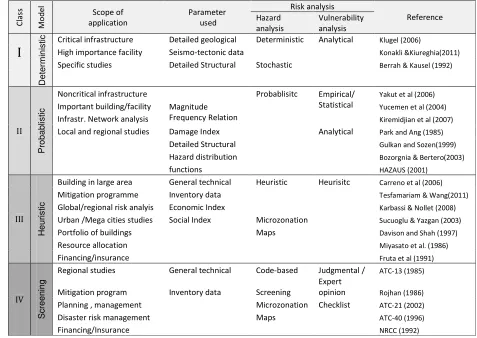
application. Reviewing the literature, the most common variants of seismic risk assessment
Table 2 – Different classes of seismic risk assessment C la ss M o d e l Scope of application Parameter used Risk analysis Reference Hazard analysis Vulnerability analysis
I
D e te rm in is tic Critical infrastructure Detailed geological Deterministic Analytical Klugel (2006)
High importance facility Seismo-tectonic data Konakli &Kiureghia(2011) Specific studies Detailed Structural Stochastic Berrah & Kausel (1992)
II P ro b a b lis ti c
Noncritical infrastructure Probablisitc Empirical/ Statistical
Yakut et al (2006) Important building/facility Magnitude
Frequency Relation
Yucemen et al (2004) Infrastr. Network analysis Kiremidjian et al (2007) Local and regional studies Damage Index Analytical Park and Ang (1985)
Detailed Structural Gulkan and Sozen(1999) Hazard distribution Bozorgnia & Bertero(2003)
functions HAZAUS (2001)
III H e u ri s ti c
Building in large area General technical Heuristic Heurisitc Carreno et al (2006) Mitigation programme Inventory data Tesfamariam & Wang(2011) Global/regional risk analyis Economic Index Karbassi & Nollet (2008) Urban /Mega cities studies Social Index Microzonation Sucuoglu & Yazgan (2003) Portfolio of buildings Maps Davison and Shah (1997)
Resource allocation Miyasato et al. (1986)
Financing/insurance Fruta et al (1991)
IV S c re e n in g
Regional studies General technical Code-based Judgmental / ATC-13 (1985)
Mitigation program Inventory data Screening
Expert
opinion Rojhan (1986) Planning , management Microzonation Checklist ATC-21 (2002) Disaster risk management Maps ATC-40 (1996)
Financing/Insurance NRCC (1992)
5.1 Deterministic Model
For high importance applications and critical infrastructure (i.e. dams, nuclear plants) a
deterministic model (DSRA) is the most appropriate option as there is no compromise
between the simplification of structural models and the efficiency of analysis (Klugel 2008).
DSRA is a deterministic approach since it is based on objective data, facts and physical
models. DSRA in broader senses can be regarded as a stochastic process (Wen 2003). Using
response spectrum and time-history analysis methods, Konakli and Kiureghian (2011)
applied a stochastic dynamic analysis to investigate bridges considering the spatial
variability of ground motions. A deterministic approach allows detailed investigation of
structural response using advanced analytical models which allow a more precise
interpretation of seismic risk with respective scenarios. However, developing such complex
models requires sophisticated tools and expertise that can be used for single studies of
5.2 Probabilistic Models
Probabilistic seismic risk assessment (PSRA) in a broader sense focuses on the most
probable earthquake by defining the frequency of events or the frequency of exceedance of
ground motion (or exceedance probability). A PSRA can be implemented for less important
applications such as regular infrastructure, facilities and buildings in both regional and
local studies. Unlike DSRA, in PSRA all possible earthquakes that may affect the system may
be considered and imported into the model. Quantification of the most probable mode of
damage is a challenging task because different states of damage have to be distinguished
objectively in terms of material, age, quality and functionality. Generally, potential losses
for different classes of structures are based on prior historical damage. The potential
damage is often presented in two forms of fragility curves (or vulnerability functions) and
damage probability matrix (DPM). Intersecting the most probable earthquake with fragility
curves, the most likely damageability level of a building can be estimated for a given
earthquake magnitude. Essentially, the vulnerability function is a subjective metric for
assessing and predicting the potential damage of buildings which is developed by
clustering the statistical damage records for different classes of buildings. Historical
records of damages are evaluated following an earthquake by groups of experts. Hence the
accuracy of the functions relies on the quality of records and expert’s experience. Coburn
and Spence (2003) developed typical vulnerability functions for masonry buildings for
different states of damages as a metric of intensity measure. More complete databases for
vulnerability functions were documented in ATC-13 (1985) and HAZAUS (2001) which
covers the most typical classes of structures in the US.
In probabilistic approaches, macro seismic intensity scales and fragility curves establish
the underlying concepts of probabilistic risk models. However, analysing the seismic risk
on the basis of vulnerability functions and intensity scales raises some issues. According to
Coburn and Spence (2003) significant uncertainty due to variations in observed data can
potentially be imported to the fragility curves while distinguishing the threshold among the
different states of damages relies on the perception of the experts and can significantly
vary among different groups of survey in different places. Another issue is the estimating of
to use for predictive purposes since intensity scales assume a relationship between the
performance of typical building types with certain configurations which may not precisely
match in practice.
There have been several attempts to improve the quality of vulnerability analysis using
analytical and empirical methods. Yucemen et al (2004) proposed a simplified damage
index to estimate the seismic vulnerability of low-rise to mid-rise reinforced concrete
buildings. Yakut et al (2006) developed a scoring system for estimating the damage within
low rise buildings using different structural and seismic modifiers. Park and Ang (1985)
developed an analytical damage index for estimating the vulnerability of RC buildings. The
potential levels of damage were characterized as a function of seismic intensity based on
two probable earthquakes, 1971 San Fernando earthquake and 1978 Miyagiken-Oki
earthquake, for calibration and verification. Basoz and Kiremidjian (1996) used the PSRA
to prioritize the risk within bridge networks that intended for retrofitting. In this process
the basic hazard and vulnerability factors (ground motion, expected structural damage)
was combined to estimate the expected utility of the bridge. Temporal variation in seismic
hazard was implicitly included in the analysis by taking the maximum credible earthquake
(500-year-return period intensity measure). Using a damage index as the sole criterion for
estimating the risk is a reliable measure, although the threshold of structural damage can
also be correlated with other indirect consequences and socioeconomic losses (e.g. human
losses and casualties, costs of rehabilitation) to get better performance (Coburn and Spence
2003). Nevertheless, importing such indirect effects into the existing frameworks is
problematic.
5.3 Heuristic Models
Probabilistic models have been used extensively in regional risk assessment due to the
inherent simplicity. These methods require extensive damage records from previous
events which may not always available. Heuristic models are an alternative mid-range
option that can be used flexibly in conjunction with analytical and empirical models to
overcome existing limitations. The common feature of heuristic models is the use of a
Basically, seismic risk management requires not only the estimation of seismic risk, but it
also needs the detailed values of risk factors to effectively support mitigation decisions.
This need requires a comprehensive systemic view that can be achieved through heuristic
frameworks. The holistic view allows customizing of the structure of risk, thereby decision
makers can better focus on different pieces of knowledge and clearly identify the critical
attributes within the risk system. A heuristic model in a broader sense can be regarded as
“a transparent simulation box” while is applicable as an information system and useful tool
for higher classes of mitigation programme. However the scope of these models is limited
to approximate risk assessment for disaster planning and management and they are not
precise enough to be used in the detailed design stage, comparing to deterministic and
probabilistic models.
The application of systems approach in modelling the seismic risk has been reported in
literature. Miyasto et al (1986) have developed a hierarchical risk system for preliminary
evaluation of seismic risk for different types of buildings. Fruta et al (1986) proposed a
knowledge-based expert system for assessing the damage status of bridge structures based
on the fuzzy reasoning method. Gulkan and Yakut (1996) developed a rule-based expert
system for integrating various seismic and structural attributes for estimating the damage
levels of the buildings. Davison and Shah (1997) introduced a linear additive model for
evaluating and comparing earthquake risk between major metropolitan cities worldwide.
Cardona et al (2004) developed a holistic risk system, taking into the account
socioeconomic aspects of seismic risk, including physical exposure, social fragility and
resilience. Using the structural damageability index as the major factor, Tesfamariam and
Wang (2012) established a fuzzy-based risk assessment system for prioritizing civic
infrastructure in the US. Using a weighted arithmetic mean (WAM), Sucuoglu and Yazgan
(2003) have developed a two-level seismic risk assessment tool for Istanbul. The model
integrates the most critical structural performance modifier using multivariable stepwise
linear regression analysis procedure. Karbassi and Nollet (2008) developed a fuzzy
inference system to evaluate the risk of failure in water main pipelines in Quebec. The
common advantage of existing heuristic model is a systematic aggregation of likely impacts
to evaluate the utility of the interest options for certain area that could effectively support
assess the accuracy and reliability of simulation. Another issue of heuristic is the scope of
application of each model limited to the certain situations designed for and may not have a
wide generality to be applied to other regions. Nevertheless, heuristic models are still an
open context capable of addressing several policy challenges involved within mitigation
programme at larger organizational scale.
5.4 Screening Models
Screening models provide a simple method for highlighting vulnerable buildings among
large group. The process is conducted a rapid visual survey to identify inventory and thus
classifies buildings that are potentially hazardous for safety (ATC-21 2002) by the mean of
structural performance index (SPI). Hazardous buildings are identified by examining the
building characteristics such as seismicity, soil condition, structure type and irregularities,
usage and occupancy to determine the overall SPI. Different versions of screening
procedures have been suggested by ATC for evaluating the potential hazardous buildings
(ATC-10 1982; ATC-13 1985; ATC-14 1987; FEMA-154 2002). ATC-13 and ATC-14 provide
data and methodology that serve as the basis for “Rapid Visual Screening “(RVS) updated in
FEMA-154 particularly developed for the hazardous regions of US such as California. A
similar process was developed in Canada (NRCC 1992) and NewZealand (NZSEE 2009).
Screening models follow a simple procedure to rapidly evaluate those buildings that
require urgent mitigation action. The process supports the mitigation process by
addressing the public safety concerns within the community. However the scope focuses on
structural damage as direct mean of vulnerability assessment; other indirect damage
induced by earthquake hazards such as ground failure (e.g. Liquefaction, landslide) is not
addressed in these models. In addition, the form, quality and accuracy of scoring tactics is a
major concern in screening models. The information collected from a field survey is always
prone to high subjective error. As a result, great amount of uncertainty can be imported
into the model due to variability between the observed and actual data. Other
shortcomings of screening models are addressed in the literature (Rojhan 1986; Karbassi
and Nollet 2008). The scoring model and its weight are pre-set and provided for facilities in
California. The procedure uses general buildings with average conditions as representative
of the whole structural group. There is the largest margin of uncertainty within the visual
information are required for verification and validation of the model. In a broader sense,
screening models can be regarded as a specific case of heuristic models as they use the
simple additive model to score the alternative buildings according to their structural type,
age, material and configurations. The scope of screening models and rigidity in using
built-in criteria limits their applicability to prelimbuilt-inary risk assessment.
6. Problems in Seismic Risk Management
Risk assessment entails the process of quantifying the risk and essence of any disaster
management process. It offers a reliable tool for making rational decisions that is often
used prior to rehabilitation and developing emergency response and recovery plans.
Decisions about mitigating seismic risk rely on the quality of the risk assessment and the
spectrum of uncertainties in risk parameters and process. Some of these uncertainties can
be addressed and reduced stochastically through standard procedures (i.e. ATC-14 1987).
Eguchi and Seligson (2008) note about evaluation pitfalls that commonly occur in standard
procedures and lead to under-prediction within large scale and over-prediction of losses in
small earthquake events. They justify that the damage functions developed for such
earthquakes are mostly based on specific scenarios derived from severe earthquakes in
California (1971 San Fernando and 1994 Northridge) thereby covering a narrow range of
magnitude (strong to severe), and essentially ignoring the potential losses within areas
experiencing lower or greater (outrange earthquakes) (Eguchi et al 2008). The mitigation
decisions made based on these models could be valid only for a specific geographical area
and may not reliable for other regions. For example, ATC-14 method of “Evaluating the
seismic resistance of Existing Buildings” deals with regions experiencing few, but low
intensity earthquakes which is applicable to certain regions of the US. Thus, the selection of
appropriate analysis should be based on understanding the underlying concept, scope of
analysis and considering its strength and limitation to different applications.
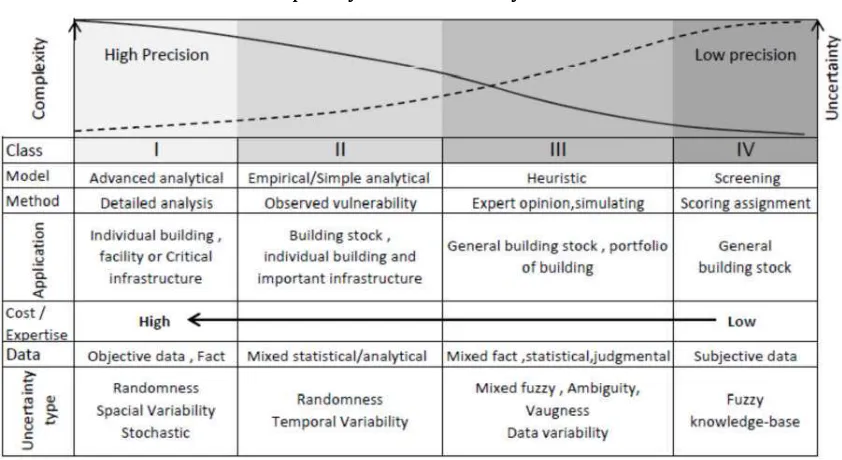
From a system viewpoint, various classes of applications can be distinguished according to
their accuracy and complexity of modelling as indicated in Table 3. The complexity and
uncertainty of each procedure might significantly vary dependant on the scope and type of
problems for which they designed. For example, some deterministic models are suitable for
evaluation and prioritizing. Thus, to handle the problem of seismic risk management, the
prospective models should have adequate functionality and structure to address the
multifaceted nature of risk. The risk analysis must be appropriate to the scope of
application, not be too complex that make the process expensive, and also not too simple to
trade-off the simplicity for effectiveness. The model should also have adequate preciseness
to handle both objective and subjective uncertainties commonly involved with different
[image:15.595.70.491.259.489.2]types of qualitative and quantitative information.
Table 3 – Complexity and uncertainty within different classes
Currently, the majority of existing models has primarily focused on the structural system
performance, building capacity, layout and certain response parameters. Detailed risk
analysis relying on a comprehensive data collection that are generally employed for the
assessment of individual buildings, as they require sophisticated modelling, thereby aim to
determine whether the building needs rehabilitation (Yakut et al 2006). Although detailed
analysis provides high-precision results, it is restricted to individual case studies and thus
cannot be used for regional studies in which a large number of buildings is involved.
Furthermore, these methods are based on underlying theory that could only handle the
inherent variability of the hazard data (randomness) and are unable to address the
uncertainties commonly involved in decision process due to modelling, parameters and
modellers perception of risk. Klugel (2008) reviewed different versions of seismic risk
insufficient understanding of modern risk analysis. This could result to inability to present
a correct definition of the true relationship and hence proposes inappropriate treatment of
uncertainty. For such situations, heuristic models utilizing limited data and simple
simulation are preferred because they require less cost and expertise to deal with and take
into consideration more practical factors tailored for regional studies. These models have
the flexibility to deal with a broad range of data and precision in practice. Hence, the
research study seeks to establish a heuristic model, able to handle a portfolio of building in
regional level effectively and efficiently.
Viewed from this perspective, the heuristic method was identified as the best category that
fits the scope of study and thus adopted for the problem of seismic risk management for
several reasons. First, the risk management process is an interdisciplinary concept that
several risk parameters (expressed in various forms, accuracy and quality) from multiple
sources have to be combined as an input data; while processing such a complex
information system is beyond the ability of conventional methods. Second, the subjectivity
involved within seismic risk management requires a flexible, well-structured methodology
that could simply handle the predominant form of knowledge consistent with uncertainty
theories. For example, risk analysis is concerned with estimating the potential impacts and
disastrous consequences. The diagnosis of damage is a subjective process that is largely
based on the intuition and experience. A knowledge based system provides a consistent
means of system approach that is capable of handling vague, imprecise knowledge and
addressing the subjectivities involved within the process. Third, decision making in
mitigation is a multidisciplinary process and requires detailed information within each
category (e.g. Hazard and Vulnerability) along total risk. Heuristic (system) view of risk
suggests a comprehensive picture of seismic risk by the means of detailed knowledge,
thereby supports seismic risk management. Overall, heuristic model can explain and clearly
address the systemic interaction involved with the process of seismic risk assessment and
management.
Risk management strategies are concerned with an objective risk assessment that is based
on hazard analysis (e.g. intensity) and vulnerability analysis (e.g. potential damage).
Ultimate efficacy of risk management is to provide an effective and efficient risk
assessment to support decisions and policy options (Smith et al 2006). Underestimation of
risk may result in ineffective mitigation and inadequate preparedness and response
measures; while over-estimation of risk could lead to costly mitigation efforts. Decisions
about risk management are made upon risk assessment results which are rarely free of the
multidimensional aspects of the earthquake, including social, political, economical and
strategic considerations. Thus, seismic risk management can be particularly challenging
because multiple participants with different sorts of influence and behaviour are involved
in the risk process (Bristow et al 2012). Further, the difficulties in processing risk can be
referred to two major concerns and limitations; The complexity of the disaster system due
to the interactions among multiple quantitative/qualitative, linear/non-linear risk
variables. Establishing the proper relationships among risk input parameters and output
consequences is difficult. The uncertainty involved within seismic risk assessment are
related to describing the level of hazard (identification of initiating events, measurements
of severity of ground shaking and frequency of occurrence which is random in nature) and
to the vulnerability of facilities (estimate of loss to facilities for various levels of intensity is
subject to ambiguity in knowledge and lack of experience)
This implies that the characterization of uncertainties is critical in both hazard and
vulnerability assessment. According to McGuire (2008) unbiased quantification of
uncertainties is crucial to making rational decisions for risk mitigation and seismic risk
cannot be accurately estimated without quantifying the epistemic uncertainties in ground
shaking or in building response and damage. The need to quantify uncertainty has been
extensively addressed in risk applications such as NERHP, PEER and FEMA. However the
reliability of these models in describing and incorporating the uncertainties within the
process has not properly examined. For example HAZUS provides a standard loss
estimation model through probability estimation of credible earthquakes for high seismic
regions in the US; although the inability to explicitly address the uncertainty reduces the
cost-effectiveness of retrofitting options proposed by the model (Davison 2008; Durham et
Canada (NRCC 1992) serve as a rapid diagnostic tool for prescribing ‘retrofit’ or ‘not to
retrofit’ decision. Essentially, these approaches target a broad range of buildings through
simple walk-down survey; while they fail to clearly address the detail reasoning for the
decision. Analytical approaches provide an in-depth investigation of earthquake hazard,
although it is limited to merely provide a random picture of seismic risk. Further, existing
risk assessment approaches provide a prescriptive procedure that covers general types of
problems. Predefined (built-in) risk parameters in such approaches can be adapted to
cover broad spectrum of facilities in terms of size, functions, occupancy load, etc. In
addition, current approaches integrate some information with pre-set-weights based on
the common statistical cases. The main issues in these prescriptive approaches are
inability, inflexibility to add/remove new variables/options due to prescriptive concept;
the inability to change the importance (or weight) of the variables for certain problems; the
inability to track the operation and parameters in the model; the inability to apply for
particular seismic application (i.e. critical portfolio of buildings); the inability for tuning
due to the low sensitivity of model to small changes in risk input parameters (i.e. screening
models).
Rational risk management should be capable of comparing and prioritizing multiple
alternatives effectively. The ability to compare risk across regions becomes more critical to
both private and public stakeholders who have competing priorities for urgent retrofitting
action. Inadequate risk-informed decisions could compromise the mitigation measures by
retarding the retrofitting, renovation and even reconstruction process. Moreover, there is a
need for a simple but a well-grounded risk management system to interplay within
different levels of risk knowledge and decision makers. Therefore, a rational risk
management system to address multidimensional impacts of earthquakes and support
mitigation decisions is paramount.
8. Uncertainty in Disaster Context
The nature of uncertainty in a problem is crucial and should be carefully considered prior
to the selection of an appropriate method (Ross 2004). The challenge of selecting method is
“to formulate suitable numerical models in a quantitative manner without ignoring
of an analysis, computational results may deviate significantly from reality and associated
decision may lead to serious consequence” (Beer et al 2013). Basically, a mathematical
model can be formulated by analysing the nature of the available information. In reality,
available information may appear in various forms, objective or subjective, imprecise,
incomplete vague, ambiguous, conflicting and linguistic. The appropriate model should
support the type and quality of information to consistently address the problem in a
particular case.
Table 4 gives a summary of information commonly used in various seismic risk
applications. Refer to various classes of risk analysis already discussed in Chapter 2
(section 2.6), the role of vulnerability or hazard analysis might vary considerably. For
example, the stochastic nature of the earthquake (or randomness) in terms of time
(temporal) and location (spatial) is a core concept within DSRA and PSRA; while in
heuristics and screening approaches the vulnerability assessment is highlighted. Decisions
regarding risk mitigation have been highly focused on estimating the capacity of damage
within existing buildings rather than spatial or temporal considerations of an event. The
inherent ambiguity and vagueness associated with vulnerability assessment make a
compelling reason that seismic risk assessment is prevailed by subjectivities as results of
vague or imprecise terms frequently used in risk assessment, damage assessment and
expert judgments. Vague, imprecise and incomplete nature of inputs of the risk parameters
can be suitably handled using fuzzy set theory.
Table 4 - Generic information/policies involved within seismic applications
Urban planning Planners Identify high risk locations for
urban design and
infrastructure development
Risk mapping Risk
Building Retrofit Owners The best retrofitting option Structural capacity
Cost-benefit Vulnerability Economy Mitigation Programme Disaster manager
Identify high-risk portfolio
screening Potential buildings capacity Vulnerability Insurers and reinsurers Insurer company
Set insurance premium Annualized loss
exceedance probability Hazard Emergency planning Civil protection agencies
Plan size and location of
emergency facilities Estimate potential fatalities, injuries, damages Hazard Vulnerability Exposure Building code development Building regulators Determine optimum resistance levels Structural algorithm Experiments cost-benefit data Vulnerability, Hazard Economy
Sources: Ozcan et al (2011), Birkmann (2006), UN-ISDR (2004), NRC (2011)
Furthermore, “the level of uncertainty within a system is proportional to its complexity,
which arises as a result of vaguely known relationship among various entities, and
randomness in the mechanism governing the domain” (Deng et al 2011). Zadeh (1973)
asserted “as the complexity of a system increases, our ability to make precise and yet
significant statements about its behaviour diminishes until a threshold is reached beyond
which precision and significance (or relevance) become almost mutually exclusive
characteristics”. According to Blockley (2013) and Zadeh (1996) “complex systems cannot
be dealt with effectively by the use of conventional approaches largely because the
description languages based on classical mathematics are not sufficiently expressive to
serve as a means of characterization on input-output relations in an environment of
imprecision, uncertainty, and incompleteness of information”. In addition, it is difficult to
precisely establish the temporal and spatial relation for earthquake events due to
complexity and random nature of earthquake. Application of probability theory in the large
9. Case Study 1: A National Risk Mitigation Programme for Schools
A mitigation programme is a good example of the application of systemic risk management.
The vast majority of school buildings within high seismic developing countries requires
urgent mitigation measures as they have been built upon outdated codes. Identifying the
critical group and prioritizing them in order of urgency is crucial before any retrofitting
commences. For instance, consider a mitigation programme in which large numbers of
school buildings are competing for retrofitting funds. While the schools are subjected to
varying degree of seismic hazard, the choice of alternatives is a multicriteria problem that
not only involves with physical, structural aspects of buildings (i.e. structural performance)
but it also contains socioeconomic dimensions (i.e. population exposed) and other
background characteristics of community resilience (i.e. response management index, first
aid facilities, shelters, hospitals, etc). The need to prioritize and decide on a large number of
retrofitting projects with multiple interactions within tangible or intangible risk criteria
require a systematic approach which is beyond the capability of conventional probabilistic
methods. In addition, the efficacy of the right retrofitting choice of interest is important as
it can affect the whole cycle of disaster management by improving the response, recovery
service and ultimately strengthening the safety protection within the community.
Generally, several variables involved in such decisions including technical, social,
economical, and environmental. In order to integrate several dimensions under a common
framework, risk mitigation Programmes require a structured algorithm to initially
recognize which class of buildings, under what conditions, and definition of safety level,
and performance criteria should be imported into the Programme (Holmes 1996). Given
the diversity in size, scope, functionality and configuration of existing school buildings and
considering the immense uncertainty associated with risk management process, modelling
should be grounded on a systemic basis presenting the multidimensionality characteristics
of seismic risk through integration of multiple metrics. The questions and challenges in
seismic risk management process cannot be addressed effectively and reliably without
adhering to a systemic approach to risk modelling, assessment and management. Thus,
prioritizing the retrofitting school buildings requires a holistic risk-informed system to
effectively address not only physical impacts of the earthquake, but also the socioeconomic
application of system-based risk management within multiple regions prone to varying
seismicity has been extensively discussed by Vahdat et al (2014 a,b). Vahdat and Smith
(2014) also demonstrated the application of system approach in prioritizing the seismic
risk of school buildings. According to these studies, the application of system approach in
school buildings is critical in three aspects. First, it identifies the potential impact of
earthquakes on school buildings in terms of multiple dimensions. Second, the new model
offers a systematic method for aggregating risk factors and for studying the characteristics
of seismic risk assessment of school safety. While, the conventional screening models can
handle a limited number of retrofitting projects manually, which is costly, time consuming
or require a great amount of information and experienced; the new models offers a
systematic method, capable of handling large number of cases. Third, it demonstrates the
importance of a multi-level hierarchy for structuring seismic risk. The advantage of this
structured knowledge is providing a deeper insight to the seismic risk and its relevant
impacts in different categories in a systematic manner. Unlike previous frameworks
focusing only on physical aspects of seismic risk, the system-based approach improves the
existing models, providing a comprehensive picture of seismic risk that allow incorporating
multidimensional aspects such as socioeconomic criteria in the decision process.
Consequently, any systematic methodology for aggregating, selecting and ranking risk must
be within a system-based framework to systematically balance the multiple criteria,
alternatives and stakeholders involved.
10. Case Study 2: Regional Risk Mitigation Programme
Another example that it might be considered is how to identify an appropriate system for
assessing risk of failure within a portfolio of infrastructure exposed to varying degree of
seismic hazard. Figure 2 illustrates the process of reasoning toward a seismic risk
management system. The complexity of large scale disaster management programmes
often involved with a balancing feedback between multiple stakeholders, different contexts
(perspectives) and domains (scope of technical alternatives). Multiplicity of views and
interests of individual and organization within risk management process causes an
inherent complexity that requires a systematic, structured reconciliation of disparate, often
conflicting goals and contradictory information (Avouris 1995). Such mitigation decisions
different levels of organizational, operational and local users. Unlike man-made systems
that can be described through a finite number of states, predicting the consequence in such
a natural system is difficult due to the dynamic nature of earthquakes. The estimation of
the parameters involved in earthquake hazards usually involves imprecise or vague data,
incomplete information or lack of historical data requiring an appropriate mechanism to
capture, share, and process the information. Various uncertainties are present in
identifying the hazard, modelling and assessing the risk, mainly stemming from knowledge
deficiency. This can be even worse when the focus turns to regional risk management in
which a large number of cases involved. For such a situation, a structured knowledge based
approach is required to systematically manage the information in different layer of system
[image:23.595.70.499.336.621.2]effectively and efficiently.
Figure 2 – Process of identifying a risk management system (Vahdat 2015)
Another dimension of the problem is type of knowledge involved in risk assessment
process. Considering a large scale infrastructure network, ambiguity and vagueness is
common form of uncertainty which can be found in many aspects of analysis including
collection information, perception of data, knowledge base, statement of goals and Risk identification Risk assessment Risk Management
Multidisciplinary process Multiple sources and scope of data involved
Multiple participants involved
Conflict among variables Poor knowledge sharing & transfer
Multiple cause & effects Unstructured and unorganized
Knowledge deficiency vagueness, incompleteness, impreciseness U n ce rt a in
ty Lack of Systematic
objectives. For example, natural language is often used by experts to describe the potential
vulnerability of existing facilities. The expert judgment could be a major source of
knowledge deficiency in large complex systems. According to Bender (1996) providing the
balancing feedback and facilitating the understanding of the various relationships among
participants which frame the problem context, is essentially a knowledge-based problem
and thus must be treated through a knowledge-based approach.
Therefore, artificial intelligence can be adopted as the overarching strategy to deal with
such knowledge-centred challenge. The complex problem of risk assessment and
management can be handled through a simple and manageable set of sub-systems. The
underlying idea is to cope with the complexity of a problem by applying some kind of
decomposition of large systems to lower complex systems. The problem can be framed in
the form of computer software decision support which can take the shape of expert system
or some other forms of AI technique. A risk assessment model based on the knowledge
base expert system (KBES) is then defined as an objective for the regional risk mitigation
programme.
11. Conclusion
Seismic risk management is multidisciplinary nature that concerned with both systematic
and policy challenges to support different stages of preparedness, mitigation, response and
recovery. The issues and challenges involved within risk management policies require a
comprehensive, strategic and integrated approach in the disaster management cycle,
including all aspects and levels and with due consideration to preparedness and mitigation
and response management which cannot be achieved without a system-based view. A risk
management system can effectively address this need, using a decision support system for
greater public awareness, enhanced infrastructure resilience and organization agility to
response and recover following an earthquake. In addition, it allows allocating and tracking
the resource that ultimately secure the effectiveness and public engagement.
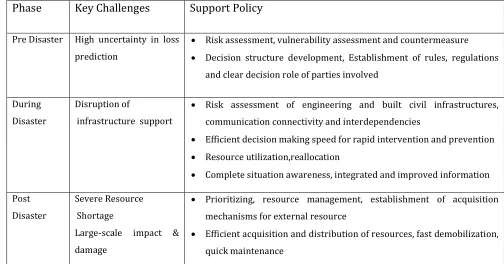
A key policy implication of the current study would be an adequate and consistent
normative framework which is essential to implement risk management. Since, the existing
frameworks are fragmented, a systematic integration of multiple policies within seismic
Table 5 – Key challenges and support policy
Phase Key Challenges Support Policy
Pre Disaster High uncertainty in loss
prediction
Risk assessment, vulnerability assessment and countermeasure Decision structure development, Establishment of rules, regulations
and clear decision role of parties involved
During
Disaster
Disruption of
infrastructure support
Risk assessment of engineering and built civil infrastructures, communication connectivity and interdependencies
Efficient decision making speed for rapid intervention and prevention Resource utilization,reallocation
Complete situation awareness, integrated and improved information
Post
Disaster
Severe Resource
Shortage
Large-scale impact &
damage
Prioritizing, resource management, establishment of acquisition
mechanisms for external resource
Efficient acquisition and distribution of resources, fast demobilization,
quick maintenance
As a result, the study suggests a system perspective taking advantages of a robust,
interoperable system to maintain a better situational awareness prior to an event. This
helps decision makers to understand and evaluate the consequences of alternative courses
of action and follow-up on decisions. This outcome reveals the fact that the holistic view of
seismic risk can effectively address the existing constraints and policy challenges involved
with seismic risk management.
12. References
Ahmad, S.S. and Simonovic, S.P. (2011) A three dimensional fuzzy methodology for flood risk analysis. Journal of Flood Risk Management (4): 53–74.
Altay, N. and Green, W.G. (2006) OR/MS research in disaster operations management. European Journal of Operational Research 175(1): 475–493.
ATC-13 (1985) Earthquake Damage Evaluation Data for California. Redwood City, CA: California Seismic Safety Commission.
ATC-14 (1987) Evaluating the Seismic Resistance of Existing Buildings. Redwood City, CA: California Seismic Safety Commission.
ATC-40 (1996) Seismic Evaluation and Retrofit of Concrete Buildings. Redwood City, CA: California Seismic Safety Commission.
Aven, T (2011) On some recent definitions and analysis frameworks for risk, vulnerability, and resilience. Risk Analysis. Vol. 31, No.(4).
Avouris, N.M. (1995) Cooperating knowledge-based systems for environmental decision support. Knowledge Based Systems 8(1): 39–54.
Basoz, N. and Kiremidjian, A. (1996) “Risk assessment of highway transportation systems” The John A. Blume Earthquake Engineering Center Report No. 118,
Department of Civil and Environmental Engineering, Stanford University, Stanford, CA. Beer, M., Ferson, S. and Kreinovich, V. (2013) Imprecise probabilities in engineering
analyses. Mechanical Systems and Signal Processing (37): 4–29.
Bender, M. and Simonovic, S.P. (1996) A systems approach for collaborative decision support in water resources planning. Int. journal of Technology Management, Inderscience publishers 3-5(19): 546–556.
Berrah, M. and Kausel, E. (1992) Response spectrum analysis of structures subjectedto spatially varying motions. Earthquake Engineering and Structural Dynamics 6(21): 461– 470.
Birkmann, J. (2006) Measuring Vulnerability to Natural Hazards: Towards Disaster Resilient Societies. Tokyo, Japan: United Nations University Press, pp. 24–37.
Blockley, D. (2013) Analysing uncertainties: Towards comparing Bayesian and interval probabilities. Mechanical Systems and Signal Processing 37(1–2): 30–42.
Bostrom, A., Turaga, R. and Ponomariov, B. (2006) Earthquake mitigation decisions and consequences. Earthquake Spectra 22(2): 313–327.
Bozorgnia, Y. and Bertero, V.V. (2003) Damage spectra: Characteristics and applications to seismic risk reduction. Journal of Structural Engineering 129(10): 1330–1340.
Bristow, M., Fang, L. and Hipel, K.W. (2012) System of systems engineering and risk management of extreme events: Concepts and case study. Risk Analysis 32(11): 1935– 1955.
Cardona, O., Ordazb, M.G., Yaminc, L.E., Marulandad, M.C. and Barbat, A.H. (2008) Earthquake loss assessment for integrated disaster risk management. Journal of Earthquake Engineering 12(S2): 48–59.
Carreno, M.L., Cardona, O.D. and Barbat, A. (2006) Evaluation of the Risk Management Performance. Proceedings of the 250th Anniversary of the 1755 Lisbon Earthquake. Lisbon, Portugal.
Coburn, A. and Spence, R. (2003) Earthquake Protection. Chichester, UK: John Wiley & Sons. Davidson, R.A. and Shah, H.C. (1997) An Urban Earthquake Disaster Risk Index. Stanford,
California: John A. Blume Earthquake Engineering Center. Report 121.
Deng, Y., Sadiq, R., Jiang, W. and Tesfamariam, S. (2011) Risk analysis in a linguistic environment: A fuzzy evidential reasoning-based approach. Expert Systems with Applications (38): 15438–15446.
Durham, S.D., Johari, P. and Bausch, D. (2008) Strategic directions in seismic modeling: HAZUS® development and current applications for catastrophe planning. In: A. Bostrom, S.P. French and S.J. Gottlieb (eds.) Risk Assessment Modeling and Decision Support. Springer Verlag, pp. 101–116.
Eguchi, T.E. and Seligson, H.A. (2008) Loss estimation models and metrics. In: A. Bostrom, S.P. French and S.J. Gottlieb (eds.) Risk Assessment Modeling and Decision Support. Springer Verlag, pp. 135–156.
FEMA 154 (2002) Rapid Visual Screening of Buildings for Potential Seismic Hazards: A Handbook. Washington DC: Federal Emergency Management Agency.
Fruta, H., Shiraihi, N., Umano, M. and Kawakami, K. (1991) Knowledge-based expert system for damage assessment based on fuzzy reasoning. Computers and Structures 40(1): 137– 142.
Gulkan, P. and Sozen, M.A. (1999) Procedure for determining seismic vulnerability of building structures. ACI Structural Journal 96(3): 336–342.
Gulkan, P. and Yakut, A. (1996) An expert system for reinforced concrete structural damage quantification. In: J.K. Wight and M.E. Kreger (eds.) Mete A. Sozen Symposium-A
Tribute from His Students. ACI Special Publication No. SP-162. pp. 53–71. Haimes, Y. (2009) On the complex definition of risk: A system-based approach. Risk Analysis 29(12): 1647– 1654.
Haimes, Y. (2012a) ‘Systems-based guiding principles for risk modeling’, planning, assessment, management, and communication. Risk Analysis 32(9): 1451–1467.
Haimes, Y. (2012b) Systems-based approach to preparedness for response to, and recovery from natural and human-made disasters. Leadership Management Engineering 12(4): 288–298.
HAZUS (2001) Earthquake loss estimation methodology, Technical and users manual, http://www.fema.gov/plan/prevent/hazus.
Holmes, W. (1996) Seismic Evaluation of Existing Buildings State of the Practice, 11thWorld
Conference on Earthquake Engineering. Acapulco, Mexico: Pergamon.
Karbassi, A. and Nollet, M.J. (2008) Development of an index assignment procedure compatible with the regional seismicity in the province of Quebec for the rapid visual screening of existing buildings. Canadian Journal of Civil Engineering 35(9): 925–937. Klügel, J., Mualchin, L. and Panza, G.F. (2006) A scenario-based procedure for seismic risk
analysis. Engineering Geology 1-2(88): 1–22.
Klugel, J.U. (2008) Seismic hazard analysis. Earth Science Review 88(1–2): 1–32.
Konakli, K. and Kiureghian, A. (2011) Stochastic Dynamic Analysis of Bridges Subjected to Spatially Varying Ground Motions. Berkeley, CA: Pacific Earthquake Engineering Research Center (PEER).
Lahdelma, R., Salminen, P. and Hokkanen, J. (2000) Using multicriteria methods in environmental planning and management. Environmental Management 26(6): 595–605. McGuire, R.K. (2008) Seismic risk mitigation decisions under uncertainty. In: A. Bostrom,
S.P. French and S.J. Gottlieb (eds.) Risk Assessment Modeling and Decision Support. Berlin Heidelberg: Springer Verlag, pp. 85–198.
Miyasato, G.H., Levitt, R. and Boissonnade, A. (1986) Implementation of a knowledge based seismic risk evaluation system on micro computers. Artificial Intelligence 1(1): 29–35. Neal, D.M. (1997) Reconsidering the phases of disaster. International Journal of Mass
Emergencies and Disasters 15(2): 239–264.
NRCC (1992) Manual for Screening of Buildings for Seismic Investigation. prepared by Institute for Research in Construction Ottawa, Canada: National Research Council Canada.
NRC (2011) National Earthquake Resilience, Research, Implementation and Outreach. Washington DC: National Academy Press.
Park, Y.J. and Ang, A.H.-S. (1985) Mechanistic seismic damage model for reinforced concrete. Journal of Structural Engineering 111(4): 722–739.
Rojhan, C. (1986) ATC methodology and data for rapid assessment of seismic vulnerability. In: C. Scawthorn (ed.) Techniques for Rapid Assessment of Seismic Vulnerability. Proceedings of a Session at Structures Congress’ 86; 15–18 September, New Orleans, LA. New York: ASCE.
Ross, T. (2004) Fuzzy Logic with Engineering Application. The Atrium, Southern Gate, Chichester: John Wiley and Sons.
Simonovic, S.P. (2011) System Approach to Management of Disasters: Method and Application. Hoboken, NJ: John Wiley & Sons.
Smith, NJ., Merna, T. and Jobling, P. (2006) Managing Risk in Construction Projects. Blackwell Science Ltd.
Standards Australia/Standards New Zealand (1995) Australian/New Zealand Standard – Risk Management. Sydney, Australia: Standards Australia.
Sucuoglu, H. and Yazgan, U. (2003) Simple survey procedures for seismic risk assessment in urban building stocks. In: S.T. Wasti and G. Ozcebe (eds.) Seismic Assessment and Rehabilitation of Existing Buildings. Dordrecht, The Netherland: Kluwer Academic Publishers.
Tesfamariam, S. and Goda, K. (2013) Handbook of Seismic Risk Analysis and Management of Civil Infrastructure Systems. Cambridge, UK: Woodhead Publishing Limited.
UN/ISDR (2004) Living with Risk: A Global Review of Disaster Reduction Initiatives. International Strategy for Disaster Reduction, 2004 version Geneva, Switzerland: UN Publication.
UN-ISDR (2006) Hyogo Framework for Action 2005-2015: Building the Resilience of Nations and Communities to Disasters, United Nations International Strategy for Disaster Reduction, Extract from the final report of the World Conference on Disaster Reduction (A/CONF.206/6), March 16, 2005, Hyogo, Japan.
Vahdat, K. and Smith, N.J. (2014) A risk-based system for managing the retrofitting of school buildings in seismic prone areas: A case study from Iran. International Journal of Risk Assessment and Management 17(4): 311–331.
Vahdat, K., Smith, N.J. and Amiri, G.G. (2014a) Fuzzy multicriteria for developing a risk management system in seismically prone areas. Socio-Economic Planning Sciences (48): 235–248.
Vahdat, K., Smith, N.J. and Amiri, G.G. (2014b) Developing a Knowledge Based Expert System (KBES) for Seismic Risk Management. Proceedings of the Second International Conference on Vulnerability and Risk Analysis and Management (ICVRAM), Liverpool, UK: ASCE (American Society of Civil Engineer), pp. 1746–1755.
Vahdat, (2015) Seismic Risk Management, PhD Thesis, University of Leeds, Leeds, UK. Wen, Y.K., Ellingwood, B.R., Veneziano, D. and Bracci, J. (2003) Uncertainty Modeling in
Earthquake Engineering, MAE Center Project FD-2 Report http://citeseerx.ist.psu.edu/ viewdoc/download?doi=10.1.1.115.1598&rep=rep1&type=pdf.
Yakut, A., Ozcebe, G. and Yucemen, M. (2006) Seismic vulnerability assessment
using regional empirical data. Earthquake Engineering Structural Dynamic 35(10): 1187– 1202.
Yucemen, M.S., Ozcebe, G. and Pay, A.C. (2004) Prediction of potential damage due to severe earthquakes. Structural Safety 26(3): 349–366.
Zadeh, L. (1973) Outline of a new approach to the analysis of complex systems and decision processes. IEEE Transactions on Systems Man and Cybernetics MC-3(1): 28–44.
Zadeh, L. (1996) The role of fuzzy logic in modeling, identification and control. In: L.A. Zadeh, G.J. Klir and B. Yuan (eds.) Fuzzy Sets, Fuzzy Logic and Fuzzy Systems: Selected