Executive Function: A comparison between Normal Ageing Adults and Older Adults suffering Traumatic Brain Injury.
Ty A. Dawson BPsych (Hons)
Submitted in partial fulfilment of the requirements for the Degree of Doctor of Psychology
School of Psychology University of Tasmania
This thesis contains no material which has been accepted for a degree or diploma by the University or any other institution. To the best of my knowledge and belief this thesis contains no material previously published or written by another person except where due acknowledgement is made in the text of the thesis, nor does the thesis contain any material that infringes on copyright.
_____________________________ Date:___________________ Ty Dawson
This thesis may be made available for loan and limited copying in accordance with the Copyright Act 1968.
_____________________________ Date:___________________ Ty Dawson
15.4.2012
Acknowledgements
This thesis, aside from being a body of work, also represents the final chapter in my student life; neither would have been possible without the generosity and support of many people. Thanks go to my original supervisor Maria Hennessy for getting the ball rolling, and thanks to all at the Menzies Institute for the opportunity to collaborate. Thanks too are due to Martin Morrissey for his assistance when
attempting to recruit an early Alzheimer’s cohort and to Ann Stark and Mandy Matthewson for their assistance with recruiting the 50-59 year olds. I owe many thanks to all at the Neurotrauma register, especially Matt Thomas and Sama Johnson.
I am very grateful to James Alexander for his input on earlier phases of this thesis, not just for his advice with stats, but even more so for his pragmatism in the face of recruiting difficulties. I am also indebted to Deborah Graham of James Cook University. Deborah’s mentoring and tutelage set me on my postgraduate trajectory and her contribution to my academic carer and the professional life it qualifies me for cannot be underestimated.
I would like to thank the 2004 postgraduate cohort for welcoming the ‘new kid at school.’ Thanks go to my family and friends for their ongoing support, particularly the friends I have been lucky enough to make since moving to Tasmania – friends really are the family we choose for ourselves. I would like to thank all the
participants who gave up their time for this research project, without them, none of this would be possible.
Table of Contents
Abstract 1
Chapter 1 Overview of the Thesis 3
Chapter 2 Executive Function the Construct 6
2.1 Defining Executive Function 6
2.2 Theories of Executive Function 7
2.3 Evolution of Theoretical Perspectives 8
2.4 The Central Executive 9
2.5 An Alternate Account – is Executive Function simply g? 11 2.6 Process Fractionation Models of Executive Function 11
Chapter 3 The Measurement of Executive Function within the fields of
Ageing and Traumatic Brain Injury 13
3.1 Methodological and Measurement Issues in Ageing
Research 13
3.2 Difficulties with Definition, Operationalisation and
Validity 16
3.3 Task Purity / Impurity 17
3.4 Novelty and Ecological Validity 17
3.5 Reliability 19
3.6 Sensitivity 19
3.7 Heterogeneity of Measures Employed 20
3.8 Summary 20
Chapter 4 Review of Popular Measures of Executive Function and other
Relevant Instruments 22
4.1 Fluency Tasks 22
4.1.1 Phonemic Fluency 23
4.1.2 Excluded Letter Fluency 25
4.1.4 Alternate Uses (AU) Test 26
4.1.5 Figural Fluency 29
4.2 The Stroop Task 31
4.3 The Trail Making Test (TMT) 33
4.4 Dual-Tasks 35
4.4.1 Telephone Search while Counting (TSC) 35
4.5 Wisconsin Card Sort Test (WCST) 37
4.6 Tower of Hanoi (ToH) and Tower of London (ToL) 40
4.7 The Cognitive Estimates Test (CET) 41
4.8 The Self-Ordered Pointing Task (SOPT) 42 4.9 The Multiple Errands Task (MET) and the Six Elements
Test (SET) 43
4.10 The Delis-Kaplan Executive Function System (D-KEFS) 44 4.11 The Behavioural Assessment of Dysexecutive Syndrome
(BADS) 44
4.12 Executive Measures – Summary 46
4.13 Non-Executive Measures of Interest 46 4.14 Hopkins Verbal Learning Test-Revised (HVLT-R) 47 4.15 The Rey-Osterrieth Complex Figure Test (ROCFT) 48
4.16 Digit Span 49
4.17 Digit Symbol-Coding 50
4.18 Summary – Non Executive Measures 51
Chapter 5 Literature Review of the Process Fractionation of Executive
Function 52
5.1 Summary 60
Chapter 6 Normal Ageing 61
6.1 Physical Changes that Occur within the Brain during
Normal Ageing 61
6.2 Cognitive Ageing 61
6.3 Global Accounts of Cognitive Ageing 63
6.4 Specific Mechanism Accounts of Cognitive Ageing and
6.5 Summary 65
Chapter 7 Executive Function and Normal Ageing 66
7.1 Research using Extreme Age Group Designs 67
7.2 Research using Narrower Age Ranges 75
7.3 Summary 78
Chapter 8 Older Adults, TBI and Executive Function 82
8.1 Traumatic Brain Injury (TBI) 82
8.2 The Pathophysiology of Traumatic Brain Injury 83 8.3 Why study TBI and Executive Function? 86
8.4 Epidemiology of TBI 86
8.4.1 Age and Gender 86
8.4.2 Severity 87
8.4.3 Mechanism of Injury 88
8.5 Why study TBI in Older Adults? 88
8.6 Diagnostic Issues 90
8.7 Rating TBI Severity 90
8.8 Methodological Issues in TBI research 92 8.9 Review of the Literature concerning mTBI and Cognition 93 8.10 Review of the Literature concerning TBI, Age and
Cognition 96
8.11 Traumatic Brain Injury and Executive Function 101
8.12 Summary 108
Chapter 9 Study 1 - The Impact of Age on Executive Function:
Aims, Method and Results 113
9.1 Aims and Hypotheses 113
9.2 Participants 116
9.2.1 60 to 69 year olds 116
9.2.2 50 to 59 year olds 118
9.3 Procedure 118
9.4 Tests Administered - Executive Measures 119
9.4.2 Semantic Fluency 120 9.4.3 Ideational Fluency – The Alternate Uses (AU) Test 120
9.4.4 The Stroop Test 121
9.4.5 Dual-task; Telephone Search While Counting
(TSC) 121
9.5 Tests Administered - Non-Executive Measures 121 9.5.1 Hopkins Verbal Learning Test-Revised (HVLT-R) 122 9.5.2 The Rey-Osterrieth Complex Figure Test (ROCFT) 122
9.5.3 Digit Span 122
9.5.4 Digit Symbol-Coding 123
9.6 Results 123
9.7 Demographic Data 124
9.8 Effects of Age, Education and Gender on Executive
Function 126
9.9 Effects of Age, Education and Gender on other
Cognitive Variables 131
9.10 Relationships Within and Between Measures across
Cognitive Domains 138
9.11 Discussion 142
9.12 The Impact of Age on Executive Function 143
9.12.1 Phonemic Fluency 143
9.12.2 Semantic Fluency 145
9.12.3 Ideational Fluency – the Alternate Uses (AU) Test 146
9.12.4 The Stroop Test 147
9.12.5 Divided Attention – Telephone Search While
Counting (TSC) 148
9.13 The Impact of Age on other Cognitive Measures 149 9.13.1 Hopkins Verbal Learning Test-Revised (HVLT-R) 149 9.13.2 The Rey-Osterrieth Complex Figure Test (ROCFT) 151
9.13.3 Digit Span 151
9.13.4 Digit Symbol-Coding 153
Chapter 10 Study 2 - The Impact of TBI on Executive Function for Older 156
10.1 Aims and Hypotheses 156
10.2 Participants 158
10.3 Procedure and Measures 160
10.4 Data Analysis 161
10.5 Demographic Data 162
10.6 The Effect of TBI on Executive Measures 165 10.7 The Effect of TBI on other Cognitive Measures 167 10.8 Relationships Between Injury Variables, Demographic
Variables and Cognition for the TBI Group 168 10.9 Relationships Within and Between Measures across
Cognitive Domains for the TBI Group 169
10.10 Discussion 171
10.11 Sample Characteristics 172
10.12 The Impact of TBI on Executive Function 173
10.12.1 Verbal Fluency Measures 173
10.12.2 The Stroop Test 175
10.12.3 Trail Making Test Part B (TMT-B) 176
10.12.4 Divided Attention – Telephone Search While
Counting (TSC) 177
10.3 The Impact of TBI on other Cognitive Measures 178 10.13.1 Hopkins Verbal Learning Test- Revised (HVLT-R) 179 10.13.2 The Rey-Osterrieth Complex Figure Test (ROCFT) 179
10.13.3 Digit Span 180
10.13.4 Digit Symbol-Coding 181
10.4 Relationships between Injury Variables and Cognition 181
10.5 Wider Discussion 183
10.6 Summary and Conclusions 187
Chapter 11 General Discussion 189
11.1 Further Discussion of the Alternate Uses (AU) Test 192 11.2 Strengths and Limitations of the Current Investigation 192
11.3 Directions for Future Research 200
Appendix A CD A1 Health Questionaire
A2 Health Questionaire
Appendix B CD
BI Raw Data Study 1 B2 Descriptives
B3 ANOVAs – executive measures B4 ANOVAs – non-executive measures B5 Correlations
Appendix C CD
C1 Raw Data Study 2 C2 Descriptives C3 t-tests
List of Tables
Chapter 8 – Older Adults, TBI and Executive Function
Table 8.1 Levels of TBI severity by measure 92
Chapter 9 – Study 1 – The Impact of Age on Executive Function
Table 9.1 Age and Gender across the Groups 125
Table 9.2 Education by Age and by Gender 125
Table 9.3 Education Group by Age 126
Table 9.18 Post-hoc results for Age and Digit Symbol-Coding 137 Table 9.19 Relationship between Age, Education, and Cognitive Measures 139 Table 9.20 Relationships between select Executive and Non-Executive
Measures 140
Table 9.21 Relationships between Digit Span variables and other Cognitive
Measures 141
Chapter 10 - Study 2 - The Impact of TBI on Executive Function for
Older Adults
Table 10.1 Demographic data for TBI subjects and Matched Controls 163
Table 10.2 Demographic data for Mild and Moderate TBI subjects 164
Table 10.3 Average Age and PTA for Mechanism of Injury 164
Table 10.4 Performance of TBI sufferers and Controls on Executive
Measures 165
Table 10.5 Performance of TBI sufferers and Controls on Non-Executive
Measures 167
Table 10.6 Relationships between select Executive and Non-Executive
Measures for TBI patients 170
Table 10.7 Relationships between Digit Span variables and other Cogntive
Measures for TBI patients 171
Chapter 11 - General Discussion
Normal Ageing cohort 193
Table 11.2 Methodological differences in select studies employing the
List of Figures
Chapter 2 - Executive Function the Construct
Figure 2.1 Baddeley's revised working memory model 9
Figure 2.2 A simplified version of the Norman & Shallice model
representing the flow and control of information 10
Chapter 4 - Review of Popular Measures of Executive Function and
other Relevant Instruments
Figure 4.1 The WCST 38
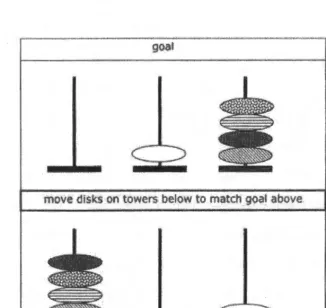
Figure 4.2 Example of a ToL trial 40
Chapter 5 - Literature Review of the Process Fractionation of
Executive Function
Figure 5.1 The process fractionation model of
Executive Function as proposed by Miyake et al. 55
Chapter 8 – Older Adults, TBI and Executive Function
Figure 8.1 TBI as principal diagnosis, cases by sex and age group from
Australia 2004-2005 87
Chapter 9 – Study 1 – The Impact of Age on Executive Function:
Aims, Method and Results
Figure 9.2 Dual-Task performance by Age and Gender 131
Figure 9.3 Digit Symbol-Coding performance by Age and Gender 135
Abstract
This thesis contrasted the performance of normal ageing adults with older TBI patients on one of the most elusive neuropsychological constructs, executive function. Executive function purportedly controls and integrates cognitive activity, reflecting conscious, strategic goal-directed operations (Stuss & Levine, 2002). However, debate rages as to whether executive function is actually a distinct construct, or merely represents g (Salthouse, 2005; Wood & Liossi, 2007).
With respect to normally ageing, it is promulgated that executive functions are among the first to be impacted given that the ‘seat’ of executive function, the frontal lobes, decline at a faster rate than other brain regions (West, 1996). The pathophysiology of traumatic brain injury (TBI) also renders the frontal lobes and thus executive function vulnerable (McDonald, Flashman & Saykin, 2002), and older adults have the second higher incidence of TBI. As such, both groups represent logical choices to study and a research paucity exists (Garden, Phillips & MacPherson, 2001; Rappoport et al. 2006). This thesis aims to reduce this paucity by further elucidating the executive function of both these populations. A secondary aim is to further examine the utility of the Alternate Uses (AU) Test (Guilford, Christensen, Merrifield & Wilson, 1978) as a measure of executive function.
contrary to predictions; while there was some impact of age on executive function, memory and information processing speed also suffered.
Study 2 recruited a group of older TBI sufferers (n = 20, age range 50-79 years) at 6-12 months post injury. Patients were tested against age and education matched controls from Study 1. Executive function was expected to be preferentially impacted by TBI and this hypothesis was supported. The Alternate Uses paradigm showed sensitivity to both normal ageing and TBI.
CHAPTER 1
Overview of the Thesis
Australia, as a developed country has an increasingly ageing population (Myburgh et al. 2008). This is due both to people living longer and the post World War II baby boom (Goldstein & Levin 2001; Hickman, Howieson, Dame, Sexton & Kaye, 2000). The phenomenon will increase as the baby boomer generation reaches 65 years and older (Myburgh et al., 2008). Traumatic brain injury (TBI) is also a major public health issue (Helps, Henley & Harrison, 2008) and underfunded and under studied in Australia (Hillier, Hillier & Metzer, 1997). Aside from representing a major health concern, TBI is of particular relevance to the field of ageing as older adults have the second highest incidence of TBI (Goleburn & Golden, 2001; Myburgh et al., 2008).
Negatively impacted by both normal ageing and TBI, executive function is a logical focus for those with an interest in the cognitive outcomes of either group (Banich, 2009; Bryan & Luszcz, 2000a; Wood & Liossi, 2007). Executive dysfunction is the most common presenting problem in neuropsychological practice (Stuss, & Levine, 2002) and executive functions are among the earliest cognitive competencies impacted by the normal ageing process (Bryan & Luszcz, 2000a). Tests of executive function are relevant in a wide range of clinical and research contexts and executive deficits feature in a wide range of
construct, issues of definition, the evolution of theoretical perspectives and introduces some of the controversy around validity, explored in greater detail in subsequent chapters.
The measurement of executive function is the most challenging and problematic area of neuropsychology (Crawford, 1998; Levine, Stuss, & Milberg, 1995). In addition to the issues inherent with the measurement of executive function, there are also methodological issues salient to research in the fields of both cognitive ageing and TBI to consider. Specific methodological issues in the study of TBI are held over until Chapter 8. Chapter 3 covers the issues pertaining to measurement in ageing and executive function. Chapter 4 gives in depth coverage to popular measures of executive function and additional non-executive measures employed by the current investigation.
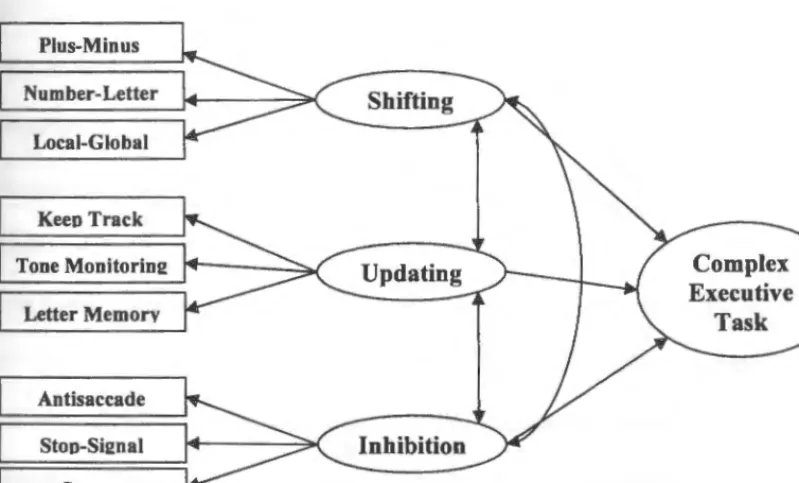
Although a central executive has been proposed, there is good evidence to suggest that executive function is not unitary (Banich, 2009; Miyake et al., 2000).
Process-fractionation models seek to delineate the actual processes occurring when a task postulated to require executive function is performed. The relative contribution of various processes (memory, attention), the non-random involvement of processes which are not intended to be measured (motor speed, visual scanning skill), and the degree of dependence or
interdependence of specific executive sub-processes (e.g. inhibition, monitoring, set-shifting) are examined (Miyake et al., 2000). Chapter 5 reviews the literature concerning process fractionation models of executive function.
also covered in Chapter 8 before the disparate bodies of literature dealing with the cognitive sequelae of mild TBI (mTBI), the cognitive outcome of older adults suffering TBI, and the impact of TBI on executive function are reviewed.
This thesis comprises two Studies. Study 1 examines executive function in a large normal ageing cohort aged 50-79 years. Measures of information processing speed and memory were also included so that the frontal ageing hypothesis (West, 1996) could be tested against competing global accounts of cognitive ageing. A contribution of this study was the sampling of a narrow age range facilitating the further delineation of the course of executive function in older adulthood. In this field extreme age-group designs predominate. Such designs do not allow examination of whether cognitive decline is gradual, or sharper after a ctricial period is reached. This is seen as an important question by Hedden and Gabrieli (2004). Study 2 examined executive functioning in a cohort aged 50-79 years who had suffered TBI of mild-to-moderate severity in the preceding 6-12 months. This severity range was chosen as most TBI sustained by older adults are within this range, yet paradoxically, very little is known about cognitive outcome at this end of the injury spectrum for older adults (Rapoport et al., 2006). The non-acute post injury phase was chosen given that the chronicity of deficits remains a critical issue (Binder, Rohling & Larrabee, 1997; Lezak et al., 2004). An additional aim of this thesis was to further examine the utility of the Alternate Uses (AU) test (Guilford, Christensen, Merrifield & Wilson, 1978) as a measure of executive function among the two populations of interest (Bryan, & Luszcz, 2000a; Butler, Rorsman, Hill & Rogerio, 1993). As such it was included in both studies.
CHAPTER 2
Executive Function the Construct
2.1 Defining Executive Function
Executive function is a term that has been fairly well known within the
neuropsychological nomenclature for the past two decades. Lezak (1982) popularised the umbrella term ‘executive functioning’ and Baddeley and Wilson (1988) coined the term dysexecutive syndrome. Dysexecutive syndrome refers to the problems that can occur post brain-injury with the break-down in control functions for cognitive, emotional and
behavioural responses (Lezak, Howieson & Loring, 2004; Chan & Manly, 2002). Executive function has become a pronounced focus of interest in the field (Jurado & Rosselli, 2007; Phillips, 1999; Salthouse, 2005), with over 2500 articles published between 1996 and 2006 (Alvarez & Emory, 2006).
The field remains both controversial and unclear. Executive function is a
psychological construct, and not an anatomical one (Strauss, Sherman & Spreen, 2006; Stuss, 2006) and the term has been a theoretical rather than operational definition (Burgess, 1997). There is little agreement within the literature as to what executive function is, or what the executive functions actually are (Banich, 2009; Daniels, Toth & Jacoby, 2006; Jurado & Rosselli, 2007; Wecker, Kramer, Wisniewski, Delis & Kaplan, 2000).
controlling lower-level ones. Thus, executive function can be thought of as a meta-cognitive process, the process of an individual marshalling their cognitive resources to adapt to the demands of the real world. Executive behaviours also extend beyond the cognitive to
emotional regulation and social interaction. The inappropriate social behaviour of individuals who have suffered frontal lesions is a case in point (Lezak et al., 2004). The social and emotional aspects of executive function are beyond the scope of this review.
Executive function has typically been the concern of those working in rehabilitation settings (Burgess, 1997) and executive dysfunction is the most common presenting problem in neuropsychological practice (Stuss, & Levine, 2002). Executive deficits are a feature of a wide range of neuropsychiatric conditions including ADHD, substance abuse, traumatic brain injury, schizophrenia, the dementias and Parkinson’s disease (Banich, 2009; Elliott, 2003; Jester et al., 2009; Kennedy, et. al, 2008) and declines in executive functioning are also associated with advancing age (Bryan & Luszcz, 2000a; Lowe & Rabbitt, 1997; Piguet, et al., 2005). When executive systems break-down, behaviour is poorly organised, poorly
controlled and disinhibited (Elliott, 2003; Jurado & Rosselli, 2007). Thus, research has been initially driven by the practical need to understand executive function, rather than as a theoretical endeavour.
2.2 Theories of Executive Function
can “better account for the many disparate pieces of knowledge currently available” (p. 92). Such a theory is yet to emerge.
As the construct was rooted in the neuropsychological study of the problems experienced by patients suffering frontal lesion damage (Miyake et al., 2000; Hedden & Yoon, 2006), historically the terms frontal and executive function have been used interchangeably (Strauss et al., 2006). Anatomically the frontal lobes are the seat of executive functioning (Lezak et al., 2004; Stuss, 2006) and the prefrontal cortex is of particular importance (Elliott, 2003; West, 1996). While the other lobes are largely devoted to the processing of sensory information, the frontal cortex is distinct by being generally responsible for the processing of actions (Fuster, 2002). Of course, executive function is not purely frontal in that other cortices are recruited in the service of goal directed behaviour. For example, temporal integration is the result of cooperation between prefrontal and subcortical structures within the frontal lobe and then parietal, occipital and temporal lobes (Fuster, 2002). Thus using the terms frontal and executive interchangeably is unsuitable (Strauss et al., 2006), and has been a source of considerable confusion within this field (Alvarez & Emroy, 2006; Elliott, 2003; Strauss et al., 2006; Stuss, 2006).
2.3 Evolution of Theoretical Perspectives
measuring executive function. Baddeley and Hitch's (1974) model of working memory, and Norman and Shallice's (1986) Supervisory System then had a further influence on the field, as each features a central 'executive.' They are described forthwith
2.4 The Central Executive
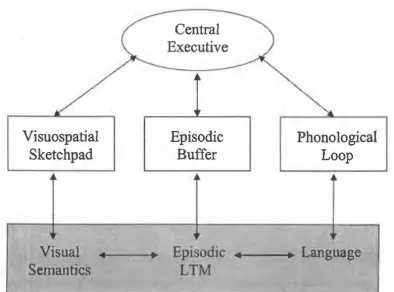
As an alternative model of short-term memory to that of Atkinson and Shiffrin (1968), Baddeley and Hitch (1974) offered a model featuring three parts. The term working memory (WM) was used as opposed to short-term memory, reflecting that information was both stored and manipulated. Germane to this thesis, this model contained a central executive as
depicted in Figure 2.1. The central executive was postulated to function as an attentional
control system, integrating auditory and visual information from the other slave systems, the phonological loop and the visuospatial sketch-pad (Baddeley, & Della Sala, 1998; Baddeley,
& Hitch 1974). A fourth component, an episodic buffer, was later added to the model
(Baddeley, 2000).
Visuospatial
Sketchpad
V1sual
Semantics
•
Central
Episodic
Buffer
Phonological
Loop
_,. ___
� Language
Figure 2.1. Baddeley's revised working memory model. LTM = long-term memory. From "The Episodic Buffer:
[image:24.557.60.454.397.689.2]Following on from Baddeley and colleagues, Norman and Shallice (1986) introduced
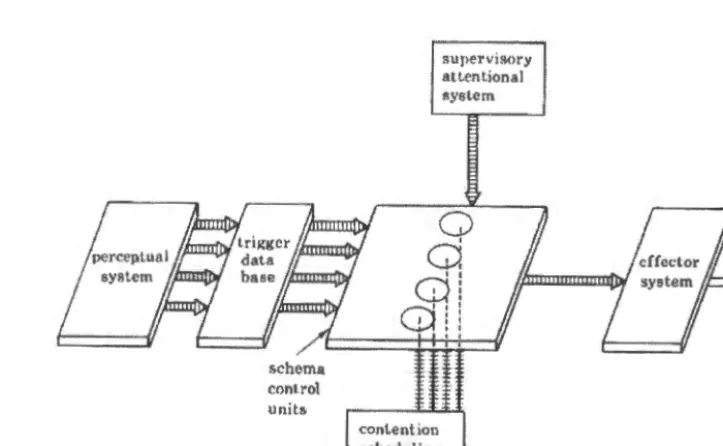
the concept of the Supervisory System. The model, depicted in Figure 2.2, translates
elements ofLuria's (1973) ideas into the argot of cognitive psychology and
information-processing theory (Stuss, Shallice, Alexander & Picton, 1995). The model is primarily
concerned with the control of attention, and a central premise is the distinction between
automatic processing and the processing required in novel situations. Novelty of course, is
theorised to draw upon executive function. With a familiar task, habitual and even automatic
responses are enacted. If the task is novel, controlled processing is required, and a selection
of alternatives are formulated and evaluated. Habitual responses may need suppression until
their appropriateness can be established by the Supervisory System, a central executive.
units
supervisory at. ten tiona!
system
Q
Q
I I
Ot
Q ··:
contention scheduling
[image:25.557.84.446.346.569.2]:' :'
Figure 2.2. A simplified version of the Norman & Shallice model representing the flow and control of
information. The lines with arrows represent activating input, the crossed lines represent the primarily mutually inhibitory function of contention scheduling. Adapted from "Specific Impairments of Planning" by T. Shallice, 1982, Royal Society of London Philosophical Transactions Series B, 298, p. 200.
As with Lezak (1982), Norman and Shallice not only made a contribution to theory,
and Cognitive Estimates Test were devised to test the model as opposed to relying on traditional neuropsychological measures (Bryan, & Luszcz, 2000a).
2.5 An Alternate Account – is Executive Function simply g?
An alternate account questions the very validity of executive function as a construct. The position proposed by Duncan, Johnson, Sawles and Freer (1997) and held by Crawford, Bryan, Luszcz, Obonsawin & Stewart (2000), Salthouse (2005) and Wood and Liossi (2007) is that executive function is actually not distinct from general intelligence or “g.” This postulate, comes in part from the strong correlations between executive measures and other measures of cognition (Obonsawin et al., 2002). However, data has been produced
documenting independent contributions to variance in cognitive function, over and above g, attributable to executive function (Jester et al., 2009; Levine, Stuss & Milberg, 1995; Strauss et al., 2006; Stuss & Alexander, 2000) refuting explanations of executive function as being non-distinct from g. The work of Duncan et al., (1997), Salthouse (2005) and Wood and Liossi (2007) is reviewed in more detail in Chapter 5 and Section 7.1.
2.6 Process Fractionation Models of Executive Function
Although a central executive has been proposed, there is good evidence to suggest that executive unction is not unitary (Fisk & Sharp, 2004; Miyake et al., 2000). There is no homunculus, no little man in the head (Kennedy et. al, 2008; Stuss & Levine, 2002). The debate is lively, Lowe and Rabbitt (1997) suggests that a range of different “frontal” tasks can be employed when considering executive function, and Wecker et al., (2000) note that “many executive function tests do not delineate what is being assessed” (p. 412). While earlier models had a unitary flavour, more recently, Fisk and Sharp (2004) cite a “growing consensus” toward the fractionability of executive processes.
‘planning,’ ‘inhibition,’ ‘monitoring’ and ‘control.’ These constructs map roughly onto Luria’s (1973) framework of, ‘program’, ‘monitor’ and ‘regulate’, and overlap with Lezak’s (1982) subsequent notions of ‘volition’, ‘planning’, ‘purposive action’ and ‘effective
performance.’
Process-fractionation models seek to delineate the actual processes occurring when a task postulated to require executive function is performed. The relative contribution of various processes (memory, attention), the non-random involvement of processes which are not intended to be measured (motor speed, visual scanning skill), and the degree of
dependence or interdependence of specific executive sub-processes (e.g. inhibition, monitoring, set-shifting) are examined.
A landmark paper in the attempt to advance theory and present executive function as a fractionable construct was published by Miyake et al., (2000). Miyake and colleagues
CHAPTER 3
The Measurement of Executive Function within the fields of Ageing and Traumatic
Brain Injury
According to Crawford (1998), executive function can be “regarded as constituting the most problematic area in neuropsychological assessment” (p. 209). There is a need for an increase in the sensitivity of which we can measure executive function, and for greater
construct and ecological validity (Burgess et al., 2006; Chan, Shum, Toulopoulou, & Chen, 2008). The need for more valid and sensitive measures will only escalate as the
neuropsychologist is increasingly asked to describe function and establish the degree of impairment, as opposed to being asked to localise lesions as in years gone by (Norris & Tate, 2000). Additionally, as our understanding and conceptualisations of executive function become more sophisticated, so too must our measurement instruments, especially with increased emphasis being placed on the fractionation of executive processes (Banich, 2009; Lezak, Howieson & Loring, 2004).
In addition to the issues inherent with the measurement of executive function, there are also methodological issues salient to research in the fields of cognitive ageing and TBI to consider. Measurement issues in the study of ageing will be covered briefly, before issues germane to the measurement of executive function are covered in more depth. Specific methodological issues in the study of TBI are held until Chapter 8, where the epidemiology and pathophysiology of TBI are also dealt with.
3.1 Methodological and Measurement Issues in Ageing Research
having the limitations of being logistically more difficult and being time and resource
intensive (Hedden & Gabrieli 2004; Park, Polk, Mikels, Taylor & Marshuetz, 2001). Ideally, longitudinal research would cover a minimum of three time-points allowing the detection of curvilinear trends (Christensen et al., 2008). Attrition is often a problem in longitudinal ageing research as mortality and the move from community to institutional settings over the duration of a study is not uncommon (Kail & Cavanaugh 2000; Park et al., 2001). Selective attrition is also an issue, where more interested and motivated individuals, who are often more educated and of higher socioeconomic status, remain (Bieliasuskas, 2001). Another problem that can arise with longitudinal designs, quite salient to executive function, is the possibility that repeated measurement decrease novelty and thus validity (Hedden & Gabrieli 2004; Ettenhofer, Hambrick, & Abeles, 2006; Strauss, Sherman & Spreen, 2006). The related issue of the novelty criterion is examined in Section 3.4.
A cross-sectional approach collects data from different groups (e.g. old vs. young, clinical vs. non-clinical) at a single point in time, or at a number of separate points in time (Kail & Cavanaugh 2000; Park et al., 2001). Such an approach is also not without its disadvantages. This design is associated with the problem of increased measurement error (Howell, 1997). Further, rather than simply increasing random error, cohort effects can exacerbate error in a systematic way as groups can differ on many factors including education, nutrition, and frequency of exposure to words or concepts (Bieliasuskas, 2001; Hedden & Gabrieli 2004; Park et al., 2001). As age groups become more extreme cohort effects typically become more pronounced (van Hooren et al., 2007).
intra- individual differences associated with advanced ageing (Bryan, & Luszcz, 2000a; Hedden & Gabrieli 2004; Raz, 2004). Extreme age group designs have been the most frequently used paradigm in the study of executive function and ageing, which is clearly evident in the literature review to follow in Chapter 7.
Another issue in the field of neuropsychology concerns the appropriateness, quality and availability of existing norms (Strauss et al., 2006). For cognitive tests, norms for older adults tend to be from small samples, often of North American origin (Clark et al., 2004). Clark and colleagues also suggests that the ten year age bands typically employed are too broad when studying older adults. Thus any research efforts to contribute more relevant norms, more stratified norms, or norms based on larger samples are meritorious (Strauss et al., 2006).
In the study of ageing, there are important considerations in regard to screening of samples. Screening is necessary to reduce the impact of extraneous variables. Studies of normal cognitive ageing may be contaminated by the inclusion of pre-clinical dementing individuals, which may inturn lead to an overestimation of age related differences
(Bieliasuskas, 2001; Hedden & Gabrieli 2004). Thus screening for the presence of such disorders is advisable although we can never be sure that such individuals have not been included (Buckner, 2004; Lezak et al., 2004). Raz (2004) advocates even further screening for cerebrovascular disease, stroke and diabetes due to the negative influence on cerebral structure and function. Most of the studies of normal cognitive ageing reviewed in Chapter 7 select participants as community dwelling, and exclude on the basis of neuropsychological conditions and major physical or psychiatric illness. So while the careful screening of samples is certainly advocated, judiciousness is recommended due to the potential for
the performance of older adults may actually be overestimate due to an unrepresentatively healthy sample (Hedden & Gabrieli, 2004).
3.2 Difficulties with Definition, Operationalisation and Validity
The terms ‘frontal’ and ‘executive’ have often been used interchangeably within neuropsychology (Bryan, & Luszcz, 2000a; Strauss et al., 2006). As individuals with frontal lobe lesions had difficulty on many of the most popular measures such used today, such as the Wisconsin Card-Sorting Test (WCST), Phonemic Fluency, Semantic Fluency, Design Fluency and the Stroop, these tasks came to be regarded as tests of frontal function (Lezak et al., 2004; Strauss et al., 2006). In a rather circular fashion, the approach was then to label tests sensitive to frontal damage as ‘executive tests,’ and then to validate such tests on those with frontal lesions (Chan et al., 2008; Stuss & Levine, 2002).
This is problematic as a relationship between frontal damage and impairment on a particular test does not automatically render the task a valid test of executive function (Bryan, & Luszcz, 2000a), and is also inaccurate as both frontal and non-frontal areas are recruited in the performance of such tasks (Strauss et al., 2006). More recently, the call has been made to examine the properties of such measures and the processes they invoke with greater reference to definitions of executive function and theory (Banich, 2009; Miyake et al., 2000).
However, it is difficult, as suggested by Jurado and Rosselli (2007), to establish the validity of a group of tests, when the construct itself is ill defined.
Newer tests such as the Tower of London (ToL), Cognitive Estimates Test (CET), and the Self-Ordered Pointing Task (SOPT) have been developed from the cognitive
2008). An area of opportunity in the study of executive function is to further validate both the newer and existent measures, that is to establish what is actually being measured when a purportedly executive task is administered (Jurado & Rosselli, 2007; Miyake et al., 2000).
3.3 Task Purity / Impurity
The issue of the degree of task purity / impurity is another challenge. As a meta-process, executive function, by very definition covers multiple cognitive domains and thus tasks cannot be considered process ‘pure’ (Ettenhofer et al., 2006; Stuss et al., 2002). Performance on any individual task represents the pooled outcomes of many distinct
functional processes both executive and non-executive (Miyake et al., 2000; Rabbitt, 1997). Further, to be valid, executive measures also require a fair degree of complexity, rendering them effortful (as opposed to automatic) (Chan et al., 2008; Shallice, 2002). However, increasing complexity is psychometrically paradoxical because as intricacy increases tasks load on multiple executive and non-executive processes (Strauss et al., 2006; Stuss, & Alexander, 2000). It is difficult enough to establish the purity of different executive tasks from one another, and even more difficult to distinguishing between ‘executive’ and ‘non-executive’ ones (Bryan & Luszcz, 2000a).
3.4 Novelty and Ecological Validity
In routine, over-learned tasks, the demands on executive function are reduced or even minimal. Neuropsychological tests generally have the following properties; instructions are clear, trials are short, initiation is prompted by the examiner and goals and successful
performance are typically well-outlined (Bamdad, Ryan and Warden, 2003; Garden, Phillips & MacPherson, 2001). These same properties pose a threat to the validity of executive function and lead some writers to go as far suggesting that the structure of the testing
situation functions as frontal lobes by proxy (Lezak et al., 2004; Wood & Liossi, 2007). It is far from unusual in the clinical realm for an individual to appear unimpaired on standard tests of executive function while very real problems in daily life ensue (Kennedy et. al, 2008; Lezak et al., 2004; Spencer & Johnson-Greene, 2009). The situation may arise out of both a lack of sensitivity and a lack of ecological validity on the part of existing measures (Bamdad et al., 2003; Burgess et al., 2006).
3.5 Reliability
Given the difficult state of affairs in relation to defining and operationalising
executive function and the multi-factorial nature of the construct, it is unsurprising that there are also reliability issues with many measures of executive function. Low correlations between tests of executive function are common, with inter-correlations being typically around r = .4 or lower (Lowe & Rabbitt, 1997; Miyake et al., 2000; Obonsawin et al., 2002). It is difficult to ascertain the extent to which the tasks themselves have inherently poor reliability, or merely reflect the involvement of non-executive processes, and differences in strategies employed to complete the task or different aspects of executive function (Chan et al., 2008; Jester et al., 2009). As aforementioned in Section 3.4, decreased novelty after a prior administration may also reduce reliability. Measures that have greater external validity such as the Multiple Errands Test (MET, Shallice & Burgess, 1991) or the Alternate Uses (AU) Test (Guilford, Christensen, Merrifield & Wilson, 1978), both reviewed forthwith in Chapter 4, typically have inherent difficulties with objective scoring (Bryan, & Luszcz, 2000a; Knight, Alderman & Burgess, 2002).
3.6 Sensitivity
Sensitivity of measures employed is an issue in both the clinical and experimental realm. Clinically, measures must be able to detect the dysexecutive problems that manifest themselves as very real problems in living while not being readily apparent on such
instruments as the WAIS or the WMS (Lezak et al., 2004; Strauss et al., 2006).
Sensitivity is a particular issue for some of the more traditional measures of executive function (Butler, Rorsman, Hill & Rogerio 1993). As aforementioned, most of these
traditional measures were developed on patients with frontal lesions (Lezak et al. 2004; Strauss et al., 2006). As such, the question arises when a lack of differences in normal populations is apparent, as to whether the lack of difference reflects the absence of an age related decline, or merely a lack of sensitivity on the part of traditional clinical
neuropsychological measures employed (Bryan, & Luszcz, 2000a). Compounding the situation, the most sensitive measures are long and unpleasant (such as the WCST), which may make them less than ideal for use with older adults and other populations (Bryan, & Luszcz, 2000a; Lezak et al., 2004).
3.7 Heterogeneity of Measures Employed
There is no “gold standard” for measuring executive function (Banich, 2009;
Ettenhofer et al., 2006) thus the heterogeneity of measures employed is another complicating factor (Hart, Whyte, Kim & Vaccaro, 2005; Strauss et al., 2006). This makes cross-study comparisons difficult. Even if one took a popularist approach and used the most common measures (the WCST, the Stroop, the Trail Making Test, Phonemic and Semantic Fluency), multiple variations of these measures exist further complicating matters. Often adoption of variants makes methodological sense, such as versions of Card-Sort or Tower type tasks, where length and difficulty are manipulated intentionally. In other cases deviations from established versions and procedures are perplexing and add unnecessary ‘noise’ to an already befuddling field (Hart et al., 2005).
3.8 Summary
pronounced with advanced age (Ardilia, 2007; Raz, 2004) and cohort effects can inflate measurement error (Hedden & Gabrieli, 2004; Lezak et al., 2004). The measurement of executive function is especially problematic (Crawford, 1998; Phillips, 1997). Among the difficulties that exist are heterogeneity of measures used and the lack of a ‘gold standard’ (Strauss et al., 2006). Due to the inherent complexity of the construct, and difficulties in defining and operationalising executive function, validity and reliability problems abound (Lezak et al., 2004; Chan et al., 2008). Despite advances in the field, the measurement of executive function remains a challenge to neuropsychologists and others concerned with the construct (Banich, 2009; Chan et al., 2008). Thus, while existing measures may be
CHAPTER 4
Review of Popular Measures of Executive Function and other Relevant Instruments
Although readers will be familiar with many of them, it is useful to cover the
measures of executive function most commonly encountered within the literature. Broadly, measures can be considered ‘traditional,’ that is coming out of efforts to study frontal function, including such measures as Trail Making Test (TMT), the Wisconsin Card Sort (WCST), the Stroop and various fluency paradigms, or as being ‘newer,’ arising from a cognitive neuroscience approach, with the Cognitive Estimates Test (CET), the Self-Ordered Pointing Test (SOPT), and Tower Tests, among others, serving as exemplars (Bryan, & Luszcz, 2000a; Lezak, Howieson, & Loring, 2004; Phillips, Wynn, McPherson, & Gilhooly, 2001). The Alternate Uses (AU) task (Guilford, Christensen, Merrifield & Wilson 1978) is also covered in particular detail given the secondary of aim of this thesis to further test its usefulness as a measure of executive function. Two relatively recent batteries, the Delis-Kaplan Executive Function System (D-KEFS; Delis, Delis-Kaplan & Kramer, 2001), and the Behavioural Assessment of Dysexecutive Syndrome (BADS; Wilson, Alderman, Burgess, Emslie, & Evans, 1996) will also receive attention. After measures of executive function are detailed, selected divergent measures used by the current investigation will also be reviewed.
4.1 Fluency Tasks
Fluency tasks utilise the technique of item generation and are frequently used in neuropsychology to assess executive function. Although procedures vary across the numerous paradigms, basically, participants are required to produce as many unique
Rorsman, Hill & Rogerio, 1993). These tasks also have other executive components as they require initiation, monitoring of output and remaining cognisant of rules (Lezak et al., 2004; Strauss et al., 2006). Fluency measures are typically conceptualised as measures of cognitive flexibility (Henry & Crawford, 2004).
4.1.1 Phonemic Fluency
Henry and Crawford (2004) suggest that Phonemic Fluency tasks were originally devised as measures of Verbal Intelligence Quotient (VIQ), while they are now frequently used to assess executive function (Lezak et al., 2004; Phillips, 1999). Participants are typically asked to produce words beginning with a particular letter, over a short time period (typically one minute). The ‘F, A and S’ combination, originating with Benton is the best known, giving rise to the name ‘FAS’ (Tombaugh, Kozak, & Rees, 1999). Subject are informed that the use of proper nouns is prohibited, as are variations of the same word (fly, flew, flying) and repetitions. The term COWA or COWA T (Controlled Oral Word
Association Task) is used by some researchers to refer to Verbal fluency only, and by others to refer to both Phonemic and Semantic Fluency tasks being administered. As such, the moniker COWAT is avoided herein to remove confusion.
Phonemic Fluency tasks are thought to be executive in nature as strategic retrieval of information is required, as well as monitoring of output to ensure that responses confirm to task rules and are goal relevant (Bryan, & Luszcz, 2000a; Turner, 1999). Phillips (1997) suggests that someone with inefficient executive function employs poorer strategy and thus generates fewer words. However, the validity of Phonemic Fluency as a measure of
executive function is contestable, as many authors suggest that the act of performing letter fluency may be a straight, simple process of lexical access rather than one which is
According to a comprehensive norming study by Tombaugh et al., (1999), Phonemic Fluency performance is more education than age sensitive, with these variables accounting for 18.6% and 11% of the variance respectively. Thus, Lezak et al., (2004) advocate the use of norms that take into account demographics. Gender effects are minimal although there is sometimes a slight advantage in favour of educated females (Lezak et al., 2004; Tombaugh et al., 1999).
Parallel forms such ‘CFL’, ‘BHT’ and ‘PRW’ exist (Bennett, Ong & Ponsford, 2005a; Ross et al., 2007; Troyer, Moscovitch & Winocur 1997), with high reliability being noted (Lezak et al., 2004; Troyer et al., 1997). Lezak et al. note that scores are fairly stable across time making the task suitable for longitudinal work. Ettenhofer, Hambrick, and Abeles (2006), Ross et al., (2007) and Tombaugh et al. (1999), have all recorded test-retest reliability between r .73-.84. The utility of qualitative scoring methods is covered forthwith in Section 4.1.3.
4.1.2 Excluded Letter Fluency
The Excluded Letter Fluency paradigm originated with Crawford, Wright and Bate (1995). This task requires participants to articulate as many words as possible that do not contain specified letters (E and R, or parallel in form A and T) in two 60 second trials
(Hughes & Bryan, 2002; Strauss et al., 2006). By increasing the tasks demands the paradigm is thought to involve more than just straight lexical access and is thus a more potentially valid alternative to the standard Phonemic Fluency task (Shores et al., 2006). Crawford et al., (1995) have demonstrated TBI sensitivity and Bryan and Luszcz (2000b) demonstrated age sensitivity. Bryan and Luszcz (2000b) and Hughes and Bryan, (2002) have recorded internal consistencies between r .61-.76 for trials using the letters “A” and “E.” Shores et al., (2006) published reliability and normative data from a large sample of young adults aged 18-34 years. In the Shores et al. cohort, internal consistency between the letters A, E and I was r = .84, and 1-year test-retest reliability coefficient was r = .67. A degree of discriminant validity is evident as the measure correlated at only r = .45 with WAIS-R full scale IQ scores (Shores et al.). The Excluded Letter Fluency paradigm has not yet been widely adopted.
4.1.3 Semantic Fluency
Semantic Fluency tasks require respondents to name as many category members as they can think of, most commonly ‘animals,’ or ‘grocery items’ (Lezak et al., 2004;
Tombaugh et al., 1999). Category members can start with any letter and repetitions are to be avoided (Strauss et al., 2006). The Semantic Fluency task is both one of the more sensitive traditional neuropsychological measures and one of the more widely employed (Lezak et al., 2004; Henry & Crawford, 2004). The need to generate a self-initiated search strategy is said to reflect executive process (Bryan, & Luszcz, 2000a).
‘Clusters’ and ‘Switching’ of responses on this task, and also have done so to a lesser extent with the Phonemic Fluency paradigm (Hughes & Bryan, 2002; Raskin & Rearick, 1996; Ross, et al., 2007; Troyer, 2000). ‘Clusters’ are defined as with the number of words within a particular Semantic or Phonemic category, and ‘Switching’ as the process of moving from one Cluster to the next. The work of Ross et al., suggests that scoring systems for calculating clusters and switches have poor inter-rater and test-retest reliability. Hughes and Bryan (2002) and Raskin and Rearick (1996) both produced results where such additional analyses were largely uninformative. The interested reader can see Mayr (2002) for further critique of the methods for calculating such indices, and also Lezak, et al., (2004).
Test-retest reliability for the Semantic Fluency task over one month is moderate at r = .56 according to Bird, Papadopoulou, Ricciardellie, Rossor and Cipolotti (2004), although when studying older adults over a relatively short time period Ettenhofer et al., (2006) returned a much higher r = .81. It is unsurprising that reliability for Semantic Fluency is lower than for Phonemic Fluency as only one trial is used for the former, in contrast to the typical three for the later (Ross et al., 2007; Strauss et al., 2006). Results from the norming study by Tombaugh et al. (1999) indicate Semantic Fluency to be sensitive both to age
(accounting for 23.4% of the variance) and education (accounting for 13.6% of the variance). Lezak et al., (2004) advocate the use of norms that take into account demographics, such as those offered by Tombaugh et al. (1999). Gender effects are noted as being insignificant (Lezak et al., 2004; Tombaugh et al., 1999). The sensitivity of the Semantic Fluency paradigm to TBI has also been established (Henry & Crawford, 2004; Raskin, & Rearick, 1996).
4.1.4 Alternate Uses (AU) Test
1995). A measure of Ideational Fluency, the Alternate Uses (AU) Test, also known as Uses for Objects, is one such example. Originally devised as a test of divergent thinking (Guilford et al., 1978; McCrae, Ehrenberg & Costa, 1987), this task can be considered executive in nature by virtue of not only requiring the participant to select appropriate search strategies, but by also representing a novel and somewhat ambiguous situation (Bryan, & Luszcz, 2000a; Turner, 1999).
The AU test requires participants to give as many different uses for a particular object (for example, ‘bottle,’ ‘paper clip,’ and ‘hat’) as possible within a specified time period. The time given per trial, the number of trials and the stimulus objects themselves vary
considerably across the literature. Responses are scored as either correct or incorrect. Errors include perseverations, repetitions and merely describing the object rather than giving a use (Bryan, & Luszcz, 2000a). Researchers concerned with the study of creativity also score responses for the degree of novelty by either making a subjective judgement or by calculating infrequency of response statistically (Hocevar, 1979).
documented significantly poorer AU performance for those with frontal lobe lesions in comparison to normal controls. Turner (1999) demonstrated impaired AU performance in Autism sufferers when contrasted with normal controls, and also impaired performance for autistic subjects with high intellectual functioning on the task relative to controls with IQ scores lower than 76. In contrast to Wilson and Gilley, differences between matched controls and Parkinson’s sufferers were documented by Tomer, Fisher, Giladi and Aharon-Peretz (2002).
Bryan and Luszcz (2000b), Parkin and Java, (1999) and Parkin and Lawrence (1994) have all shown the AU task to be age sensitive. In terms of sensitivity to TBI, Milders, Fuchs and Crawford (2003) recorded a trend for poorer performance of TBI sufferers relative to controls, while Crawford et al., (1995) published a conference abstract suggesting that the AU task was the most sensitive of verbal fluency measures employed within a TBI sample.
4.1.5 Figural Fluency
Figural Fluency tests, also known as Design Fluency, were designed to be analogous to their verbal counter parts (Goebel, Fischer, Frestl & Menhdorn, 2009; Strauss et al., 2006). Such tasks require respondents to generate as many novel abstract designs as possible. As with Verbal Fluency tasks, such tests are argued to be executive in nature as better strategy usage aids performance (Goebel et al., 2009). Early ‘free’ conditions were difficult to score reliably (Lezak et al., 2004; Strauss et al., 2006) which led to the development of figural versions. Subjects are given dotted matrices, and required to connect dots to produce unique designs. The most common versions are the Ruff Figural Fluency Test (RFFT; Ruff, Evans, & Marshall, 1986) and its forerunner, the Five Point Figure Test (FPFT; Regard, Strauss & Knapp, 1982; Goebel et al., 2009). The Delis-Kaplan Executive Function System (D-KEFS; Delis, Kaplan & Kramer, 2001; reviewed subsequently in Section 4.10) also contains a variant. The FPFT is within the public domain while the RFFT is commercially distributed (Lezak et al., 2004; Strauss et al., 2006).
The principal difference between the FPFT and the RFFT are the matrices. The FPFT stimuli are pages with identical square grids, featuring a five-point dot design arranged in eight rows of five columns (Strauss, et al., 2006). The RFFT stimuli pages also feature five dots matrices (Ruff et al., 1986). The RFFT stimuli are more complex than that of the FFPT, being asymmetrical and changing across five successive trials. Trial 1 features the standard 5 dot grid, while trials 2 and 3 feature the same grid with the addition of distracter stimuli (diamonds and lines respectively). In trials 4 and 5 distracter stimuli are absent, while the dot matrices are variations on the original from trial 1 (Ross, Foard, Hiott and Vincent, 2003; Strauss, et al., 2006).
errors. Goebel et al., (2009) and Ross et al., (2003) have also devised qualitative ratings of strategy employed during performance of the FPFT and the RFFT respectively. The usefulness of such qualitative scoring needs to be established further.
Despite similar psychometric properties, there are poor correlations between the three most popular variants of this task (Strauss et al., 2006). Both the RFFT and the FPFT are typically free of gender effects and feature high inter-rater reliability (Goebel et al., 2009; Lezak et al., 2004; Ross et al., 2003; Strauss et al., 2006). Both paradigms are subject to considerable practice effects (Goebel et al., 2009; Kraybill & Suchy, 2008; Ross et al., 2003) which could render them unsuitable for repeat administration.
In terms of validity, in a study by Goebel and colleagues (2009), the FPFT correlated significantly with IQ score and Trail Making Test Part-B (TMT-B) performance only, but not with Phonemic Fluency. Kraybill and Suchy (2008) noted a similar relationship between the TMT-B, the RFFT, and a lack thereof for Phonemic Fluency. Thus, while exhibiting
executive properties, Figural Fluency paradigms seem most similar to the TMT-B in
requiring flexibility in the visuospatial domain as opposed to being visual analogues of verbal fluency (Kraybill & Suchy, 2008; Strauss et al., 2006). In terms of motor skill, Kraybill and Suchy examined the contribution of motor processes to RFFT performance. Ruff et al., (1986) had previously noted a relationship between performance and motor speed in severe but not moderate TBI cases. Kraybill and Suchy found that RFFT productivity did not correlate with a measure of motor fluency (making unique hand movements) and that the contribution of motor speed was relatively low (4.5%) giving further evidence of validity. Milders et al., (2003) reported that depressed motor speed in TBI patients did not fully account for the differences between TBI sufferers and controls on this measure.
for 26.8% of the variance in performance, with a further 18.7% accounted for by age.
Conversely, Kraybill and Suchy (2008) found only a slight correlation with age for the RFFT, however the age range of their sample was more restricted (18-60 years). Ross et al., (2003) and Ruff, Light and Evans (1987) have both shown the RFFT to be age sensitive. Ruff et al. (1986) and Milders et al. (2003) have shown the RFFT to be sensitive to the impact of TBI.
4.2 The Stroop Task
The Stroop Task is one of the most widely used neuropsychological measures and the prototypic paradigm for examining individual differences in susceptibility to interference (Banich, 2009; Stuss, Floden, Alexander, Levine, & Katz, 2001). Multiple versions exist, including the commercial ‘Golden’ version, a version included in the D-KEFS and the Victoria version (Lezak et al., 2004; Strauss et al., 2006). In the ‘classic’ paradigm
individuals first read the names of colours written in black ink, followed by naming colour patches, and finally, naming colours printed in a non-corresponding colour (Stuss et al., 2001). Pachana, Thomspon, Marcopulos & Yoash-Gantz (2004) have developed a variant specifically for use with older adults to get around the issue of blue / green confusion, although such an issue was not identified in review by Bryan and Luszcz (2000a). The Pachana et al. version of the Stroop does not appear to have been widely adopted, having not been encountered in any of the literature reviewed in subsequent Chapters.
All Stroop trials are timed and it is the slowing of performance in the final trial (the ‘interference’ or ‘incongruent’ trial) or the comssion of errors which are of primary interest (Bryan, & Luszcz, 2000a; van der Elst, van Boxtel, van Breukelen & Jolles, 2006). Although variants on the control trials exist, the interference condition is common across
the score for the incongruent trial as such a calculation allows for correction in baseline variability in processing speed (Strauss et al., 2006; Troyer, Leach, & Strauss, 2006). Analysis of errors is less common, especially among normal ageing samples, due to the low frequency in which such errors occur (Strauss et al., 2006; Stuss et al., 2001). When errors occur on the incongruent trial, they reflect the failure of inhibition.
The Stroop test can be considered an executive control task as it requires the avoidance of a habitual but goal-irrelevant response (word reading) in favour of a less-practiced but goal-relevant one (naming the colour of the ink in which the word is written) (Bugg, DeLosh, Davalos, & Davis, 2007; van Hooren, Valentuin, Ponds & van Boxtel, 2007). The data of Troyer et al., (2006) provides strong support for the Stroop’s validity as a test of the executive domain of inhibition, rendering an age related global slowing
explanation far less tenable. The Stroop is known to be age sensitive (Bryan, & Luszcz, 2000a; Klein, Ponds, Houx & Jellemer 1997; van Boxtel, ten Tusscher, Metsemakers, Willems & Jolles, 2001; van der Elst et al., 2006; Troyer et al., 2006; Wecker, Kramer, Wisniewski, Delis & Kaplan, 2000) and is also sensitive to the impact of TBI (Chan, 2000), but not within mTBI range (Strauss et al., 2006). The impact of age had a far larger effect (r =. 62) than the contribution of education (r .14 -.24) according to Troyer et al., (2006). In Klein et al.’s (1997) study, IQ contributed around 10.5% of the variance.
Debate exists around the most appropriate version of the Stroop. Both Bryan and Luszcz (2000a) and Lezak et al., (2004) suggests that longer version of the Stroop are most sensitive, while Klein and colleagues (1997) postulate the opposite. Both Strauss et al. (2006), and Troyer et al. (2006) take issue with the norms provided for the Golden Version, and advocate use of the Victoria Version given its brevity, the existence of well-stratified norms and by virtue of it being in the public domain. Overall it remains unknown the degree to which the various versions of the Stroop are correlated with one another (Strauss et al., 2006; van der Elst et al., 2006).
4.3 The Trail Making Test (TMT)
Trail Making tasks are variously suggested to reflect the ability to shift mental set, the ability to exercise inhibition and interference control, and planning and sequencing ability (Mitchell & Miller, 2008; Sanchez-Cubillo et al., 2009). The task has been considered variously as an attentional measure and as one of executive function (Sanchez-Cubillo et al., 2009; Strauss et al., 2006). The TMT is within the public domain (Lezak et al., 2004) and is amongst the most popular measures within neuropsychology (Ettenhofer et al., 2006;
Tombaugh, 2003).
The TMT consists of two parts. In Part A, the stimulus page consists of consecutively numbered circles, while for Part B, stimuli consists of circles with co-varying numbers and letters. Part A serves as a control trial; the participant is required to connect the circles in numerical order as rapidly impossible. For Part B, participants are to connect alternate circles by number-letter-number in ascending order as rapidly as possible. Strauss et al., (2006) give detailed instructions for administration.
minus trial A removes processing and motor speed components, making it the purest measure. However, Perianez et al., (2007), using both a mixed clinical (TBI and schizophrenia) and normal sample, found B-A to correlate with TMT-B score at r = .9, suggesting that B-A is redundant. This however threatens validity as the high degree of co-linearity suggests that cognitive flexibility is not the main determinant of performance (Lezak et al., 2004).
Tombaugh (2003) conducted a large norming study (n = 911 normal adults, age range 18-89 years). Age was much more highly correlated than education, with the two variables shown by regression analysis to account for 58% and 6% of the variance respectively. Upon further exploration of the impact of education, the variable was found to exert an influence only on those older than 54 years, and then it only accounted for between 3-7% of the
variance. The work of Hester, Kinsella, Ong and McGregor (2005) also suggests that gender and education exert only a nominal influence. Tables of stratified norms provided by
Tombaugh (2003) greatly extended those available previously, and Hester et al., (2005) provide further stratified Australian norms for use with older adults.
4.4 Dual-Tasks
Attention, the physiological process of selective apportionment of neuronal resources is often postulated as coming under executive control (Fuster, 2002; Shallice & Burgess, 1998). Thus, allocation of attention in demanding circumstances is often of interest to those studying executive function (Falconer, Geffen, Olsen & McFarland, 2006). Dual tasks require different cognitive operations to be conducted simultaneously allowing the assessment of divided attention. Dividing attention is contested to make demands on the central executive according to the theory of Supervisory Attentional System (Norman & Shallice, 1986; Shallice, 2002; Shallice & Burgess, 1998).
Divided attention and selective attention decrease more heavily with advanced age than the ability to sustain attention or concentrate (Bieliasuskas, 2001; Treitz, Heyder & Daum, 2007). These facets of attentional control are also negatively impacted by TBI (Chan, 2000; Robertson, Ward, Ridgeway, & Nimmo-Smith, 1994). A heterogeneous range of dual tasks are employed in the field of executive function and ageing (Fisk & Sharp, 2004; Treitz, et al., 2007), and the field of executive function and TBI (Chan, 2000; Mangels, Craik, Levine, Schwartz & Stuss, 2002; Mathias, Beall & Bilger, 2004). In terms of fractionating executive processes, dual tasks are typically independent of g and load separately from other executive measures (Bate, Mathias & Crawford, 2001; Chan, Hoosain & Lee, 2002; Fisk & Sharp, 2004; Miyake et al., 2000).
4.4.1 Telephone Search while Counting (TSC)
audio tone strings, under timed conditions. The difference in time taken between the two conditions, corrected for accuracy, gives a measure of divided attention; a ‘dual task decrement’ (Robertson, et al.). This is effectively the ‘cost’ of dividing attention.
Robertson et al., (1994) do not provide data on internal reliability, which Strauss et al., (2006) speculate is due to the speeded nature of the task. Test-retest values are
marginally acceptable to poor, with r = .59 being recorded by both Chan et al., (2002) and Robertson et al. in ethnically different samples. At face value, the task has ecological validity as it is designed to approximate everyday activity (Strauss et al.). In terms of divergent validity, the correlation of TSC with the National Adult Reading Test (NART; Nelson, & O'Connell, 1978); as a measure of g, is almost non-existent at r = -.03 (Robertson et al.). Chan et al., (2002) found that TSC did not correlate significantly with TMT-B, Digit-Symbol Coding, Digit Span, the Six Elements Test (SET; Shallice & Burges, 1991), Multiple Errands Task (MET; Shallice & Burgess, 1991), Stroop or Verbal and Figural Fluency tests, with correlation coefficients of r .06-.18 being recorded. In a study by Bate and colleagues (2001), correlations for the TSC with the Stroop, Paced Auditory Serial Addition Test (PASAT; Gronwall, 1977), digit symbol, digit span and a measure of selective attention ranged between r .24-.37 When factor analysis is used, TSC appears to load on a factor separate from other facets of attention and other measures from the TEA, suggesting that TSC is indeed a valid measure of divided attention (Bate et al., 2001; Chan et al., 2002).
TBI severity relative to controls, although great heterogeneity in time since injury and large SDs in the TBI group may have obscured such differences. Bate and colleagues (2001) did not detect differences between controls and severe TBI patients on the TSC, and suggest that Robertson et al. may have been able to do so due to the use of a small sample, by having a shorter post-injury interval and by failing to control for the influence of IQ. Conversely, Hennessy, Geffen, Pauley & Cutmore (2003) found that the TSC was the only measure of several employed which differentiated mTBI sufferers from orthopaedic controls at one month post-injury. Chan (2000) also detected differences in mild-to-moderate TBI cases relative to controls, although his patients were specifically selected as having attentional problems which would be expected to bias the results. Despite the purportedly high sensitivity of the TSC, this task does not appear to have been previously employed by published studies of normal ageing. Remaining untested among normal ageing groups, and having some sensitivity among TBI groups even at the milder end of the injury spectrum, the instrument is worthy of further study and an appropriate inclusion in the current study.
4.5 Wisconsin Card Sort Test (WCST)
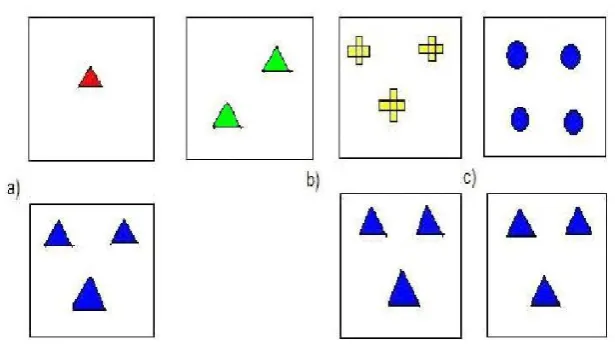
per card, matching the shapes (e.g. sorting stars with stars), or colour, again illustrated in Figure 4.1.
Figure 4.1. The WCST. Cards are sorted by either a) shape, b) number, or c), colour.
Participants are not given instructions as to the sorting rules, but merely given feedback in the form of ‘yes’ or ‘no’ as to whether a sort was correct by the examiner; the sorting rule changes without warning (Lezak et al., 2004; Rhodes, 2004). A perseverative response would be sorting by an old rule, even after being given negative feedback several times suggesting that the sorting rule has changed. Individuals suffering frontal lobe damage frequently respond perseveratively on this task (Banich, 2009).
The task is considered difficult due to the unannounced sorting rule changes and the task’s length (15 to 30 minutes). As such many respondents find the task relatively