Questioning Philosophy
MSc Thesis
(Afstudeerscriptie)
written byMatteo Ferrari
(born 21st of December, 1995 in Genova, Italy)
under the supervision of Maria AloniandPaul Dekker, and submitted to the Board of Examiners in partial fulfillment of the requirements for the
degree of
MSc in Logic
at theUniversiteit van Amsterdam.
Date of the public defense: Members of the Thesis Committee:
27th of August, 2019 Dr. Ekaterina Shutova (Chair) Dr. Maria Aloni
Dr. Paul Dekker
Questioning Philosophy
Abstract
This thesis develops a nominalist approach for the area of Philosophical Logic that deals with existence and identity.
It does so from an epistemic perspective, with the objective of describing what a philosopher can call knowledge when discussing such topics.
One of the features of the Philosophical Inquisitive Logic (PhIL) here outlined is given by techniques from Inquisitive Logic. Such semantics is expressive enough to characterize not only declarative statements but also questions, in the optics that within philosophy a good unanswered question is as important as a good answer.
Questioning Philosophy
Acknowledgments
To quote Leopardi, what you are about to read are: “The toilsome papers where
my prime was being consumed, the best of me”
-A Silvia, Giacomo Leopardi
But no person is an island. Or, if they are, they probably live in an archipela-gos.
What I mean is that surviving this Master and Thesis had no little effect on my surroundings, and it greatly affected my work and my life.
That is why it fills me with joy to remember every person that positively affected this journey.
To start I want to thank my supervisors Maria Aloni and Paul Dekker, that during the past months inspired and encouraged me to go in whichever direc-tion I wanted to explore.
I also have to thank more generally the ILLC as physical institution and as col-lection of people, since in both understanding it always made me feel welcomed and supported.
Unfortunately, there is not enough ink in the world to thank every specimen of the Master of Logic as they deserve. I thanks Leo, Ignacio, Kristoffer, Martin, Sebastian, Adrien, Hrafn, Federico, Francesco, Zhuoye, Tatevik, Davide, Raja, Georgi, Nachiket, Filippo, Robin, Dimitrios and Marco alongside many other nice people I met during this experience.
They say the strongest steel is forged by the fires of hell, it is pounded and struck repeatedly before it is plunged back into the molten fire. That is why I feel that the connections I made with those people that, as me, wrote their thesis at the ILLC during the summer time is stronger than it could have ever been.
Rachael, Chase and Michael made those warm days in the MoL room not only bearable, but enjoyable.
A special thanks to goes to Yvette, who initiated me to bouldering and Mina, who always had a witty comment to better me.
I will always remember Nuno and David as the the most supporting and funny people at the ILLC, Giuliano as the cheerful South-Italian friend that every one needs in their life, Angelica as the sassiest individual that “New Amsterdam” has to offer, Pedro as the deadpan friend I needed around, Erin as the sweetest logician I know and Evi as the best mole of the Master of Logic.
Questioning Philosophy
Danielle, Honorine, Nick, Yinmin, Javier and Vahid. The next year I had a shorter staying there with Tommaso, Troy and many others.
Also I have to mention Cesare and Ben, the friends from my city that I met only here in Amsterdam and Martina, my high school friend that ‘followed’ me there.
I want to thank Quincy, who stayed by my side in the most chaotic days of my life and made the moments we spent together oasis in the stress.
As the list goes on I have to return to my origins, thanking my old friends and loved ones: Chiara, Ottavio, Federica, Federico and Simone alongside many others.
To Matteo B., that put up with my gibberish arguments beyond the humanly possible.
Questioning Philosophy
“Not all questions are answered, commander, but fortunately some answers are questioned.”
Contents
1 Informative and Inquisitive Content 7
1.1 General Notions . . . 8
1.1.1 Information State . . . 8
1.1.2 Issue . . . 8
1.2 Content . . . 9
1.2.1 Informativeness and Inquisitiveness . . . 10
1.2.2 Algebraic Notions . . . 10
1.3 First-Order Inquisitive Logic . . . 11
1.3.1 The Language . . . 11
1.3.2 Semantics . . . 12
1.3.3 The novelty of Questions . . . 14
1.3.4 Modalities and Questions . . . 15
1.4 Identity in FOIEL . . . 18
2 Questions in Philosophy 21 2.1 To be or not to be? . . . 22
2.1.1 Predication . . . 23
2.1.2 Quantification . . . 24
2.1.3 Identity . . . 25
2.1.4 non-trivial existence . . . 26
2.2 Agents within the system . . . 26
2.3 NecessaryvsNecessarily Known . . . 27
2.3.1 On Metaphysical Compatibility . . . 29
3 Partial Modal Logic 31 3.1 Partial Semantics . . . 31
3.1.1 Models for Partial Logic . . . 34
3.1.2 Algebraic approach . . . 34
3.1.3 Substitutivity of Identicals . . . 36
3.1.4 Algebraic approach for Informative Content . . . 37
3.2 Entailment and Validity in the Bilateral Approach . . . 38
3.2.1 Entailments . . . 38
3.2.2 Valid and Invalid formulas . . . 41
3.2.3 Properties and Closure . . . 42
3.2.4 Parallelisms with Other Non-Classical Logics . . . 48
3.3 Classical Logic in a restricted Language . . . 49
Questioning Philosophy
3.3.3 Classical validity and PhIL validity . . . 54
4 Philosophical Inquisitive Logic 59 4.1 PhIL’s Semantics . . . 59
4.1.1 The Model . . . 60
4.1.2 Support conditions . . . 62
4.2 Entailments and Validity . . . 65
4.2.1 Entailment in PhIL . . . 65
4.2.2 Validity in PhIL . . . 67
4.3 Standard INQ in the restricted Language . . . 69
4.3.1 Propositional Rules . . . 70
4.3.2 First-Order Rules . . . 73
4.3.3 Modal Fragment . . . 74
4.4 Results . . . 75
5 Conclusion 79 5.1 Other topics of interest . . . 79
5.1.1 Analyticity and Indexicals . . . 79
5.1.2 Story telling vs Reasoning on the Premises . . . 80
5.2 Conclusion . . . 83
A Partial Modal Logic 87 A.1 Defined Logical Operators . . . 87
A.2 Algebraic approach for the Valuation Function . . . 87
A.2.1 Basic Algebraic Operations . . . 88
A.2.2 Defined Algebraic Operators . . . 88
A.2.3 Recursive Definition of the Valuation Function . . . 88
A.3 Algebraic approach for Informative Content . . . 89
A.3.1 Truth-set and Falsehood-set . . . 89
A.4 Partial Modal Logic Correspondence . . . 89
A.4.1 truth/falsehood and Valuation . . . 90
A.4.2 Informative Content and Valuation . . . 92
B Philosophical Inquisitive Logic 95 B.1 Defined Logical Operators in PhIL . . . 95
B.1.1 Expressiveness . . . 96
B.2 Downward Monotonicity . . . 97
B.3 Singleton-World Correspondence . . . 98
B.4 Algebraic approach for Inquisitive Content . . . 100
B.4.1 Defined Operator . . . 100
B.4.2 Acceptance-set and Rejection-set . . . 100
B.5 PhIL Correspondence . . . 100
Introduction
The objective of this thesis is to develop a formal semantics that can merge a nominalist approach to Philosophical Logic and Epistemic Logic, in order to have a philosophically satisfactory characterization of knowledge within a given philosophical theory as ontologically neutral as possible.
The aim of such approach is to be metaphysically innocent, in order to provide a flexible“logical toolkit” for counterfactual and modal reasoning.
Two different non-classical approaches converge in this work: Inquisitive Se-mantics, worthy of a brief introduction since it is an ever expanding and recent field, and Partial Logic, which will be employed non-standardly.
The former will be introduced in chapter 1 on page 7 and I will be particularly interested in its Epistemic expansion, that will serve as core of this project. Inquisitive Semantics has been developed mainly by Ivano Ciardelli, Jeroen Groenendijk, and Floris Roelofsen; its expressive power makes it possible to treat not only declarative sentences but also questions. Partial Logic will be introduced in chapter 3 on page 31 in response to the problems and proposed solutions discussed in chapter 2 on page 21.
In the rest of this chapter I will discuss how the primitive concepts of “knowl-edge” and “agent” are interpreted in standard Epistemic Logic and how they should be read within the system that will be discussed in chapter 4 on page 59: Philosophical Inquisitive Logic (PhIL).
Reasoning Agents
The first lineof the voice “Epistemic Logic” in the Stanford Encyclopedia of Philosophy says:
“Epistemic logic is the logic of knowledge[...].”
Questioning Philosophy
The Properties of Knowledge
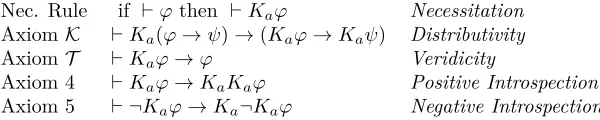
A standard approach to Epistemic Logic is described in the introductory sections of [Hans Van Ditmarsch, 2015]. I will assume familiarity with the formal aspects of Modal Logic and standard Epistemic Logic here and just discuss why a certain formalization is employed and which kind of philosophical interpretation it has. The modal systemS5, a proper extension ofK, is used to capture what Van Ditmarsch calls the ‘properties of knowledge’. The Rules and axioms ofS5 are the following, for every agenta∈ A:
Nec. Rule if ⊢φthen ⊢Kaφ Necessitation
AxiomK ⊢Ka(φ→ψ)→(Kaφ→Kaψ) Distributivity
AxiomT ⊢Kaφ→φ Veridicity
Axiom4 ⊢Kaφ→KaKaφ Positive Introspection
[image:10.612.180.480.220.280.2]Axiom5 ⊢ ¬Kaφ→Ka¬Kaφ Negative Introspection
Figure 1: Axioms and Rules in Classical Epistemic Logic
Given such a characterization, these agents have of course a very peculiar type of knowledge.
In particularNecessitationtells us any agent knows every theorem provable in their theory, while Distributivity let them know any consequence that their personal knowledge entails.
Veridicity says that we can call knowledge only what actually happens to be true, Positive and Negative Introspection that our agents have a perfectly clear access to their own body of knowledge, and they are always able to specify what they know and what they do not know. From this brief description we may notice that the knowledge we are addressing is bothpotential andidealin the literal sense.
This conception is similar to a Platonic Epistemology: the most iconic ex-ample of it can be met in the Socratic dialogue Meno [Bluck, 1961]. There Socrates shows that a slave can understand how to draw a square twice the area of another, even if he lacks ofmathematical maturity.
For Plato, Meno’s slaveremembers theorems that he knew a priori rather than discoveringorlearningthem, proving that the knowledge of mathematical truth was inside him all along. The provable mathematical truth “The area of a square bbuilt on the diagonal of a squareais twice the area ofa” is everyone’s potential knowledge.
TheVeridicityof knowledge appears to be a really intuitive constraint. Con-sider the following sentence:
(1) “Psyche knows that the creature who kidnapped her is a monster. How-ever, he is actually Eros the god of love.”
Questioning Philosophy
Introspection is similar to the example of Meno’s slave: given enough time and help remembering he will be able to know that he knows many cheerful facts about the square of the hypotenuse. This confirms the idea of potentiality of knowledge.
Negative Introspection is probably the black sheep among the properties of knowledge. It states that if an agent does not know something then they know that they do not know it. Of the aforementioned properties of knowledge it is probably the most debatable axiom, even when considering an ideal and potential interpretation of knowledge. Consider for example the sentence:
(2) “King Priam does not know that the Trojan Horse is full of Greek war-riors.
Therefore, King Priam knows that he does not know whether the Trojan Horse is full of Greek warriors.”
It seems too strong to be forced to admit that just from being ignorant about some proposition we can deductively know we are ignorant, even if we have no disposition toward the object of our ignorance. I will address this problem again in section 1.3.4 on page 17 along with an alternative proposal that leverages on Inquisitive Semantics.
Inquisitive and Classical Agents
We can conclude that this general account of Classical Epistemic Logic is at its core the “logic of perfectly self aware logicians”.
It is not particularly problematic if some predictions are not met by actual epistemic agents or if they are far too ideal: an agent in our theory is to an actual logician what a Turing Machine is to any actual machine able to manipulate symbols.
In INQ Epistemic Logicthe properties of knowledge in figure 1 on the pre-ceding page are preserved unchanged in the declarative fragment. The main difference is in term of the modal operator Ka is expressibility: it is possible,
for example to say that an INQ agent can know the answer of a question. Moreover, it is possible to introduce an inquisitive modalityEaφ, read as “agent
aentertainsφ”. This modality is equivalent to knowledge for declarative formu-las; however, an agent mayentertaina question withoutknowinghow to answer it.
These concepts will be clarified in section 1.3.4 on page 15, and for an even more detailed account the reader can refer to [Ciardelli, 2014]. In the article the properties ofKa andEa are characterized as shown in figure 2 on the next
Questioning Philosophy
For⊕ ∈ {Ka, Ea |a∈ A}andαdeclarative
Nec. Rule if ⊢φthen ⊢ ⊕φ Necessitation
AxiomK ⊢ ⊕(φ→ψ)→(⊕φ→ ⊕ψ) Distributivity
AxiomT ⊢Eaα→α Veridicity
Axiom4 ⊢Eaφ→EaEaφ Positive Introspection
Axiom5 ⊢ ¬Eaφ→Ea¬Eaφ Negative Introspection
Equivalence ⊢Eaα↔Kaα K-E equivalence on declaratives
[image:12.612.164.568.98.198.2]K?distrib. ⊢Ka?{α1, . . . , αn} →Kaα1∨. . .∨Kaαn K distribution over interrogatives
Figure 2: Axioms and Rules in INQ Epistemic Logic
Philosophically Inclined Agents
Once the standard account has been clarified we can analyze how Philosophically Inclined Agents (PIA) are different from their classical counterparts.
Even assuming that questions in philosophy are as important as answers there are other reasons why “going inquisitive” is the best choice.
To answer the question “What is a Philosophically Inclined Agent?” is to answer the question “What can a Philosophically Inclined Agent know?”. Well, I can start with an easy remark: if they know more it is only because they can express more, and they see the world as infinitely more complex than their non-philosophical counterparts (nPIA)do.
A PIA uses concept like “necessary” and “contingent”, entertains theories about counterfactual reasoning, is able to reason about what exists and what does not and says that something is true only if it is verifiable.
When a PIA and a nPIA have a conversation, the latter believes that the informative content of whatever the formers adds is either trivial or meaning-less, but they share a common ground onevery-day life facts.
Most of the things that a PIA can express in the fragment that is theirs alone is ‘armchair knowledge’ in the most classical sense.
Assume for example they do not remember every detail from their class in Philosophy of Language, but they know:
(3) “necessarily, either Hesperus is equal to Phosphorus or Hesperus is dif-ferent from Phosphorus”
Rather than considering this as a statement about the objects involved they would consider it a fact about how the names involved are used in counterfac-tual arguments.
Questioning Philosophy
1. Informative and Inquisitive Content
There are various way to describe the meaning of a declarative sentence in a truth-conditional semantics. In particular, in Possible Worlds (PW) semantics we are given a Logical Space W, a set of worlds we could be living in, among which we have to find which one is the real one.
Given a sentence in our language its intension is classically taken to be the set of all PW where said sentence is true. When we seek and use information we can interpret that as a way of locating ourself in the Logical Space with more precision.
For example, take an action like looking outside the window and recognizing that the sentence “It is raining” is true. Once we do it, we can conclude that we are located in that portion of the logical space where the sentence is true. In this way we can link sentences to the information that a speaker conveys in uttering them.
The goal of inquisitive semantics is to extend such account and deal not only with purely informative statements, but also with questions. This means that a sentence may not only contains information about how the world is, but also raise an issue about it.
Definition 1 [Informative and Inquisitive Content]
Given a LanguageL, For any sentenceφwe define
Informative Content of φ the intension ofφin the logical space
Inquisitive Content of φ the issue thatφraises
Take two sentences like the following, where the disjunction is interpreted as inclusive:
(4) Marco plays baseball on Thursday and on Tuesday (5) Marco plays baseball on Thursday or on Tuesday
The two sentences have of course a different informative content. While example 4 is true if and only if Marco plays baseball both on Thursday and on Tuesday, for example 5 to be true we only require that he plays on either of those days.
However, one may say that while the first sentence has nothing more to it than what it is asserting, example 5 leaves open an issue: namely, which disjunct makes it true.
Informative and Inquisitive Content Questioning Philosophy
(6) Everyone plays baseball (7) Someone plays baseball
Once again we can see how given the truth of the former there seems to be no issue worth to be discussed, while the truth of the latter raises the question “Can you give me an example?”.
The interpretation of such “open questions” left by disjunction and exis-tential quantification in INQ is that such operators introduce inquisitiveness. However, before getting to the technical notions of INQ it is useful to introduce some more general concepts and terms that will be used even further on in the thesis.
1.1 General Notions
1.1.1 Information State
An information state is defined standardly as a set of Possible Words. What a set of PW represent is a body of information: namely, those statements that are true in all the worlds contained in it. As seen in the previous section we can denote the entirety of our Logical Space withW, the set of all PW.
Definition 2 [Information State]
sis an information state iff s⊆ W
It can help to think about states as ways of finding the actual world in a more specific location of the logical space. Under such interpretation it is easy to see how an informative state t contains at least as much information as s if it locates the actual world with at least as much precision. To express this concept we say thattis an enhancement ofs.
Definition 3 [Enhancement]
t enhancessifft⊆s
From the few definitions we have seen so far we can see why W can be referred to as the ignorant state, since every state enhances it. Another state worth addressing is the empty state∅, that is enhancement of any other state and is called theinconsistent state.
1.1.2 Issue
An issue is identified by the set of all the information states that contain enough information to resolve the issue itself. It is assumed that if sresolves an issue I, then also every enhancement ofsdoes. This is expressed using the operation of downward-closure; ifA⊆P(W):
Informative and Inquisitive Content Questioning Philosophy
Definition 4 [Issue]
An issue is a non-empty and downward-closed set of information states.
Iis an issue iff for someS⊆P(W),S̸=∅andI=S↓
Definition 5 [Resolving a Issue]
An information state s resolves an issue I if and only if s is an element ofI.
We say thatIissettled insiffs∈I
For example the issue embodied by example 5 on page 7 can be solved not only by the state s that confirms Marco plays on Thursday, but also by any more specific statet⊆s(Ex. He plays only on Thursday).
I will provide more examples of issues and resolutions in figure 1.2 and 1.3 on page 15.
We also have for issues the equivalent of what enhancement was for infor-mation states. We call this relationrefinement, it compares two issues based on which information states would settle them.
Definition 6 [Issue Refinement]
An issueJ is at least as inquisitive asI if every state that settlesJ also settles I.
J refines IiffJ ⊆I
Given an issueI we callalternativesinIall the maximal information states sthat settle it, i.e. the least amount of information we need to settle the issue. Set theoretically, these are called the maximal elements ofI. f
Definition 7 [Alternatives in an issue]
The alternatives inI are all maximal elements of an issueI sis analternativeinI iffs∈I and there is not∈I such thats(t
1.2 Content
Going back to the notion of informative and inquisitive content we can now characterize it in a given languageLof Inquisitive Semantics.
The Inquisitive Content of φ, denoted as [φ] is a non-empty, downward closed set of information states.
By definition we have that[φ]is always an issue.
The Informative Content of φ, denoted as|φ|is the union of all the infor-mation states in[φ].
Informative and Inquisitive Content Questioning Philosophy
1.2.1 Informativeness and Inquisitiveness
A sentence φ will be said to be inquisitive if its informative content is not enough to resolve the issue it raises. In the following sections I will sometimes refer to inquisitive sentences asinquisitive statementsor questions while I call non-inquisitive sentences alsodeclarative statements.
Further distinctions among sentences can be made. A sentence can be informa-tive in case its informainforma-tive content is not trivial, i.e. more informainforma-tive than the ignorant state.
We calltautology a proposition that is neither inquisitive nor informative. More formally we have the following equivalences:
Definition 8 [Informative and Inquisitive sentences]
For anyφ∈ L,
• φis inquisitive iff|φ| ̸∈[φ]iff[φ]has no supremum • φis informative iff|φ|(W
• φis a tautology iffW ∈[φ]
1.2.2 Algebraic Notions
Now it is possible to define entailment and algebraic operations on informative and inquisitive content. For a thorough discussion on the topic the reader is invited to check [Ciardelli and Roelofsen, 2011]
In short, we can define entailment between sentences as inclusion in the set-theoretic sense, both for states and for issues.
Definition 9 [Classical Entailment]
We say thatφclassically entailsψ iff|φ| enhances|ψ| For anyφ, ψ∈ L,φψiff|φ| ⊆ |ψ|
Definition 10 [Inquisitive Entailment] We say thatφentails in INQ ψ iff[φ]refines [ψ]
For anyφ, ψ∈ L,φ|=ψiff[φ]⊆[ψ].
Informative and Inquisitive Content Questioning Philosophy
Definition 11 [Meet, Join and Relative Pseudo-Complement]
For anyφ, ψ∈ L,
[φ]∩[ψ]def={s|s∈[φ]ands∈[ψ]} [φ]∪[ψ]def={s|s∈[φ]or s∈[ψ]}
φ⇒ψdef={s|For allt⊆s; ift∈[φ] thent∈[ψ]}
Applying the definition|φ|def=∪[φ]it is possible to recover the operators on informative content. With such characterization of entailment we have that, for an inquisitive language L, ⟨[φ]L,|=⟩ forms a complete Heyting algebra, while
⟨|φ|L,⟩is a Boolean Algebra.
Now that the terminology and intended reading of the primitive concepts is fixed it is possible to talk about howSemantic ContentsandSupport Conditionsare defined in standard First-Order INQ Epistemic Logic.
1.3 First-Order Inquisitive Logic
1.3.1 The Language
The languageLfor standard First-Order Inquisitive Logic (FOINQ) as described in [Ciardelli, 2015] is based on a signature that consists in a set of function symbolsF and a set of relation symbolsR, with arity n≥0. For simplicity in this thesis I will consider a language with only zero place functionsn∈N, that we can call names, and variablesx∈Var. The logical base are the connectives (aka, the intuitionist/inquisitive disjunction) and→(implication); the constant
⊥(false), the quantifier∃(aka, the intuitionist/inquisitive existential) and the families of modal operators Ka (Agenta knows) andEa (Agentaentertains),
with index a∈Ag.
We can recursively define terms t and well formed formulas φ as follows, assumingn∈N,Rn ∈ R,a∈Ag,t⃗n1:
tdef=n|x
φdef=Rn(⃗tn)| ⊥ |φ∧φ|φ φ|φ→φ| ∃x.φ|Kaφ|Eaφ
Other operators can be defined as follows:
¬φdef=φ→ ⊥ ⊤def=¬⊥ ∀x.φdef=¬∃x.¬φ φ↔ψdef= (φ→ψ)∧(ψ→φ) !φdef=¬¬φ ?φdef=φ ¬φ φ∨ψdef=!(φ ψ) ∃x.φdef=!∃x.φ
In section 1.3.3 on page 14, after having introduced the semantics, I will discuss how the different operators introduce and preserve inquisitiveness.
1⃗tn
Informative and Inquisitive Content Questioning Philosophy
M=⟨W,{Σa|a∈Ag},D,I⟩
W non-empty set of possible worlds.
D non empty set whose elements are called individuals
ΣAg ={Σa|a∈Ag} a set of inquisitive state mapsfor every agenta
inAg, such thatΣa:W →P(P(W)).
Σa(w) adownward-closed set of information states:
a’s inquisitive state atw
σa(w)
def
=∪Σa(w): a′sinformative (or epistemic) state atw.
I is a mapW → Iw:w7→Iw s.t.:
– for every namen∈NL,Iw(n)∈ D
Moreover, for everyw, v∈ W and anyn∈NL,
Iw(n) =Iv(n)
[image:20.612.171.492.82.325.2]– for everyn-ary relation symbolR∈ RL,Iw(R)⊆ Dn
Figure 1.1: First-Order INQ Epistemic Model
1.3.2 Semantics
A First-Order INQ Epistemic modelis defined as the quadruple M = ⟨W,{Σa|a∈Ag},D,I⟩, described in figure 1.1. On such model we can specify
in which set of worlds w ∈ W a well formed formula φ is classically true, i.e. φ’s truth-set.
The truth-set of φcorresponds to what we have been calling φ’s Informative Content.
In this chapter I will only introduce truth-conditions for the primitive operators and treat the truth-set of an expression as function of the truth-conditions. It is however possible to give them a separate characterization and prove their correspondence, as done in previously mentioned articles.
In general, for any φ∈ L:
We write M, wgφiff inM,φis true atwunder the assignmentg
We call φ’s truth-set|φ|gM s.t|φ|gMdef={w∈ W|M, wgφ}
The assignment g : Var → N fixes the interpretation of x ∈ Var; we write g[x7→n] for the assignment that maps xto n. The referent of a termt in w under an assignmentg is defined as follows:
[x]gwcoincides withg(x)
Informative and Inquisitive Content Questioning Philosophy
Definition 12 [Truth-Set ofAtom]
For any Rn(⃗tn) ∈ Atom; the truth set of Rn(t⃗n) in M rela-tive to the assignmentgis denoted as|Rn(⃗tn)|g
M. • |Rn(⃗tn)|g
M={w∈ W| ⟨Iw([t1]gw), . . . , Iw([tn]gw)⟩ ∈Iw(Rn)}
For brevity I will specify the modelMand assignment g only if needed or in case a new notation is introduced.
The inductive clauses for the base of operators are the following:
M, wgRn⃗t n
iff w∈ |Rnt⃗n|gM
M, wg⊥ never
M, wgφ∧ψ iff M, wgφandM, wgψ
M, wgφ ψ iff M, wgφorM, wgψ
M, wgφ→ψ iff ifM, wg φthenM, wgψ
M, wg∃x.φ iff There is an∈Nsuch thatM, wg[x7→n]φ
M, wgKaφ iff for allw∈σa(w)M, sgφ
M, wgEaφ iff for all for allt∈Σa(w),t|=gφ
These truth conditions for the modalKa and the other non-modal operators
are the ‘classical’. By which I mean that under a naturalrenamingevery formula PW-valid in INQ is also valid in classical first-order logic, and vice-versa. In particular we can define classical entailment and validity.
Definition 13 [Classical Entailment and Classical Validity]
φψ iff For everyM,gandw∈ W, ifM, wgφthenM, wgψ
φ iff For everyM,g andw∈ W,M, wgφ
However, the notion characterizing Inquisitive Semantic is that of support-set of φ, i.e. the set of information states s ⊆ W such that s supports φ. The support-set of φcorresponds to what we have been calling φ’s Inquisitive Content.
For anyφ∈ L:
We write M, s|=gφiff in M,φis supported bysunder the assignmentg
We call φ’s support-set[φ]gM s.t[φ]Mg def={s⊆ W|M, s|=gφ}
Informative and Inquisitive Content Questioning Philosophy
M, s|=gRnt⃗ n
iff s⊆ |Rnt⃗n|gM
M, s|=g⊥ iff s=∅
M, s|=gφ∧ψ iff M, s|=gφandM, s|=gψ
M, s|=gφ ψ iff M, s|=gφorM, s|=gψ
M, s|=gφ→ψ iff For allt⊆s, ifM, t|=gφthenM, t|=gψ
M, s|=g∃x.φ iff There is an∈Nsuch thatM, s|=g[x7→n]φ
M, s|=gKaφ iff for allw∈s,σa(w)|=gφ
M, s|=gEaφ iff for allw∈s, for allt∈Σa,t|=gφ
With these definitions it is also possible to prove that truth in a PW w is equivalent to support in the singleton state{w}, i.e.:
For allM, g, wandφ∈ L; M, wgφiffM,{w} |=gφ
Once we define entailment and validity we obtain a logic that is called in-termediate, being strictly stronger than intuitionistic logic and weaker than classical logic.
Definition 14 [INQ Entailment and INQ Validity]
φ|=ψ iff For everyM,gands⊆ W, ifM, s|=gφthenM, s|=gψ
|=φ iff For everyM,g ands⊆ W,M, s|=gφ
1.3.3 The novelty of Questions
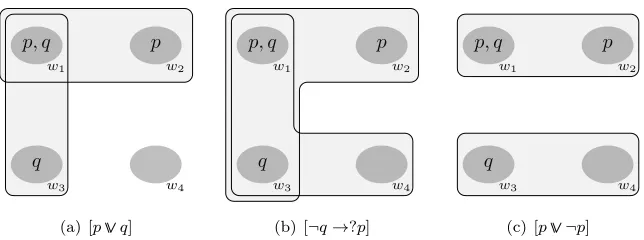
As anticipated, the operators that introduce questions in this semantics are and ∃ at the level of states. In order to better understand how that is done consider the example shown in figure 1.2 and 1.3.
The gray areas in evidence are the maximal statesthat support the formulas
p, q
w1
p
w2
q
w3 w4
(a)[p]
p, q
w1
p
w2
q
w3 w4
(b)[q→p]
p, q
w1
p
w2
q
w3 w4
[image:22.612.172.492.512.630.2](c)[p∨q]
Informative and Inquisitive Content Questioning Philosophy
p, q
w1
p
w2
q
w3 w4
(a)[p q]
p, q
w1
p
w2
q
w3 w4
(b)[¬q→?p]
p, q
w1
p
w2
q
w3 w4
[image:23.612.116.438.106.226.2](c)[p ¬p]
Figure 1.3: inquisitive propositions
written below them, they are also calledalternatives (see definition 7). There-fore, the support-set for said formulas would be the downward closure of such alternatives, while the truth-set their union. The difference between declaring that “p or q” (p∨q) and asking “p or q?” (p q) can be seen in 1.2(c) and 1.3(a). They are equally informative, since the union of the alternatives in 1.3(a) is equal to the one in 1.2(c), however 1.3(a) is a refinement of 1.2(c).
In the same example we can see that only the alternative of 1.2(a) enhances 1.2(b) and 1.2(c), and settles every issue in example 1.3, and that the issue 1.3(a) is a refinement of 1.3(b).
Other interesting facts are that though 1.3(b) and 1.3(c) are both not in-formative they are not tautologies in INQ. In fact they do have an inquisitive content strictly more refined than the powerset of the whole space.
1.3.4 Modalities and Questions
Knowledge and Questions:While for declaratives the modal operator Ka
behaves exactly as it does in classical Epistemic Logic it is interesting to mention how it interacts with questions.
Take for example figure 1.4 and 1.5. There we have thata’s epistemic states inw1andw2(i.e. the union over the inquisitive state) are such that∪Σa(w1) =
∪
Σa(w2) =σa(w1) =σa(w2) ={w1, w2}.
Now consider the expression Ka(p ¬p). This formula turns to be supported
in a statesif and only if the agenta’s epistemic state is an element of[p ¬p], i.e if and only ifaknowsthe answer to the question whetherpor¬p. In 1.4(a) and 1.5(a) this requirement is met: {w1} |= Ka(p ¬p), {w2} |= Ka(p ¬p)
therefore{w1, w2} |=Ka(p ¬p).
In general we say thats|=Kaφif and only if in every woldw∈sthe epistemic
state ofais informative enough forato settle the issue raised byφ.
Informative and Inquisitive Content Questioning Philosophy
p, q
w1
p
w2
q
w3 w4
(a)Ka?p
p, q
w1
p
w2
q
w3 w4
[image:24.612.227.436.107.227.2](b)¬Ea?q
Figure 1.4: Σa(w1) ={{w1, w2}}↓
know which of those alternativesisthe case. Again take figure 1.4 and 1.5 as an example. There we have thata’s inquisitive state inw1isΣa(w1) ={{w1, w2}}↓
while inw2 it isΣa(w2) ={{w1},{w2}}↓.
Now take the expression Ea(q ¬q). This formula turns to be supported in a
state sif and only if the agent a’s inquisitive state is a subset of [q ¬q]. In figure 1.4(b) this requirement is not met, while it is in 1.5(b):
thus{w1} |=¬Ea(q ¬q)and{w2} |=Ea(q ¬q).
If we consider a non-inquisitive formula !φ it turns out that s |= Ea!φ if
and only s |= Ka!φ. However, with inquisitive propositions φ we only have
that if s |=Kaφ then s |=Eaφ. This reflects the idea that knowing a fact is
equivalent to entertain it, and knowing the answer to a question entails being able to entertain its question.
With the epistemic modality of Knowledge and Entertain it is possible to define the Epistemic attitudeWonder:
p, q
w1
p
w2
q
w3 w4
(a)Ka?p
p, q
w1
p
w2
q
w3 w4
[image:24.612.227.435.505.629.2](b)Ea?q
Informative and Inquisitive Content Questioning Philosophy
Definition 15 [Wondering]
“AgentaWonders whether φ” if and only if
“AgentaEntertains the issueφ even though they do not know how it is settled”
Waφ
def
=Eaφ∧ ¬Kaφ
Inquisitive Negative Introspection
In light of the inquisitive expressiveness, consider again example 2 on page 3 phrased withwonderingas defined above:
(8) “(Having heard Cassandra’s prophecy) King Priam wonders whether the Trojan Horse is full of Greek warriors.
i.e. He does not know whether Trojan Horse is full of Greek warriors, but he is entertaining the question.
Therefore, King Priam knows that he does not know whether the Trojan Horse is full of Greek warriors.”
If we feel like the this inference is more valid than the one in example 2 it could be interesting to substitute Axiom5 with what I call Axiom5i:
Axiom5i ⊢(Eaφ∧ ¬Kaφ)→Ka¬Kaφ Inquisitive Introspection
Being an instantiation of the weakening rule it is easy to see that “Axiom 5 0 ⊢Axiom5i”.
The notion ofwonderingemployed in this example should be read in a weaker way than the one used in the standard INQ Semantics. In fact, when agents in INQ wonder about an issue they want to know settle it.
On the other hand, the reading I propose is much more focused on the potential disposition we may have toward asking ourselves a certain question.
For example, in standard INQ it would be wrong to say “King Priamwonders whether the Trojan Horse is full of warriors”, simply because he will not try to open the horse and control if it is. However, I say that for a philosophical analysis it is not contradictory to wonder about issues that are not to be settled. We can find other examples in which Axiom 5i seems a good alternative to Axiom 5. I can at any time entertain the question the question “What did my brother have for breakfast?”, of course without the urgency of calling him to have an answer. Moreover, every time I wonder about such question I would also admit that I know I do not know what he had for breakfast.
On the other hand, I can safely assume the reader does not know what my brother had for breakfast2. However, it would be far fetched to conclude they knew they did not know what my brother had for breakfast before reading this section, possibly because they were not able to entertain the idea that I have a brother in the first place.
Informative and Inquisitive Content Questioning Philosophy
1.4 Identity in FOIEL
Let us now consider identity. The main problem with identity in FOIEL is that it can not be introduced directly.
For example, assume that the support condition for identity was the following (I will call this toy-identitytoy
=):
M, s|=ttoy=t′ iff For allw∈s;Iw(t) =Iw(t′)
Due to the fact that names are treated as rigid designators in our models (see def. in figure 1.1 on page 12), we would have to conclude from such a definition that (toy-)identity is always trivial.
FACT 1[Triviality of toy-identity] If M, s|= (htoy=p)thenM |= (htoy=p)
Proof. Assume that there is a ModelMsuch that for a non empty states⊆ W,M, s|=g(h
toy
=p). By toy-identity definition this means that (I) For all w ∈ s Iw(h) = Iw(p). Take an arbitrary w′ ∈ W.
By the constraint on I we have that (II) Iw(h) = Iw′(h) and (III)
Iw(p) =Iw′(p). By (I), (II) and (III) we have thatIw′(h) =Iw′(p),
thus by toy-identity definition M, w′ g (h
toy
=p). Since this is true for anyw′∈ W and(htoy=p)is atomicM,W |=g(h
toy
=p).
That is why, if the constraint on rigidity is not dropped, identity has to be treated differently. The way it is done in [Ciardelli, 2015] is by introducing equivalence classesonD. This means that a model for epistemic INQ semantics with equality is going to look like the following:
M=⟨W,{Σa|a∈Ag},D,I,∼⟩
∼: a map assigning to eachw∈ W an equivalence relation
∼w⊆ D × D s.t.
– for anyR∈ R, ifd∼wd′:
d∈Iw(R)iffd′ ∈Iw(R)
Informative and Inquisitive Content Questioning Philosophy
An “epistemic individual” can be interpreted as a way in which a certain object is conceptualized. Take for example Mattia Pascal, the main character of Pirandello’s “The Late Mattia Pascal”; who, after faking his death, escaped his life in Miragno to live in Rome under the pseudonymAdriano Meis. Both names refer to the same person, but to two different epistemic individuals. Mattia’s fellow citizens talking about ‘Mattia Pascal’ address the individual they believed to be dead, whilst people in Rome call ‘Adriano Meis’ who they see as a foreigner arrived few months before.
Identity is not trivial since there are worlds in which such epistemic individ-uals are not in the same equivalence class, and worlds where they are: in the former an identity statements is true, while in others it is not.
M, s|=gt=t′ iff For allw∈s;Iw(t)∼wIw(t′)
A reason why this approach is not particularly satisfactory is that whenever we discuss entities we refer directly to objects, not to conceptualizations. When we use the names “Hesperus” and “Phosphorus” we are talking about the same planet even though we can believe we are not. The interpretation of epistemic individuals is, in this respect, too bounded to the subjective use of names. Moreover, when we assert an identity statement like “Hesperus is Phosphorus” what we do is not only claiming that individuals picked by the names are one and the same, but also that the way the two names pick them are the same, not unlike two different proofs with the same conclusion. With epistemic individual is difficult to have a direct interpretation of such claims.
Another consequence of this approach, that seems far more counterintuitive, is that every way of referring to these clusters of epistemic individuals is always felicitous, i.e. picks up existing objects.
Moreover, having to refer to objects in a domain would expose any philosophical account to the question “what are exactly these objects?” and “how do we say that they have such-and-such property?”. Said question is even more difficult to answer if we have to explain how abstract entities like epistemic individuals have properties.
2. Questions in Philosophy
In this chapter I will discuss some issues that motivates the expansions and variations that will be introduced in Philosophical Inquisitive Logic (PhIL).
It is no secret, the term philosophy is broad; and so is the notion of philo-sophical issue. And a good question in philosophy is often more interesting than a good answer. One of the most interesting questions is of course “How many interesting questions are out there?”. By interesting I mean worthy of a philosophical endeavors and sufficiently distinct to others.
For example, there are just so many disguises that Russell’s Paradox can use before we are able to recognize its pattern. A barber with an insanely strict rule, a librarian with the passion of cataloguiong catalogues, a Cretan criticizing his fellow citizens, the halting problem, Tarski’s Truth predicate and many others are substantially the same cup of tea.
What we discussed so far concerns mainly epistemology, therefore it seems natural to include problems that deal with what we know within philosophy. For this reason it seems natural to leave out paradoxes like the liar and the sorites, since they seem to defy the notion of knowledge and valid reasoning. As toolbox devoted to describe reasoning and arguing within a given philosoph-ical system, PhIL wants to be able to entertain different standpoints concerning ontological status and what they entail once endorsed rather than a specific philosophical position. Particular attention will be devoted to describe logical arguments and expressions with as little ontological commitment as possible. For this reason, PhIL models are structured to accommodate a nominalist inter-pretation: i.e. names and predicates are taken to be primitive entities, rather than objects and extensions. Using these primitive notions it is possible for both realists and anti-realists to interpret entities as they see fit. While a real-ist would assume that names are nothing but pointers to real objects and will use predicates to define the extensions of properties, an anti-realist would regard any interpretation of this kind as too committing.
Some may say that such a move is like putting the cart before the horse. I feel that such approach is more flexible, since the primitive entities are ab-stract enough to allow an arbitrary interpretation, and more epistemologically adequate, since it focuses onwhat can be said rather than onwhat there is.
Questions in Philosophy Questioning Philosophy
2.1 To be or not to be?
A consequence of the standard INQ, alongside many other classical accounts, is that it is only possible to address existing objects.
Consider the following expressions: (9) “Cicero is Tully” (cicero=tully)
(10) “There is a Roman orator who served as consul in the year 63BC”
∃x.Roman Orator(x)∧Consul in 63BC(x)
(11) “Cicero is the Roman orator who served as consul in the year 63BC” Roman Orator(cicero)∧Consul in 63BC(cicero)
(12) “Cicero exists” ∃x.(cicero=x)
For our purpose we can treat these all there sentences as declaratives and look at their informative content, i.e. set of worlds where the sentence is true.
In Ciardelli’s account example 9 is informative, since the name Cicero and Tully can refer to different epistemic individuals, that may be in the same equiv-alence class only in certain worlds. Formally, a subset of the logical space A s.t.:
A={w∈ W |Iw(tully)∼Iw(cicero))
}
The sentence expressed in example 10 is also informative, and it identifies the portionB s.t.:
B={w∈ W | ∃d∈ D.d∈Iw(Roman Orator)∧d∈Iw(Consul in 63BC)
}
And of course, saying that Cicero was a Roman Orator, as in example 11, is also informative with the following intension:
C={w∈ W |Iw(cicero)∈Iw(Roman Orator)∧Iw(cicero)∈Iw(Consul in 63BC)
}
However, we can consider the plausible scenario in which some historian finds a body of evidencesΓsupporting the falsehood of example 10: there was no consul in63BCthat also happened to be an orator, because some laws would not allow this specific combination.
At the same time our current body of evidences ∆tells us example 11 cannot possibly be rejected, i.e. every text mentioning Cicero says he had to be a con-sul in63BC and an orator.
What we can deductively conclude from such inquiry is that, if we cannot dis-trust neitherΓnor∆, we have conclude that Cicero did not exist, thus rejecting example 12.
The problem is that example 12 turns out to be a tautology, since there is always an assignmentg[x7→Cicero]that, for every w, maps the variable[x]Mg
to the nameCicero.
Questions in Philosophy Questioning Philosophy
More generally, every claim of existence like example 12 on the facing page is non-informative.
|∃x.x=t|={w|wg ∃x.x=t
}
= ∪
n∈N
{
w|wg[x7→n]x=t
}
= ∪
n∈N
{
w|Iw(g(x))∼wIw(t)
}
={w|∃n∈N.Iw(n)∼wIw(t)
}
={w|Iw(t)∼wIw(t)
}
=W
From this proof follows that the informative content of|∃x.x=t|is equal to the ignorant state.
An unwanted corollary of this fact is that whenever we introduce a knowledge or belief operator we are forced to conclude that, at any time, we know or believe that everything that exists ought to exist.
A way of circumventing this problem is to be able to treat existence as a special predicate, opposed to standardpredications (i.e. P ⃗n). I will call such unary predicateEand, for an arbitrary namen,E(n)will read within a model as “nexists”. Within the theory “notE(n)” will mean “ndoes not exist”; however, for ontological neutrality, in the meta-theory I will use the expression “n is infelicitous”.
Employing an existence predicate is neither a new move in philosophical logic nor free of consequences, in fact there are some issues to determine:
• What is the truth-value of a First-Order predication with infelicitous names?
• Which quantifiers can we have in this theory, and how do they behave? • How are identity statements evaluated?
2.1.1 Predication
In this fragment of PhIL any standard predication that includes an infelicitous name is meaningless. By meaningless (i.e. N) I mean neither true (1) nor false (0), but rather a value in-between. In fact, the ordering relation on truth-values will be the following: 1> N >0. This choice can be motivated through a “verificationist” optic: To say that a predicate is true or false I must find a way to verify it. To assert that “Ann is a lawyer” is true or false I should check Ann’s whereabout, but if “Ann” is infelicitous there is no way to prove it nor to disprove it.
Questions in Philosophy Questioning Philosophy
evaluated in the actual world, have the same strength since we have no mean of verifying either claim.
In section 5.1.2 on page 80 I will argue that while themeaningless truth-value can be employed for atomic fictional statements and “Story telling” (i.e. listing coherent but unverifiable claims) there is a way to bring falsehood and truth back to the fictional table: what we can do is respectively checking for fictional coherence (“Harry Potter is a Wizard and Harry Potter is Not a Wizard” would be false) and reason on the premises (“If Harry Potter is a Wizard then Harry Potter is a Wizard” would be true).
For these prediction to work the account in Chapter 3 and 4 will not do the job; however they are going to be the middleman for further developments, as I will stress in the conclusion.
The semantics I will be using to characterize complex sentences is a partial (bilateral) system, with truth () and falsehood ( ). Given a sentenceφ, we can talk about its extension (truth-value) in a possible world w s.t.if JφKw ∈
{1, N,0}is an evaluation function.
JφKw= 1 iff wφ
JφKw= 0 iff w φ
JφKw=N iff neitherwφnorw φ
The requirement that only “verifiable” standard predications have a truth is equivalent to the following constraint:
JP ⃗nKw∈ {1,0} iff For alln∈n ,⃗ JE(n)Kw= 1
2.1.2 Quantification
This approach leads to two different kinds of quantification: one is a “weak quantification”, and it is purely nominal, while the other is the “strong quan-tification”, and it reflects the classical one. It is often stated in philosophy that calling the quantifier∃theExistential Quantifiercan sometimes be an abuse of meaning since the dual of Universal Quantification should be called Particular Quantification.
For example in [Orenstein, 1995] ‘How to Get Something from Nothing’ the au-thor notices how from a valid sentence like ‘P(n)∨ ¬P(n)’ it is possible, via Introduction of the Existential, to conclude that ‘∃x.P(x)∨ ¬P(x)’. However this statement is true only in models with non-empty domain.
To avoid this problem we will say that from any valid sentence ‘φ’ we are al-lowed to derive a weak ‘for a particularn,φ[n/x]’, rather than the much stronger
Questions in Philosophy Questioning Philosophy
Weak and Strong Quantifiers
Consider the following definitions and their intended reading in light of the aforementioned distinction:
Weak Universal Quantifier
• M, w ∆ x.φiff For all namesn,M, wφ[n/x]
• M, w ∆ x.φiff There is a name ns.t. M, w φ[n/ x]
Weak Particular Quantifier
• M, w Σ x.φ iff There is a namens.t. M, wφ[n/x]
• M, w Σ x.φ iff For all namesn,M, w φ[n/x]
Strong Universal Quantifier
• M, w∀x.φiff For all namesn, ifM, wE(n)thenM, wφ[n/x]
• M, w ∀x.φiff There is a namens.t. M, wE(n)andM, w φ[n/x]
Strong Particular Quantifier
• M, w∃x.φiff There is a namens.t. M, wE(n)andM, wφ[n/ x]
• M, w ∃x.φiff For all namesn, ifM, wE(n)thenM, w φ[n/x]
With the difference introduced by weak and strong quantification using the term “Particular Quantifier” is extremely important. In fact only the Strong Particular Quantifier∃is, strictly speaking, an existential quantifier.
2.1.3 Identity
Identity in PhIL differs from standard predications in that it cannot be unde-fined. Within a nominalist approach identity statements are claims about how names are used. Considering a statement like n=mthere are three different situations that may occur:
• Bothnandm are felicitous, therefore the way we use them is influenced by their reference: n=mis true if their reference is indeed the same, and false if it is not.
• A name is felicitous and the other is not, therefore the identity statement is false in virtue of this difference.
Questions in Philosophy Questioning Philosophy
The third point is of course the most vulnerable to controversy, but it is quite a conventional linguistic practice.
Consider the fictional Headmaster of Hogwarts, from the fantasy novel Harry Potter: (Albus Percival Wulfric Brian) ‘Dumbledore’.
With the current definitions of existence every name he can have is undoubtedly infelicitous. Since the name has been translated along with the text, readers from different nations know him with different aliases: in Dutch he is ‘Perka-mentus’, in Italian ‘Silente’ and in Norwegian ‘Humlesnurr’.
However, once it is established that the actual world has no referent to support or reject an identity statement like “Dumbledore is Silente” it is reasonable to assert that this statement is true from purely linguistic conventions.
2.1.4 non-trivial existence
Going back to example 12 on page 22 it is possible to show that under the afore-mentioned conditions the strong particular quantifier (aka existential quantifier) is no longer trivial. In fact we have the following:
w∃x.x=cicero iff There is a namens.t. wE(n)andw(x=cicero)[n/x]
thus wE(cicero)and w(cicero=cicero)
iff wE(cicero)
What is trivial is the weak particular quantifier Σ x.x=cicero, but its truth simply implies that Cicero has a name.
2.2 Agents within the system
Once it is possible for an epistemic agent to know if a name is felicitous or not, it seems equally interesting to be able to talk about the existence of oneself and other agents as well.
This topic is particularly important when addressed in conjunction with self-locating beliefs [Perry, 1979]: i.e. sentences like ‘I am in Wisconsin’ and ‘John Perry believes he is Adam Smith’.
In order to do so I will have in the language L, as a subset of the names
N, the set of the agents’ names Ag, that will also serve as index for the modal operatorsKx andEx. It will be possible to express for example that “Agent a
knows agentb exists” (KaE(b)).
Rather than considering Veridicity as axiom I will assume a weakened version called Conditional Veridicity, i.e. “if an agents’ epistemic state is consistent then it is factual”. I call this AxiomD→T: ¬Ka⊥ →(Kaφ→φ)
Conditional Reflexivity: if Exists w′∈ W;w′∈σa(w)thenw∈σa(w)
The reason for this weakening is because the converse of Factuality implies that “Ifφthenadoes not know¬φ”.
Questions in Philosophy Questioning Philosophy
exist then they do not know they exist”. To prevent this, I will say that any agent’s knowledgeKaψis determined atwif and only if aexists inw.
Moreover, an agent’s epistemic state will be consistent if and only if they exist. So that with Conditional Reflexivity we will be able to recover Veridicity if only if the agent exists.
This idea is particularly close to the Cartesian‘Cogito, ergo sum’, which is going to be the name of the restriction on the epistemic accessibility relation σa that
will determine the validity of Axiom E(D): ¬Ka⊥ ↔ E(a):
Cogito, ergo sum:JA(a)Kw= 1iff Existsw′ ∈ W;w′∈σa(w)
2.3 Necessary
vs
Necessarily Known
One of the most interesting distinctions in philosophy of language was intro-duced in 1892 by the German philosopher and mathematician Gottlob Frege, in his article “Sense and Reference” [Frege, 1948].
I will consider the example introduced by Frege in its version used in Naming and Necessity [Kripke, 1980]. The reason why I prefer Kripke’s setting is that it focuses on names rather than on definite descriptions, but it still discusses the same issues. Kripke discusses three different approaches to the status of identity in natural language: (i) identical objects are necessarily identical, (ii) identity statements between rigid designators are necessary and (iii) identity statements using what we call ‘names’ are necessary.
Firstly, we have to outline the difference between Kripke’s rigid designators and a nominalist “rigid behaviors”. The formers are by definition designators that have the same referent in every possible world, therefore we have that “x is a rigid designator” if and only if “x has the same referent in every possible world”. It is easy to see that this property of a designator is functional to its referent.
However, without a notion of objects or domain such a definition cannot be ap-plied. Instead, we will say that “two designatorsnandmbehave rigidly” if and only if “They are co-extensional in every metaphysically possible world1”. Therefore rigidity is taken to be a relation between referents across worlds rather than between a referent and a reference across worlds.
I will not discuss in this thesis (iii), assuming that when a Philosophically Inclined Agent (PIA) uses names they behave rigidly. Moreover, as previously pointed out, with a nominalist approach we do not have to worry about thesis (i): from an epistemological point of view necessity will be understood with respect to identity statements rather than ontological necessity of identity. Thesis (ii) appears to be a requirement dictated by norms of reasoning and understanding. If I say thatxandyare co-extensional in the actual world, it would be nothing
1A subset of what we have implicitly called up until nowlogically possible worlds. This
Questions in Philosophy Questioning Philosophy
but talking of linguistic conventions to say that they could have referred to different objects. Possibly a linguistic convention that would not reflect the way we use names in counterfactual arguments and that would make them even more obscure.
Think about the two names given by the Greeks to Venus: Hesperus (h), the Evening Star, and Phosphorus (p), the Morning Star. The two names refer to the same object, namely Venus, and we consider them to behave rigidly. Now, we can say “Hesperus could have been a star”, but if that was the case how could we assert that “Phosphorus could not have been a star” without causing confusion? Following a reference across worlds is nothing but following its referent. That said, take the following derivation:
Alice knows thatpis a planet Necessarilyp=h Alice knows thathis a planet
This would be classically a logically valid inference, by the meaning of identity and application of substitution. However, Alice could have read thatpis indeed Venus, without knowing that the same holds for h, and that it holds trivially since the two names refer to the same object. Maybe Alice read thatpis Venus in an article, but she thinks thathis actually a star. In other words, Alice could not know the identity statement p= h, even though it is necessary. In order to describe this situation we need to to distinguish between agents’ knowledge and metaphysical necessities.
As argued by Kripke the fact that “Hesperus is equal to Phosphorus” is an example of a statement that is indeed necessary, but not a priori. In fact, in order to know that they are the same object we need a scientific inquiry.
Consider figure 2.1. The case we want to describe surely must have two worlds w, v ∈ σa(w) such that w (a = b) and v (a ̸= b), in this way
Alice’s epistemic state will be such that σa(w)̸|= (a=b) andσa(w)̸|=¬(a=
b). However, I call these two worlds not Metaphysically Compatible since, as previously stated, it is not reasonable to say that in w it is true that (a=b)
a=b
a̸=b
Questions in Philosophy Questioning Philosophy
but it could have been true that(a̸=b).
In technical terms, if we callN(w)the set of all worlds that aremetaphysically accessible tow, we want to excludev fromN(w).
More formally we can introduce some definitions: Definition 16 [Metaphysical Accessibility]
We say thatw′ is metaphysically accessible tow if and only ifw′∈ N(w)
Definition 17 [Possibility]
We say that in a worldwit is possible that φiff whas a metaphysically accessible word where φis true
w ♢φ iff There is aw′∈ N(w);w′φ
Definition 18 [Necessity]
We say that in a worldwit is necessary that φiff in all metaphysically accessible worldsφis true
w φ iff For allw′∈ N(w);w′φ
In the previous example, we can explain the knowledge that Alice lacks of by saying that she does not know which metaphysical necessity is actual. Once she will discover that in facth=p, she will be able to rule out both the factual statementh̸=pand the modal statement♢(h̸=p), meaning that not only she will have a better understanding of her position in the logical space, but also how to use those names in counterfactual and modal statements in virtue of their identity.
For example, if Ann knows that, for certain namesx&y,x=y then she knows that “adoes not exists necessarily” implies “b does not exists necessarily”. Notice that such conclusion does not follow from discovering facts with no meta-physical impact: i.e. if she discovers that Venus is yellowish-white, she cannot conclude that it is necessarily so.
2.3.1 On Metaphysical Compatibility
On one hand, we can regard the given definition of Metaphysical Accessibility as purely descriptive: it is used to tell us what we mean when we say possible andnecessary.
On the other hand, the notion of Metaphysical Compatibility is normative. It would tell whether a certain worldwcanaccess another.
Questions in Philosophy Questioning Philosophy
worlds with conflicting ontologies are always metaphysically incompatible. We can extend this account in order to fit our Philosophical Theory (PT).
For example, if we were to assume the previously mentioned “necessity of identity statements”, every identity statement would be necessary, i.e. it is always the case that “if a=b then(a=b)”. Similarly, if we want to model the way Essentialists reason we will have thatsomeproperties are necessary.
In our case we want identity statements to restrict the notion of metaphysical compatibility in the theory: i.e. ifwandv are metaphysically compatible then for every identity statementx=y,wx=y iffvx=y.
We can force such condition saying that arbitrary names inNalways behave rigidly. I call thisNominal Rigidity, and it limits compatibility as follows:
Definition 19 [Nominal Rigidity]
v and w are compatible under Nominal Rigidity if and only if For allf, g∈N,Jg=fKw=Jg=fKv.
Now all we need to do is to specify that the Accessibility RelationN of every acceptable model must follow the norm that the compatibility relation induces. In particular, we are going to require that if v ∈ N(w) then v is compatible withw.
To summarize, the philosophical motivations and background for PhIL in-clude being able to discuss infelicitous names (and subsequently their impact on predication, quantification and identity statements), being able to approach counterfactual/modal reasoning and consider the epistemic agents as ‘living’ parts of our model rather than just external entities.