Rochester Institute of Technology
RIT Scholar Works
Theses
Thesis/Dissertation Collections
1973
Statistical analysis of grain growth based on the
Frieser-Eger film on development kinetics
Noreen Vredenburg
Sharon Perry
Follow this and additional works at:
http://scholarworks.rit.edu/theses
This Thesis is brought to you for free and open access by the Thesis/Dissertation Collections at RIT Scholar Works. It has been accepted for inclusion in Theses by an authorized administrator of RIT Scholar Works. For more information, please [email protected].
Recommended Citation
STATISTICAL ANALYSIS OF GRAIN GROWTH
BASED
ON THE FRIESER-EGER FILM ON DEVELOPMENT KINETICS
hy
Noreen
Vredenhurg
Sharon L.
Perry
A thesis submitted in partial fulfillment of the
requirements for the degree of Bachelor.'of^-Science -inhthe College of Photographic Arts and Science
of the Rochester Institute of
Technology
June,
1973
Thesis
11
TABLE OF CONTENTS
Abstract
Pages.::
1-2
Acknowledgements
Page
<
11
Introduction
Pages
1-3
Chapter
#1
Exper1mental Procedure
Pages
4-8
Chapter #2 Experimental Results
Page
9-
22
Chapter
#3
Summary and Conclusions
Pages 23-25
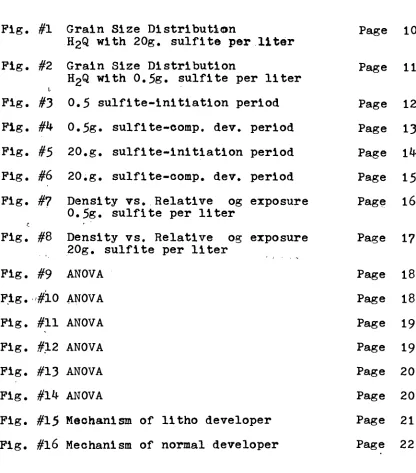
LIST OF FIGURES
Fig.
#1
Grain Size Distribution Page 10H2Q
with20g.
sulfite per literFig.
#2
Grain Size Distribution Page 11H2Q
with0.5g.
sulfite per liter
i-Fig.
#3
0.5
sulfite-inltiation period Page 12Fig.
#4
0.5g.
sulfite-comp. dev. period Page13
Fig.
#5
20.
g. sulfite-inltiation period Page 14Fig.
#6
20.g. sulfite-comp.dev.
period Page15
Fig.
#7
Density
vs. Relative og exposure Page 160.5g.
sulfite per literFig.
#8
Density
vs. Relative og exposure Page17
20g.
sulfite per literFig.
#9
ANOVA Page 18Fig.
#10
ANOVA Page 18Fig.
#11
ANOVA Page19
Fig.
#12
ANOVA Page19
Fig.
#13
ANOVA Page 20Fig.
#14
ANOVA Page 20Fig.
#15
Mechanism of litho developer Page 21 [image:4.555.69.485.160.633.2]ABSTRACT
Data were obtained from the Frleser-Eger film on
develop
ment kinetics for Initiation times and for total development
times of individual grains
(times
of completedevelopment)
in a lithographic developer and in a hydroquinone developer
with normal sulfite level. Approximate areas were computed
for each grain. The purpose of this investigation was to
compare the process of deveTLopment at the two sulfite levels
and to determine if there is a functional relationship bet
ween total development time and grain size. Different rela
tionships were expected for the two types of developers. This
data analysis permits a better understanding of the differences
between lithographic and normal hydroquinone developers.
The data were obtained
by
observing a number of grains throughout the development process. The film was run through the
projector one frame at a time and each frame was counted so
that the initiation times and times of complete development
could be
determined.
The location of the grains In questionwas maintained
by
means of a grid. The areas were measuredusing the geometric shape Of the individual grains. The -shape
There were no functional relationships between grain size
and times of complete development or initiation times for
the two
developers.
There was,however,
a significantdifference between the two developers with respect to
Initiation
times.
The initiation period for the0.5
g.sulfite developer Is shorter than the
20g.
sulfite developersInitiation period. This difference is believed to be the
result of different development mechanisms for the developers,
The results of this evaluation are useful only as an example
of a possible statistical analysis for films of a similar
ACKNOWLEDGEMENTS
We would like to express our special thanks to our advisor,
Dr.
Burt Carroll who has helped us throughout our thesis.Also,
a special thank-you goes to Rochester's DuPontPhoto-Products Plant for computer time and cooperation and The
INTRODUCTION
The process of development is often considered to exist in
two phases. The first phase or initiation period is the
initial stage of the reduction in which no microscopically
visible reduction of the grain is apparent. The second
phase or completion period of a grain is the microscopically
visible growth of silver in the grain until no further silver
growth is visible.
Meidinger"
studied the kinetics of development of large
individual silver bromide grains.
Microscopically,
he determined the Initiation period and the rate of completion of
development through-out a grain. He observed a decrease in
initiation period with increase in exposure until a maximum
was reached. The completion rate was independent of exposure.
Both initiation period and completion rate decreased with in
creased bromide concentration in the
developer.
Both increasedwith increases In pH of the developer and both decreased when
the developer was diluted with water. He found that the rate
of propagation of developments throughout the grain varied with
Freiser and Eger studied the process of development
by
usinginfra-red microcinematography. The purpose of his investiga
tion was to obtain qualitive information regarding photo
graphic
development.
Eger investigated several differentdevelopers.
Extended work on two of the developers Frieserand Eger used are studied in our thesis to obtain quantitative
data.
The first was a litho type developer and the second was a
normal hydroquinone
developer.
The only difference in thetwo
being
the amount of sulfite present. The litho type contains
0.5g
of sulfite per liter and the normal hydroquinonedeveloper contains 20.0 g of sulfite per
liter.
These twodevelopers were selected for comparisons of initiation
periods and periods of complete
development.
The data wascollected so that any functional relationship between grain
sizes and initiation periods and complete development times
could be detected and differences between developers.
The sulfite content of a developer can change the developers
properties. The sulfite in a hydroquinone black and white
developer usually reacts with the oxidation products
(quinone)
to form sulfonates. These oxidation products usually have an
undesirable Influence throughout
development,
therefore thesulfite acts as a preservative for hydroquinone and its
de-rlvitives. Sulfite can have three
functions;
preservative,The sulfite concentration in graphic arts developers is kept
very low in order to utilize
the
phenomenon known as "infectious development"
(the
more rapid
development
of grains Inthe immediate neighborhood of already
developing
grains).Frotschen1
in
1937
proposed that infectious development wasdue to the catalytic effect of oxidation products. Yule11
postulated that the active catalyst was the semiquinone. The
semiquinone concentration can build up only at low sulfite
concentrations. The
developing
reaction is autocatalytic underthese conditions. Yule11 believes that the semiquinone is
considerable stable
by
absorption on to the silver halidegrain. This provides the right environment for infectious
development.
Some compromise concerning sulfite concentration in a graphic
arts developer is needed in order to obtain "good" dot quality
In a graphic arts film. At low sulfite concentration, the
lateral diffusion of hydroquinone oxidation products from the
exposed area to
developing
grains leads to spreading of thedot
image,
as well asIncreasing
thedensity
within thedot.
If the sulfite is completely absent, the excessive diffusion
of oxidation products results in a large spread of the
dot.
The compromise sulfite concentration must .be such that infec
tious development is promoted within the .dot
image,
withoutany appreciable spread beyond the exposed area. Yule11 found
this compromise sulfite concentration to be around
lg.
perEXPERIMENTAL PROCEDURE
A l6mm Kodak Pagent Projector was modified so that the film
could be advanced one frame at a time
by turning
a crank.As each frame was advanced, a counter was also advanced to
keep
track of the total number of frames that have beenexamined.
Thus,
initiation periods and periods of completedevelopment can be measured in terms of the number of frames
and
by dividing by
the number of frames exposed per second,we can calculate the times.
The projector was set up on a bench so that the image could
be projected on the wall giving a projected image size of
diameter
11.5
Inches. The grains in question were locatedoh a grid. The grid was 12 x 12 inches and divided into 1
inch squares. The grids were made on
97$
reflectance, whitecards. The grains in question were then outlined with
marking pen and numbered. One grid was made for each run.
The grains selected for use in this analysis had to meet the
following
specification:1)
the grains must be completelyin
focus,
and2)
the grains must not overlap or have a commonborder.
These stipulations were necessary to avoidor the possibility that with a slightly out of focus grain,
a development site might not be visible.
Many
grains had tobe dropped from the analysis because
they
could not meet therequirements.
The approximate area for each grain was computed
by
usingthe area formula for its geometric shape, circular, trian
gular or
hexagonal.
All measurements were made usingdrafting
dividers.
These measurements were made using the outer edgeof the grains. For grains with irregular shapes, approxima
tions were made. That
is,
irregular shaped grains were calledeither
triangles,
circles orhexagons,
whichever it mostclosely resembled.
Every
grain in question was examined in the frame beforepro-gressing to the next frame. It was noted that Just prior to
the appearance of a development site, some grains were covered
with a neutral
density
"cloud".
We can find no explanationfor this occurance.
It was noted
during
the examination of the20g.
of sulfitehydroquinone
developer,
that the runs varied,Inlength.
Theruns and lengths are shown in the tables below.
20g.
sulfitehydroquinine
developer.
t ,
Run 1
7
ft.Run 2
6
ft.Run
3
19
ft.
0.5g
sulfitelitho
developer
Run 1
6.5
ft.
Run 2
5
ft.
Run
3
6.5
ft.
Run
k
4.5
ft.
Drs.
Frieser and Eger were questioned, vialetter,
what theproblem might
be.
They
indicated that some of the fruns weremade at
3
frames per second and that others were made at5
frames per second.
They
did not,however,
know which weredone at.which frame rate. The film was then run through a
normal
l6mm.
projector andby
observing the "flicker" of thefilm,
we were able to determine that 'the longer runs weremade at
5
frames per second.It was also noted that some of the grains were .completely
developed at the first frame. This was accounted for
by
Drs.
Frieser and Eger.
They
said that the camera was not turnedon
Immediately
after the developer came in contact with thegrains.
They
estimate that a period of about 10 seconds"elapsed before the camera was started. This necessitated
adding 10 seconds to each of' the initiation periods.. Since
this is only an approximation, this analysis can be used
only as an example of the method
by
which other such films canbe analyzed.
However,
the results within a single run areThe data that was collected were analyzed statistically.
Analysis of Variance
(ANOVA)
(Figs.
9-l4)
, best line offit curves
(Figs.
3-6),
and grain size distributions wereapplied to the data
(Figs.
1 &2).
An emulsion like that used In this film was prepared
by
Dr.Burt Carroll. The emulsion Dr. Eger used for his thesis is
not chemically sensitized and consists of larger than normal
grain sizes which are not typical of practical emulsions.
Sensitometric evaluation of this emulsion gave a macroscopic
view of the difference between developers as well as the ab
normality of the emulsion.
Film samples were exposed to a Kodak step tablet
by
means ofan EG & G sensitometer at 10~3 seconds.
The developers were prepared as stated in Dr. Egers thesis.
The "normal"
hydroquinone developer was made up with little
trouble.
However,
the pH was statedby
Eger asbeing
11.2and was found to be 10.8. The film was processed without any
adjustments for pH. The litho
developer,
however,
oxidizedalmost immediately. It was prepared several times without
success. Dr. R. Francis was consulted and he suggested
pre-paring the developer in two parts. The first part was
2.5g
hydroquinone and
0.5g
sodium sulfite and water to make 500 ml,The second part was
50.
Og
potassium carbonate andl.Og
potas-slum bromide and water to make 500 ml. Both parts were made
in water at
70*
8
immediately
before use. The exposed strips were developedfor
30,
60,
90,
120 and 150 seconds with continuous rockagitation. The process was as below
(at
70*F)
:Litho..* or normal developer
30,
60,
90.120,
& 150 secondsWater
Stop
Bath 30 secondsFixer
(F.
5)
2 minutesWash
(gentle
agitation)25
minutesDry
at 100* FSince the emulsion does not contain a
hardener,
care wastaken to avoid washing the emulsion off the
base.
The processwas repeated several
times,
but uniform images could not beobtained. The
density
values for each step were readby
meansEXPERIMENTAL RESULTS .
Grain size distributions
(Figs.
1 &2)
were plotted for boththe litho and the "normal" hydroquinone
developers.
Thesedistributions were essentially the same
Indicating
that thesamples were adequate for showing the grain size distribution
for the emulsion. When plotted on
log-log
paperthey
indicated a normal distribution.
Analysis of Variance
(ANOVA)
were run to determine whether ornot there was a significant difference between the runs for
each
developer,
between the various grain sizes and betweenthe two developers. Each ANOVA was run with respect to initia
tion period and with respect to period of complete development.
The results are shown in Figs-.
(9-14).
A computer program was used to plot the grain size vs. initia
tion period data and to determine the best line of fit for the
data for the two
developers.
The same program was used forthe period of complete
development.
Again the program was runfor both
developers.
See Figs{3-6)6
A development time series
(Dlotg
E)
was plotted from the sensitometric data obtained from the emultion prepared
by
Dr.Burt Carroll. Figs
(7
&8).
Pictures showing the different mechanisms of development
10'
Ei*L
i
G-RBlIU
Si HE
DISTRIBUTION)
W^Q-
Wi+h
2L0<.
sulfite,
perUhr
pH
.:
2
8
1
> i
11
0
I
0
0.
l_
GRfilN
SIZE
DISTRIBUTION
W^Q
wM
O.S3.
Sutf.U
per
.Liter_pH11.2
U
M
/* s&
/.6
.1.01.
oo
qraih
s/z^
O vn * 01 in *
8
in o * oS
3
cuK xi
O o
1 i
X V OL
X >
&
>1
e
e
u.II
2 CC <c tn < in
>-1
-+ + -+ + + + + 4-+V i* i-*
+
in
9
8
S
if!
u
I
iu inf
0> O "V cfl ID
S
8
S3
a
"13
x > "
> >
X
8
>S
xia
p
a o ul^ >
v- > V- M
^
a: < cn < u>>-S
+
+
+I?
T
8
t
in
cu
CD
o
o
o
3
men 03 I
0
M
z
<
s
^
^
f\ T T CJ) O
a & 8 s
s
$ 6
" *\k>
x
S
> a xca a u> a
H
xoc
?
&
&
k r
+
u
* IM
+
L.
-J3
Vo
4. *CO
*
4 + <*-+ . Ikih
. ""-o
4. V
-OJ
+ ++ + * 4-1 + +t
* * + *?**V
2
01 PI t- 4-^ <0s'S
3
IS
o*4as
O
fe
8!
10 cn
ft
SI
IV to*N
*
8
cnO N01 tftw Oi(U Ul ft H10 o cn o
15
2. 0*UJ
1-1
th
3
o
ru
o caa >- a
u> <; co
o.
I-+ 4- ?
4
fe
8
CO D CR Cd CO o5
8?
id8
10 (0&
(u ms
rs v^w
Ht 10 z 0 M 0 < V (V rv o (V rt8
111
?
th'1Inrli
18
ANOVA - FIG
#9
c*= .05
response variable = initiation period
0.5g.
sulfite - hydroquinone developerSOURCE SS
<
---hS
--RATIO SIGN.
Runs
884.3
3
294.81.85
noGrain Size
485.8
k
121.5
.76 noInteraction
866.5
12 72.2 .45 noError 9081.8
57
159.3
TOTAL 11.318.4 76
\
ANOVA - FIG
#10
oc= .05
response variable = period of complete development
0.5g.
sulfite - hydroquinone developerSOURCE SS
f
MS.
RATIO
r "' SIGN.
Runs 718.4
3
239.5
2.07
noGrain Size 959.2
4
239.82.07
noInteraction
320.9
1226.7
.23 noError
5316.3
46 115.619
ANOVA - FIG
#11
c=
.05
response variable = Initiation period 20g. sulfite - hydroquinone developer
~* " --"' - ,
SOURCE SS
X
MS.
RATIO SIGN.
Runs
6680.85
2 3340.43.29
noGrain Size
857.59
4
214.4 .21 noInteraction 9986.82
8
1248.41.23
noError
31429.
ll"
31
TOTAL
48954.37
45
-,ANOVA - FIG
#12
c<= .05
response variable = period for completion of development
20g. sulfite - hydroquinone developer
SOURCE
r=-SS
\
MS RATIO SIGN.
Runs 1831.40
3
610.47
2.32 noGrain Sizes
63.927
4
15.98 .061 noInteraction
5672.5
12472.71
1.80 noError 9993.2 38 262.98
20
ANOVA - FIG
#13
oC= .05
response variable = initiation period
0.5g
sulfite developer vs.20g
sulfite developerA
M
SOURCE SS
t
i -
-MS RATIO SIGN.
Developers.
8528.5
18528.5
17.09
yesError
898O.
1 18498.9
TOTAL
1,1 iJ
17508.5
19
, .
-. : w
ANOVA - FIG
#14
<^= .05
response variable = period of complete development
0.5g
sulfite developer vs.20g
sulfite developerf" SOURCE 1 -SS 1 : ms > RATIO
SIGN,,,
' Developers 16.2 1 16.2 .113
y
no
Error 2562.6 18 142.36
Al
i
JA
Cu
4
Qi
CD
6
O
n
SUMMARY AND CONCLUSIONS
The sensitometric curves do show, on a macroscopic scale,
a significant sensitometric difference betwen the two
developers.
Through the use of the statistical
tool,
the analysis ofvariance it was determined that there was no significant
difference between runs for either developer using the
initiation period or the period of complete development as
response variables.
There were no functional relationships between grain sizes
and initiation periods for the
0.5g
and20g.
sulfite hydroquinone
developers,
nor were there functional relationshipsbetween grain sizes and periods of complete development for
the same developers.
There is a significant difference between the
0.5g
sulfitedeveloper and the
20g
sulfite developer with respect toinitiation period. The average initiation period: for the
0.5g
sulfite is44
sec. as compared with the83
sec. averageinitiation period for the
20g
sulfite. Turbide and Williams24
increased
the Initiation perioddecreased.
A guess as to why thedifference
might be explainedby
the difference indevelopment
mechanism for the two developers(Figs.
15
& 16). There Is no significant difference between the0.5g
sulfitedeveloper
and the20g
sulfite developer with respect toperiod of complete
development.
Dr. Eger described two types of development which are
dependent
upon the composition of the developer and to someextent on the exposure conditions. The first type is the
"accretion development"
which spreads throughout the grain
from one or a few initiation points. Accretion development
occurred when there was a small number of active nuclei and
the developer showed marked initiation period. Accretion
development was noticed in the runs for the
20g
sulfite-hydroquinone developer. The second type is
Dr.
Eger's"infectious development" in which protruberances from one
developing
grain start development in another. This definition of "infectious development" was not seen in the runs
for the
0.5g
sulfite developer.The litho type developer attained a greater gamma as compared
with the normal hydroquinone developer after 1 minute deve
lopment. This suggests that the rate of development for the
litho developer is greater than for the normal
developer.
This agrees with our previous results, the litho developer had
The results of this evaluation are useful only as an example of a possible statistical analysis for films of
a similar nature. This particular emulsion has definite
drawbacks- its large grains are not typical of practical emulsions, and it is not chemically sensitized.
26
LITERATURE REFERENCES
Hans
Eger,
"Infrared Microcinematographic and radiochemical investigations of Photographic
Develop
ment,"
Dissertation,
Teoh. HochschuleMunchen,
1969.
2Gorokhovskii
,Polovtseva,
Shamsheva,
UshechiNauchn,
"Kinetics of the Initial Stage of Photographic Dev
elopment,"
FOT
13 3041,
I968.
^Zwicky,
H.
, "The Mechanism of LithoDevelopment,"
Photo.
Korr.
v.107,
1971.
^James,
T.H. , "The charge Effect in Relation to the Kineticsof Photographic Development
III,
The Abnormal Behavior of Sulfite-Free CausticHQ
Developers,"j.
Franklin Inst.240,
1945.
*James,
T.H.,
"The Initiation of Development,*'J.
-Photo. Sci.vl9,
1971.
Karrer,
J.,
Berg W.F.,
"The Induction Period of PhotographicDevelopment," SPSE Conference
Summary,
May
1970.7
'Zwicky,
H. , "Some Studies of LithoDevelopment,"
Photo.
Korr.,
1966.
p
Jaenicke,
W. , "Mechanism of the Development of SingleGrains,"
Photographic Science,
Zurich,
I96I.
"Meidinger,
"Studies of the Photographic Development Process,"Physik z36, 1935.
10Frotschner,
H.
, Photogr.Korr.,
27.
801,
1937.