A COMPARATIVE STUDY ON THE EFFECTIVENESS OF AEROBIC
EXERCISE WITH CONVENTIONAL THERAPY ON IMPROVING
FUNCTIONAL ABILITIES IN EARLY OSTEOARTHRITIC KNEE
Dissertation work submitted to
THE TAMIL NADU DR. M. G. R. MEDICAL UNIVERSITY,
Chennai-32
towards partial fulfillment of the requirements of
MASTER OF PHYSIOTHERAPY
Degree programme
Submitted by
Reg no: 27092304
P.P.G. COLLEGE OF PHYSIOTHERAPY
9/1, keeranatham road,
P.P.G. COLLEGE OF PHYSIOTHERAPY
9/1, KEERANATHAM ROAD,
SARAVANAMPATTI,
COIMBATORE-641035.
www.ppgphysiotherapy.ac.in
Dissertation work entitled
A COMPARATIVE STUDY ON THE EFFECTIVENESS OF
AEROBIC EXERCISE WITH CONVENTIONAL THERAPY ON
IMPROVING FUNCTIONAL ABILITIES IN EARLY
OSTEOARTHRITIC KNEE
Submitted by
Reg no: 27092304
Under the guidance of
MR.S.CHERALATHAN M.P.T (Ortho), MIAP
Professor
Dissertation submitted to
THE TAMILNADU DR. M. G. R. MEDICAL UNIVERSITY,
CHENNAI-32.
CERTIFICATE- I
This is to certify that the dissertation work entitled “A COMPARATIVE
STUDY ON THE EFFECTIVENESS OF AEROBIC EXERCISE WITH
CONVENTIONAL THERAPY ON IMPROVING FUNCTIONAL ABILITIES
IN EARLY OSTEOARTHRITIC KNEE” was carried out by Reg. No. 27092304 of
P.P.G College of physiotherapy Coimbatore-35, affiliated to the Tamilnadu Dr.
M.G.R. Medical University, Chennai-32, under the guidance of Prof. S.
CHERALATHAN M.P.T (Ortho), MIAP.,
CERTIFICATE - II
This is to certify that the dissertation work entitled “A COMPARATIVE
STUDY ON THE EFFECTIVENESS OF AEROBIC EXERCISE WITH
CONVENTIONAL THERAPY ON IMPROVING FUNCTIONAL ABILITIES
IN EARLY OSTEOARTHRITIC KNEE” was carried out by Reg. No. 27092304
of P.P.G College of physiotherapy, Coimbatore-35, affiliated to the Tamilnadu Dr.
M.G.R medical university, Chennai-32, under my guidance and direct supervision.
Prof. S. CHERALATHAN M.P.T (Ortho), MIAP.
Guide
ACKNOWLEDGEMENT
It is my bounded duty to express at the outset the heartiest gratitude to
MY PARENTS for their strong support and encouragement that enabled me to turn
this idea into a reality. I am very grateful to them throughout my life.
I express my sincere gratefulness to our Chairman Dr.L.P.THANGA VELU,
M.S., F.R.C.S., and our correspondent Mrs. SHANTHI THANGAVELU, M.A.,
P.P.G group of institutions, Coimbatore, for their encouragement and providing the
source for the successful study.
I express my sincere thanks to my principal Prof.K.RAJA SENTHIL M.P.T
(Cardio-Resp).,MIAP., PhD Principal of P.P.G.College of physiotherapy who extend
his guidance and encouragement throughout this project.
I express my special thanks to my Guide Prof. S.CHERALATHAN M.P.T
(Ortho), MIAP., and co-guide Associate Professor M.SENTHIL KUMAR M.P.T
(Sports), MIAP., for offering me perceptive inputs and guiding me entirely through
the course of my work and without their tireless guidance, support, and constant
encouragement this project would not have come through.
I would like to express my heartfelt thanks to P.G co-coordinator Prof. M.
MANOJ ABRAHAM M.P.T(Ortho), MIAP and Asso. Prof. N. UMA MPT
(Neuro),MIAP and Assistant Professor A.K.THARICKK M.P.T(Cardio)MIAP.,
My heartfelt thanks to other PHYSIOTHERAPY FACULTY members for
their guidance and encouragement throughout my studies.
I express my thanks to all the PATIENTS who cooperated to fulfill this
project work possible.
Last, but not least, I thank my FRIENDS AND FAMILY MEMBERS, my
spouse G.GEETHA and my twin daughters MAADHINI AND MAATHANGI
who are my source of strength and provided support and encouragement throughout
A COMPARATIVE STUDY ON THE EFFECTIVENESS OF AEROBIC
EXERCISE WITH CONVENTIONAL THERAPY ON IMPROVING
FUNCTIONAL ABILITIES IN EARLY OSTEOARTHRITIC KNEE
ABSTRACT
Study objectives: To find out the effectiveness of aerobic exercise with conventional
therapy on improving functional abilities in early osteoarthritic knee.
Participants: 30 subjects with early osteoarthritis knee were selected. They were
divided into control group and experimental group with 15 patients in each group.
Outcome measures: WOMAC scale is used to measure the functional abilities before
and after the treatment.
Results: Statistical analysis can be done by using paired‘t’ test shows improvement of
functional abilities.
Conclusion: It can be concluded from this study that aerobic exercise with
conventional therapy shows significant improvement in the functional abilities in
patients with early osteoarthritic knee.
Key words: Osteoarthritis, WOMAC scale, Ultrasound therapy, Isometric exercise,
CONTENTS
CHAPTER TITLE
PAGE
NO.
I
INTRODUCTION1.1 Introduction 1.2 Need for the study
1.3 Operational definitions 1.4 Aim of the study
1.5 Objectives of the study 1.6 Hypothesis
1 4 5 7 7 8
II
REVIEW OF LITERATURE 9III
MATERIALS AND METHODOLOGY3.1 Materials 3.2 Methodology 3.2.1.Study design 3.2.2.Sampling technique 3.2.3. Sample size
3.2.4. Study method 3.2.5. Selection criteria Inclusion criteria
Exclusion criteria 3.2.6. Study setting 3.2.7. Study duration
3.2.8. Measurement parameter 3.2.9. Statistical tool
3.2.10.Treatment techniques 3.2.11. Procedure. 14 14 14 14 14 14 15 15 15 16 16 16 16 18 20
IV
DATA PRESENTATION 21V
DATAANALYSIS AND INTERPRETATION 22VI
RESULTS 28VII
DISCUSSION 29VIII
SUMMARY AND CONCLUSION 33IX
LIMITATIONS AND SUGGESTIONS 34X
BIBLIOGRAPHY 35XI
APPENDIX I 38APPENDIX II 39
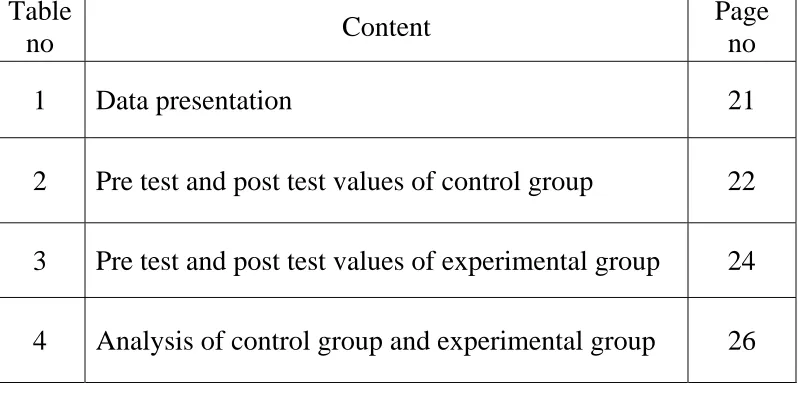
LIST OF TABLES
Table
no
Content
Page
no
1 Data
presentation
21
2
Pre test and post test values of control group
22
3
Pre test and post test values of experimental group
24
[image:9.612.115.514.194.392.2]LIST OF GRAPHS
Graph
no.
Content
Page
no.
1
Pre test and post test value of control group
23
2
Pre test and post test value of experimental group
25
INTRODUCTION
Osteoarthritis was earlier described as a disease of wear and tear, a degenerative
disorder, but, recent advances show that it represents a dynamic process, which involves
uncoupling of balance between cartilage degeneration and regeneration. 0steoarthritis
usually presents as joint pain with structural changes, crepitus, bony enlargements,
deformity, instability and restriction of movements. Associated muscular weakness and
wasting may also occur. Morning stiffness is a common complaint but brief in duration,
usually lasts for 5-15 minutes but not exceeding 30 minutes.
A. Graham Apleys(1993) defines osteoarthritis as a chronic joint disorder in
which there is progressive softening and disintegration of articular cartilage accompanied
by new growth of cartilage and bones at the joint margins (osteophytes) and capsular
fibrosis. These changes result from a variety of abnormalities that predisposes to
mechanical failure of the hyaline cartilage.
A.V.Kulkarni (1999) stated that osteoarthritis of knee is much more common in
India because of the life style of cross-legged sitting and squatting. Hyaline cartilage gets
degenerated and eroded in osteoarthritis. Since the cartilage is devoid of innervations, any
injury to it will not be appreciated until there is a synovial reaction. Since the synovium is
innervated it transmits nociception.
Early osteoarthritis tends to occur commonly between the age group of 30-50
years. The symptoms are usually characterized by pain and stiffness. The stiffness tends
to follow periods of inactivity; morning stiffness dissipates within 30 minutes of walking.
Rene Calliet (1992) stated that pain can also be experienced when the cartilage
undergoes sufficient degeneration to expose the underlying bone which is also innervated
and transmits pain. Cartilage becomes thinner due to friction and develops osteophytes,
which are irregular bony outgrowth that leads to stiffness of joints.
The major role of exercises is development, enhancement or maintenance of the
strength of muscles and relief of pain.
Common types of exercises encountered for osteoarthritis are stretching,
strengthening, isometric and aerobic exercises.
The isometric exercises commonly used involve muscle contraction in which
there is no shortening or lengthening of the muscle. Due to its effect of reduction in
intramuscular friction, it reduces the pain. The isometric effect on quadriceps and
hamstrings given alternatively reduces pain thereby improving functional ability.
Ultrasound is a therapeutic modality that has been used by physical therapists for
many years. Ultrasound is applied using a round-headed wand or probe that is put in
direct contact with the patient's skin. Ultrasound gel is used on all surfaces of the head in
order to reduce friction and assist in the transmission of the ultrasonic waves. Therapeutic
ultrasound is in the frequency range of about 0.8-3.0 MHz.
The waves are generated by a piezoelectric effect caused by the vibration of
crystals within thehead of the wand/probe. The sound waves that pass through the skin
cause a vibration of the local tissues. This vibration or cavitations can cause a deep
where a heating effect is not desirable, such as a fresh injury with acute inflammation, the
ultrasound can be pulsed rather than continuously transmitted.
The home exercise programme is simple to use and applicable for all age groups.
It was designed to maintain and improve the strength of muscles acting around the knee,
the range of motion at the knee joint and loco motor function. The programme is self
paced but become progressively more challenging.
Current literatures shows that aerobic exercises has greater effects on various
systems of the body namely cardiovascular system, musculoskeletal system, metabolic
system and psychologically. The aerobic exercise helps in thickening of cartilage,
increase in overall muscle strength, and increase in muscle endurance there by slowing
down the rate of joint degeneration which helps the early osteoarthritic patients to
NEED FOR THE STUDY
Osteoarthritis is one of the most crippling degenerative disorder, if untreated may
result in permanent disability. Wide range of physiotherapy modalities like interferential
therapy, shortwave diathermy, wax bath, TENS along with mobilization and muscle
power strengthening exercises plays vital role in minimizing the disability.
Only few studies are available regarding to prove the effectiveness of aerobic
exercises with conventional therapy like ultrasound therapy, isometric exercises and
home based exercise programme on improving functional abilities in early osteoarthritic
knee. So there is a need to further support the efficacy of effectiveness of aerobic
exercises with conventional therapy like ultrasound therapy, isometric exercises and
OPERATIONAL DEFINITIONS
OSTEOARTHRITIS
Osteoarthritis (OA) refers to a clinical syndrome of joint pain accompanied by
varying degrees of functional limitation and reduced quality of life. It is by far the most
common form of arthritis and one of the leading causes of pain and disability worldwide.
Altman RD, Asch E, Bloch D et al. (1986)
AEROBIC EXERCISE
Aerobic exercise is physical exercise that intends to improve the oxygen system,
aerobic means "with oxygen", and refers to the use of oxygen in the body's metabolic or
energy-generating process. Many types of exercise are aerobic, and by definition are
performed at moderate levels of intensity for extended periods of time.
Kenneth H. cooper, Col.Pauline potts (1968)
ISOMETRIC EXERCISE
Isometric exercise is a static form of exercise that occurs when a muscle contracts
without an appreciating change in the length of the muscle or without visible joint
motion.
Carolyn Kisner Lynn Allen Colby (1996)
WOMAC SCALE
The Western Ontario and McMaster Universities Arthritis Index (WOMAC)
is a set of standardized questionnaires used by health professionals to evaluate the
and was developed at Western Ontario and McMaster Universities. It assesses the pain,
joint stiffness, physical, social and emotional function of a person with osteoarthritis in
determining the overall level of disability.
William McMaster (1830)
ULTRA SOUND THERAPY
Therapeutic ultrasound in physical therapy is alternating compression and
rarefaction of sound waves with a frequency of >20,000 cycles/second. Therapeutic
ultrasound frequency used is 0.7 to 3.3 MHz Maximum energy absorption in soft tissue is
2 to 5 cm. Intensity decreases as the waves penetrate deeper. They are absorbed primarily
by connective tissue: ligaments, tendons, and fascia (and also by scar tissue)
AIM OF THE STUDY
¾ To find out the effectiveness of aerobic exercises with conventional therapy on
improving functional abilities in early osteoarthritic knee.
OBJECTIVES OF THE STUDY
¾ To find out the effectiveness of conventional therapy like ultrasound therapy,
isometric exercises and home based exercise programme on improving functional
abilities in early osteoarthritic knee
¾ To find out the effectiveness of aerobic exercises with conventional therapy like
ultrasound therapy, isometric exercises and home based exercise programme on
improving functional abilities in early osteoarthritic knee.
¾ To compare the effectiveness of aerobic exercises with conventional therapy like
ultrasound therapy, isometric exercises and home based exercise programme on
HYPOTHESIS
NULL HYPOTHESIS
There is no significant difference exists between aerobic exercises and
conventional therapy in improving functional abilities on early osteoarthric knee.
ALTERNATE HYPOTHESIS:
There is significant difference exists between aerobic exercises and conventional
REVIEW OF LITERATURE
¾ Rutjes AWS, Nuesch E, Sterchi R, Juni P. et al., ( 2009)
They suggest that therapeutic ultrasound may be beneficial for patients with
osteoarthritis of the knee. Because of the low quality of the evidence, we are uncertain
about the magnitude of the effects on pain relief and function, however. Therapeutic
ultrasound is widely used for its potential benefits on both knee pain and function, which
may be clinically relevant. Appropriately designed trials of adequate power are therefore
warranted.
¾ Bischoff HA, Roos EM.et al., (2003)
Stated aerobic exercise seems to be equally effective in regard to pain and
function in patients with OA. In obese patients with OA, a combination of diet and
exercise may be advantageous for optimal benefits I health related quality of life and
physical function.
¾ Stensdotter AK, Hodges PW, Mellor R, Sundelin G, Hager-Ross C.et al.,
(2003)
Stated exercise in closed kinetic chain promotes more balanced initial quadriceps
activation than does exercise in open kinetic chain.
¾ French DN, Kraemer WJ, Cooke CB. et al., (2003)
Stated that performing a sequence of repeated maximal isometric knee extensions
(3 repetitions of 3 seconds) prior to selected dynamic exercise may have favorable effects
¾ Jonders I, Stewert C, Spaepen A. et al., (2003)
Stated that maintenance of stance limb stability requires a subtle interplay of
muscle activations. Weakness in a single muscle is unlikely to be adequately
compensated for by increasing or decreasing the activation of one muscle alone.
¾ Dr. Micheal Olpin et al., (2003)
Stated musculoskeletal benefits include increasing the thickness of cartilage in the
joints, increasing the strength of connective tissue such as ligaments and tendons,
increases overall muscle strength increases overall muscle endurance maintains and
increases muscle and joint degeneration, increases bone density.
¾ Brosseau L, Macleay L, Robinson V. Wells G, Tugwell P.et al., (2003)
Stated both high intensity and low intensity aerobic exercise appear to be equally
effective in improving a patient’s functional status, gait, pain and aerobic capacity for
people with OA of the knee.
¾ Roos E. et al., (2002)
Stated aerobic exercises have positive effects on pain and function. The minimum
recommendations of exercise and equivalent to the recommendations of physical activity
to obtain or maintain a good general health.
¾ Pennix BW, Rejeski WJ, Pandya J, Miller ME, Di Bari M, Applegate WB,
Pahor M. et al., (2002)
¾ Cheing GL, hui- chan CW, chan km.et al.,(2002)
Stated isometric exercise training five days four weeks reduced knee pain towards
the end of the treatment period.
¾ Kubo k, kanehisa h, ito m, fukunaga t. et al., (2001)
Stated isometric training increases the stiffness and young’s modulus of human
structures as well as muscle strength and size This change in the tendon would be
assumed to be an advantage for increasing the rate of torque developed and shortening
the electromechanical delay.
¾ Kishore K et al., (2001)
Concluded that pain becomes the main focus of the therapeutic management
arthritis. A regular low-impact exercise of OA joints doesn’t increase the development of
OA.
¾ Neptune RR, Kautz SA, Zajic FE. et al (2001)
Stated in this study examining individual contributions of the ankle plantar flexors
to the body segment energetic using a musculoskeletal model and generate a forward
dynamics simulation of normal walking at 1.5 m/s. throughout single –leg stance both
SOL and GAS provide vertical support, in mid single-leg stance SOL and GAS have
opposite energetic effects on the leg and trunk to ensure support and forward progression
of both the leg and trunk, and in pre-swing only GAS contributes to swing initiation.
¾ Sheila O’ Reilly et al.,(1997)
¾ Hurwitz DE, Ryals AR, Block JA, Sharma L, Schnitzer TJ, Andriacchi TP et
al., (2000)
Stated that decrease in pain among patients with medical tibiofemoral
osteoarthritis to increased loading of the degenerative portion of the joints.
¾ Saito T. Koshino T et al., (2000)
Stated substance p and calcitonin generated peptide were found more frequently
in the medial than in the lateral or supra patellar areas. Substance p positive free nerve
endings showed more dendritic morphologic features in the medial region than did those
in the lateral and supra patellar regions and small nerves in the medial region; the
synovitis was more remarkable than in the lateral region.
¾ Robertson and Baker et al.,(1999)
Examined 35 randomized controlled trials, the reviewers reported finding little
evidence that active therapeutic US was more effective than placebo US in treating
people with pain or a range of musculoskeletal injuries or in promoting soft tissue healing
¾ Roland et al., (1998)
Stated that OA has an insidious onset and the cardinal symptom of disease is pain
during functional activity and is relieved by rest in early stage.
¾ Huskisson EC et al., (1997)
Stated that there are more sensitive tools than other measures to changes in pain
¾ Borjesson M, Robertson E, Weidenhielm L, Mattsson E, Olsson E. et al.,
(1996)
Stated walking three times a week for five weeks in patients who experienced a
feeling of overall improvement in the knee and ability of descending steps improved.
These improvements are beneficial to the patients and support the positive effects of
exercise and activity.
¾ Carolyn kisner Lynn Allen Colby et al.,(1996)
Isometric exercise is a static form of exercise that occurs when a muscle contracts
without an appreciating change in the length of the muscle or without visible joint
motion.
¾ Neuberger GB, Kasal S, Smith KV, Hassanein R, DeViney S. et al., (1994)
Stated that perceived benefits of exercise were a significant predictor of exercise
participation. Subjects with less formal education, longer duration of arthritis, and higher
impact of arthritis scores perceived fewer benefits of exercise, while subjects who
MATERIALS AND METHODOLOGY
MATERIALS¾ Treadmill
¾ Ultrasound therapy unit
¾ Aqua sonic gel
¾ Pillows
¾ Towels
¾ WOMAC index chart
¾ Chair
¾ Couch
METHODOLOGY
STUDY DESIGN
¾ Experimental study design with pre-test and post-test.
SAMPLING TECHNIQUE
¾ Purposive sampling technique.
SAMPLE SIZE
¾ Study sample consists of 30 subjects.
STUDY METHOD
¾ Subjects were divided into control group and Experimental group.
CONTROL GROUP
EXPERIMENTAL GROUP
o 15 subjects were treated with aerobic exercise and conventional
therapy (ultrasound therapy, isometric exercises and home programe
exercises).
SELECTION CRITERIA
INCLUSION CRITERIA
¾ Age 35-50 yrs
¾ Gender : both male and female
¾ Current symptoms of pain and stiffness (6 month) during weight bearing
activities.
¾ Early morning stiffness subsiding with inn 30 minutes on activity.
EXCLUSION CRITERIA
¾ Current participation in a regular exercise program
¾ Existing medical problem that would preclude increased physical activity.
¾ Subjective complaint of instability
¾ Ligamentous instability.
¾ Knee flexion Contracture
¾ Inflammatory arthritis
¾ Major reconstructive surgery on lower extremity joint.
¾ Multiple major joint involvements.
¾ Deformities of lower limb
¾ Conditions such as stroke
STUDY SETTING
¾ Aswin multispecialty hospital, Coimbatore.
¾ Bone and joint hospital, Coimbatore.
PERIOD OF STUDY
¾ Three months
MEASUREMENT PARAMETER
¾ WOMAC index [Western Ontario And Mc Master University Scale]
STATISTICAL TOOLS
In this study‘t’ test is used to analyze the result. The intra group analysis
was done using paired ‘ t’ test.
Paired ‘t’test
s
n
d
t
=
s
=d - Means of deviation
n - Total member of subjects
s - Standard deviation
∑ d2 - sum of squared deviation
Unpaired t- test
Unpaired t- test to assess the changes between the groups.
2
1
2
1
2
1
Ν
+
Ν
Ν
Ν
−
=
S
X
X
t
(
)
(
)
2
2
1
2
2
2
2
1
1
−
+
−
+
−
=
∑
∑
n
n
x
x
x
x
S
X1 - mean of control group.
X2 - mean of experimental group.
N1 – number of subjects in control group.
N2 – number of subjects in experimental group.
TREATMENT TECHNIQUES
CONTROL GROUP
1) ULTRA SOUND THERAPY
Dose : 0.8 to 1.2w.cm2
Mode : pulsed
Pulse ratio : 1 : 2
Duration : 10 minutes
2) ISOMETRIC KNEE EXERCISES
1. Quadriceps set:
The patient is asked to sit on a chair or lie down with the knee straight on a couch
by tightening the muscles on top of thigh by straightening the knee as much as the
patient can. Then the patient places his/her hand on top of the thigh to feel the
muscles tighten. The tightness of the muscle has to be hold for the count of 5. The
procedure is repeated for 5-10 times.
2. Straight leg rise:
In this procedure the patient lies flat on back on the bed or on a floor, by bending
one knee and placing foot flat on the bed.[this helps to stabilize the pelvis and
protects the lower back] straightens the other knee. By tightening the muscle on the
top of the thigh of the straight leg and slowly raises the entire leg 12-18 inches off the
patient can keep the back pressed against the bed with abdominal muscles gently
tightened, repeated for 10 times. This is isometric at knee not at hip.
3. Short arc quadriceps:
This type of exercise is often well tolerated when the knee is painful because the
knee is exercised only in small part of its range of motion. The patient lies on back
and put a rolled up towel bolster measuring 3-6 inches diameter under the knee,
straightens the knee. When the patient can feel the knee pushing down into the
bolster as the heel lifts up and the quadriceps muscle in front of the thigh tightens.
Repeated 10 times.
4. Hamstrings set:
The patient lies on back resting the heel on the bed, or sitting at the edge of the
chair, resting the heel on the floor. Then the patient bends the knee slightly and digs
his/her heel down into the bed or the floor squeezing it towards the patient, but not
allowing it to move. The patient should be able to feel the muscles at the back of the
thigh tightening. Repeated for 5-10 times.
5. Seated combination quadriceps/hamstring set:
In this procedure the patient is seated in the chair, crossing his/her ankle over the
left, the left foot is flat on the floor. By pushing back with the right ankle against the
left, the patient can feel the muscle on the back of the right thigh tighten, adds a
forward press with the left ankle against the right and the patient can feel the muscle
3) HOME PROGRAME EXERCISES
The patients were taught the above said isometric exercises to be done initially,
later which had included progressive resisted exercises using sand bags and elastic
bands. Which was self paced and advised depends upon the patients requirements.
EXPERIMENTAL GROUP
AEROBIC EXERCISE
In this aerobic exercise programme the patients were asked to walk for 30 minutes
on a treadmill for 3 days in a week for 5 weeks at a normal walking speed of 3km/hr.
In addition to the aerobic exercise programme the patients were given ultrasound
therapy, isometric exercises and to continue the home programe exercises.
PROCEDURE
After getting informed consent 30 subjects were selected using purposive
sampling techniques and assigned into two groups as controlled group and experimental
group.
The subjects of control group were given conventional physiotherapy treatments
like ultrasound therapy, isometric exercises and home based exercise programme and the
experimental group were given aerobic exercise in addition with the conventional
therapy. Functional abilities were measured by using WOMAC scale index chart. Pre test
and post test data were collected, tabulated, analyzed using‘t’ test and tested for
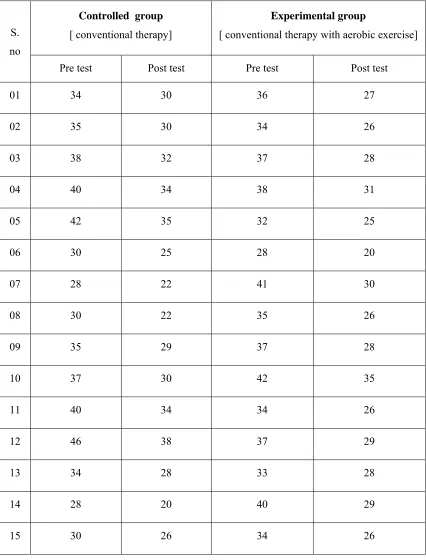
DATA PRESENTATION
TABLE : 1Pre test and post test value of WOMAC scale score for control group and experimental group.
S. no
Controlled group
[ conventional therapy]
Experimental group
[ conventional therapy with aerobic exercise]
Pre test Post test Pre test Post test
01 34 30 36 27
02 35 30 34 26
03 38 32 37 28
04 40 34 38 31
05 42 35 32 25
06 30 25 28 20
07 28 22 41 30
08 30 22 35 26
09 35 29 37 28
10 37 30 42 35
11 40 34 34 26
12 46 38 37 29
13 34 28 33 28
14 28 20 40 29
DATA ANALYSIS AND INTERPRETATION
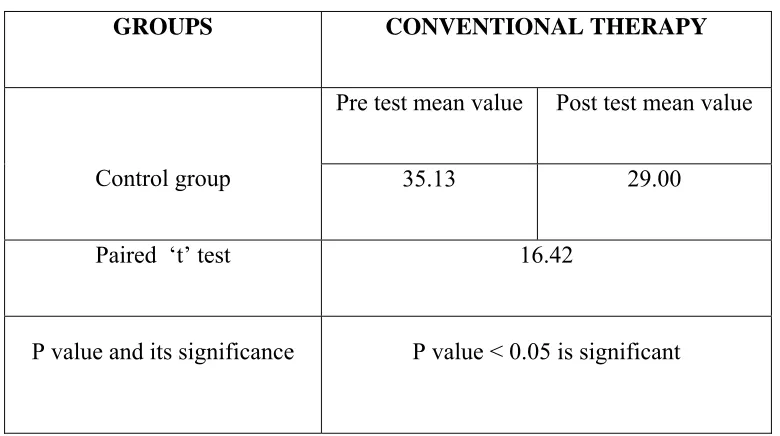
TABLE –II
ANALYSIS OF PRE-TEST AND POST-TEST DATA OF WOMAC SCALE
SCORE FOR CONTROL GROUP
For 14 degrees of freedom at 5% level of significance, the student ‘t’ test value
for control group (conventional therapy) was 16.42 and the critical value was 1.761,
which states that there exists significant difference between the pre test and post test
values of control group.
GROUPS CONVENTIONAL THERAPY
Control group
Pre test mean value Post test mean value
35.13 29.00
Paired ‘t’ test 16.42
ANALYS
0
5
10
15
20
25
30
35
40
SIS OF PRE
GR E-TEST AN SCORE F
35.13
Pre te
RAPH I ND POST-T OR CONTR3
est
Po
TEST DATA ROL GROUost test
A OF WOM
UP
29
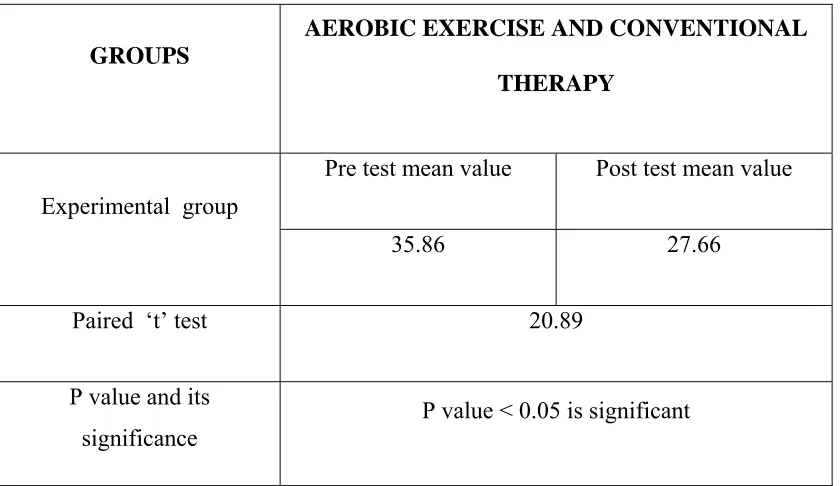
TABLE III
ANALYSIS OF PRE TEST AND POST TEST VALUES OF WOMAC SCALE
SCORE FOR EXPERIMENTAL GROUP
For 14 degrees of freedom and at 0.05 level of significance, the critical value is
1.761 and the calculated value is 20.89, since the calculated value is more than the critical
value, there exists a significant difference between pre test and post test value of
experimental group. GROUPS
AEROBIC EXERCISE AND CONVENTIONAL
THERAPY
Experimental group
Pre test mean value Post test mean value
35.86 27.66
Paired ‘t’ test 20.89
P value and its
ANALYSI
0 5 10 15 20 25 30 35 40
IS OF PRE
SC
TEST AND
CORE FOR
35.86
Pre test
Graph II
D POST TE
EXPERIM
Post tes I
EST VALUE
MENTAL GR
27.66
st
ES OF WOM
ROUP
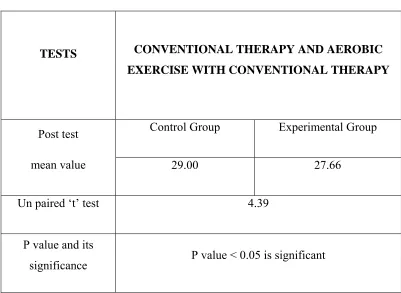
TABLE IV
ANALYSIS OF POST TEST VALUE OF CONTROL GROUP AND
EXPERIMENTAL GROUP
TESTS CONVENTIONAL THERAPY AND AEROBIC
EXERCISE WITH CONVENTIONAL THERAPY
Post test
mean value
Control Group Experimental Group
29.00 27.66
Un paired ‘t’ test 4.39
P value and its
significance P value < 0.05 is significant
For 28 degrees of freedom at 5% level of significance, the calculated post test ‘t’
value between control group and Experimental group was 4.39 and the critical value
ANALY
27.2
27.4
27.6
27.8
28
28.2
28.4
28.6
28.8
29
YSIS OF PO
CONTRO
Contr
OST TEST V
OL GROUP
29
rol group
Graph II
VALUE OF
P AND EXP
RESULTS
Effectiveness of control group is elicited comparing the pre test and post
test values of control group using paired‘t’ test, the calculated value is 16.42, whereas the
critical value is 1.761. Since the calculated value is greater than the critical value, there
exists a significant difference between the pretest and post test values of control group.
When comparing the mean values of both, the post test mean value 29.00 is lesser than
the pre test mean value 35.13 which confirms that there is a significant improvement in
the functional abilities on early osteoarthritis knee.
Effectiveness of Experimental group is elicited by comparing the pretest and post
test values of experimental group using paired ‘t’ test, the calculated value is 20.89,
whereas the critical value is 1.761. Since the calculated value is greater than the critical
value, there exists a significant difference between the pretest and post test values of
Experimental group. When comparing the mean values of both, the post test mean value
27.66 is lesser than the pre test mean value 35.86, which confirms that there is a
significant improvement in the functional abilities on early osteoarthritis knee.
While comparing the post test value of control group and experimental group
subjects using unpaired‘t’ test is 4.39 whereas the critical value is 1.761. Since the
calculated value is more than the critical value, it states that there is significant
difference between the post values of both control group and experimental group. Hence
it confirms that there is a significant improvement in post test value of experimental
DISCUSSION
This study has focused on the effects of aerobic exercise along with other
conventional treatments like ultrasound therapy, isometric exercises and home based
exercise programme on early osteoarthritic knee.
Moskowitz (2004) states that osteoarthritis of the knee is common, increasing
with age in both women and men but are more prevalent in women following 4th decade.
Osteoarthritis represents an imbalance in the destructive and synthetic processes at
cartilage due to excessive loading which leads to erosion at the cartilage. In addition there
is a decreased concentration and viscosity at the synovial fluid in osteoarthritic patients.
These changes address both the symptoms of pain and loss of mobility.
Appropriately strengthened muscles may help to minimize the adverse effects of
weight bearing on the joints by reducing the amount of force that is transmitted across the
affected joints. It has been shown that weak quadriceps muscles are common in people
experiencing symptoms of osteoarthritis at the knee. In addition, studies have shown that
when these patients strengthen their quadriceps muscles significant improvements in pain
and function are seen when compared with those who did not strengthen these muscles.
Miyaguch et al developed an isometric exercises program and analyzed the
increase in the biochemical properties at joint fluid and pain relief resulting from
Often, people with osteoarthritis limit their activities due to pain and range of
motion restrictions. This can result in decreased cardiovascular fitness, with associated
functional decline and adverse effects on overall health. Thus, it is important that
patients with osteoarthritis find ways to maintain cardiovascular fitness.
By improving endurance, we may be able to regain functions that have been lost,
and reengage in enjoyable activities that had been discontinued. In addition to functional
improvements, exercise has also been shown to decrease pain in osteoarthritis. For
example, participating in aerobic exercises such as walking or cycling has been shown to
decrease the pain related to arthritis and improves functional abilities.
Proctor and Kelly stated the response at articular cartilage to isometric exercises
in which stress loads being placed upon articular cartilage were diffused and articular
cartilage provided adequate lubrication thereby decreasing the pain and improving
functional status.
Fitzgerald (2004) moderated the relationship between quadriceps strength and
physical function in individuals with knee OA and stated physical function may be more
severely affected by weakness at Quadriceps muscles.
Andrew M. Baye (2004) stated that isometric exercise protocols increases
strength of muscles, but more at different angles.
Nichols DS (1994) Evaluated the effect of walking on pain and found a beneficial
For example, participating in aerobic exercises such as walking or cycling has been
shown to decrease the pain related to arthritis and improves functional abilities.
Michael Olpin (2003) stated that Aerobic exercises increases thickness of
cartilage, increases strength of connective tissues such as ligaments and tendons increase
the size of skeletal muscle increases overall muscle strength and slows the rate of joint
degeneration thereby decreasing the risk of injuries to locations such as knee
Fisher KM (1997) stated that subjects with OA knee had reduced muscle strength
and functional capacity. Physical agents are devices using physical modalities to produce
beneficial therapeutic effects. Heat, cold, pressure, light and even electricity have been
used for thousands of years to accelerate healing and decrease pain. Heat therapy is
applied to obtain analgesia, decrease muscle spasm, increase collagen extensibility and
accelerate metabolic processes. Two forms of heat therapy are available. Superficial
agents such as hot packs heat the skin and subcutaneous tissues, while deep heating
agents such as therapeutic ultrasound may produce temperature elevations of 4-50
Tseng BS (1995) stated that muscle mass motor unit number activation and
synchronization that are highly related to strength had an indirect effect on endurance
exercises and mitochondria concentration highly related to endurance capacity were
increased and maintained by endurance training
Appropriate aerobic training program slows the rate of joint degeneration by
improving the quality of cartilage and its substances. Thereby increases excessive loading
on cartilage and strengthening of muscles, which serves as a main cause for the
Comparison of functional status of WOMAC between controlled group and
experimental group shows statistical significance between post-treatment groups.
When comparing the mean values, experimental group showed improvement than
the controlled group. There exists a mean difference between control group and
SUMMARY AND CONCLUSION
SUMMARY
In an effort to find out the efficacy between conventional therapy like ultrasound
therapy, isometric knee exercises and self paced home exercises and aerobic exercise on
improving functional abilities in early osteoarthritis of knee patients, 30 subjects were
selected using purposive sampling technique and assigned in to two groups with 15
subjects each.
Control group was treated with ultrasound therapy, isometric exercises and
appropriate home exercises for a period of 3 months and the experimental group were
treated with aerobic exercise using treadmill along with the above said conventional
treatment.
Pre-test and Post-test scores are recorded and analysis was done using independent
‘t’ test which favored the alternate hypothesis.
The intra group analysis was done and results were analyzed using paired‘t’ test, which favored the alternate hypothesis. Statistical analysis shows that there is significant
improvement in functional abilities in experimental group based upon the WOMAC index scale.
CONCLUSION
Hence, it can be concluded that the aerobic exercise program in addition with the
conventional therapy like ultrasound therapy, isometric knee exercises and home exercise
SUGGESTIONS AND LIMITATIONS
¾ This study was very short term and therefore to make it more valid long term is
necessary.
¾ Since the study has been done with smaller number of subjects further studies
should be conducted with large group of population.
¾ Further study can be done along with PNF technique and other forms of exercises
like closed and open kinetic exercises.
¾ Variation in climate, drugs, diet, personal habit, side of involvement, gender, age
BIBILIOGRAPHY
1. ANDREW M BAYE (2004) Isometric timed static contractions and static holds.
Page 1-11
2. APLEY’S AG, SOLOMON L. System of orthopaedics and fractures p.no, 80;
ed 7th (1993).
3. BASFORD JR. Physical Agents. : DeLisa JA, Gans BM, eds. Rehabilitation
Medicine: Principles and Practice. Philadelphia: Lippincott-Raven; 483–503,
1998.
4. BISCHOFF HA, ROOS EM. Effectiveness and safety of strengthening, aerobic,
and co ordination exercises for patients with osteoarthritis. Curr Opin
Rheumatology1. 2003Mar; 15(2):141-4
5. BROSSEAU L, MACLEAY L, ROBIMSON V, WELLS G, TUGWELL P.
Intensity of exercise for the treatment of osteoarthritis. Cochrane Database Syst
Rev.2003 (2) CD004259
6. CAROLYN KISNER LYNN ALLEN COLBY (1996): Therapeutic Exercise
Foundation, Edition 3rd Pg.71
7. CYNTHIA C. NORKIN, “ joint structure and function – a comprehensive
analysis”. FA Davis Company, Philadelphia, 1983.
8. FRENCH DN, KRAEMER WJ, COOKE CB. Changes in dynamic exercise
performance following a sequence of preconditioning isometric muscle actions. J
Strength cond. Res.2003 Nov: 17(4):678-85
9. GUPTA SP, “ Statistical methods ”, Sultan Chandand Sons Publications,
10.HURWITZ DE, RYALS AR, BLOCK JA, SHARMA L, SCHNITZER TJ,
ANDRIACCHI TP. Knee pain and joint loading in subjects with osteoarthritis
of the knee, j orthop res.2000 jul;18(4)572-9.
11.HUSKISSON EC; “measurement of pain” J Rheumatology (1986); 9:768-9
12.KOTHARI CR. “Research methodology methods And Techniques”, Wiswa
Prakasam, New age international (p) Ild, New delhi, e/2,1990.
13.KUBO K, KANCHISA H, ITO M, FAKUNAGA T, Effects of isometric
training on the elasticity of human tendon structures in vivo. J Appl physiol. 2001
Jul; 91(1) 26-32
14.KULKARNI GS, Textbook of orthopaedics and trauma: vol 3rd edition (1999):
page no.3046-3048.
15.NEUBERGER GB, KASAL S, SMITH KV, HASSANEIN R, DEVINAY S.
determinants of exercise and aerobic fitness in outpatients with arthritis. Nur Res.
1994 jan-feb: 43(1): 11-7
16.O’RELLY SC, JONES A, MUIR KR, DOHERTY M. Quadriceps weakness in
knee osteoarthritis the effect on pain & disability ANN Rheum Dis 1998
Oct;57(10)588-94
17.PENNIX BW, REJESKI WJ, PANDYA J, MILLER ME, DI BARI M,
APPLEGATE WB PAHOR M.E Exercise and depressive symptoms: a
comparison of aerobic and resistance effects on emotional and physical function
in older persons with high and low depressive symptomtology. J Gerontol B
18.RENE CAILLIET, M.D. (pain series); knee pain and disability edition 3rd;
(1992); page no.146&190
19.ROEBROECK ME, DEKKER J, OOSTENDORP RAB,The use of therapeutic
ultrasound by physical therapists in Dutch primary health care.1998;78:470–9.
20.ROLAND W.MOSKOWITE M.D: Osteoarthritic: Diagnosis and management
(1984): page no.149-154
21.ROOS E.(physical activity can influence the course of early arthritis. Both
strength training and aerobic exercise provide pain relief and functional
improvement) Lakartidningen. 2002 Nov 7; 99(45):4484-9
22.SHEILA O’REILLY (1997), effect of isometric exercises vol.4 no.7: Pg.176-80
23.STENSDOTTOR AK, HODGES PW, MELLOR R, SUNDELIN G,
HAGER-ROSS C. Quadriceps activation in closed and in open kinetic chain
exercise. Medical science sports exercises2003 Dec; 35 (12):2043-7
24.SUSAN B O SULLIVAN, “Physical Rehabilitation Assessment And Treatment”,
Jaypee brothers Publications, new Delhi, e/3, 1998.
25.TSENG BS (1995) Endurance Exercises and mitochondrial concentration J
APPENDIX -I
Subjective assessmentName :
Age :
Sex :
Occupation :
Address :
Date of Admission :
Present complaint :
Past Medical History :
Personal history :
Objective Assessment
On Observation :
On Palpation :
On examination :
Measurement : WOMAC index scale
Progression chart : WOMAC index scale for
improvement in functional ability.
S.no Pre test value Post test value
APPENDIX – II
THE WESTERN ONTARIO AND MC MASTER UNIVERSITY (WOMAC) OSTEOARTHRITIS INDEX
The WOMAC categories are
Level of difficulty in performing the following functions
¾ Descending stairs ¾ Ascending stairs ¾ Rising from sitting ¾ Standing
¾ Bending to the floor ¾ Walking on flat ¾ Getting in/out of a car ¾ Going shopping ¾ Putting on socks ¾ Rising from bed ¾ Taking off socks ¾ Lying in bed
¾ Getting in/out of bath ¾ Sitting
¾ Getting on/off toilet ¾ Heavy domestic duties ¾ Light domestic duties
The WOMAC Parameters are
¾ 0-None, 1-slight, 2-moderate, 3-severe, 4-extreme
APPENDIX- III
INFORMED CONSENT FORM
TITLE: “A COMPARATIVE STUDY ON THE EFFECTIVENESS AEROBIC
EXERCISE WITH CONVENTIONAL THERAPY ON IMPROVING
FUNCTIONAL ABILITIES IN EARLY OSTEOARTHRITIC KNEE”
INVESTIGATOR: ………
PURPOSE OF THE STUDY:
I……….. , have been informed that this study will work towards
achieving the near normal attainment of functional abilities and reduction in pain for
early osteoarthritis knee for me and other patients.
PROCEDURE:
Each term of the study protocol has been explained to me in detail. I understand
that during the procedure, I will be receiving the treatment for one time a day. I
understand that I will have to take this treatment for four months.
I understand that this will be done under……… supervision. I am also
aware that I have to follow the therapist’s instructions as has been told to me.
CONFIDENTIALITY:
I understand that medical information provided in this study will be confidential.
If the data are used for publication in the medical literature or for teaching purpose, no
RISK AND DISCOMFORT:
I understand that there are no potential risks associated with this procedure, and
understand that………. will accompany me during this procedure. There are no
known hazards associated with this procedure.
REFUSAL OR WITHDRAWL OF PARTICIPATION:
I understand that the decision of my participation is wholly voluntary and I may
refuse to participate, may withdraw consent at any time during the study.
I also understand that the investigator may terminate my participation in the study
at any time after she has explained me the reasons to do so.
I ……….. have explained to………. the purpose of the
research, the procedures required and the possible risks and benefits, to the best of
my ability.
……… ………
Investigator Date
I ……….. confirm that ……… has explained me the purpose of the
research, the study procedure and the possible risks and benefits that I may
experience, I have read and I have understood this consent to participate as a
subject in this research project.
……….. ………
Subject Date
……….. ……….