EFFECTIVENESS OF LOW INTENSITY AQUATIC EXERCISE
AND FLOOR EXERCISE IN IMPROVING FUNCTIONAL VITAL
CAPACITY AND FORCED EXPIRATORTY VOLUME AMONG
SUBJECTS WITH COPD
A COMPARATIVE STUDY
A project submitted towards partial fulfillment of the
requirements of for the degree of
MASTER OF PHYSIOTHERAPY
Submitted by
Register number: 271730205
under the guidance of
Prof. SUBHASINI,
M.P.T (Cardio-Resp)., MIAP.,
Submitted to
THE TAMIL NADU Dr. M.G.R. MEDICAL UNIVERSITY
Chennai – 32
P.P.G. COLLEGE OF PHYSIOTHERAPY
9/1, Keeranatham road,
Saravanampatti ,
Coimbatore – 641035
EFFECTIVENESS OF LOW INTENSITY AQUATIC EXERCISE
AND FLOOR EXERCISE IN IMPROVING FUNCTIONAL VITAL
CAPACITY AND FORCED EXPIRATORTY VOLUME AMONG
SUBJECTS WITH COPD
A COMPARATIVE STUDY
INTERNAL EXAMINER :
EXTERNAL EXAMINER :
A project submitted in partial fulfillment
of the requirement for the degree of
MASTER OF PHYSIOTHERAPY
To
THE TAMILNADU Dr. M. G. R. MEDICAL UNIVERSITY,
CHENNAI-32
CERTIFICATE - I
This to certify that the project work entitiled
“EFFECTIVENESS OF LOW INTENSITY AQUATIC EXERCISE
AND FLOOR EXERCISE IN IMPROVING FUNCTIONAL VITAL
CAPACITY AND FORCED EXPIRATORTY VOLUME AMONG
SUBJECTS WITH COPD"
was carried out by
Reg.No. 271730205
,
PPG College of physiotherapy,Coimbatore-35,
affiliated to The
Tamilnadu Dr. M.G.R Medical University , Chennai – 32.
This
work was done under the supervision and guidance of
Prof.
SUBHASINI,
M.P.T (Cardio-Resp)., MIAP.
CERTIFICATE - II
This is to certify that the project work entitled
“EFFECTIVENESS OF
LOW
INTENSITY
AQUATIC
EXERCISE
AND
FLOOR
EXERCISE IN IMPROVING FUNCTIONAL VITAL CAPACITY
AND FORCED EXPIRATORTY VOLUME AMONG SUBJECTS
WITH COPD"
was carried out by
Reg. No. 271730205 PPG College
of physiotherapy, Coimbatore-35,
affiliated to
the Tamilnadu Dr. M.
G. R medical university, Chennai-32
, under my guidance and direct
supervision
GUIDE
ACKNOWLEDGEMENT
I give my thanks to
GOD ALMIGHTY
for providing me the
wisdom and knowledge to complete my study successfully .
It is my bounded duty to express heartiest gratitude to my parents
and family for their support and encouragement that enabled me to turn
this idea in to reality.
I express my sincere gratefulness to
Dr. L.P. THANGA VELU
M.S.,F.R.C.S, Chairman and
Mrs. SHANTHI THANGAVELU
, M.A.,
correspondent, PPG group of institutions, Coimbatore, for their
encouragement and providing the source for the successful of the study .
I
express
my
sincere
thanks
to
my
principal
Dr.
f.C.SIVAKUMAR.MPT (Orthopaedics), Ph.d.,
PRINCIPAL PPG.
College of physiotherapy who extend his guidance and encouragement
throughout this project.
I express heartful thanks to my Guide
Prof. SUBHASINI,
M.P.T
(Cardio-Resp)., MIAP
for offering me perceptive inputs and guiding me
through the course of my work .
I express my thanks to each and every
PATIENTS
who
co-operated to fulfill this dissertation work possible .
CONTENTS
S.
NO.
TITLE
PAGE
NO
I.
INTRODUCTION
1.1 Background of the study
1.2 Need of the study
1.3 Aim of the study
1.4 Objectives of the study
1.5 Hypothesis
1.6 Operational definitions
3
7
7
7
8
8
2
REVIEW OF LITERATURE
2.1 Review of literature related to Chronic Obstructive
Pulmonary Disease.
2.2 Review of literature related to Aquatic Exercise
2.3 Review of literature related to floor exercise program
2.4 Review of literature regarding outcome measures
2.4.1 Review of literature regarding Modified Borg Scale
2.4.2 Review of literature regarding six minute walk test
10
3
MATERIALS AND METHODOLOGY
3.1 Study Design3.2 Study population
3.3 Sample Size
3.4 Sampling Technique
3.5 Study Setting
3.6 Study Duration
3.7 Selection Criteria
3.7 Materials
3.8 Parameter
3.9 Procedure
3.10 Technique
23 23 23 23 23 23 23 24 24 25 27
IV.
DATA ANALTSIS AND RESULTS
4.1 Statistical Tools
4.2 Demographical Data
4.3 Descriptive analysis of MIP for Group A and Group B
4.4 Descriptive analysis of MEP for Group A and Group B
4.5 Descriptive analysis of FVC Group A and Group B
4.6 Descriptive analysis of FEV1 Group A and Group B
4.7 Descriptive analysis of Six Minute Walk Test Group A
and Group B
29
30
31
32
33
35
37
V.
DISCUSSION
39
VI.
SUMMARY AND CONCLUSIONS
6.1 Summary
6.2 Conclusion
42
43
VIII REFERENCES
45
IX
ANNEXURES
Annexure - I
Annexure - II
Annexure - III
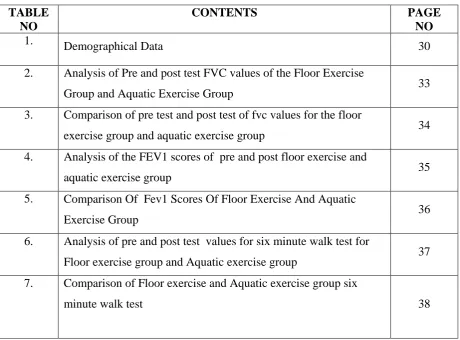
LIST OF TABLES
TABLE NO
CONTENTS PAGE
NO
1. Demographical Data 30
2. Analysis of Pre and post test FVC values of the Floor Exercise
Group and Aquatic Exercise Group 33
3. Comparison of pre test and post test of fvc values for the floor
exercise group and aquatic exercise group 34
4. Analysis of the FEV1 scores of pre and post floor exercise and
aquatic exercise group 35
5. Comparison Of Fev1 Scores Of Floor Exercise And Aquatic
Exercise Group 36
6. Analysis of pre and post test values for six minute walk test for
Floor exercise group and Aquatic exercise group 37 7. Comparison of Floor exercise and Aquatic exercise group six
LIST OF GRAPHS
GRAPH NO
CONTENT PAGE NO
1. Graphical representation most inspiratory pressure
comparison of two groups. 31
2. Graphical representation most expiratory pressure comparison
of two groups. 32
3. Graphical representation FVC for two groups.
34
4. Graphical representation FEV1 of two groups.
36
5. Graphical representation 6MWT for two groups.
1
EFFECTIVENESS OF LOW INTENSITY AQUATIC EXERCISE AND
FLOOR EXERCISE IN IMPROVING FUNCTIONAL VITAL CAPACITY
AND FORCED EXPIRATORTY VOLUME AMONG SUBJECTS WITH
COPD
A COMPARATIVE STUDY
ABSTRACT
INTRODUCTION
Despite the growing number of studies reporting therapeutic success in water environments, research involving aquatic exercise among patients with Chronic Obstructive Pulmonary Disease (COPD) is scarce. This study evaluates the impact of low-intensity aquatic exercise and floor exercises on COPD.
PURPOSE OF THE STUDY
The purpose of the study is to compare the effectiveness of low intensity aquatic exercise in improving functional capacity and forced expiratory volume among subjects with COPD.
METHODOLOGY:
30 subjects were selected based on the inclusion and exclusion criteria and were divided into two groups, Group A (15) and Group B (15). Group A received low intensity Floor exercise and Group B received low intensity Aquatic exercise and the Functional capacity and Forced Expiratory volume were measured using the 6 minute walk test, spirometer.
Results:
2
Conclusion:
The study concluded that the subjects in the Aquatic exercise group showed statistically significant improvement (i.e) the subjects in (Group B) showed increase in functional capacity and forced expiratory volume when compared to the subjects in floor group (Group A).
KEYWORDS
COPD, Low intensity aquatic exercise and floor exercise,Functional capacity, Forced expiratory volume, 6 minute walk test.
3
CHAPTER I
1.1 INTRODUCTION
Chronic Obstructive Pulmonary Disease is a preventable and treatable disease, where
airflow obstruction occurs with bronchial hyper responsiveness. COPD includes the chronic
bronchitis and emphysema. Chronic bronchitis is characterized by chronic cough with
expectoration for at least 3 months of the two consecutive years and Emphysema is defined as
permanent abnormal distention of the air spaces distal to the terminal bronchioles.
Chronic Obstructive Pulmonary Disease (COPD) is currently one of the leading causes of morbidity and mortality worldwide.1 Sufferers develop progressive incapacity and impaired quality of life associated with healthcare costs, including hospitalization for complications.2 Intolerance of physical exertion among these patients is one of the main consequences of the disease, primarily due to decreased ventilatory capacity.3, 4
The disease has been associated with dyspnea and reduced quality of life,5 leading to significant functional limitations in COPD patients,6 compromising performance in activities of daily living.7 Although this dysfunction has multifactorial causes, chronic decline in fitness is a major factor in the pathogenesis of muscle abnormalities. As such, several treatment strategies have been proposed, including physical exercise,8 considered the best available form of improving muscle function.6,7
World wide,11 deaths from COPD have reached over 180,000 annually. In the United States, the number of COPD has leapt over 60% since the early 1980s and deaths have doubled to 5000 a year. Mortality due to COPD is not comparable in size to the day to day effects of the disease. Although largely avoidable, COPD tends to occur in epidemics and affects young people. The human and economic burden associated with this condition is severe.
4
among children in the Caroline Islands to virtually zero in Papua New Guinea. In Brazil, Costa Rica, Panama, Peru and Uruguay, prevalence of COPD symptoms in children varies from 20% to 30%. In Kenya, it approaches 20% .In India, rough estimates indicate a prevalence of between 10% and 15% in 5-11 year old children.
The global prevalence of COPD11 is anticipated to be approximately 4.5%. There are about 334 million patients with COPD affecting all age groups across the world. The prevalence of COPD has increased over time and an additional 100 million people world wide are expected to develop COPD by the year 2025. In India analysis using different estimating models (INSEARCH, GINA, WHO) suggest the prevalence of COPD varies between 2.05 to 3.5 (17- 30 million patients).
COPD is a common chronic communicable disease, that affects as many as 334 million people of all ages in all parts of the world. 14% of world’s children experience COPD symptoms
8.6% of young adults (aged 18-45) experience COPD symptoms. The burden of COPD is greatest for children aged 10 to 14 years and the aged 75 to 79 years. COPD is the 14th most important disorder of world in terms of extent and duration of disability.
Indian Council of Medical Research the prevalence of COPD3 is 2.05% (2.28 in rural and 1.64 in urban). There is wide variation among different areas, low in urban Secunderabad (.37%) and rural Mumbai(.74%) and relatively high at Kolkata rural (4.52%), urban(5.52%) and rural Trivandrum. Bangalore had a major prevalence of COPD as compared to other North Indian cities. In Kerala the prevalence of COPD is 10.92% in urban area and 13.18% in rural area. 5.93% of person in urban and 7.88% in rural have severe COPD. Allergic rhinitis and COPD is more prevalent in women; but varies with region.
5
Mortality WHO (2015); World wide, deaths from COPD have reached over 180,000 annually. In the United States, the number of COPD has leapt over 60% since the early 1980s and deaths have doubled to 5000 a year. Mortality due to COPD is not comparable in size to the day to day effects of the disease. Although largely avoidable, COPD tends to occur in epidemics and affects young people. The human and economic burden associated with this condition is severe.
It is estimated that COPD accounts for about one in every 250 deaths world wide. Many of the deaths are preventable, being due to sub optimal long term medical care and delay in obtaining help during the final attack.
Pulmonary Rehabilitation also called as pulmonary rehab5 or PR, is a broad program that helps to improve the well being of people to have chronic (on going Breathing Problems). PR also can benefit people how need lung surgery, both before and after the surgery. PR doesn’t replace medical therapy. Instead, its used with medical therapy and may include exercise training, nutritional counseling, education on your lung disease or condition and how to manage it, energy-conserving techniques, breathing strategies, psychological counseling and / or group support.
Pulmonary rehabilitation is an effective therapy. It results in improvement in exercise tolerance, improvement in the sensation of dyspnea, improvement in the ability to perform activities of daily living, improvement in health related quality of life, improvement in muscle strength, endurance masses, reductions in number of days spent in hospital. pulmonary rehabilitation is considered to be an important therapeutic intervention.
The exercise component of the program is personalized to the patients capabilities and individual goals. Current guidelines states that the exercise component of pulmonary rehabilitation should consist of aerobic exercises to achieve generalized strengthening of the peripheral muscles.
6
LOW INTENSITY EXERCISE
Intensity is the amount of physical power, expressed as a percentage of maximum, the body uses in performing an activity measuring vital capacity and forced expiratory volume is the method most often used to evaluate intensity in everyday life or to set the level of exercise.
AQUATIC THERAPY
Aquatic therapy refers to treatment and exercises performed in water for relaxation, fitness, physical rehabilitation, and other therapeutic benefit. Treatments and exercises are performed while floating, partially submerged, or fully submerged in water.
Many aquatic therapy procedures require constant attendance by a trained therapist, and are performed in a specialized temperature-controlled pool. Aquatic exercise is popular for all ages, healthy individuals with a disability, individuals with a diagnosed disease, individuals with special needs, and individuals in physical therapy.
A huge variety of aerobic and strength exercises can be performed in water.26 The purpose of the study is to compare the effectiveness of high intensity aerobic exercise in ground level versus water level to improve the functional capacity among subjects after COPD.
7
1.2 NEED OF THE STUDY
According to other researches, COPD patients were cautioned for decades to avoid aquatic exercise, to avoid physiological cardio respiratory changes. These cautions are responsibly safe and ethical considering there was very little research evidence of aquatic exercise for various respiratory health concerns. More research is needed even though it has increased in recent decades.
The Research on aquatic exercises is scarce for subjects with COPD so this present study sought to determine the impact of a water environment on the effectiveness of training by comparing the effect of floor exercise versus aquatic exercise on the treatment.
So the need of the study is to compare the effectiveness of low intensity aquatic exercise versus floor exercise to improve the functional capacity and forced expiratory volume among subjects with COPD.
1.3 AIM OF THE STUDY
The aim of the study is to compare the effectiveness of low intensity aquatic exercise and floor exercise to improve the functional capacity and forced expiratory volume among subjects with COPD.
1.4 OBJECTIVE OF THE STUDY
To evaluate the effectiveness of low intensity aquatic exercise to improve the functional
capacity and forced expiratory volume among subjects with COPD.
To evaluate the effectiveness of low intensity floor exercise to improve the functional
capacity and forced expiratory volume among subjects with COPD.
To compare the effectiveness of low intensity aquatic exercise versus floor exercise to
8
1.5 HYPOTHESIS
NULL HYPOTHESIS
There would not have been any significant improvement in the functional capacity after the application of low intensity floor exercise versus aquatic exercise among subjects with COPD.
ALTERNATIVE HYPOTHESIS
There would have been any significant improvement in the functional capacity after the application of low intensity floor exercise versus aquatic exercise among subjects with COPD.
1.6
OPERATIONAL DEFINITIONS
COPD
Obstructive lung disease is general term that refers to a number of chronic pulmonary conditions, all of which obstruct the flow of air in the respiratory tract and affect ventilation and gas exchange. Each disease has its unique features and is distinguished by the cause of the obstruction of airflow, the onset of the disease, the location of the obstruction, and the reversibility of the obstruction.
CAROLYN
DYSPNEA
Dyspnea means difficulty in breathing. It is otherwise called the air hunger. Normally, the breathing goes on without consciousness. When breathing enters the consciousness and produces discomfort, it is called dyspnea. Dyspnea is defined ‘ as a consciousness of necessity for increased respiratory effort’.
9 HYDROTHERAPY
Aquatic exercise refers to the use of multi depth immersion pools or tanks that facilitate the application of various established therapeutic interventions, including stretching, strengthening, joint mobilization, balance and gait training and endurance training.
LYNN ALLEN COLBY FUNCTIONAL CAPACITY
The extent to which a person can increase exercise intensity and maintain increased levels, dependent largely on cardio respiratory fitness.
FARLEX
10
CHAPTER II
REVIEW OF LITERATURE
2.1 Review of literature related to Chronic Obstructive Pulmonary Disease.
James K.Stooler et al., (2016) was conducted the study to find out the increasing prevalence, mortality, and disease burden. Recent estimates suggest that there are approximately 23.6 million men and women with COPD in the U.S. and more than 52 million sufferers around the world. The worldwide prevalence is likely to be underestimated for several reasons, including delays in establishing the diagnosis, the variability in defining COPD, and the lack of age-adjusted estimates. A recent multinational population-based study, placed the worldwide overall prevalence of stage-II or higher COPD at 10.1% with a higher prevalence rate for men (11.8%) than for women (8.5 %). The rates and severity of Spiro metrically confirmed COPD were higher than those previously reported. Age adjustment is important because the prevalence of COPD in people aged 65 years. In 1995, 553,000 patients were treated for COPD in the U.S., two-thirds of them were aged >65 years. The prevalence of COPD in those aged >65 years was 4 times that among those aged 45-64 years.
11
and hypercapnic patients. Expressing Paco2 as a combined function of VT and PPLmin (stepwise multiple regression analysis) explained 71% of the variance in Paco2. Tidal volume was directly related to inspiratory time (TI), and TI was inversely related to the pressure required for breathing relative to inspiratory muscle strength (PPLSW, %PPLmin). There was an association between the severity of dyspnoea and both the increase in PPLSW (%PPLmin) and the shortening in TI The results indicate that, in stable patients with COPD with severe airflow obstruction, hypercapnia is associated with shallow breathing and inspiratory muscle weakness, and rapid and shallow breathing appears to be linked to both a marked increase in the pressure required for breathing relative to inspiratory muscle strength and to the severity of the breathlessness.
K. Hill et al., (2013) was conducted a study at School of Physiotherapy and Exercise Science Western Australia .Comprehensive pulmonary rehabilitation is an important component in the clinical management of people with chronic obstructive pulmonary disease (COPD). Although supervised exercise training is considered the cornerstone of effective pulmonary rehabilitation, there are many other components that should be considered to manage the impairments and symptom burden, as well as the psychosocial and lifestyle changes imposed by COPD. These include approaches designed to: 1) facilitate smoking cessation; 2) optimise pharmacotherapy; 3) assist with early identification and treatment of acute exacerbations; 4) manage acute dyspnoea; 5) increase physical activity; 6) improve body composition; 7) promote mental health; 8) facilitate advance care planning; and 9) establish social support networks. This article will describe these approaches, which may be incorporated within pulmonary rehabilitation, to optimise effective chronic disease self management.
12
from 15 articles, and mortality data from 58 articles. Prevalence ranged from 0.2%–37%, but varied widely across countries and populations, and by COPD diagnosis and classification methods. Prevalence and incidence were greatest in men and those aged 75 years and older. Mortality ranged from 3–111 deaths per 100,000 populations. Mortality increased in the last 30– 40 years; more recently, mortality decreased in men in several countries, while increasing or stabilizing in women. Although COPD mortality increased over time, rates declined more recently, likely indicating improvements in COPD management. In many countries, COPD mortality has increased in women but decreased in men.
Facchiano L, Hoffman Snyder C, Nunez DE et al., (2011) was conducted a study in missourito investigate the breathing retraining as a self-management strategy for individuals with chronic obstructive pulmonary disease (COPD) guided by Rosswurm and Larrabee's evidence-based practice model. Scientific literature review, grey literature review, and hand searching.An exhaustive review of the literature revealed evidence that regularly practiced pursed lip breathing is an effective self-management strategy for individuals with COPD to improve their dyspnea.They concluded that implementation of this non-pharmacological self-management intervention will improve perception of dyspnoea, functional performance, and self-efficacy in individuals with COPD.
13
acupuncture, acupressure, distractive auditory stimuli (music), relaxation, hand- held fans, counselling programs or psychotherapy. There is also no evidence to support the use of supplemental oxygen to reduce dyspnoea in non hypoxemic patients with advanced COPD. Recognizing the current unfamiliarity with prescribing and dosing of opioid therapy in this setting, a potential approach for their use is illustrated. They concluded the role of opioid and other effective therapies in the comprehensive management of refractory dyspnoea in patients with advanced Chronic Obstructive Pulmonary Disease.
Anna sap this and Sara booth et al., (2008) conducted a study in to evaluate the increasing evidence that the end of life needs of those with advanced COPD is not being met by existing services. Many barriers hinder the provision of good end of life care in COPD, including the inherent difficulties in determining prognosis. This review provides an evidence-based approach to overcoming these barriers, summarizing current evidence and highlighting areas for future research. They conclude end of life needs, symptom control, advance care planning, and service development to improve the quality of end of life care.
P.samarakoon et al., (2008) Conducted a study to investigate the increasing reports describing invasive pulmonary aspergillosis (IPA) in patients with chronic obstructive pulmonary disease (COPD) without the classic risk factors for this severe infection. The available literature on this association is based on case reports or small case series. The aim of this review is to systematically review these cases and describe the clinical features, diagnostic studies and outcome. They identified all the cases of IPA and COPD reported in the literature and had enough clinical information. They also included five cases of IPA in patients with COPD identified by the authors. These cases were systematically reviewed for clinical features, diagnostic studies and outcome.
14
were conducted a 1 year follow-up cost of illness study in a general Population, recruiting ever smoking Global Initiative for Chronic Obstructive Lung Disease (GOLD) stage 2+ COPD patients and ever smokers without COPD. They were used diaries to recollect data, and comprehensive questionnaires to cover all costs of COPD. The main challenges were the participants’ unwillingness to complete diaries, the large amount of information and the logistics
related to following up 476 individuals on four occasions during one year.
2.2 Review related to aquatic exercise
YAZIGI F, et al.,(2018) In his study, the cadence and water temperature effect on physiological responses during water cycling ten young men were included and performed the protocols in separate days. Blood lactate concentration, heart rate, oxygen uptake, ventilation and thermal comfort were collected during the exercise. The maximal HR and VO2 showed no significant differences between the protocols: HRmax:189 ± 7 (land), 188 ±14(wc27),185 ± 9 bpm(WC31) and VO2max: 4.2 ± 0.4 (land), 4.1 ± 0.5 (WC27) and 4.3 ± 0.51 min (-1) (WC31). However, the maximal BL demonstrated significant lower value during the water protocols compared to the land protocol (p=0.018). All the sub maximal physiological responses showed significant differences between the cadences (60, 70, 80 and 90 rpm). The effect of warm temperature was significant for TC response (p=0.001) showing higher values at 31°C than 27°C (TCW27:7 ± 1 and TCW1:9± 1), finally concluded that higher physiological responses were showed by increasing the cadence by 10 rpm and the subjects were more comfortable when cycling in the lower water temperature.
15
extensor and flexor TW of the elbow joints in the training groups were increased (p<0.01), and the WG differed from the CG in extensor TW and ER and flexor TW (p<0.01), while the LG differed from the CG in flexor TW and extensor ER (p<0.05). PT, PT/body weight (BW), and TW in the knee joint extensor in the training groups were increased as well (PT and PT/BW: p<0.05, TW: p<0.01), and the WG differed from the CG in terms of knee joints outcomes, while the LG differed from the CG in flexor TW only (p<0.05).Water-based Liuzijue exercise has beneficial effects on COPD patients' respiratory muscle strength and peripheral skeletal muscle function, and additional benefits may exist in endurance of upper limbs and strength and endurance of lower limbs when compared with land-based Liuzijue exercise.
CIDER ASA., et al., (2017)
In this study, Aquatic exercise is effective in improving exercise performance in
patients with heart failure and type 2 diabetes mellitus, Twenty patients ( Four women ) with both CHF and 2dm (age 67.4 ± 7.1, NYHA II-III) were randomly assigned to either aquatic exercise or a control group. The patients exercised for 45 minutes 3 times /week in 33-34oc , swimming pool, concluded that aquatic exercise could be used to improve exercise capacity and muscle function in patients with the combination of CHF and 2DM[32].16
swimming pool is a feasible and positive alternative venue for PR for COPD patients in primary care.
Rune Lundgren, et al (2011)
The effect of high intensity physical group training in water and on land for patients
with COPD with regard to physical capacity and health related quality of life (HRQoL). A
controlled, semi-randomised study was conducted where 30 patients were randomised to training
either in water or on land. Thirteen patients constituted a control group. Forty-three outpatients,
with moderate to severe COPD (27w/16m), from two local hospitals in northern Sweden, were
included in the study. High intensity physical group training in water (water group) or on land
(land group) was performed for 12 weeks, three times per week, 45min per session. The control
group received no intervention. Pre- and post-intervention, all patients performed incremental
and endurance shuttle walking tests (ISWT and ESWT), cycle ergometer tests and responded
questionnaires about HRQoL (St. Georges Respiratory Questionnaire—SGRQ and SF-36). The
patients trained with a mean heart rate of 80–90% of peak heart rate. Both training groups
increased the distance walked, i.e. land group in ISWT (25m) and water group in ESWT (179m).
The water group increased the distance in ESWT significantly more that both the land and the
control groups. Both training groups increased the time cycled (40–85s) and work load (10–
20W) in the cycle ergometer test. The control group deteriorated in HRQoL according to total
score in SGRQ while the training groups remained constant. The water group improved their
activity score in SGRQ and their physical health score in SF-36 and those improvements were
significant as compared to the land and the control groups. In conclusion, high intensity physical
group training in water is of benefit for patients with COPD. It was in some areas found to be
even more effective regarding improvements in physical capacity and experienced physical
17
2.3 Review of literature related to floor exercise program
Antonino Bianco et al, May 2017 Calisthenics was a term used to define a generic
set of body weight exercises. Such term is now used to define a world wide spread disciplinebased on body weight and gymnastics exercises. The aim of this study was to administer a
calisthenics training protocol and evaluate its effects on posture, strength and body composition
in untrained individuals. Twenty-eight male participants (24.2 ± 4.2 years; 67.0 ± 8.3 Kg; 173.3
± 5.2 cm) were divided into two groups, a Calisthenics based intervention group (SG) and a
control group (CG). The SG exercised for 8 weeks. Each participant underwent a body
composition analysis, a postural assessment, a handgrip test, a push-up and a pull-up test. Each
participant was tested at baseline and post intervention. RESULTS: The SG improved their
posture (with open eyes p < 0.001 and with closed eyes p < 0.05), their strength (push-up test p <
0.01 with a 16.4% increase and pull up test p < 0.0001 with a 39.2% increase) and their body
composition (Fat mass 14.8 ± 5.1 vs. 11.4 ± 5.9, p < 0.01). No difference was shown for the
handgrip test. No significant differences were displayed in any variable of the CG between pre
and post measures. Calisthenics training is a feasible and effective training solution to improve
posture, strength and body composition without the use any major training equipment.
18
physical training program (aerobic/calisthenic training). During the 8-week study, both groups participated in an identical running program performed three times per week on alternate days. Additionally, aerobic/circuit weight training participants completed two circuits (1 circuit = 15 exercises) three times per week on alternate days to running. Study findings show the experimental aerobic/circuit weight training program produced significantly greater dynamic muscular strength and muscular endurance changes than the standard aerobic/calisthenic program.
Berube c, et al (2015) The effect of different exercise training modalities in patients
with chronic obstructive pulmonary disease, including strength training (n = 17), endurance training (n = 16), and combined strength and endurance (n = 14) (half of the endurance and half of the strengthening exercises). Data were compared at baseline, the end of the 12-week exercise-training program, and 12 weeks later. Improvement in the walking distance was only significant in the strength group. Increases in submaximal exercise capacity for the endurance group were significantly higher than those observed in the strength group but were of similar magnitude than those in the combined training modality, which in turn were significantly higher than for the strength group. Increases in the strength of the muscle groups measured in five weight lifting exercises were significantly higher in the strength group than in the endurance group but were of similar magnitude than in the combined training group, which again showed significantly higher increases than subjects in the endurance group. Any training modality showed significant improvements of the breathlessness score and the dyspnea dimension of the chronic respiratory questionnaire. In conclusion, the combination of strength and endurance training seems an adequate training strategy for chronic obstructive pulmonary disease patients.19
controlled trial to assess the efficacy of a physical exercise training programme in patients with mild to moderate COPD.
In this randomized controlled trial situated in the primary care setting, 102 patients with mild to moderate airflow obstruction (FEV1 ≥ 50% of predicted), dyspnoea and a physically inactive lifestyle will be randomized to an intervention or control group. The intervention group receives a 4-month physical exercise training programme at a local physiotherapy practice, which includes exercise training, resistance training, breathing exercises and advises on how to increase the level of physical activity. The control group receives usual care, i.e. advises on how to increase the level of physical activity and a sham treatment at a local physiotherapy practice of which no physiological training stimulus can be expected. Primary outcome is functional exercise capacity at 4-months measured on the six-minute walk distance. Secondary outcomes include peripheral muscle strength, physical activity in daily life, health related quality of life, dyspnoea score and patients' perceived effectiveness. Follow-up measurement will take place at 6 months after baseline.
20
activities of daily living while it reduced dyspnea, fatigue. It is necessary to integrate calisthenic exercise to the comprehensive pulmonary rehabilitation.
2.4 Literature regarding outcome measures
Spirometry
Antonius Schneider et al., (2018)
They evaluated the sensitivity, specificity and predictive values of spirometry for the diagnosis of COPD in patients suspected of suffering from an airway disease in primary care and they estimated high diagnostic accuracy using spirometry in COPD.Thomas L petty., (2017)
John Hutchinson introduced spirometry in 1846. Joseph milic emili coined the term vital capacity. Tiffneau of paris added the term timed vital capacity that is FEV1 to spirometry.21
Modified borg scale
2.4.1 Modified Borg Scale
Alfredo Chetta et al., (2017); This study also gives evidence that the score of bronchoconstriction associated breathlessness evaluated on a modifies borg scale is a tool to successfully use to measure the perception of symptoms in patients with chronic respiratory failure.
Borg et al., ( 2015 ); Modified Brog scale is a category scale that consists of numerical ratings of sensation intensity that are anchored by verbal descriptions of sensation intensity. This scale was originally developed by Borg to allow ratings of perceived exertion during exercise. Borg scale is relatively easy for the patients to learn to use and it appears to produce valid and reproducible measurement.
Burdon et al (2011); The usual means of assessing the subjective elements of breathlessness are the modified Borg scale of perceived breathlessness and visual analogue scores. The original Borg scale of perceived exertion has been modified for the measurement of breathlessness. It has 12 points, 1 of which have accompanying verbal descriptors.
2.4.2 Six Minute Walk Test
A M. Li, J. Yin et al., (2015); The aim of this study was to assess the reliability and validity of the six minute walk test (6 MWT) in healthy children. Concurrent validity was demonstrated by good correlation between the six minute walking distance and maximum oxygen uptake determined on the exercise treadmill. Test-rest reliability was undertaken in 52 subjects, and the intra class correlation coefficient (95% confidence interval) was calculated as 0.94 (0.89-0.96). In addition, Bland and Altman plots demonstrated a high degree of repeatability. In healthy children, the 6-min walk test is a reliable and valid functional test for assessing exercise tolerance and endurance.
22
23
CHAPTER III
MATERIALS AND METHODOLOGY
3.1 STUDY DESIGN
The study design is a comparative study design with pre and post test evaluation.
3.2 STUDY POPULATION
Subjects with COPD were selected for this study.
3.3 SAMPLING SIZE
30 subjects with COPD were enrolled for this study.
3.4 SAMPLING TECHNIQUE
Thesubjects were selected based on convenient sampling technique and they were divided into two groups.
3.5 STUDY SETTING
The study was conducted at outpatient Department
Floor exercise : Sane fitness center, Coimbatore.
Aquatic exercise: Life fitness center, Coimbatore.
24
3.7 SELECTION CRITERIA
INCLUSION CRITERIA Age : 40 years.
Both genders will be included.
Non smokers or Ex – Smokers for at least three months.
Free of lung infection and had medical supervision and authorization
for inclusion in the study.
EXCLUSION CRITERIA
Terminal illness (Life expectancy of > 6 Months )
Diagnosed psychiatric condition or any other condition that modifies pursed
health status.
Inability to understand spoken or written.
Modification of COPD treatment within the last month.
Likely to be admitted to hospital or an institution at enrolment because of their
COPD.
Patients with Neuro muscular, Renal and cardiac disease.
Patients with uncontrolled hypertension and diabetes mellitus and those who did
not perform functional tests or did not complete the 24 sessions.
3.8 MATERIALS
- Floater- Stop watch - spirometer
3.9 PARAMETER
RESPIRATORY MUSCLE STRENGTH ASSESSMENT
25 PULMONARY FUNCTION EVALUATION
Forced Vital Capacity (FVC), Forced Expiratory Volume in one second (FEV1), and the Tiffenau index (FEV1/FVC) were measured according to recommendations of the American Thoracic Society (ATS).12,13 Relative values were calculated using Knudson et al. reference equations.14
FUNCTIONAL CAPACITY EVALUATION
Functional capacity was assessed by maximum distance traveled in the 6-Minute Walk Test (6MWT), in accordance with ATS recommendations.16 The test was conducted in a straight, covered corridor 30 m long. Pulse Oxygen Saturation (SaO2%), Cardiac Frequency (CF), Arterial Pressure (AP), perceived respiratory exertion scale (Borg dyspnea) and lower limb fatigue (Borg lower limbs) using the Borg CR10 scale,17 were measured at the beginning and end of the testing. Two tests were conducted on alternate daysand the best values were used. The 6MWT was performed by the same investigator, without assistance, using standard phrases of encouragement at the end of each minute.
BODE MORTALITY PREDICTOR INDEX.
The BODE index was calculated for each patient using the variables FEV1, distance traveled in the 6MWT, MRC and BMI. Points for each variable were added to determine the BODE score.
3.9 PROCEDURE
26
30 subjects were randomly allocated into two groups by lot method. Group A consisting of 15 subjects and they were received low intensity floor exercise. Group B consisting of 15 subjects and they were received low intensity aquatic exercise.
Both the group members received intervention for one session per day three times in a week for 8 weeks. The total treatment session was 24 sessions. The primary outcome of the study was functional capacity and it was measured by using six minute walk distance test. The pre and post score values of functional capacity and forced expiratory volume were measured and data were recorded.
LOW INTENSITY FLOOR EXERCISE
1st stage: continuous exercises for upper and lower limbs, for 15 min, without weights
according to the ability of each patient, consisting of callisthenic activities associated with the respiratory cycle.
2nd stage: unsupported upper limb exercises using weights (halters) and diagonal
movements for 2 min, with equal rest periods. Weekly loads were increased according to the individual ability of each participant. Ideal weight used was previously established by the incremental test, training with an initial weight of 50% of the maximum load supported by the subject.
3rd stage: lower limb training performed on an exercise bicycle for 30 min. Exercise intensity was determined individually by a Borg dyspnea and perceived effort score of 5.20
4th stage: 15 min of cooling-down exercises for musclegroups used during the session.
LOW INTENSITY AQUATIC EXERCISE
The physical training session was divided into four phases 19,in a pool heated to 32 ± 2 °C:
1st phase: continuous warm-up exercises for the upper and lower limbs for 15 min,
without weights, consisting of callisthenic activities related to the respiratory cycle. 2nd phase: unsupported upper limb exercises, using two diagonal movements and
27 of the maximum load supported by the patient.
3rd phase: training for lower limbs using floats positioned between the legs and subjects
performing bicycle movements in the water for 30 min. Exercise intensity was individually determined by applying the BORG dyspnea and perceived effort score of 5. 4th phase: approximately 15 min of cooling down exercises for muscle groups used
during the session.
3.10 TREATMENT TECHNIQUE
Subjects in each group were received common form of warm up and cool down session.
WARM UP SESSION:
Continuous exercises for upper and lower limbs, for 15 min, with and with out weights according to the ability of each patient, consisting of callisthenic activities.
TECHNIQUES:
LOW INTENSITY FLOOR EXERCISE
Subjects in Group A were received low intensity floor exercise. The exercise was given in the form of 6MWT and with or without Weight lifting.
LOW INTENSITY AQUATIC EXERCISE
Subjects in Group B were received low intensity aquatic exercise. The exercise was given in the form of 6MWT.
28
MEASUREMENT PROCEDURE OF FUNCTIONAL CAPACITY:
The functional capacity was measured by using six minutes walking distance test. The test was conducted in a straight, covered corridor of 30 meters long. The subjects were seated in the starting point. About 10 minutes of rest period was given to all the subjects for general relaxation.
The subjects were instructed to walk in straight for six minutes without any diversion and also there were asked to inform any discomfort during the test.
29
CHAPTER IV
DATA ANALYSIS AND RESULT
The study consisting of two group to find out the effectiveness of low intensity aquatic exercise and floor exercise training on functional capacity among subjects with COPD.
4.1 STATISTICAL TOOLS
Within group analysis was done by using paired t- test and between group analysis was done by using unpaired t-test.
PAIRED ‘t’ TEST
The paired test was used to find out the statistical significance between pre and post t-test values of low intensity floor exercise and aquatic exercise before and after treatment for Group A and Group B.
d= difference between the pre test Vs post test d-= mean difference
30
4.2 DEMOGRAPHIC DATA
Variable Group A Group B
AGE 47.2 48.5
[image:40.612.68.547.117.180.2]DURATION(weeks) 12 12
31
4.3 ANALYSIS OF THE PRE AND POST MAXIMUM INSPIRATORY
PRESSURE FOR FLOOR GROUP AND AQUATIC GROUP
When evaluating respiratory muscle strength, a statistical difference was observed in maximal respiratory pressures in the training groups after the physical exercise program; MIP in the FG pre test was 72.8 and post test was 75.4, AG pre test was 92.8 and 94.8. However, intergroup comparison showed a significant difference in the MIP between the FG and AG training groups
Graph No :1: Graphical representation shows most inspiratory pressure comparison of two groups.
0 10 20 30 40 50 60 70 80 90 100
Floor Group Aquatic Group
MIP-Pre test
MIP-Post test 72.8 75.4
32
4.4 ANALYSIS OF THE PRE AND POST MAXIMUM EXPIRATORY
PRESSURE FOR FLOOR GROUP AND AQUATIC GROUP
When evaluating respiratory muscle strength, a statistical difference was observed in maximal expiratory pressures in the training groups after the physical exercise program; MEP in the FG pre test was 85.4 and post test was 88.4, AG pre test was 96.2 and 98.4. However, intergroup comparison showed a significant difference in the MEP between the FG and AG training groups.
Graph No :2: Graphical representation shows most expiratory pressure comparison of two groups.
75 80 85 90 95 100
Floor Group Aquatic Group
MEP Pre Test
MEP Post Test 85.4
88.4
96.2
33
4.5 Analysis of Pre and post test FVC values of the Floor Exercise Group and Aquatic Exercise Group
GROUP
N
PRE TEST
t
SIGNIFICANCE
VALUE
MEAN
SD
Floor Group 15 2.1713 .35924 .343 .734
Aquatic Group 15 2.1153 .51950
Group N Post test t Significance Value
Mean SD
Floor Group 15 2.2540 .35910 2.590 .015
[image:43.612.71.515.160.368.2]Aquatic Group 15 2.6580 .48587
Table No: 02 : For pre test floor group mean value is 2.1713 and standard deviation is.35924. For the pre test aquatic exercise group mean value is 2.1153 and standard deviation is.51950. The ‘t’ value is .343 which is significant at 5% level. That there is significant difference
between the FVC scores of the two groups at 5 % level of significance.
34
COMPARISON OF PRE TEST AND POST TEST OF FVC VALUES FOR
THE FLOOR EXERCISE GROUP AND AQUATIC EXERCISE GROUP
Group
N
improvement
t
Significance Value
Mean
SD
Floor Group 15 2.1713 .35924 14.224 .000
[image:44.612.73.506.322.574.2]Aquatic Group 15 2.2540 .35910
Table No: 03 The ‘t’ value is 14.224 which is significant at 5% level. The post FVC values are significantly greater than the pre FVC value. Data analysis shows improvement in vital capacity.
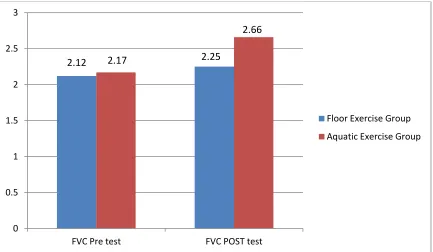
Graph No :3: Graphical representation shows FVC for two groups. 0
0.5 1 1.5 2 2.5 3
FVC Pre test FVC POST test
Floor Exercise Group
Aquatic Exercise Group
2.12 2.17 2.25
35
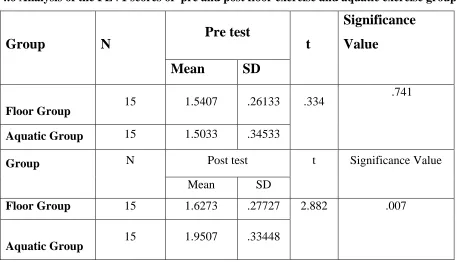
4.6 Analysis of the FEV1 scores of pre and post floor exercise and aquatic exercise group
Group
N
Pre test
t
Significance
Value
Mean
SD
Floor Group 15 1.5407 .26133 .334
.741
Aquatic Group 15 1.5033 .34533
Group N Post test t Significance Value
Mean SD
Floor Group 15 1.6273 .27727 2.882 .007
[image:45.612.71.530.82.344.2]
Aquatic Group 15 1.9507 .33448
Table No: 04 For pre test floor group mean value is 1.5407 and standard deviation is .26133. For pre test aquatic group mean value is 1.5033 and standard deviation is .34533. The ‘t’ value is .334 which is not significant at 5% level. That is there is no significant difference between the pre fev1 scores of the two groups at 5% level.
36
COMPARISON OF FEV1 SCORES OF FLOOR EXERCISE AND AQUATIC EXERCISE GROUP
Group
N
Improvement
t
Significance
Value
pretest
Posttest
Floor Group 15 1.5407 1.50 3.514 .003
[image:46.612.72.513.152.275.2] [image:46.612.70.508.351.608.2]Aquatic Group 15 1.6273 1.95
Table No: 05 The ‘t’ value for both group is 3.514 which is significant at 5% level. Data analysis shows significant improvement in forced expiratory volume.
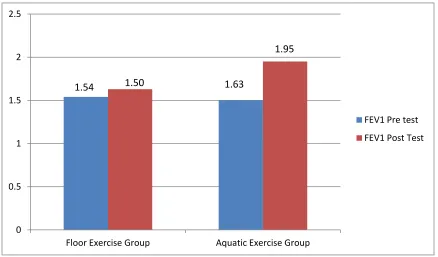
Graph No :4: Graphical representation shows FEV1 of two groups. 0
0.5 1 1.5 2 2.5
Floor Exercise Group Aquatic Exercise Group
FEV1 Pre test
FEV1 Post Test
1.54 1.50 1.63
37
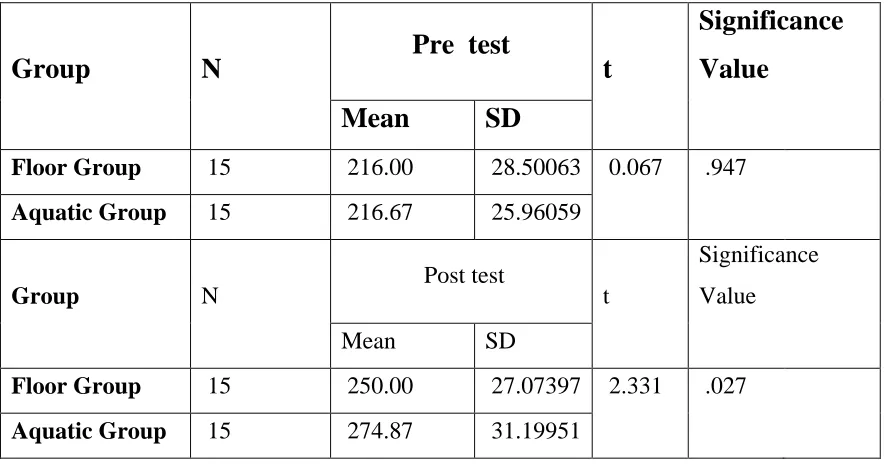
4.7 Analysis of pre and post test values for six minute walk test for Floor exercise group and Aquatic exercise group
Group
N
Pre test
t
Significance
Value
Mean
SD
Floor Group 15 216.00 28.50063 0.067 .947
Aquatic Group 15 216.67 25.96059
Group N Post test t
Significance Value
Mean SD
Floor Group 15 250.00 27.07397 2.331 .027
[image:47.612.71.515.133.366.2]Aquatic Group 15 274.87 31.19951
Table No: 06 For pre test floor group mean value is 216. 00 and standard deviation is 28.50063. For the aquatic exercise group mean value is 216.67 and standard deviation is 25.96059. The ‘t’
value is 0.067 which is not significant at 5% level. That there is no significant difference between the pre 6MWT scores of the two groups at 5 % level
38
Comparison of Floor exercise and Aquatic exercise group six minute walk test
Group
N
Improvement
t
Significance
Value
Mean
SD
Floor Group 15 216.67 25.96059 26.692 .000
Aquatic Group 15 274.87 31.19951
. Table No: 07 The ‘t’ value is 26.692 which is significant at 5% level. That there is significant difference between the pre and post 6MWT values at 5% level of significance. The post 6MWT values are greater than the pre 6MWT values. This might be due to the effect of aquatic exercise
Graph No :5: Graphical representation shows 6MWT for two groups. 0
50 100 150 200 250 300
Floor Group Aquatic group
Pre test
Post Test 216 216.67
39
CHAPTER V
DISCUSSION
The present study assessed the impact of two low-intensity physical training protocols (floor and aquatic exercise) on COPD, by analyzing several outcomes. The data suggest that both modalities of low-intensity physical exercise were beneficial to patients with moderate to very severe COPD. An interesting finding is that, with the same exercise intensity, the group submitted to training in water exhibited additional benefits for physical capacity in relation to the floor exercise group.
COPD occurs among adults, primarily from their forties onwards. This may explain the difference between the FG and AG in regard to age, despite the randomized nature of the study. However, for the lungs in particular, it is difficult to distinguish between impacts resulting solely from Physiological aging and those attributed to the cumulative effect of environmental action.
Thus, cellular changes caused by aging and those provoked by smoking may involve interrelated pathogenic mechanisms. Aging can lower the injury threshold or increase mechanisms involved in lung damage through smoking. Tobacco smoke can also act as an environmental factor, disrupting organ repair and maintenance, contributing to the aging process.21 According to our results, FEV1 increased significantly in the training groups. This finding corroborates several literature studies1,5 confirming that the rehabilitation program results in improved spirometry, despite previous research indicating pulmonary rehabilitation22 does not alter pulmonary function. Nevertheless, the long-term behavior of pulmonary function after completing a physical exercise program is unknown. Patients who presented exacerbation and therefore changed the medication were excluded. The individuals used the same drug and dose during the entire study. Thus, the changes in FEV1 in the training groups were induced by exercise.
40
muscle strength, although the effectiveness of specific muscle training is widely debated9 aquatic exercises is greater when compared with floor exercises, capable of achieving double the value required to produce an aerobic training effect in this environment.
The assessment of HRQOL is an important issue to take into account when developing therapeutic strategies andb Redelmeier et al.,27 studied 112 patients with COPD, suggesting that an alteration of 54 m in the 6MWT can be considered clinically relevant. Puhan et al28,reported that 6MWT must change by approximately 35 m in subjects with moderate to severe COPD in order to represent a significant effect. This was not observed in the floor exercise group, which exhibited a slight increase of only 22 m after training. Furthermore, a reduction in the 6MWT was recorded in the CG, corroborating a similar study.20This demonstrates the high physical and functional limitations of physically inactive COPD patients.
Thus, these results indicate that energy spent performing evaluating the results thereof. At the beginning of the present study, the SGRQ was not able to differentiate the two groups, but for all domains analyzed the worst quality of live. Perhaps this can be explained by the GC have more elderly patients than the other groups examined, and probably have a reduced ability to perform activities with age.
It is well documented that individuals with COPD have impaired HRQOL9,20. When assessing quality of life levels among patients in the present study, a difference was found in all domains of the COPD-specific questionnaire, the SGRQ, before and after physical training. Research on the effects of pulmonary rehabilitation in COPD patients found better scores for all domains of the SGRQ after rehabilitation.22,30
41
literature comparing aquatic and floor exercise environments in this population.The first carried out reports that all subjects performed exercises better in water, with no clinically relevant desaturation, arrhythmia or discomfort and suggest that cardiorespiratory adaptation during physical training in water fully compensates the restricted lung volume evidenced by hydrostatic pressure32
42
CHAPTER- VI
SUMMARY AND CONCLUSION
6.1 SUMMARY
In the present study, which used low-intensity physical exercise without specific respiratory muscle training, MIP and MEP increased significantly with the intervention proposed and was better in training groups when compared to the control. However, there as no difference in regard to the environment used and maximal respiratory pressures. A possible explanation for the respiratory muscle strength gain achieved through physical exercise is structural changes in the size and proportion of type I and II muscle fibers of the internal and external intercostals muscles, as well as accessory respiratory muscles.
In clinical practice, the 6MWT is frequently used to evaluate changes in functional capacity among COPD patients after pulmonary rehabilitation.Contrary to expectations, physical training groups in this study did not significantly increase 6MWT distance following intervention
A number of clinical investigations have analyzed the benefits of pulmonary rehabilitation through exercise capacity, severity of dyspnea and HRQOL. These findings are based on controlled, randomized clinical trials. Results obtained for these variables show that benefits to COPD are generally greater than in any other treatment. A significant increase was also observed in the 6MWT following intervention for the AG, in accordance with the relevant literature. This important outcome is directly reflected in the improved functional capacity recorded in the group submitted to water training, since aerobic metabolism is the energy source used to sustain physical activity in water.
43 6.2 CONCLUSION
44
CHAPTER VII
LIMITATION AND SUGGESTION
LIMITATIONS:
The study was conducted on smaller samples.
The study included males and females, if one gender was considered homogenicity can
be maintained.
Only one outcome measures was included.
Study did not include follow up programme to know whether the effect was maintained. Only one type of training was given to the subjects.
SUGGESTIONS:
Long term follow up is needed to evaluate whether there is any sustained effect after
treatment.
Studies including large sample size are recommended to make the results more valid. It is suggested that number of treatment sessions should be increased and the effect
45
CHAPTER-VIII
REFERENCE
1. Halbert RJ, Natoli JL, Gano A, Badamgarav E, Buist AS, Mannino DM. Global burden of COPD: systematic review and meta-analysis. Eur Respir J 2006;28(3):523e32. 2. Chapman KR, Mannino DM, Soriano JB, Vermeire PA, Buist AS, Thun MJ, et al.
Epidemiology and costs of chronic obstructive pulmonary disease. Eur Respir J 2006;27(1):188e207.
3. Evans RA, Singh SJ, Collier R, Williams JE, Morgan MDL. Pulmonary rehabilitation is successful for COPD irrespective of MRC dyspnoea grade. Respir Med
2009;103(7):1070e5.
4. Brouillard C, Pepin V, Milot J, Lacasse Y, Maltais F. Endurance shuttle walking test: responsiveness to salmeterol in COPD. Eur Respir J 2008;31:579e84.
5. Rejbi IBC, Trabelsi Y, Chouchene A, Turkia WB, Saad HB, Zbidi A, Kerken A, Tabka Z. Changes in six-minute walking distance during pulmonary rehabilitation in patients with COPD and in healthy subjects. Int J Chron Obstruct Pulmon Dis 2010;5:209e15. 6. Pitta F, Troosters T, Spruit MA, Probst VS, Decramer M,Gosselink R. Characteristics of
physical activities in daily life in chronic obstructive pulmonary disease. Am J Respir Crit Care Med 2005;171(9):972e7.
7. Velloso M, Stella SG, Cendon S, Silva AC, Jardim JR. Metabolic and ventilatory parameters of four activities of daily living accomplished with arms in COPD. Chest 2003;123(4):1047e53.
8. van Helvoort HA, de Boer RC, van de Broek L, Dekhuijzen R, Heijdra YF. Exercises commonly used in rehabilitation of patients with chronic obstructive pulmonary disease: cardiopulmonary responses and effect over time. Arch Phys Med Rehabil 2011;92:111e7. 9. Ries AL, Bauldoff GS, Carlin BW, et al. Pulmonary rehabilitation:joint ACCP/AACVPR
46
10. Bernard S, Whittom F, LeBlanc P, Jobin J, Belleau R, Be´rube´ C,et al. Aerobic and strength training in patients with chronic obstructive pulmonary disease. Am J Respir Crit Care Med 1999;159(3):896e901
11. Global Initiative for Chronic Obstructive Lung Disease (GOLD). Global strategy for the diagnosis, management, and prevention of chronic obstructive pulmonary disease 2008. 12. Miller MR, Crapo R, Hankinson J, Brusasco V, Burgos F, Casaburi R, et al. General
considerations for lung function testing in series ATS/ERS task force: standardisation of lung function testing. Number 1 in this Series. Eur Respir J 2005;26(1):153e61.
13. Miller MR, Hankinson J, Brusasco V, Burgos F, Casaburi R, Coates A, et al.
Standardisation of spirometry in series ATS/ERS task force: standardisation of lung function testing. Number 2 in this Series. Eur Respir J 2005;26(1):319e38.
14. Knudson RJ, Lebowitz MD, Holberg CJ, Burrows B. Changes in the normal expiration flow-volume curve with growth and aging. Am Rev Respir Dis 1983;127(6):725e34. 15. Black LF, Hyatt RE. Maximal respiratory pressures: normalvalues and relationship to age
and sex. Am Rev Respir Dis 1969;99(5):696e702.
16. American Thoracic Society. ATS statement: guidelines for the six-minute walk test. Am J Respir Crit Care Med 2002;166(1):111e7.
17. Borg GAV. Psycho-physical bases of perceived exertion. Med SciSports Exerc198214 18. Camelier A, Rosa FW, Salmi C, Nascimento OA, Cardoso F, Jardim JR. Using the Saint
George’s Respiratory Questionnaire to evaluate quality of life in patients with chronic obstructive pulmonary disease: validating a new version for use in Brazil. J Bras Pneumol 19. Rodrigues SL, Viegas CAA, Lima T. The effectiveness of thepulmonary rehabilitation
program as an ancillary treatment for chronic obstructive pulmonary disease. J Pneumol 2002;28(2):65e70.
20. Wadell K, Sundelin G, Henriksson-Larse´n Karin, Lundgren R. High intensity physical group training in water e an effective training modality for patients with COPD. Respir Med 2004; 98(5):428e38.
47
22. Seymour JM, Moore L, Jolley CJ, Ward K, Creasey J, Steier JS, Yung B, Man WD-C, Hart N, Polkey MI, Moxham J. Outpatient pulmonary rehabilitation following acute exacerbations of COPD. Thorax 2010;65:423e8.
23. Jenkins Sue C. 6-Minute walk test in patients with COPD: clinical applications in pulmonary rehabilitation. Physiotherapy 2007;93(3):175e82.
24. Cortopassi F, Castro AA, Porto EF, Colucci M, Fonseca G, Torre-Bouscoulet L, Iamonti V, Jardim JR. Comprehensive exercise training improves ventilatory muscle function and reduces dyspnea perception in patients with COPD. Monaldi Arch Chest Dis
2009;71(3):106e12.
25. Ramirez-Sarmiento A, Orozco-Levi M, Guell R, Barreiro E, Hernandez N, Mota S, Sangenis M, et al. Inspiratory muscle training in patients with chronic obstructive pulmonary disease: structural adaptation and physiologic outcomes. AmJ Respir Crit Care Med 2002;166:1491e7.
26. Rae S, Whit P. Swimming pool-based exercise as pulmonary rehabilitation for COPD patients in primary care: feasibility and acceptability. Prim Care Respir J 2009; 18(2):90e4.
27. Redelmeier DA, Bayoumi AM, Goldstein RS, Guyatt GH. Interpreting small differences in functional status: the six minute walk test in chronic lung disease patients. Am J Respir Crit Care Med 1997;155(4):1278e82.
28. Puhan MA, Mador MJ, Held U, Goldstein R, Guyatt GH, Schu¨nemann HJ. Interpretation of treatment changes in 6- minute walk distance in patients with COPD. Eur Respir J 2008; 32(3)
29. O’Donnell DE. Hyperinflation, dyspnea, and exercise intolerance in chronic obstructive
pulmonary disease. Proc Am Thorac Soc 2006;3(2):180e4.
30. Ninot G, Moullec G, Picot MC, Jaussent A, Hayot M, Desplan M,Brun JF, Mercier J, Prefaut C. Cost-saving effect of supervised exercise associated to COPD
self-management education program. Respir Med 2011;105:377e85.
48
CHAPTER-IX
ANNEXURE-I
INFORMED CONSENT FORM
TITLE: A COMPARATIVE STUDY ON EFFECTIVENESS OF LOW INTENSITY FLOOR EXERCISES AND AQUATIC EXERCISES IN IMPROVING FUNCTIONAL CAPACITY AND FORCED EXPIRATORY VOLUME AMONG SUBJECTS WITH COPD.
INVESTIGATOR:
CO-INVESTIGATOR:
PURPOSE OF THE STUDY:
I --- have been informed that is study will help clinicians and therapists to find out the effectiveness of floor and aquatic exercise on improving functional capacity and forced expiratory volume.
PROCEDURE:
I --- understand that I will undergo experiments with --- Under the direct supervision of coach. I am aware that I have to follow therapist’s instruction as has been told to
me.
RISK AND DISCOMFORT:
I --- understand that there are no potential risks associated with this procedure, and understand that --- will accompany me during this procedure.
CONFIDENTIALITY :
49
no name will be used and photographs will be used without identify for publication and presentation.
REQUEST FOR MORE INFORMATION:
I --- understand that I may ask any question about the study at any times……… are available to answer my question. Copy of this concern form will be given to me keep for my careful reading.
REFUSAL OR WITHDRAWAL OF PARTICIPATION:
I ………understand that my participation is voluntary and I may withdraw consent
and discontinue participation at any time after he has explained the reasons for doing so.
INJURY STATEMENT:
I ………..Understand that the diagnosis/ treatment procedure, under the guidance of my
therapist, is likely to cause any/ no injury. In such case medical attention will be provide, but in compensation will be provide.
I understand my agreement to participation in this study and I am not waiving any of my legal rights. I ………… confirm that ……… have explained me the purpose of the study
procedure and possible risk that it may experience. I have read and I have understood this concern to participate as a subject in this study………
………. ………
SUBJECT DATE
………. ……….
50
I have explained………. The purpose of the research, the procedure required and the
possible risks and benefits, to the best of my ability.
Investigator’s Signature
51
ANNEXURE –II
RESPIRATORY ASSESSMENT FORM
SUBJECTIVE EVALUATION
OBJECTIVE ASSESSMENT
A.
DYSPNOEA