arXiv:hep-lat/0111056v1 28 Nov 2001
The
η
and
η
′
mesons from lattice QCD.
C. Michael1
Theoretical Physics Division, Dept. of Mathematical Sciences, University of Liverpool, Liverpool L69 3BX, UK
PACS: 11.15, 12.38.Gc
Abstract
Lattice QCD allows a first-principles study of QCD with the freedom to vary the number and masses of the quarks. I present results on the flavour singlet correlations (this illuminates OZI violating effects) for mesons. Concentrating on the pseudoscalar mesons, the flavour singlet mass split-ting (η, η′ mass splitting) appears naturally. I also present results on
an investigation of decay constants for the η and η′ (f
η) and discuss
which quantities may be accessible in future lattice studies. The Witten-Veneziano approach can also be explored by determining the quenched topological susceptibility on a lattice.
1
Introduction
There is considerable interest in understanding hadronic decays involvingη and
η′in the final state. The phenomenological study of hadronic processes involving
flavour singlet pseudoscalar mesons makes assumptions about their composition. Here I address the issue of the nature of theηandη′from QCD directly, making
use of lattice techniques.
Lattice QCD directly provides a bridge between the underlying quark de-scription and the non-perturbative hadrons observed in experiment. The am-plitudes to create a given meson from the vacuum with a particular operator made from quark fields are measurable, an example being the determination of
fπ. It also allows a quantitative study of the disconnected quark contributions
that arise in the flavour singlet sector. The lattice approach provides other in-formation such as that obtained by varying the number of quark flavours and their masses.
In the case of pseudoscalar mesons, the chiral perturbation theory approach also provides links between a quark description and the hadronic states. Indeed since lattice studies are increasingly difficult as the quark mass is reduced, the objective is to find a region of quark mass which is accessible from the lattice and for which chiral perturbation theory is reasonably convergent. As an example, lattice studies [1] can be used to estimate the size of the higher order terms in a chiral lagrangian approach.
For the pion, lowest order chiral perturbation theory has the well known consequence that the decay constant fπ describes quantitatively both the µν
and γγ decays. For the flavour singlet states (η and η′), the situation is more
complicated [2]. The axial anomaly now involves a gluonic component and the definition of decay constants is not straightforward. From the chiral perturba-tion theory descripperturba-tion, one expects the mixing ofη andη′ to be most simply
described in a quark model basis. In the flavour singlet sector, for pseudoscalar mesons, one then has contributions to the mass squared matrix with quark model content (uu¯+dd¯)/√2 ands¯s(which are labelled asnandsrespectively):
m2
nn+ 2xnn √
2xns √
2xns m2ss+xss
(1)
Here m corresponds to the mass of the flavour non-singlet eigenstate and is the contribution to the mass coming from connected fermion diagrams while
xcorresponds to the contribution from disconnected fermion diagrams. In the limit of no mixing (allx= 0, the OZI suppressed case), then the quenched QCD result is that theηis degenerate with theπmeson and theη′ would correspond
to thess¯pseudoscalar meson. This is not the case, of course, and the mixing contributionsxare important.
Using as inputmnn,mss,mηandmη′, the three mixing parametersxcannot
be fully determined. It is usual to express the resulting one parameter freedom in terms of a mixing angle, as illustrated in fig. 1, here defined by
η=ηnncosφ−ηsssinφ η′ =ηnnsinφ+ηsscosφ (2)
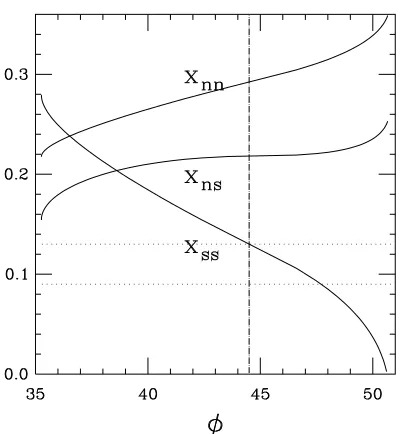
The resulting values of the mixing parameters xare shown in fig. 2 (the input value formss will be discussed later).
Theηandη′ mesons are often described in an SU(3) motivated quark basis,
namely η8 = (u¯u+dd¯−2ss¯)/
√
6,η1 = (uu¯+dd¯+ss¯)/
√
3. The mixing angle
θ in this basis (see fig. 1) would be given byφ−54.70 in a lowest order chiral perturbation theory. In order to havefK 6=fπ, one needs higher order terms in
the chiral perturbation theory treatment and then the mixing scheme becomes more complicated [2] in this basis with more than one angle needed.
In the SU(3) symmetric limit, mnn =mss =m andxnn=xns =xss =x,
so that only one mixing parameter is relevant and the mixing matrix simplifies considerably to a diagonal form with elementsm2(octet) andm2+ 3x(singlet).
Previous lattice studies [3] have used degenerate quarks, so have explored this case and have found that the mixing parameterxis of a magnitude which can explain qualitatively the observed splitting between theη andη′ mesons.
Here I describe a non-perturbative study in QCD from first principles which will be able to establish the values of the mixing parametersx, including the pattern of SU(3) breaking. This more comprehensive study would take into account the different masses of the light (u and d) quarks and the heavier s
Figure 1: The mixing illustrated in the quark model basis for flavour singlet pseudoscalar mesons.
using quarks as light as the nearly masslessuand dquarks and also it is more tractable to use an even number of degenerate quarks in the vacuum. As I shall show, despite these restrictions, a thorough study of the mixing betweenη and
η′ is possible.
I focus here on the results of lattice evaluations and I address four topics where lattice input permits us to construct a firm foundation for theη,η′mixing:
• From comparing pseudoscalar meson masses with valence quarks of two different masses (namely meson massesm11,m12 andm22), one can
esti-mate the massmssof the unmixed ¯ssmeson, given the observedmns and mnnmasses (ieK andπrespectively).
• From measuring the mixing parametersx11,x12 and x22 between initial
Figure 2: The mass mixing parametersxin GeV2versusη,η′mixing angleφin
theηnn, ηss basis. The horizontal dotted lines give the allowed range from the
lattice determination ofxss. The vertical line illustrates the preferred solution.
basis.
• For Nf = 2 degenerate flavours of quark, one can determine the
pseu-doscalar decay constants for the flavour singlet and non-singlet meson. This input allows us to discuss the relation between the observedγγ de-cay modes ofπ0,η andη′ and the underlying quark content.
• The topological susceptibility can be measured in both quenched and full QCD and shows the behaviour expected for it to be related to the flavour singlet pseudoscalar mass generation.
2
Connected and disconnected contributions
[image:4.612.153.353.199.416.2]η
η
[image:5.612.135.301.145.280.2]η
η
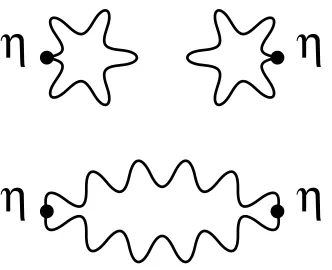
Figure 3: The disconnected (above) and connected (below) correlators for flavour singlet pseudoscalar mesons at time separationt. Here the wiggly lines represent full quark propagators.
a quark field. A suitable sum over quark flavours yields the required state (π,
η, etc). By summing over spatial positions, one can create a state with zero momentum. One then studies these pseudoscalar mesons by creating them at timet= 0 and annihilating them at timetand using the full quark propagators evaluated on the lattice to construct the correlator C(t). The basic strategy is then that at large t where excited state contributions will be negligible, this correlator behaves ase−mtwheremis the lightest mass state with the specified
quantum numbers. Hence one can determine meson masses.
A feature that occurs exclusively for flavour singlet mesons, is that there are two independent ways to link up the quarks and antiquarks between the initial and final state - as illustrated in fig. 3. Moreover, these connected and disconnected contributions can be evaluated separately on a lattice, so giving additional insight. Indeed the connected contributionC(t) is just the same for flavour singlet and non-singlet mesons. Thus the disconnected contributionD(t) is responsible for the difference between them. So, at large t one has for the flavour non-singlet correlator
C(t) =C(t)→ce−mt (3)
and for the flavour singlet correlator
C(t) =C(t) +D(t)→de−m′t
(4)
Note that this implies that at larget
D(t)
C(t) =
d ce
−(m′ −m)t
−1≈ dc −1−dc(m′−m)t+O[(m′−m)2t2] (5)
Thus a study ofD/Cgives information on the mass splitting between singlet and non-singlet. This has been explored on a lattice for mesons of all JP C
values that can be made by local quark bilinears [4]. This study finds that the only sizeable contributions toDcome for the scalar and pseudoscalar quantum numbers. This conclusion is in agreement with the experimental observation that the meson spectrum is approximately ideal (ie as in the naive quark model) except for those two quantum numbers.
For the pseudoscalar case the behaviour of D/C is such that the flavour singlet meson is heavier than the flavour non-singlet, as indeed required by experiment. Also, forNf degenerate flavours of quark, the flavour singlet mass
is given bym′ =p
m2+N
fx, in terms of the mass matrix approach described
above. This gives us access to values ofxfrom the lattice for different values of
Nf.
As well as the simple case where all quarks have the same mass and are present as sea-quarks in the vacuum, one can consider on a lattice other cases. One relevant case is with 2 flavours of sea quark (thought of as n quarks), but with mesons made out of ns¯ or ss¯ where the s quark is heavier and so not included in the sea. Here we have a partially quenched scenario since thes
quarks are not present in the sea. In this case one can show that the disconnected diagram withnnas a source andssas a sink can be expressed [5] as
Dns(t)
p
Cnn(t)Css(t)
=
√
2xnst
2√mnnmss
+O(x2t2) (6)
which allowsxns to be evaluated. Likewisexss can be evaluated.
3
Lattice results
3.1
The
s
s
¯
pseudoscalar mass
A meson made froms¯squarks is necessarily flavour singlet and so can mix with other flavour singlet operators via gluonic interactions. In order to understand the mixing between theη andη′, it is important to ask a hypothetical question:
what would be the mass of a pseudoscalar meson made ofss¯quarks but which is flavour non-singlet? This question can be addressed readily by lattice studies where the extra interactions (disconnected diagrams) associated with the flavour singlet case can be removed explicitly.
Chiral symmetry considerations lead to the expectation that the pseudoscalar meson composed of quarks of massMq has mass squaredm2which behaves
quarks for instance), one expects the meson mass to vary approximately lin-early with the quark mass. Here we are not concerned with the region of very small quark mass where chiral logs are important [2], so one can summarise this behaviour by
m2=bMq+cMq2+O(M
3
q) (7)
For a pseudoscalar meson made of two different quarks of massMnandMs, we
shall assume its mass only depends on (Mn+Ms)/2 and not on (Ms−Mn)/2
as found in lattice studies [6] and in lowest order chiral perturbation theory. If eq. 7 were valid with just the linear term in the quark mass(ie c = 0), then one directly obtains the required mass of the pseudoscalar meson composed of
squarks,m2
ss= 2m2sn−m2nn, that is 2K2−π2, leading tomss = 0.687 GeV.
This can be explored on a lattice by measuring the pseudoscalar meson mass for valence quarks in combinations 11, 22 and 12. Then, for smallc/b, one has
c
4b2 = 1 2(m
2
11+m222)−m212
(m2
22−m211)2
(8)
One can then to use dynamical configurations with sea quarks of type 1 and consider the propagation of mesons made of either quark 1 or quark 2, where quark 2 corresponds to a heavier quark.
From such lattice studies, a statistically significant curvature from thecterm is obtained. Applying this value ofcto the determination of themssmass from
theπand K masses, gives [5] a relative shift upwards due to the curvature term (c) of 1.1(3)%, corresponding to a value ofmss= 0.687 + 0.008 GeV.
3.2
Flavour-singlet mixing
The mass splitting between flavour non-singlet and singlet mesons can be mea-sured, as discussed above, using lattice evaluation of disconnected quark prop-agators. This is not an easy task: the contamination from excited states is difficult to remove and the statistical errors turn out to be relatively large. Ini-tial studies have been in the quenched approximation [3, 7, 8]. Here, although there is no flavour splitting of the masses, the mass splitting matrix elementx
can be evaluated. It is, however, preferable to be able to study the mass splitting directly and hence here I focus on results from full QCD simulations [9, 10, 5]. Some technical details of lattice simulations of disconnected correlators can be found in ref. [7].
Already in the first quenched studies [3], it was found that x increases as the quark mass is decreased. Moreover, it will be interesting to check to see if there is a factorisation of xas expected in some chiral perturbation theory descriptions [2], namelyx2
12=x11x22. Consider now the more realistic (partially
Setting the sea quark mass to strange in both quenched andNf = 2
evalu-ations leads to a consistent lattice estimate [5] ofxss in the range 0.09 to 0.13
GeV2. This value is also consistent with that reported from a study ofN
f = 2
by the CP-PACS collaboration [11] with strange quarks which gives values of
xss = 0.10 GeV2 and 0.14 GeV2 (depending on using tmin = 2, 3 in fits,
re-spectively). These lattice values are obtained at quite coarse lattice spacings and there may be some additional systematic error arising from the extrapo-lation to the continuum limit. The authors [5] have, however, chosen to use a non-perturbatively improved fermion action [12] to minimise this extrapolation error.
They are unable to determine directly the mixing strengths x for lighter quarks than strange. However, thexvalues do show a decrease with increasing quark mass and also approximate factorisation. So they assume that the value of xcontinues to increase as the quark mass is decreased below strange in a similar way to the decrease seen from twice strange (type 2) to strange (type 1) where approximate factorisation is found.
Consider now the consequence of this lattice determination of the mixing, using input massesmnn = 0.137 GeV,mss = 0.695 GeV (as discussed above)
and with x values in line with the results above, namely xss ≈ 0.12 GeV2, x2
ns≈xnnxss and, though with big errors from the extrapolation,xnn/xss≈2.
Fig. 2 shows the xvalues needed to reproduce the known η andη′ masses for
each mixing angle φ. The lattice determination ofxss is shown by the dotted
horizontal band. Keeping close to this band while satisfying the other lattice constraints is possible for the mixing illustrated by the vertical line. This has
xnn = 0.292, xns = 0.218, xss = 0.13 GeV2 which gives a description of the
observedηandη′masses while being consistent with the QCD inspired evidence
about the mixing strengths. This assignment corresponds to a mixing angleφin theηnn, ηss basis of 44.50. Note that this is almost maximal which implies that
the quark content (apart from the relative sign) of the η and η′ meson is the
same. The corresponding mixing angle in the η8, η1 basis (modulo comments
above) is a value ofθ of−10.20.
3.3
Flavour-singlet decay constants
One contribution to the decays ofπ0, η andη′ to γγ is via the quark triangle
diagram. The quark model gives a decay proportional toQ2
i for the contribution
from a quark of charge Qi. Thus for theπ0 meson and the flavour-singlet nn
and ssmesons, the quark charge contributions to the decay amplitudes would be in the ratio 1 : 5/3 :√2/3. The experimental [13] reduced decay amplitudes for π0, η, andη′ are in the ratio 1.0 : 1.00(10) : 1.27(7). This information can
This suggests a mixing angle of θ≈ −200is preferred [2, 13].
For the flavour non-singlet mesons we have
h0|Aµ|πi=f
πqµ (9)
where the axial current is the local quark bilinear. From evaluating this ex-pression on a lattice, the pion decay constant can be determined, after taking account of the differences between lattice and continuum regularisation schemes. MoreoverfK can be evaluated too and one finds thatf increases with
increas-ing quark mass, just as known from experiment. This increase is evidence for a contribution from beyond the lowest order in chiral perturbation theory.
For theη andη′, however, the flavour singlet combination will have gluonic
contributions from the anomaly since
∂µAµ= 2m
qP+ 2NfQ (10)
forNf quarks of massmq, whereP is the local bilinear representing the
pseu-doscalar current andQis known as the topological charge density and is given in terms of the gluonic field by Q=g2ǫ
µνρσFµνFρσ/(32π2). This identity
un-derlines the inevitability of gluonic contributions to the flavour singlet meson interactions. Thus for the flavour singlet (here labelled η′) defining a decay
constant by
h0|Aµ|η′i=f
η′qµ (11)
is less satisfactory sincefη′ will be scale dependent because of the gluonic
con-tributions from the axial anomaly: namely there will be non-zero amplitudes
h0|Q|η′i (12)
I now address the issue of determining these decay constants directly from QCD using lattice methods. The study uses 2 flavours of degenerate quark and one defines the decay constants by eq. 9, 11. For the isospin 1 state (π- like), this is on a firm footing because of the axial ward identity hence fπ will be
scale invariant. For the flavour singlet pseudoscalar meson, here called η′, the
decay constant defined as in eq. 11 will not be scale invariant because of gluonic contributions arising from the anomaly [2] as discussed above. In an exploratory lattice study [5] the decay constants are obtained with lattice regularisation and one can compare the singlet and non-singlet values.
These decay constants can be thought of as giving the quark wave function at the origin of the pseudoscalar meson. In principle it would be possible to explore also the local gluonic contributions to the flavour-singlet mesons (eq. 12) but it will be difficult to relate lattice regulated results to the continuum and this has not been attempted.
obtained from lattices with Nf = 2 flavours of degenerate sea quark. In this
case there is no need for mixing angles to describe the spectrum (which will have one isoscalar and one isovector neutral particle). As a first crosscheck, one finds that lattice studies correctly give a flavour non-singlet decay constant that increases with quark mass in reasonable agreement with experiment [13] assuming a steady increase from fnn= 131 MeV andfns= 160 MeV tofss.
For the flavour singlet case, the determinations of f have relatively large statistical errors and the systematic error from changing the type of fit is also comparable. For the case withNf = 2 degenerate quarks, the comparison of the
flavour singlet and non-singlet shows that the singlet decay constants appear to be somewhat larger, though the errors are too big to substantiate this.
Combining the mass dependence one finds in the flavour non-singlet sector with the near equality of singlet and non-singlet decay constants, we can deduce properties of the physical case with three light quarks. Thus, in terms of the traditional treatment [13], we would expect fη/fπ > 1 and fη′/fπ > 1. One
way to minimise the effects of mixing is to consider X = (a2
η+a2η′)/a
2
π where a refers to the reduced decay amplitude. Using the conventional formulae for the decay amplitudes would then give a value ofX = 3r2 (whereris a suitably
weighted average of fη/fπ and fη′/fπ which are both greater than 1). Thus
the traditional treatment gives X > 3 which is significantly larger than the experimental value [13] of 2.64(24). Thus it appears unlikely that the traditional treatment (with the decay toγγ being given by the analogue of the formula for pions) is correct for any mixing angle.
I conclude that there is no support for the traditional assumption that the singlet decays are given by a similar expression to the non-singlet. As has been pointed out by many authors [2], this is plausible for at least two reasons: (i) the
ηandη′mesons are heavier and therefore less likely to dominate the axial current
or, equivalently, higher order corrections to chiral perturbation theory will be more important (ii) the flavour-singlet axial anomaly has a gluonic component which will give additional contributions to any hadronic process.
3.4
Where does the
η
′mass come from?
The lattice studies show that the gluonic contributions that build up the discon-nected correlators are such as to reproduce the experimentalη and η′ masses.
This is of course as it should be - QCD is expected to be accurate for these phenomena - and it is the lattice methodology that is being tested.
One can now ask why these OZI-rule violating gluonic interactions are sub-stantial for pseudoscalar mesons but small for most other cases (scalar mesons excluded).
option is indeed appropriate for a discussion of the OZI violating effects for scalar mesons.
For the pseudoscalar case, the presence of vacuum fluctuations with those quantum numbers is the candidate. These are commonly called topological charge density fluctuations and they are necessary since the anomaly implies that ǫµνρσFµνFρσ is coupled to currents with pseudoscalar quantum numbers.
It must be emphasised that these contributions do not need to have anything to do with isolated instantons.
This relationship between fluctuations in topological charge density and the singlet mass generation can be made semi-quantitative via the Witten-Veneziano formula:
m2η′ =
2Nf f2
π
χ (13)
where χ = R
d4x < Q(x)Q(0) > is the topological susceptibility in the pure
gauge (Yang-Mills or quenched) theory (here η′ is to be interpreted as the
flavour singlet component in the chiral limit). The derivation of this relationship (see ref [16] for a recent discussion) involves studying correlations of topologi-cal charge density assuming that u =Nf/Nc can be varied. Then theu = 0
limit (where a massless contribution is present in the flavour-singlet channel in the quenched chiral limit) can be related to full QCD at u6= 0 where there is no such massless flavour-singlet particle, hence the topological susceptibility is zero in the chiral limit. The relationship follows from assuming that the light-est flavour singlet pseudoscalar meson dominates the behaviour of topological charge correlations in this region of smalluand near the chiral limit.
Lattice techniques can be used to evaluate the quenched topological suscepti-bility and the value obtained is consistent [7, 8] with this relationship. Evidence is also mounting [17, 19, 18] that χ does vanish in full QCD as the sea quark mass goes to zero, as implied in the above discussion.
On a lattice one can investigate whether these topological charge density fluctuations arise from instantons or not, the latter being the expectation at largeNc. The Witten-Veneziano formula is a largeNc result and does seem to
be qualitatively satisfied, which is some evidence to suggest that the physical case with Nc = 3 may be qualitatively similar to the large Nc world. The
nature of the topological charge density on the lattice can be revealed by low lying eigenmodes of the fermion operator, see ref. [20], and this suggests that some elements of an instanton description are indeed present. Varying Nc in
this study does suggest that at larger Nc (e.g. 4) the instanton features are
4
Conclusion
Flavour singlet mesons can, in principle, be easily studied on a lattice. In prac-tice, lattice studies have been hampered by two constraints. One is that the disconnected quark diagrams needed for a study of singlet mesons are intrinsi-cally noisy. Much larger data sets (tens of thousands of gauge configurations) will be needed to increase precision. Another constraint is that one is unable to work with sea quarks substantially lighter than strange. Also it has not yet been possible to attempt a continuum limit extrapolation of the lattice results, although a lattice formalism that should improve this extrapolation was used.
A lattice study of the disconnected diagrams that cause flavour-singlet mesons to differ from non-singlet mesons shows that these OZI-rule violating effects are only large for pseudoscalar and scalar mesons. Here we discuss the structure of the mixing in the singlet pseudoscalar mesons.
From the careful perturbative study of mass formulae for flavour non-singlet pseudoscalar mesons made of different quarks, one deduces that the ss
state lies at 695 MeV. One then determines the pattern of mixing for the flavour singlet sector, obtaining xss ≈ 0.12 GeV2, xnn/xss ≈ 2 and x2ns ≈ xnnxss.
These conditions are indeed consistent and point to a mixing close to maximal (φ= 45±20) in the nn, ss basis (this corresponds to a conventional (η
8, η1)
mixingθ of−10±20).
It is now possible to explore the decay constants which give the coupling to a local quark antiquark pair for singlet pseudoscalar mesons from the lattice. The results show similar decay constants for singlet and non-singlet states of the same mass but with quite large errors. This, combined with experimental data, suggests that the traditional description ofγγ decays is inadequate. There will indeed be gluonic contributions to singlet meson decays and these have not yet been explored in detail from the lattice.
Lattice studies confirm the qualitative relationship between the pseudoscalar singlet mass and the topological charge density fluctuations.
Since lattice techniques give a reasonable description of the flavour singlet pseudoscalar mesons, it will be feasible to use such techniques to study hadronic decays involving ηandη′.
5
Acknowledgements
I thank Craig McNeile for many useful discussions and contributions.
References
[1] UKQCD Collaboration; Irving A. C.el al.Phys. Lett. B (in press).,
[2] Leutwyler H., Nucl. Phys. Proc. Suppl. 64, 223 (1998); Kaiser R. and Leutwyler H., hep-ph/9806336; Feldmann T.et al., Phys. Rev.D58, 114006 (1998) and Phys. Lett. B449, 339 (1999). For a review see Feldmann T., Int. J. Mod. Phys.A15, 159 (2000), hep-ph/9907491.
[3] Kuramashi Y.et al., Phys. Rev. Lett.72, 3348 (1994).
[4] UKQCD Collaboration; McNeile C., Michael C. and Sharkey K. J., Phys. Rev. D (in press), hep-lat/0107003.
[5] UKQCD Collaboration; McNeile C. and Michael C., Phys. Lett.B491, 123 (2000), hep-lat/0006020.
[6] UKQCD Collaboration, Allton C. R.et al., Phys. Rev.D49, 474 (1994).
[7] G¨usken S., ”Numerical challenges in lattice quantum chromodynamics” (Wuppertal 1999), p. 115; hep-lat/9906034.
[8] Bardeen W.et al., Nucl. Phys. B (Proc. Suppl.)73(1999) 243;ibid83-84, 215 (2000); Phys. Rev.D62, 114505 (2000)
[9] Michael C., Foster M. and McNeile M. (UKQCD Collaboration), Nucl. Phys. B (Proc. Suppl.)83-84, 185 (2000), hep-lat/9909036.
[10] SESAM-TχL Collaboration, Struckmann T.et al., hep-lat/0006012.
[11] CP-PACS Collaboration, Ali-Khan A. et al., Nucl. Phys. B (Proc. Suppl.)
83, 162 (2000), hep-lat/9909045.
[12] UKQCD Collaboration, Allton C. R.et al., Phys. Rev.D60, 034507 (1999).
[13] Partice Data Group, Caso C.et al., Euro. Phys. Jour.C3, 1 (1998).
[14] UKQCD Collaboration, Bali G.et al., Phys. Lett.B309, 378 (1993).
[15] Huntley A. et al., Nucl. Phys. B286, 211 (1987); Campbell N. A. et al.,
Phys. Lett. B167, 91 (1986).
[16] Giusti L.et al., hep-lat/0108099.
[17] D¨urr, S., Proc. QCD@Work: International Conference on QCD: Theory and Experiment, Martina Franca, Italy, 16-20 Jun 2001; hep-lat/0108015.
[18] Kovacs, T. G. hep-lat/0111021.
[19] UKQCD Collaboration, Allton C. R. et al., Phys. Rev. D (in press),
hep-lat/0107021.