string solutions
Thesis submitted in accordance with the requirements of the University of Liverpool for the degree of Doctor in Philosophy
by Paul Dempster
Abstract
We consider various geometrical and physical aspects of the supergravityq-maps, which
are induced by dimensional reduction to three dimensions of five-dimensional N = 2
supergravity theories coupled to vector multiplets. In this way, the q-maps can be
thought of as a composition of ther-maps andc-maps. We treat in parallel the case of
reduction over two space-like directions and over one space-like and one time-like
direc-tion. We observe that in the latter case, surprisingly, the order in which the time-like
and space-like reductions are performed is relevant for some geometrical properties of
the resulting reduced theories. For the simplest example of pure supergravity in five
di-mensions, we show indeed that the target manifolds obtained from the two reductions
correspond to inequivalent open submanifolds in the pseudo-Riemannian symmetric
space G2(2)/(SL2 ·SL2). Moreover, each submanifold is endowed with a different in-tegrable structure which makes one a complex manifold and the other a para-complex
manifold.
As an application we investigate how the q-map can be used to generate new
non-extremal and non-extremal non-BPS static black string solutions in five dimensions. We
also make progress towards constructing new stationary solutions. The generic nature
of these constructions, which don’t rely on the target manifolds being symmetric spaces,
allow us to gain a more systematic understanding of various properties of black objects
in supergravity.
Declaration
I hereby declare that all work described in this thesis is the result of my own research
unless reference to others is given. None of this material has previously been submitted
to this or any other university. All work was carried out in the Theoretical Physics
Division of the Department of Mathematical Sciences, University of Liverpool, UK,
during the period of October 2010 until April 2014.
Publication list
This thesis contains material that has appeared in the following publications by the
author:
(1) P. Dempster and T. Mohaupt,“Non-extremal and non-BPS extremal five-dimensional
black strings from generalized special real geometry,” Class. Quant. Grav.31(2014)
045019 [arXiv:1310.5056].
(2) V. Cort´es, P. Dempster and T. Mohaupt,“Time-like reductions of five-dimensional
supergravity,” JHEP04 (2014) 190 [arXiv:1401.5672].
Unpublished material will also be presented, some of which is scheduled to appear in
the following publications:
(3) V. Cort´es, P. Dempster, T. Mohaupt and O. Vaughan, “Special geometry of
Eu-clidean supersymmetry IV: the local c-map,” to appear.
(4) V. Cort´es, P. Dempster and T. Mohaupt,“Time-like reductions of five-dimensional
supergravity with vector multiplets,” to appear.
There are also two publications by the author, completed during the period of the
degree, that will not be presented in this thesis:
(5) P. Dempster and M. Tsulaia, “On the structure of quartic vertices for massless
higher spin fields on Minkowski background,” Nucl. Phys. B865 (2012) 353-375
[arXiv:1203.5597].
(6) I. L. Buchbinder, P. Dempster and M. Tsulaia,“Massive higher spin fields coupled
to a scalar: aspects of interaction and causality,” Nucl. Phys.B877(2013) 260-289
Contents
1 Introduction 1
2 Preliminary mathematics 9
2.1 Differential geometry . . . 9
2.1.1 Basics of differential geometry . . . 10
2.1.2 Connections on the tangent bundle . . . 10
2.1.3 Pseudo-Riemannian geometry . . . 15
2.1.4 Special real geometry . . . 20
2.2 (Para-)Complex differential geometry . . . 24
2.2.1 Almost -complex structure . . . 25
2.2.2 Integrability of an almost complex structure . . . 25
2.2.3 Integrability of an almost para-complex structure . . . 28
2.2.4 Almost -hermitian and -K¨ahler manifolds . . . 29
2.2.5 Special -K¨ahler manifolds . . . 29
2.3 (Para-)Quaternionic-K¨ahler and hyperk¨ahler geometry . . . 33
2.3.1 Preliminaries . . . 34
2.3.2 Hyperk¨ahler manifolds . . . 36
2.3.3 Quaternionic-K¨ahler manifolds . . . 37
2.3.4 Para-quaternionic-K¨ahler manifolds . . . 42
2.4 Lie algebras . . . 44
2.4.1 Preliminaries . . . 44
2.4.2 Real forms of Lie algebras . . . 48
2.4.3 Root spaces . . . 50
2.4.4 The Iwasawa decomposition for Lie algebras . . . 53
3 Preliminary physics 55 3.1 Black objects in supergravity theories . . . 55
3.1.1 From strings to supergravity . . . 56
3.1.2 Black p-branes . . . 58
3.1.3 Properties of the solutions . . . 60
3.1.4 Field configurations . . . 60
3.1.5 Non-linear sigma models . . . 61
3.1.6 Totally geodesic submanifolds . . . 62
3.2 The five-dimensional theory . . . 64
3.2.1 The field content . . . 64
3.2.2 The five-dimensional action . . . 66
3.3 The four-dimensional theory . . . 67
3.3.1 The field content . . . 67
3.3.2 The four-dimensional action . . . 69
3.4 The hypermultiplet sector . . . 70
3.5 Dimensional reduction . . . 71
3.5.1 Kaluza-Klein dimensional reduction . . . 71
3.5.2 Dimensional reduction . . . 72
3.5.3 Reduction of five-dimensional supergravity . . . 76
3.5.4 Reduction of four-dimensional supergravity . . . 78
3.6 r-maps andc-maps . . . 80
3.6.1 The supergravity r-maps . . . 81
3.6.2 The supergravity c-maps . . . 83
4 The supergravity q-maps 86 4.1 The q-maps from dimensional reduction . . . 87
4.2 The group manifold . . . 90
4.2.1 Isometries generated by r-maps . . . 93
4.2.3 Isometries generated by the q-map . . . 96
4.3 Time-space vs. Space-time reductions . . . 102
4.3.1 The (t, ψ) flip . . . 104
4.3.2 The hidden symmetry . . . 106
4.4 Geometrical data onG . . . 108
5 Time-like reductions of pure supergravity 111 5.1 Dimensional reduction of pure five-dimensional supergravity . . . 112
5.2 Aspects of G2(2)and its subgroups . . . 116
5.2.1 Description of the Lie algebra of G2(2) . . . 116
5.2.2 The solvable Iwasawa subgroup L⊂G . . . 117
5.2.3 The symmetric spaceS =G2(2)/(SL2·SL2) . . . 118
5.2.4 Open orbits in the symmetric space . . . 120
5.3 Automorphisms of the solvable algebra . . . 121
5.4 Identifying the open orbits corresponding to ST and TS reductions . . . 124
5.4.1 An open orbit corresponding to Time-Space reduction . . . 124
5.4.2 An open orbit corresponding to Space-Time reduction . . . 126
5.4.3 Disjoint open L-orbits onS . . . 129
5.5 Geometric structures on the Iwasawa subgroup . . . 129
6 Five-dimensional black string solutions 133 6.1 The ans¨atze . . . 134
6.2 The three-dimensional action . . . 135
6.3 The three-dimensional Einstein equations . . . 137
6.4 The three-dimensional scalars . . . 139
6.4.1 Determining ξ . . . 140
6.4.2 Determining ˜ζi . . . 141
6.4.3 Determining wi . . . 142
6.5 Five-dimensional solutions . . . 143
6.5.1 Non-extremal black strings . . . 144
6.5.3 The remaining conditions . . . 146
6.5.4 Extremal black strings . . . 149
6.5.5 The geometry of extremal solutions . . . 151
6.6 Four-dimensional solutions . . . 153
7 Stationary five-dimensional black objects 155 7.1 Consistent truncations . . . 156
7.2 Electric truncation I . . . 157
7.2.1 Equations of motion . . . 158
7.2.2 Extremal BPS and non-BPS solutions . . . 159
7.3 Electric truncation II . . . 161
7.3.1 Relating the electric truncations . . . 163
7.4 Magnetic truncation . . . 163
7.4.1 Equations of motion . . . 166
7.4.2 Extremal BPS and non-BPS solutions . . . 166
7.4.3 Non-extremal solutions . . . 167
7.4.4 Four-dimensional solutions . . . 172
Introduction
String theory has long been considered the most likely candidate to provide a consistent
theory of quantum gravity. Since the “second superstring revolution” we have been able
to go beyond string perturbation theory and understand many of the non-perturbative
aspects of string theories, both through various dualities and through the emergence
of the eleven-dimensional theory known as M-theory [1–4]. An important tool in this
regard is provided by supergravity theories, which arise naturally as low-energy effective
theories of string and M-theory.
By considering strings propagating in backgrounds which involve different compact
manifolds, the number of supercharges, as well as the matter content, admitted by the
effective supergravity theories can be varied. An important aspect of such
supergrav-ity theories, which we will make use of throughout this thesis, is the fact that they
come equipped with two types of geometry: spacetime geometry and the geometry of
the scalar target manifold. For theories with 16 or more supercharges (N ≥4 in four
dimensions), the geometry of the scalar manifold is completely fixed once the matter
content of the theory is specified. On the other hand, for theories with 8 or 4
super-charges (N = 2 or N = 1 in four dimensions) the matter content does not completely
fix the scalar geometry, and so such theories can possess a much richer structure.
Whilst the scalar manifolds of N = 1 theories in four dimensions are only required
to be K¨ahler [5], those of the N = 2 theories (which we will concentrate on in this
thesis) must satisfy more restrictive conditions, and are controlled by the properties
of special geometry. As well as being interesting for purely mathematical reasons [6,
7], such geometry plays an important role in the understanding of non-perturbative
aspects of gauge theories [8, 9], string compactifications [10, 11], and the microscopic
understanding of black hole physics [12–15]. More recently, special geometry has been
used to construct new solutions toN = 8 supergravity [16,17], as well as to obtain new
asymptotically-AdS solutions in gauged supergravities [18–20] with applications to the
AdS/CFT correspondence.
We now present an introduction to the main results in this thesis:
The r-map, c-map and q-map
For the N = 2 supergravity theories in which we will be interested in this thesis one
can understand the effect of both space-like and time-like dimensional reduction via
a series of maps between the target manifolds of such theories: the r-maps [21, 22],
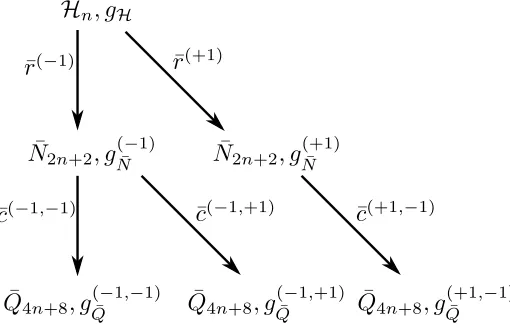
c-maps [23, 24] andq-maps. This latter can be understood as the compositionq=c◦r
of an r-map and a c-map. These maps provide us with important tools both in a
mathematical and physical context, and remain an active area of research.
Mathematically the r-map, c-map, and by extension the q-map, all preserve
com-pleteness [25]. Therefore, by classifying complete projective special real manifolds,
a project initiated in [26], one can obtain large classes of complete, and generically
non-homogeneous, quaternionic-K¨ahler manifolds.
Physically, each of these maps can be understood as a relation between the target
manifolds of two rigid or locally supersymmetric field theories. In this thesis we will be
interested in taking as our starting point a five-dimensional N = 2 theory ofn vector
multiplets.
In the case of rigid supersymmetry, the target manifold of this theory is an affine
special real manifoldMn. By space-like reduction, we obtain a four-dimensional theory
of n vector multiplets, with target space an affine special K¨ahler manifold. A further
space-like reduction gives a three-dimensional theory, for which the degrees of freedom
Q4n [27]. This provides us with maps
Mn r
−→N2n c
−→Q4n.
If instead one reduces over a time-like direction, then the target manifolds of the
re-sulting Euclidean theories are equipped with a split-signature metric, and can be
de-scribed using para-complex geometry [28, 29]. Indeed, time-like reduction of the
five-dimensional theory gives rise to a target space which is affine special para-K¨ahler [28].
Likewise, both time-like reduction of the four-dimensional Minkowski theory and
space-like reduction of the four-dimensional Euclidean theory give rise to target spaces which
are para-hyperk¨ahler [29].
In the case of local supersymmetry, the target manifold of the five-dimensional
N = 2 supergravity theory with n vector multiplets is a projective special real
mani-fold ¯Mn [30]. By space-like reduction we obtain a four-dimensional theory of (n+ 1)
vector multiplets, the extra degrees of freedom compared to the rigid case coming from
the reduction of the gravity multiplet. The relevant target manifold is a projective
spe-cial K¨ahler manifold ¯N2n+2. A further space-like reduction gives a three-dimensional supergravity theory, for which the degrees of freedom can this time be packaged into
(n+ 2) hypermultiplets, with target space a quaternionic-K¨ahler manifold ¯Q4n+8 [24], as required by supersymmetry [31]. This provides us with maps
¯
Mn
¯
r
−→N¯2n+2 ¯
c
−→Q¯4n+8.
If instead one reduces over a time-like direction, then the target manifolds of the
result-ing Euclidean-signature supergravity theories are again equipped with split-signature
metrics, and can be described using para-complex geometry. Time-like reduction of
the five-dimensional theory gives rise to a target space which is projective special
para-K¨ahler [32].
The study of the time-like versions of the c-map has only been undertaken fairly
recently, in work by the author and collaborators [33, 34]. Here it is shown that both
of the four-dimensional Euclidean theory give rise to a three-dimensional Eulclidean
theory whose target manifold is para-quaternionic-K¨ahler.
In Chapter 4 we analyse in detail the structure of those (para-)quaternionic-K¨ahler
manifolds which are in the image of one of theq-maps.
Commutativity of space-like and time-like reductions
A central theme throughout this thesis is the use of time-like dimensional reduction as a
solution-generating technique. In particular, instanton solutions to the
dimensionally-reduced Euclidean theories can be dimensionally lifted to provide us with stationary
solitonic solutions, e.g. black holes, to our original supergravity theories [35]. Such
solutions play a crucial role as testing ground for various conjectures in string theory
and other theories of quantum gravity [1].
The structure of Euclidean supergravity theories is much less well understood than
Minkowski-signature ones, and they often present us with surprising features. For
example, in [36] it was shown that time-like reductions of IIA and IIB supergravities
give rise to two inequivalent (i.e. not related by a real field redefinition) nine-dimensional
Euclidean supergravities. This is in contrast to the case of space-like reduction, where
the two nine-dimensional Minkowski theories are related by real field redefinitions:
an artefact of T-duality. One of the primary motivations for this thesis is to better
understand the structure of Euclidean-signature field theories (both with rigid and
local supersymmetry), continuing the work of [28, 29, 32].
An important question that arises in the study of Euclidean supergravity theories
obtained from both space-like and time-like reductions is whether the order of the
reduction matters. In [36] it was argued that, for the case where the scalar manifold
of the Euclidean theory is a homogeneous (coset) space, this order does not matter.
However, their argument rested on being able to parametrise the scalar coset manifold
using the Borel gauge, which for the cosets appearing in Euclidean supergravity theories
(which have non-compact stability group [35]) does not provide aglobal parametrisation
of the manifold.
super-gravity coupled to an arbitrary number of vector multiplets. Upon reduction to a
three-dimensional Euclidean theory, the scalar target manifolds are generically
non-homogeneous. However, one can use properties of the special geometry underlying
these theories to get a handle on the admissible geometric structures which are present
for all such spaces.
A surprising result of this thesis, which has been presented in a publication by the
author [37], is that, even for the simplest case of pure five-dimensional supergravity,
some of these geometric structures are sensitive to the order in which the space-like
and time-like reductions occur. Note that this is in contrast to the situation for rigid
supersymmetry, where it was shown in [29] that the three-dimensional Euclidean
the-ories obtained by time-then-space (TS) and space-then-time (ST) reductions could be
related by a real field redefinition.
In Chapter 5 we show the two scalar manifolds obtained from TS and ST reduction
of the five-dimensional pure supergravity theory can be distinguished by the existence
of different integrable structures on each. Indeed, for TS reduction, the scalar manifold
comes equipped with an integrable para-complex structure, whilst for ST reduction
we find an integrable complex structure. This fact is generic for all target manifolds
obtained after dimensional reduction of the five-dimensional N = 2 theories to three
Euclidean dimensions, and so this non-commutativity of time-like and space-like
reduc-tions is expected to carry over to the general five-dimensional theory with an arbitrary
number of vector multiplets. This will be analysed further in a future publication by
the author [38].
Black string solutions
In four dimensions, no-go theorems [39] forbid the existence of extended black objects
in general relativity with horizon topology different to S2, which is the case for black holes.
However, higher dimensions are less restrictive, and one can construct solutions
with more exotic horizon topology, see e.g. [40]. The general class of such solutions
symmetry in some spacetime directions. Such solutions are of particular interest in the
context of string theory.
Such black objects come in two main classes: extremal and non-extremal. These are
distinguished thermodynamically by the fact that extremal black objects have vanishing
horizon temperature. In theories of extended supergravity, extremal objects can be
further separated into BPS and non-BPS. The BPS objects are characterised by the
preservation of some degree of the supersymmetry of their parent theory, and saturate
the Bogomolnyi bound relating their mass to the central charge of the underlying
supersymmetry algebra.
The advantage of studying BPS solutions is that they can be obtained and classified
using the so-called Killing spinor equations [41]. These are a set of first-order
differ-ential equations, and are therefore generally easier to solve than the full second-order
field equations. Such objects are by now well understood, both at a macroscopic and
microscopic level. Constructing non-BPS and non-extremal solutions is significantly
more involved, since these do not satisfy the Killing spinor equations, and as such there
is still a lot to discover.
In this thesis we will concentrate on the case of stationary black strings (1-branes)
in five dimensions. These possess translational symmetry in both a time-like and
space-like direction, which constitute the worldvolume directions of the string. By
dimension-ally reducing over these isometric directions we obtain a three-dimensional
Euclidean-signature supergravity theory, to which we can find instanton solutions. These can then
be lifted back to five dimensions, and to the sought-after black string solutions. This
procedure is generally known as ‘diagonal’ dimensional reduction and oxidation [42].
This dimensional reduction provides us with the link between the spacetime
geome-try and the target space geomegeome-try. In particular, reduction from five to three dimensions
implements the q-map at the level of the target space. All of the five-dimensional
de-grees of freedom then parametrise the para-quaternionic-K¨ahler manifold in the image
of the q-map. In fact, for the static extremal black strings we will meet in Chapter
6, the truncation of certain five-dimensional fields means that we are restricted to a
Our method for constructing instanton solutions to the three-dimensional Euclidean
theory follows the philosophy of [43], and can be interpreted from the point-of-view of
the target space geometry in the following manner. Single-centred extremal BPS black
strings correspond to null geodesic curves contained within the eigendistributions of
the integrable para-complex structure, whilst non-BPS black strings correspond to null
geodesic curvesnot contained within these eigendistributions. Indeed, we can use such
a geometrical characterisation of extremal solutions whenever the underlying target
manifold admits an integrable para-complex structure. In Chapter 7 we utilise this
fact to construct new BPS and non-BPS stationary solutions for which we relax the
condition of staticity.
The construction of non-extremal solutions is less formulaic. Since non-extremal
black objects are non-BPS, we are unable to use Killing spinor equations. However,
various methods have been used to construct non-extremal black holes and black branes,
which often involve reducing the equations of motion to first-order [44–46].
In Chapter 6, we extend the formalism of [47, 48] and construct non-extremal
solu-tions directly at the level of the equasolu-tions of motion. We first impose that the solusolu-tions
be spherically symmetric in the three-dimensional space transverse to the string. We
are then able to integrate the second-order equations of motion directly and obtain a
general solution, before finding conditions on the integration constants which ensure
that the five-dimensional solutions correspond to physical black strings with finite scalar
fields. These solutions have appeared previously in a publication by the author [49].
This formalism can also be extended to more general non-extremal stationary
solu-tions, and we make progress in this direction in Chapter 7.
Outline
This thesis is organised as follows: in Chapters 2 and 3 we introduce the main
math-ematical and physical background needed to understand the bulk of this thesis. In
Chapter 4 we analyse the supergravity q-maps for the case of an arbitrary number
of vector multiplets coupled to supergravity, and motivate the question of ST vs. TS
five dimensions, and show that dimensional reduction over one space-like and one
time-like direction provides us with two inequivalent open submanifolds of the symmetric
space G2(2)/(SL2·SL2). In Chapters 6 and 7 we then turn to spacetime geometry. In Chapter 6 we construct new non-extremal and extremal non-BPS static black string
solutions to five-dimensional supergravity with vector multiplets. Then, in Chapter 7,
we relax the condition of staticity and construct more general stationary solutions. We
finish in Chapter 8 with conclusions and ideas for future work.
Notation and conventions
Preliminary mathematics
In this chapter we introduce the various mathematical ideas which will be important
throughout this thesis. We begin by simply requiring the existence of a differentiable
manifold, and add further structure (metric, complex structure, quaternionic structure,
etc.) to this as we go.
We begin in Section 2.1 with an overview of differential geometry, introducing the
elementary material upon which the rest of the chapter builds and working up to
special real geometry, which will play an important role in this thesis. In Section 2.2
we introduce the dual notions of complex and para-complex differential geometry, with
the aim of describing projective special (para-)K¨ahler manifolds, before moving on to
discuss (para-)quaternionic-K¨ahler manifolds in Section 2.3. Finally, in Section 2.4, we
turn to the subject of Lie algebras, presenting a number of key results which will be of
use in Chapter 5.
2.1
Differential geometry
In this section we introduce a number of fundamental concepts in differential geometry,
with the aim of familiarising the reader with the tools needed to approach the bulk of
this thesis. We do not claim to give a completely rigorous account of the material, and
refer liberally throughout to the relevant source material for further information.
After some basics, we define in Section 2.1.2 the notion of an (affine) connection
on a differentiable manifold , and use this to discuss geodesy, holonomy and curvature.
We then equip our manifold with a pseudo-Riemannian metric in Section 2.1.3 and
use this to discuss the Levi-Civita connection, orthonomal frames, pseudo-Riemannian
symmetric spaces, and finish with Berger’s theorem on Riemannian holonomy. We end
with Section 2.1.4 on the subject of special real geometry, which contains many of the
results we will use throughout this thesis.
2.1.1 Basics of differential geometry
Throughout this section we takeM to be some arbitrary m-dimensional differentiable
manifold. We denote by Γ(T M) the set of smooth vector fields on M, i.e. the set of
sections of the tangent bundleT M, and by F(M) the set of smooth functions onM.
Integral curves
Let X ∈ Γ(T M) be some smooth vector field. Then we define an integral curve
generated byX to be a function
γ : [a, b]→M,
parametrized by t ∈ [a, b] such that the tangent to the curve at a point γ(t) ∈ M is
Xγ(t), i.e. the value of the vector field at that point.
In particular, take some local coordinate patch U ⊂M on which we choose a set of
local coordinates{xµ}. Then the integral curve is defined by the property
dxµ dt =X
µ(x(t)). (2.1)
2.1.2 Connections on the tangent bundle
We now introduce the notion of an affine connection on a differentiable manifold M.
Affine connections
We define anaffine connection ∇via the map
∇: Γ(T M)×Γ(T M) → Γ(T M)
(X, Y) 7→ ∇XY. (2.2)
In order to be a connection, ∇ must satisfy some properties, namely linearity in its
first argument and the Leibniz identity in its second, viz.
∇f X+gYZ =f∇XY +g∇YZ,
for any X, Y, Z ∈Γ(T M) and f, g∈F(M) some smooth functions on M, and
∇X(f Y) =X(f)Y +f∇XY,
for any X, Y ∈Γ(T M) and f ∈F(M).
Another way of formulating this is via the language of derivations. In particular,
we choose some smooth vector fieldX ∈Γ(T M). Then define a linear map
∇X : Γ(T M)→Γ(T M),
which acts as a derivation on the module of smooth vector fields Γ(T M) over the ring
of smooth functions F(M). In this context, saying that ∇X acts as a derivation just
tells us that it is linear∇X(Y +Z) =∇XY +∇XZ and satisfies the Leibniz property
as before.
Affine connection in a coordinate basis
Suppose we now choose some coordinate basis forT M, soX =Xµ∂µ. Then
∇XY = Xµ∇µ(Yλ∂λ)
= Xµ
h
∂µYλ+ ΓλµνYν
i
∂λ,
where we have used both linearity (first line) and the Leibniz property (second line) of
the connection. Theconnection coefficientsare defined via.
∇µ∂ν =: Γλµν∂λ,
i.e. they are the components of the vector field∇µ∂ν in the coordinate basis.
The affine connection on functions
We extend the action of the affine connection ∇X to the space of smooth functions F(M) onM by
∇Xf =X(f) =£Xf,
where£Xf is the Lie derivative off along the curveX. In a coordinate basisX =Xµ∂µ
we have
X(f) =Xµ ∂f ∂xµ,
which is just the usual directional derivative off along the vector field X.
The affine connection on tensor fields
We can further extend the definition of ∇X to arbitrary rank tensor fields by simply
requiring it to act as a derivation on the algebra of tensor fields D(M) over R. In
particular, we want it to preserve tensor-type (i.e. map tensors of rank (r, s) to tensors
of rank (r, s)), to commute with contractions, and to satisfy
∇X(T1⊗T2) = (∇XT1)⊗T2+T1⊗(∇XT2). (2.3)
As a quick example, we compute the action of∇X on a smooth 1-formω∈Γ(T∗M). Take some vector field Y ∈ Γ(T M). Then on the one hand the definition of ∇X on F(M) tells us that we should have
On the other hand, the property (2.3) tells us that
∇X(ω(Y)) = (∇Xω)(Y) +ω(∇XY),
i.e. the connection acts first on one argument then the other. Putting this together we
find the action of ∇X on cotangent vector fields to be
(∇Xω)(Y) =X(ω(Y))−ω(∇XY). (2.4)
Parallel transport and geodesics
Choose some smooth vector field V ∈ Γ(T M), and consider the integral curve c(t)
generated byV.
Definition 1. We say that a vector fieldX ∈Γ(T M) isparallel transportedalong
a curve c(t) if
∇VX= 0.
Using this, we define the notion of a geodesic curve γ(t) as an integral curve
generated by a vector fieldV ∈Γ(T M) which satisfies
∇VV = 0,
at least up to some reparametrization of the curve.
Given a point p ∈ M, we can define the notion of a geodesic symmetry as a
mapsp :M →M which fixespand reverses geodesics throughp, i.e.sp(γ(t)) =γ(−t).
In other words sp(p) = p and (sp)∗ = −1TpM, where (sp)∗ : TpM → TpM is the
differentialofsatp. Note that the mapsp need only be defined in a neighbourhood
of p. Geodesic symmetries will be important later when we talk about symmetric
spaces.
Holonomy
Given a connection ∇ on M, we can use the notion of parallel transport to define a
In particular, takep∈M and consider the set of all closed loops inM based at p:
Cp(M) ={γ : [0,1]→M|γ(0) =γ(1) =p}.
Now, take a vectorX∈TpM and parallel transport it around some loopc(t)∈Cp(M).
The result will be a new vectorXc∈TpM. Hence, to each loop we can associate a map
Pc:TpM →TpM which takes X7→Xc.
The set of all such transformations, obtained by considering all possible loops in
Cp(M), gives a group Hol(∇, p) ⊂ GL(m,R) called the holonomy group at p.
Ex-plicitly, the action of an element Hol(∇, p) onTpM is given by
PcX=Xh=Xµhµνeν,
whereh∈Hol(∇, p) and {eµ} is a basis of TpM.
Note that if M is arcwise connected, then Hol(∇, p)∼= Hol(∇, q) for anyp, q∈M.
Hence the holonomy group is independent of the base point, and we simply refer to
Hol(∇). This will be the case for all of the manifolds we encounter in this thesis.
Moreover, if we consider only the subset C0
p(M) ⊂ Cp(M) of loops that are
ho-motopic to the identity (can be shrunk to a point) then we obtain the restricted
holonomy group at p, denoted Hol0(∇, p). For simply-connected manifolds this of course coincides with Hol(∇, p).
The torsion tensor
A particularly important tensor field that can be constructed from the affine connection
∇is the torsion tensor
T : Γ(T M)×Γ(T M) → Γ(T M)
(X, Y) 7→ ∇XY − ∇YX−[X, Y]. (2.5)
In a coordinate basis {∂µ} we have
T(X, Y) =
Γλµν−Γλνµ
Definition 2. We call an affine connection ∇ torsion-free if T(X, Y) = 0 for any
X, Y ∈Γ(T M).
In terms of a coordinate basis, the torsion-free condition just tells us that the
connection components Γλµν are symmetric in their lower indices.
The curvature tensor
Another important tensor field constructed from the connection is thecurvature
ten-sor
R: Γ(T M)×Γ(T M)×Γ(T M) → Γ(T M)
(X, Y, Z) 7→ ∇X∇YZ− ∇Y∇XZ− ∇[X,Y]Z. (2.6)
In a coordinate basis {∂µ} we have
R(X, Y)Z =XµYνZρ
h
∂µΓλνρ−∂νΓλµρ+ ΓλµσΓσνρ−ΓλνσΓσµρ
i
∂λ.
Definition 3. We call an affine connection∇flatifR(X, Y)Z = 0for anyX, Y, Z ∈
Γ(T M).
Note that for manifolds with flat connection, the holonomy group Hol(∇) is trivial
(see 10.25 of [50]).
2.1.3 Pseudo-Riemannian geometry
We now move on to consider differentiable manifolds endowed with additional structure,
namely the existence of a metric g.
Let (M, g) be a pseudo-Riemannian manifold of signature (p, q). We call an affine
connection ∇ on M metric compatible if ∇g = 0. It turns out that there exists
a unique metric compatible torsion-free connection D on (M, g), which we call the
Levi-Civita connection.
We can compute the Levi-Civita connection explicitly using the Koszul formula [51]
+g([X, Y], Z)−g(X,[Y, Z])−g(Y,[X, Z]), (2.7)
whereX, Y, Z ∈Γ(T M). Note that when takingX, Y, Z to be coordinate vector fields,
and hence to commute, the final three terms on the right hand side of (2.7) vanish,
and one recovers the usual form of the Levi-Civita connection in terms of Christoffel
symbols. The complementary case, where X, Y, Z are left-invariant vector fields, will
be useful in Chapter 4.
Orthonormal frame
Given a pseudo-Riemannian manifold (M, g), we can define an orthonormal frame
{ea}, which spans T M, satisfying
g(ea, eb) =ηab,
where
ηab=
−1p 0
0 1q
.
We can relate the basis{ea} to a coordinate basis{∂µ} by
ea=eaµ∂µ.
The vielbeinseaµ areSL(m,R) matrices and satisfy
eaµebνgµν =ηab,
wheregµν =g(∂µ, ∂ν) are the components of the metricg in the coordinate basis. The
inverse vielbeineµa is given by
eµa=gµνηabebν.
Any two orthonormal frames {ea} and {e0
a} are related by an SO(p, q)
orthonormal frames is to introduce a principalSO(p, q) bundle, called theframe
bun-dle, overM [52].
We can define a dual basis {θa} of T∗M satisfying θa(e
b) = δba. In terms of the
coordinate basis {dxµ}, we have
θa=eaµdxµ,
and so the metricg can be written
g=gµνdxµ⊗dxν =ηabθa⊗θb.
For most of the applications in this thesis, it will be convenient to work in such an
orthonormal frame.
Connection 1-form and Cartan’s structure equations
Given an affine connection ∇on a pseudo-Riemannian manifold (M, g), we can write
∇XY in terms of an orthonormal frame {ea}, as we did with the coordinate basis in Section 2.1.2. In particular,
∇XY =Xa
eaYc+Ybγabc
ec,
where we have defined the connection coefficients with respect to the basis{ea} as
∇aeb =:γabc ec.
These can be related to the connection coefficients Γρµν of Section 2.1.2 by
γabc =eλceaµ
∂µebλ+ebνΓλµν
.
We can likewise write the components of the torsion tensorT and curvature tensor R
We define the connection 1-formas
ωab =γbca θc. (2.8)
This satisfies Cartan’s structure equations
dθa+ωab∧θb =Ta, (2.9)
dωab+ωac∧ωcb =Rab, (2.10)
where we have defined the torsion 2-form Ta = 12Tbcaθb ∧θc, and the curvature 2-form Rab= 12Rabcdθc∧θd.
Pseudo-Riemannian symmetric spaces
An important class of pseudo-Riemannian manifolds, which will appear in Chapter 5,
are symmetric spaces. In order to define these, we follow Theorem 10.72 of [50] and
Corollary 8.16 of [53].
Theorem 1. Let (M, g) be a pseudo-Riemannian manifold. Then the following are
equivalent:
(i) DR= 0, where D is the Levi-Civita connection on(M, g).
(ii) The geodesic symmetrysparound any pointp∈M acts isometrically, i.e.(s∗g)p =
gp.
Recall [51] that the pullback(sp)∗ acts on the (0,2) tensor field gas
(s∗g)p(X, Y) =g((sp)∗X,(sp)∗Y), X, Y ∈TpM.
Definition 4. A pseudo-Riemannian manifold satisfying (i) or (ii) in Theorem 1 is
called locally symmetric.
If, in addition, (M, g) is complete and simply-connected, then it is a symmetric
space. In this latter case, the manifold is a homogeneous space1 G/H for which there
1
exists a certain involutive automorphismσ ofG. In particular, letGσ ={g∈G|σ(g) =
g} be the fixed-point set of the involution, and Gσ
e the component connected to the
identity. Then Gσe ⊂H ⊂Gσ. A consequence of this is thatGσe, H and Gσ all have the same Lie algebrah. We will have more to say on this in Section 2.4.
Symmetric spaces have an important role to play in the context of extended
su-pergravity theories, as they often turn up as the target manifolds of certain non-linear
sigma models [35]. Indeed, it is in just such a setting that we will meet them in Chapter
5.
Berger’s list of Riemannian holonomies
The notion of holonomy gives rise to a classification of Riemannian manifolds, known
as Berger’s theorem, which will prove illuminating in the remainder of this thesis. We
follow 10.92 of [50].
Theorem 2. Let (M, g) be a Riemannian manifold which is not locally symmetric
and for which the restricted holonomy group Hol0(D) is irreducible2. Then Hol0(D) is contained within one of the groups in Table 2.1.
Holonomy Dimension Manifold
SO(n) n Orientable
U(n) 2n K¨ahler
SU(n) 2n Calabi-Yau
Sp(n) 4n Hyperk¨ahler
Sp(n)·Sp(1) 4n Quaternionic-K¨ahler
G2 7 G2-manifold
[image:28.612.173.426.438.552.2]Spin(7) 8 Spin(7) manifold
Table 2.1: Berger’s list of Riemannian holonomies
As an example of what Table 2.1 means, we show:
Theorem 3. For a generic orientable Riemannian manifold (M, g) of dimension n,
the holonomy group Hol(D) is contained withinSO(n).
Proof: We first note that, since Dg = 0, the connection D preserves the length of
a vector. Hence, gp(PcX, PcX) = gp(X, X) for any X ∈ TpM. Expanding in an
2
orthonormal frame {ea} forTpM, we find
ηab =hachbdηcd,
and so h ∈SO(n) ⊂GL(n,R). Hence, the holonomy group is reduced to a subgroup
Hol(D)⊂SO(n).
For the case where M is a (irreducible, simply-connected) symmetric space G/H,
the holonomy group is simply equal to the isotropy subgroupH. This will be important
when we look at the symmetric space G2(2)/(SL2·SL2) in Chapter 5.
Manifolds of special holonomy play an important role in string compactifications
(see [54] and references therein) due to the fact that they admit covariantly constant
spinors (Theorem 3.6.1 of [55]). In particular, this means that strings propagating on a
background including one of these compact manifolds (e.g. heterotic strings onR3,1×X6 whereX6 is a Calabi-Yau threefold [56]) preserve some number of supercharges in the lower-dimensional non-compact space .
2.1.4 Special real geometry
Special real manifolds are central to the main subject matter of this thesis:
five-dimensionalN = 2 supergravity theories. We will see in Chapter 3 that the consistent
supersymmetric coupling of five-dimensional N = 2 vector multiplets with gravity
re-quires the presence of a so-called “projective special real” manifold. In this section
we will introduce the relevant mathematical framework to understand this result. We
follow [48, 57] and unpublished work by V. Cort´es and T. Mohaupt.
We start with an intrinsic definition of a Hessian manifold, and add further structure
until we reach a conic affine special real (CASR) manifold. We then define a projective
special real (PSR) manifold as a certain quotient of, or equivalently a hypersurface in,
the CASR manifold.
Definition 5. A pseudo-Riemannian manifold(M, g,∇)endowed with a flat,
Given a flat torsion-free connection, ∇, we can cover M with a set of ‘normal
coordinates’hI such that the connection components ΓI
J K vanish. This tells us that
∇XY =XI(∂IYJ)∂J, with ∂I =
∂ ∂hI.
Then the requirement that ∇g be completely symmetric, i.e. that (∇Xg)(Y, Z) be symmetric in X, Y, Z, can be shown to be equivalent to the condition
∂IgJ K =∂JgIK,
which tells us that locally the metric g can be written as
g= ∂
2H
∂hI∂hJ dh
I⊗dhJ,
for someHesse potentialH(h). For the particular case in which the function H is a
cubic polynomial, we have
Definition 6. A Hessian manifold(M, g,∇) with Hesse potential a cubic polynomial
is called an affine special real manifold.
Affine special real manifolds appear in supersymmetric field theory when one wants
to write down a consistent interacting Lagrangian for rigid N = 2 vector multiplets
in five dimensions. In this case, one finds that the scalar fields contained within the
vector multiplets should parametrise an affine special real manifold [28, 58].
Definition 7. A d-conic Hessian manifold (M, g,∇, ξ) is a Hessian manifold (M, g,∇) endowed with a vector fieldξ such that:
(i) Dξ= d21, where D is the Levi-Civita connection on (M, g).
(ii) ∇ξ=1.
The first of these conditions can be analysed by recourse to the Koszul formula
(2.7) withY =ξ. The left hand side then reads
using the first conic condition. Since this is now symmetric in X, Z we need only
concentrate on those terms on the right hand side of (2.7) which are likewise symmetric
inX, Z. Hence, we have
d g(X, Z) =ξg(X, Z) +g([X, ξ], Z) +g([Z, ξ], X),
which in components reads
d gIJ =ξK∂KgIJ +gKJ∂IξK+gIK∂JξK =£ξgIJ. (2.11)
Thusξ acts as a homothety on the metricg.
We turn next to the second condition defining the d-conic Hessian manifold, which
tells us that ∇Xξ = X for any smooth vector field X ∈ Γ(T M). In terms of special coordinateshI this becomes
XI(∂IξJ)∂J =XJ∂J,
or in other words ∂IξJ =δIJ. Hence, the vector field ξ is an Euler vector field
ξ=hI∂I,
with respect to the special coordinates. Plugging this into (2.11) we find
hK∂KgIJ = (d−2)gIJ,
which tells us that the components of the metricg on ad-conic Hessian manifold, with
respect to the special coordinate basis, are homogeneous of degree d−2. Since we
saw already thatgIJ =∂I,J2 H, then the Hesse potential for a d-conic Hessian manifold
should be homogeneous of degree d. Combining this with the definition of an affine
special real manifold, we have
H(h) =cIJ KhIhJhK for some constants cIJ K.
In the physics literature, CASR manifolds play an important role in moving between
theories with rigid and local supersymmetry. In particular, the additional assumption
that the Hesse potential be homogeneous means that the rigid theory is invariant under
superconformal transformations [57]. One can therefore use the superconformal calculus
in five dimensions [59, 60] to construct a locally supersymmetric theory. Geometrically,
this corresponds to performing the so-called ‘superconformal quotient’, which we now
discuss.
From CASR to PSR manifolds
We start with a CASR manifold (M, g,∇, ξ), which we take to be some domainM ⊂Rn
parametrized by special coordinates hI, with I = 1, . . . , n. The vector field ξ induces an R+ action onM given by
hI 7→λhI, λ∈R+.
Hence, the domain M should be chosen such that it is invariant under multiplication
by positive numbers.
There are a number of equivalent ways to define a projective special real (PSR)
manifold. The most familiar is to define a PSR manifold as a hypersurface H ⊂ M
given by
H={x∈M|H(x) = 1}.
The full CASR manifold can then be obtained from Hby theR+ action generated by
ξ. We can equip Hwith the metricgH=−13g|H, which is assumed to be Riemannian. Away from Hthe tensor field−1
3gon M gives rise to a Lorentzian metric onM, since it is negative definite in the direction of ξ [57].
We can also think ofHas the set of cosets ofM under theR+action. In other words,
we can obtainHby ‘projecting’ along the orbits of the vector field ξ, i.e.H ∼=M/R+.
We now want to equip H with a Riemannian metric. Since £ξg= 3g, we see that
defineHas a Riemannian coset space, we want a tensor field on M upon whichξ acts
isometrically. To this end, we define
a= ∂
2H˜
∂hI∂hJdh
I⊗dhJ, where H˜ =−1
3logH. (2.12)
One can show that the tensor field a satisfies £ξa= 0, i.e. it is constant along orbits
of ξ. Since it will be useful in Chapter 3, we write explicitly the components of a in
terms of the special coordinates:
aIJ =−2
(ch)IJ
chhh −
3 2
(chh)I(chh)J
(chhh)2
, (2.13)
where we have definedchhh:=cIJ KhIhJhK, (chh)I :=cIJ KhJhK, etc.
We can therefore define a PSR manifold Has the quotient
H ∼=M/R+,
with quotient metric obtained from a. Note that for the hypersurface embedding i :
H →M, the pullback of−13g and ainduce the same metric onH:
gH=i∗
−1
3g
=i∗(a).
Projective special real manifolds will be important in Chapter 3, where we will
see that they naturally appear when one tries to consistently couple N = 2 vector
multiplets to gravity in five dimensions.
2.2
(Para-)Complex differential geometry
This section deals in parallel with the subjects of complex and para-complex differential
geometry, which have many important applications in supergravity. Whilst complex
differential geometry is fairly familiar, the use of para-complex differential geometry in
physics was only formalised fairly recently [28]. By introducing the notion of-complex
manifolds, we are able to treat both types of geometry on the same footing.
The primary aim of this section is to provide the necessary material to understand
projective special -K¨ahler manifolds, which appear in the study of four-dimensional
N = 2 vector multiplets coupled to gravity. However, along the way we will introduce
a host of material which will prove useful throughout this thesis. We begin in Section
2.2.1 by defining almost-complex structures, and treat their integrability in Sections
2.2.2–2.2.3, before moving on in Section 2.2.4 to-K¨ahler manifolds. Finally, the main
bulk of this section is contained in Section 2.2.5 where we introduce the notion of special
-K¨ahler manifolds.
We mostly follow the treatment of [52] for complex geometry, and [28, 32] for its
para-complex cousin.
2.2.1 Almost -complex structure
An -complex structure J is a tensor field such that at each point p ∈ M, the
endo-morphismJp ∈End(TpM) satisfies
Jp2=IdTpM.
For=−1 this is the usual definition of an almost complex structure. For= 1 we also
impose that the two eigenspacesTpM±= ker(Idp∓Jp) have the same dimension [28].
In this caseJ is called an almost para-complex structure.
Given an almost-complex structure J on M, we can define a dual structure J∗ ∈
Γ(End(T∗M)), which is defined by
(J∗ξ)(X) =ξ(J X),
for any ξ∈Γ(T∗M), X ∈Γ(T M).
2.2.2 Integrability of an almost complex structure
We follow Section 2.11 of [50], which gives three equivalent criteria for an almost
Vector fields
LetZ∈TpMC∼=TpM⊗Cbe a vector in the complexified tangent space at some point
p∈M, and Jp∈End(TpMC) an almost complex structure.
Since Jp is an anti-involution, we can split the complexified tangent space into two
disjoint subspaces [52]
TpMC=TpM+⊕TpM−,
where
TpM±=
n
Z ∈TpMC|JpZ =±iZ
o
. (2.14)
We callTpM+theholomorphic tangent spaceandTpM−theanti-holomorphic
tangent space. These are also sometimes denoted TpM(1,0) and TpM(0,1), which is
the notation we use in the following. Hence, any almost complex structure J gives
rise, at each point p ∈ M, to a decomposition of TpMC into a holomorphic and an
anti-holomorphic tangent space.
We decompose the generators TpMC = span{Xa} into TpM(1,0) = span{Xi} and
TpM(0,1) = span{X¯¯i}. Then
Definition 9. The almost complex structure J is integrable if [Xi, Xj]∈TpM(1,0)
for anyXi, Xj ∈TpM(1,0).
Since the generatorsXa∈TpMC satisfy the relations
[Xa, Xb] =fabcXc,
the statement that J is integrable is equivalent to the statement that the structure
constantsfabc satisfy
fijk¯ = 0, f¯ik¯j = 0. (2.15)
Using this information we can find an equivalent condition for an almost complex
1-forms
Given the basis {Xa} of TpMC, we can define a dual basis {θa} of the complexified
cotangent spaceTp∗MC∼=T∗
pM⊗Cin the usual way. One can then show [51] that the
θa satisfy
dθa=−fbca θb∧θc. (2.16)
The decomposition, via J, of TpMCinto a holomorphic and anti-holomorphic
tan-gent space induces a similar decomposition ofTp∗MC intoT∗
pM(1,0) and Tp∗M(0,1). We
can then split {θa} into disjoint sets {θi} and{θ¯¯i}.
The exterior derivative decomposes as
dθi =−fi
jkθj∧θk−2fji¯kθ
j∧θ¯¯k−fi
¯
j¯kθ¯
¯
j∧θ¯¯k,
so that J being integrable in the vector field sense given above is equivalent to the
vanishing of the final term here. As such, we have
Theorem 4. The almost complex structure J is integrable in the sense of Definition
9 iff the exterior derivative dθ of any holomorphic 1-form θ ∈ Tp∗M(1,0) contains no (0,2)form.
Newlander-Nirenberg theorem
The final condition for J to be integrable is the subject of the famous
Newlander-Nirenberg theorem. We first define theNijenhuis tensor3
N(X, Y) :=−J2[X, Y] +J[J X, Y] +J[X, J Y]−[J X, J Y]. (2.17)
Then the Newlander-Nirenberg theoremstates:
Theorem 5. The almost complex structure J is integrable in the sense of Definition
9 iff N(X, Y) = 0 for anyX, Y ∈Γ(T M).
The proof can be found in Theorem 8.12 of [52]. Note that the vanishing of the
Nijenhuis tensor is a local condition, so only needs to hold on open sets of M. This
3
will be important in Chapter 5, when we see that two open orbits contained within the
same pseudo-Riemannian symmetric space admit different integrable structures.
2.2.3 Integrability of an almost para-complex structure
The condition for integrability of an almost para-complex structure can be derived
similarly to the complex case in the previous subsection. However, in this case the
eigendistributionsTpM± are real vector spaces. Since Jp is an involution onTpM, we
can make the decomposition
TpM =TpM+⊕TpM−,
where
TpM±={X∈TpM|JpX=±X}.
Then Frobenius’ theorem guarantees that the almost para-complex structure J is
in-tegrable if [X, Y] ∈ TpM+ for any X, Y ∈ TpM+. Again, this is equivalent to the
condition that the Nijenhuis tensor (2.17) vanishes [28, 61].
The integrability of an almost-complex structureJ defines onM the structure of
an-complex manifold. The simplest examples areCn, whereCis the ring of-complex
numbers
C:=R[i], i2 =.
We call i the -complex unit. For =−1 this is the usual complex unit i, while for
= 1 we have a para-complex unit, generally denoted e. Note that the set of
para-complex numbers is not a field, since it admits zero divisors. Hence, one needs to be
careful when using certain facts from linear algebra. For an overview, see [61].
Note (Proposition 2 of [28]) that a para-complex manifold (M, J) of real dimension
2m is locally a product manifold, so that we can find local coordinates (zi+, z−i )i=1,...,m
for whichdz±i ◦J =±dz±i . For further details and examples of para-complex manifolds, and para-complex geometry in general, see [62] and references therein.
A function f : M → C is called -holomorphic if df J = idf. This is a
manifolds (M, J) and (M0, J0), which satisfies df J =J0df.
2.2.4 Almost -hermitian and -K¨ahler manifolds
An almost-complex manifold (M, J) equipped with a pseudo-Riemannian metricgis
said to bealmost -hermitian ifgis compatible with J, i.e.
gp(JpX, JpY) =−gp(X, Y),
for any X, Y ∈ TpM. Then we can define a 2-form ωJ, called the fundamental
2-form, on (M, g, J) via
ωJ(X, Y) =g(J X, Y).
We have
Definition 10. An almost-hermitian manifold(M, g, J) isalmost -K¨ahler if the fundamental 2-formωJ is closed, dωJ = 0.
If J is integrable, then we obtain the usual condition for (M, g, J) to be an
-hermitian or-K¨ahler manifold. In particular, in this case dωJ = 0 can be shown to be
equivalent toDJ = 0, where D is the Levi-Civita connection on (M, g). Then locally
one can find a set of-holomorphic coordinatesza such that the metric g is given by
g= Re
∂2K ∂za∂z¯bdz
a⊗dz¯b
,
for some functionK(z,z¯) called the -K¨ahler potential.
2.2.5 Special -K¨ahler manifolds
Just as the special real manifolds we met in Section 2.1.4 will prove to be useful for
five-dimensional supergravity theories, so the special K¨ahler manifolds we will introduce
next will be important for the study of four-dimensional N = 2 supergravity theories,
as we will see in Chapter 3.
We begin this section by defining the notion of an affine special -K¨ahler (ASK)
dimensions. In particular, in order to consistently couple rigidN = 2 vector multiplets
in four-dimensional Minkowski ( =−1) or Euclidean ( = 1) space(time), the scalar
fields should parametrise an affine special -K¨ahler manifold [5, 28].
Definition 11. An-K¨ahler manifold (M, g, J) equipped with a flat torsion-free
‘spe-cial’ connection∇ is called affine special -K¨ahler if:
(i) ∇g is completely symmetric, i.e. (M, g,∇) is Hessian.
(ii) ∇ω= 0, where ω is the fundamental 2-form on (M, g, J).
Since (M, g,∇) is Hessian, we can use the arguments of Section 2.1.4 to introduce a
set of ‘special’ coordinatesXI on M. The second condition then implies [28] that the
special coordinates are compatible with the -K¨ahler structure. That is, the metric g
can be obtained from the-K¨ahler potential
K(X,X¯) =i(XIF¯I−X¯IFI), (2.18)
where F(X) is an -holomorphic function called the prepotential. Here we have
used the notation FI(X) =∂IF(X), etc. The components of the metric on the ASK
manifold are then given by4
NIJ(X,X¯) :=
∂2K
∂XI∂X¯J =−i FIJ −F¯IJ
. (2.19)
Following the story of special real geometry in Section 2.1.4, we next define a
conic affine special -K¨ahler (CASK) manifold. This plays the same role for the
four-dimensional theory as the CASR manifold did for the five-four-dimensional theory. Namely,
it allows us to move between theories with rigid and local supersymmetry by means of
the superconformal calculus (see [5] and references therein).
Definition 12. A conic affine special -K¨ahler manifold (N, gN, J,∇, ξ) is an
affine special -K¨ahler manifold (N, gN, J,∇) endowed with a vector fieldξ satisfying:
(i) Dξ= Id, where D is the Levi-Civita connection with respect to gN.
4Here we writeN
(ii) ∇ξ= Id.
Comparing to Definition 7 we see that CASK manifolds are a subclass of 2-conic
Hessian manifolds. We saw there that the vector field ξ was an Euler vector field
with respect to the special real coordinates. Likewise, using special -holomorphic
coordinates XI on N, we find that the conditions (i) and (ii) of Definition 12 imply that
ξ=XI ∂ ∂XI + ¯X
I ∂
∂X¯I. (2.20)
We can also introduce a second privileged vector field J ξ on N, given by
J ξ=iXI
∂
∂XI −iX¯ I ∂
∂X¯I. (2.21)
Together ξ and J ξ generate a C∗ action on the CASK manifold N. In the case
= −1, we see that ξ generates dilatations XI → |λ|XI, while J ξ generates a U(1)
transformation
XI 7→eiφXI, X¯I7→e−iφX¯I.
In the case= 1,C∗ is the group of invertible para-complex numbers, which is
discon-nected [61]. We can therefore choose whether to allow the full action of C∗=1 ≡ C∗, or just the component connected to the identity C0∗. Note that the action of e ∈C∗
induces an anti-isometry on the CASK manifold which takesgN 7→ −gN.
Performing an analysis similar to that in Section 2.1.4, we find that ξ acts
homo-thetically ongN, while J ξ acts isometrically
£ξgN = 2gN, £J ξgN = 0.
Moreover, the components (2.19) of the metric gN should be homogeneous of degree
d−2 = 0, which implies that the prepotentialF(X) should be homogeneous of degree
2.
Motivated by analogy with CASR manifolds, we define a tensor field
g= ∂
2K
∂XI∂X¯JdX
The components of the tensor fieldg are given by
gIJ¯=− NIJ
XNX¯ +
(NX¯)I(N X)J
(XNX¯)2 , (2.23)
where NIJ are the components of the metric gN on N (2.19). We note that XIgIJ¯=
gIJ¯X¯J = 0, which implies that the tensor field g is degenerate along the directions spanned by{ξ, J ξ}
g(ξ,·) =g(J ξ,·) = 0.
Hence g does not provide a metric on the CASK manifold. However, both ξ and J ξ
act isometrically ong
£ξg=£J ξg= 0.
Definition 13. A projective special -K¨ahler (PSK) manifold ( ¯N ,g,¯ J¯) is de-fined to be the quotient manifold N/C∗ of a conic affine special -K¨ahler manifold
(N, gN, J,∇, ξ). The metric g¯ on N¯ is induced by the tensor field g on N, while the
-complex structureJ¯onN¯ is induced from J onN.
The C∗ action by which we quotient to get the PSK manifold is that generated
by the vector fields{ξ, J ξ}. Since the tensor field gis isometric along these directions,
it gives a natural metric on the quotient space N/C∗. Note that the action of e∈C∗
mentioned above, which acts as an anti-isometry on the CASK manifold, has no effect
on the metric g of the PSK manifold.
There are a number of ways to think of this construction. It is often convenient
to consider a codimension 1 hypersurface S ⊂ N inside the CASK manifold, given
by gN(ξ, ξ) = const. This fixes the homothety ξ acting on gN and defines a so-called
Sasakian manifold. A particularly useful choice is to consider the hypersurface{K =
1}, where K is the -K¨ahler potential for gN. Since we still have the U(1) action
generated by J ξ, we can then think of the Sasakian manifold S as a U(1) principal
bundle over the PSK manifold ¯N, so ¯N =S/U(1).
The PSK manifold ¯N can be parametrized by a set of projective coordinates
zA= X
A
Since the prepotential F(X) is homogeneous of degree 2, we write
F(X0, X1, . . .) = (X0)2F
1,X
1
X0, . . .
:= (X0)2F(z1, . . .),
which defines a non-homogeneous prepotential F(z). Using the notation FA := ∂z∂FA,
etc. we can write the metric ¯g on the PSK manifold as
¯
g= Re
∂2K(z,z¯)
∂zA∂z¯B dz
A⊗dz¯B
, (2.24)
where
K(z,z¯) =−log i
2(F −F¯)−(FA+ ¯FA)(zA−z¯A)
. (2.25)
Projective special -K¨ahler manifolds will appear in Chapter 3 when we consider
the coupling of local N = 2 vector multiplets. We will see that our use of a factor
will allow us to treat the case of such theories living in four Minkowski or Euclidean
dimensions simultaneously. Indeed, the coupling of vector multiplets in 3+1 dimensions
will naturally be described by using projective special K¨ahler geometry (=−1), while
in 4 + 0 dimensions they will be described by projective special para-K¨ahler geometry
(= 1).
2.3
(Para-)Quaternionic-K¨
ahler and hyperk¨
ahler
geome-try
In this section we introduce the material necessary for understanding
quaternionic-K¨ahler and hyperk¨ahler geometry. Although fairly complicated mathematically, such
manifolds appear naturally in physics, as we will see in Chapter 3, when one considers
theories of rigid or localN = 2 hypermultiplets.
We first go through some of the preliminaries (Section 2.3.1) for defining
-quaternionic-K¨ahler manifolds. In Section 2.3.2 we define hyperk¨ahler manifolds,
be-fore finishing with (pseudo-)quaternionic-K¨ahler manifolds in Section 2.3.3 and
para-quaternionic-K¨ahler manifolds in Section 2.3.4.
pre-dominantly [50, 55, 63].
2.3.1 Preliminaries
Symplectic groups
The definitions of hyperk¨ahler and quaternionic-K¨ahler manifolds involve the
symplec-tic groups, as we saw in Table 2.1. We define the symplectic group Sp(2n, F) ⊂
SL(2n, F) over a field F (generally taken to be R or C) to be the group of 2n×2n
matricesM with coefficients inF which satisfy
MTΩM = Ω,
where Ω is the skew-symmetric matrix
Ω =
0 1n
−1n 0
.
We can use this to define5 thepseudo-unitary-symplectic group Sp(k, l) via
Sp(k, l) =U(2k,2l)∩Sp(2k+ 2l,C)⊂SO(4k,4l).
A particularly useful low-dimensional example is the case k+l= 1, in which case
Sp(2,C) can be identified withSL(2,C), and we see that
Sp(1) =SU(2).
Finally, it will be useful to define a product of the groups Sp(k, l) andSp(1) via
Sp(k, l)·Sp(1) = (Sp(k, l)×Sp(1))/Z2,
where theZ2 factor corresponds to multiplication by±Id. This product has a natural
5
action on Hm, where m=k+l, via
Sp(k, l)·Sp(1)×Hm → Hm
(Aµν, λ;xµ) 7→ Aµνxνλ†,
which makes obvious the action ofZ2 described earlier.
Almost -hypercomplex structures
SupposeM admits two anti-commuting almost complex structures J1, J2, such that
J1J2=−J2J1, J12 =J22=−Id.
Then there is a third almost complex structure J3 = J1J2 with J32 = −Id. In fact, we can define a familyI of almost complex structures onM parametrized by the
two-sphere S2 of unit imaginary quaternions. That is, take ai+bj+ck ∈ Im(H) = S2.
Then
(aJ1+bJ2+cJ3)2=−Id.
The triple{J1, J2, J3} we call an almost hypercomplex structureon M [64]. Suppose now that M admits an almost complex structure J1 and an almost para-complex structure J2, which anti-commute. Then there exists a second para-complex structure J3 = J1J2. In this case we call the triple {J1, J2, J3} an almost
para-hypercomplex structureon M [65].
Almost -quaternionic manifolds
A manifold M is said to be almost -quaternionic if there exists a sub-bundle Q⊂
End(T M) such that for anyx∈M there exists some open neighbourhoodU 3x such
that
Q|U = span{J1, J2, J3},
where theJα are a basis of almost-hypercomplex structures on M. We will callQan
For = −1 this is the usual definition of a quaternionic structure (Section 1.2
of [63]), while for= 1 we call it apara-quaternionic structure [61].
-Quaternionic hermitian manifolds
Let (M, g) be a pseudo-Riemannian manifold such that (M, Q) is an almost
-quaternionic manifold for which the basis of almost -hypercomplex structures are
metric compatible, i.e.
gp(J X, J Y) =−gp(X, Y),
for any X, Y ∈ TpM and J ∈ Qp. Then (M, Q, g) is quaternionic hermitian for
=−1 and para-quaternionic hermitianfor= 1.
2.3.2 Hyperk¨ahler manifolds
We now move on to define hyperk¨ahler manifolds. In the same way that the affine
special real/K¨ahler manifolds which we met earlier encode the couplings of rigidN =
2 vector multiplets, so hyperk¨ahler manifolds encode the couplings of rigid N = 2
hypermultiplets, as we will see in Chapter 3.
As we saw in Theorem 2, the statement that a Riemannian manifold (M, g) be
hyperk¨ahler is a statement about its Riemannian holonomy group. In particular, letD
be the Levi-Civita connection on a 4n-dimensional Riemannian manifold (M, g). Then
Definition 14. (M, g)ishyperk¨ahler if the Riemannian holonomy group Hol(D) is contained within Sp(n).
Note that as Lie groups Sp(n) ⊂ SU(2n) so hyperk¨ahler manifolds represent a
subclass of K¨ahler manifolds. In particular, they are Ricci flat (see Proposition 10.29
of [50]).
Relation to almost complex structures
We can make the relation between hyperk¨ahler and almost K¨ahler manifolds more
Theorem 6. A Riemannian manifold (M, g) is hyperk¨ahler iff ∃ an almost
hyper-complex structure {J1, J2, J3} such that (M, g, Jα) is an almost K¨ahler manifold with
respect to each of the Jα.
We can package these conditions into one by defining the quaternion-valued 2-form
ω∈Ω2(M,H) via
ω =iω1+jω2+kω3,
and requiringdω= 0.
This has so far only said that hyperk¨ahler manifolds are almost K¨ahler. However,
there is a theorem by Hitchin (Lemma 1.1.3 of [63]) which tells us that the almost
complex structures Jα are integrable if dω = 0, i.e. if (M, g, Jα) is hyperk¨ahler. The
existence of such a triplet of integrable complex structures in fact makes this a
hyper-complex manifold (Section 7.5.1 of [55]).
Examples
In the casen= 1 we have Sp(1) =SU(2), so a four-dimensional hyperk¨ahler manifold
is K¨ahler and Ricci flat, and vice versa. As such, a compact four-dimensional K¨ahler
manifold with vanishing first Chern class (i.e. a Calabi-Yau 2-fold) is hyperk¨ahler. Such
manifolds are either a torus or aK3 surface.
Non-compact four-dimensional hyperk¨ahler manifolds are important examples of
gravitational instantons, i.e. solutions to the four-dimensional Einstein equations in
Euclidean signature [66, 67].
2.3.3 Quaternionic-K¨ahler manifolds
If we were following directly the discussion of special real and special K¨ahler geometry
above, the natural progression would be to define some notion of “conic-hyperk¨ahler”
manifolds, before taking a superconformal quotient to obtain quaternionic-K¨ahler6 manifolds which could then be used to construct theories of local N = 2
hypermulti-plets.
6If we were to continue our naming conventions, these might be called “projective hyperk¨ahler”, but
We do not enter into details on this subject, however, as it would remove us too far
from the central narrative. In terms of the superconformal calculus for four-dimensional
hypermultiplets [68], we want to be able to construct a hyperk¨ahler cone, or Swann
bundle [69], over a quaternionic-K¨ahler manifold. This admits a certain H∗ action
which allows us to perform the superconformal quotient as in the real and K¨ahler cases
above. The mathematical details of this procedure goes under the name “QK/HK
correspondence” [70] and is the subject of much recent study [71–76].
As we saw in Theorem 2, the statement that a Riemannian manifold (M, g) be
quaternionic-K¨ahler is a statement about its Riemannian holonomy group. In
partic-ular, let D be the Levi-Civita connection on a 4n-dimensional Riemannian manifold
(M, g) for n≥2. Then
Definition 15. (M, g)is quaternionic-K¨ahler if the Riemannian holonomy group Hol(D) is contained within Sp(n)·Sp(1).
In the casen= 1, we haveSp(1)·Sp(1)∼=SO(4) so any oriented four-dimensional
manifold would automatically be quaternionic-K¨ahler in this sense. However, one
gen-erally applies a more restrictive condition on (M, g) in this case, namely (Section 7.5.1
of [55]):
Definition 16. A four-dimensional Riemannian manifold (M, g) of signature (4,0)
is quaternionic-K¨ahler if it is oriented, Einstein, and has self-dual Weyl tensor.
Relation to quaternionic structure
There is an important theorem (Proposition 14.36 of [50]) which relates the definition of
a quaternionic-K¨ahler manifold given above to the existence of a quaternionic structure
Qon (M, g). In particular
Theorem 7. A Riemannian manifold (M, g) is quaternionic-K¨ahler iff ∃ a
quater-nionic structure Q such that (M, Q, g) is quaternionic hermitian and:
(i) The Levi-Civita connection preserves Q.