Improve Training Effectiveness
Thesis submitted in accordance with the requirements of the
for the degree of
Doctor of Business Administration (DBA)
by
Gosim Martin Onu Chukwu
MBA (University of Calabar), MPH (University of Liverpool)
2
Declaration
No portion of this work has been submitted in support of an application for degree
or qualification of this or any other University or institution of learning.
3
Abstract
Author: Gosim Martin Onu Chukwu
Title of Thesis: “Participatory evaluation: an action research intervention to improve training effectiveness”
Background: The managers of Zenith Medical Centre, a Nigerian hospital, desired to
experiment a change to a process of evaluation that could improve training effectiveness for all stakeholders. Concern about evaluating training for effectiveness is not new. The past 50 years have witnessed a growing number of evaluation methods developed by scholars and
practitioners to provide human resource development (HRD) professionals with alternatives for measuring training outcomes. However, investigation on the uses of evaluation data to improve training outcomes from the perspectives of divergent stakeholders is limited. Participatory evaluation (PE) through action research (AR) intervention was particularly considered as a viable means of improving training effectiveness by increased use of evaluation data.
Aims of the Investigation: The aims of the intervention were to deepen insight and
understanding of PE from the perspectives of stakeholders, practically implement a change of the evaluation system and produce new knowledge for the action research community.
Design/Methodology/Approach: The action research approach was used from a social
constructionist perspective to engage training stakeholders in the organization as participants. This perspective required working in the participatory action research (PAR) mode. Therefore, the project followed a cyclical process model (CPM) of the AR iterative process of constructing, planning, acting and evaluating. The CPM model was to accommodate the quality principles for using theory to both guide issue diagnosis and reflection on the intervention. Data on
4
Findings: By identifying and discussing their stakes, contributions and inducements in training, participants were able to reflect on their own learning, gain insight into their own work
situation by sharing experiences and these facilitated peer and management support. The results were deeper insight into training evaluation; change in behavior and perceptions; and the use of quality data to improve training design, delivery and participation. The participatory process also enabled participants to learn self-direction and self-management by becoming aware of discussing problems or issues of concern to them in the workplace, group coherence and social support. Profoundly, all levels of stakeholders tried actively to change their working conditions by participating in action research activities.
Implications: The study has implications for research and practice in three perspectives: First-person implications of deepening the researcher’s understanding and knowledge and providing professional development for his practice; second-person implications of deepening
understanding and knowledge and providing improved day-to-day practice for the participants, practical solutions to the issue and organizational learning for the client; and third-person implication of providing specific knowledge for the wider action research community.
Limitations: The research does not cover the political implications of the findings and
opportunities they create for further research. It is limited to evaluation process while leaving out organizational decision making which is another factor affecting the utilization of evaluation data. Future studies should consider the question of what happens if the process of evaluation is right but the organizational politics or decision making structures hinders evaluation use.
Word count: 50,881 (excluding appendices and references) Abstract: 503
5
Dedication
6
Acknowledgements
I would like to thank Dr. Lisa Anderson for her great wealth of supervisory input into this
research. I also recognize that a lot of other academics including my able doctoral tutors equally made significant inputs in providing the background knowledge, initial directions and
encouragement to enable me complete this assignment. Particularly, I would want to mention Dr. Ruth Sacks, Dr. Evangelia Katsikea, Dr. Pascale Hardy and Professor Elena Antonacoupolou for their guidance in my doctoral development plan (DDP).
I would also like to thank Dr. Kennedy Ononaeke, my primary contact, the co-medical directors and entire management and staff of Zenith Medical Centre (ZMC) for providing me the needed cooperation and logistics in the research site. I would particularly like to thank the participants who spared the time to share their views and experiences. Their insights have been invaluable.
My wife, Jennifer Njideka; my children, Isaac Obinna, Samuel Eric Emeka and Catherine Adaku and other members of my extended family deserve my appreciation for the inconvenience and neglect they had to bear at times for the sake of my engagement in this academic work.
7
Table of Contents
Declaration ... 2
Abstract ... 3
Dedication ... 5
Acknowledgements ... 6
Table of Contents ... .7
List of Figures ... ..9
List of Tables ... ....10
Abbreviations ... ..11
Chapter 1: Purpose and Rationale of the Study ... .12
1.1 Introduction ... ...12
1.2 Background of the Study ... ...13
1.3 Why Participatory Evaluation is Worth Studying ... ....16
1.4 Why this Action Research is Worth Doing ... ...16
1.5 Motivation for the Study ... ...17
1.6 Research Question ... ...17
1.7 Research Objectives ... ...18
1.8 What the Study Will Contribute to the World of Theory and Practice ... ...18
1.9 Methodological Considerations ... ...19
1.10 How the Thesis is Structured ... ...19
1.11 Chapter Summary ... .21
Chapter 2: The Context of Participatory Evaluation ... ....22
2.1 Introduction ... ...22
2.2 Debates About Training Effectiveness and Training Evaluation ... ...22
2.3 Understanding Training Evaluation ... .24
2.4 The Stakeholder Approach to Training Evaluation ... .27
2.5 Utilization of Evaluation Data to Improve Training Effectiveness ... .31
2.6 Participatory Evaluation... .32
2.7 The Action Research Approach ... ..37
2.8 Chapter Summary ... .41
Chapter 3: Methodology and Methods of Inquiry ... .43
8
3.2 What Influenced My Choice of Methodology ... .45
3.3 Philosophical Assumptions ... .47
3.4 Theoretical and Methodological Framework ... .52
3.5 Research Design and Methods ... ..65
3.6 Chapter Summary ... 80
Chapter 4: Story and Outcomes ... .82
4.1 Introduction ... .82
4.2 Constructing the Action Research Intervention ... .83
4.3 Planning the Action ... .86
4.4 Summary Analysis of Evaluation Data ... .101
4.5 Implementation Action of the PE and Outcome Measures ... .104
4.6 Evaluating the PE Action ... .119
4.7 Chapter Summary ... .128
Chapter 5: Reflection on the Story in the Light of the Experience and Theory.... 130
5.1 Introduction ... .130
5.2 Implications for Theory ... .130
5.3 Implications for Practice ... .134
5.4 Chapter Summary ... .137
Chapter 6: Self-Reflection and My Learning as an Action Researcher ... .139
6.1 Introduction ... .139
6.2 Meta Learning on Action Research ... .140
6.3 Learning in Action ... 145
6.4 Dealing with Challenges ... .148
6.5 Quality and Rigor in Action Research ... .149
6.6 Chapter Summary ... 159
Chapter 7: Conclusion ... .160
Appendix A: Focus Groups and Interview Questions ... .166
Appendix B: Participant Information Sheet ... .167
Appendix C: Participant Consent ... .170
Appendix D: Thesis Proposal ... .171
9
List of Figures
Figure 1.1: Image of the Hospital Premises ... 14
Figure1.2: Location of Zenith Medical Centre ... 15
Figure 3.1: The AR Cycle ... 63
Figure 4:1 The Cyclical Process Model ... 84
Figure 4:2 Final Template of Training Stakeholder Contributions and Inducements ... 103
Figure 6:1 My Learning Window ... 140
10
List of Tables
Table 2.1: Comparison of Some Forms of Participatory Evaluation ... 42
Table 4.1: Action Research Cycles and Resulting Interventions ... 82
Table 4.2: A Priori Themes (Stakes) in the First Focus Group Discussion ... 88
Table 4:3 Template of Stakeholder Contributions ... 91
Table 4:4 Template of Stakeholder Inducements ... 97
11
Abbreviations
AR – action research
CAL – critical action learning
CFR – Commander of the Federal Republic CPM – cyclical process model
DBA – Doctor of Business Administration DDP – doctoral development plan
FRSC – Federal Road Safety Commission
HEFAMAA – Lagos State Health Facilities Monitoring and Accreditation Agency HMOs – Health Maintenance Organizations
HRD – human resource development IPs – Individual Projects
LRT – Lune Rivers Trust
LTSI – Learning Transfer System Inventory model MBA – Master of Business Administration
MPH – Masters in Public Health
NHIS – National Health Insurance Scheme NHS – National Health Service (UK) OD – organizational development PAR – participatory action research
PATEM – participatory training evaluation method PE – participatory evaluation
P-PE – practical participatory evaluation ROI – return on investment
TKM – The Kirkpatrick Model TNA – training need assessment
T-PE – transformative participatory evaluation UK – United Kingdom
12
Chapter 1: Purpose and Rationale of the Research
1.1Introduction
Utilization is an emerging development in evaluation practice. Participatory evaluation (PE) could be a powerful method to increase the generation and uses of evaluation data to improve program outcomes from the perspectives of all stakeholders. Interest in the measurement of training outcomes, in particular, is not new. A growing number of evaluation methods
developed by scholars and practitioners to provide human resource development (HRD)
professionals with alternatives for measuring training outcomes have emerged over the past 50 years. However, the concentration has been more on design, processes and variables for
judging the success of training programs often based on employee attitudes rather than on using evaluation data to improve training. The little attention paid to evaluation utilization has created a gap in knowledge and limited practice development.
13
importance of information as the levels of outcomes are ascended” as major limitations of the Kirkpatrick model (2004:342).
Despite attempts to update the Kirkpatrick’s model in response to mounting criticisms
(Kirkpatrick, 1996/2006), gaps still exist in that investigation into the uses of evaluation data to improve training outcomes from the perspectives of divergent stakeholders is limited (Bober & Bartlett, 2004). Firstly, training is in most cases generally regarded as a matter of faith – a belief that training must always result in better performance; secondly, the understanding and
importance of using evaluation results correctly is limited in both macro and organizational levels (Lewis, 1997; Guerci, Bartezzaghi & Solari, 2010). There is therefore a need for my current study of participatory evaluation, through an action research intervention, to address the resulting shallowness of evaluation utilization in one of my client organizations.
1.2 Background of the Study
The management of Zenith Medical Centre (ZMC), a medium-sized Nigerian private hospital and maternity home (Figure 1.1) desired to experiment with a change to a process of evaluation that could improve training effectiveness for all stakeholders. The need was prompted by what the management considered undesirable level of improvement of training effectiveness
following previous evaluations in the hospital which was usually conducted by a management executive and seldom used for top management decision making.
Zenith Medical Centre is dedicated to providing quality healthcare services to clients. As healthcare specialists, the hospital partners with clients to identify their healthcare needs and empower them to not only attain but also retain optimum health. The management of ZMC believes that by empowering the client, he or she enjoys a longer, healthier life that leads to higher productivity. Their size notwithstanding, the hospital is licensed and fully-equipped to provide a range of healthcare services including general health management, general surgery, child welfare/immunization, ante-natal and post-natal care, family planning, infertility
14
[image:14.612.77.411.209.405.2]industrial medical services and specialist care. The hospital’s accrediting agencies includes Lagos State Health Facilities Monitoring and Accreditation Agency (HEFAMAA), National Health Insurance Scheme (NHIS), Federal Road Safety Commission (FRSC) and several leading Health Maintenance Organizations (HMOs).
Figure 1.1 Image of the Hospital Premises
To succeed in meeting clients’ expectations in these services in pursuit of their vision to be one of the top providers of quality healthcare services in Nigeria, ZMC strives to engage and retain well-trained high-calibre of medical and non-medical staff. Their belief in the power of training and development to assist them deliver on their brand promise of providing quality healthcare is guided by their core values captured in the acronym PACT – professionalism, accessibility, customer service and trust. During the course of this intervention I was facilitating a customer service training designed by my firm, Capacity for Africa (CIR Africa Limited) for the hospital. Customer service training has recently been a major concern for the hospital but, as in many other organizations, there has been little or no effort to utilize data generated by the traditional training evaluation method usually conducted by a management staff in improving future training programs (Bates, 2004). Management’s desire to change to an evaluation method that would increase training effectiveness for all stakeholders coincided with my search for a
15
[image:15.612.73.415.477.693.2]One of the key factors that make customer service training so crucial for the hospital is its geographical location. Zenith Medical Centre is located in a sparsely populated area along the major expressway that connects Abeokuta, the capital city of Ogun State to Ikeja, the capital city of Lagos State (see Figure 1.2). From Abeokuta axis are many small to medium hospitals charging lower fees for lower services while towards Ikeja axis are medium to large hospitals (including a state general hospital, a military hospital and a private tertiary hospital) that offer higher services at higher charges. Management of ZMC therefore believes that only superb customer service would enable it compete successfully under the prevailing circumstances and that effective training for staff is essential for reaching this goal. The hospital’s desire coincided with my quest for a suitable field site to conduct an action research intervention on any aspect of my training consultancy practice for the purpose of meeting the partial requirement for the award of a doctorate in business administration (DBA) by the University of Liverpool. The issue of participatory evaluation of training in the hospital provided me the work-based platform to self-study in action towards achieving my personal passion for meta-learning and professional development as a scholar-practitioner which was my impetus to engage in the DBA journey. Being a designer, vendor and facilitator of training for the hospital qualified me for the self-study and as one of their training stakeholders.
Figure 1.2 Location of Zenith Medical Centre
16 1.3 Why Participatory Evaluation is Worth Studying
Evaluation is critical to the economic survival of the HRD function and ultimately of the
organization (Kelly, Orgel & Baier, 1984). Research findings indicate that perception of training evaluation differs among groups in the organization according to their respective roles in training. For example, line managers perceive training from the angle of sponsors of training, employees from the perspective of participants in training, and training professionals from the viewpoint of providers of training (Michalski & Cousins, 2000). However, training evaluation research and practice have been dominated by a focus on outcomes of completed training programs, or on methods used to assess these outcomes. This focus has largely neglected formative evaluation, which involves evaluating training during design and development. The focus of this intervention is to review existing models of formative evaluation and suggest “an integrative practice” (Brown & Gerhardt, 2002) that is specifically targeted at improving training delivered in work organizations through increased use of evaluation data.
Evaluating in HRD refers to the improvement of programs. Although accountability data are needed and virtually every HRD operation could use data to better justify its existence, the value of HRD is not the main reason to evaluate it. Rather, as Brinkerhoff (1987) argues “when evaluation data are systematically collected and used to make programs work better the ‘proof‘ argument tends to take care of itself” (1987:6). I prefer participatory evaluation (PE) to other training evaluation methods because it encourages stakeholder participation in both the collection (generation) and use (utilization) of qualitative evaluation data to improve future training outcomes (Cousins & Earl, 1992).
1.4Why This Action Research Intervention is Worth Doing
17
practical solution to the organizational problem and at the same time contribute to the stream of literature on evaluation utilization by understanding how the increased use of evaluation data, collaboratively generated by representatives of stakeholder groups, improves training effectiveness for the stakeholders. Particularly, participatory action research (PAR) will be followed because this mode of AR improves practice while simultaneously advancing scientific knowledge (Whyte, 1991).
1.5Motivation for the Study
I was motivated by my development over the years as a scholar-practitioner to study PE through an AR intervention. The critical action learning (CAL) interventions I carried out in my practice as a training consultant in the course of the DBA programme developed in me the passion for attempting new ways of doing things which AR promotes. Moreover, the project is being undertaken at a time training evaluation is a topical issue for my clients. I believe that besides achieving a practical solution and generating new knowledge, the study will further develop my meta-competencies as a scholar-practitioner.
1.6 Research Question
The main purpose of the first component of this study is to implement participatory evaluation (PE) to address the issue of shallowness of evaluation and the second component is to deepen understanding of the process through the action research (AR) approach. The first component will focus on increased evaluation utilization and participation of stakeholders and the second component on the iterative AR cycles of constructing, planning, acting and evaluating.
My main research question incorporating both components of this thesis is:
“How can we increase the use of evaluation data to improve training effectiveness?”
18 1.7 Research Objectives
There are two principal objectives of the intervention, namely:
To deepen understanding of how participatory evaluation (PE) increases the generation and utilization of training evaluation data;
To implement a change to PE in the hospital.
In order to achieve these two broad objectives, the research is also expected to:
Provide learning and insight into the process of PE;
Change stakeholder perceptions of training and evaluation; Lead to the organization of better quality training;
Produce change in participants’ behavior resulting in improved training outcomes.
1.8 What the Study Will Contribute to the World of Theory and Practice
The relevance of the study is that by understanding and practically generating and utilizing quality evaluation data to improve training design, delivery and participation, a dynamic net balance would have been struck between stakeholder contributions (investments) and
19
Grounding of action research in the first-person (me), second-person (we) and third-person (they) research in this way has become an acceptable practice (Bradbury & Reason, 2001; Zuber-Skerritt & Fletcher, 2007).
1.9 Methodological Considerations
The second component of the research will address significant issues in relation to methodological debates in AR. I will analyze my own experiences from the research
collaboration, draw upon reflexive research methodologies, first-person action research and confessionals. In other words, I will reflect upon a fairly recent trend toward more collaborative and action-oriented research which focuses on integrating research and practice through co-creation of actionable knowledge between researcher and participants. Because of my
philosophical stances in subjectivist ontology and social constructionist epistemology, I consider that the AR approach best meets the criteria for conducting the intervention. While there are many AR modes just as there are several participatory evaluation forms, PAR will be used to actualize the spiral cycles of constructing, planning, acting and evaluating action (Coghlan & Brannick, 2010). My choice of PAR over other AR modes is anchored on its ability to combine practical-philosophical function and balance researcher-practitioner co-participation in research (Whyte, 1991; Argyris & Schon, 1991).
1.10 How the Thesis is Structured
20
In Chapter 3, I take up the ontological, epistemological and methodological considerations as pillars of the action research intervention (Coghlan & Brannick, 2010). Relying on the more current classification of knowledge problematics into objectivism, subjectivism and
intersubjectivism (Cunliffe, 2011) rather than the age-long positivist and functionalist research paradigm dichotomy (Burrell & Morgan, 1979) helps me to easily locate my philosophical
stance in subjectivism. It is therefore necessary that I also focus on social constructionism which considers meaning-making as a product of human relationships (Gergen & Gergen, 2008) and is compatible with both my underlying research philosophy and the action research approach. To engage in the spiral action research cycles of constructing, planning, acting and evaluating in full collaboration with participants/stakeholders as required by the participatory action research mode, I find focus groups and one-on-one interviews as helpful data generation methods. Using template analysis as thematic style to analyze the data is also a necessary tool to understand the meaning of the data from the perspectives of the participants and therefore localize the knowledge creation process.
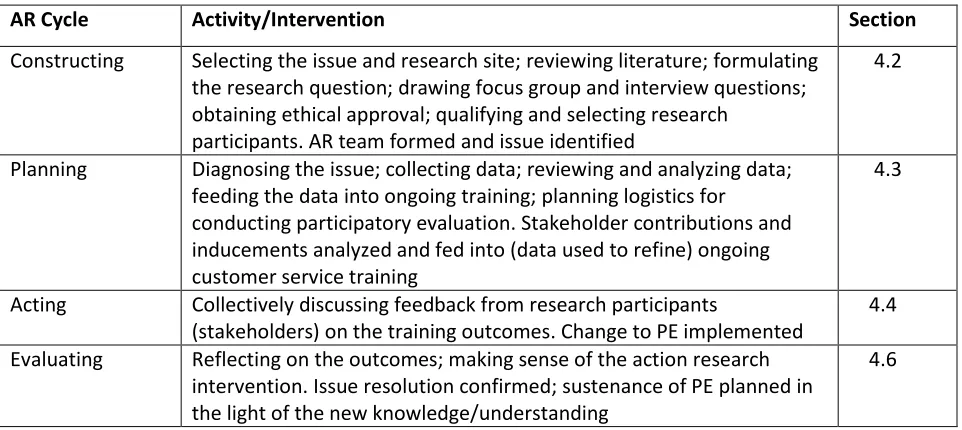
Chapter 4 covers my story of and outcomes from the intervention. It includes an account of how I have engaged in the intervention with the participants in four AR cycles from constructing (scanning and problematizing) the issue through to planning and actually taking action to
implement the desired change to participatory evaluation in the hospital. It also contains
reflective boxes that capture my thinking through my field journal as the project was underway. The chapter concludes with an account of a collaborative evaluation of the action. This includes reflections on lessons learned by participants on the action research process, how their
21
I adapted the Johari window as my learning (knowing and discovering) window (Figure 6.1) in Chapter 6 for self reflection and discussion of my meta-learning from the AR intervention. This covers the insights I have about the content and what I have learned about the issue regarding my client organization, my practice and the AR process. It also includes how I have learned to deal with challenges in research and practice relationships. The chapter concludes with a methodological reflection discussing quality of the AR process. This is important because the quality of action research is not judged by the normal criteria of reliability (replicability), objectivity (value-freedom) and generalizability (internal and external validity) with which positivist science is measured. Rather, action researchers are encouraged to establish the criteria by which their research should be evaluated including how they generate, gather, explore and evaluate data and how they question and interpret events through the iterative action research cycles (Coughlan, 2001). I therefore try to provide answers to key questions surrounding the quality of the process I took throughout the intervention and how this has contributed to my meta-learning. In the concluding chapter (Chapter 7), I traced my journey of the action research intervention from what attracted me to study PE through the actual implementation of the change to a reflection on the theoretical and practical implications of the findings. I also pointed out the limitations of the study and opportunities these present for future research.
1.11 Chapter Summary
22
Chapter 2: The Context of Participatory Evaluation
2.1 Introduction
Research aimed at improving training effectiveness through participatory evaluation (PE) evokes a number of concepts. This is especially so when action research (AR) intervention is contemplated for the purpose. Smits, Champagne and Blais (2009) has acknowledged regarding participatory evaluation that it is a field that requires strong theories and the exploration of relevant concepts which will assist any effort to track as well as improve its mechanisms and results. Therefore, the first step towards increasing our understanding of participatory evaluation is to conceptualize its dimensions. How does participation by relevant training stakeholders increase utilization of evaluation data? How does this increased use of evaluation data improve training effectiveness? To answer these key research questions and many
relevant other concerns in an AR setting where the goals are to generate insight to deepen professional knowledge and improve the practice, quality and uses of training evaluation data in the organization, a foray into the existing body of knowledge in training evaluation, training effectiveness, the stakeholder approach, utilization of evaluation data and participatory evaluation is apt. The purpose of this chapter is to take that foray.
2.2 Debates about Training Evaluation and Training Effectiveness
23
training program design (Diamantidis & Chatzoglou, 2012) and employee characteristics (Latif, 2012; Noe, 1986; Noe, & Schmitt, 1986).
A number of trainers’ attributes that drive training effectiveness, though long recognized in human resource development (HRD) programs literature (Cooper, 1969), have also recently been further explored (Chukwu, 2013; Gan, Lee & Soutar, 2009; Ghosh et al, 2012; Holladay & Quinones, 2008; Mamaqi, Miguel & Olave, 2011). Hence, training effectiveness can rightly be defined as “the study of the individual, training and organizational characteristics that influence the training process before, during and after training” (Alvarez, Salas & Garofano, 2004:389). This guiding definition differentiates the work from the many previous studies of training effectiveness that are based on the traditional post training evaluation.
However, the rather narrow distinction and alignment of the two concepts – training evaluation and training effectiveness – suggest that the best to be desired in training evaluation should be an integration of training effectiveness. This would help determine the factors influencing training outcomes at different levels of the training (Alvarez, Salas and Garofano, 2004). The argument for integration is consistent with Holton’s (1996) inclusion of particular effectiveness measures in his training evaluation model in challenge of the Kirkpatrick’s four-level model.
24 2.3 Understanding Training Evaluation
Evaluation of post-training attitudes, skills and knowledge is not new and ensuring the effectiveness of training has long been of serious concern to researchers (Guba & Lincoln, 1981). A 1968 survey of 110 industrial organizations evaluating training conducted by Catanello and Kirkpatrick and reported by Burgoyne and Cooper (1975) revealed that even though
organizations were engaged in one form of training or the other, “very few were assessing anything other than trainee reactions” (Foxon, 1989:89). That the concentration has been on trainee reactions may be a little wonder because the human resource development (HRD) literature seems to accept the definition of training as “a planned learning experience designed to bring about permanent change in an individual’s knowledge, attitudes, or skills” (Noe & Schmitt, 1986:497). It has also been acknowledged that most of the intriguing training evaluation research in the early 1980s was focused on the influences on learning of learner dispositions (Holton, 2005). Changes in trainee attitudes as a result of training were subsumed under “learning” in the often cited Kirkpatrick’s evaluation model, and this has been the concentration of most training evaluation research and practice (Bates, 2004). That the trend continued for too long is evident from the concentration of training evaluation research on the Kirkpatrick’s four-level criteria for over 40 years without much change (Saks & Burke, 2012; Twitchell et al, 2000).
25
training programs will be more effective and at the same time the learning will be more likely to transfer to work performance (Saks & Burke, 2012).
This “improvement” might be necessary because, as Bates (2004) argues in a critique of the Kirkpatrick four-level training evaluation model which focuses on reaction, learning, behaviour and results (Kirkpatrick, 1979), both the summative question concerning whether the training was effective and the formative question about how the training can be modified in order to increase its potential for effectiveness are yet to be adequately addressed by existing research. Alvarez, Salas and Garofano (2004) also posits that the purpose of training interventions is usually concerned with changes in employee attitudes. Based on this outcome-centered concept of summative evaluation, Wang and Wilcox (2006) identified a number of benefits accruable to HRD aside from justifying their budget and the return on investment (ROI) success measurement (Barnett & Mattox, 2010; Phillips, 1997). These include validation of
implemented interventions, demonstration of the value of training interventions to
organizational decision makers, discovery of areas of training interventions that fail to meet the expectations of stakeholders, provision of opportunities for future improvement and perhaps assisting and supporting future training and HRD investment (Wang & Wilcox, 2006).
2.3.1 Forms of Training Evaluation
Campbell (1998) outlines the simple process of training evaluation in the traditional approach. According to this schema proposed by L’Angelle (1996), evaluation process usually conducted by an expert (internal or external to the organization) is divided into three parts: first, planning of the evaluation; second, collection and interpretation of information/data; and third,
preparation of recommendations and action plan. The first part, planning the evaluation, involves determining the requirements for evaluation from specialist and training managers, specifying evaluation purposes and objectives, identifying sources of information, determining the appropriate methods for collecting information/data and preparing an evaluation schedule, perhaps involving stakeholders. In part two, data collection and interpretation include
26
collecting and collating of data, and analysis and interpretation of the data. Finally, part three, preparation of recommendations and action planning demands formulating recommendations, drawing up a plan for corrective action and, of course, writing the evaluation report (Campbell, 1998).
Consequently, the common forms of evaluation are those based on the conventional tenets of the professional evaluator expressing his or her own neutral and objective judgement of the outcome. Anderson (2010) views this type of evaluation as reminiscent of “an exercise in proving or disproving that something worked rather than providing the basis for further
learning and of a dynamic approach to programme development” (2010:297). Wang and Spitzer (2005) divided the training and HRD evaluation evolution of the past 50 years into three stages. The first stage, according to their classification, is a practice-oriented atheoretical stage
dominated by Kirkpatrick four-level scheme from late 1950s to the late 1980s. The second stage is a process-driven operational stage dominated by the ROI wave of the late 1980s to the early 2000s. The third stage is the research-oriented comprehensive stage believed to rule from the late 1980s (Wang & Wilcox, 2006).
More recently, however, growing emphasis is shifting to stakeholder-focused evaluation and utilization of evaluation data (e.g. Burgoyne, 1994; Greene, 1988; Guerci & Vinante, 2010; Mishalski & Cousins; 2001; Nickols, 2005; Wang & Wilcox, 2006). There is also a recent shift from ROI to “return on expectation” (Anderson, 2008b) which I consider as only but a look at one side of the coin as this measure of outputs ignores the inputs from the stakeholders. Application of these newer concepts are expected to generate evaluation information that can identify weaknesses which, when corrected, will lead to improvements in training programs. It is also envisaged by their proponents that these would create greater accountability among training stakeholders (Saks & Burke, 2012).
27
al, 2003). The implication of this finding is that not only what is included in the evaluation process (e.g. any of the four levels of the Kirkpatrick model - reaction, learning, behavior and results) but who is included (stakeholders such as trainers, trainees, trainees’ managers, human resource/training managers, etc.) could help determine training effectiveness. In order to include the various process variables as well as the multiple training stakeholders in an
empirical evaluation of training effectiveness, a review of literature on the theoretical aspects of stakeholder management becomes inevitable.
2.4 The Stakeholder Approach to Training Evaluation
The main purpose of evaluation is to determine the value of what is being evaluated (Nickols 2005). Training evaluation enables the determination of the value of the training intervention. But this raises the vital question: value to whom? The problem with prevalent traditional training evaluation based on the 50-year old Kirkpatrick model has been succinctly stated by Nickols (2005:121) as “primarily of interest to trainers but not to the many constituencies served by training, trainers, and the training function.” There is therefore the need to consider the stakeholder approach to training evaluation in order to determine to whom value of training is related in the course of evaluation. There is no doubt that the general program evaluation literature contains evidence of fairly well developed stakeholder-based evaluation but it has not been that fully recognized in training evaluation practice until recently (Mishalski & Cousins, 2001).
Nickols (2005) vividly presents the basic premise on which a stakeholder approach to evaluating training is built. Recognizing the multiplicity of groups within an organization that could have a stake in any training intervention conducted for members of the organization, the author posits that the needs and requirements of these stakeholders or stakeholder groups must be factored in when designing, developing, delivering and evaluating training interventions. This would help ensure that the subsequent evaluations will be effective, i.e., meet expectations or the desired results. Furthermore, as a “politically complex” activity (Mishalski & Cousins, 2001),
28
(Verhezen, 2010) that often pervades the complexity and politics of organizations using unitary evaluation activities. For reasons such as this, Cunningham (2002) makes a good case for developing both human and social capital in organizations. The author argues that “If training stays focused on the individual (human capital) level it may be missing on important changes in developing organizational performance” (2002:89). Quoting from Cohen and Prusak (2001:4) who defined social capital as consisting of “the stock of active connections among people: the trust, mutual understanding and shared values and behaviors that bind the members of human networks and communities and make cooperative action possible”, the author urges the HRD function to recognize the social capital needs of organizations. Otherwise, he suggests that this might form a new role for training functions if they must deliver on their obligations to their organization in the future (Cunningham, 2002).
In the light of the foregoing, the basic assumptions of the stakeholder approach to training evaluation (and which constitute evaluation data) are as follows:
trainers and their managers might desire to demonstrate the value of what they do; funding managers might be interested in the ROI of the training;
course instructors and developers might want to know the nature and extent of learning that took place and level of transfer to the workplace;
trainees might be concerned about how the subject matter of the training (including the concepts, principles, methods, tools and techniques covered) is applicable or relevant to their day-to-day job functions and the time value of the training;
training vendors might be interested in how satisfied the training department (their client) is with the training they bought;
trainees, trainers and perhaps others might be concerned about learning (i.e. skills and competencies acquired);
trainees’ (line) managers and trainers are interested in participants’ behavior change on the job;
29
every stakeholder might want to know what the trainees think “because if the trainees are sharply and uniformly critical of the training, very little else matters” (Nickols, 2005:124).
2.4.1 Foundations of the Stakeholder Theory
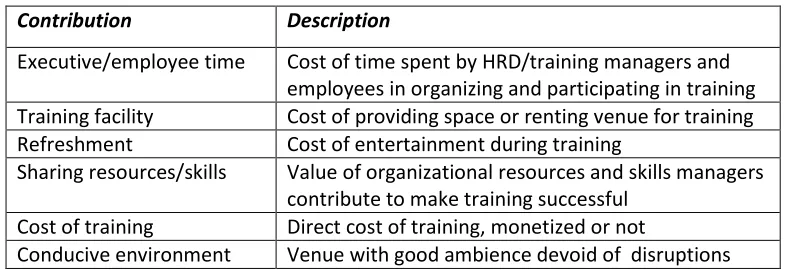
Stakeholder theory is grounded in the early works of Barnard (1947) and later Freeman (1984). The essence of the theory is that all organizations – profit, non-profit, public, and private – serve and depend on multiple constituencies such as customers, employees, and investors (Nickols, 2005). The concern of researchers and practitioners should now be to recognize the importance of serving and satisfying the interests of the various constituents of training in the organization. This is based on the understanding highlighted by Nickols (2005) that the various training stakeholder groups have contributions to make the training successful as well as inducements to gain as a return from their contributions. The task of training should be to achieve and maintain a dynamic net balance (between the contributions and the inducements) to the organization on a continued basis. A stakeholder is defined as “a person or group with an interest in seeing an endeavour succeed and without whose support the endeavour would fail” (Nickols, 2005:127). The endeavour here is training and typical training stakeholders have been identified to include trainees, trainers, line managers, funding managers, training developers, training managers, training vendors, and other members of the organization served by training (Nickols, 2005).
Going by the formal language of organizational theory where stakeholders exchange
contributions in return for inducements, it requires no special gift of perception to discern that the various stakeholders must perceive value in the exchange. That is to say that the
30
(2010:404). The authors reviewed theoretical and empirical research evidence to show that the organization that employs good stakeholder relations enjoys superior financial performance on the long run. It is also believed that poorly performing firms improve their performance more quickly when there are good stakeholder relations (Palmer et al, 2010).
2.4.2 Issues with the Stakeholder Theory
Stakeholder theory is not without controversy. While the stakeholder concept has become widely accepted in management literature to the extent that it has been equated with the naturalness of breathing or drinking a cup of water, Antonacoupolou and Meric (2006) question whether it is not a mere philosophical hoax. After their analysis of the critiques of the concept such as its ambitions, scientific status, generalization and informational role, the authors conclude that “stakeholder theory is an ideological product rather than a scientific process” (2006:24). In a similar vein, Cennamo, Berrone and Gomez-Mejia (2009) and Santana (2012) present the dark sides of stakeholder management but make credible case for efficacious use of the concept in management.
While Santana (2012) emphasizes the importance of identifying and sifting “definitive stakeholders” from “dangerous stakeholders”, Cennamo, Berrone and Gomez-Mejia (2009) outline the “conditions under which executives might have a real self interest in pursuing a broad stakeholder management (SM) orientation to enlarge their power” (2009:491). In his own critique, Goodpaster (1991) presents a rather paradoxical outlook to the stakeholder approach: the conflict between managing the ethical relationship with shareholders and the interest of other stakeholders in an enterprise. In consonance with this view, Fraser (2007) also notes the paradox of developing an evaluation framework that will determine return on
31
usefulness attached to different types of training evaluation data. Considering that the study also indicated differences between training and non-training groups with respect to training investments, outcomes and measurement preferences, the author concluded that it could be in the best interest of practitioners that the multiple needs and perspectives of the variety of training stakeholders in the organization (those who contribute to and are served by training) are incorporated in the evaluation of training effectiveness.
In an analysis of training stakeholders’ evaluation needs, Guerci and Vinante (2010) identified the convergences and divergences between stakeholder groups’ evaluation needs which ROI-focused training evaluation models often neglect. However, the authors noted particular limitations in their empirical study which create a gap for possible development and future research. The main limitation concerns the correlation of the value which the stakeholder-based evaluation adds to the training process with the levels of increase in performance. It is believed that pursuing this aspect of training evaluation research “could be useful in identifying the applicability conditions for stakeholder-based evaluation and privileged contexts of
application” (Guerci & Vinante, 2010:400). A study to fill this gap in literature should be based on participatory evaluation (PE), described as a transition from conventional evaluation which attempts to use evaluation data to change organizational development processes that could help the organization achieve improved performance from different stakeholder perspectives (Greenwood & Levin, 2007). Yet, experts have cautioned about the need for training evaluators to think carefully about uses to which evaluation outcomes are intended to be for and the preferences of the stakeholders who will be using the evaluation data regarding the way the training outcomes are measured (Kraiger, 2002; Palma, 2003).
2.5 Utilization of Evaluation Data to Improve Training Effectiveness
32
evidence and information upon which future decisions about training can be based. This, according to the argument, is contrary to the attempt at providing irrefutable proof which the scientific method sets to achieve. However, the change of focus from trainee reactions to the use of “utilization” to measure training results can be traced to the work of Grenough and Dixon (1982) which suggested a strategic evaluation model to generate future oriented
management information which is designed to identify whether or not trainees are using their experience. The study further suggests that for such an evaluation to worth its while, the results expected to be produced by training, the actual results that occurred, how useful or otherwise the results are and how the results will be used in the future should also be determined (Foxon, 1989).
Good as the training evaluation models that incorporate a consideration of the utilization of evaluation data might be, lack of participation by non-evaluator practitioners has been indicted as a potential cause of low utilization of evaluation results (Smits, Champagne & Blais, 2009). There is therefore the need to find out not only how participation of all relevant stakeholders increases the generation and utilization of evaluation data but also how this participatory approach improves training effectiveness. In discussing stakeholder participation as one route to evaluation utilization from a review of two case study evaluations, Greene (1988) sought to suggest that there is “a link between a participatory evaluation process and meaningful,
substantive uses of the evaluation results” (Greene 1988:100). Perhaps subscribing to this view, Patton (2008; quoted by Datta, 2013:256) emphasizes the requirements of utilization-focused evaluation to include “extraordinary skills in mediation, listening, being a resource for how, rather than an advocate for what”. These lines of argument suggest that participatory evaluation is utilization-focused and could lead to finding a solution to the question of how increased use of evaluation improves training effectiveness.
2.6 Participatory Evaluation
33
enhancing evaluation utilization through primary users’ increased depth and range of participation in the applied research process” (Cousins & Earl, 1992:397). Participatory
evaluation could be used for the evaluation before, during or after the implementation of the project, program or intervention. One example is a study that was conducted to evaluate a game for social problem-solving skills at the start of the development aimed at ensuring that the desired game attributes were successfully embodied in the final game (Tan et al, 2013). Kuzmin (2012) also illustrates a step-by-step process of post-training study using participatory training evaluation method (PATEM) as a collaborative evaluation capacity building strategy. The former case shows that a pre-training participatory evaluation would be necessary to generate quality evaluation data to feed into developing and delivering training programs to ensure desired outcomes. The import of the later case is that post-training participatory evaluation is equally necessary to collaboratively reflect on lessons learned thereby building capacity for the organization.
However, it has been acknowledged that evaluation is contextual (Chouinard, 2013). These include the political, philosophical and pragmatic justifications of participatory evaluation. Chouinard contends that “the issue in participatory evaluation is not about which methods to use, but whose voices to include, how to include them, and determining who will speak for whom” (2013:241). This raises a number of tensions: relational, epistemological, pedagogical, contextual, political, methodological and organizational. Methodology in participatory
evaluation is seen as a bridge between epistemologies that guide the research and the methods of data collection – and the participatory approach does not favor any one method. Hence, method selection and design in this type of research has been described as “eclectic, as methods are adapted for use based on organizational and community context, rather than on predetermined metrics and measures of success” (Chouinard, 2013:247). Moreover, because some approaches seem more appropriate for some contexts and questions than others, it is recommended that paradigms, frameworks and methods could be combined to help
34 2.6.1 Scope of Participatory Evaluation
From all indications, it appears that participatory evaluation (PE) is the appropriate umbrella concept for interventions involving stakeholder participation in the generation and utilization of evaluation data. Although only one form of collaborative inquiry (Cousins & Whitmore, 1998) and congruent with the process of cooperative inquiry (Heron, 1996; Reason, 1988; Heron & Reason, 2008), PE encompasses the stakeholder as well as utilization focused approaches to the training intervention. PE also falls within the purview of evaluative inquiry defined as the
“*r+eformulation of traditional evaluation practices” (Coghlan & Brannick, 2010:49). The core issue in traditional evaluation practices is accountability to authority. For example, evaluations for programs are usually required by private funders, local authorities, governments and organizational leaders for the purpose of guiding or legitimating their funding decisions or to control activities that they support (Greenwood & Levin, 2007:184). PE can have different foci other than accountability.
2.6.2 Justifications for participatory evaluation
Traditional evaluation methods which are usually based on Kirkpatrick’s four-level criteria have not proved effective in assisting HRD practitioners to translate evaluation data to uses that improve training effectiveness (Bates, 2004) (see section 2.3 above). Despite all the goodwill intended by such evaluation schema and the tools to aid the process, problems arise for several reasons. For example, reports are often ignored as non-essential especially when it is favorable, the evaluator is part of the decision making process or it is communicated only to senior
management instead of to all stakeholders (Campbell, 1997). Chouinard (2013) holds that there are three conceptually distinct justifications for adopting the participatory approach to program evaluation generally. According to the author, these include rationales used to advance
collaboration such as political justification, philosophical justification and pragmatic
justification. In the words of the author, political justification is “rooted in concerns for social justice and based on a moral and normative sense of obligation involving the ideals of
35
While philosophic justification is also concerned with the central idea that evaluation is contextual, it advocates that multiple participants should be included in the knowledge
production process. Finally, a pragmatic justification is described by the author as “practical in orientation, and based on the belief that increased participation will lead to results that better support program and organizational decision making” (Chouinard, 2013: 242). While the last justification is in tandem with Patton’s (1988) advocacy for utilization focused evaluation and can contribute to the enhancement of organizational learning, organizational change
management literature points to the difficulty often encountered in coping with the political and philosophical justifications as postulated by Chouinard (2013). For example, her implied claim that for embracing the forgoing justifications for collaborative inquiry, PE should be “a new uber-standard for all evaluation” has been severely criticized by Datta (2013) who rather favors “evaluation multiplism” (2013:254) which I understand to mean various approaches to conducting evaluation.
Another area of conflict could be where management decision to adopt participatory
evaluation is resisted by employees. A way of dealing with such employee resistance to change has been suggested for organizations desiring successful implementation. According to this view, efforts should be geared towards generating employee support and enthusiasm for any proposed changes rather than expending such on managing resistance. For example, Piderit (2000) has proposed “a multidimensional view” in responding to proposed organizational changes. This should move from the usual monolithic and/or dialectic negotiations that pervade employer-employee relationships and communication to a trialectic approach that captures employee responses along the emotional, cognitive, intentional or more dimensions (Piderit, 2000). However, as has been stated above, training stakeholders include not only employees but other groups or individuals internal and/or external to the organization (section 2.4). Participatory evaluation of training effectiveness therefore requires insight into the responses or reactions of wider stakeholder groups or individuals.
36
Participatory evaluation lays much emphasis on participation. Empowerment of individuals or groups is part of the political justifications of PE (Chouinard, 2013). The applicability of these tenets constituting good practice of participatory evaluation has been articulated by Cousins and Whitmore (1998) in their classification of the process into two streams: practical
participatory evaluation (P-PE) and transformative participatory evaluation (T-PE). In T-PE the transformation of power relations and the promotion of social action and change are the primary concerns of evaluation processes and outcomes. Evaluation in this view is a
developmental process which involves less powerful stakeholders in the course of investigation, reflection, negotiation, decision-making and knowledge creations, but at the same time strives to change individual participants and power dynamics at play in a socio-cultural setting. The authors observe that the evaluation team may be fairly dependent on professional evaluators and facilitators for training at the early stages of the process, but they become more
sophisticated as soon as the process progresses. The result is that they become responsible for virtually every aspect of the evaluation including the organization and implementation,
evaluation results dissemination, sense-making, group coordination, decision making, change management and action taking (Cousins & Whitmore, 1998).
The objectives of P-PE and T-PE overlap but there are observable differences in primary functions. While P-PE focuses primarily on practical problem solving, T-PE focuses on empowerment. Similarly, while there are overlaps between the two sub-approaches of participatory evaluation in secondary and other functions, they have different ideological and historical roots (Cousins & Whitmore, 1998). Yet, the integrated rationale for practical
participatory evaluation (P-PE) is that the concern for utilization of the resulting evaluation data is just about the same as for the findings. Secondly, it is not enough that the evaluation is utilization-orientated; the planned change agency role is incorporated as part of the elements of the evaluation. Furthermore, the concern for utilization and impact of evaluation are not just about the particular program being evaluated but extends to future applications. This
expectedly has organizational learning and change as the by-products. Research has
37
1998:89). This suggests that if applied in a hospital setting, P-PE involving medical and non-medical training stakeholders would help enhance how training evaluation results are utilized.
Transformative participatory evaluation (T-PE), on the other hand, aims to demonstrate social change. This has been explained partly as “a reaction to positivist models of inquiry that were seen as exploitative and detached from urgent social and economic problems” (Cousins & Whitmore, 1998:90). The underpinning concepts of the transformative participatory evaluation (T-PE) sub-approach therefore include seeking answers to questions such as (1) “Who creates and controls the production of knowledge” and (2) “How is the evaluation conducted?” In this way, the distance between researcher and researched are broken down such that all
participants are contributors working collectively to achieve the purpose of the evaluation (Cousins & Whitmore, 1998). Of course, T-PE involves critical reflection if the above aims are to be achieved. As Antonacopoulou (2004) explains, critical reflection helps in giving more
attention to the organizational learners’ experiences and problems in order to reveal the inherent social and political dynamics. This requires that the participants should question, doubt and consider the different social factors surrounding the evaluation process. The participants’ own biases and assumptions should also be challenged (Cousins & Whitmore, 1998). The foregoing characteristics of both types of participatory evaluation make it attractive for me to undertake a study of the phenomenon through the action research approach.
2.7 The Action Research Approach
38
for evaluating the results of strategies tried out in practice” (McTaggart, 1991:170). According to the central tenet of Argyris’ interpretation of Kurt Lewin’s (1946) concept, action research involves change experiments on real problems in social systems that focus on a particular problem with a view to providing solution to the client’s system (Argyris et al, 1985).
Gummesson (2000) has enumerated the characteristics of action research. From a
management perspective, these characteristics involve taking action and pursuing dual goals of solving organizational problem and contributing to the body of scientific knowledge, i.e.
research in action. It also involves the iterative process of the researcher, in collaboration with client personnel as co-researchers, continuously adjusting to new information and new events as they unfold. It involves developing holistic understanding, recognizing the complexity of organizational systems (Stacey, 2011), for example, in the training consultancy industry and the healthcare industry where AR has gained ground over the years (Bate, 2000).
According to Coghlan and Brannick (2010), action research intervention aims at organizational or system change as well as consideration and understanding of the ethical framework of the organization. Action research can use quantitative and/or qualitative methods of data
generation but quantitative methods have limitations in providing in-depth explanations of training evaluation phenomenon. Qualitative research methods are more likely to provide rich insight and in-depth understanding of the experiences of the individuals and groups as well as the meanings they attach to training evaluation process. Action research also requires the level of thorough preunderstanding of the corporate or organizational environment, structures and systems in which the intervention is situated. It calls for explicitly stating the theoretical underpinnings of these preunderstandings (Coghlan & Brannick, 2010).
Action research is conducted in real time as an intervention to promote reflection and organizational learning and assurance of quality in the underlying research philosophy of the researcher (section 3.3). This is important because action research is judged by the criteria of its own terms and not in terms of positivist science (Coghlan & Brannick, 2010). In positivist
39
refers to value-freedom. Internal validity refers to correct mapping of the phenomenon with findings while external validity refers to generalizability of findings (Denzin & Lincoln, 1994). Conversely, quality and rigor issues in action research are different (see section 6.4). Evered and Louis (1981) maintains that inquiry of this nature does not require any “scientific method”. Instead, Coghlan and Brannick (2010) outlines the necessary requirements for using this form of inquiry in action research. These include justification of topic and approach, description and defense of rigor in methodology (quality and rigor questions), familiarity with existing content and process literature – conceptually, on whose shoulders the researcher is to ride on.
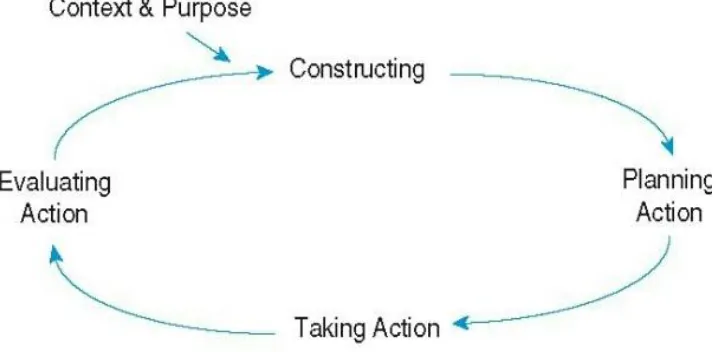
The iterative cycles action research entails include problem identification, planning, acting, and evaluating (Coghlan, 2001). I will discuss details of each cycle of the process later in Chapter 3 (section 3.4.5). The intended change involves inquiry and seeking to increase understanding of individuals and the groups through participation of relevant stakeholders in action to challenge the status quo. As Moore (2007:30) emphasizes, “You don’t do action research in order to simply maintain the status quo”. The improvement of the problem situation is intended to simultaneously contribute to new knowledge in social change. This is the kind of action research long advocated by Rapaport that “seeks to optimize the realization of both the practical affairs of man and the intellectual interest of the social science community”
(1970:510). In this respect, action research perhaps stands as the most appropriate approach to engage in first person, second person and third person research, all of which would be desired for an intervention focused on organizational change. It can be reasoned that implementing the intended change to a training evaluation method through action research stands to benefit the academic and professional development of the researcher as a scholar-practitioner, benefit the participants as co-researchers in their day-to-day practices and benefit the focal organization in improved training effectiveness. At the same time it will generate new knowledge to HRD and to the action research community in general.
2.7.1 Brief History of Participatory Action Research
40
context of social movements in the developing world” (Kemmis & McTaggart, 2003:272). Two key themes of this movement were the development of theoretical arguments for action-focused approaches to AR and the quest to link with broad social movements through PAR as an alternative philosophy of social research (Kemmis & McTaggart, 2003).
Key features of participatory action research have been identified as involving a spiral of self-reflective cycles of planning a change, acting and observing the process and consequences of change, reflecting on these processes and consequences leading to a repeat of the cycle (Kemmis & McTaggart, 2003). Because the stages overlap, strictly following the steps by participants is not the criterion for a successful PAR. Rather, successful PAR is measured by “whether *researchers+ have a strong and authentic sense of development and evolution in their practices, their understandings of their practices, and the situations in which they
practice” (Kemmis & McTaggart, 2003:277, authors’ emphases). Moreover, action researchers generally are not the best of “rule-followers” (Brydon-Miller, Greenwood & Maguire, 2003). The self-reflective practice is performed in collaboration with participants as co-researchers in the belief that by thus constituting practices in social interaction between people, changing practices becomes a social interaction (Kemmis & McTaggart, 2003). This makes participatory action research, at its best, “a social process of collaborative learning realized by groups of people who join together in changing practices through which they interact in a shared social world in which, for better or worse, we live with the consequences of one another’s actions” (Kemmis & McTaggart, 2003:277).
2.7.2 Principles of Participatory Action Research
41 2.8 Chapter Summary
Concern for training effectiveness is not new. Evaluation methods for measuring training effectiveness are not lacking in the literature. The potential of utilization of evaluation data is strong but has received little attention. It is important to fill this gap by finding out how
utilization-focused participatory evaluation (PE) increases the use of evaluation data to improve training effectiveness. What constitutes evaluation data, from the stakeholder perspective, includes the various stakes held in training inside and outside the organization (by trainers, training managers, trainees, line managers, senior management, funding managers, training vendors and course instructors) and their contributions and inducements (Nickols, 2005).
The practice of PE can be built on different premises and participation can also be
conceptualized in different ways. One is Guba and Lincoln’s (1981, 1989) postulation which holds that evaluation is a process of construction and reconstruction of realities. Another is Patton’s (1986, 1997) utilization-focused evaluation which emphasizes the imperative of using evaluation results to improve projects or activities. Of course, there is Guzman’s (1989)
empowerment evaluation which aims at empowering dominated group to join the struggle for a better society. It is imperative for an AR intervention on PE to draw from these perspectives as all are relevant to attaining the objectives of the study. In each perspective, consideration of the stakeholders is paramount. Particularly, the pragmatic and emancipatory functions of PE are shared by P-PE and T-PE with a central function of fostering evaluation data use, “with the implicit assumption that evaluation is geared toward program, policy, or organizational
decision-making” (Cousins & Whitmore, 1998:88).
42
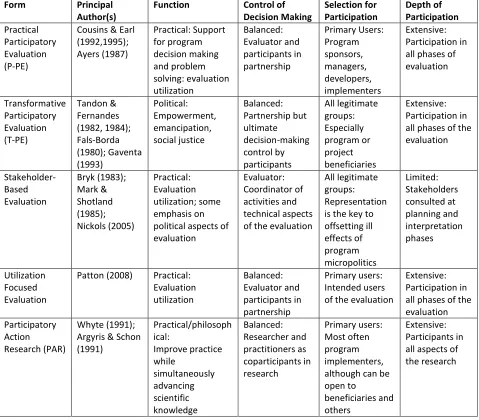
[image:42.612.68.547.250.670.2]participatory evaluation (Table 2.1) shows similarities in P-PE, utilization-focused evaluation and PAR in terms of function, control of decision making, selection for participation and depth of participation (Cullen & Coryn, 2011). Stakeholder-based evaluation also shares similar characteristics with PAR except that the depth of stakeholder participation is limited to planning and interpretation stages (Cullen & Coryn, 2011).
Table 2.1: Comparison of Some Forms of Participatory Methods
Form Principal Author(s)
Function Control of Decision Making Selection for Participation Depth of Participation Practical Participatory Evaluation (P-PE)
Cousins & Earl (1992,1995); Ayers (1987) Practical: Support for program decision making and problem solving: evaluation utilization Balanced: Evaluator and participants in partnership Primary Users: Program sponsors, managers, developers, implementers Extensive: Participation in all phases of evaluation Transformative Participatory Evaluation (T-PE) Tandon & Fernandes (1982, 1984); Fals-Borda (1980); Gaventa (1993) Political: Empowerment, emancipation, social justice Balanced: Partnership but ultimate decision-making control by participants All legitimate groups: Especially program or project beneficiaries Extensive: Participation in all phases of the evaluation Stakeholder-Based Evaluation Bryk (1983); Mark & Shotland (1985); Nickols (2005) Practical: Evaluation utilization; some emphasis on political aspects of evaluation
Evaluator: Coordinator of activities and technical aspects of the evaluation
All legitimate groups: Representation is the key to offsetting ill effects of program micropolitics Limited: Stakeholders consulted at planning and interpretation phases Utilization Focused Evaluation
Patton (2008) Practical: Evaluation utilization Balanced: Evaluator and participants in partnership Primary users: Intended users of the evaluation
Extensive: Participation in all phases of the evaluation Participatory
Action
Research (PAR)
Whyte (1991); Argyris & Schon (1991) Practical/philosoph ical: Improve practice while simultaneously advancing scientific knowledge Balanced: Researcher and practitioners as coparticipants in research Primary users: Most often program implementers, although can be open to
beneficiaries and others
Extensive: Participants in all aspects of the research
43
Chapter 3: Methodology and Methods of Inquiry
3.1 Introduction
The choice of methodology has long been recognized as a critical component of research related to evaluation (Burgoyne & Cooper, 1975). This is probably because methodology is the point of the research where both the conceptual and practical issues are integrated1 and this requires that the researcher clearly states the theoretical and philosophical frameworks of his study (Burgoyne & Cooper, 1975). I consider the choice of methodology particularly important in my present research not only because the issue is about changing an existing system of training evaluation that does not encourage the use of evaluation data to improve future training (section 1.2) but also because of the various modes through which action research could be carried out (see section 3 below). Theory-practice focused research such as this particular one will require a different methodological approach from one that is purely academic focused (see section 3.4.1.2 below).
In this chapter, I will discuss the philosophical assumptions that underpin my current research (section 3.3). I will also discuss in more detail the methodological approaches chosen from my review of the literature (sections 2.7) as the framework for the study (section 3.4) and the step-by-step process of carrying out the research. Meanwhile, suffice it to state at this juncture that my philosophical stances for the research will be subjectivist ontology and social constructionist epistemology. My methodological approach will be qualitative, using action research approach. The action research mode I follow will also depend on my underpinning research philosophy. Other major influences on my choice of methodology are my development as a scholar-practitioner discussed in the next section (section 3.2) and my relationship with the focal organization as their training consultant. I believe that making clear my philosophical stances
1
Anderson, Herriot and Hodgkinson (2001) caution that taking of solely practice or practitioner perspective could
result in “unauthorized and invalid practice” just as taking solely researcher or academic perspective could