This is a repository copy of Affinities and Beyond! Developing Ways of Seeing in Online
Spaces.
White Rose Research Online URL for this paper:
http://eprints.whiterose.ac.uk/115020/
Version: Accepted Version
Article:
Davies, J. (2006) Affinities and Beyond! Developing Ways of Seeing in Online Spaces.
E-Learning and Digital Media, 3 (2). pp. 217-234. ISSN 2042-7530
https://doi.org/10.2304/elea.2006.3.2.217
[email protected] https://eprints.whiterose.ac.uk/ Reuse
Unless indicated otherwise, fulltext items are protected by copyright with all rights reserved. The copyright exception in section 29 of the Copyright, Designs and Patents Act 1988 allows the making of a single copy solely for the purpose of non-commercial research or private study within the limits of fair dealing. The publisher or other rights-holder may allow further reproduction and re-use of this version - refer to the White Rose Research Online record for this item. Where records identify the publisher as the copyright holder, users can verify any specific terms of use on the publisher’s website.
Takedown
If you consider content in White Rose Research Online to be in breach of UK law, please notify us by
Paper presented by Julia Davies at UKLA International Conference, Bath UK, July 2005. Final version published and available online here: http://journals.sagepub.com/doi/abs/10.2304/elea.2006.3.2.217
You know what, since I was given my pro account IÕve been carrying my digital camera everywhere I go and IÕve taken to looking at the world through my flickÕr eyes!!
Anya, 2005
Affinities and beyond!! Developing ways of seeing in online spaces
This paper presents an insider view of an online community of adults involved in sharing digital photography through a host website, ÔFlickrÕ (http://www.flickr.com/). It describes how reciprocal teaching/learning partnerships in a dynamic multimodal environment are achieved through the creation of a ÔThird SpaceÕ (Bhabha, 1994) or ÔAffinity SpaceÕ (Gee, 2004) where ÔFunds of KnowledgeÕ (Moll 2000) are shared and processed in such a way that new meanings and discourses are generated. It is argued that this process is evidence of valuable learning and of the deepening of global understandings within the local space of ÔFlickrÕ. The new understandings are at least partly identifiable on the Flickr space, through the co-constructed ÔfolksonomyÕ or Ôonline taxonomyÕ of ways of looking at the world. Further, the paper provides evidence for broadening existing definitions of literacy, at a time when the visual mode increasingly works interactively with verbal cues and explanations.
Introduction
Even in the recent past, photography has been a relatively expensive hobby; cameras required special film,
time-consuming and costly processing, and even when results were disappointing, images were rarely
discarded since they had cost the aforementioned money and time. Many photographs remain treasured
artefacts; they are often framed or carried around in diaries or wallets; they are kept in albums and under
wraps; passed from hand to hand for special viewing. Stories often get told around much-thumbed snaps
before being stored away for another time. Such stories can draw friendships closer; they can confirm family
ties; images offer evidence of growth, of significant events, places visited, can disseminate news and reflect
the photographerÕs own perspective. This is not an obsolete or out-of-date process. But nowadays, digital
cameras have provided further options for image production and photo-sharing; processing can now be
almost instantaneous; many of us constantly, opportunistically, carry our cameras; we delete images; we
view them on mobile-phone screens, pc screens and on TVs; we transmit images globally, print them on
paper and t-shirts, and even use them as Instant Message icons. Results are often more sophisticated and
of better quality than those glossy prints we paid so much for, only a few years ago. Editing programmes,
allowing the manipulation of pictures and even the addition of text and music are now included with new pcs
so that participation in this photo-production revolution is accessible by millions. I believe many people are
experimental and creative in what they photograph and accumulating experience as photographers in their
daily lives. In this paper, I discuss the activities of individuals and groups on a photo-sharing website, Flickr,
(http://www.Flickr.com) and the ways in which their interactions on this site further intensify their
photographic experiences, thus affecting their ways of seeing, experiencing and understanding the world.
Respondents to my email questionnaire reflect on the hours they spend on Flickr; how it has changed the
way they look at the world; how they now carry cameras everywhere they go; how they even attend
meet-ups internationally, just to see their Flickr friends face-to-face (DrJoanne, 2005; Flickr Meetup, 2005). With
basic membership free of charge, Flickr is easy to join, yet seems difficult to leave.
I am interested in describing the interactive process of learning that is taking place within the Flickr site and I
believe the processes I discuss reflect learning at its best: it is social; it is motivated; it is embedded in
peopleÕs lives; it is compelling and enjoyable. Learning on Flickr occurs as a social practice; the structure of
the community supports development, constant review, a sharing of power and multiple ways of engaging
with others. Moreover, many of the interactants involved in the online practices I describe, are aware that
they are learning and this seems to motivate them further. I argue that the structure of the site, which allows
multiple routes into participation and which values a broad range of types of contribution, make the space
compelling. I believe that the space empowers interactants in a range of ways, partly through the siteÕs
structure which actively encourages participants to take part in meaning making practices and partly
through ÔFlickritesÕ awareness of their own learning.
Ludicorp was set up in February 2004 to develop an interactive online game (Hicks, 2004) and Flickr
photosharing was later developed to further capitalise on the interactive capabilities of LudicorpÕs software
(Tik, May 2005).The companyÕs gamble that people would enjoy sharing and discussing their photographs
paid dividends, for more than 80% of FlickrÕs users make their photographs ÔpublicÕ rather than ÔprivateÕ and
belong to groups they have set up within Flickr (Butterworth, 2005). If The GuardianÕs figures are correct,
(McClellan, 2005) FlickrÕs membership will by now be between a half and one million, all of whom must
declare themselves over 13.
I argue then, that it is the multiple social possibilities within the Flickr space, particularly the social learning
which ÔFlickritesÕ find so conducive; one respondent to my questionnaire summed this up in her comment,
that was to do with boring places like school, but now I realise learning stuff is to do with living your life and really noticing what is going on around you.
(Margo, 2005).
In this paper I elaborate upon the nature of the online learning on the Flickr site; I postulate what structures
support that learning, and what principles may be transferable to other spaces. I describe interactive, social
learning processes which allow individuals to reconsider the way they see themselves and their social
worlds. Their interactions with others and the sharing of social discourses, helps them to develop a new
space, a Third Space, where new sets of social practices and codes of conduct evolve over time, allowing
individuals to re-examine some of their experiences whilst acquiring new ones. The online ÔFlickr
experienceÕ leeches through to offline practices, and membersÕ worlds are often seen through the ÔFlickr
lensÕ; for example in online questionnaire responses Anya (2005) (above), talks about her ÔFlickr eyesÕ and
Reggio (2005) explains ÔI now take a camera of some sort with me virtually everywhere I go, Peter Parker
styleÕ .
In thinking about the concept of spatiality in relation to learning processes, I draw on the work of Bhabha
(1994), Leander and Sheehy (2004) and Moje et al (2004) as well as to GeeÕs work, looking at learning as a
social practice and more particularly at his model of ÔAffinity SpacesÕ (2004). I consider the relationship
between Third Space theories and GeeÕs Affinity Spaces using them to help deconstruct my own
observations and involvement in online learning practices. Indeed this project has arisen as a by-product of
an autoethnography on blogging, which I am conducting with Guy Merchant (Davies and Merchant,2005). In
addition to my observations of my own experiences, those of others, I have also used e mail questionnaires
sent to my contacts on Flickr. The representation is therefore affected by my own routes through the space
and the contacts I have made; although these have been quite broad ranging and eclectic, I have not, for
example joined any Ôprivate groupsÕ or groups which contain censored ÔadultÕ content. I have not attempted
to give an overall view of the site; the work is about how Flickr supports collaborative networked learning
and this is not undermined by its omissions.
Third Space Theory
Sheehy and Leander write that Ôrecent theorising has brought to light that space is a product and process of
socially dynamic relations.Õ (Sheehy and Leander 2004:1) and some theorists (Bhabha,1994; Moje et al.,
2004; Wilson 2003) have used the metaphor of a ÔThird SpaceÕ in order to conceptualise notions of social
learning. Here, I develop some ideas around Third Space in relation to Flickr, where new social procedures
and values have developed through shared practices. I show how, whilst residing in one geographical
users, through their contacts with others, are developing new Discourses (Gee, 1996), new Funds of
Knowledge (Moll, 2000) which give them new ways to think about and ÔseeÕ their worlds, by sharing their
views with others.
ÔFlickritesÕ bring to the Flickr space contributions such as digital images; comments about photographs
(comments on photo content, composition, format, source, meanings); technological solutions and
suggestions; as well as all kinds of information. These contributions are brought to the Flickr space thus
constituting the fabric of the Flickr space. This space is therefore in a state of both constant affirmation and
renewal; for contributions can be seen to both sustain the existing values as well as to develop them. These
contributions include glimpses of everyday lives; representations of artefacts; observations and
commentaries, and are sourced from the everyday experiences of Flickr members, representing what Moll
(2000) refers to as ÔFunds of KnowledgeÕ or what Gee refers to as Discourses. Gee describes Discourses
(with a large D) as,
Ways of behaving, interacting, valuing, thinking, believing, speaking É that are accepted as instantiations of particular roles É by specific groups of people ÉDiscourses are ways of being Ôpeople like usÕ. They are ways of Ôbeing in the worldÕ; they are Ôforms of lifeÕ. They are thus always and everywhere social and products of social histories.
Gee, 1996: viii
Thus for example, a Flickrite might contribute images to the site which depict preparations for a traditional
wedding (emersongeek, 2005); or Abu Dhabi girls in traditional dress ( Emaratiprincess, 2005), or even a
soldier reading Faust (Lt. TL, 2005) for example. These images reflect Funds of Knowledge, or values of a
particular cultural and familial sort; semiotic analysis would reflect the importance of dress codes, of social
values reflected through these images, for example. Yet when such photographs are placed with similar
others, for example in a group reflecting Muslim Cultures; weddings in general; military life, an individual
picture can accrue resonances beyond its individual meanings, being representative of a wider
demonstration of a range of cultural traditions and ceremonies. As I shall show, the Flickr Space can the
integration of multiple Funds of Knowledge or Discourses, can be a transformative process, so that
generating within the Flickr space are new Funds of Knowledge and new Discourses. I further contend, like
Moje et al (2004), that the process of recognition of differences between different kinds of Discourse, of
ways of seeing things, understanding the world and of organising thoughts, facilitates the reinterpretation of
previously unquestioned knowledges, or Discourses. So the co-existance, (sometimes juxtaposition), of
different Discourses, can facilitate dynamic, social learning. Moje et al (2004) describe the process in this
we call this integration of knowledges and Discourses drawn from different spaces the construction of Ôthird spaceÕ Édifferent or alternative, space of knowledge and Discourses.
Moje et al, 2004:41
Further, drawing on the work of Soja (1996), Moje et al (2004) argue that
what seem to be oppositional categories can actually work together to generate new knowledges, new Discourses, and new forms of literacy. Indeed a commitment to third space demands a suspicion of binaries;
Moje et al, 2004:42
BhabhaÕs work takes this idea in a direction which articulates my own understanding of the way Third Space
works for Flickrites:
Third Space É constitutes the discursive conditions É that ensure that É even the same signs can be appropriated, translated, rhetoricized and read anew
Bhabha, 1994: 37
BhabhaÕs work,(1994) looking at the coming together of cultures within colonialist societies celebrates the
notion of hybridity; seeing the space where different Discourses must be straddled as providing the potential
of a superior vision, of greater insight and offering new possibilities. He sees a third space as being a
product of the coming together of two cultures or Discourses. The transformative work that takes place in
order to create a Third Space, is then a positive process, whereby Discourse differences, or as Moje et al
(1994) characterise it, Ôcompeting DiscoursesÕ (43) are brought together so that a Ôproductive hybrid cultural
spaceÕ Moje et al, 2004:43) is co-constructed. I see this as valorising both the local Discourses and funds of
knowledge brought by individual Flickrites, as well as that of the group as a whole. We witness therefore, a
positive process of glocalisation (Luke and Carrington, 2002); here I am talking about the way in which Flickr
gains the attributions of a locality, of a familiar space with its own evolved understandings, yet drawn from
global members. One e-mail questionnaire respondent commented that, ÔMany of my contacts are in North
America, and I have learnt a lot about how similar and how different they are from English peopleÕ (Trois
T•tes, 2005), while DrJoanne explains
I have definitely learned about other parts of the world - England, esp. (Nottingham and Essex). Also, being Polish and having immigrated from Poland, I feel that I can keep my finger on the pulse of what is going on back home through my countrymen's photographic images and comments.
Learning as a Social Practice
I have discussed that I see Flickr as a Third Space because of the ways in which Discourses come together,
undergoing a transformative process to create a new space with its own values and Discourses, as Bhabha
exlains,
The third space displaces the histories that constitute it, and sets up new structures of authority, new political initiatives É The process of cultural hybridity gives rise to something different, something new and unrecognisable, a new area of negotiation, meaning and representation
Bhabha, 1990: 211
The concept is a useful one, but I would argue Flickr is not quite the Third Space of BhabhaÕs colonial
societies; the Discourses that are brought to Flickr are not eclipsed or ÔdisplacedÕ by Flickr; it is rather that
participants can move across spaces, understanding differences, learning from each space, able to operate
in more than one context, but learning from each.
In this next section I describe GeeÕs theory of social learning. I suggest this is a useful model to describe
the specifics of online social learning and which I believe reveal the mechanisms through which online third
spaces are made possible. Gee describes Affinity Spaces in some detail (2004) however features I identify
as significant here are that in an Affinity Space:
There is a common endeavour (interests, goals or practices);
The space has content;
The content is organized;
Individuals can choose to interact with content and/or each other;
Individuals share the same space- even if fulfilling different roles;
There are many ways (portals) of entering the space;
New content can be generated;
Many types of knowledge (individual, distributed, dispersed and tacit) are valued;
Group endeavour is valued and encouraged;
Interactivity is required to sustain the affinity space;
Newbies and masters occupy the same domain - there is no segregation;
There are many ways of participating and these can change temporally;
There are many ways of gaining status;
The organisation of the space can change through interaction;
Learning is social and enjoyable.
In the following section I illustrate the ways in which I see GeeÕs principles being realised within Flickr. I view
his model as a way of demystifying how third spaces can be generated not just in online groups, but also in
other domains, such as schools and colleges.
Flickr: Affinities and Beyond!!
[image:8.612.92.521.259.498.2]A Common Endeavour
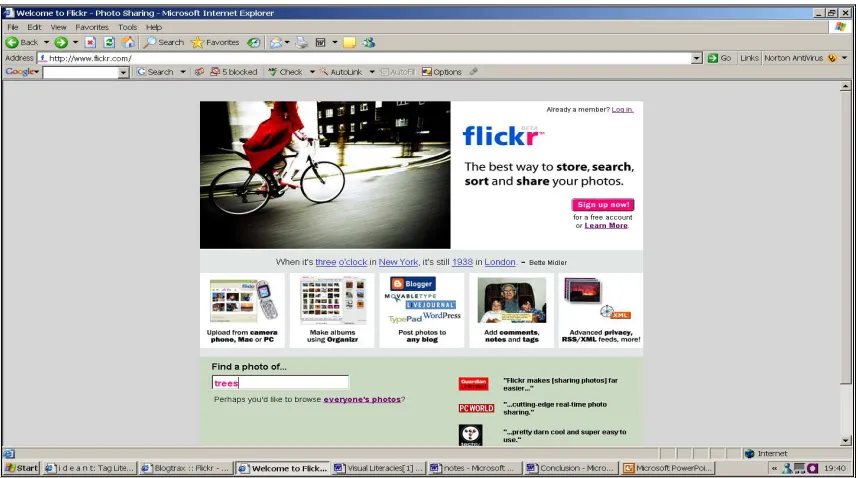
Figure One: Welcome page of Flickr (http://www.flickr.com/)
Like many ÔFlickritesÕ I initially came to the site simply intending just to use it to upload my photographs to a
space from where I could publish to my blog (online web blog). With the recent surge of interest in blogging
internationally, this has meant a concomitant interest in spaces like Flickr. Similarly, others arrived intending
just to set up photographs for use on other sites, perhaps personal sites, market place sites, (such as
e-bay), or shared interest sites. Some individuals have been attracted by the idea of sharing photographs with
friends and family Ð a kind of online glass cabinet or photograph album. Others will have arrived from
reading blogs and following links from those (Butterfield, 2005; McClellan, 2005). It is possible to use Flickr
in these singular, purposeful ways and not become involved with other peopleÕs content; one can mark
without a password, simply looking at images without sharing or interacting with others. In GeeÕs terms
(2004), it is possible to interact with just the content, just other particiants, or to interact with content and
other participants. Yet as has been established above, the site is more than a static repository and most
users participate in the social affordances of the space (Butterfield, 2005) In the pages below, I describe the
ways in which interactivity is facilitated and the ways in which interactants come to learn. Here I show a
range of portals to the site and a variety of ways in which content can be generated and organised Ð a
crucial factor in provoking interaction. Yet all those who interact on the site, either by looking, reading,
commenting or uploading, will be relating in some way with the image-related content, thus sharing, Ôa
common endeavourÕ (Gee, 2004: 85).
Content Organisation and Interactivity
Crucially, the organisation of content and the interactivity of the site work in unison, with each fostering the
other, keeping the site viable and dynamic. By tying one to the other, the motivation to remain involved in
both is high. By contributing content, one interacts and can select the degree of interactivity; conversely, in
order to interact one can select to contribute from a range of content possibilities. For example, in
contributing images, there are a number of choices offered, so that one can label the new images with tags,
(of any kind, such as according to theme, genre, content, colour, literally any label); organise them in sets
(again of any kind); contribute to a communal group; add comments/captions or a description to the image;
or even add textual notes superimposed on the images themselves (the text is revealed by gliding the cursor
across a given image). In this way individuals can extend the modality of their images and can use the
image to interact with others; moreover, in order to add tags, it is necessary to repeatedly examine the
details of the photograph so that they can be mentioned. In this simple way, visual literacy skills become
sharpened. Below I offer details of how the range of modes provide different affordances, provoke different
kinds of interaction and affect the fabric of the site.
Comments
Comments can be left by anyone with a Flickr account, and as in advertising, these align the image with
particular meanings. Comments often indicate why the photograph may have been placed as part of a group
or set, how a person wants others to interpret and see the photograph, or to give information about it. Often
the comments will give information about how the photograph came to be taken, including biographical
detail. Flickrites often get to know each other through comments and sustain dialogue over a period of time.
Notes
Through comments and notes, images are affected semiotically, since words can work to emphasise some
features, undermine others or explain. In the example below, Miss Peach has shown the contents of her
handbag, and has added notes for further interest and information, such as: Ôpink make-up bag got from
JapanÕ, or Ôsamsung triband colour flip phoneÕ, and Ôbeloved Dior messenger bagÕ. This is a carefully
photographed still life; not only is Miss Peach able to indicate aspects of the image she wants us to notice,
such as the brand name of items and the co-ordinating theme of her personal affects, but she performs
important identity work, since she makes it clear that this is her bag and belongings. Picking up on these
themes comments from others include, ÔIt all matches too, awesomeÕ and Ônice, jÕadore Dior aussiÕ.
At the time this image was placed on the site, many other similar noted-images proliferated, for the note
facility had been newly introduced. The knowledge for using notes became distributed through use of the
application and via the Help Forum. Miss Peach subsequently added her image to the ÔWhatÕs in your bag?Õ
photo pool; through this action Miss Peach became an active member of the group. The image thus became
part of a new set, accruing slightly different meanings than those it had when left side by side with her other
work. . The arrangement of her image alongside others of that genre, meant that it accrued new meanings,
set adjacent to others, reflecting the groupÕs interest in collections of items. An image which alongside Miss
PeachÕs other work was a reflection of her, but alongside other collections reflected for example, collective
[image:10.612.91.483.449.692.2]interest in this new genre and in other membersÕ lives.
Tags and Groups
When uploading a photograph, as described above, any number of single word tags can be listed to
describe that image and these will be the words which will afford the selection of that the image via a search
engine. For this reason, many Flickrites put as many tags as they can to each image, maximising interaction
opportunities. That comments are highly valued was confirmed through my questionnaire respondentsÕ
words; typical responses included, ÔI love feedback on my photos.Õ (Ingrid, 2005); ÔI adore people to
comment on my work.Õ (Rachel, 2005), and as Billy (2005) would have it, ÔI always comment on other
peopleÕs photos cuz I ABSOLUTELY LUVV IT when they comment on mine!! ;))Õ. The tags help support
interactivity and keep traffic to an individualÕs photographs high.
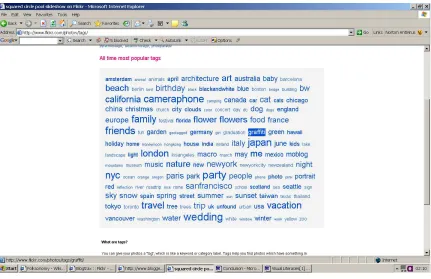
Within Flickr, one page reveals the most popular tags, arranged alphabetically, with larger font to reflect te
most popular tags. This Ôtag cloudÕ is generated and constantly updated according to use, and whilst it is
responsive to practice, practice is undoubtedly affected by the cloud itself, since Flickrites are motivated by
[image:11.612.91.522.372.651.2]interactivity.
Yet tags also function as content-organisers; they classify images in a manner which reflect usersÕ interests;
they allow re-definitions within Discourses and Funds of Knowledge, privileging some concepts above
others. Tags are powerful since the choice of category implies something about the value system of those
who use that tag; by classifying images, one can impact on the way the images are interpreted; moreover if
a tag seems popular, Flickrites may be encouraged to actually look for things in ÔmeatspaceÕ that could be
labelled with a particular tag Ð and thus increase traffic and interactivity around their images. The term
ÔfolksonomyÕ has gained currency on the Internet to describe this phenomenon, (wikipedia.com 2005b) of
the way content management impacts upon shared meanings and the development of cultural
understandings. Thus the Flickr tags bring together images in particular ways, and tags can be used to pull
together images from right across the space. Tags can overlap, reflecting diverse interests and possibilities
in terms of reading images and thinking about the world from which they come. As the images provide the
digital landscape of the Affinity Space, the ways they are classified represent FlickrÕs folksonomy.
A ÔgroupÕ on Flickr is a specialised term, which describes the way in which one person (or several) can
gather together, or invite others to contribute images which fit a particular category. More strongly than tags,
I believe that groups on Flickr groups reflect the folksonomy of the space. These groups come in a wide
range of forms and often when a new group begins, Flickrites, will search their existing collections for
images to contribute. Some groups require a great deal of effort to contribute, in terms of finding appropriate
items to photograph; others require great observation skills; some will involve the elaborate setting up of a
contrived photograph, whilst others require online technical skills to manipulate an existing image. Groups
can therefore impact on the way FlickriteÕs live their lives; they can lead individuals to review and reinterpret
existing photographs or to develop their technical expertise. One particularly elaborate group was set up
by a parent in order to involve international support for her son to carry out a project. The group members
needed to go to a site which held an image of ÔFlat StanleyÕ, (Hapakorean 2005a) a character from a
childrenÕs book. They then needed to cut out this picture and then take a photograph of themselves and
upload the photograph to the Flickr group, (Hapakorean 2005b) prior to uploading to the project site (Caleb,
2005). This project allowed the child to be involved in a project of international proportions; the interactivity
and co-operation from Flickrites, made this a particularly Ôcreative commonsÕ type of activity. Some groups
work as games, for example ÔVisual BingoÕ invites images which represent the numbers called on the
traditional game of Bingo, such as Ô8 = Garden GateÓ. ÔPhotochainÕ asks for contributions a little like
dominoes; the first mage might have a cigarette as main focus, but there is a key in the background. A key
could be the main focus of the next image. Figure Three (below) presents a chart reflecting some of the
groups on FlickÕr; these are organised to reflect what is required of Flickrites and how the groups operate as
(Add Figure Three here.)
The term ÔmemeÕ describes the process whereby a cultural unit, maybe a word or sign, passes around a
group, embedding itself within the culture (wikipedia.org, 2004). Memes in Flickr promote group cohesion
contribute to its social history, acting like social cement. A meme is often an Ôin-jokeÕ across a group of
people. Knobel (2005) describes memes as
contagious patterns of cultural information that are passed from mind to mind and which directly shape and propagate key actions and mindsets of a social group. Memes include popular tunes, catch-phrases, clothing fashions, architectural styles, ways of doing things, and so on.
(Knobel, 2005:1)
One such meme is the use of groups as discussed above where members are required to locate particular
instances to photograph to contribute to the Affinity Space; the Affinity Space of Flickr thus widens into the
daily lives and experiences of participants and the meme enters their everyday lives, affecting the
Discourses there. Figure Three shows how this might involve users in looking at the world in new ways as
described by the groupÕs theme - whether it be ÔForsaken by SocietyÕ, Ôstar not starÕ or ÔVisual resistanceÕ, for
example. Individuals may need to be particularly observant; audacious or bold; to go to specific places or to
do particular activities. Biographical comments suggest that many FlickritesÕ life experiences are shaped
partly by the desire to offer certain shots to particular groups.
More on Groups: Developing Ways of Seeing
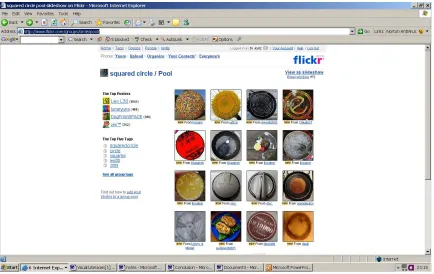
The group ÔSquared CircleÕ had an astonishing 2588 members at the time of writing (July 2005) and eligible
images are simply ones depicting a circle in a square. This intriguing set of images is a disparate collection,
including buttons, plates, knobs, CDs, flower centres, wheels and so on. It is easy to find items to add and to
do so is to become part of one of the largest groups on the site, contributing to a huge patchwork that is
Figure Five: The Squared Circle pool 2005
More difficult to contribute to, requiring observation skills as well as either individual knowledge (from oneÕs
head) or distributed knowledge (information taken from the site itself) is Visual Bingo. The group ÔStar not
StarÕ, requiring representations of stars, has people finding the shape in flowers, lights, tattoos, drawings,
jewellery and so on, with commenters often noting the ubiquity of the star symbol. In this exchange of
comments we see that there is a keenness not only to join in but to have good photos too:
Once you start looking you see stars everywhere
t'aint that the truth. Of course, of the five or so that I've seen in the last couple days,
all of my photos came out like crap.
Accommodating Discourses
In this next photograph we see how the search for a striking contribution to Star not Star involved a number
Figure Six: Star not Star: Becky 2005
The behaviour of the American based Becky, and her primary school pupils, was affected by the idea of Star
not Star, originating from an English Flickrite. BeckyÕs image received more than 70 complimentary
comments, ranging from one word accolades, to detailed descriptions about the light and shade, the
symbolism and composition, for example. 53 people picked it as a ÔfavouriteÕ and within two months had
been viewed 380 times, thus becoming iconic within the group. These comments were interspersed with
replies from Becky, who overwhelmed by the responses, gave additional details about taking the
photograph. Here is her third reply:
Oh my..such thoughtful words...thank you so very much. Actually, while conducting a
photo contest out in the school yards and in-between my kids taking turns with their
shots...the others and I made time for some shadow play in the grass as the sunshine
was brilliant, and for some odd reason, this idea dawned on me and while trying to put
this together in my mind on how to compose such a thing, it just fell into place even
with the inability to form and join their hands together to make this star. And I just
basically held out my camera underneath their arms and shot away. It really was a
spontaneous effort on my part...and the kids were thrilled to death by it. I feel very
proud of myself for this shot...finally, for once.
Becky shared her experience, embedding it within the social history of the group. Despite BeckyÕs insistence
that the shot was achieved through luck, continual praise prompted her to more carefully articulate and
re-consider events in a process that reflected heightened consciousness of the way the light helped her
achieve success. BeckyÕs participation in the group helped her reflect repeatedly on her experiences and to
consider them in the light of the groupÕs valorisation, thus learning from them and developing the way she
thought about the photograph.
Sharing Values through Wit
Other memes within the Flickr Affinity Space operate as pure fun, sometimes requiring daring and wit. ÔGirls
eating SandwichesÕ group is a humorous look at the often embarrassing scenes of overloaded bread rolls
and buns, enthusiastic eaters, and an insight into peopleÕs lives. Brought together as a group, the images
look comical and Flickrites therefore share a joke, showing tacit agreement that Girls eating Sandwiches
often look funny. Similarly, the absurd humour in the collection named ÔShopping CartsÕ shows abandoned,
broken or overloaded carts, making a collaborative joke through the accumulation of images. Some memes
wittily dig at contemporary political or social themes, such as the UKÕs General election campaigns, Charles
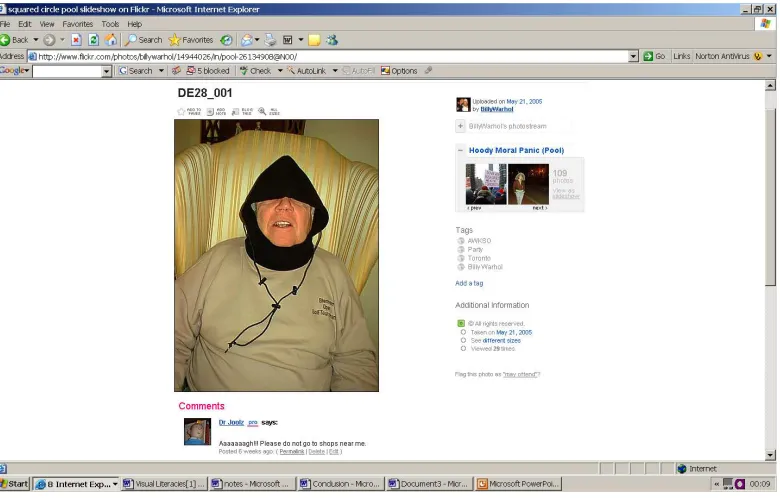
and CamillasÕ wedding and the installation of a new pope. The group ÔHoody Moral PanicÕ refers to Media
coverage in the UK about youths going in shopping centres wearing hooded jackets and behaving badly.
[image:16.612.92.482.449.698.2]This photograph exemplifies the ironic stance taken by the group:
By contributing in this way, individuals make political alliances and statements through images and wit.
Comments like Ômust... cross... street... to escape this... venemous villain!Õ continues this joke in the same
vein, valorising knowledge of politics gained beyond the Affinity Space Ð dispersed knowledge. In cases like
this, local to the UK, those beyond the borders comment with their views on the situation, able to take on the
joke and the politics which implies that the Affinity Space has permeable borders where these politics are
relevant to all.
Ways of Seeing: Part 2 (Distributed and Dispersed Knowledge)
The art of photography attracts many who are interested in other kinds of visual representation, so in
addition to encouraging the search for patterns and shapes in the environment as discussed above, others
focus on Street Art, graffiti and even the work of individual street artists such as Banksy. Within these
groups there are discussions about how street-art should be valued; the identifying features of particular
artists, genres and subjects. Often there are links to other sites with academic articles about Street Art,
exhibitions or maps giving the location of particularly interesting pieces of work. All types of knowledge are
given value, affirming a further principe of GeeÕs Affinity Spaces (2004). In this particularly brave shot, there
is a nice juxtaposition commented upon by the photographer himself, (Ôtaking a snap of a favourite Banksy
when he walks into shotÉ how fortuitousÕ) as well as others, who note for example, ÔWonderfully timed -
[image:17.612.93.483.449.695.2]great shot!Õ:
The careful, ironic titling and the excitement at the fortuitous composition of the image reflect a group which,
(shown in comments throughout this groupÕs work), values careful composition, knowledge of the artists and
the location of their work. Individual, dispersed and distributed knowledge is pooled within the group, with
discussions referring to images elsewhere on Flickr as well as sites beyond.
Reviewing Funds of Knowledge through newly acquired skills
Browsing through the site, examples of ways in which individuals are looking anew at familiar places
abound. For example, SlimFattyÕs set ÔTourist at homeÕ illustrates her new perspective on familiar territory.
She comments on the set she has made:
These are pictures that a tourist might take here in Philadelphia. I'm a native to this
city and because of my interest in photography, there are lots of places in the city
that I'm only just now taking an interest in.
SlimFatty, 2005
SlimFattyÕs photographs reflect her growing expertise and confidence over a period of time, and her
comments about her work reflect her awareness of that learning process. For example she discusses self
portraiture, her use of colour, her new camera, and later, the acquisition of a zoom lens. Some groups are
dedicated to self-conscious work, so there are meta-groups featuring images of people taking photos and
groups which are set up to look like stills from films for example. The ÔDirector of PhotographyÕ features of
shots taken not from films, but are evocative of film genre. By contributing to this group, one requires either
tacit, intuitive or schooled knowledge of conventions film conventions; the ability to observe what is being
imitated and stylised in film; the keen eye to select from unrehearsed, ÔnaturalÕ contexts, moments which
appear staged or that evoke film-realism. Bringing these to the Flickr space, is to renegotiate the meanings
Figure Nine: Director of Photography: Traversing the tunnel: Lorenzo: 2005
The kinds of photograph one would expect to find in private family albums are also to be found abundantly
in the Flickr space. Moreover, much of the interaction that takes place in the comments sees the exchange
of personal details, biography sharing - anecdotes revealing a perhaps somewhat disarming show of trust.
We see comments of the quality we witness when ÔrealÕ artefacts are passed hand to hand. First days of a
newly born babyÕs life, marriages, christenings, refurbished homes, parties, even births are shown. The
gathering of artefacts, of experiences of family groups smiling out radiantly, or solemnly with graduation
scrolls and so on, give a unifying feel to these experiences which are ceremoniously marked. Despite the
many warnings that digital photographs are dangerous, that pornographers manipulate images for sinister
ends, there is an overwhelming number of infants photographed full faced and displayed publicly within the
space. It is as if Flickrites in their great numbers are acting in defiance and somehow through abundance of
availability, as though the shared practice of showing such ÔriskyÕ images lose the currency often accrued
through rarity.
The comments which follow HapaKoreanÕs pictorial presentation of her family life (Hapakorean 2005c), are
children and so the space provides a forum for discussing motherhood in a particular way too. Take this
short extract as an example:
i think your babies are just the sweetest things... i cant wait to have my own =)
Awe, thanks. =) I love them to pieces. Ever since I was a little girl I always wanted a
big family. I lucked out and found a husband who wanted the same. Three boys
down, one last shot to go for that little girl. =) We'll wait 2 years before that venture.
The birth of your 1st child will change you forever. You'll love like you never imagine
you could love. It's AMAZING.
KrissieP and HappaK March 2005
Nevertheless, Hapakorean has chosen to licence her photographs in such a manner that copies cannot be
made; there is varied practice across the site, since the choices are there. Some people choose to keep all
images private; some keep them all public Ð some have a mix. Similarly, some have all their work will all
rights protected, while others allow copying of all the work; others have a variety of options depending on
the type of image.
I have shown above ways in which different groups require different kinds of knowledge, (individual,
distributed, dispersed and even tacit), which foster different types of allegiance and coherence expressed
through a range of modalities. In order to add particular types of image, different knowledge is required,
demonstrating the close relationship between content management, interaction and learning. I have shown
how individuals share Funds of Knowledge and Discourses through the matching of images to particular
ideas and how memes work to affirm the ÔfolksonomyÕ of the space. Images are the primary means of
connecting and most Flickr members choose to take part in interactions, since these so keenly anchor
preferred meanings to content, and this in turn provokes interaction from others.
Additional routes to interactivity and status
To acquire a great deal of traffic to oneÕs personal photostream is a key way in which to gain status, but
there are many ways in which traffic can be acquired. Many Flickrites spend a lot of time commenting on
otherÕs work, sometimes putting links in to their own photographs of similar content.
Onlookers can add a ÔfavouriteÕ tag to a photograph; this is one way to show admiration, whilst another is to
photographer and url location to a selected blog. In this way traffic is increased to that personÕs part of the
Flickr space. ÔFavouritingÕ is often reciprocal and so it pays off to be supportive of others. Moreover, one can
make someone a ÔcontactÕ and thus have them listed on oneÕs own space. This works as a prompt to look at
their photoÕs regularly and again, interactivity is promoted since the process of contacting is usually
reciprocated. This kind of activity reflects the many ways of gaining status and contact groups often reflect
the professed interests of individuals. Thus there are groups of contacts which are primarily interested in
graffiti, for example, or in professional type ÔartyÕ shots, for example.
Content Generation and Knowledge sharing
Members can join a range of fora, some of which are run by the ÔFlickr TeamÕ, such as the help forum; a
place for suggesting new ideas to the team as well as to other Flickrites. Innovation is highly valued and the
invention or extension of uses of existing software is a constant source of discussion. News travels fast and
memes like the Flickr badge, or travels fast and has high currency. New ideas spread quickly since they
can be seen in use immediately, publicly shared and exemplified in a range of creative ways. Some experts
gain great notoriety and admiration whilst photographs they take are of less interest. In this way we see how
[image:21.612.169.443.413.607.2]different types of knowledge are valued and that all portals allow routes to different types of leadership.
Figure Eleven: The authorÕs Flickr ÔbadgeÕ
Conclusions
Digital technologies are supporting many individuals to become more visually literate; that is we are
ideas and new ways of seeing and to bring cultural understandings together with others, where they can be
re-examined, used and transformed in the image making practices of others. I have found GeeÕs work useful
in deconstructing how these processes function; he shows how by valuing the different types of knowledge
that individuals might share with others in a space, develops the learning of many. Communal activities such
as those seen on Flickr have the potential not only to help individuals learn from each other but to also to
create new meanings together. These new meanings can reside socially within that Third Space in which
they have been created, but they can also support individuals to see their world in new ways. GeeÕs
delineation of the features of Affinity Spaces, sheds light on the features that need to be in place for the
creation of Third Spaces which as he argues, could potentially be created on line or within classrooms.
Further Work
I aim to continue this exploration of Third spaces, Affinity Spaces and theories of social learning. As yet
un-problematised in this piece are the dimensions of power I have seen; despite the creative commons
atmosphere engendered through the reciprocity built into the structures and through the multimodal
affordances, nevertheless there remain un-theorised hierarchies of power. BernsteinÕs work on vertical and
horizontal discourses (1999) and BourdieuÕs (1986) forms of capital will be invoked in order to develop
understand how these processes operate within online affinity spaces. .
References
Anya (2005) E mail correspondence with author, retrieved 15th June 2005.
Becky (2005) Retroeve in Star not Star. Retrieved 4th July from http://www.flickr.com/photos/idio/12700924/.
Bernstein, B. (1999) Vertical and Horizontal Discourse. In British Journal of Sociology of Education. Vol20:2
157-173.
BillyWarhol (2005) Hoody Moral Panic: DE28-001. Retrieved 3rd July from
http://www.flickr.com/photos/billywarhol/14944026/in/pool-26134908@N00/.
Bourdieu, P. (1986) The Forms of Capital (ranslated by Nice, R.) in J.G. Richardson (1986) Handbook for
Butterfield, S. (2005) Ô Developing a new Photo CommunityÕ interview retrieved 30th June 2005 from
http://www.forbes.com/video/?video_url=http://www.forbes.com/video/fvn/tech/tm_flickr&id=tm_flickr&title=D
eveloping+A+New+Photo+Community&tab=Technology.
Bhabha, H.K. (1990) The Third Space. In J.Rutherford (Ed.) Identity, community culture, difference (pp207
Ð 221)). London: Lawrence and Wishart.
Bhabha, H.K. (1994). The Location of Culture. London: Routledge.
Caleb, (2005) CalebÕs Flat Stanley Project. Retrieved 26th July 2005 from
http://calebsflatstanley.blogspot.com/
Davies, J. (2005 forthcoming) Nomads and Tribes: Online meaning-making and the Development of New
Literacies. In J. Marsh and E. Millard (eds.) Popular Literacies, Childhood and Schooling. London:
Routledge/Falmer.
Davies, J. (2004) Negotiating Femininities on-line. Gender and Education 16(1), 35-49
DrJoanne (2005) Email correspondence with author, retrieved 14th June 2005.
Flickrblog, (2005) Yahoo actually does acquire Flickr. Retrived 30th June 2005, from
http://blog.flickr.com/flickrblog/2005/03/yahoo_actually_.html.
Flickrtags (2005) Flickr most Common tags. Retrieved July 4th from http://www.flickr.com/photos/tags/.
Flickr meetup (2005) Find Flickr Fan Groups in Your area. Retrieved 30th June 2005 from:
http://flickrfan.meetup.com/
Gee, J.P. (2004) Situated Language and Learning: A Critique of traditional Schooling. London: Routledge.
Gee, J.P. (2003) What Video Games have to Teach us about Learning and Literacy. New York: Palgrave
Macmillan.
Gee, J. P. (2000) The New Literacy Studies, in D. Barton, M. Hamilton, and R. Ivanic, (eds.) Situated
Gee, J.P. (1996) Social Linguistics and Literacies: Ideology in discourses (2nd Edition). London: Falmer.
Hapakorean (2005a) Flat Stanley retrieved July 26th 2005 from
http://photos13.flickr.com/14413302_56b8e4c787_o.jpg
Hapakorean (2005b) Flat Stanley Group. Retrieved 26th July 2005 from
http://www.flickr.com/groups/flatstanley/
HapaKorean (2005c) Baby FeSee Bryce Grow. Retrieved July 4th 2005 from
http://www.flickr.com/photos/hapakorean/sets/124285/.
Hicks, M. (2004) Online Collaboration Borne From Multiplayer Game. Article retrieved 30th June 2005 from
http://www.eweek.com/article2/0,1759,1526440,00.asp.
Tik, J. (2005) Why is Flickr so Successful. In Flickr Photosharing. Retrieved online 3rd July 2005 from
http://flickr.com/groups/topic/36512
KrissieP and HappaK ( 2005) No Photos Please: Comments. Accessed July 5th 2005 from
http://www.flickr.com/photos/hapakorean/5706943/
Knobel, M. (2005) Memes, literacy and affinity spaces: Implications for policy and digital divides in
education. Conference paper presented to the ÒPolicy Options and Models for Bridging Digital DividesÓ
Conference Global Challenges of eDevelopment Project, March 14-15, 2005. Retrieved 26th JULY 2005
from http://www.geocities.com/c.lankshear/memes1.html
Leander, K. and Sheehy, M. (Eds.) (2004) Spatializing Literacy Research and Practice New York: Peter
Lang.
Lt.Tl (2005) Reading Faust. Retrieved online 26th July 2005 from
http://www.flickr.com/photos/74878147@N00/28141651/.
Lorenzo (2005). Director of Photograhy: Traversing the tunnel. Retrieved July 4th 2005 from
/Luke, A and Carrington, V. (2002). Globalisation, Literacy, Curriculum Practice. In R. Fisher, M. Lewis & G.
Brooks, (Eds) Language and Literacy in Action. London: Routledge/Falmer. Retrieved 2nd July 2005 from
http://www.education.tas.gov.au/english/word/Global.doc
Margo (pseudonym) (2005). E mail correspondence with author, retrieved June 15th 2005.
McClellan, J. (2005) An innovative photo organising service is taking the web by storm. Retrieved 29th June
2005 from:http://www.guardian.co.uk/online/story/0,3605,1403974,00.html. February 3rd 2005.
Miss Peach (2004) Whats in my bag?: Peachbag(1). Retrieved July 3rd 2005 from
http://www.flickr.com/photos/peach-life/2431236/).
Moje,E.B., Ciechanowski, K.M.mKramer,K., Ellis,L.,Carrillo, R., Collazzo, T. (2004) Working towards third
space in content area literacy: An examination of everyday funds of knowledge and Discourse. In Reading
Research Quarterly 39(1)( pp38- 70). International Reading Association.
Moll, L. (2000). Inspired by Vygotsky: Ethnographic experiments in education. In (C. Lee & P. Smagorinsky,
Eds). Vygotskian Perspective on Literacy Research: Constructing Meaning through Collaborative Inquiry.
(pp. 256-268). Cambridge University Press, Cambridge, MA.
Phil*s (2005) Banksy: Death Cop. Retrieved 3rd July from
http://www.flickr.com/photos/36147733@N00/22930373/in/pool-banksy/.
Reggio (2005) E mail correspondence with author, retrieved 17th June 2005.
Sheehy, M. and Leander,K. (2004) Introduction. In Leander, K. and Sheehy, M. (Eds.) (2004) Spatializing
Literacy Research and Practice New York: Peter Lang.
Soja, E.W. (1996) Thirdspace; journey to Los Angeles and other real-and-imagined places. Malden, mA:
Blackwell.
Sheehy, M. and Leander, K. (2004) Introduction. In K. Leander and M. Sheehy (eds.) Spatialising Literacy
Slimfatty (2005) Tourist at home. Retrieved July 3rd 2005 from
http://www.flickr.com/photos/slimfatty/sets/240419/.
Wikipedia.org (June 2005.) Meme. Retrieved 3rd July 2005 from http://en.wikipedia.org/wiki/Meme. (modified
3rd July 14.07)
Wikipedia.org (June 2005b) Folksonomy. Retrieved 4th July 2005 from