Rochester Institute of Technology
RIT Scholar Works
Theses Thesis/Dissertation Collections
2013
Cuddlefish
Rebekah Gamin
Follow this and additional works at:http://scholarworks.rit.edu/theses
This Thesis is brought to you for free and open access by the Thesis/Dissertation Collections at RIT Scholar Works. It has been accepted for inclusion in Theses by an authorized administrator of RIT Scholar Works. For more information, please [email protected].
Recommended Citation
CUDDLEFISH by Rebekah Gamin
SUBMITTED IN PARTIAL FULFILLMENT OF THE REQUIREMENTS FOR THE DEGREE OF MASTER OF FINE ARTS
IMAGING ARTS/COMPUTER ANIMATION SCHOOL OF FILM AND ANIMATION COLLEGE OF IMAGING ARTS AND SCIENCES
ROCHESTER INSTITUTE OF TECHNOLOGY ROCHESTER, NEW YORK
May 2013
_____________________________________ Tom Gasek, Chair
Assistant Professor
School of Film & Animation
_____________________________________ Charles Bandla
Visiting Faculty
School of Film & Animation
_____________________________________ Mark Reisch
Lecturer
Table of Contents
Abstract …... 3
Acknowledgements …... 4
Introduction …... 5
Preproduction …... 6
Art Direction …... 6
Character Design …... 9
Story Development …... 16
Further Study …... 17
Production …... 18
Animation …... 18
Set Modelling, Texturing, & Lighting …... 19
Postproduction …... 20
Audio …... 20
Compositing …... 20
Critique Reception …... 22
Abstract:
“Cuddlefish” is an animated graduate thesis film about a young girl who befriends
a giant squid. The story contains themes of rejection, hopefulness, and forgiveness. The
film’s protagonist, a young girl, ambles alone down a busy boardwalk at dusk. She meets
a giant squid who is also in need of companionship, and they become friends. However,
it’s difficult to be friends with a squid.
The film was produced primarily in Autodesk Maya with post-production done in
Adobe After Effects and Adobe Premiere. The film has a runtime of three and a half
minutes. The protagonist and antagonist of the film, along with the environments, were
modelled and rendered three dimensionally in Maya. The secondary characters of
passersby and a cat were drawn two dimensionally and rigged in Maya in a “paper
cutout” style. Opening and closing titles were added in Adobe After Effects. Also, an
underwater overlay effect was done in Adobe After Effects. Music and sound FX were
added in Adobe Premiere.
The production of “Cuddlefish” stretched out over 5 years, with the majority of
that time being spent in pre-production developing the characters and their story in an
attempt to achieve emotional depth while still maintaining brevity. This paper will be a
record of the process of making “Cuddlefish” and the lessons learned along the way.
I would first like to thank my partner, Joseph Arcovitch, for his unwavering
support and encouragement along this five year journey. In addition to being a sounding
board for story and production process ideas, he also did the final modelling of my sets,
modelled a wardrobe for the girl character, and set up the lighting and rendering for the
film. His assistance was invaluable.
I’d also like to thank my advisor, Tom Gasek, for his patience and persistence in
encouraging me to finish my film. I didn’t realize when I asked him to be my thesis
advisor, I’d be asking him to commit to five years worth of emails, but he stuck with it.
He gave me advice while still respecting my right to follow my own path in production.
I’d like to thank my friend Ignacio Barrios for taking my girl character and
re-modelling her and adding a feature-film-quality rig to her. I struggled for a very long
time in making her appealing and he has a talent for adding charm to characters that
renewed my zeal for my own film.
Thanks to my committee members, Mark Reisch and Charles Bandla for staying
on board and dropping in with important secondary feedback.
Also, thanks of course to my family, who are always in my corner, especially along
a five-year production of a short film.
Introduction:
year, I was preoccupied with the idea of loneliness and seeking companionship. I felt
fascinated by the idea of getting rejected and being able to recover and put yourself out
there again. This lead me to writing a short story about 3 young orphaned sisters on an
island. When two of the sisters were eaten by a maniacal giant squid, the third girl
attacked it, sacrificing herself until she’s rescued by a giant golden koi who brings her
back to life. Since this was generally un-produceable, that story got trimmed and altered
until it resembled my official pitch about a girl on a pier, befriending a squid. From there,
I was off to the races on pre-production.
Preproduction:
After completing my coursework at RIT, I moved out to San Francisco in order to
set myself up for industry-related employment, and began pre-production.
inspirations was the Yuriy Norshteyn film “Hedgehog in the Fog.” I saw this for the first
time in my History of Animation course at RIT and it stuck with me. The soft color
palette, rich textures, and of course, the fog itself, were mesmerizing. Normally I would
avoid finding inspiration in the same medium, but I felt I would be able to differentiate
[image:7.612.74.538.534.693.2]my film sufficiently in medium and storytelling that it would feel entirely new.
fig 1 - images from Yuriy Norshteyn’s “Hedgehog in the Fog”
I was also inspired by the illustrator Irma Gruenholz. She does diorama-style
illustrations using plasticine clay and shallow depth. I wanted to incorporate this depth
fig 2 - Illustrations by Irma Gruenholz
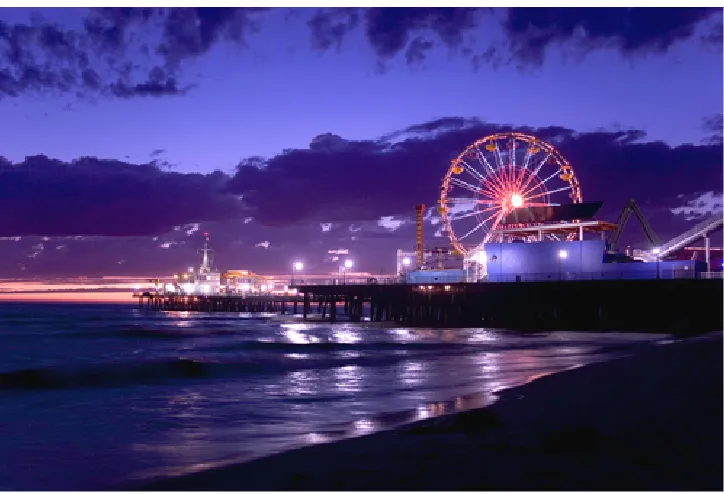
Other inspirations for art direction included the Santa Monica Pier for its’ iconic
circus-on-a-pier silhouette. Also, the San Francisco Bay area furthered my love of fog.
The evening “blue soup” fog I drive home across the Golden Gate bridge in is both
isolating and beautiful. Another inspiration was”tilt shift” videos taken of Walt Disney
World. “Tilt shift” is a technique of selective focusing that makes the subject look like a
[image:8.612.125.487.286.533.2]miniature. It was my hope that this would add to the tangibility of the film.
fig 4 - San Francisco fog, Walt Disney World photographed in “tilt-shift”
Much later on I was also inspired by the television show “Jelly Jamm” which has
that plasticine look I was going for and an extreme style of animation that is very
appealing. It is limited while still being expressive. I studied this animation technique in
order to improve the readability of my animation
fig 5 - promotional image from the television show “Jelly Jamm”
[image:9.612.164.449.440.606.2]the final versions. The original designs for the squid were, obviously, based on squid
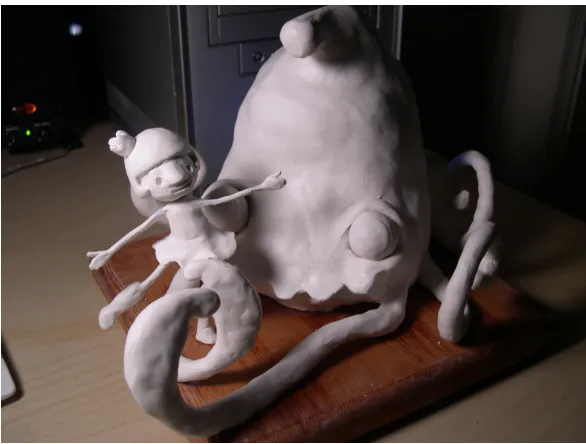
[image:10.612.109.402.152.374.2]anatomy. I began by creating a maquette of my characters.
fig 7 - early squid character design sketches
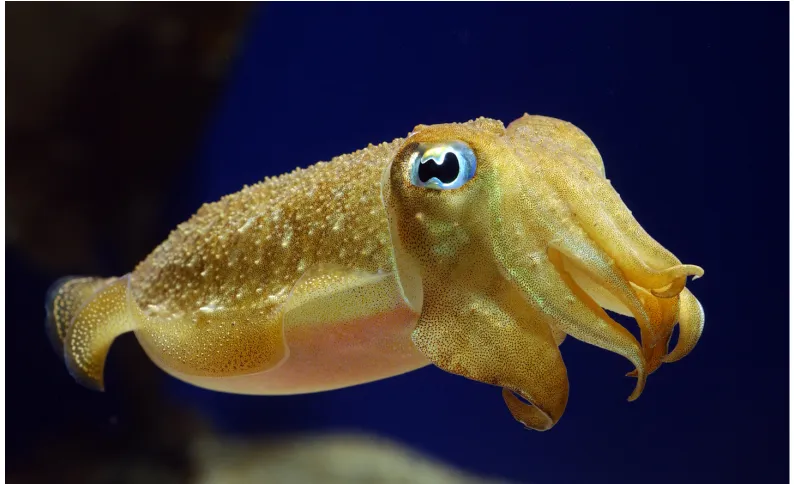
I ran into a major problem in getting the squid’s face to be expressive enough to
carry his role in the film. After a trip to the Monterey Bay Aquarium and seeing the
cuttlefish exhibit, I was inspired to redesign my character slightly after the anatomy of
the cuttlefish. The cuttlefish has large eyes on the front of his mantle with what look like
brow ridges (eyelids), and two primary arms with secondary tentacles hanging off either
altered my model to reflect the cuttlefish and I also came up with the idea for the final
[image:12.612.107.504.154.396.2]title of the film at this point.
fig 8 - cuttlefish
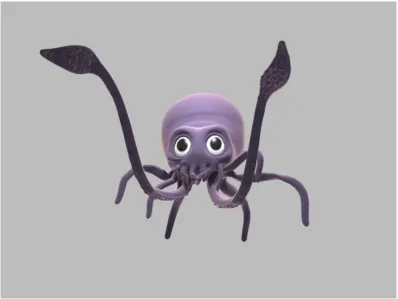
I rigged the squid using the plugin for Maya called The Setup Machine which
allowed me to add an unlimited amount of tentacles. I had difficulty rigging the squid’s
face so I stuck with something simple and skinned the brows to joints which I controlled
by their rotation. I rigged the eyes using a texture and animating the UV’s. I rigged the
lids by creating multiple models of the lids in different positions and then swapping
fig 9 - final character design for the squid
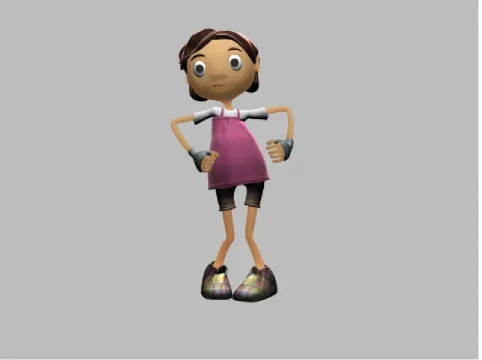
The design of the girl was much more taxing. I modelled my original sketches but
struggled with her face a great deal. Also, while her character was written to be very
young (7 or 8) the model ended up looking much older (like 12 or 13). I worked with this
model for a long time before cutting my losses and resigning to rigging her in order to
fig 11 - first pass girl model
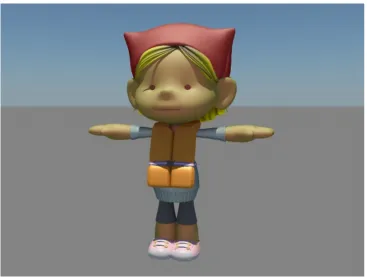
After running into problems rigging her face, I appealed to my friend Ignacio
Barrios for help as he is a professional technical director. He offered to remodel the girl
because she needed better edgeloops to make the rig work, and he had an idea of how to
soften her model in order to make her look much younger. I was over the moon when he
sent me his sketches of the redesign and I’m just as pleased with the final version of her.
I sketched up a wardrobe for the girl and Joe modelled them for me and I skinned
them to my final rig. I also rigged her eyes to match the squids using a texture and
think it was ultimately worth it to get a much more appealing character.
fig 12 - final girl model
I also required some tertiary characters to fill out the story. I did some early
tests of animating these character two-dimensionally in Flash. While I was happy with
how these turned out, they were relatively time consuming. After assisting Joe
Arcovitch on his thesis film “Mystery Spot”, I fell in love with his hand drawn characters
that he turned into puppets in Maya, as if they were paper cutouts. I asked him to
create a generic black-silhouetted figure of a man and a woman and a cat which took him
very little time, and I was thrilled with the quick results in the final film . You get the
sense that the girl is surrounded by other living beings but they are separate from her
I did rough set design for the entire film as one complete set that I could shoot
around. I did this so that I could reference this one complete set file into all of my
animation files. I added the Maya oceans plugin to this set and with minor color and
scale tweaks, it looked quite good. I decided to create the underwater shots using After
Effects so I followed a tutorial to create the light rays and bubbles effects and was able to
overlay this on my underwater shots to good effect.
My storyboard and animatic probably took the majority of my pre-production
time. I worked and reworked the story many times to try to get the story powerfully
across with the least amount of superfluous detail possible. During this time, I pondered
over separating my characters as a protagonist and antagonist and clarifying their
motivations. My advisor and I went back and forth on this topic at length. I discovered
that while the squid is a more interesting character, in order to achieve what I wanted to
with the story, I had to spend more time with the girl in order to convey a convincing
story arc. This forced me to stretch out the introduction section of the film to set up the
two characters meeting. I also simplified the squids character into basically a puppy so it
wouldn’t overcomplicate things in such a short film. I was pleased with how this allowed
me to spend more time on the emotional beats and sell them.
While working on my animatic, I enrolled in supplementary online animation
courses to increase my abilities specifically in character animation. I knew after my
one-quarter and two-quarter films that I had a long way to go to be able to produce
emotionally believable character performances in my animation.
From that, I landed employment in a quickly growing video game company that
emphasizes storytelling and cinematics. After an intense year of focusing on
brevity of animation using cinematic methods such as a greater variety of shot types and
well-placed close ups. This was a boon from the standpoint of being able to complete my
animation in a timely manner without having to cut shots. Now I felt truly prepared to
start animating my film.
Production:
I began laying out my film in Maya after receiving the 1st pass on the
re-mastered girl model. I was able to use the incredibly useful Maya plugin called Blue
Pencil in order to sketch facial expressions and additional elements onto the scenes in 3D
space in order to visualize my film as a whole while other pieces were still yet to be done.
This is where a command of iterative animation passes really saved my film. I laid out
found myself adding a lot of time to the film to let the shots breathe.
A big question that came up during this process was whether or not to show the
squid in the opening shot of the film. I wanted to show him in the opening shot to start
the film off with a lot of intrigue. However, once I got that shot laid out, it felt confusing
and misleading. At my advisor’s suggestion I tried different things with that opening shot
and landed on the final version of the squid mysteriously and melancholically passing
through the water before crossfading to the night sky and panning down over the pier.
I continued doing the animation in iterative steps to move the film forward
consistently while waiting on things like the girl rig to be finished. I knew I was asking a
huge favor in having a friend put together an entire re-model and re-rig of the girl so late
in the production process and I accounted for that by planning out iterations of the
animation, which I could do without needing the final version of the girl. I started out
with basic animation of the girl’s body. Then I animated all the secondary shadow
characters, then I animated the squid’s main body. Following that was multiple iterative
passes as pieces of the face rigs fell into place. I can’t emphasize enough how this helped
me to stay on schedule. While I did end up pushing back my dates slightly, I was still
able to complete the overall animation on time.
At the same time as my animation passes, Joe was helping me out with the art of
the film. He finalized the models of my sets based on the rough models that I had done
and textured them. He added lights to the set and a fog effect. Ambient occlusion was
set up to add to the tangibility I wanted. Also, a Z-depth render layer was created to
Postproduction:
In every project I’ve worked on, post-production has become the compression
point in the schedule and this film was no different. The delays in finalizing my girl
character rolled downhill to having just a few weeks for post-production. As soon as I
was finalizing shot I was setting them up to render on a separate machine.
For the rendering process, I again had the help of Joe in setting up render layers
to add depth, ambient occlusion, and glowing lights. This extended the amount of time it
took to render a shot, which forced me to not render in high definition, but I felt the
sacrifice was worth it for the mood it created.
I kept the titles and credits very simple using the text tools in After Effects. I
used a blur effect on the opening title of the film to make it feel as if it was under water
and the squid were “wiping” it away. I also wanted to use the closing credits as an
and stuck through to the end of the film. I thought it was necessary to see them enjoying
their time together without harming each other and co-opt that lengthy shot for my
credits.
For sound design I used a lot of Creative Commons assets. Early on, I asked a
friend who was also a musician to create a soundtrack for the film. Unfortunately, the
track I got back lacked the emotional variability to support the film. I learned a lot from
this and felt that I just couldn’t afford the quality of music I wanted for a custom score.
Instead, I turned to the Creative Commons licensed works of Kevin MacLeod. His work
runs the risk of being overused in animated student films because he has a library of
good, free songs that he allows people to use, but I sought out some lesser known tracks.
I asked the advice of a friend who does sound mixing in his spare time on how to mix
separate tracks together in order to get the emotional variability I required but I just
Critique Reception:
Reception of my film was mostly positive. My committee pointed out render
errors that I experienced that I would like to go back and fix given more time. For
example, the fact that you can see the squid below the water was something I didn’t
realize until I had run out of time to re-render. The other criticism I received from my
committee which I felt was a valid concern was how quickly the film concluded. I think it
would have been nice to add another funny shot when the girl had returned to the squid
with her boat and life preserver.
Screenings were interesting and unexpected. The squid received quite a few
laughs and “aww”s from the audience. A few students commented that they enjoyed the
film. Skip, as my respondent, praised the film for it’s storyline and themes of loneliness
and independence. He felt the art direction set the mood very well but some of the
silhouettes, such as the peanut, got washed out. I thought this was fair and if I had it to
do again, I think I would have changed the poses as the girl holds the peanuts.
At this point that the screening took an unexpected turn where I received a great
deal of criticism for the length of time it took me to complete my film. I was asked what
emphasized how my career had informed my film, and the unexpected side benefits of
taking the full 5 years. However, the senior faculty still felt that I had taken too long.
Overall I was pleased with the positive reception of my film and was disappointed
that the discussion of my film was sidelined in favor of discussing program politics.
Conclusions:
The great irony of this long and arduous film production process is that, even
though I desired to create a top-quality final product that measured up with the best
that I was seeing of 3D animated shorts, I realized the ultimate purpose of the thesis is in
learning as much as possible. While I’m very proud of the final product, I can see how
much further I’d have to go to reach that extremely high bar I had set for myself. I think
most students want their final school film to be as great as major studio work and I was
no different.
An important lesson I learned was in regards to projects going stale. Technically I
don’t think an animated short should take 5 years but I ran into the age-old problem of
my ambitions being far beyond my skills and instead of settling for my skills at the time,
I tried to improve them. It was extremely important towards the last leg of production
to find aspects of my film to feel re-inspired by. The redesign of my girl character was
one of those things. Like all creative projects, though, eventually I just had to ship it,
which was for the best.
Another valuable skill that I learned from this, and it was entirely because I
waited so long to finish my film, is how to balance work and a creative side project. While
I ran into a stretch of luck that work wasn’t too hectic during the busiest animation
full day of work. I hope to keep this up in the future because it is so important to have
creative side projects even if you have a creative job. It felt refreshing to get home and
be my own director. While I did need to be wary of burnout, it felt great to feel
productive in my free time.
The most important lesson I learned from my film was in working with others. It
is absolutely impossible to achieve excellence in every single aspect of an animated film
in the short time we are given to complete them. My focus on animation was ultimately
a very good choice for me, and I’m very proud of how much better I’ve gotten at
animation since I started classes at RIT so many years ago. I earnestly tried my hand at
all other aspects of the film but where I fell tragically short, I was extremely lucky to be
close to people who could help me, and were so graciously willing. The single most
important thing I got from my education at RIT was the people that I met, and having
the tremendous assistance of Joe Arcovitch and Ignacio Barrios in making my film what
Appendix A:
Original Story Pitch
“Tarpaulins”
It's dusk and the boardwalk circus has ended its’ show for the evening. A young
girl walks out of a broken down little tent shaded by the circus’ animal caravans. She
looks untidy and while she is a member of the circus, she's more a servant than the star.
Above her head the ringmaster can be heard yelling at the animals and a whip is
cracking. Frieda looks away sadly and spots a wadded up paper bag on the ground left
over from the crowd. Inside are some peanuts. For her, this is dinner, so she shoves
some in her mouth. She goes off down the boardwalk hopping from post to post along the
edge of the pier casually tossing peanuts into her mouth and humming a little hum.
When a couple passes by she jumps down and gives them a curtsy. They toss her a coin
out of pity, which she grateful snatches up and shoves in her pocket.
Frieda continues out to the end of the pier and turns a pirouette then jumps down off the
posts and sits with her legs dangling off the end of the pier. She stares out at the horizon
and carelessly munches peanuts, dropping a couple in the water underneath her. She is
humming to herself when she hears a bubbly humming response from under the water.
In shock, she drops the peanut bag beside her and begins to run back down the pier. The
pier begins to shake and she falls and looks backwards to see a big squiddy paw appear
over the edge of the wood and snatch the rest of the peanuts. Munching and bubbly
water. The giant squid, Gaspar, is happily eating but when he sees her he gets scared,
squeaks, and sinks back quickly. Frieda tosses a peace offering peanut over the edge.
Gaspar emerges hesitantly and eats that peanut too. Their eyes meet and she offers him
another peanut that he snatches with one of his big squiddy hands and munches happily.
She pets his massive paw gently.
Frieda visits Gaspar again and they play as Frieda does acrobatics and Gaspar
tosses her around with his fins and let’s her ride on his back like a circus pony. The
ringmaster appears and yells at Frieda to come back and do her chores but Gaspar
reaches up and grabs a hold of her. He picks her up and hugs her, but she looks unsure,
as she knows she must go in. The ringmaster spots the action from offshore and gets the
wrong idea. He starts yelling for help. Shortly thereafter, an angry mob of circus folk
runs down the pier. Gaspar protectively carries her out to sea. He pulls her unthinking
under the water and wants to continue to play but it's immediately obvious that Frieda
isn't doing so well. She's turning blue and drowning. Gaspar clings to her, he doesn't want
to give her up but he glances up at the waters surface and understands that Frieda can't
survive underwater. He cradles her above the water and takes her back to the pier. The
posse of circus folks is yelling and throwing things at him as he sets her gently on the
wood. Some are tossing ropes trying to tie him up. Frieda chokes a bit but is breathing.
Gaspar watches her as he sinks away backwards into the darkness out of the reach of
their ropes. The circus people didn’t even care about Frieda’s well being as much as
tormenting the giant squid.
Gaspar waits for her return at the end of the pier. He waits day and night for her
but there is no sign. She is ill and is a little scared of Gaspar, too. Gaspar finally gives up
floating above him in the water. As he's watching it, a small object appears overboard
and floats down towards Gaspar; it's a peanut. Gaspar cautiously approaches it and
realizes its Frieda! He surfaces sheepishly and Frieda gives her a friendly pat. She's
forgiven him. He grabs a hold of the boat and pulls it behind himself quickly, like a motor
boat. He can't hold her, and he's not her pet, but they can be friends at least.
Visual Treatment & Production Process
This animated short will be a hybrid of 2D and 3D. It will have a hand-made look
by incorporating textures made by real watercolor art applied to flat 3D objects in Maya.
It's in this manner I hope to mimic classic theatre set design. My main inspiration for the
artistic look of this film is from old circus and freak show posters of the 30's and 40's.
(See examples on last page). Their bold color palette and strong line work will be
incorporated throughout.
Other inspiration comes from films such as Science of Sleep and the classic work
of Georges Méliès. There's a certain charm that comes only from when the seems are
visible, or you know how the magic trick works, and I believe that same charm can apply
to 3D animation when you work to overcome the computer generated look that Maya
produces by default and let the human, hand-touched portion of the film shine through. I
intend to push the 3D medium to achieve that fine, crafted effect.
Also influenced by the “steam punk” or Victorian meets clockwork-style
technology artistic style.
Estimated length:
Budget
Services
Direction in kind
Storyboarding in kind
Character Design in kind
3D Animation in kind
Modeling/Textures in kind
Rigging in kind
Lighting in kind
Rendering in kind
Compositing in kind
2D Animation in kind
Sound Design in trade for services rendered
Products
AutoDesk Maya Complete RIT facilities
Adobe Creative Suite 3 RIT facilities
Computer hardware upgrades $1200.00
External hard drive storage (500gb) $120.00
Render Farm usage RIT facilities
Recordable Disc media $40.00
Instructional books $200.00
Art/drawing supplies $200.00
Sound effects (www.soundrangers.com) $220.00
DVD tutorials $180.00
Marketing
Festival entry fees $200.00
Total out-of-pocket $2360.00
Appendix B: