promoting access to White Rose research papers
White Rose Research Online
[email protected]
Universities of Leeds, Sheffield and York
http://eprints.whiterose.ac.uk/
White Rose Research Online URL for this paper:
http://eprints.whiterose.ac.uk/42635/
Conference paper
Sawalha, M. and Atwell, E.S. (2008) Comparative evaluation of Arabic language
morphological analysers and stemmers. In: Proceedings of COLING 2008 22nd
International Conference on Comptational Linguistics (Poster Volume)). COLING
2008, 18 Aug 2008 - 22 Aug 2008, Manchester. Coling 2008 Organizing
Comparative Evaluation of Arabic Language Morphological
Analysers and Stemmers
Majdi Sawalha
School of Computing, University of Leeds, Leeds LS2 9JT, UK.
Eric Atwell
School of Computing, University of Leeds, Leeds LS2 9JT, UK.
Abstract
Arabic morphological analysers and stemming algorithms have become a popular area of research. Many computational linguists have designed and developed algorithms to solve the problem of morphology and stemming. Each researcher proposed his own gold standard, testing methodology and accuracy measurements to test and compute the accuracy of his algorithm. Therefore, we cannot make comparisons between these algorithms. In this paper we have accomplished two tasks. First, we proposed four different fair and precise accuracy measurements and two 1000-word gold standards taken from the Holy Qur’an and from the Corpus of Contemporary Arabic. Second, we combined the results from the morphological analysers and stemming algorithms by voting after running them on the sample documents. The evalua-tion of the algorithms shows that Arabic morphology is still a challenge.
1 Three Stemming Algorithms
We selected three stemming algorithms for which we had ready access to the implementation and/or results.
Shereen Khoja Stemmer : We obtained a Java version of Shereen Khoja’s stemmer (Khoja,1999). Khoja’s stemmer removes the longest suffix and the longest prefix. It then matches the remaining word with verbal and
© 2008. Licensed under the Creative Commons At-tribution-Noncommercial-Share Alike 3.0 Unported license ( http://creativecommons.org/licenses/by-nc-sa/3.0/). Some rights reserved.
1
Tim Buckwalter web site: http://www.qamus.org
noun patterns, to extract the root. The stemmer makes use of several linguistic data files such as a list of all diacritic characters, punctuation char-acters, definite articles, and 168 stop words (Lar-key & Connell 2001).
Tim Buckwalter Morphological analyzer: Tim Buckwalter developed a morphological ana-lyzer for Arabic. Buckwalter compiled a single lexicon of all prefixes and a corresponding uni-fied lexicon for suffixes instead of compiling numerous lexicons of prefixes and suffix mor-phemes. He included short vowels and diacritics in the lexicons1.
Tri-literal Root Extraction Algorithm : Al-Shalabi, Kanaan and Al-Serhan developed a root extraction algorithm which does not use any dic-tionary. It depends on assigning weights for a word’s letters multiplied by the letter’s position, Consonants were assigned a weight of zero and different weights were assigned to the letters grouped in the word “ ” where all affixes are formed by combinations of these letters. The algorithm selects the letters with the lowest weights as root letters (Al-Shalabi et al, 2003).
2 Our Approach: Reuse Others’ Work
The reuse of existing components is an estab-lished principle in software engineering. We pro-cured results from several candidate systems, and then developed a program to allow “voting” on the analysis of each word: for each word, exam-ine the set of candidate analyses. Where all sys-tems were in agreement, the common analysis is copied; but where contributing systems disagree on the analysis; take the “majority vote”, the analysis given by most systems. If there is a tie, take the result produced by the system with the highest accuracy (Atwell & Roberts, 2007).
3 Experiments and Results
ran-domly selected chapter number 29 of the Qur’an “Souraht Al-Ankaboot” “The Spider” in Eng lish see figure 1; and a newspaper text taken from the Corpus of Contemporary Arabic devel-oped at the University of Leeds, UK. We se-lected the test document from the politics, sports and economics section, taken from newspaper articles, see figure 2 (Al-Sulaiti & Atwell, 2006). Each test document contains about 1000 words. We manually extracted the roots of the test documents’ words to compare results from dif-ferent stemming systems. Roots extracted have been checked by Arabic Language scholars who are experts in the Arabic Language.
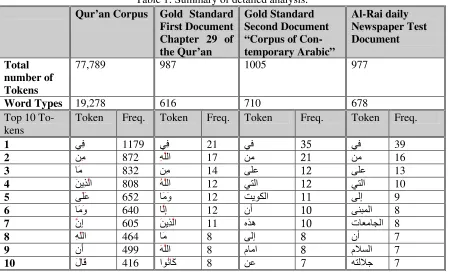
Table 1 shows a detailed analysis been done for the sample test documents, the Qur’an corpus as one unit, and a daily newspaper of contempo-rary Arabic test document, taken from Al-Rai
Figure 1: Sample from Gold Standard first document taken from Chapter 29 of the Qur’an.
daily newspaper published in Jordan. The analysis also shows that function words such as “” “fi” “in”, “” “min” “from”, “” “Ala” “on” and “ا” “Allah” “GOD” are the most frequent words in any Arabic text. On the other hand, non functional words with high fre-quency such as “تا” “Al-Jami’at” “Uni-versities” and “ا” “Al-Kuwait” “Kuwait” gives a general idea about the main topic of the article.
Simple tokenization is applied for the text of the gold standard documents. This will ensure that test documents can be used to test any stemming algorithm smoothly and correctly.
4 Four Accuracy measurements
In order to fairly compare between different stemming algorithms we applied four different
[image:3.595.68.518.492.765.2]Figure 2: Sample from Gold Standard document taken from the Corpus of Contemporary Arabic.
Table 1: Summary of detailed analysis. Qur’an Corpus Gold Standard
First Document Chapter 29 of the Qur’an
Gold Standard Second Document “Corpus of Con-temporary Arabic”
Al-Rai daily Newspaper Test Document
Total number of Tokens
77,789 987 1005 977
Word Types 19,278 616 710 678
Top 10 To-kens
Token Freq. Token Freq. Token Freq. Token Freq.
1 ِ 1179 ِ 21 35 39
2 ِ 872 اِ 17 21 16
3 َ 832 ِ 14 12 13
4 اَ ِ 808 اُ 12 ا 12 ا 10
5 َ َ 652 و َ َ 12 ا 11 إ 9
6 و َ َ 640 إ ِ 12 نأ 10 ا 8
7 ن إ ِ 605 اَ ِ 11 ه 10 ت ! ا 8
8 اِ ّ 464 َ 8 إ 8 نأ 7
9 ن أ َ 499 اَ 8 ما 8 م%& ا 7
10 ل (َ َ 416 ا ) آ ُ َ 8 7 %+ 7
ن , - ه و . ا / ن أ ا آ 0 ن أ س ا 2 & 3 أ - ا َ ُ َ ْ ُ َ ْ ُ َ َ ُ ُ َ َ ُ َ ْ ُ َ ُ َ ِ َ َ 5 و ا ( 6 7 ا ا 5 - 8 ( ا 6 / و َ َ ْ َ َ َ ُ َ َ َ ِ ُ َ َ ْ َ َ َ ْ ِ ِ ْ َ ِ َ ِ َ َ ْ َ َ َ ء : ) / & ن أ ت ; 5 & ا ن ا 2 & 3 م أ 5 < ذ ا َ َ َ ُ ِ ْ َ َ ِ َ > َ ُ َ ْ َ َ ِ َ ِ َ ْ َ َ ِ ِ َ ْ ا ? + أ ن @ ا ء / + 0 ن آ ن A َ َ َ ِ َ ِ َ ِ ُ ْ َ َ َ َ َ ُ ُ ْ َ ه و تB
َ ُ َ ٍ َ ِ
D ا ن إ & , 6 ه ! ) @ 6 ه + و -5 ا E5 & ا F ِ َ َ َ ِ ِ ِ ْ َ ِ ُ ِ َ ُ َ ِ َ َ َ َ َ َ ُ ِ َ ْ ُ ِ - 8 ن 0 , ت A G ا ا و ا . ا و 5 ا ْ ُ ْ َ َ > َ ُ َ ِ َ ِ ُ ِ َ َ ُ َ َ ِ َ َ ِ َ َ ْ ِ َ
) آ ي ا & 3 أ - 8 I ! و - 8 J ; 5 : ُ َ ِ َ َ ْ َ ْ ُ َ ِ ْ َ َ َ ْ ِ ِ َ > َ 5 7 و و ن ا
َ ْ َ َ َ ُ َ ْ َ
< K L 5 < ك 0 N كا 6 ه + ن إ و & 3 6 ا < ن &) @ ا ِ ِ َ َ َ ْ َ َ ِ َ ِ ْ ُ ِ َ َ َ َ ِ َ ً ْ ُ ِ ْ َ ِ َ ِ َ َ ِ ْ ن J - آ < - ; ) P - + 0 إ 8 Q J - َ ُ َ ْ َ ْ ُ ُ َ ِ ُ ُ > َ ُ َ ْ ُ ُ ِ ْ َ َ ِ َ ُ ْ ِ ُ َ َ ٌ ْ ِ ا و
َ ِ َ
S 6 ت A G ا ا و ا . ِ ْ ُ َ ِ َ ِ ُ ِ َ َ ُ َ 5 A G ا - 8
َ ِ ِ ِ ْ ُ َ
T<+Uاو T;:V ة05X 6 (و إو T ا /: T;:Uا ه Y < T/5 ?PJ T,(و ل/ ا اه و T جو0J ت< ا ة66+ T+ ة0 تأ6< 2Q/ ا ?[ 0N ا ة5A 66! ا ?N ا هر< ] جو0 ت< ا ه ]) كهو 0Uا ?XUا ] ا ,7< ت/X او قا0Uا د6 0Uا ة5A ?`:و <ر( ا ة66! ا T5) ا T0/ ا
accuracy measurements. Each time we ran the experiment, a comparison of the results with the gold standard was performed.
The first experiment was done by comparing each root extracted using the three stemming al-gorithms with the roots of words in the gold standard.
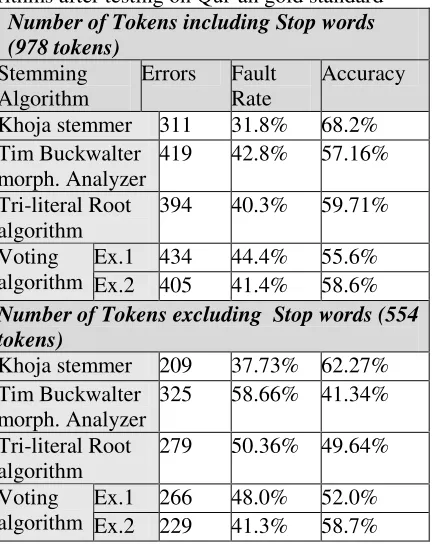
[image:4.595.306.531.171.463.2]The second experiment excludes from the words’ list stop words. The third experiment compares all word-type roots to the gold standard’s roots. Finally, word-type roots excluding the stop words are compared to the gold standard’s roots. Tables 4-7 show the accuracy rates resulting from the four different accuracy measurements.
Table 2: Tokens Accuracy of stemming algo-rithms after testing on Qur’an gold standard
Number of Tokens including Stop words (978 tokens)
Stemming Algorithm
Errors Fault Rate
Accuracy
Khoja stemmer 311 31.8% 68.2% Tim Buckwalter
morph. Analyzer
419 42.8% 57.16%
Tri-literal Root algorithm
394 40.3% 59.71%
Ex.1 434 44.4% 55.6% Voting
algorithm Ex.2 405 41.4% 58.6%
Number of Tokens excluding Stop words (554 tokens)
Khoja stemmer 209 37.73% 62.27% Tim Buckwalter
morph. Analyzer
325 58.66% 41.34%
Tri-literal Root algorithm
279 50.36% 49.64%
Ex.1 266 48.0% 52.0% Voting
[image:4.595.68.284.191.466.2]algorithm Ex.2 229 41.3% 58.7%
Table 3: Word type Accuracy of stemming al-gorithms after testing on Qur’an gold standard
Number of Word Types including Stop words (616 word types)
Stemming Al-gorithm
Errors Fault Rate
Accuracy
Khoja stemmer 224 36.36% 63.64% Tim Buckwalter
morph. Analyzer
267 43.34% 56.66%
Tri-literal Root algorithm
266 43.18% 56.82%
Ex.1 242 39.3% 60.7% Voting
algorithm Ex.2 219 35.6% 64.4%
Number of Word types excluding Stop words ( 451 word types)
Khoja stemmer 155 34.37% 65.63%
Tim Buckwalter morph. Analyzer
251 55.65% 44.34%
Tri-literal Root algorithm
214 47.45% 52.55%
Ex.1 174 38.6% 61.4% Voting
algorithm Ex.2 151 33.5% 66.5%
Table 4: Token Accuracy of stemming algo-rithms. Tested on newspaper gold standard
Number of Tokens including Stop words(1005 tokens)
Stemming Al-gorithm
Errors Fault Rate
Accuracy
Khoja stemmer 231 22.99% 77.01% Tim Buckwalter
morph. Analyzer
596 59.30% 40.70%
Tri-literal Root algorithm
234 23.28% 76.72%
Ex.1 303 30.15% 69.85% Voting
algorithm Ex.2 266 26.47% 73.53%
Number of Tokens excluding Stop words (766 tokens)
Khoja stemmer 212 27.7% 72.3% Tim Buckwalter
morph. Analyzer
431 60.70% 39.30%
Tri-literal Root algorithm
253 35.63% 64.37%
Ex.1 303 39.56% 60.44% Voting
algorithm Ex.2 266 34.73% 65.27%
Table 5: Word type Accuracy of stemming al-gorithms. Tested on newspaper gold standard
Number of Word Types including Stop words (710 word types)
Stemming Al-gorithm
Errors Fault Rate
Accuracy
Khoja stemmer 232 32.68% 67.32% Tim Buckwalter
morph. Analyzer
431 60.70% 39.30%
Tri-literal Root algorithm
253 35.63% 64.37%
Ex.1 248 34.93% 65.07% Voting
algorithm Ex.2 215 30.28% 69.71%
Number of Word types excluding Stop words ( 640 word types)
Khoja stemmer 184 28.75% 71.25% Tim Buckwalter
morph. Analyzer
423 66.09% 33.91%
Tri-literal Root algorithm
224 35.00% 65.00%
Ex.1 252 39.4% 60.6% Voting
[image:4.595.171.516.474.771.2]Experiments are done for results generated from the three stemming algorithms after executing them on both gold standard documents.
The output analysis of the stemming algo-rithms is considered as input for the “voting” program. The program reads in these files, token-izes them, and stores the words and the roots ex-tracted by each stemming algorithm in temporary lists to be used by the voting procedures.
The temporary lists work as a bag of words that contains all the result analysis of the ming algorithms. Khoja and the tri-literal stem-ming algorithms generate only one result analy-sis for each input word, while Tim Buckwalter morphological analyzer generates one or more result analysis. These roots are ranked in best- first order according to accuracy measurement done before. Khoja stemmer results are inserted to the list first then the results from tri-literal stemming algorithm and finally the results of Tim Buckwalter morphological analyzer.
After the construction of the lists of all words and their roots, a majority voting procedure is applied to it to select the most common root among the list. If the systems disagree on the analysis, the voting algorithm selects “Majority Vote” root as the root of the word. If there is a tie, where each stemming algorithm generates a different root analysis then the voting algorithm selects the root by two ways. Firstly, it simply selects the root randomly from the list using the
FreqDist() Python function in experiment 1.
Secondly, In experiment 2, the algorithm selects the root generated from the highest accuracy stemming algorithm which is simply placed in the first position of the list as the root of the word are inserted to the list using the best-first in terms of accuracy strategy.
After the voting algorithm, the selected root is compared to the gold standard. Tables 2-5 show the result of the voting algorithm which achieves promising accuracy results of slightly better than the best stemming algorithm in experiment 2 and a similar accuracy rates for the best stemming algorithms in experiment 1.
5 Conclusions
In this paper, we compared between three stem-ming algorithms; Shereen Khoja’s stemmer, Tim Buckwalter’s morphological analyzer and the Tri-literal root extraction algorithm.
Results of the stemming algorithms are com-pared with the gold standard using four different accuracy measurements. The four accuracy
measurements show the same accuracy rank for the stemming algorithms: the Khoja stemmer achieves the highest accuracy then the tri-literal root extraction algorithm and finally the Buck-walter morphological analyzer.
The voting algorithm achieves about 62% average accuracy rate for Qur’an text and about 70% average accuracy for newspaper text. The results show that the stemming algorithms used in the experiments work better on newspaper text than Quran text, not unexpectedly as they were originally designed for stemming newspaper text. All stemming algorithms involved in the ex-periments agreed and generate correct analysis for simple roots that do not require detailed analysis. So, more detailed analysis and en-hancements are recommended as future work. Most stemming algorithms are designed for information retrieval systems where accuracy of the stemmers is not important issue. On the other hand, accuracy is vital for natural language proc-essing. The accuracy rates show that the best al-gorithm failed to achieve accuracy rate of more than 75%. This proves that more research is re-quired. We can not rely on such stemming algo-rithms for doing further research as Part-of-Speech tagging and then Parsing because errors from the stemming algorithms will propagate to such systems.
Our experiments are limited to the three stemming algorithms. Other algorithms are not available freely on the web, and we have been unable so far to acquire them from the authors. We hope Arabic NLP researchers can cooperate further in open-source development of resources.
References
Al-Shalabi, R., Kanaan, G., & Al-Serhan, H. (2003, December). New approach for
extract-ing Arabic roots. Paper presented at the
Inter-national Arab Conference on Information Technology (ACIT’2003), Egypt.
Al-Sulaiti, Latifa; Atwell, Eric 2006. The design
of a corpus of contemporary Arabic.
Interna-tional Journal of Corpus Linguistics, vol. 11, pp. 135-171. 2006.
Atwell, Eric and Roberts, Andy, 2007. CHEAT: combinatory hybrid elementary analysis of text
in: Proceedings of Corpus Linguistics 2007. Khoja, Shereen, 1999. Stemming Arabic Text. http://zeus.cs.pacificu.edu/shereen/research.htm Larkey Leah. S. and Connell Margrate. E. 2001.
Arabic information retrieval at UMass. In